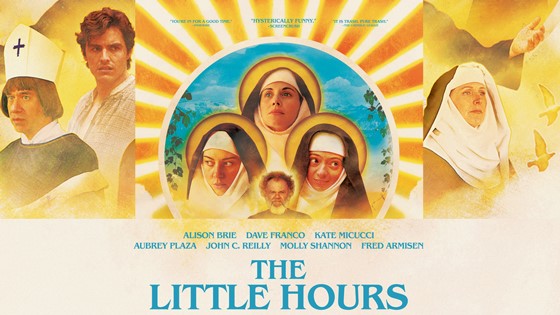
The Little Hours

(USA / Canada 2017)

“Eating blood? Do you think I’ve ever written down ‘eating blood’ before? Where am I?”

— Bishop Bartolomeo

From what I remember in my English lit classes, Geoffrey Chaucer called it as he saw it. He took a dim view of piousness and devotion because he knew that neither makes someone a good person. Hold that thought.

Some people take religion very seriously. Others reach such a high level of intellectual refinement or maturity that it puts them beyond crass, juvenile humor. Good for them — I’m not one of those people. I adore a snarky, irreverent story; it’s even better when it involves absurdism or sacrilege and still has something to say. The Little Hours is exactly that: a farce with a point.

Set during the Middle Ages, hapless Fr. Tommasso (John C. Reilly) has the unenviable job of overseeing a convent. Yipee. He finds himself without a gardner when Lurco (Paul Weitz) quits after three hateful young nuns — vain Sr. Alessandra (Alison Brie), nerdy gossipry Sr. Ginerva (Kate Micucci), and belligerent Sr. Fernanda (Aubrey Plaza) — physically attack him one too many times.

While on a mission selling embroidery to raise funds for the convent, Fr. Tommasso, lost and drunk, crosses paths with Massetto (Dave Franco), a servant running from his master, obnoxious douchebag Lord Bruno (Nick Offerman). Bruno is out for blood (not to mention balls) after he discovers Massetto has been carrying on with his wife (Lauren Weedman) for some time.

Fr. Tommasso learns of Massetto’s dilemma and makes a proposal: Massetto can work in the garden at the convent, but he must pose as a deaf-mute to avoid stirring the ire of the nuns. Massetto accepts, but things don’t pan out quite as intended. The young nuns are, well, horny. Not long after he arrives at the convent, Massetto is getting it on with both Alessandra and Fernanda. All hell breaks loose when they find out.

Written and directed by Jeff Baena, The Little Hours is loosely based on — or a spoof of — a novella from Giovanni Boccaccio’s The Decameron, a 14th Century epic. If this sounds highbrow, don’t fret — it’s the only sophisticated thing about this film, which is fine because it is above all else a comedy.

Loaded with f-bombs, sex, and general malice, The Little Hours is an amusing mix of Mean Girls and Monty Python. The cast works well as an ensemble, bringing out and playing off of each other’s goofiness in an endearing way. I see hints of improvisation, which brings even more energy to the whole thing. Although the story peters out toward the end, Baena keeps the momentum going strong for most of it. What could have been a thin joke stretched out too long and too far stays fresh and fun with this vibrant and funny cast.

For all its silliness and flippancy — pretty much all seven deadly sins make an appearance here — Baena raises an interesting point. The Little Hours is very much a comedy about desire, and it get its laughs from the conflict between desire and appearance. Without getting preachy, The Little Hours shows that piousness and devotion don’t douse the flames of desire; sometimes, they fan them. After all, we’re all merely human. I can’t help thinking that Chaucer would approve.

With Molly Shannon, Fred Armisen, Jon Gabrus, Jemima Kirke, Adam Pally, Paul Reiser

Production: StarStream Media, Bow and Arrow Entertainment, Destro Films, Dublab Media, Productivity Media, Concourse Media, Exhibit Entertainment, Foton Pictures

Distribution: Gunpowder & Sky (USA), Mongrel Media (Canada), GEM Entertainment (International)

90 minutes
Rated R

(Gene Siskel Film Center) B

http://www.thelittlehoursmovie.com

The Lobster

(Ireland/UK/Greece 2015)

“Now the fact that you will turn into an animal if you fail to fall in love with someone during your stay here is not something that should upset you or get you down. Just think, as an animal you’ll have a second chance to find a companion. But, even then, you must be careful; you need to choose a companion that is a similar type of animal to you. A wolf and a penguin could never live together, nor could a camel and a hippopotamus. That would be absurd.”

—Hotel Manager

Every now and then, a film so wonderfully unique comes along that you just don’t know what exactly to make of it until you take some time to digest it (I took all summer to write and post this entry). The Lobster is such a film. It’s not going to appeal to everyone—it’s a dark, subtle, absurd, uncomfortable, irreverent, and totally open-ended satire of the desire to be “in a relationship.” None of this is the stuff of a summer movie, but I loved it precisely because of these qualities. So far, The Lobster is easily my favorite film I’ve seen this year—released in Europe last fall, it crossed the Atlantic just this past spring.

In the not-so-distant future in a not-so-distant society, being single is against the law. Regardless of the reason for their singularity (death of a spouse, divorce, being dumped), unattached adults must check into a certain hotel designated for singles and find a suitable match, verified and approved by the hotel manager (Olivia Colman), within 45 days. Everything is regimented with meal times, active learning exercises, forced social events, and a strict prohibition on masturbation (though one form of sex with the housekeeping staff is required). “Guests” can buy additional time by shooting “loners”—rogue outlaw singles who escaped to the woods—on daily hunting excursions that resemble Hunger Games. Those who fail to find someone before their time runs out are transformed into the animal of their choice, selected during their initial processing, and banished to the woods.

The Lobster’s protagonist, mild-mannered David (Colin Farrell), finds himself at the hotel, his brother, Bob—now a dog—in tow, after the end of his marriage. He chooses a lobster as his animal because “lobsters live for over one hundred years, are blue-blooded like aristocrats, and stay fertile all their lives.” He also likes the sea.

WARNING: Potential spoilers ahead!

The Lobster is essentially divided into two acts: the first in the hotel and the second in the woods. David connects with fellow guests the Lisping Man (John C. Reilly) and the Limping Man (Ben Wishaw). David notices that the guests there tend seek others like themselves—except for Heartless Woman (Angeliki Papoulia), an emotionless femmebot who seeks out no one but has a seemingly infinite amount of time left thanks to her ruthless archery skills. David decides to go for her, which leads him to the woods. There, he meets the Short Sighted Woman (Rachel Weisz), who is near-sighted like he is. They connect, but the militaristic Loner Leader (Léa Seydoux) forbids all romance—punishable by mutilation. “We dance alone,” she tells David as she hands him an iPod. “That’s why we only play electronic music.”

Written by Yorgos Lanthimos and Efthimis Filippou, the screenplay feels like a Chuck Palahniuk novel. The story is so bizarre and far fetched that it seems silly on paper, but proves incredibly powerful once in motion—in the same way that Being John Malkovich, another film I love that requires the same suspension of disbelief, didn’t sound like much to me before I saw it. Lanthimos has a taste for sadness and the macabre, and he liberally infuses The Lobster with both. He doesn’t take a dim view of relationships, but he notices the dim things people do to have one. The cinematography by Thimios Bakatakis is fabulously drab, with a cool, monotonous, faded color palette that creates a sense of distance and evokes a sense of resignation. Classical music plays throughout to add a kind of Clockwork Orange weirdness to the whole thing.

Despite the mood here, the story turns out to be oddly beautiful. Farrell gives one of his best performances—he drops all his rakish charm to become a colorless, big-bellied middle-aged schlub I found myself rooting for with each predicament he gets into. The inability of David and the Short Sighted Girl to express their feelings for each other is damn near heartbreaking. The entire cast is outstanding, and not a single character is superfluous. The second act is noticeably slower than the first, and perhaps could have been shorter than it is. Regardless, the momentum continues to build to a brilliantly ironic ending that comes about through David’s nearsightedness.

The Lobster doesn’t resolve in the end, which is my favorite thing about it. The viewer is left to decide what happens—and I’ve already discussed different opinions others have about whether David did, or didn’t. It’s the kind of film that lingers on in your memory and forces you think about it even though you’ll never know for sure.

Side note: the film’s website has a quiz that determines your suitable animal. Mine were an elephant, a horse (which finds pleasure in carrots, music, and oral sex), and a water bear. I chose a horse, of course.

119 minutes
Rated R

(ArcLight) A-

http://thelobster-movie.com


horse_poster