La Chinoise

(France 1967)

“Okay, it’s fiction. But it brings me closer to reality.”

— Véronique

Set in the context of the New Left movement in late 1960s France, Jean-Luc Godard’s La Chinoise is not really about the political ideas it raises — many of which seem relevant today. No, at its core is Godard satirizing the idealism of youth.

Structured as a mockumentary in what undoubtedly is an intentionally scrappy art school style, La Chinoise is a series of “interviews” of five middle class college students about their Maoist terrorist organization. Headquartered in a loft apartment in a suburb of Paris, they named their organization “Aden Arabie” after a novel by French communist Paul Nizan.

The apartment, all done up in primary colors like a Piet Mondrian painting, is owned by one of the members’ parents.

Véronique (Anne Wiazemsky, who sadly died exactly a week before the screening I attended) (https://www.nytimes.com/2017/10/05/obituaries/anne-wiazemsky-french-film-star-and-novelist-dies-at-70.html) is the bossy leader, a philosophy student from a family of bankers. She’s involved with Guillaume (Jean-Pierre Léaud), a “theatrical actor.” Yvonne (Juliet Berto) grew up on a farm and works as a housekeeper and occasional hooker. She’s involved with Henri (Michel Semeniako), a writer who protests and publishes essays. Serge Kirilov (Lex de Bruijin) is a Russian nihilist who is single and suicidal.

La Chinoise is dense with ramblings about social and economic philosophy, politics, and literature. However, Godard uses all of it to make his point: these are kids who are still naïve and don’t fully grasp what they say they stand for. He shows them running around with toy weapons, playing school, and acting out scenes from books in the apartment, often cutting to pictures of comic book and cartoon characters. The joke is pretty funny when you consider the bourgeois backgrounds of the kids.

A conversation between Véronique and French philosopher Francis Jeanson on a train best illustrates Godard’s point: he asks a series of questions challenging her proposal to blow up the university in an effort to expose the flaws in her plan — and maybe get her to question her motives and the depth of her conviction. It goes over her head. So much for carrying pictures of Chairman Mao.

Side note: Claude Channes’s song “Mao-Mao” features prominently here. It’s a nifty little earworm.

With Omar Blondin Diop

Production: Anouchka Films, Les Productions de la Guéville, Athos Films, Parc Film, Simar Films

Distribution: Athos Films (France), Pennebaker Films (United States), Kino Lorber

96 minutes
Not rated

(Gene Siskel Film Center) C+

https://www.kinolorber.com/film/view/id/1111

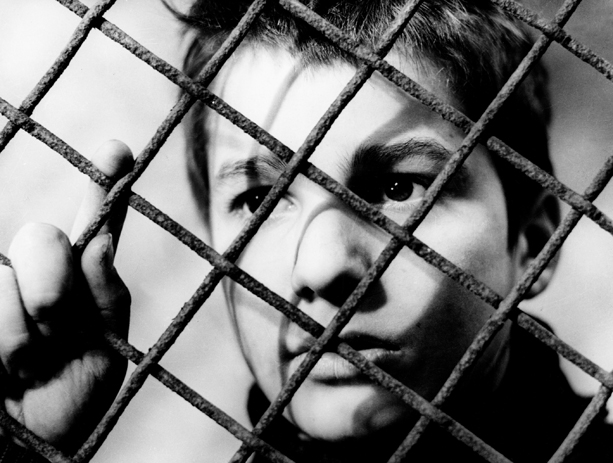
The 400 Blows [Les Quatre-cents coups]

(France 1959)

Childhood is fertile ground for storytelling. Usually, the stories that sell are heavily nostalgic and sweet, but the more interesting ones tend to come from a darker past. French New Wave pioneer François Truffaut’s autobiographical film The 400 Blows is the latter.

Antoine Doinel (Jean-Pierre Léaud) is a prepubescent boy experiencing an existential crisis. At home, something is bubbling between his parents, mother Gilberte (Claire Maurier) and stepfather Julien (Albert Rémy). At school, a contemptible teacher known as “Sourpuss” (Guy Decomble) has him pegged as a troublemaker.

Antoine and his friend René (Patrick Auffay) cut class one day. They walk around, catch a movie, and enjoy a carnival ride—the Rotor, a cylindrical room that spins and the floor drops out, causing the riders to “stick” to the walls due to centrifugal force. While they’re running around, Antoine sees his mother kissing some man on the street. She sees Antoine when it’s too late.

The next day, Antoine makes up an excuse for his absence: he says his mother died. It doesn’t work. After a few incidents involving Balzac, a fire, running away from home, and a stolen typewriter, Antoine winds up at a reform school.

Some New Wave films are hard to follow or just boring to watch. Not so with The 400 Blows, and for quite a few reasons.

The narrative is definitely loose. Like all New Wave films, what happens isn’t as important as what the director is showing us. Here, though, the plot is straightforward and sticks to a more traditional structure even if it doesn’t have a true “climax” or a single moment of reckoning. Truffaut gives us some really great scenes in this movie, not the least of which is this one:

400 Blows paddywagon.jpg

The 400 Blows is realistic and personal; it unfolds like something literally happening right before us. The acting, naturalistic and unscripted, is probably the biggest boon to the film. That said, Henri Decaë’s camerawork is a major contribution as well. He shoots on the streets of Paris using hand-held equipment, which allows him to get right up in front of the action. It’s likely a product of an independent low-budget film, but intentional or not The 400 Blows is so much better as a result; this film would not work the same way without Decaë.

Truffaut makes us empathize with Antoine. He’s not a bad kid; his behavior is no worse than his classmates or the adults around him. He’s made out to be a bad kid, though. The sad part is that he believes it. What’s more, he clearly sees more to life than the little spot he occupies, but he’s no better off after he tries to be. At the end of the film, I want to be on the beach with him to tell him he’ll be okay.

As for the seemingly nonsensical title, I didn’t realize that it’s a literal English translation of the French idiom “faire les quatre cents coups”, which means “to raise hell.” Now that I know that, the title totally makes sense.

Nominated for an Oscar for its screenplay by Truffaut and Marcel Moussy (https://www.oscars.org/oscars/ceremonies/1960), The 400 Blows is a movie that consistently ends up on many “must see” lists. It’s considered a landmark film for good reason. It’s hard to believe that this is Truffaut’s first film.

With Georges Flamant, Pierre Repp, Daniel Couturier, Luc Andrieux, Robert Beauvais, Yvonne Claudie, Marius Laurey, Claude Mansard, Jacques Monod, Henri Virlojeux, Jeanne Moreau, Jean-Claude Brialy, François Nocher, Richard Kanayan, Renaud Fontanarosa, Michel Girard, Henry Moati, Bernard Abbou, Jean-François Bergouignan, Jacques Demy, François Truffaut, Philippe De Broca, Jean-Luc Godard, Jean-Paul Belmondo, Michel Lesignor

Production: Les Films du Carrosse

Distribution: Cocinor, MK2 Films, Janus Films (USA), Criterion (USA)

93 minutes
Not rated

(iTunes rental) A-