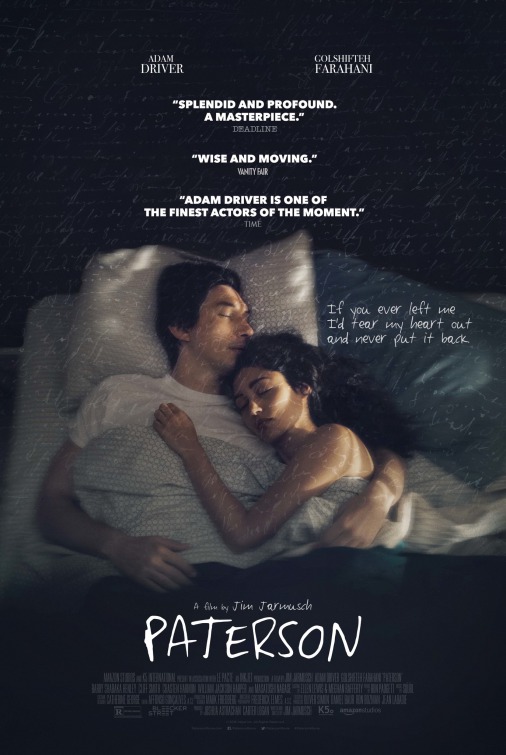
(USA 2016)
Not a lot happens in Jim Jarmusch’s new film Paterson—it is, to borrow from Seinfeld, a show about nothing. Starting on a random Monday, the story follows Paterson (Adam Driver)—a Paterson, New Jersey, city bus driver and closet (or in this case, basement) poet—through his daily routine for a whole week. He finds inspiration in the simplest things: passengers, barflies, Ohio Blue Tip matches. He works it all into his “secret notebook” of poetry, scribbled in sidebars onscreen. Some of it is interesting, some not so much.
Jarmusch throws a lot out there: never mind the recurring parallels between Paterson and those he encounters—there’s imagery of twins, waterfalls, circles, and fireballs. Attempting to infer a weighty point in all of it, though, is probably an exercise in futility; this is fluid stream of consciousness. The story is more a string of vignettes: Paterson’s wife, Laura (Golshifteh Farahani), orders a guitar online and later serves Brussels sprout and cheddar pie for dinner; the bus Paterson drives breaks down; a situation arises in the bar where Paterson has a beer every night when he walks his wife’s dog, Marvin (Nellie, who, sadly, passed away before Paterson came out: http://www.indiewire.com/2016/05/the-2016-palm-dog-posthumously-awarded-to-nellie-the-dog-from-jim-jarmuschs-paterson-289094/).
The characters Paterson encounters are plentiful and colorful: defeatist coworker Donny (Rizwan Manji); a rapper (Method Man) in a laundromat; a young poet (Sterling Jerins) waiting for her mother in the bus yard; Marie (Chasten Harmon) and her sensitive beau, Everett (William Jackson Harper), whom she’s trying to dump; a nameless gangbanger (Luis Da Silva, Jr.) who warns Paterson about dog-jacking (not that it stops him from tying Marvin to a spigot outside the bar every night); anarchists, old ladies, and braggarts on the bus.
Perhaps the most accomplished thing about Paterson is its rhythm: the plot moves slowly but in a purposely metered fashion. Cinematographer Frederick Elmes creates a dreamy and downright poetic look. The relationship between Paterson and the world has its own set of rules. This film reminds me of Dead Man, which I haven’t seen in two decades: quietly contemplating routine and rut, Paterson ultimately celebrates the poetry in the mundane. The unnamed traveler and angel (Masatoshi Nagase) at the end literally gives us the “a-ha” moment. With nearly no outside sound, not even music, I thought of one thing: if James Joyce’s Ulysses were made into a movie, it would feel a lot like this. Unlike Leopold Bloom, though, Paterson’s wife isn’t cheating on him, and no one except Marvin seems to mind his presence.
Side note: for some reason, the screening I caught included Spanish subtitles, unintentionally adding another layer of what-the-fuck. Paterson is not a movie for everyone, but I definitely see a following here. I liked it.
Also starring Barry Shabaka Henley, Trevor Parham, Troy T. Parham, Kara Hayward, Jared Gilman, Johnnie Mae.
Produced by K5 International, Le Pacte, Animal Kingdom, and Inkjet Productions
Distributed by Bleeker Street Media and Amazon Studios
118 minutes
Rated R
(Landmark Century) B-
http://www.bleeckerstreetmedia.com/paterson


 moviebloke