Inland Empire [A Woman in Trouble]

(USA/France/Poland 2006)

“What the bloody hell is going on?” asks Kingsley Stewart (Jeremy Irons) at one point during Inland Empire, David Lynch’s last (so far) full length feature film. It’s an excellent question, one that no doubt anyone watching this three-hour nightmare has already wondered by this point.

Laura Dern is Nikki Grace, an elegant actress up for the lead in a new film, On High in Blue Tomorrows, due to start shooting very soon. A strange Polish neighbor (Grace Zabriskie) who lives “just up the way” drops by her California mansion one afternoon and casually but ominously brings up a murder in the film. “That’s not part of the story,” Nikki tells her visitor, who insists she’s wrong and throws a tantrum right there in the sitting room, screaming about “brutal fucking murder” and an unpaid bill. Annoyed and visibly freaked out, Nikki has her butler (Ian Abercrombie) remove her.

Nikki gets the part. Some weirdness happens, and the film’s director (Irons) tells Nikki and her rugged costar Devon Berk (Justin Theroux) that the film is supposedly cursed: it’s a sort of remake of an old Polish movie called 47 that was never completed because of a double murder on the set. The actors are upset but they agree to proceed with production despite the producers’ lack of transparency.

Meanwhile, Nikki is falling for Devon. The narrative gets weird here, ping-ponging back and forth between Nikki and Devon and their characters, Susan and Billy, as well as Susan’s husband, Smithy (Peter J. Lucas), who knows something is going on. Billy’s wife (Julia Ormond) proves to be a character of interest of ever increasing importance, bleeding into another seemingly unrelated subplot about Sue Blue (Dern), a rough and caustic Hollywood chick who finds herself pregnant. The problem is, her husband (Lucas) is sterile. And just who are all these hookers hanging out with Sue, smoking and dancing to “The Loco-Motion” in her living room?

Interspersed between all this is yet another triangular subplot set in 1800s Poland: a cheating wife (Karolina Gruszka) learns that her husband (Krzysztof Majchrzak) plans to kill her lover (Lucas). And just to keep thing interesting, Lynch throws in “The Rabbits,” a spooky sitcom about a family of…rabbits. Actually, actors in rabbit suits (one of them has the voice of Naomi Watts). Later, Sue somehow ends up in their living room.

Probably his most indulgent film, Inland Empire is the kind of thing I imagine most people associate with David Lynch: a surreal trip through the subconscious, the imagination, alternate universes, and time that starts out with a discernible plot but disintegrates into seemingly disjointed events, actors playing multiple characters, bizarre and vivid imagery, random upbeat pop songs, and a creepy score by Marek Zebrowski. Flashes of Lynch’s usual sense of humor pop up here and there, but for the most part this is a dark and somber film about betrayal, loss, and karma. Perhaps its strongest aspect is its overriding sense of dread, and the worst thing about is that it’s impossible to tell whether the scary part is coming or has already arrived.

Inland Empire is surely a horror film. I imagine not many people get into it, and most even being turned off. Length and structure—or lack thereof—aside, it’s not an easy film to watch or understand, and frankly I’m not entirely sure I grasp what the whole thing is about. Indeed, different characters say “I don’t understand” over and over, and Devon/Billy tells Grace/Susan a few times that she isn’t making sense. A common thread that ties the multiple plots together eventually emerges, but I get the impression that this is merely a heap of undeveloped ideas Lynch assembled into one big project.

Still, I found myself mesmerized all the way through. The ending, where Sue’s fate plays out over the stars on the Hollywood Walk of Fame, is dowright distressing. In a way, it’s also beautiful. Lynch offers a lot to chew on here; I’ve gone over it multiple times since I saw it. I have my theory of what really transpires in Inland Empire, and someday I’ll watch again with an eye toward backing it up. It won’t be anytime soon, though.

Post script: I had the pleasure of seeing John Waters speak in the afternoon before I caught Inland Empire. Needless to say, it required a major shift in gears.

With Harry Dean Stanton, Diane Ladd , Mary Steenburgen, Terry Crews, William H. Macy, Leon Niemczyk, Nastassja Kinski, Monique Cash, Latrina Bolger, Fulani Bahati, Ashley Calloway, Erynn Dickerson, Jovonie Leonard, Jennifer Locke, Helena Chase, Nae

Production: Absurda, Studio Canal, Fundacja Kultury, Camerimage Festival

Distribution: Ryko (USA), 518 Media (USA), Absurda (USA), Studio Canal (International), Mars Distribution (International)

180 minutes
Rated R

(Music Box) A

David Lynch: A Complete Retrospective

http://www.inlandempirecinema.com

David Lynch

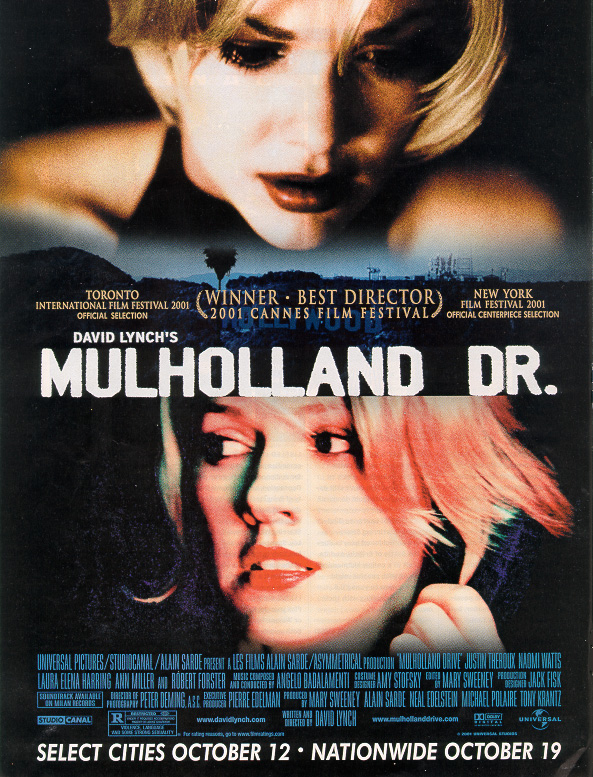
Mulholland Dr.

(USA/France 2001)

“No hay banda, il n’est pas d’orchestra. It is all an illusion.”

—The Magician at Club Silencio

The perfect opener for a retrospective on its director, Mulholland Dr. is an inimitable film that’s really hard to write about. You can look for answers online all you want, but even after seeing it multiple times you still don’t know what happens in it.

Not unless you’re David Lynch. That doesn’t make it any less enjoyable, though.

I’ve seen Mulholland Dr. maybe three times, and I’m not sure. I have my theories. Maybe they’re right, maybe not. Who cares? As with any of Lynch’s best films, the draw to Mulholland Dr. is that it’s a puzzle. He makes you work to solve it, or at least try to. He gives you just enough to go on but leaves the whole thing open to interpretation. At points, he gets you so frustrated, you lose patience and you hate him. But you don’t want him to stop. It’s artistic sadomasochism.

What began as a project for television is a mystery mindfuck tailored to the big screen. Dreamlike, hypnotic, and erotic, Mulholland Dr. is visually demanding and aesthetically worth every minute. The premise is deceptively simple: perky and wide-eyed blond actress Betty (Naomi Watts) arrives in Hollywood and bumps into beautiful young brunette Rita (Laura Harring), who can’t remember who she is after a car accident on Mulholland Drive.

As the two set out looking for clues to Rita’s identity, Lynch throws in a bunch of random characters, muddled subplots, and perplexing events. The narrative arc he puts us on comes to an abrupt halt with a small blue box the girls acquire at a night club. This is where Lynch pulls the rug out from under us.

Mulholland Dr. is definitely a love story—one fraught with competition, petty jealousies, one-upmanship, and ultimately murder. Lynch’s trademark sense of humor flickers here and there, but this is still dark stuff. I see Mulholland Dr. as a denouncement of Hollywood and all its ruthless superficiality. It’s a town that eats you up and spits you out.

Motifs of filmmaking, commerce, ego, vision, and of course the color blue stand out. Rebekah Del Rio’s performance of “Llorando” is beautifully forlorn and eerie. I would be remiss not to mention Peter Deming’s cinematography, which makes Mulholland Dr. shine.

Sadly, Lynch hasn’t done a proper film since 2006. He’s the one living filmmaker whose work I miss the most. Mulholland Dr. is a testament to why: like the street where it takes its name, this film is twisting, treacherous, and ultimately breathtaking.

With Jeanne Bates, Robert Forster, Brent Briscoe, Patrick Fischler, Michael Cooke, Bonnie Aarons, Michael J. Anderson, Ann Miller, Angelo Badalamenti, Dan Hedaya, Daniel Rey, Justin Theroux, David Schroeder, Robert Katims, Marcus Graham, Tom Morris, Melissa George, Mark Pellegrino, Vincent Castellanos, Rena Riffel, Michael Des Barres, Lori Heuring, Billy Ray Cyrus, Tad Horino, Missy Crider, Melissa Crider, Tony Longo, Geno Silva, Katharine Towne, Lee Grant, Lafayette Montgomery, Kate Forster, James Karen, Chad Everett, Wayne Grace, Rita Taggart, Michele Hicks, Michael Weatherred, Michael Fairman, Johanna Stein, Richard Green, Conti Condoli, Lyssie Powell, Scott Coffey

Production: Les Films Alain Sarde, Asymmetrical Productions, Babbo Inc., Canal+, The Picture Factory

Distribution: Universal Pictures

147 minutes
Rated R

(Music Box) A-

David Lynch: A Complete Retrospective

http://www.lynchnet.com/mdrive/

The Kid

(USA 1921)

I must confess that I never saw a Charlie Chaplin film until The Kid, his first full-length feature—he wrote, produced, directed, and starred in it. He also composed the score, something I didn’t know silent movies had; I guess I assumed organ players picked their own music to accompany films in those days. It’s a small miracle that The Kid made it out in one piece, as its production faced some financing difficulties (http://about.bankofamerica.com/en-us/our-story/making-of-charlie-chaplins-the-kid.html#fbid=eIQZsBMJxKN) and its release was entangled in Chaplin’s divorce proceedings and studio double-dealing. It was a huge success, becoming the second-highest grossing film of 1921 (http://www.filmsite.org/1921.html) (http://www.wikiwand.com/en/The_Kid_(1921_film) ). It’s easy to see why.

I enjoyed The Kid more than I expected. I was taken aback at how well this film, nearly a century old, works even by today’s standards. It’s a beautifully executed story with elements that seem way ahead of its time. A penniless unmarried woman (Edna Purviance) abandons her illegitimate newborn in the back seat of an expensive Model-T type limo parked in front of a mansion. Two gangsters who steal the limo pull over and dump the baby among some trash in an alley when they discover him crying. The tramp (Chaplin) happens upon him. After a few failed attempts to pawn off the baby on someone else, he finds a note inside his blanket, begging whoever finds him “to love and care for this orphan child.” The tramp takes him in, names him “John,” and raises him as his own in the tenement where he lives.

Five years pass. The tramp has taught John (Jackie Coogan, who later in life would play Uncle Fester on The Addams Family) how to help him eke a living off a window repair scam. By now, the woman is a rich performer who does charity work to help the poor. She crosses paths with John, but of course doesn’t realize who he is. The tramp calls a physician (Jules Hanft) when John gets sick and unwittingly sets in motion a chain of events that threatens to separate them when child welfare authorities take custody of John to place him in an orphanage.

The Kid may very well be the first “dramedy” ever; the opening card (this is a silent picture) gets that out up front, revealing it to be “[a] picture with a smile—and perhaps, a tear.” Chaplin’s trademark slapstick is a prominent ingredient, but he infuses serious drama into the story. The opening sequence that tells us about John’s parents is tragic, but it doesn’t compare to the scene in which the child welfare authority agents take John away from the tramp: the kid is in tears, desperately reaching out of the truck for the tramp to rescue him. Soon, the tramp is running after the truck in an intense rooftop chase and ultimately gets to it, pulling John out of the back. You feel every rush of emotion the characters do—amazing considering it’s accomplished without sound or words. Chaplin and Coogan adeptly convey feelings with simple body movements, facial expressions, and their eyes. Even the mundane parts of their day—like making breakfast and getting dressed—ooze a tenderness that emphasizes their bond.

I picked up on a few themes, but two struck me in particular. The first is religion, though I’m not entirely sure how to interpret it. Much of it comes from the hospital at the beginning and the notorious weird dream sequence the tramp has toward the end of the film—I found this scene curious because I’m not sure how it fits into the whole picture. The point could have something to do with a number of things: mercy, the golden rule, resurrection (this film has a few examples of rebirth and reinvention), salvation, hypocrisy, or something else altogether. The second theme is urban poverty; Chaplin is obviously making a statement about it in the way he shows authority figures—cops, child welfare agents, the doctor who turned him in—barging in on his low-status life and throwing it into turmoil.

The Kid is interesting not only for the autobiographical elements Chaplin incorporates, but also for the time period it depicts. The restored print I saw was luminous and crisp, vividly showing details from the sets (bricks on the buildings, dust in the streets, the tramp’s shabby furniture), the textures of the characters’ clothing, and even the skin tone and hair quality of some of the actors. It’s simultaneously cool and mildly creepy. The exteriors, shot mainly in Hollywood and downtown Los Angeles, remarkably capture the look and feel of a grimy Victorian city. An extra bonus was a live organ player at the screening I caught.

Speaking of Los Angeles, many of the filming locations still exist. Here’s a great blog that shows them today: https://silentlocations.wordpress.com/2016/01/09/how-charlie-chaplin-filmed-the-kid-2/.

The Kid is more complex that it looks. It’s thoroughly satisfying on multiple levels: narrative, visual, social, and historical. I’m thrilled I had an opportunity to see it on the big screen.

In 2011, the United States Library of Congress deemed The Kid “culturally, historically, or aesthetically significant” and selected it for preservation in the National Film Registry (https://www.loc.gov/programs/national-film-preservation-board/film-registry/complete-national-film-registry-listing/).

68 minutes
Not rated

(Music Box) A

Full movie (with sound):

https://www.youtube.com/watch?v=ZNyttSbCUCU


The Outrageous Sophie Tucker

(USA 2014)

Who was Sophie Tucker? Born Sonya Kalish in 1887, The Outrageous Sophie Tucker walks us through her rags to riches climb to the top of vaudeville in the early 20th Century and makes a strong case for her as the true original sassy, strong blonde—long before Madonna, Marilyn Monroe, and even Mae West.

Tucker seems like she was a riot: she stayed out all night and slept until afternoon, she had a girlfriend during the Depression, and J. Edgar Hoover (allegedly) wanted one of her gowns. Thoroughly enjoyable on multiple levels and from multiple perspectives, The Outrageous Sophie Tucker is historical, political, social, and even prurient (i.e., celebrity gossip from Hollywood’s Golden Era). It also celebrates early Jewish contributions to American entertainment—remarkable for a time when being Jewish wasn’t exactly kosher in America.

Minneapolis-St. Paul International Film Festival

(St. Anthony Main) B+

http://www.menemshafilms.com/outrageous-sophie-tucker

Maps to the Stars

(USA 2014)

David Cronenberg’s satire of the film industry and fame in general. Drifter Agatha (Mia Wasikowska) from Jupiter (Florida, not the planet) shows up in L.A. to hook up with Carrie Fisher—who makes a brief cameo—and is hired as the personal assistant of whack job actress Havana Segrand (Julianne Moore). Agatha has an odd obsession with fading child star Benjie Weiss (Evan Bird), whose father (John Cusack) happens to be Segrand’s “healer.” Robert Pattinson costars as Jerome, Agatha’s hired driver and an aspiring actor/screenwriter.

Hollywood loves to make snarky movies about itself, and this cynical little tale is no exception. Though not the same movie, Maps to the Stars is cut from the same cloth as maybe The Player. The ending left me with a lot of fodder to ponder and discuss, but the story as a whole lacks something– maybe wit? Bite? Excitement? I don’t know, but Maps to the Stars is not Cronenberg’s best work even if it stands on its own. The strong performances all around are what elevate it from what is potentially a low-end David Lynch knock-off.

(Music Box) B-

http://mapstothestarsfilm.com

https://youtu.be/fwxmnyoofPs