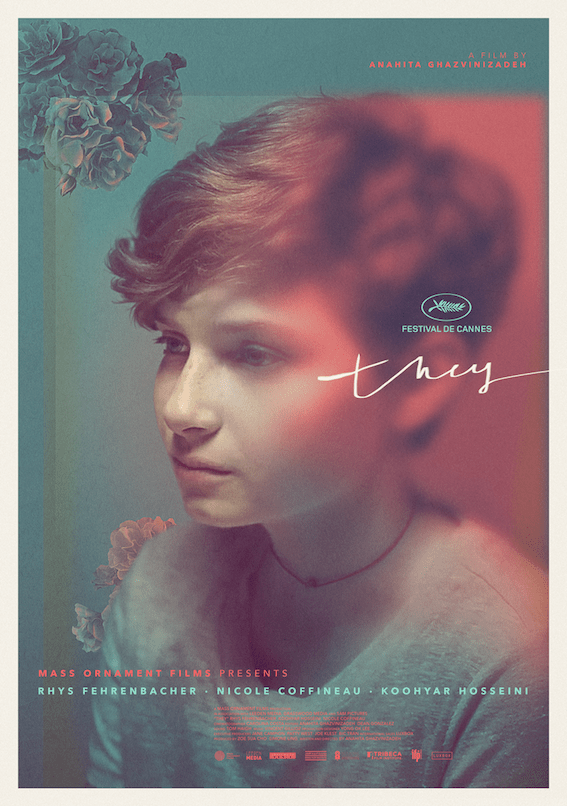
They

(USA / Qatar 2017)

“You’ll never be a girl. You’re not a boy. So you’re probably nothing.”

— J

Writer/director Anahita Ghazvinizadeh’s debut feature film They delicately tells the story of J (Rhys Fehrenbacher), a quiet suburban Chicago teen transitioning from male to female. Along with therapy sessions and physician consultations for “puberty blocking” drugs and “bone density” test results, J is processing the social and psychological implications of their change. We know it’s happening, but we see it in action when J puts on a dress and goes outside, or when he explains to others how to make an introduction to a stranger and which pronoun to use (“they,” hence the title).

The process is awkward, particularly when older sister, Lauren (Nicole Coffineau), brings her fiancé, Araz (Koohyar Hosseini), home to meet the family. With mom (Norma Moruzzi) away caring for an aunt who has early onset dimentia, J is left to deal alone. Meeting Araz’s Iranian family in the suburbs seems to be a reckoning for J.

If nothing else, They is visually arresting, artfully shot with georgeous pans and closeups of buildings, walls, plants, and flowers. Ghazvinizadeh plays with reflections on glass and uses a muted color pallet that nicely underscores J’s fluid state of mind. It sets just the right tone: hazy and dreamy.

That said, both the narrative and the character development in They fall short. I’m not sure Lauren and Azaz are necessary, and I certainly don’t have more than a passing sense of who they are or why they’re here. The dinner at Araz’s family is dropped in clumsily, throwing off the trajectory of the story. The focus gradually and inexplicably shifts away from J, which I found strange.

Watching They feels voyeuristic, which isn’t a bad thing in itself. However, it feels like an obstacle — a transparent partition — keeps me from getting too close to the characters. That’s a shame because this is a film that demands an amount of intimacy that simply isn’t accommodated. On top of that, the actors’ naturalistic performances meander quite a bit, which made me zone out at times.

Overall, They could have been a much more powerful statement. Still, it’s a decent effort even with its shortcomings and a few dull parts.

With Diana Torres, Evan Gray, Drew Sheil, Leyla Mofleh, Mohammad Aghebati, Alma Sinai, Arian Naghshineh, Ava Naghshineh, Aerik Jahangiri, Farid Kossari, Kaveh Ehsani, Robert Garofalo, Eric Fehrenbacher, Vicki Sheil

Production: Mass Ornament Films

Distribution: N/A

Screening introduced by Anahita Ghazvinizadeh and followed by a live Q and A with Ghazvinizadeh, Rhys Fehrenbacher, and Rob Garofalo

80 minutes
Not rated

(AMC River East) C-

Chicago International Film Festival

https://www.massornament.com/they

The Florida Project

(USA 2017)

“Relax. Your daughter’s perfectly fine in my hands.”

— Moonee

Sean Baker’s Tangerine (https://moviebloke.com/2015/07/28/tangerine/) impressed me. On the surface an offbeat odyssey of castoffs living on the fringe in West Hollywood, it’s one of those films that creeps up and hits you at the end. Comprised largely of small moments and vignettes strung together, its sum is much more — and completely different — than its parts: insightful, powerful, and quietly profound.

Come to think of it, Barry Jenkins’s Moonlight (https://moviebloke.com/2016/11/19/moonlight/) operates in a similar way even though it’s not the same story.

I was thrilled to hear that Baker has a new film, The Florida Project, out this fall. The comments I overheard from audience members while walking out of a prerelease screening were amusing but maddening: “That was realism, hard realism. Too hard.” “Well, that didn’t go anywhere.” “I had to force myself to stay awake.” “I wouldn’t recommend that to anyone.” Insert eyeroll here.

I disagree. The Florida Project switches gears, so it doesn’t end up where it seems to be going. The trailer makes it look like a childhood nostalgia movie, and it starts out like one. But it’s not. Often amusing but just as often difficult to watch, it paints a vivid picture that doesn’t criticize, demean, or sentimentalize its characters or their situation. I’ve heard Baker lauded for his humanism; his work definitely shows plenty of that if nothing else. His best attribute may be his willingness to let his characters develop into real people over the course of two hours or so.

To be clear, the impact of The Florida Project is not immediate. Baker’s pace isn’t quick, either. Written by Baker and Chris Bergoch, The Florida Project starts out as a sort of Little Rascals sitcom involving the misadventures of besties Moonee (Brooklynn Prince) and Scooty (Christopher Rivera), two grade school kids growing up in a sketchy roadside motel, the Magic Castle, that sits along a tawdry strip just outside the Magic Kingdon — a.k.a. Disney World in Orlando. A gun shop, a convenience store, a market that sells oranges, and a boarded up clinic dot the strip, which incidentally intersects with Seven Dwarves Lane.

Moonee and Scooty spend their days running around, screaming, and stirring up mischief. They spit all over a motel guest’s car. They drop water balloons on people. They spy on an elderly topless sunbather (Sandy Kane). They scam change to buy ice cream. They set a fire. They recruit a third hellion, Jancey (Valeria Cotto), who lives next door and easily goes along with their antics probably because there’s no one else to play with. Their favorite target is weary motel manager Bobby (Willem Dafoe).

Slowly, a different picture emerges and The Florida Project becomes another film. Moonee’s mother, Halley (Bria Vinaite), can’t get it together. Feral and clearly her own worst enemy, she lives hand to mouth with her young daughter. She’s constantly about to be evicted, and she takes free meals wherever she can get them. When selling stolen amusement park passes and wholesale perfume in the parking lot of a “nicer” motel up the street doesn’t work, she turns tricks in the room.

After Halley has a falling out with Scooty’s mom, Ashley (Mela Murder), Baker literally zooms in on Moonee.

The events here are purposely mundane, and it’s hard to say exactly where the climax is. It doesn’t matter: The Florida Project works because of the way Baker executes the story. He’s just as careful about choosing what he shows as what he doesn’t. The thrill here is watching the characters develop, anyway; that’s what makes The Florida Project soar. It doesn’t hurt that the acting is superb, particularly Vinaite, Prince (who at six years old is a natural — I almost cried when she did), and Dafoe, whom I haven’t seen this good since Mississippi Burning.

Alexis Zabe’s cinematography — alternating long shots and pans with almost uncomfortably close shots — works beautifully with the gorgeously effervescent color palette. The ending is unexpectedly touching and fun. The Florida Project just might be the first Oscar contender I’ve seen this year.

With Josie Olivo, Aiden Malik, Caleb Landry Jones, Shail Kamini Ramcharan, Sonya McCarter, Karren Karagulian, Kelly Fitzgerald, Lauren O’Quinn, Edward Pagan, Cecilia Quinan, Kit Sullivan, Andrew Romano

Production: Cre Film, Freestyle Picture Company, June Pictures, Sweet Tomato Films

Distribution: A24 (USA), Altitude Film Distribution (UK), Elevation Pictures (Canada), Filmcoopi Zürich (Switzerland), September Film (Netherlands), Front Row Filmed Entertainment (United Arab Emirates)

115 minutes
Rated R

(AMC River East) A-

Chicago International Film Festival

https://a24films.com/films/the-florida-project

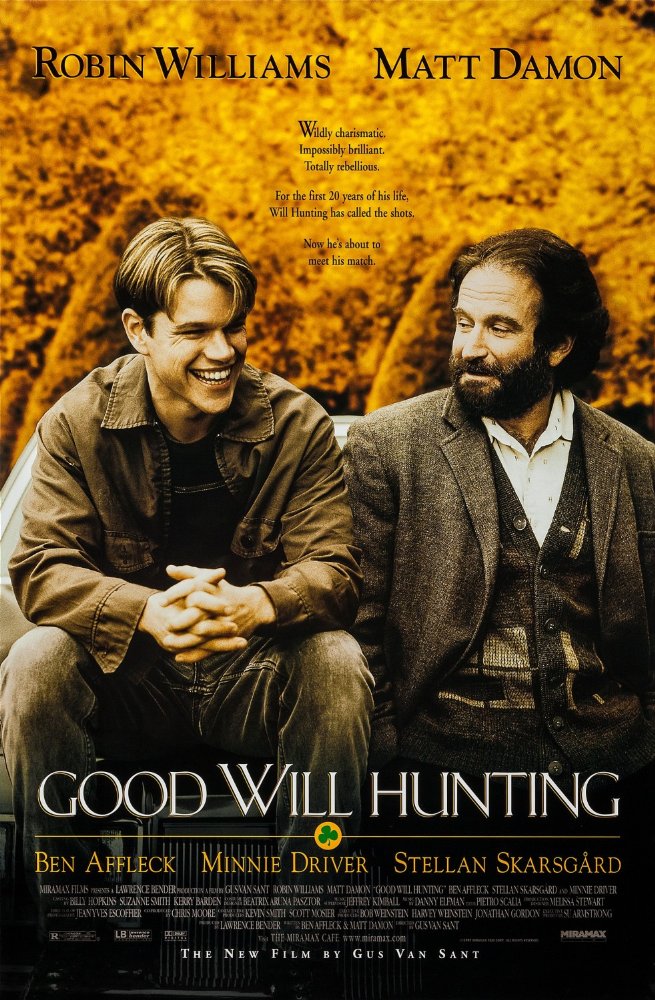
Good Will Hunting

(USA 1997)

“Well, I got her number. How do you like them apples?”

—Will Hunting

Good Will Hunting, the final screening of Chicago International Film Festival’s Totally ’90s series, is not something I associate with its director, Gus Van Sant. Frankly, I didn’t know he directed it until I saw his name in the credits.

No, I associate Good Will Hunting with longtime friends Matt Damon and Ben Affleck, who while they were both still relatively unknown turned the former’s drama class project into the script that would become this film (http://www.eonline.com/news/802830/looking-back-at-the-totally-crazy-story-behind-the-making-of-good-will-hunting). The success of Good Will Hunting seemed to come out of nowhere and established both of them as actors—never mind that they snagged the Oscar for Best Screenplay in 1998 (https://www.oscars.org/oscars/ceremonies/1998). Damon and Affleck have both written since, but none of their screenplays has been as successful as this one.

Gerald Lambeau (Stellan Skarsgård), a professor at MIT, is baffled when someone anonymously solves a wicked hahd math problem he posted on a chalkbaord in the hall as a challenge to his students—he expected it to take the entire semester. No one steps up to claim the work. He posts a second problem, one that took his colleagues two years to figure out. He’s amazed when he catches one of the school’s janitors, Will Hunting (Damon), red-handed. Will won’t have anything to do with Lambeau—until he ends up in jail for assault.

Recognizing Will’s gift, Lambeau makes a deal with him: he’ll pay for bail if Will works with him on math and sees a therapist. The problem is, Will doesn’t make it easy to connect. In fact, five different therapists fail. As a last resort, Lambeau calls former classmate Sean Maguire (Robin Williams), who has a similar Southie background as Will and stands up to his crap. Sean sees that Will is deflecting to hide his self-sabotaging tendencies.

Meanwhile, Will meets Skylar (Minnie Driver), who sweeps him off his feet. It all goes well until she tells him she’s going to medical school at Stanford—and asks him to go with her.

The script here is loaded with good ideas and gorgeous details—that story about Sean ditching a Red Sox game to be with a girl he just met in a bar (she would become his wife) is gold. So is Will’s confrontation with a grad student (Scott William Winters) at a dive. Hearing Damon sing “Afternoon Delight” while he’s faking hypnosis is hilarious. The story, though, is predictable. Good Will Hunting excels because of the acting. The casting—by Kerry Barden, Billy Hopkins, and Suzanne Smith—makes all the difference in the world.

With Ben Affleck, Casey Affleck, John Mighton, Rachel Majorowski, Colleen McCauley, Cole Hauser, Rob Lyons, Steven Kozlowski, Jennifer Deathe, Philip Williams, Patrick O’Donnell, Kevin Rushton, Jimmy Flynn, Joe Cannon, Ann Matacunas, George Plimpton, Francesco Clemente

Production: Lawrence Bender Productions, Be Gentlemen Limited Partnership, Miramax Films

Distribution: Miramax Films (USA), Bac Films (France), Buena Vista International (UK), Cecchi Gori Distribuzione (Italy), Filmes Castello Lopes (Portugal), Intersonic (Czech Republic), Laurenfilm (Spain), Lider Films (Argentina), SF Norge A/S (Norway), Scanbox Entertainment (Sweden), Scotia International Filmverleih (Germany), Shochiku-Fuji Company (Japan), Svensk Filmindustri (SF) (Sweden), Svenska Filminstitutet (SFI) (Sweden), United International Pictures (UIP) (Switzerland)

126 minutes
Rated R

(Public Chicago) B

Chicago International Film Festival

https://www.miramax.com/movie/good-will-hunting/

Empire Records

(USA 1995)

“I’m the idiot, you’re the screw up, and we are all losers,” sums up Empire Records general manager Joe (Anthony LaPaglia) when he realizes that clerk Lucas (Rory Cochrane) blew the store’s receipts in Atlantic City the night before, which incidentally was the first time Joe let him close shop. His heart was in the right place: Lucas wanted to raise capital to buy the store before owner Mitchell (Ben Bode) sells it to a lame corporate chain called Music Town. Empire Records, you see, is more than a retail outlet: it’s a haven for floundering misfits, including a young shoplifter (Brendon Sexton) who goes by “Warren Beatty.”

Empire Records was a box office bomb (http://www.boxofficemojo.com/movies/?id=empirerecords.htm). Carol Heikkinen’s script is earnest in its desire to (I guess) reveal some revelation about ’90s youth, but the plot is all too predictable, coming off as a third-rate The Breakfast Club. The cast, though, is impressive; loaded with professionals (Debi Mazar and Maxwell Caulfield) and future stars like Renée Zellweger and Liv Tyler, the actors collectively ooze a credible chemistry. Director Allan Moyle pulls some decent performances out of them. A playfully snarky sense of humor about American culture pervades this film, evident in such nifty devices as “Rex Manning Day” and a dream sequence involving Gwar.

Empire Records is very much a product of its time, but that’s what makes it interesting to watch now. This no doubt is why it was selected as the third screening of Chicago International Film Festival’s Totally ’90s series.

With Robin Tunney, Johnny Whitworth, James “Kimo” Wills, Ethan Embry, Coyote Shivers

Production: Monarchy Enterprises B.V., New Regency Pictures, Regency Entertainment, Warner Brothers

Distribution: Warner Brothers

90 minutes
Rated PG-13

(Public Chicago) C+

Chicago International Film Festival

T2 Trainspotting

(UK 2017)

“You’re a tourist in your own youth.”

—Sick Boy

“Face your past. Choose your future.” That’s what the poster for T2 Trainspotting says. Perhaps it should say, “Paybacks are a bitch,” something Mark Renton (Ewan McGregor) finds out pretty quickly when he returns home to Edinburgh after 20 years in Amsterdam following his little fuckover at the end of Trainspotting. Ostensibly back to make amends and settle his debt, Renton knows that forgiving and forgetting isn’t so easy—or smooth. Truth be told, he probably didn’t expect it to be.

Renton finds Spud (Ewen Bremner) unemployed, still struggling with heroin, and literally killing himself—like, alone with a plastic bag over his head in his dingy apartment. Sick Boy (Jonny Lee Miller) is a full-fledged douche, complete with a failing bar—the Port Sunshine—that he inherited from his aunt, a blackmail sex scam he runs on the side with a Bulgarian partner—Veronika (Anjela Nedyalkova), whom he fancies as his girlfriend—and a seriously unflattering coke habit. Oh yeah, he’s still bleaching what he’s got left of his hair. Neither is stoked about Renton showing up, but Sick Boy is clearly more bitter than Spud. He has a plan to get even.

Soon, however, Renton and Sick Boy are up to their old tricks, nightclubbing, tripping, and yes, thieving. In one of T2‘s best scenes, they head somewhere outside Edinburgh and hit a pub that looks more like an American VFW hall. It’s some weird open mic night for a crowd of Protestant Unionists who are rabidly anti-Catholic because of history. Explaining it all to Veronika in the car before the heist—the plan is to pickpocket as many ATM cards as they can get their hands on—Renton calls them “relics.” After a successful mission, the bouncer won’t let them leave until they perform a number. What they come up with is brilliant.

The fun and games come to a grinding halt when Begbie (Robert Carlyle), who’s serving a 25-year prison sentence and is denied parole because of his anger management problem, breaks out of jail and runs into Renton. He loses his shit in yet another great scene. Renton gets away for the moment but Begbie is on his trail, which leads him to a sketchy business partnership. Will history repeat itself?

I was skeptical when I heard director Danny Boyle was making a sequel; I guess I thought Trainspotting didn’t need a follow up. T2, which is loosely based on Irvine Welsh’s 2002 novel Porno, lacks the youthful vigor of the original and frankly isn’t as cool. How could it be? It wouldn’t exist without Trainspotting; it’s got flashbacks and obligatory references, some more clever than others, throughout. Kelly Macdonald has a fun cameo, Renton’s “Choose Life” monologue is updated, that toilet makes a brief appearance, and there’s a nice remix of Iggy Pop’s “Lust for Life” at the end (and yes, we know it’s coming).

Still, T2 stands on its own. It’s fueled by nostalgia and revenge, which in this case turns out to be a rather interesting combination. T2 has more of a conventional plot, and it’s oddly fascinating. The dialogue is every bit as wickedly sharp as before. These boys have grown up—they’ve turned into sad men because they’ve chosen unfulfilled promise and disappointment (to use Renton’s words). Now they have to deal with it, which isn’t what I imagined them doing in 20 years—if they even lived, which they most definitely have. Surprise! We all know someone like this, right? I would see T2 again.

At a post screening discussion, Boyle said he really made an effort to connect to the original. He succeeded, in a good way. As for the title, he said it’s an homage of sorts to Terminator director James Cameron, whom the characters would simultaneously want to honor and piss off.

With Shirley Henderson, Scot Greenan, Pauline Lynch, James Cosmo, Eileen Nicholas, Irvine Welsh

Production: Film4, Creative Scotland, Cloud Eight Films, DNA Films, Decibel Films

Distribution: TriStar Pictures

Screening followed by a live Q and A with Danny Boyle and Irvine Welsh moderated by Richard Roeper

117 minutes
Rated R

(AMC River East) B

Chicago International Film Festival

http://www.t2trainspottingmovie.com

https://www.facebook.com/T2TrainspottingMovie/?brand_redir=490630094455946

Can’t Hardly Wait

(USA 1998)

As teen comedies go, the ’90s were a teenage wasteland. Sure, there were a few classics: Dazed and Confused, Clueless, Election, and American Pie immediately come to mind. That’s really about it. Can’t Hardly Wait, the second film of Chicago International Film Festival’s Totally ’90s series, is a typical specimen from the decade: it has some moments, but overall it’s either bland or reductive. Frankly, I don’t even remember it in theaters, which probably says all I need to know.

The setting is a huge kegger in a Los Angeles suburb the night of graduation. Leading man Preston Meyers (Ethan Embry), a sensitive dork, has longed for class babe Amanda Beckett (Jennifer Love Hewitt) ever since he first laid eyes on her during freshman year: he knew they were destined to be together when he noticed the same strawberry Pop Tarts in her bag that he had in his. She went for Mike Dexter (Peter Facinelli), a jock, instead; they dated all through high school. Word on the street is, Mike dumped Amanda. Intrigued, Preston persuades his snarky and derisive bestie Denise Fleming (Lauren Ambrose), certainly no woo-woo girl, to accompany him.

Meanwhile, class geek William Lichter (Charles R. Korsmo), who looks like a deranged Harry Potter, shows up to exact revenge against Mike, his lifelong nemesis. Mike, who dumped Amanda so he could be free to sleep around all summer, isn’t having fun—he’s preoccupied reconsidering his decision. While Preston chases after Amanda to give her a letter in which he spills his guts, Denise gets locked into a secluded bathroom with wannabe gangsta/raver Kenny Fisher (Seth Green), who wears big sneakers and goggles and thinks he’s a stud but isn’t.

Co-directors and screenwriters Harry Elfont and Deborah Kaplan clearly watched a ton of ’70s and ’80s teen flicks. They have good ideas, but I’ve seen them done before and done better. The only storyline that really interested me was the one with Denise and Kenny in the bathroom. And I love Seth Green. Other than that, the situations and the dialogue here lack any snap or punch. It’s all pretty flat.

This is not to say I hated Can’t Hardly Wait; I didn’t. I just didn’t love it. It was merely okay. I consider myself a teen movie aficionado, and this did not move me. The soundtrack is way better.

With Michelle Brookhurst, Alexander Martin, Erik Palladino, Channon Roe, Sean Patrick Thomas, Freddy Rodríguez, Joel Michaely, Jay Paulson, Jason Segel (in his first appearance onscreen), Selma Blair, Jerry O’Connell

Production: Columbia Pictures Corporation, A Tall Trees Production

Distribution: Columbia Pictures

101 minutes
Rated PG-13

(Public Chicago) C

Chicago International Film Festival

Clueless

(USA 1995)

“Searching for a boy in high school is as useless as searching for meaning in a Pauly Shore movie.”

—Cher Horowitz

The first screening of Chicago International Film Festival’s Totally ’90s series is Clueless, a sort of link between ’80s classics like Valley Girl and Heathers and later films like Election, 10 Things I Hate About You, Mean Girls, and even Fox’s current television series Scream Queens. Adapted from Jane Austen’s Emma, which I haven’t read and probably never will, Clueless transmits the novel’s heroine across time and space from outside London in the early Nineteenth Century to Beverly Hills in the late Twentieth. It’s a cute idea that works—I didn’t know until this screening that the story is 200 years old. As if!

“Hymenally challenged” (i.e., virgin) 16 year old California girl Cher Horowitz (Alicia Silverstone) is vain, popular, and rich. Perhaps not surprisingly, she’s incredibly superficial, even if she means well. Her mother died in “a freak accident during a routine liposuction,” leaving her father, brass-balled Type A litigator Mel (Dan Hedaya), to raise her. When Cher gets a bad report card, she enlists her bestie Dionne (Stacey Dash), a hip black version of herself, to help fix up two nerdy tough-grading teachers, Mr. Hall (Wallace Shawn) and Miss Geist (Twink Caplan). Her plan is simple: she wants to get them laid so they’ll chill out and be receptive to negotiating her grades. Meanwhile, Cher adopts a new student, “tragically unhip” druggie tomboy Tai (Brittany Murphy) as a pet project: Cher plans to make Tai more like Cher. Duh. Semi-crunchy, socially conscious stepbrother Josh (Paul Rudd) does not approve of Cher’s antics.

Written and directed by Fast Times at Ridgemont High‘s Amy Heckerling, Clueless feels like an ’80s throwback, but it’s still a lot of fun. Loaded with great zingers and one-liners, I laughed a lot. It also has a ton of references to ’90s pop culture that clearly date the film (Luke Perry? Snapple? A Cranberries CD?! Egads!). Clueless lacks a ceratin bite that makes “mean girl” flicks so, well, biting. I guess a large part is because Cher and Dionne aren’t really mean girls; they’re actually pretty naive. After all, it takes Cher awhile to figure out that Christian (Justin Walker), the guy she lusts after, is a friend of Dorothy. Hello?

With Julie Brown, Jeremy Sisto, Breckin Meyer, Donald Faison, Elisa Donovan

Production: Paramount Pictures

Distribution: Paramount Pictures (USA)

97 minutes
Rated PG-13

(Public Chicago) B-

Chicago International Film Festival

https://www.facebook.com/CluelessMovie

Amélie [Le Fabuleux Destin d’Amélie Poulain]

(France/Germany 2001)

“I like to look for things no one else catches.”

—Amélie Poulain

The Associate Board of Chicago International Film Festival presented a special screening of Jean-Pierre Jeunet’s Amélie, a sumptuous, romantic fantasy of a film that looks as good as it feels. I’ve seen it many times. It’s unrealistic, maybe even a bit silly; yet, it always leaves me smiling. I couldn’t pass up the chance to see it again.

Young Amélie Poulain (Flora Guiet) has a lonely childhood: her odd parents are overreactive, overprotective, and emotionally distant, preferring to rearrange the contents of their toolbox and purse than pay much attention to her. It’s so bad that her heart races when her father, Raphaël (Rufus), a physican, touches her during her annual checkup—a narrator (André Dussollier) explains that all she wants is a hug.

Her father misdiagnoses Amélie with a heart condition. As a result, she’s kept inside from the world and homeschooled by her mother, Amandine (Lorella Cravotta), a rather hysterical woman with a nervous tic in her eye. Amélie retreats into her imagination to deal with it all. Her home environment is so stifling, it makes her pet goldfish, Blubber, jump out of its bowl in multiple suicide attempts. A separate suicide at Notre-Dame, this one successful, changes Amélie’s life, leaving her father to raise her alone without any siblings, which her mother apparently wanted for her. C’est la vie.

Fast forward to 1997: grown up Amélie (Audrey Tautou) is a stylish but shy waitress at a café in the 18th Arrondissement of Paris—artsy Montmartre. While home alone (as usual) in her flat one evening—August 31, 1997—a TV news report of Princess Diana and Dodi Fayed’s fatal car accident jolts Amélie, causing a chain reaction that leads her directly to a rusty box of a boy’s trinkets from the 1950s hidden in her bathroom wall. She discerns the identity of the family who lived in her flat back then and devises an elaborate scheme to reunite the boy, now an older man (Maurice Bénichot), with his “treasures” while staying completely anonymous and out of view. It works, bringing happiness to him and in the process to Amélie.

Thrilled with her accomplishment, she decides that her life’s work will be making others happy—in her own amusingly roundabout, always off to the side way. Amélie, you see, prefers to be invisible. She describes what she sees to a blind man (Jean Darie), kidnaps her father’s garden gnome to inspire him to travel, mails a bunch of fake love letters to her landlord (Yolande Moreau) whose husband abandoned her decades ago, and fixes up a hypochondriac coworker (Isabelle Nanty) with a volatile café patron (Dominique Pinon) who just got dumped.

Amélie’s covert approach goes swimmingly for others, but not so much for her own happiness—something she discovers once she encounters Nino Quincampoix (Mathieu Kassovitz), a handsome and quirky stranger who works at a porn shop and collects discarded photos from a photo booth at Gare de l’Est. Amélie can’t bring herself to show herself to Nino, let alone speak to him through a door. Can her neighbor, “the Glass Man” (Serge Merlin), talk some sense into her?

Everything about Amélie dazzles. Just like earlier films Delicatessen and The City of Lost Children, Amélie is a treat, showcasing Jeunet’s distinct buoyantly surreal visual and narrative style. He’s more sophisticated here, though. He throws in offbeat narrative sidebars that tell about his characters. With wide shots, unexpected angles, a pallet of vividly dark colors, and a mix of elements from different decades, he concocts an idealized version of Paris that highlights all that makes it romantic and dreamy. It works well with Bruno Delbonnel’s cinematography, which has a cool sepiatone air to it. My favorite shot is the one of Amélie literally dissolving into a puddle of water.

Tatou is wonderfully mischievous, emulating both Audrey Hepburn in Breakfast at Tiffany’s and Tinkerbell. You can’t help but fall for her as she turns the mundane into magnifique. Kassovitz, who comes off as a weirdo at first, capably metamorphoses Nino into a go-getter who turns out to be a great match for Amélie. Plus, he’s easy on the eyes.

122 minutes
Rated R

(Public Chicago) A

Chicago International Film Festival

http://www.miramax.com/movie/amelie/

Staying Vertical [Rester vertical]

(France 2016)

Writer-director Alain Guiraudie’s Staying Vertical is a strange trip indeed. Traveling through the mountains while writing a script, screenwriter Léo (Damien Bonnard) comes upon Marie (India Hair), a single mother of two and a shepherd who works on her father’s farm. Within the first 20 minutes or so of the film, he knocks her up and sticks around after the baby is born. Without explanation, Marie takes off with her two boys, leaving Léo behind to care for the baby. Marie’s father, Jean-Louis (Raphaël Thiéry), allows him to stay on the farm in exchange for taking care of the sheep.

Meanwhile, Léo develops an obsession with a pretty young buck named Yoan (Basile Meilleurat), who lives down the road with a cantankerous old man, Marcel (Christian Bouillette). Their relationship is ambigous: Yoan seems to do nothing but occasionally clean Marcel’s house—and not very well—while Marcel sits in his chair, blasting Pink Floyd and condemning Yoan with anti-gay rants. While this is going on, Léo seeks assistance for his writer’s block from a spiritual healer (Laure Calamy) while dodging his publisher (Sébastien Novac).

Staying Vertical has some great characters, particularly Marcel and Yoan. It also has a few gorgeous and memorable images, such as a brood of vagrants descending upon Léo and the baby under a bridge and a truly odd final scene involving wolves coming out of the dark onto the farm. Other than that, though, it’s really nothing more than a number of episodes and subplots that don’t exactly connect. A pervading homoeroticism that starts out mildly interesting goes somewhere completely unbelivable. I’m not sure what the point of it is, but I can say that about a lot in this film.

98 minutes
Not rated

(AMC River East) C

Chicago International Film Festival

http://www.wildbunch.biz/movie/staying-vertical/

Fire at Sea [Fuocoammare]

(Italy 2016)

“It is the duty of every human, if you’re human, to help these people.”

—Dr. Pietro Bartolo

Gianfranco Rosi’s Fire at Sea is inconsistent. On the plus side, it’s a beautifully shot film that recalls Italian neorealism with its ordinary characters, setting, and action. He follows a few different narratives, including a doctor, Pietro Bartolo; a pubescent boy, Samuele Pucillo; an old lady; and throngs of refugees mostly from Africa and the Middle East who arrive by boat to the sleepy Mediterranean island of Lampedusa, where these fishing townsfolk live. Using a kind of day-in-the-life approach, Rosi contrasts the lives of those who have all one way or another ended up on this island. Dr. Bartolo’s job is to examine the refugees as they arrive, and his commentary on what he’s seen is sad. Pucillo is a fisherman’s kid who’s nursing a lazy eye. The old lady (who’s name I didn’t catch and I’m not going to find it now) listens to the radio in her kitchen and requests songs for her son, who’s away at sea. I think. The refugees are something else altogether, and a few get camera time to tell their stories. There’s a great scene where a bunch of them sing a haunting African chant/rap about their persecutors. There’s another where a group of men divides up to play soccer, and we get insight into their allegiances.

On the negative side, Fire at Sea meanders. A lot. Rosi doesn’t exactly connect the refugee crisis to the islanders, so Pucillo and the old lady seem superfluous; their stories actually interfere with what I was far more interested in: the refugees. It’s a pretty and non-judgmental film, but it doesn’t take a stand. I sense a point about loss in here somewhere, but it doesn’t quite get there. I was bored during most of it, I’m sorry to say.

114 minutes
Not rated

(AMC River East) C

Chicago International Film Festival

https://www.kinolorber.com/film/view/id/2363