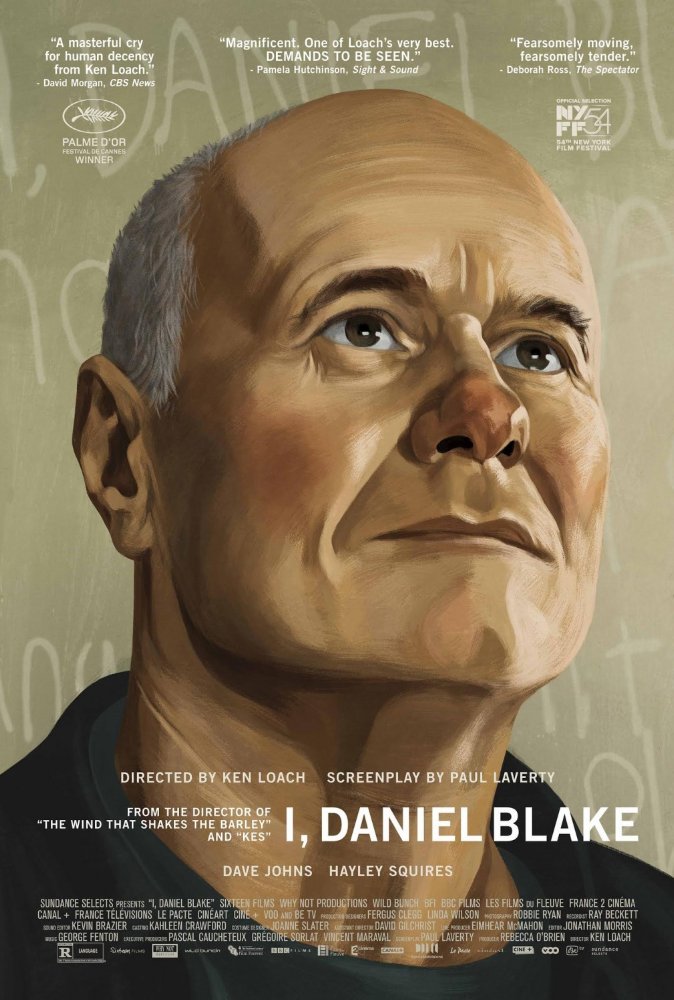
I, Daniel Blake

(UK/France/Belgium 2016)
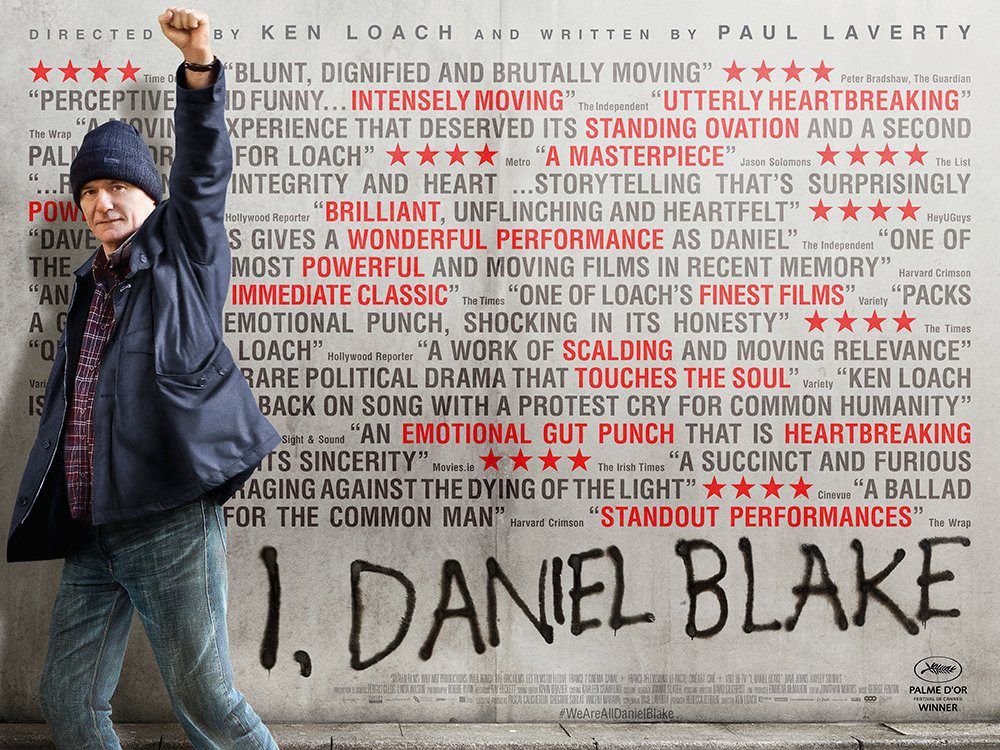
I Daniel Blake.jpg

Ken Loach’s I, Daniel Blake has gotten a lot of attention and praise. Good: it wrestles with a topic that’s timely on both sides of the Atlantic—and elsewhere, for that matter. A political and poweful message, Loach has touched many a nerve. Case in point: I, Daniel Blake won the Palm d’Or at the Cannes Film Festival, where it finished with a 15-minute standing ovation (http://variety.com/2016/film/global/palme-dor-ken-loach-rebecca-obrien-1201785482/). 15 whole minutes?! Wow.

Daniel Blake (Dave Johns) is a kind of antihero. He’s gruff, he’s private, he’s not handsome or young. He probably goes to church. A heart attack seems like the thing that would change his life, but what really does is a new neighbor (Hayley Squires) and her two kids (Briana Shann and Dylan McKiernan).

I didn’t stand up, but I get it. Bureaucracy versus common sense is always fertile ground for storytelling. I applaud Loach for what he’s saying here, I really do. I, Daniel Blake is a good film: it’s engaging, brave, and relatable. The acting is good all around. So is the premise.

In my opinion, though, it just isn’t a great film. We’re talking shades of meaning here, so if you have five seconds to spare, I’ll tell you why. First, I’ve seen this device many times before—in the last year, even. A cranky old man meets a character that represents youth and hope, and it totally melts the icy facade and changes his life. Well, OK. This sense of hope is usually personified by the very person society looks down on. Next?

Second, I saw where the plot was going way before I got there. Again and again. Predictability is never groundbreaking.

Third, I can’t help but think that this film takes the easy way out. A heart attack in a movie ends only one way. And it’s only a sad ending. Yeah, I, Daniel Blake is emotionally manipulative.

So, my issues center on Paul Laverty’s writing. I wish I had a better way to tell this story. I don’t. For all its pluses and minuses, though, I’d rather watch something more intense. Overall, I, Daniel Blake is disappointingly soft.

With Kate Rutter, Sharon Percy, Kema Sikazwe, Steven Richens, Amanda Payne, Chris Mcglade, Shaun Prendergast, Gavin Webster, Sammy T. Dobson, Mickey Hutton, Colin Coombs, David Murray, Stephen Clegg, Andy Kidd , Dan Li, Jane Birch, Micky McGregor, Neil Stuart Morton

Production: Sixteen Films, Why Not Productions, Wild Bunch, British Film Institute (BFI), BBC Films, Les Films du Fleuve, Canal+, Ciné+

Distribution: Entertainment One Films (UK), Le Pacte (France), Cinéart (Belgium/Netherlands), Cinema (Italy), Feelgood Entertainment (Greece), Prokino Filmverleih (Germany), Scanbox Entertainment (Denmark), Sundance Selects (USA), Transmission Films (Australia), Vertigo Média Kft. (Hungary), Canibal Networks (Mexico), Cine Canibal (Mexico), Imovision (Brazil), Mont Blanc Cinema (Argentina), Longride (Japan)

100 minutes
Rated R

(Music Box) B

https://www.wildbunch.biz/movie/i-daniel-blake/

Florence Foster Jenkins

(UK 2016)

“People can say I can’t sing, but they can’t say I didn’t sing.”

—Florence Foster Jenkins

A lot of hype surrounded Florence Foster Jenkins before it arrived at a theater near us last fall. We wanted to catch it during its original run, but it came and went before we got around to seeing it. So, inspired by a post earlier in the day, I rented it on a Friday when we had no plans other than dinner at home. The night we watched it just happened to be Friday the 13th, which somehow seems appropriate.

Based on actual events and set during WWII, Florence (Meryl Streep) is a rich Manhattan society lady of a certain age who runs in an arty circle and knows a lot of people, some with money and others who follow it. She operates a private venue dedicated to opera, the Verdi Club, where she stars in a show and has a non-speaking role. Dying of either syphillis or the treatment for it—mercury and arsenic!—her one wish is to perform for an audience at Carnegie Hall. The problem is, she can’t sing; she’s downright awful. Her entrance here, lowered onstage from a rope and pulley while dressed as an angel with a harp, reminds me of Sarah Jessica Parker’s entrance (“I offer you mortals the bird of peace so that you may change your ways and end this destruction”) in Ed Wood, Tim Burton’s 1994 biopic about a similarly talentless film director who came along a decade or so later. The comparison is so apt that I wonder if it was intentional. Here, Florence’s husband, St. Clair Bayfield (Hugh Grant), doesn’t help matters by exaggerating her talent.

Determined to make her dream come true, Florence hires a vocal trainer, Carlo Edwards (David Haig), and a pianist, Cosmé McMoon (Simon Helberg), to put together a show. Established and well-known Carlo is content to take Florence’s money, build her ego, and let her dream on. Budding Cosmé, however, struggles with lying to her about her obvious ineptitude, not to mention her negative impact on his professional reputation. He soon sees that those around Florence stretch the truth about a lot of things when dealing with her.

Nicholas Martin’s script is kind to its characters, going for laughs in a way that doesn’t demean any of them. I never heard of her until this film, but the actual Florence Foster Jenkins was an interesting person. Her singing truly was awful:
https://www.youtube.com/watch?v=Hcs9yJjVecs. As always, Streep is spot on with her portrayal. She seems to have fun in this role, and it shows. Grant, who usually bores me but doesn’t here, is well suited for St. Clair: he’s stuffy and straight, but he nicely coveys an underlying deceitfulness that doesn’t come off as sinister. I like the way director Stephen Frears plays with deceit here, ultimately using it to depict a very touching side of St. Clair—who lives with his mistress (Rebecca Ferguson) in Brooklyn in apartment that Florence pays for. Much to my surprise, though, Big Bang Theory‘s Helberg steals practically every scene he’s in: keeping it subtle with Cosmé’s homosexuality (as Cosmé himself no doubt would have done during his day), he plays his character as a spineless, perennially uncomfortable, asexual bundle of nerves. He peppers his performance with grimaces and nervous giggles. Later, he delivers a line to explain his tardiness to Florence (of course, it involves sailors) with perfect and priceless dryness. He outshines everyone here.

Florence Foster Jenkins has some funny moments and some very touching ones. I found it enjoyable enough, but certainly not a knockout. It could have benefitted from a little more quirk and edge, especially considering its title character who showed no shortage of either.

Also starring Nina Arianda, Stanley Townsend, Allan Corduner, John Sessions, John Kavanagh, David Menkin, and Sid Phoenix

Produced by Qwerty Films, Pathé Pictures International, and BBC Films

Distributed by Paramount Pictures (USA)

111 minutes
Rated PG-13

(iTunes rental) C

http://www.florencefosterjenkinsmovie.com