Rosenwald

(USA 2015)

“Rosenwald school” is a curious name that sounds like the Jewish equivalent of a Catholic Magdalene home, where unmarried pregnant girls of yore were tucked away to do laundry for nuns until they had their babies. It’s not; it was actually a number of schools for black children built in the American South during the early 20th Century. I never heard of these or the man whose name they bear, Julius Rosenwald. Biographer Aviva Kempner tells his story in a decidedly straightforward manner through photos, narration, clips, and interviews with descendants, historians, and Rosenwald school alums like Maya Angelou and Congressman John Lewis. At the end, we even hear from Rosenwald himself.

Born in Springfield, Illinois, where he lived across the street from the Lincoln home, Rosenwald—who considered himself “a member of a despised minority”—first made a name selling men’s clothes with his cousin. A series of fortuitous events resulted in a partnership with Sears Roebuck in Chicago in 1895. He got rich creating the Sears catalog, the Amazon of a hundred years ago, as one interviewee calls it. Motivated by a number of things—his friendship with Booker T. Washington, Chicago Sinai congregation rabbi Emil G. Hirsch, the Jewish concept of tikkun olam (“repair the world”), Washington’s Up From Slavery and William Henry Baldwin, Jr.’s An American Citizen, and a disturbing similarity between the persecution of blacks in the States, particularly the South, and that of Jews in Russia—he started a fund to build schools where the government apparently wouldn’t. He also offered money to build YMCAs in various cities.

Rosenwald’s funding scheme was unique: he paid a third of the cost, with the rest of the funding to be provided (or raised) by the community where the school or YMCA would be built. It worked, and more than 5,000 schools were built. Rosenwald didn’t stop there: he also contributed to housing in Chicago, established the Museum of Science and Industry, and set up a fund for artists and intellectuals. Recipients were in diverse disciplines and included Langston Hughes, Ralph Ellison, Katherine Dunham, Gordon Parks, Jacob Lawrence, Dr. Charles Drew, and even Woody Guthrie. Rosenwald is intriguing not just for its named subject but also for the subjects it gets into on the side: American civil rights, art, and Chicago history.

(Gene Siskel Film Center) B

http://www.rosenwaldfilm.org

The Big Short

(USA 2015)

I’m no economist, and, well…math is hard. I get that lax lending practices led to the housing market collapse in 2008, but I sure as hell don’t have a firm grasp on what else contributed to the financial meltdown. With The Big Short, writer and director Adam McKay takes on the courageous and potentially suicidal task of explaining it all, Schoolhouse Rock style—only hopped up on Adderall.

Based on the nonfiction exposé The Big Short: Inside the Doomsday Machine by Michael Lewis, The Big Short follows the intertwined stories of Michael Burry (Christian Bale), a socially inept Metallica-blaring doctor-turned-hedge fund-manager with Asperger’s, a glass eye, and a cyst on his face that bummed me out every time I saw him; douchebag Wall Street trader Jared Vennett (Ryan Gosling), who doubles as narrator; cynical, boorish, and fictitious Chicken Little hedge fund manager Mark Baum (Steve Carell) and his team; newbie investors Charlie Geller (John Magaro) and Jamie Shipley (Finn Wittrock); and retired banker Ben Rickert (Brad Pitt), who’s got no love for the business. In one way or another, they all aim to profit from mass calamity—and they succeed. The standouts here easily are Gosling and Carell, who have a natural chemistry and seem to have fun with their parts. Pitt, who plays psychos and goofballs better than anyone (e.g., True Romance, 12 Monkeys, Fight Club, Snatch—need I say more?), has a secondary role, but he’s awesome; I didn’t recognize him right away. Bale, on the other hand, is a bit much—to the point of being a downer.

The story involves dry, technical, and boring financial concepts, usually abbreviations: credit default swaps (CDS), collateralized debt obligations (CDOs), NINJA loans—not the stuff that typically generates emotion or drama. McKay uses a number of offbeat but smart gimmicks to explain the basics: celebrity cameos (Selena Gomez and Anthony Bourdain, to name two), demonstrations (a la Jenga), breaking character, songs and graphics. His approach does the trick, and it’s entertaining. Very much so. However, it’s not perfect: the pacing, though not as frenetic as Wolves of Wall Street, still wore me out by the end. Some questions remain in my mind—like how you can bet against something like the economy. It’s also still unclear how it all happened. To quote the movie, though, “[t]he truth is like poetry, and most people fucking hate poetry;” I think that’s the essence. One thing is certain: McKay is outraged; by showing us that the nonsense continues, he wants us to be, too.

(AMC River East) B-

http://www.thebigshortmovie.com/


The Danish Girl

(USA/UK 2015)

On paper, The Danish Girl has everything going for it: a sensationalist plot with real-life characters, weighty and timely subject matter, pretty scenery, nifty period clothes, a love story, and a nice dose of tragedy. Visually, it’s a beautiful film: cinematographer Danny Cohen gives it the soft, muted look of an impressionist painting; the interiors are as alluring as the exterior shots. The setting—the early 20th Century art scene in Copenhagen and Paris—evokes a sense of glamor and romance. The acting is okay for the most part, but Alicia Vikander is outstanding. Still, the sum here is no greater than its parts.

Based on David Ebershoff’s novel based on the life of Dutch artist Einar Wegener (Eddie Redmayne), the first known person to undergo sex reassignment surgery, and his wife, Gerda Gottlieb (Vikander), The Danish Girl is a good story even if it isn’t historically accurate. One day, Gottlieb asks Wegener to stand in for her model so she can finish a painting; she gives him a pair of panty hose, and he is immediately cozy in them. Thus begins Wegener’s road to becoming “Lili,” as christened by the couple’s friend, Ulla (Amber Heard). Lili becomes Gottlieb’s muse, showing up in her paintings. They sell. Lili accompanies Gottlieb to a ball as Wegener’s “cousin,” and everyone is fooled. Wasn’t that easy, isn’t she pretty in pink?

The Danish Girl is fictionalized, and as a result liberties are taken for time constraints, continuity, and drama. I get that. Nonetheless, this film doesn’t come off as genuine because it oversimplifies and sanitizes the issues it seems to want to bring to light and then gives them superficial treatment. Lili’s transition is too quick, and her adjustment—touched on but not explored—is seamless for today let alone 1926. Redmayne’s portrayal of Lili is silly: he bats his eyelashes and caresses his frocks with all the campy drama Johnny Depp mustered up wearing an angora sweater in Ed Wood. Lili looks like Molly Ringwald, right down to her stylish scarves—the real Lili looked like Oscar Wilde in a dress. Wegener and Gottlieb were more complicated and had a more complex and unconventional relationship. The truth here is so condensed and whitewashed that this might as well be a fairy tale.

The Danish Girl might make you cry, but it’s just not convincing even within the confines of a two-hour film. Too bad, because it could’ve been much more.

(ArcLight) C-

http://www.focusfeatures.com/the_danish_girl

The Overnight

(USA 2015)

Sex can be a funny topic with loads of material. The Overnight, a limited independent release from last summer, seems like a little gem. It opens promisingly with Taylor Schilling (Orange is the New Black) and Adam Scott (Parks and Recreation) in what just might be hands down (but not off) the most pathetic sex scene ever. It’s really funny, and gets us off to a good start. Sadly, the momentum doesn’t last long.

The couple just moved from Seattle to Los Angeles, and doesn’t know anyone. While at the park with their son, they meet Kurt (Jason Schwartzman), a goofy ageing hipster who sells water coolers by day and who we later learn also paints close up portraits of assholes—as in, anuses—and sells videos of his wife, Charlotte (Judith Godrèche), online. Kurt invites the couple over for a “play date” for their boys (he and Charlotte have a son the same age) that ends up looking more and more like a play date for the adults once the kids are asleep.

I wanted to like The Overnight, but I didn’t. It shows a few flickers of light: the characters are thrust into some palpably uncomfortable situations, including a weird penis dance by the pool (they’re prosthetics) and an even weirder hand job. One of the last scenes actually gets sexy for a hot moment. Unfortunately, though, the whole thing goes limp early on; the story never takes off and the situations just aren’t that wild. Sure, there’s full frontal nudity (albeit prosthetics), but there’s nothing edgy or clever about it. The problem is the writing: Patrick Brice either ran out of ideas or didn’t know where to go with the story. Intentionally or not, the wrap up puts out a moral position that rings, um, judgmental. I didn’t find The Overnight fresh or funny; I found it unimaginative and tedious the more it went on.

(Home via iTunes) C-

http://theovernight-movie.com


The Hateful Eight

(USA 2015)

The trailers piqued my interest but didn’t totally sell me, so I wasn’t sure about The Hateful Eight. My apprehension was unfounded: it’s gotdamn motherfucking Quentin Tarantino, all the motherfucking way, motherfucker. If that last sentence sounds good to you—and you read it how Jules Winnfield might say it—well, you’re in for a treat. I said, goddamn, god damn!

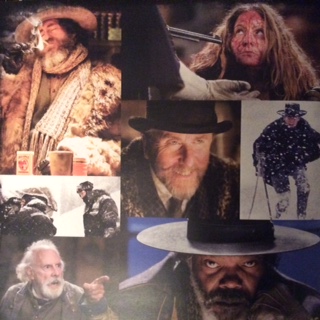
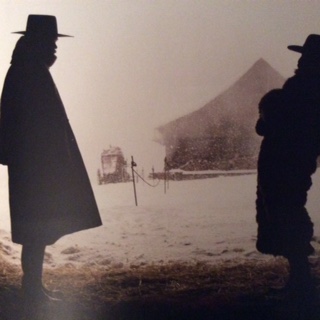
Traveling through Wyoming on the way to Red Rock not long after the Civil War, bounty hunter Major Marquis Warren (Samuel L. Jackson) is caught in the mountains just as a blizzard is a-brewing. He stops a stagecoach that happens to be carrying another bounty hunter, John “The Hangman” Ruth (Kurt Russell), and his captive, the lovely Daisy Domergue (Jennifer Jason Leigh)—who has blood on her face for nearly the entire film—and finagles a ride. Another guy, Chris Mannix (Walton Goggins), who claims to be en route to Red Rock to become sheriff, is thrown into the mix. The blizzard forces them to seek shelter at Minnie’s Haberdashery, where they join four strangers: “Mexican Bob” (Demian Bichir), smarmy Oswaldo Mobray (Tim Roth), quiet cowboy Joe Gage (Michael Madsen), and “The General” (Bruce Dern), a frail former Confederate soldier. Niceties, banter, and then expletives are exchanged until characters are killed off, Ten Little Indians style but with twists—Agatha Christie never blew anyone’s nuts off. Then again, Tarantino’s way of telling a story is completely his own.

True to form, Tarantino jams The Hateful Eight with memorable miscreants, snappy dialogue, and impossibly crazy cutthroat situations. The action here is intense and suspenseful, unfolding gradually and teasingly. The timing is out of sequence—no shock there. The plot gets thicker with each character that falls off, leaving questions begging for answers. Best of all, not a single performance is subpar and not a single character—except maybe Minnie’s helper—is superfluous. Russell and Dern stand out, but Jackson is a master scene-stealer—his delivery is so strong that you simply cannot turn away when he speaks. Channing Tatum makes a surprise appearance and gives an even more surprisingly impressive performance.

Well, let’s not start sucking each other’s dicks quite yet. The story has a hole or two, and the gore is so over the top it loses its impact at points. There’s the use of the ‘n’ word like a mere conjunction. Jason Leigh sounds annoyingly like Roseanne Barr. Oh yeah—more than eight characters actually appear, which a couple of times—namely when everyone is in the same small room—requires extra concentration to follow along. All that said, though, none of it detracts from enjoying the film. Yes, it lacks the elegance and grace of Kill Bill, my personal favorite, but The Hateful Eight is toward the top of Tarantino’s resume. I loved every minute—which did not seem like three hours.

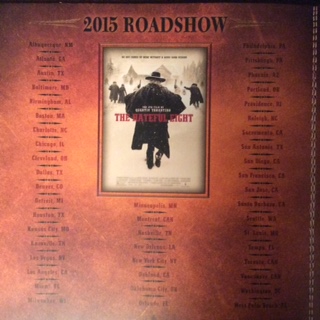
Side note: the overall experience was one I’ve never had at a movie theater. Truly a bona fide “event,” the atmosphere was like a rock concert: the screening was sold out ahead of time, and the crowd was abuzz with excited fans taking pictures and chattering about other Tarantino films. Some had on Reservoir Dogs and Kill Bill tee shirts. The line to get in was all the way to the next block. Programs were provided. Shot on decadent 70-millimeter film, the Music Box showed The Hateful Eight on a brand spanking new screen it acquired for this special “roadshow engagement.” The price was double a normal ticket but oh so worth it.

The Hateful Eight ended my year of movies on a high note—I can’t think of a better director to release a new film to close out the year. To borrow from it, “Old Mary Todd is calling, so it must be time for bed.” Time will tell for sure, but I think this one belongs to the ages.

(Music Box) A+

http://thehatefuleight.com


image1     image3     image2     image4     image5     image6


Antonio Gaudí

(Japan 1984)

Barcelona, one of my favorite cities, owes much of its color to Antoni Gaudí, whose personal stamp is all over it. With Antonio Gaudí [アントニー・ガウディー], Hiroshi Teshigahara directs a virtual tour of Gaudí’s major and not so major works, getting close up and even inside a few spots one otherwise might never see.

Antonio Gaudí is pretty, artful, perhaps even poetic; but it’s boring. Teshigahara offers no commentary or background on anything other than—surprise!—La Basílica de la Sagrada Família; even then, the narration is two minutes long, if that. A 72-minute moving postcard, Antonio Gaudí amounts to nothing more than an educational film or a tourism video. I’d rather see Gaudí’s work in person.

(Gene Siskel Film Center) D

https://www.criterion.com/films/536-antonio-gaudi

Meet the Patels

(USA 2015)

Poking fun at cultural differences and the generation gap seems like an easy way to get a laugh, and maybe it is. Fortunately, it works in Meet the Patels, a genuinely funny documentary of one man’s search for love that becomes a family project. After breaking up with his Caucasian girlfriend of two years– a girlfriend he never mentioned to his immigrant parents– L.A. based comic Ravi Patel decides to try the traditional Indian system of hooking up: letting the parents arrange it. Why not? It worked for them, and his mother is known for her matchmaking skills.

Although we don’t see much of sister Geeta as she records everything, her presence is pervasive: she’s off-camera laughing mischievously, goading her brother and chiding him when he vacillates on dating matters. The real stars, however, are Patel’s parents, father Vasant and mother Champa, who fret endlessly over the fact that their children are approaching their thirties and are STILL single, as though this qualifies them as town lepers. Vasant goes so far as to declare, in all seriousness, that not getting married makes one “the biggest loser you can be.” They quickly put together Ravi’s “biodata,” which essentially is a dating resume, and forward biodatas of potential matches to him. They take him to weddings and give him pep talks. They send him all over the States to meet Indian girls. The results are amusing and illuminating. For example, I didn’t know “wheatish brown” is a thing to look for in a mate. I never heard that some skin tones and geographical areas are more desirable than others. I had no idea that many Patels prefer to marry other Patels.

Ravi’s deadpan “OMG” delivery is consistently fun, and animated bits interspersed throughout the film keep the mood light. In the end, it’s clear that no matter how disparate certain views may be, parents and their children can find a middle ground, adapt, and find happiness together. Meet the Patels is warm, relatable, and something pretty much anyone will find entertaining. I laughed a lot.

(Gene Siskel Film Center) B

http://www.meetthepatelsfilm.com

Christmas, Again

(USA 2015)

Nothing puts me in the Christmas spirit like a gloomy holiday story. Noel (Kentucker Audley) sells Christmas trees on a makeshift lot on a sidewalk in Brooklyn. He works an all-night 12-hour shift. He constantly has to ride his worker, Nick (Jason Shelton), and Nick’s girlfriend (Oona Roche) to get anything done. He fields petty questions and solves petty holiday problems for petty, self-absorbed customers. He sleeps and eats—I wouldn’t call it living—in a trailer on the street, where he survives on a diet of energy pills and antidepressants stashed in an Advent calendar. He buys scratch-off lottery tickets for fun. Oh yeah, he broke up with his girlfriend sometime in the last year. Noel seems lonely. Or is he just someone who doesn’t need the company of others?

One night while working, Noel comes across a woman, Lydia (Hannah Gross), passed out on a bench in a park. Their paths—and her jittery boyfriend’s—cross a few times, and that’s it. 

Christmas, Again probably is not going to end up being anyone’s favorite Christmas movie anytime soon, but it works on quite a few levels. More a string of quiet events than a full story, its real achievement is the mood it sets. Dolorous and blue, the camera moves slowly and blurs the background leaving only hints of cold colors. The cinematography (Sean Price Williams) is beautiful, making the shots literally an opaque blue. I loved the old distorted Christmas music that sounds like it’s playing from an AM radio, the Christmas lights permanently out of focus in the background, and the uneasy, unnatural, and sometimes suspenseful interactions between Noel and Lydia, both of whom are easy on the eyes. There’s a palpable sense of despondency that comes through here.

(Gene Siskel Film Center) B

http://www.xmasagain.com

Difret

(Ethiopia 2014)

The Diplomatic Courier (http://www.diplomaticourier.com/difret/) explains the double meaning of the Amharic word “difret,” and hence the title. Based on actual events in the life of Aberash Bekele, who according to a Newsweek interview was never informed that her story was being made into a movie (http://www.newsweek.com/2015/01/16/rape-victim-who-fought-back-and-shamed-nation-297757.html), Difret is the fictionalized account of Hirut (Tizita Hagere), an adolescent in Ethiopia whose kidnapping for a forced marriage in 1996 ended in a landmark legal decision. Walking home from school in a remote village, she is surrounded by a group of men on horses, kidnapped, raped, and held captive in a hut. Her rapist tells her that he abducted her to marry her, a tradition in these parts of the world. When she escapes with his rifle, the men chase her into a forest and she shoots her attacker dead when he ignores her warnings to back off. Enter attorney and female rights activist Meaza Ashenafi (Meron Getnet), who takes the case and argues that Hirut acted in self-defense, ultimately placing her law practice, her livelihood, and her reputation in jeopardy.

Difret, to which Angelina Jolie attached her name as executive producer, is compelling but (probably not surprising) often difficult to watch. The sexism is not just rampant, it’s downright barbaric. Hirut is vilified: she’s treated like shit in police custody, no one will testify for her, and all the village men want her dead. She doesn’t understand how Ashenafi can live happily, not to mention respectably, as a single woman. Ashenafi encounters her own obstacles and resistance from the male authority figures- to a degree even from her mentor, an educated and seemingly progressive retired attorney.

Aside from the main issues it deals with, Difret demonstrates that change, for better or for worse, hurts. Zeresenay Mehari, who directed and wrote the script, maintains objectivity for the most part; he’s respectful to both sides, and he doesn’t hit you over the head with his moral stance. He does a nice job showing the tensions that develop when tradition gets in the way of social progress. Intentionally or not, he also shows the crucial role that the legal process and a ballsy attorney play in bringing about change. Mehari is efficient in giving us just what we need to know to follow along. As a result of his efficiency, however, his characters and the story as a whole lose a sense of dimension; both are superficial in the same way a TV crime drama is. Still, Difret is worth seeing.

(Gene Siskel Film Center) B-

http://www.difret.com


Janis: Little Girl Blue

(USA 2015)

Of several celebrity biography documentaries I’ve seen this year, two stand out: Amy (as in Winehouse) and Janis: Little Girl Blue. Interestingly, both performers had similar personalities, made similar music, and traveled similar roads that ended early (at the same age, no less). Both biographies also present their subjects in an imperfect albeit human light.

Narrated by Cat Power, director Amy Berg lets Joplin tell her own story through letters she wrote to her family after leaving Texas for San Francisco in the early Sixties. Interviews with her sister, former band mates, and even Dick Cavett, who famously discussed Joplin’s upcoming ten-year high school reunion on his show less than two months before her death (and who curiously disclosed in his interview for this film that he “may or may not” have been intimate with her), round out her story. What emerges is an ambitious outcast searching for love and acceptance. Two anecdotes are particularly telling and disturbing: a fraternity voted Joplin “ugliest man on campus” during her short tenure at the University of Texas at Austin during the fall of 1962, and footage from her aforementioned ten-year reunion suggests that her old classmates ignored her when she showed up. Weird, considering she was already famous by then. Janis: Little Girl Blue shows a vulnerable side of Joplin that I didn’t know she had.

(Gene Siskel Film Center) A

http://www.jigsawprods.com/janis-little-girl-blue/