20th Century Women

(USA 2016)

“We are at a turning point in our history.”

—President Jimmy Carter

I was a little kid in the Seventies, but I have many indelibly vivid memories of the decade: huge cars, gas lines, expensive meat, hijacked planes, Sanka and Sweet’N Low, smoking everywhere, hard rock, punk rock, disco, macrame, spider plants, the Bicentennial, Sky Lab, Victoriana (we had Mucha posters in our mustard-colored kitchen), that strange Holly Hobby aesthetic. It seems like it all changed immediately when Reagan took office in 1981.

20th Century Women captures a slice of American life on that unique, unremembered and largely disowned cusp. Set as a flashback to 1979 with voiceovers that repeatedly remind us that we’re looking backward, the film is a rather remarkable time capsule. The story is simple: Dorothea (Annette Bening) is my grandparents’ age (born in 1924). She had her only son, Jamie (Lucas Jade Zumann), late in life—i.e., over age 40. She’s been divorecd for a few years, which was fine until Jamie hit puberty. Now, she needs help understanding him. She enlists his two closest allies—Julie (Elle Fanning), whose pants he wants to get into, and Abbie (Greta Gerwig), a postpunk fuckup—to help her figure him out.

Loosely based on actual events from director and writer Mike Mills’s childhood, 20th Century Women is fun to watch. Growing up in a house of females myself, I relate to a lot of his experiences. I loved all the Talking Heads, too. Oh!—and Siouxsie and the Banshees! That said, this film borders on overbearing with its nostalgia. It could’ve been so much better—the material and the talent are both there, but Mills goes for easy returns that don’t pay off. The story falls flat. Perhaps a quote from Bening in an earlier film, the superior and far more interesting Running with Scissors, succinctly sums up my problem here: “It’s shit, Fern. It’s sentimental. It’s emotionally dishonest. It implodes into nothingness.”

I wasn’t bored, and I didn’t hate 20th Century Women. But I’m never going to see this movie again. Too bad, because the acting is great. It’s a misfire due to its execution. It seemed like a good idea at the time.

Also starring Billy Crudup, Vitaly Andrew LeBeau, Curran Walters, Toni Christopher, Jimmy Carter (public domain footage)

Produced by Annapurna Pictures, Archer Gray, and Modern People

Distributed by A24

119 minutes
Rated R

(Landmark Century) C

http://20thcenturywomen-movie.com

Ed Wood

(USA 1994)

“You’re wasting your lives making shit. Nobody cares. These movies are terrible!”

—Dolores Fuller


“How do you do it? How do you get all your friends to get baptized just so you can make a monster movie?”

—Bunny Breckinridge


“Can your heart stand the shocking facts of the true story of Edward D. Wood, Jr?”

—Criswell


“Confidentially, I even paratrooped wearing a brassier and panties. I wasn’t afraid of being killed, but I was terrified of being wounded and having the medics discover my secret.”

—Ed Wood

Edward D. Wood, Jr., or simply Ed Wood, is widely regarded as the worst director of all time. In fact, he received posthumous recognition—the Golden Turkey Award—designating him as such (http://www.legacy.com/news/celebrity-deaths/article/ed-wood-the-best-of-the-worst). His silly low-budget DIY pulp/science fiction/horror flicks from the 1950s—low on plot, technique, and talent—are beloved by many because they’re so bad. Monumentally bad. Okay, maybe ridiculous is a better word. You decide from this trailer:

Based on Rudolph Grey’s book Nightmare of Ecstasy and adapted for the screen by Scott Alexander and Larry Karaszewski, Tim Burton’s labor of love, Ed Wood, is a period-piece biopic about the eccentric angora-loving filmmaker responsible for such gems as Jail Bait, Glen or Glenda, Bride of the Monster, and of course Plan 9 from Outer Space—Wood’s Citizen Kane (as Burton likens it here). This film rocks; I never get sick of it. Not ever. And for a few reasons.

The characters and performances are fantastic. Leading man Ed Wood is one of Johnny Depp’s most endearing roles; he plays Wood with an affectionate and demonstrative earnestness he’s never quite duplicated. Burton has always held sympathetic misfits in high regard—Edward Scissorhands, also played by Depp, immediately comes to mind. Here, he has a field day, bringing in an entire cast of warm and colorful weirdos that flock to Wood. Consider: best bud Bunny Breckinridge (Bill Murray), a boozy grand queen with a penchant for drama and glitter. “The Amazing Criswell” (Jeffrey Jones), an androgynous self-proclaimed psychic/horse shit artist. Max (Max Casella), the president of Wood’s fan club—and his errand boy. Overzealous, chatty crew member Conrad (Brent Hinkley). Later, Vampira (Lisa Marie), a gothic midnight movie hostess with lots of bosom, and TV wrestler Tor Johnson (George “The Animal” Steele) become regulars in Wood’s films.

The most important relationship, though, is the one between Wood and has-been Dracula star Bela Lugosi (Martin Landau), whom he meets in a coffin store. Lugosi’s life is far from glamorous: he lives alone in obscurity in a tiny tract house in a nondescript suburban neighborhood. He’s also a junkie. Wood moves from starstruck fan to employer to custodian and confidant. Landau gives a flawless performance; he earned an Academy Award for Best Supporting Actor for it. Every scene is inspired, but one of my favorites is his dramatic reading of that hackneyed “home” speech; it is, to use Wood’s word, “perfect.” Their friendship gives Ed Wood much of its warmth and humanity.

Despite the laughably amateur quality of Wood’s films—and his unorthodox way of shooting them—he gets them made. And no matter how poorly received they are, he doesn’t give up. In this sense, Ed Wood is uplifting and inspiring. He embraces his flaws, sticks to his guns, and believes in himself. Orson Welles himself (Vincent D’Onofrio) backs him up in one great scene at a bar.

Some might find the pace a bit slow. I don’t—the whole film is fun and jammed with quotable material that keeps it moving. Line after line is memorable—I could string together a bunch of quotes I know by heart and leave it at that (I’ve seen this film quite a few times). From a technical standpoint, Ed Wood is exceedingly well done. Filmed in shimmering black and white, Stefan Czapsky’s camerawork is beautiful. The cleverly composed, shadowy shots of Lugosi “fixing” in the bathroom and later tied to a bed in rehab, and Wood and future wife Kathy (Patricia Arquette) inside the carnival ride are especially remarkable. Howard Shore’s score—a rich mix of jazz, Cuban orchestration that wouldn’t sound out of place on I Love Lucy, and monster madness—is awesome.

Burton easily could have made this a snarkfest. Instead, he shows his idol in a respectful and positive light. His spirited take makes Ed Wood exceptional.

With Sarah Jessica Parker, Mike Starr, Juliet Landau, Stanley Desantis, Ned Bellamy, Norman Alden, G.D. Spradlin

Produced by Touchstone Pictures

Distributed by Buena Vista Pictures Distribution

127 minutes
Rated R

(iTunes purchase) A

Popstar: Never Stop Never Stopping

(USA 2016)

One of the best things to come from Saturday Night Live has to be its Digital Shorts segment. With titles like “Laser Cats!,” “Please Don’t Cut My Testicles,” “Jizz in My Pants,” and of course “Dick in a Box” and its follow up, “Motherlover,” the angle was decidedly crass and juvenile—high school boy stuff loaded with potty, sex, and to a lesser degree drug humor with the occasional reference to geek fodder, usually some work of the science fiction or fantasy genre. Written and produced by The Lonely Island—comedy trio Jorma Taccone, Akiva Schaffer, and Andy Samberg—the genius lied in the creators’ astute balance of pop cultural literacy, musical aptitude, and complete absurdism. Generally performed as music videos for rap and pop songs so spot on they sounded real, Digital Shorts attracted the likes of Steve Martin, Natalie Portman, Lady Gaga, Betty White, and of course Justin Timberlake.

In Popstar: Never Stop Never Stopping, The Lonely Island expands its formula into a feature length film, playing former members of Style Boyz, a boy band whose biggest hit was “The Donkey Roll” (https://youtu.be/-mRVK8-XfEU). After a rift over credit, the Boyz break up and go their separate ways. Lawrence (Schaffer) and Owen (Taccone) fail to duplicate their success, but narcissistic and dubiously talented frontman Conner Friel (Samberg) has a huge blockbuster with his solo album Thriller, Also. The film, done as a mockumentary very much in the style of This Is Spinal Tap!, picks up just as Conner’s followup, Connquest, is about to “drop” (i.e, be released). A huge media blitz including a tour is in the works. When Connquest fails to live up to its predecessor, all signs point to a Style Boyz reunion—but can that happen?

Popstar makes it abundantly clear why The Lonely Island’s brand of humor works as shorts: it simply can’t sustain a movie. With Popstar, they nail the excess, the ego, and the emptiness of the entertainment biz. Tim Meadows as Conner’s manager and Sarah Silverman as his publicist are awesome, simultaneously informing, persuading, and babysitting Conner while constantly stroking his ego. The songs sound real. Conner’s show, complete with backup dancers and a deejay, looks authentic. Some of the scenes are pretty damned funny, including one where Conner is forced to autograph a fan’s, um, junk (props for getting it through the window of the limo). It’s amusing to see real popstars like Questlove, Usher, 50 Cent, and Ringo Starr (not to mention bitch on wheels Simon Cowell) gush in fake interviews over something so obviously lame as Style Boyz and Conner. It’s fun to see P!nk, Adam Levine, and Michael Bolton perform with Conner—and “Equal Rights” (with P!nk) is a hilarious, cheerful spoof of Macklemore & Ryan Lewis’s “Same Love.” Seal and Mariah Carey make gracious cameos that show they can take a joke. This is all good. The problem is, Popstar is essentially a string of dumb gags. Unlike This Is Spinal Tap!, it gets tiresome, fast. I lost interest after a little while; the characters and the jokes are too thin to carry Popstar all the way. Even Timberlake, whose appearances with The Lonely Island have always been funny, is an uncharacteristic yawn as Conner’s chef. Meh.

Curiously, the best song for this film was deleted: https://youtu.be/t3jKtjgRZQY. Seeing it as a short probably is best, anyway.

Also starring Maya Rudolph, Joan Cusack, Imogen Poots, Chris Redd, Edgar Blackmon, James Buckley, Ashley Moore, Bill Hader, Will Forte, Will Arnett, Carrie Underwood, Nas, Akon, Big Boy, D.J. Khaled, Danger Mouse, Pharrell Williams, Jimmy Fallon, Martin Sheen, Snoop Dog, Weird Al Yankovic

Produced by Perfect World Pictures, Apatow Company, and The Lonely Island

Distributed by Universal Pictures

87 minutes
Rated R

(iTunes rental) D+

https://www.uphe.com/movies/popstar-never-stop-never-stopping

Florence Foster Jenkins

(UK 2016)

“People can say I can’t sing, but they can’t say I didn’t sing.”

—Florence Foster Jenkins

A lot of hype surrounded Florence Foster Jenkins before it arrived at a theater near us last fall. We wanted to catch it during its original run, but it came and went before we got around to seeing it. So, inspired by a post earlier in the day, I rented it on a Friday when we had no plans other than dinner at home. The night we watched it just happened to be Friday the 13th, which somehow seems appropriate.

Based on actual events and set during WWII, Florence (Meryl Streep) is a rich Manhattan society lady of a certain age who runs in an arty circle and knows a lot of people, some with money and others who follow it. She operates a private venue dedicated to opera, the Verdi Club, where she stars in a show and has a non-speaking role. Dying of either syphillis or the treatment for it—mercury and arsenic!—her one wish is to perform for an audience at Carnegie Hall. The problem is, she can’t sing; she’s downright awful. Her entrance here, lowered onstage from a rope and pulley while dressed as an angel with a harp, reminds me of Sarah Jessica Parker’s entrance (“I offer you mortals the bird of peace so that you may change your ways and end this destruction”) in Ed Wood, Tim Burton’s 1994 biopic about a similarly talentless film director who came along a decade or so later. The comparison is so apt that I wonder if it was intentional. Here, Florence’s husband, St. Clair Bayfield (Hugh Grant), doesn’t help matters by exaggerating her talent.

Determined to make her dream come true, Florence hires a vocal trainer, Carlo Edwards (David Haig), and a pianist, Cosmé McMoon (Simon Helberg), to put together a show. Established and well-known Carlo is content to take Florence’s money, build her ego, and let her dream on. Budding Cosmé, however, struggles with lying to her about her obvious ineptitude, not to mention her negative impact on his professional reputation. He soon sees that those around Florence stretch the truth about a lot of things when dealing with her.

Nicholas Martin’s script is kind to its characters, going for laughs in a way that doesn’t demean any of them. I never heard of her until this film, but the actual Florence Foster Jenkins was an interesting person. Her singing truly was awful:
https://www.youtube.com/watch?v=Hcs9yJjVecs. As always, Streep is spot on with her portrayal. She seems to have fun in this role, and it shows. Grant, who usually bores me but doesn’t here, is well suited for St. Clair: he’s stuffy and straight, but he nicely coveys an underlying deceitfulness that doesn’t come off as sinister. I like the way director Stephen Frears plays with deceit here, ultimately using it to depict a very touching side of St. Clair—who lives with his mistress (Rebecca Ferguson) in Brooklyn in apartment that Florence pays for. Much to my surprise, though, Big Bang Theory‘s Helberg steals practically every scene he’s in: keeping it subtle with Cosmé’s homosexuality (as Cosmé himself no doubt would have done during his day), he plays his character as a spineless, perennially uncomfortable, asexual bundle of nerves. He peppers his performance with grimaces and nervous giggles. Later, he delivers a line to explain his tardiness to Florence (of course, it involves sailors) with perfect and priceless dryness. He outshines everyone here.

Florence Foster Jenkins has some funny moments and some very touching ones. I found it enjoyable enough, but certainly not a knockout. It could have benefitted from a little more quirk and edge, especially considering its title character who showed no shortage of either.

Also starring Nina Arianda, Stanley Townsend, Allan Corduner, John Sessions, John Kavanagh, David Menkin, and Sid Phoenix

Produced by Qwerty Films, Pathé Pictures International, and BBC Films

Distributed by Paramount Pictures (USA)

111 minutes
Rated PG-13

(iTunes rental) C

http://www.florencefosterjenkinsmovie.com

Silence

(USA 2016)

“I pray but I am lost. Am I just praying to silence?”

—Fr. Rodrigues

Just as main character Fr. Rodrigues (Andrew Garfield) is conflicted about his faith, I’m conflicted about Martin Scorsese’s current project, Silence. This film is clearly a labor of love and something extremely personal, both of which I greatly respect. Its genesis dates back nearly 30 years to the controversial The Last Temptation of Christ—can there be a more fitting starting point?—when Scorsese read Shusaku Endo’s novel (the title is the same as the movie) about Jesuit missionaries and Catholicism in Japan in the 17th Century (http://mobile.nytimes.com/2016/11/27/magazine/the-passion-of-martin-scorsese.html?_r=0&referer=https://www.theatlantic.com/entertainment/archive/2016/12/martin-scorsese-silence-theology-art-jesuits/510827/ ). Having a Jesuit education myself, the nuance of what drives the characters (i.e., the service-oriented “men for others” philosophy of the Society of Jesus and the desire to make the right decisions and find answers) is not lost on me.

Momentary diversion: I was simultaneously amused and wowed by the number of nuns and priests in attendance at the pre-opening screening that I attended. I say “amused” because the audience looked like a Catholic J. Crew catalog; and I say “wowed” because the turnout served as a testament to the weight of this film. I felt it, and it was heavy. Credible. Plus, what does it say that a lapsed Catholic like me shows up for the pre-opening screening of a religious film as if it were a release party for a new Madonna album? More conflict.

But I digress. Silence follows two Portuguese Jesuit priests—the aforementioned Fr. Rodrigues and Fr. Garrpe (Adam Driver)—on their search to find their spiritual teacher and mentor, Fr. Ferreira (Liam Neeson), who has gone missing in Japan. The Japanese state has banned Christianity: those who practice it are hunted down by a committee, tortured, and killed. There’s an easy way out, weird as it is, that involves stepping on Catholic icons. Unsettling rumors have come to light concerning Fr. Ferreira, the most troubling of which is that he renounced Catholicism.

Silence is a gorgeous film—Rodrigo Prieto’s cinematography is breathtaking. I can feel every fly and bead of sweat I see on the screen. The idea of pushing “What Would Jesus Do?” to its mindfucking extreme is absolutely brilliant. The acting is generally flawless, but Issei Ogata easily shines lightyears beyond everyone else as the surprisingly unarresting, pragmatic, and understanding Inquisitor. Scorcese does a beautiful job demonstrating two timely ideas: tolerance is crucial for any civilized society, and doubt is totally normal. Can I get an amen? All that said, however, Silence is gratuitous in length, tedious, and exhausting. Painfully boring at points, even. The narration drove me crazy after awhile, as did the subpar Portugese accents. The ending is emotionally brutal; it’s ultimately satisfying, but you have to look closely and you have to be thinking. Normally, this wouldn’t be something worth mentioning; but at the end of such an energy zapper as Silence, it’s just not what I was prepared to do. I love what Scorcese gets at here; he does it artfully for sure, but I wish he had gone about it in a more direct and interesting way.

Also starring Ciarán Hinds, Shin’ya Tsukamoto, and Yôsuke Kubozuka.

Produced by Sharpsword Films, AI Film, CatchPlay, IM Global, Verdi Productions, YLK Sikella, and Fábrica de Cine

Distributed by Paramount Pictures

161 minutes
Rated R

(AMC River East) C+

http://www.silencemovie.com

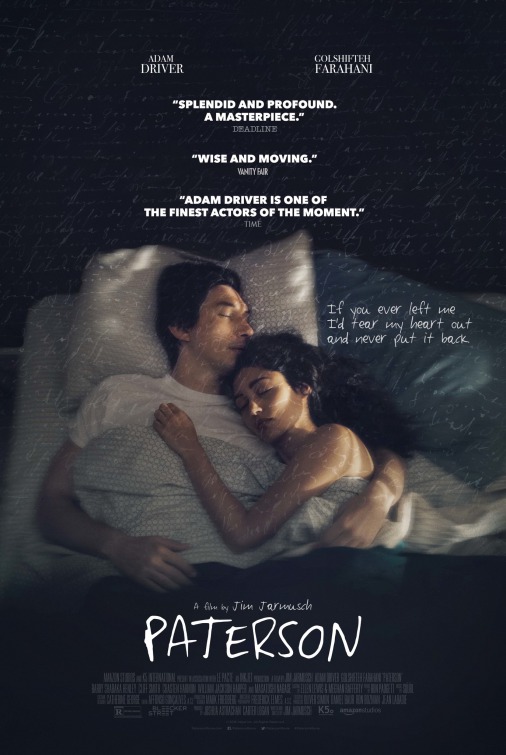
Paterson

(USA 2016)

Not a lot happens in Jim Jarmusch’s new film Paterson—it is, to borrow from Seinfeld, a show about nothing. Starting on a random Monday, the story follows Paterson (Adam Driver)—a Paterson, New Jersey, city bus driver and closet (or in this case, basement) poet—through his daily routine for a whole week. He finds inspiration in the simplest things: passengers, barflies, Ohio Blue Tip matches. He works it all into his “secret notebook” of poetry, scribbled in sidebars onscreen. Some of it is interesting, some not so much.

Jarmusch throws a lot out there: never mind the recurring parallels between Paterson and those he encounters—there’s imagery of twins, waterfalls, circles, and fireballs. Attempting to infer a weighty point in all of it, though, is probably an exercise in futility; this is fluid stream of consciousness. The story is more a string of vignettes: Paterson’s wife, Laura (Golshifteh Farahani), orders a guitar online and later serves Brussels sprout and cheddar pie for dinner; the bus Paterson drives breaks down; a situation arises in the bar where Paterson has a beer every night when he walks his wife’s dog, Marvin (Nellie, who, sadly, passed away before Paterson came out: http://www.indiewire.com/2016/05/the-2016-palm-dog-posthumously-awarded-to-nellie-the-dog-from-jim-jarmuschs-paterson-289094/).

The characters Paterson encounters are plentiful and colorful: defeatist coworker Donny (Rizwan Manji); a rapper (Method Man) in a laundromat; a young poet (Sterling Jerins) waiting for her mother in the bus yard; Marie (Chasten Harmon) and her sensitive beau, Everett (William Jackson Harper), whom she’s trying to dump; a nameless gangbanger (Luis Da Silva, Jr.) who warns Paterson about dog-jacking (not that it stops him from tying Marvin to a spigot outside the bar every night); anarchists, old ladies, and braggarts on the bus.

Perhaps the most accomplished thing about Paterson is its rhythm: the plot moves slowly but in a purposely metered fashion. Cinematographer Frederick Elmes creates a dreamy and downright poetic look. The relationship between Paterson and the world has its own set of rules. This film reminds me of Dead Man, which I haven’t seen in two decades: quietly contemplating routine and rut, Paterson ultimately celebrates the poetry in the mundane. The unnamed traveler and angel (Masatoshi Nagase) at the end literally gives us the “a-ha” moment. With nearly no outside sound, not even music, I thought of one thing: if James Joyce’s Ulysses were made into a movie, it would feel a lot like this. Unlike Leopold Bloom, though, Paterson’s wife isn’t cheating on him, and no one except Marvin seems to mind his presence.

Side note: for some reason, the screening I caught included Spanish subtitles, unintentionally adding another layer of what-the-fuck. Paterson is not a movie for everyone, but I definitely see a following here. I liked it.

Also starring Barry Shabaka Henley, Trevor Parham, Troy T. Parham, Kara Hayward, Jared Gilman, Johnnie Mae.

Produced by K5 International, Le Pacte, Animal Kingdom, and Inkjet Productions

Distributed by Bleeker Street Media and Amazon Studios

118 minutes
Rated R

(Landmark Century) B-

http://www.bleeckerstreetmedia.com/paterson

Hidden Figures

(USA 2016)

Houston, do you read me: NASA employed black people in its infancy during the early Sixties. What’s more, NASA’s first major project, Mercury, probably wouldn’t have gotten off the ground without three black female “computers,” or mathematicians, whose efforts literally put John Glenn and Friendship 7 into orbit. The result was a serious boost in American morale during the race against the Soviets into space and a boon to the Space Program under President Kennedy. So, with its historically significant and truly enlightening subject matter, what most caught me off guard about Hidden Figures is its tone, which is light, upbeat, cute, and often comical. While not in itself a bad thing, it’s not what I expected.

Unfortunately, that’s about all Hidden Figures offers that I didn’t expect. I’m not saying I didn’t enjoy this film; I did. It’s a great story about remarkable people who actually lived. According to one subject, their real stories are not far off from this film (http://www.latimes.com/science/sciencenow/la-sci-sn-hidden-figures-katherine-johnson-20170109-story.html). Taraji P. Henson plays Katherine Johnson, a recently widowed math whiz who works for NASA in Virginia, as a bookish nerd complete with glasses that keep sliding down her nose. She and her coworkers, smart and sassy Dorothy Vaughan (Octavia Spencer) and fiery and coquettish Mary Jackson (Janelle Monáe), quietly but forcefully demonstate their worth in an environment that doesn’t treat them as equals. While Katherine lugs binders and a calculator back and forth between her desk and the “colored” rest room clear across campus to figure out arcs and other shit I sure can’t, Dorothy teaches herself how to operate the new IBM that not even IBM technicians can set up correctly and Mary pushes her way into engineering classes at night in an all white, all male school. Director Theodore Melfi does a really nice job demonstrating institutionalized racism and sexism through characters who may not have anything against black people or women—as administrator Vivian Michael (Kristen Dunst) curtly tells Dorothy in one scene and unwilling research partner, Paul Stafford (Jim Parsons), makes clear to Katherine in another scene by redacting her name from a joint report they both wrote—but don’t recognize the issue.

Despite its merits, I found Hidden Figures to be slightly more sophisticated than a Lifetime movie. Melfi, who with Allison Schroeder adapted the screenplay from Margot Lee Shetterly’s book of the same name, takes a pretty basic approach to the material. It’s so easy—obvious, even—to gage where the story is headed. John Glenn (Glen Powell) sings Katherine’s praises while a love interest develops for her in handsome Col. Jim (Mahershala Ali). So cute. Hidden Figures gets into civil rights issues, but only on a superficial level. There are a few overdone Oscar grabs, like a scene between Katherine and her boss, Al Harrison (Kevin Costner), that ends with him smashing the sign outside the “colored” ladies’ rest room, but no true show stoppers. Frankly, though, most of the actors here have appeared in better movies. Too bad, because this could’ve been a great film instead of just an okay one. Hidden Figures doesn’t quite do its trailblazing subjects justice.

127 minutes
Rated PG

(AMC River East) C+

http://www.foxmovies.com/movies/hidden-figures

Lion

(Australia/UK 2016)

Like any kid, five-year-old Saroo (Sunny Pawar) is enamored of his older brother, Guddu (Abhishek Bharate). Saroo shadows Guddu everywhere, helping him do things like steal coal from trains to trade for milk for their penurious mother (Priyanka Bose) and little sister (Khushi Solanki) in their tiny village in India. After begging his brother to take him to “work” with him in a nearby city one night, both boys quickly learn that Saroo is too young to hack the late shift. Guddu leaves Saroo on a bench at a train station, promising to be right back. Saroo dozes off, waking up on an empty platform in the middle of the night. Scared and maybe cold, he gets on a vacant train and drifts back to sleep in one of the compartments. He’s jolted up while the train is speeding through terrain he’s never seen before.

The train takes Saroo to Kolkata (formerly Calcutta), where he must fend for himself. He doesn’t know the city, the language, or even his mother’s name. Kolkata is dangerous for a kid: Saroo is nearly abducted at the train station. He meets Noor (Tannishtha Chatterjee), a seemingly nice lady who takes him in. Saroo senses that her creepy friend Rawa (Nawazuddin Siddiqui) has nefarious plans for him, so he bails. A man (Riddhi Sen) eating in a café takes Saroo to the police, who turn him over to an orphanage. They try to find Saroo’s mother, but he’s unable to provide any useful information. Mrs. Sood (Deepti Naval) teaches him English and manners. An Australian couple, John (David Wenham) and Sue Brierley (Nicole Kidman), adopt him.

To use a line from the Beastie Boys, you think this story’s over but it’s ready to begin. Cut to 2008: Saroo (Dev Patel) is grown up, Westernized, and starting school for hospitality management. During introductions, he tells his classmates that he’s from Calcutta but that’s about all he knows. While attending a friend’s party, he goes to the kitchen to get a beer and sees a plate of jalebi, an orange deep-fried Indian pastry. It triggers his memory, and he becomes obsessed with finding his “real” family.

Adapted from Saroo Brierley’s memoir A Long Way Home, Lion plays out as two movies: one about young Saroo, and the other about adult Saroo. On an emotional level, Lion is a beautiful and powerful accomplishment—I defy anyone not to feel something from this film, which deals with identity, family, and home. Even so, it’s flawed. First-time feature director Garth Davis is really heavy-handed with the tears, so much that Lion comes off as trying too hard—manipulative, even. Davis connects the two stories, but he treats them vastly differently. The pace of young Saroo’s story is far superior: it flows naturally, unlike adult Saroo’s, which is choppy and abrupt. Young Saroo’s story is insightful and lyrical, while adult Saroo’s is too often inelegant. I found the unevenness distracting. Plus, the apparitions of Guddu and Saroo’s mother in Australia got silly after awhile. It shouldn’t be difficult to tell from the first three paragraphs of this entry which story I found more engaging.

Even with its flaws, Lion is still a good movie—well worth the two hours it eats of your life. The acting all around is superb, though Lucy (Rooney Mara) is a bit superfluous. Patel is great, but Pawar is the star here; it’s hard to believe this is his first film. Sia’s “Never Give Up,” which plays over the closing credits, will get stuck in your head for days.

118 minutes
Rated PG-13

(AMC River East) B-

http://lionmovie.com

Fences

(USA 2016)

The quintessential American dream home is usually depicted with a white picket fence surrounding it, the fence symbolizing a certain idyllic middle class coziness. That’s not what trash collector Troy Maxson (Denzel Washington, who doubles as director) sees when he imagines the fence he’s building in his backyard in 1950s Pittsburgh; his fence is more practical and nefarious, intended to keep his family in and his demons out.

August Wilson’s Fences starts out on a bright note: like Johnny Kemp, Troy just got paid and it’s Friday night. He’s walking home from work with his bestie, Bono (Stephen McKinley Henderson), for a drink in the backyard. Troy is jovial, recounting a confrontation with a superior (Christopher Mele) about his job assignment and singing the praises of his wife, Rose (Viola Davis). She takes a break from making dinner and steps outside, and he’s playful. All appears to be well.

The mood doesn’t stay bright for long: Troy gets mean when he drinks. The presence of his sons—Lyons (Russell Hornsby), a late-thirties jazz musician, and Cory (Jovan Adepo), a high school student—seems to worsen his mood. This is the Troy who occupies the rest of the story; he grows increasingly officious toward Cory after Rose tells him a college recruiter is wooing Cory with a football scholarship.

Troy is bitter, petty, and conflicted. He’s protective yet jealous of Cory; he loves Rose with all his heart, yet he betrays her in the worst way. Clearly a victim of circumstance, he exhibits the effects of a cycle of defeat: drinking, adultery, and resentment. Although Fences is not the same story, Troy has a lot in common with Willy Loman, the protagonist of Arthur Miller’s Death of a Salesman. Despite their societal differences, both characters failed to achieve the American dream and carry a weighty rancor because of it—the worst of it coming from within. Where Loman faces obsolescence, Troy faces never having reached a position in which he was valued in the first place. His big moment was playing baseball in the Negro league for a few years when he was young; he never had an opportunity to move onto the majors because, he says, the nation just wasn’t ready for it (don’t even bring up Jackie Robinson).

Fences is very much about the drama inside the characters rather than around them. Washington, who with Davis performed the play on Broadway in 2010, takes a straightforward approach. Aside from some period sets and costumes, he foregoes frills in favor of character and dialogue. As a result, Fences is like watching a play; the slow pace and relative lack of action will not appeal to everyone, but the intensity of the performances—every one of them rock solid and (ugh, I really hate this word, but it’s accurate) electrifying—is all I need.

Race is inextricable from Troy’s story, but Fences digs deeper than that. An awful lot is going on here—themes of family, duty, respect, and forgiveness resonate with me (and probably most people). Wilson once commented in an interview with The Paris Review that  “[b]y looking at Troy’s life, white people find out that the content of this black garbage man’s life is affected by the same things—love, honor, beauty, betrayal, duty. Recognizing that these things are as much part of his life as theirs can affect how they think about and deal with black people in their lives.” (https://www.theparisreview.org/interviews/839/august-wilson-the-art-of-theater-no-14-august-wilson). Whether the timing was planned or incidental, Fences is timely: despite the many advances that people of color have made since Troy’s world—including but certainly not limited to the first black president—things in the States today seem to be regressing. It’s disheartening to watch.

I never read any of his work, but I’ve known about Wilson for a long time not just from college literature and drama classes that mentioned him but also from productions of a few of his plays at the Goodman over the last decade. I’m embarrassed to say that Washington’s film adaptation of Fences is my first and only experience with the playwright. I loved it. Fences is one of ten plays in Wilson’s Pittsburgh Cycle, depicting the black experience in America during each decade of the 20th Century (http://www.august-wilson-theatre.com/plays.php). Washington signed on to the rather ambitious project of producing nine of them (http://www.npr.org/2016/12/25/506617435/denzel-washington-and-viola-davis-on-adapting-fences-and-honoring-august-wilson). I guess I’ll have a chance to see more.

139 minutes
Rated PG-13

(AMC River East) A-

http://www.fencesmovie.com

The Devil Wears Prada

(USA 2006)

Some movies you watch just because they start and you’re too damned lazy to see what else is on. Such is the case with The Devil Wears Prada, which served as the end of my Christmas night movie binge.

Andy Sachs (Anne Hathaway) just finished school and moved to New York City to become a journalist. While seeking employment with more weighty publications like The New Yorker, she snags a one-off interview for Runway magazine. Surprise: she gets the job—working as personal assistant to ball busting editor-in-chief, Miranda Priestly (Meryl Streep). Andy’s job duties and a chance meeting with handsome magazine writer Simon Baker (Christian Thompson) cause friction in her personal relationships, especially her chef boyfriend, Nate (Adrian Grenier). Is a job worth this much hassle?

Director David Frankel does a competent job with Aline Brosh McKenna’s screen adaptation of Lauren Weisberger’s novel even if the end result is nothing special. The acting is fine, particularly Stanley Tucci as caddy and nelly designer Nigel. It’s nice to hear Madonna’s “Vogue” in one scene outside Andy’s car. The problem I have is the script, which is formulaic and predictable girl movie stuff: awkward girl in the big city reinvents herself and not just survives but excels in the face of adversity. Of course, there’s a happy ending. The Devil Wears Prada is not my cup of tea: it’s cute, but that’s about it.

109 minutes
Rated PG-13

(Bravo) D+

http://www.foxmovies.com/movies/the-devil-wears-prada