I caught The Tell-Tale Heart as an extra at Music Box Theatre’s screening for Reel Film Day. Directed by Ted Parmelee and narrated by English actor James Mason, it’s a nifty modern take on Edgar Allan Poe’s famous 1843 short story about a murderer haunted by his victim’s heartbeat, which he hears from underneath the floorboards where he hid the body. Paul Julian’s design and Pat Matthews’s animation is shadowy and surreal, nicely depicting the horror and the madness of Poe’s classic. Boris Kremenliev’s score adds an eerie Twilight Zone feel.
“You gotta see me spend money to really appreciate me.”
—Nikki Finn
“¿Quién es esa niña?” asks the buoyant but trite title song, which topped the Billboard Hot 100 charts for a week during the summer of 1987. We all know the answer: it’s Madonna, of course. Perhaps a better question is, what happened with this movie?
Madonna is Nikki Finn, a playful gumcracking ex-con who just got out of jail serving time for a crime she didn’t commit. She’s rough around the edges but dead serious about her mission: she’s determined to find out who framed her for the murder of her boyfriend, Johnny.
Enter uptight humorless yuppie tax attorney Loudon Trott (Griffin Dunne), who works for Manhattan mogul Simon Worthington (John McMartin) and is about to marry his daughter, Wendy (Haviland Morris). Louden is charged with the task of picking up Nikki from the pen and making sure she gets on a bus to Philadelphia. Surprise: it’s not that easy with someone like darling Nikki, which becomes abundantly clear to Louden over the next 24 hours. Talk about causing a commotion.
Originally titled Slammer, Who’s That Girl is an homage of sorts to the screwball comedies of the 1930s and 1940s. It’s a total “summer movie.” Written by Andrew Smith and Ken Finkleman, and directed by James Foley, it shows glimpses of some okay ideas. It’s supposed to be fun, and to a degree it is. Madonna and Dunne concoct a believable chemistry, I’ll give them that. Dunne is a great straight guy, on par with his performance in After Hours. The problem is, Who’s That Girl just isn’t very funny. The jokes are lame, the laughs are far and few between, and the plot is predictable. The whole thing loses steam about halfway through. Murray the cougar (Murray) is a pointless gimmick that, sadly, doesn’t add anything.
The animated opening sequence is cool (and parts of it ended up in the music video for “Who’s That Girl”). The soundtrack is better than the film. Overall, though, Who’s That Girl is a pretty uninspired work. I love Madonna and I ran to the theater when this came out. I was underwhelmed then; after waiting almost 30 years to see it again, I’m underwhelmed now. Fun fact, though: Stanley Tucci and Mike Starr both have minor roles as dockworkers.
With Coati Mundi, Dennis Burkley, James Dietz, Bibi Besch, John Mills, Robert Swan, Drew Pillsbury, Liz Sheridan
“All the best people have bad chests and bone diseases. It’s all frightfully romantic!”
—Juliet Hulme
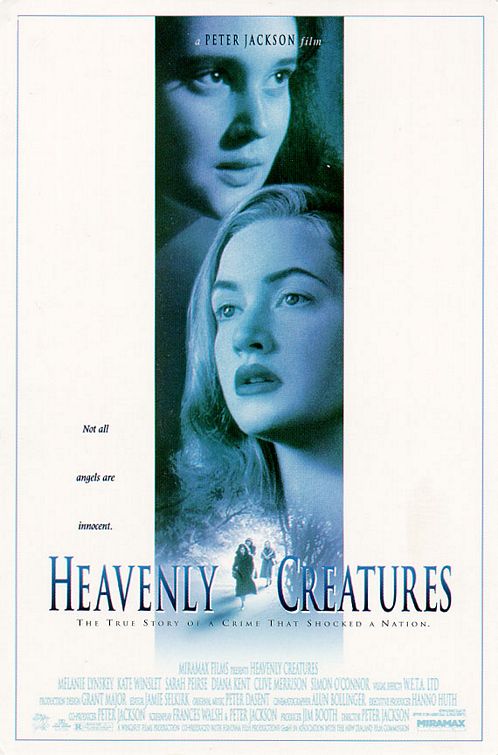
Forget Lord of the Rings—Heavenly Creatures is Peter Jackson’s coolest film. Before big budget Hollywood blockbuster fantasy franchises, the New Zealand filmmaker wrote, produced, and directed offbeat small-scale gore and porn comedies like Bad Taste (1987), Meet the Feebles (1989), and Dead Alive (1993). I’d already seen that last one by the time Heavenly Creatures came out for a limited run (in the States, anyway) in the fall of 1994. I assumed it would be another messy splatterfest—described to me as a “lesbian murder flick,” what would you think? Turns out, that’s not quite what it is.
Far more than a “lesbian murder flick” or even a brilliant stepping stone to bigger and better things, Heavenly Creatures represents a turning point in Jackson’s career. It’s a rare example of flawless execution across the board. He brings together every element—narrative, character development, casting, visuals, special effects, dialogue, period costumes and sets—to create a real humdinger.
Christchurch, New Zealand, 1952: 14-year-old Yvonne Reiper (Melanie Lynskey), who goes by “Pauline,” is a messy-haired, brooding loner at an all-girl high school. In her first scene, she’s wearing a big scowl on her face at an assembly, not singing along with the rest of her classmates—not until the school’s headmaster (Darien Takle) catches her gaze and snaps her into line with a widening of her eyes. Pauline’s father (Simon O’Connor) manages a grocery market and her mother (Sarah Pierse) runs a room and board for college students out of their home.
WARNING: Potential spoilers ahead!
A new student is introduced during French class: Juliet Hulme (Kate Winslet), the privileged daughter of a reknown college professor (Clive Merrison) and a psychologist (Diana Kent). Juliet, who proclaims she’s “actually from England” and chooses the French name “Antoinette,” captures Pauline’s attention when she insults the teacher, Miss Waller (Elizabeth Moody), unleashing a hilarious hissy fit. The scene is, in a word, awesome to watch play out. Right after that, their art teacher, Mrs. Collins (Liz Mullane), pairs the girls for an assignment that Julia disregards; instead, she draws dragon-slaying St. George, depicting him in the likeness of Mario Lanza, “the world’s greatest tenor!” She doesn’t get around to drawing Pauline, her model. Mrs. Collins isn’t impressed, but Pauline is.
Thus begins the girls’ friendship. They bond over their similar pasts involving childhood disease and extended hospital stays, a penchant for drama, and a mutual distaste for their peers (and perhaps social issues that leave a void). Juliet is mischievous and romantic, which softens Pauline and gets her to open up. Sitting out gym, they giggle over sexy WWII pulp novels. They bike through the woods and strip to their underwear, dancing and singing. They hug a bum (played by Jackson himself) on the street. They hold weird rituals for celebrities they like. They make Plasticine models, write stories, and devise an elaborate royal family tree, building around themselves a fantasy medievalesque kingdom called Borovnia where all its inhabitants worship them. Their imaginary world blurs the bounds of reality as their friendship intensifies.
A string of troubles arises that threatens to separate Pauline and Juliet: tuberculosis, an extramarital affair, a divorce, South Africa, and a medical diagnosis of incurable homosexuality. The girls decide to run away to America, but they can’t secure a passport for Pauline. They devise another scheme to stay together, but it’s a risky one: kill Pauline’s mother.
Heavenly Creatures starts out sweet—it’s something of a typical teen movie at first—but it does a complete turnaround. Based on actual events, Jackson wrote the screenplay with Frances Walsh; the real story is sad but compelling, and the script is tight. The casting—married couple John and Ros Hubbard and the aforementioned Mullane—is genius: every single actor is terrific in his or her part, even the minor ones, and it makes Heavenly Creatures all the richer. Many of them turn up in Jackson’s later projects.
Lynskey and Winslet own their characters; I can’t imagine anyone else in their roles. They’re charming, silly, histrionic, desperate, deranged, and ultimately “stark raving mad”—and they portray all of it exceptionally well. They manage to keep the homosexual subtext from getting out of hand. You can tell from Winslet’s first scene—she walks in with that crazy look on her face—that she’s destined for more. She became a star after Heavenly Creatures in a way that Lynskey didn’t, but both are mesmerizing.
The scenes in Borovnia and the Fourth World are nothing short of spectacular. Actually, many of the visuals here are burned into my memory. Alun Bollinger’s camerawork and bleached palette lends a lovely dreamlike quality. Once things start to unravel for these “nice” girls, the whole thing shifts to a darker, more sinister tone. It’s an emotional downward spiral to the end—those splatter films serve Jackson well.
Heavenly Creatures hasn’t lost its luster after nearly 25 years. I lost track of how many times I’ve seen it, yet it continues to suck me in every single time. It’s one of my favorites.
With Gilbert Goldie, Jed Brophy, Peter Elliott, Kirsti Ferry, Ben Skjellerup, Jean Guérin, Stephen Reilly, Jessica Bradley, Alex Shirtcliffe-Scott
Production: WingNut Films, New Zealand Film Commission
When I was a kid, Cedar Point would start hyping its newest ride, usually but not always a roller coaster, just as winter gave over to spring. In June, we’d finally get to the park and wait in line for two hours to experience it. Some years, the ride didn’t live up to its promise; I felt I had been duped. I recently felt that same disappointment again leaving the theater after a sold out screening of Roberto Sneider’s edgy new romantic comedy You’re Killing Me Susana.
Self-absorbed lout Eligio (Gael García Bernal) is a minor soap opera actor who believes in monogamy—for his wife, Susana (Verónica Echegui), not him. He stays out drinking, cheats on her, and sometimes drags his thespian friends over to their apartment to party into the wee hours—after Susana’s gone to bed. The look on her face and the way she pushes him off of her when he stumbles into bed and nuzzles her to cuddle is sublimely bitchy—and funny.
Eligio is the only one who’s confused when Susana leaves him. He schleps from Mexico City to Iowa to track her down, enduring American customs agents and evading campus police. He finds her enrolled in a writing program for foreign students at an unnamed university (University of Iowa, perhaps?). She’s also running around with a silent, brooding, and well-endowed Polish poet (Bjorn Hlynur Haraldsson). Without a plan or a place to stay, Eligio moves into Susana’s dorm—ostensibly to work out their issues.
Adapted by Sneider and Luis Cámara from José Agustín’s novel, You’re Killing Me Susana depicts a dysfunctional relationship that both participants take a lax approach to maintaining. I don’t mind dislikable characters, but I had some difficulty connecting with these ones. They seem to recognize a problem, but it doesn’t come off as dire. Some of what happens between them is confusing, and as a result the message gets lost. Somewhere in here, I suspect, are statements about machismo, maturity, fidelity, how men and women view sex, and what they want out of life.
The previews suggested something riotously fun and sexy, and I really like Bernal. You’re Killing Me Susana exudes that distinct cuteness with a dark undertone you see a lot in Mexican films. Overall, though, this is just okay. It has some funny moments—most of them in the trailer—but the execution is shallow, simplistic, and forgettable. Too bad, because this could have been a really powerful and interesting film.
With Ashley Grace, Andrés Almeida, Jadyn Wong, Adam Hurtig, Barbara Garrick, Ilse Salas
Toni Erdmann is not a real person; he’s the alterego of retired divorced schoolteacher Winfried Conradi (Peter Simonischek). When Winfried, a weird old hippy jokester, appears onscreen in a shaggy wig and bad fake teeth, he certainly gives the impression that those around him have to excuse his relatively harmless but tiresome—and often annoying—penchant for silliness. He is caretaker of his elderly mother, and death surrounds him. Perhaps that explains it.
Winfried’s daughter, Ines (Sandra Hüller), a young corporate sellout working on a project in Romania, drops by for a birthday. She’s on her phone most of the time, distracted by work. She’s so serious—and severe. Predictably, she doesn’t stick around long.
When his dog dies, Winfried flies to Bucharest and stalks Ines in the lobby of the office building where she works. She sees him and takes him to a reception, where she networks with Henneberg (Michael Wittenborn), an oil company executive she wants to make a deal with. The weekend is bizarre, filled with small talk, blank stares, and uncomfortable silence. Ines doesn’t bother to pretend she’s happy to see her father; in fact, it’s pretty clear she’s relieved to see him leave.
This is where Toni Erdmann gets interesting: Winfried doesn’t actually leave. Instead, he becomes “Toni Erdmann, life coach,” and sets out to reach Ines through her professional contacts. Funny thing: it actually works.
Writer/director Maren Ade has a solid grasp of strained relationships and embarrassing situations, and a sick sense of humor to boot. It’s a winning combination in Toni Erdmann, which has its share of quite a few awesomely cringeworthy moments. Your goofy dad upstaging you at a networking opportunity? Check. Naked birthday party—with coworkers? Check. An Easter party that includes an apoplectic performance of Whitney Houston’s “Greatest Love of All”? Check. A cum-soaked petit fours? Um, check.
For all its distance, Toni Erdmann turns out to be a surprisingly emotional film. It takes nearly three hours to get to it, but it ends on a whallop. It’s touching in a way I didn’t see coming. The final scene offers all anyone needs to see about this dysfunctional father/daughter relationship. And it’s beautiful.
With Ingrid Bisu, Lucy Russell, Thomas Loibl, Trystan Pütter, Hadewych Minis, Vlad Ivanov, Victoria Cocias
Production: Komplizen Film, coop99 filmproduktion, KNM, Missing Link Films, SWR/WDR/Arte
Distribution: NFP Marketing & Distribution (Germany), Soda Pictures (United Kingdom), Enfilade (Austria), Sony Pictures Classics (USA)
“My life isn’t over. Deep down, I was prepared. I’m lucky to be fulfilled intellectually.”
—Nathalie
A line from Talking Heads’ song “Once in a Lifetime” is apt to describe the root of the dramatic tension in Mia Hansen-Løve’s latest film: “Well, how did I get here?” Things to Come is a character study of Nathalie Chazeaux (Isabelle Huppert), a philosophy professor at an unnamed Paris university, as she navigates and reinvents her place in the world after her bourgeois examined life suddenly transforms into something else and leaves her floundering in the process.
Nathalie’s passion for her work is clear beyond her career: her husband of 25 years, Heinz (André Marcon), is also a philosophy professor; the textbook she wrote is something of a standard; and her apartment is crammed with books. Even her everyday conversation is peppered with references to philosophers, some I know and other I have never heard of. Her two adult children can follow her when she goes on about, oh, say, Plato, as she sets the table. She seems like someone who has always relied on intellect and reason.
The protesters blocking access to campus early in the film hint to something amiss; Nathalie participated in her share of protests back in the day, but this is different. Selfish, perhaps? One day, Heinz announces that he’s leaving her for another woman. “I thought you would love me forever,” Nathalie responds in a way that reads more like examining a problem than expressing surprise or hurt. Soon, her needy mother (Edith Scob) takes a turn for the worst, leaving Nathalie to figure out what to do with the cat. Meanwhile, her publisher informs her that her textbook’s future is uncertain. Then there’s the matter of her reunion with a former student, Fabien (Roman Kolinka), a cute and promising writer living in an anarchists’ commune.
Things to Come is very much about change, both in circumstances and relationships. Hansen-Løve takes a decidedly distant approach, letting us watch things unfold from afar. She’s not detached; she just seems more interested in showing the small events that shape Nathalie’s journey and letting us figure out the big picture. It works really well. Choosing “Unchained Melody” for the background in the final scene is especially clever; it’s clear about where Nathalie is on an emotional level, yet it’s open to interpretation about whether the future holds good things for her. It’s a happy, hopeful ending if you want it to be.
With Sarah Le Picard, Solal Forte, Guy-Patrick Sainderichin, Rachel Arditi, Yves Heck
Production: Arte France Cinéma, CG Cinéma, Detail Film, Rhône-Alpes Cinéma
Captain Fantastic came out last summer, and I wanted to see it then. I must confess, the cast interested me more than the plot.
Viggo Mortensen is the aptly named Ben Cash, a long disenfranchised survivalist who is, like, so over American capitalism and politics. He and his wife, Leslie (Trin Miller), shown almost entirely in flashback, decide to raise their six kids—three boys and three girls—off the grid in the mountain wilderness of Washington State. Removed from society, Ben and Leslie teach their kids everything from logic and philosophy to hunting and gathering to Norman Mailer and Guns ‘n’ Roses. They do it all without iPhones or religion. Kudos to that!
Nothing is perfect: Leslie suddenly dies, forcing Ben to take his feral kids into the outside 21st Century world for the first time, ever—which calls everything they planned for their family into question.
Director and screenwriter Matt Ross poses some interesting questions about society, conformity, and the social contract in a provocative and often lighthearted way. However, Captain Fantastic is not terribly surprising, which is why it doesn’t work as well as it could. At heart, it’s a standard fish out of water dramedy. Frankly, I spotted every “twist” coming before it got to me: the cop (Rex Young) who pulls over their Partridge Family van, the mildly blasphemous excuse that saves the day, the family’s visit to the supermarket, their reaction to their extended family (and vice versa), that lame scene in which Ben’s sister-in-law (Kathryn Hahn) calls him out onto the carpet for his choices and his youngest daughter (Shree Crooks) recites the Constitution to prove her wrong, eldest son Bo (George MacKay) proposing to the first girl who gives him attention—a trailer park teen queen (Erin Moriarty)—and the colleges he manages to get into, the “situation” that requires modern medical attention. Meh.
For all its grandiose intentions to take on the establishment, Captain Fantastic actually relies on a rather orthodox and pedestrian approach to make its point. Maybe that is its point, that you can’t escape society. It doesn’t mater: this story is predictable and sentimental, two things that never bode well. I expected more than Spokane Swiss Family Brady Bunch, which is essentially what this is. The one thing that saves this film from total mediocrity is the acting, which is great all around.
With Frank Langella, Ann Dowd, Samantha Isler, Annalise Basso, Nicholas Hamilton, Charlie Shotwell, Steve Zahn, Elijah Stevenson, Teddy Van Ee
Production: Electric City Entertainment, ShivHans Pictures
As teen comedies go, the ’90s were a teenage wasteland. Sure, there were a few classics: Dazed and Confused, Clueless, Election, and American Pie immediately come to mind. That’s really about it. Can’t Hardly Wait, the second film of Chicago International Film Festival’s Totally ’90s series, is a typical specimen from the decade: it has some moments, but overall it’s either bland or reductive. Frankly, I don’t even remember it in theaters, which probably says all I need to know.
The setting is a huge kegger in a Los Angeles suburb the night of graduation. Leading man Preston Meyers (Ethan Embry), a sensitive dork, has longed for class babe Amanda Beckett (Jennifer Love Hewitt) ever since he first laid eyes on her during freshman year: he knew they were destined to be together when he noticed the same strawberry Pop Tarts in her bag that he had in his. She went for Mike Dexter (Peter Facinelli), a jock, instead; they dated all through high school. Word on the street is, Mike dumped Amanda. Intrigued, Preston persuades his snarky and derisive bestie Denise Fleming (Lauren Ambrose), certainly no woo-woo girl, to accompany him.
Meanwhile, class geek William Lichter (Charles R. Korsmo), who looks like a deranged Harry Potter, shows up to exact revenge against Mike, his lifelong nemesis. Mike, who dumped Amanda so he could be free to sleep around all summer, isn’t having fun—he’s preoccupied reconsidering his decision. While Preston chases after Amanda to give her a letter in which he spills his guts, Denise gets locked into a secluded bathroom with wannabe gangsta/raver Kenny Fisher (Seth Green), who wears big sneakers and goggles and thinks he’s a stud but isn’t.
Co-directors and screenwriters Harry Elfont and Deborah Kaplan clearly watched a ton of ’70s and ’80s teen flicks. They have good ideas, but I’ve seen them done before and done better. The only storyline that really interested me was the one with Denise and Kenny in the bathroom. And I love Seth Green. Other than that, the situations and the dialogue here lack any snap or punch. It’s all pretty flat.
This is not to say I hated Can’t Hardly Wait; I didn’t. I just didn’t love it. It was merely okay. I consider myself a teen movie aficionado, and this did not move me. The soundtrack is way better.
With Michelle Brookhurst, Alexander Martin, Erik Palladino, Channon Roe, Sean Patrick Thomas, Freddy Rodríguez, Joel Michaely, Jay Paulson, Jason Segel (in his first appearance onscreen), Selma Blair, Jerry O’Connell
Production: Columbia Pictures Corporation, A Tall Trees Production
It’s definitely worth a second look. When I saw it the first time, a noisy couple behind us distracted me from the first and third acts. It was nice to go back and see what I missed the first time tuning them out. I absolutely love “Hello Stranger.”
Production: A24, Plan B Entertainment, Pastel Productions
Director Paul Verhoeven’s Elle doesn’t sound like a comedy: the central event of the film is a rape—a bloody, violent one at that. In fact, it’s the very first scene. Strangely, the opening credits warn us that what we are seeing is “a French comedy.” Really? I guess that explains it!
Michèle Leblanc (Isabelle Huppert) is raped in her dining room by a man in a ski mask while her green-eyed cat watches, detached and seemingly bored. China is smashed, furniture is toppled, blood is shed. After he leaves, Michèle cleans up the mess and resumes her life, ordering sushi delivery—a “holiday roll,” no less.
As the film proceeds, we learn a lot about Michèle. She’s the daughter of a famous mass murderer approaching parole. She’s a ballbusting owner of a video game company. Her staff, entirely young and male, either wants to sleep with her or murder her. Her son, Vincent (Jonas Bloquet), is totally whipped by a shrew (Alice Isaaz) who’s pregnant with a baby that clearly isn’t his. Her ex-husband (Charles Berling) is involved with a younger yoga instructor (Vimala Pons). Her mother (Judith Magre) is a high maintenance piece of work who carries on with men a third her age. Meanwhile, Michèle is having an affair with with Robert (Christian Berkel), the husband of her business partner (Anne Consigny).
Things get dicey when Michèle develops a thing for her neighbor, Patrick (Laurent Lafitte), a handsome banker married to a devout Catholic (Virginie Efira) who apparently won’t fuck him. Their flirtation messes with her head as she tries to figure out who raped her. She’s surrounded by men, and every one of them is suspect.
David Birke’s screen adaption of Philippe Djian’s novel Oh… is, in a word, warped. Elle plays with power, desire, sex, and of all things sympathy. Consistent with its character—a constant switcheroo you don’t know whether to trust or look away from—it’s not a sad affair. To the contrary, it’s daring, thrilling, irreverent, and totally fun. It shouldn’t work—I found myself questioning whether I should enjoy the film as much as I did—but it does. The execution of both the plot and the characters is clever—and Stéphane Fontaine’s cinematography, which nicely illustrates the psychological drama here, is flawless. If nothing else, Elle is a visually stunning film.
Iggy Pop’s “Lust for Life” plays at various points in Elle, suggesting a lot of contradictory things. I took it as ironic more than anything. Elle is not for everyone, but it’s a powerful statement for those who can handle it—the perfect film for Valentine’s Day.
With Lucas Prisor, Raphaël Lenglet, Arthur Mazet, Hugo Conzelmann
Production: SBS Productions, Pallas Film, France 2 Cinéma, Entre Chien et Loup, Canal+, France Télévisions, Orange Cinéma Séries, Casa Kafka Pictures, Proximus, Centre National de la Cinématographie, Filmförderungsanstalt











 moviebloke