Blade Runner: The Final Cut

(USA 1982, 2007)

Ridley Scott is hit or miss with me, Harrison Ford bores me, and I tend to eschew science fiction. So, neo-noir sci-fi drama Blade Runner doesn’t seem like something that would appeal to me. It does, though—in fact, I love it.

Like Alien, another gem by Scott, Blade Runner succeeds on so many levels. Executed near flawlessly, its themes and narrative, its structure and pace, its sets and technical aspects are all polished, eloquent, and downright cerebral. It cuts right to the heart of humanity—what’s beautiful about it and what isn’t, and what it is to be human.

Los Angeles, November 2019: six rogue artificial humans known as replicants that were banished to an “off-world” work camp in space return to Earth in a desperate attempt to extend their life. Created by tech behemoth Tyrell Corporation, this particular model, the Nexus-6, is the smartest and strongest replicant. However, it has a lifespan of only four years—and the meter is ticking. Fortunately for them, replicants are indistinguishable from real humans, except for their emotional responses. It takes a lengthy question-and-answer test to positively identify them.

Burned out former cop Rick Deckard (Ford), whose job as a blade runner was to track down replicants and “retire,” or kill them, is persuaded—okay, extorted—out of a self-imposed furlough to find and get rid of these troublemakers. Stat. The job isn’t an easy one, particularly where charmingly weird and conniving Pris (Daryl Hannah) and invincible badass Roy (Rutger Hauer) are involved.

As Deckard searches for his targets, he meets and gets to know the rather severely formal Rachael (Sean Young), assistant to replicant inventor Dr. Eldon Tyrell (Joe Turkel). Rachael doesn’t know she’s a replicant. Tyrell asks Deckard to retire her as well, but there’s a problem: Deckard realizes he’s falling for her.

Adapted from Philip K. Dick’s novel Do Androids Dream of Electric Sheep?—with the title taken from Alan E. Nourse’s novel The Blade Runner, which had nothing to do with Dick (https://www.neondystopia.com/cyberpunk-movies-anime/the-story-behind-blade-runners-title/)—Blade Runner is dark in every sense of the word. Jordan Cronenweth’s cinematography is stunningly bleak. The setting might be Los Angeles, but Scott slyly references Metropolis—only he refits it to Hong Kong or Tokyo. Many of the ideas explored here are eerily relevant today, especially the way morality plays out with corporations, genetic engineering, a police state, the environment, and hierarchy of life and life forms.

Blade Runner is a weighty movie, but seriousness aside—I found myself entertained with a number of things that simply aren’t present today: PanAm, Atari, and TDK. Smoking indoors. Pay phones. Photographs. Even urban decay. I was also floored that one of the replicants was “born” 20 days after this screening. Plus, Roy is a bionic Ken doll and Pris looks like a club kid from Party Monster. Still, Blade Runner is timeless; I’ll see it again in three or 33 years and still swoon over it. Yes, it’s that good. The Final Cut is Scott’s own finetuned version of the original theatrical release. It kills me that after all this time, a sequel that I probably won’t see is coming out later this year.

In 1993, the United States Library of Congress deemed Blade Runner “culturally, historically, or aesthetically significant” and selected it for preservation in the National Film Registry (https://www.loc.gov/programs/national-film-preservation-board/film-registry/complete-national-film-registry-listing/).

With Edward James Olmos, M. Emmet Walsh, William Sanderson, Brion James, Joanna Cassidy, Kevin Thompson, John Edward Allen, Robert Okazaki

Production: Ladd Company, The Shaw Brothers/Sir Run Run Shaw, Warner Brothers

Distribution: Warner Brothers

117 minutes
Rated R

(Music Box) A

https://www.warnerbros.com/blade-runner

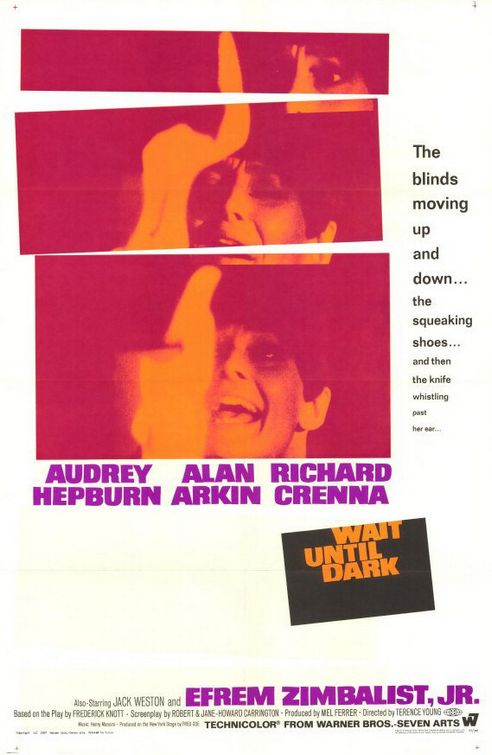
Wait Until Dark

(USA 1967)

A heroin smuggling ring. A creepy doll. A corpse. A blind woman alone in her basement apartment in the West Village. These are the elements of Wait Until Dark, a quaint and dingy little crime thriller adapted from Frederick Knott’s 1966 play by screenwriters Robert Carrington and Jane-Howard Carrington.

Suzy Hendrix (Audrey Hepburn) is the hapless gudgeon who, being blind, already has the proverbial wool over her eyes. Her husband, Sam (Efrem Zimbalist Jr.), comes home from a business trip with a doll that unbeknownst to him contains a hidden stash of heroin sewn into it. This does not bode well for Lisa (Samantha Jones), the glamorous and sexy stranger who asks him to hold it for her at JFK International Airport.

A case of mistaken identity leads a pair of small time crooks (Richard Crenna and Jack Weston) to Sam and Suzy’s apartment, where psychotic hooligan Harry Roat (Alan Arkin) coerces them into helping him find the doll—as soon as they dispose of a dead body. Nice. They devise an elaborately devious scam to recover the doll when they realize Suzy, who walks in on them, is blind.

Terence Young’s directing is certainly competent. I last saw this movie on some late night UHF station when I was a kid, and two things have stayed with me: a sense of severe claustrophobia as the story unfolds, and that fucking groovy apartment. The plot has flaws that strain credibility. For one thing, Suzy is far too unguarded for a New Yorker. Why doesn’t she lock her door? Roger Ebert pointed out this detail (http://www.rogerebert.com/reviews/wait-until-dark-1968). I didn’t obsess over it like he did, but I noticed it and thought the same thing. When Roat tells her he knows she has the doll, why doesn’t Suzy hand it over? Why does she tell Gloria (Julie Herrod) to meet Sam at the train station instead of going to the police? Why do the guys bother to put on disguises if Suzy can’t see them?

Despite these glaring issues, Young ultimately succeeds in bringing Wait Until Dark to a boil. It lives up to its hype: I saw people jump in their seats at the end. The acting here overcomes any shortcomings in plot. Hepburn is little more than a blind Holly Golightly, but at certain points she reminds me of Barbara Stanwyck screaming that she can’t wake up from a nightmare in, I think, The Night Walker. Weston is a little too bumbling, but Crenna and Arkin are chillingly menacing and foreboding even if they are silly by today’s standards (yeah, sunglasses at night went a long way making Corey Hart look tough). Henry Mancini’s eerie score is the clincher in setting the right mood.

A trivial point of interest: Suzy’s apartment is in the same block of rowhouses as the one used for the Huxtable residence on The Cosby Show (http://www.movie-locations.com/movies/w/Wait_Until_Dark.html#.WRU0W1LMyWY). The small street, St. Luke’s Place, has a bit of literary history, too (http://www.nytimes.com/1996/10/27/realestate/in-a-village-enclave-15-remarkable-rowhouses.html).

With Jean Del Val, Frank O’Brien

Production: Warner Brothers

Distribution: Warner Brothers/Seven Arts

108 minutes
Not rated

(Music Box) B-

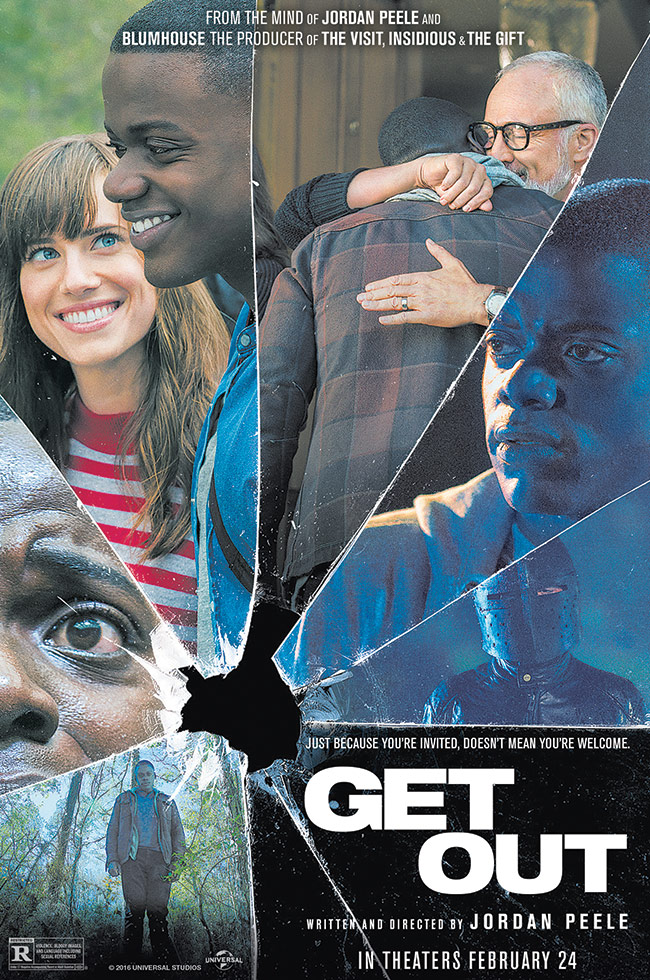
Get Out

(USA 2017)

I caught the hype surrounding Jordan Peele’s first feature length film, Get Out, a comedy horror flick that takes on race—specifically, the dynamics of white power and black subordination. He wrote the script and directed the film. I went into Get Out with some doubt and maybe trepidation about how it might come off. The concept is one that seems too easy to go horribly sideways.

I guess if anyone can pull it off, it’s Peele—and I’m relieved to report that he succeeds. With an oddly compelling mix of Guess Who’s Coming To Dinner, Meet the Parents, Nightmare on Elm Street, and The Stepford Wives, he takes on the cultural idiosyncrasies of Caucasian cultural dominance within the constructs of a horror flick. He’s got a lot of points to make, and he gets them across in a sharp but entertaining way. Like the best horror movies, Get Out makes you squirm—but it does so on multiple levels.

New York City photographer Chris (Daniel Kaluuya) is black. His girlfriend, Rose Arlington (Allison Williams), is white. She invites him on a weekend getaway to her parents’ home in upstate New York because, well, it’s time for him to meet the fam. Chris agrees, going into it nervously and not without personal baggage. His hyperactive best bud, Rod (Lil Rel Howery), a TSA agent who always expects the worst, is not helping.

Rose’s parents are, like the quiet town where they live, nice. Or at least welcoming. Dean (Bradley Whitford) drops silly slang, affects a bizarre accent, and praises President Obama. Missy (Catherine Keener) is more direct, asking pointed questions in a weird attempt to get to know Chris. It’s awkward and doesn’t quite break the ice, but it’s harmless. Right?

The family’s two longterm servants, maid Georgina (Betty Gabriel) and gardener Walter (Marcus Henderson), carry themselves like they’ve had lobotomies. Rose’s younger brother, Jeremy (Caleb Landry Jones), is, um, aggressively complimentary to Chris. On top of it, the Armitages’ neighbors are not quite right, obsessed with Chris and his virility.

During the first part of Get Out, Peele keeps things light but lets a sense of creepy unease simmer. The laughs are there, but like all of the characters coming and going from the house, something is off. He makes a major shift in tone once Missy insists on hypnotizing Chris, ostensibly to help him quit smoking. What was innocuous up to now becomes nefarious.

Ultimately, the evil here is not a monster hiding under the bed, but rather something more obvious that exists in broad daylight. I could have done without the bloody finale, but it works in the context of the film; Peele plays with genre, so I see why it’s here. Either way, Get Out is a bold move that pays off.

With Stephen Root, LaKeith Stanfield, Ashley LeConte Campbell, John Wilmot, Caren Larkey, Julie Ann Doan, Rutherford Cravens, Geraldine Singer, Yasuhiko Oyama, Richard Herd, Erika Alexander, Jeronimo Spinx, Ian Casselberry, Trey Burvant, Zailand Adams

Production: Blumhouse Productions, Monkeypaw Productions, QC Entertainment

Distribution: Universal Pictures

104 minutes
Rated R

(ArcLight) B

https://www.uphe.com/movies/get-out

https://youtu.be/A2JbO9lnVLE

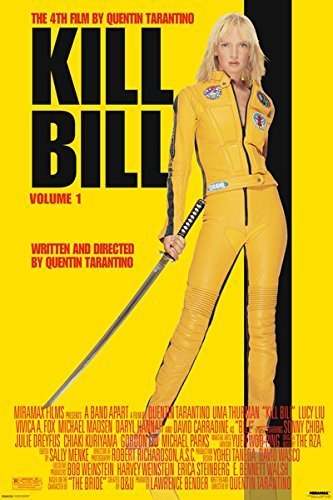
Kill Bill: Volume 1

(USA 2003)

“Revenge is never a straight line. It’s a forest. And like a forest, it’s easy to lose your way. To get lost. To forget where you came in.”

—Hattori Hanzō

“It’s mercy, compassion, and forgiveness I lack,” The Bride (Uma Thurman) plainly informs one of her assailants before she exacts revenge. “Not rationality.” Uh, really? Right off the bat, Quentin Tarantino’s Kill Bill, Volume 1 (not to be conflated with Kill Bill: Volume 2, which is longer but not quite as good) is an action film packed with snark and coolness. Uma Thurman is The Bride (codeman Black Mamba), who in the sepiatone opening scene is lying on the floor of a chapel in El Paso, Texas. She’s in a wedding dress, bleeding and pleading for her life. “It’s your baby,” she tells Bill (David Carradine, who has a bigger part in the second installment). He shoots her in the head.

Four years later, The Bride wakes up—midfuck, mind you—from a coma in the hospital. There’s no baby. She takes out a would-be rapist, Jasper (Jonathan Loughran), and an orderly named Buck (Michael Bowen), who pimped her out. Incidentally, Buck has a catchphrase that rhymes with his name—you figure it out. The Bride runs off with Buck’s truck, the “Pussy Wagon.” Once she gets her feet and legs moving, she sets out to settle a score—or six. First, though, she has to persuade retired master swordsmith Hattori Hanzō (Sonny Chiba), who runs a sushi bar in Okinawa, to make her a sword.

Kill Bill: Volume 1 is totally far fetched, but that’s not important. Like most Tarantino films, the emphasis here is on the characters and the action, not the plot; otherwise, two hours of not much more than a badass blonde babe methodically killing teammates who double-crossed her when she was a member of something called the Viper Assassination Squad wouldn’t work. Originally intended as one long film (http://killbill.wikia.com/wiki/Kill_Bill:_Vol._1), Kill Bill: Volume 1 depicts two of the paybacks: Vernita Green (Vivica A. Fox), who’s now a housewife and mother in suburban Los Angeles, and O’Ren Ishii (Lucy Liu), the head of the Tokyo Yakuza.

Beautifully staged and shot, the violence is over the top yet perfectly choreographed. The scene at the House of Blue Leaves is eloquent right down to the blood in the snow. Tarantino plays around with the sequence of events and mixes genres including anime. He employs his penchant for sharp dialogue, snazzy settings with memorable names, and sick humor. Plus, he throws in cool music and clothes; Daryl Hannah dressed as a nurse, for example, is fucking fabulous! As a result, Kill Bill: Volume 1 is a dazzling bloodfest. It takes a certain type to love a film like this—and it’s one of my favorites.

With Julie Dreyfus, Chiaki Kuriyama, Gordon Liu, Michael Parks, James Parks, Sakichi Sato, Ambrosia Kelley

Production: A Band Apart

Distribution: Miramax Films

111 minutes
Rated R

(Logan Theatre) A

https://www.miramax.com/movie/kill-bill-volume-1/

Quiz Show

(USA 1994)

“Cheating on a quiz show? That’s sort of like plagiarizing a comic strip.”

—Mark Van Doren


The quiz show scandal of the late 1950s doesn’t sound like a riveting topic for a film, but that’s exactly what it is in Quiz Show, Robert Redford’s fourth directing gig. Every aspect of this film is spectacularly elegant, starting with Bobby Darin crooning “Mack the Knife” as the opening credits roll over shots of armored security guards transferring sealed questions and answers from a bank vault to a studio. Quiz Show is a modern morality play with lots of style.

It’s 1958, and NBC’s Twenty-One is the biggest game show in America. Homely goofball Herbert Stempel (John Turturro) of Queens is a surprise celebrity after an unprecedented winning streak, but the show’s ratings have “plateaued.” The show’s sponsor, Geritol, is ready for a change. So are producers Dan Enright (David Paymer) and Albert Freedman (Hank Azaria), who decide that a charismatic, television-ready new contestant is what the show needs.

WASPy college professor Charles Van Doren (Ralph Fiennes) happens to audition for another NBC game show, the less popular Tic Tac Dough. Handsome, polished, and hailing from an eminent intellectual family, “Charlie” fits the bill for Enright and Freedman’s vision.

Enright takes Stempel out for a steak dinner and asks him to “take a dive,” or purposely lose to Van Doren, on an upcoming show. Predictably, this isn’t something Stempel wants to do—at least, not without something in return. Enright fails to deliver on purposely vague promises, and Stempel publicly calls Twenty-One a fraud, saying it’s rigged. A judge seals the findings of a grand jury investigation, which gets some very minor press: a blurb in the paper. It catches the attention of ladder climbing Richard “Dick” Goodwin (Rob Morrow), a lawyer with the House Legislative Oversight Subcommittee in Washington, D.C., who plans to “put TV on trial.”

Quiz Show didn’t set the box office on fire during its original run, which is really odd (http://www.boxofficemojo.com/yearly/chart/?yr=1994). No matter, because it’s a fine drama. Based on the book Remembering America: A Voice From the Sixties by the real Richard Goodwin, Paul Attanasio’s screenplay is meticulously calibrated and cerebral, rich with strong characters, intertwined dilemmas, a fascinating plot, and a plethora of Fifties pop cultural references without nostalgia. Redford’s pacing is excellent: he sets up the story slowly then knocks down each character one after another. He draws superb performances out of the actors, too. The literary repartee between Van Doren and his genteel father, Mark (Paul Scofield), is one of the best things about this film. A wry and subtle sense of humor keeps the story exuberant: Martin Scorsese is great as fast talking Geritol CEO Martin Rittenhome, and Christopher McDonald makes an awesome Jack Barry.

Sure, Quiz Show isn’t an “exact word” historical documentary; Redford and Attanasio took some license. However, the result is an excellent depiction of good versus evil, not just in the television industry but in corporate America altogether. There’s not a lull or a dull moment here. The only criticism I have is Morrow’s unconvincing Boston accent; that can go. Everything else, though, is brilliant. Enright’s son, Don, wrote a piece about Quiz Show for the L.A. Times (http://articles.latimes.com/1994-09-19/entertainment/ca-40429_1_quiz-show); it’s another view worth considering.

With Mira Sorvino, Johann Carlo, Elizabeth Wilson, Allan Rich, Griffin Dunne

Production: Hollywood Pictures

Distribution: Buena Vista Pictures

133 minutes
Rated PG-13

(DVD/iTunes purchase) A

TwentyOne Pic

Storytelling

(USA 2001)


“I just thought Marcus would be different. I mean, he’s got C.P.”

—Vi

I get why Todd Solondz doesn’t appeal to everyone: his outlook isn’t warm and fuzzy, his characters aren’t heroic or even admirable, and his blunt, unflattering and brutal honesty is easy to misinterpret as cruel or tasteless. To all that, I shrug; his films don’t put the viewer at ease, and that’s exactly what draws me to him. A master of the uncomfortable, he shines a light on subjects that are hard to discuss in mixed company if not off limits altogether. And he’s not moralistic about it—he leaves it to the viewer to arrive at his or her own conclusions. His moral ambiguity is perhaps the strongest characteristic of his work, and I suspect it more than anything makes people cringe because, well, it’s confusing. They don’t know what to think.

So be it. Barring one scene in Happiness that scarred me forever, Solondz’s fourth film, Storytelling, is probably his most uncomfortable—it opens with Vi (Selma Blair) riding Marcus (Leo Fitzpatrick, who played Telly in Kids), a classmate crippled from cerebral palsy. Comprised of two unconnected storylines, “Fiction” and “Non Fiction,” Solondz pulls out a broad range of societal taboos—American ones, anyway. I won’t go through them here like a grocery list, but they all involve sex and/or abuse of power.

Side note: Censorship is an unintended subject—a big red block obscures one scene in the U.S. release. It wasn’t planned that way, but rather came about by contract (http://www.indiewire.com/2002/01/interview-the-sad-comedy-solondz-discusses-storytelling-80562/ ) (https://www.brainyquote.com/quotes/quotes/t/toddsolond355306.html). My DVD doesn’t have the red block—the scene is graphic, but not pornographic. Concealing it wasn’t worth the effort or the P.R.

The first and shorter story, “Fiction,” is about the aforementioned Vi, a wannabe writer who probably doesn’t belong in the writing class she’s taking. The class is taught by Pulitzer Prize winning Gary Scott (Robert Wisdom), an imposing egomaniac author who’s also a black man. His critiques of his students’ work is harsh—except when it comes to Catherine (Aleksa Palladino), a bookish pseudointellectual who looks like she’s into S&M. Guess what happens when Vi finds herself in a bar with Scott, and an opportunity to go home with him presents itself? You’ll have to read the book—or in this case the writing assignment, as Vi does what any writer would: she writes about the experience.

The second—and longer—story, “Non Fiction,” is about unsuccessful schlub Toby Oxman (Paul Giamati), a floundering self-proclaimed documentary filmmaker, as he sets out to make an exposé on the everyday American teenager. The problem is, he can’t find a subject. Enter slackerish pothead Scooby Livingston (Steven Weber) and his dysfunctional family led by father Marty (John Goodman). A series of unplanned mishaps threatens to derail the whole project, until one morbid event turns the whole thing around. Belle and Sebastian proves a nice choice for the music.

Storytelling is not quite as intriguing as Welcome to the Dollhouse or Happiness, but it’s still quintessential Solondz. The lines here are quotable gold—particularly the exchanges between Scooby’s youngest brother, Mikey (Jonathan Osser), and the Livingstons’ housekeeper, Consuela (Lupe Ontiveros), which are nothing short of awesome. I love that Solondz calls out his critics—it’s the film equivalent of Madonna’s “Human Nature.” “Fiction” is definitely the more impactful of the two segments, but that’s because “Non Fiction” is just too long and meandering for its own good; it peters out around two-thirds of the way through. Storytelling doesn’t immediately come to mind when Solondz’s name comes up, but parts of it will definitely haunt you. Unlike his other films, I’m not sure what to make of this one.

A third scene, “Autobiography,” was shot but left out of the final product (https://en.wikipedia.org/wiki/Storytelling_(film) ) (http://www.imdb.com/title/tt0250081/trivia?ref_=tt_trv_trv ). It starred James Van Der Beek as a closeted high school football player and featured a gay sex scene with Steve Rosen. I don’t know about the sex scene, but I think a third story would have added impact.

With Maria Thayer, Steve Rosen, Julie Hagerty, Noah Fleiss, Conan O’Brien

Production: Good Machine, Killer Films, New Line Cinema

Distribution: Fine Line Features

87 minutes
Rated R

(DVD purchase) B

http://www.toddsolondz.com

Who’s Afraid of Virginia Woolf?

(USA 1966)

Elizabeth Taylor. Richard Burton. Edward Albee. Even George Segal, who was kind of a fixture on NBC during the ’80s and ’90s. Need I say more? Probably not, but I will.

Director Mike Nichols and screenwriter Ernest Lehman stick pretty close to Albee’s 1962 play with their film adaptation of Who’s Afraid of Virginia Woolf?, and it’s hard to watch. Really hard. To be fair, though, it’s supposed to be, and that’s what makes it so good.

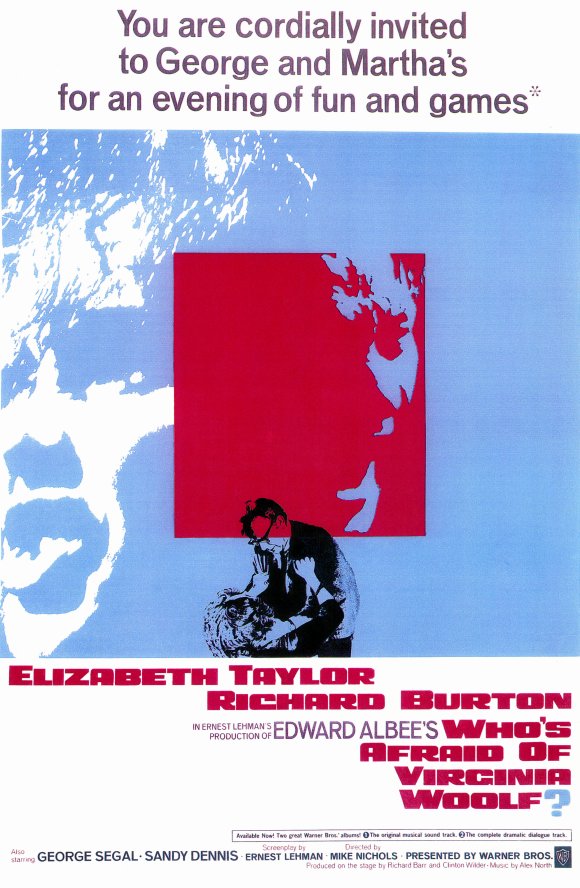
The promotional poster promises an evening of fun and games, but very little joy is to be found here, at least on the surface: all that marital baiting, sniping, and yelling is miserable. Fuck! It took me five or six false starts over a few years before I finally got into the film—and only with the help of a bottle of bourbon. Once I was in, though, I was hooked: watching this disastrous night unfold and all four characters unravel engrossed me desite the buzz I had going.

The oddly but appropriately named George (Burton), a history professor at a small East Coast university, and Martha (Taylor), the daughter of the school’s president, stumble home drunk from a faculty party, neither one listening to the other as they babble about nothing. Martha quotes Bette Davis, which ultimately reveals more about her viewpoint than any other comment she makes—and the woman can talk.

They babble and respond to each other half-heartedly. Martha tells George that she invited a young couple, a professor from another department and his wife, over for a drink. George is miffed, but there’s no time to react.

Enter Nick (Segal) and Honey (Sandy Dennis), a polite, young, good-looking couple that, as we learn, has their own set of problems. Martha and George pour drinks and pick at each other while Nick and Honey watch, uncomfortable at first, thinking maybe they shouldn’t be there. As the drinking continues, though, they’re pulled into the…drama? Turns out, they have more in common with each other than they think.

Here’s the thing about George and Martha: their marriage is dysfunctional, but they seem to operate well inside the confines of their explosive relationship—Martha brays and George stays, responding in a passive aggressive manner as he fixes them both another drink. Over and over and over again. Do they have any limits? It’s hard to say, partly because it’s never clear that we should take anything at face value: what we see is not necessarily what it is. That’s the genius of Who’s Afraid of Virginia Woolf. 

In 2013, the United States Library of Congress deemed Who’s Afraid of Virginia Woolf? “culturally, historically, or aesthetically significant” and selected it for preservation in the National Film Registry (https://www.loc.gov/programs/national-film-preservation-board/film-registry/complete-national-film-registry-listing/).

With Frank Flanagan, Agnes Flanagan

Production: Warner Brothers

Distribution: Warner Brothers

131 minutes
Not rated

(DVD purchase) A

T2 Trainspotting

(UK 2017)

“You’re a tourist in your own youth.”

—Sick Boy

“Face your past. Choose your future.” That’s what the poster for T2 Trainspotting says. Perhaps it should say, “Paybacks are a bitch,” something Mark Renton (Ewan McGregor) finds out pretty quickly when he returns home to Edinburgh after 20 years in Amsterdam following his little fuckover at the end of Trainspotting. Ostensibly back to make amends and settle his debt, Renton knows that forgiving and forgetting isn’t so easy—or smooth. Truth be told, he probably didn’t expect it to be.

Renton finds Spud (Ewen Bremner) unemployed, still struggling with heroin, and literally killing himself—like, alone with a plastic bag over his head in his dingy apartment. Sick Boy (Jonny Lee Miller) is a full-fledged douche, complete with a failing bar—the Port Sunshine—that he inherited from his aunt, a blackmail sex scam he runs on the side with a Bulgarian partner—Veronika (Anjela Nedyalkova), whom he fancies as his girlfriend—and a seriously unflattering coke habit. Oh yeah, he’s still bleaching what he’s got left of his hair. Neither is stoked about Renton showing up, but Sick Boy is clearly more bitter than Spud. He has a plan to get even.

Soon, however, Renton and Sick Boy are up to their old tricks, nightclubbing, tripping, and yes, thieving. In one of T2‘s best scenes, they head somewhere outside Edinburgh and hit a pub that looks more like an American VFW hall. It’s some weird open mic night for a crowd of Protestant Unionists who are rabidly anti-Catholic because of history. Explaining it all to Veronika in the car before the heist—the plan is to pickpocket as many ATM cards as they can get their hands on—Renton calls them “relics.” After a successful mission, the bouncer won’t let them leave until they perform a number. What they come up with is brilliant.

The fun and games come to a grinding halt when Begbie (Robert Carlyle), who’s serving a 25-year prison sentence and is denied parole because of his anger management problem, breaks out of jail and runs into Renton. He loses his shit in yet another great scene. Renton gets away for the moment but Begbie is on his trail, which leads him to a sketchy business partnership. Will history repeat itself?

I was skeptical when I heard director Danny Boyle was making a sequel; I guess I thought Trainspotting didn’t need a follow up. T2, which is loosely based on Irvine Welsh’s 2002 novel Porno, lacks the youthful vigor of the original and frankly isn’t as cool. How could it be? It wouldn’t exist without Trainspotting; it’s got flashbacks and obligatory references, some more clever than others, throughout. Kelly Macdonald has a fun cameo, Renton’s “Choose Life” monologue is updated, that toilet makes a brief appearance, and there’s a nice remix of Iggy Pop’s “Lust for Life” at the end (and yes, we know it’s coming).

Still, T2 stands on its own. It’s fueled by nostalgia and revenge, which in this case turns out to be a rather interesting combination. T2 has more of a conventional plot, and it’s oddly fascinating. The dialogue is every bit as wickedly sharp as before. These boys have grown up—they’ve turned into sad men because they’ve chosen unfulfilled promise and disappointment (to use Renton’s words). Now they have to deal with it, which isn’t what I imagined them doing in 20 years—if they even lived, which they most definitely have. Surprise! We all know someone like this, right? I would see T2 again.

At a post screening discussion, Boyle said he really made an effort to connect to the original. He succeeded, in a good way. As for the title, he said it’s an homage of sorts to Terminator director James Cameron, whom the characters would simultaneously want to honor and piss off.

With Shirley Henderson, Scot Greenan, Pauline Lynch, James Cosmo, Eileen Nicholas, Irvine Welsh

Production: Film4, Creative Scotland, Cloud Eight Films, DNA Films, Decibel Films

Distribution: TriStar Pictures

Screening followed by a live Q and A with Danny Boyle and Irvine Welsh moderated by Richard Roeper

117 minutes
Rated R

(AMC River East) B

Chicago International Film Festival

http://www.t2trainspottingmovie.com

https://www.facebook.com/T2TrainspottingMovie/?brand_redir=490630094455946

All About Eve

(USA 1950)

“Fasten your seatbelts, it’s going to be a bumpy night.”

—Margo Channing

That iconic line succinctly captures the essence of Joseph L. Mankiewicz’s All About Eve, a sharp commentary on the treacherous relationship between female ambition and the American obsession with youth that still rings—and stings—true nearly 70 years later.

Based on Mary Orr’s short story The Wisdom of Eve, Bette Davis is Broadway legend Margo Channing, who’s turning 40 and sees doors closing in her professional and personal life. One rainy night, Karen Richards (Celeste Holm), Margo’s bestie, happens upon a young starstruck fan waiting backstage to meet Margo after a performance of her latest play, the aptly titled Aged in Wood. The fan, of course, is wide-eyed Eve Harrington (Anne Baxter), a mousy but well-spoken girl in an oversized trenchcoat who says she followed Margo from San Francisco to New York City and has seen every performance of the play—from the back of the house.

Karen, whose husband is none other than playwright Lloyd Richards (Hugh Marlowe), Margo’s frequent collaborator and author of Aged in Wood, brings Eve into Margo’s dressing room to meet her. Lloyd is there, along with Margo’s fiancé, director Bill Simpson (Gary Merrill), and her crusty sharp-tongued maid, Birdie (Thelma Ritter). Eve wins over everyone in the room with her poignant backstory about a poor midwestern upbringing on a farm, a husband killed in the War, and a humble stiff upper lip. Everyone, that is, except Birdie—she smells a rat.

Margo takes Eve under her wing as her personal assistant. Eve quickly proves to be an ace at organizing Margo’s affairs—and sneaking herself squarely into the middle of them. She aligns with caustic theater critic Addison DeWitt (George Sanders), who like Birdie doesn’t buy what Eve puts out there but unlike Birdie sees a mutual opportunity. Things sour all around when Margo learns that her producer, Max Fabian (Gregory Ratoff), designates Eve as her understudy without consulting her first.

Often compared to Sunset Boulevard for a variety of reasons, All About Eve is not as dark or campy but is way bitchier. From a technical standpoint, the script is tighter, the production more sophisticated, and the story a lot wittier. All things considered, it’s way more fun and has held up quite well—sure, the voiceovers are overdramatic, but these are theater people so it fits. I found it particularly interesting to see this film again right around the beginning of the FX series Feud, which not only is half about Davis but elaborates on the same issues that All About Eve raises. It underscores much of what Davis said about the industry in interviews late in her life.

None of the men here have any reason to worry about their age; for all of them, their success has nothing to do with how old they are or even how they look (their thing is power, but that’s another discussion). The women, on the other hand, constantly struggle to secure and then maintain their positions—and they’re ruthless about it. Eve earns the acting award she gets at the end (which is really the beginning): she fools everyone to manipulate them into giving her what she wants. It’s clear that sooner than later, she’ll be right where Margo is, for better but more likely for worse.

In one of her earlier roles, Marilyn Monroe makes an amusingly memorable appearance as dippy starlet Miss Casswell, who’s trying to catch a break. She’s got the best line of all: “I don’t want to make trouble. All I want is a drink.” Amen!

In 1990, the United States Library of Congress deemed All About Eve “culturally, historically, or aesthetically significant” and selected it for preservation in the National Film Registry (https://www.loc.gov/programs/national-film-preservation-board/film-registry/complete-national-film-registry-listing/).

With Barbara Bates, Craig Hill, Helen Mowery, Steven Geray

Production: 20th Century Fox

Distribution: 20th Century Fox

138 minutes
Not rated

(AMC River East) A

Fathom Events

Lonesome [Solitude]

(USA 1928)

The promotional poster touts something “New! Different! Refreshing!” It sounds like soda, but it’s not: it’s Lonesome, a real charmer that still works as it nears its centennial.

Music Box Theatre screened a crisp restored 35mm print of Paul Fejos’s Lonesome for Reel Film Day, a countrywide event honoring films of the almost abandoned format (https://drafthouse.com/event/reel-film-day). The program was a double feature that included the Adam Sandler vehicle Punch Drunk. I didn’t stick around so I can’t comment on Punch Drunk, but Lonesome was an excellent choice.

Mary (Barbara Kent), a telephone operator for Ma Bell, and Jim (Glenn Tyron), a punch press operator in a factory, are two young working stiffs in the Big Apple. Both live alone in small rented room (not together—there’d be no movie then), and participate in an urban rat race that actually looks busier and grungier than what we have today.

Clearly, the film predates the standard five-day work week: the calendar in Mary’s room indicates that the day is Saturday, July 3. As Mary and Jim finish their respective jobs, which Fejos shows in a narrative that goes back and forth between the two, their work friends invite them to join in their weekend plans. Mary and Jim both see immediately that they’ll be the odd one out, as all of their friends are paired up. Both politely decline, going home dejectedly without any plans.

After they each see the same marching band advertising a cheap carriage ride to Coney Island, Mary and Jim end up going there solo on the same trip. They meet at the beach, and a modest flitration ensues. He tells her he’s a millionaire, and she tells him she’s a princess. They get along well, and commence an impromptu date, walking around, playing carnival games, and dancing. A fortune teller (Fred Esmelton) reveals that Mary has already met the man who will become her husband.

Mary and Jim get separated after a mishap on a rollercoaster. The problem is, they each have a tiny picture of the other from a photo booth and they only know each other’s first name. Finding each other in the throngs of people at the park that evening is like searching for a needle in a haystack. Have they lost each other before they even had a chance?

Edward T. Lowe, Jr. and Tom Reed adapt a cute story by Mann Page; it’s a simple yet clever plot. Despite its age, one point in Lonesome still rings loud and clear and true: connecting in the big city is harder than it looks. We all get wrapped up in the daily stuff of our lives, and we tend to overlook what’s right in front of us. Kent and Tyron are both adorable. Gilbert Warrenton’s kinetic camerawork captures a lot in the background, and it makes the shots at Coney Island especially fun to watch.

Lonesome features two or three abruptly placed “talking” scenes—the film was made when sound was a new thing—and the dialogue is laughably awful. There are also a few color tinted night shots: marquee lights, fireworks, stars. It’s really cheesy. That said, these are short, minor disruptions that don’t detract from enjoying this film for all its silent era charisma.

In 2010, the United States Library of Congress deemed Lonesome “culturally, historically, or aesthetically significant” and selected it for preservation in the National Film Registry (https://www.loc.gov/programs/national-film-preservation-board/film-registry/complete-national-film-registry-listing/).

With Fay Holderness, Gusztáv Pártos, Eddie Phillips, Andy Devine, Edgar Dearing

Production: Universal Pictures Corporation/Universal Pictures (USA)

Distribution: Universal Pictures Corporation/Universal Pictures (USA), European Motion Picture Company (UK), The Criterion Collection (DVD)

75 minutes
Not rated

(Music Box) A

Reel Film Day: A Celebration of 35mm Cinema

https://www.criterion.com/films/28212-lonesome

http://www.imdb.com/video/screenplay/vi389587993/