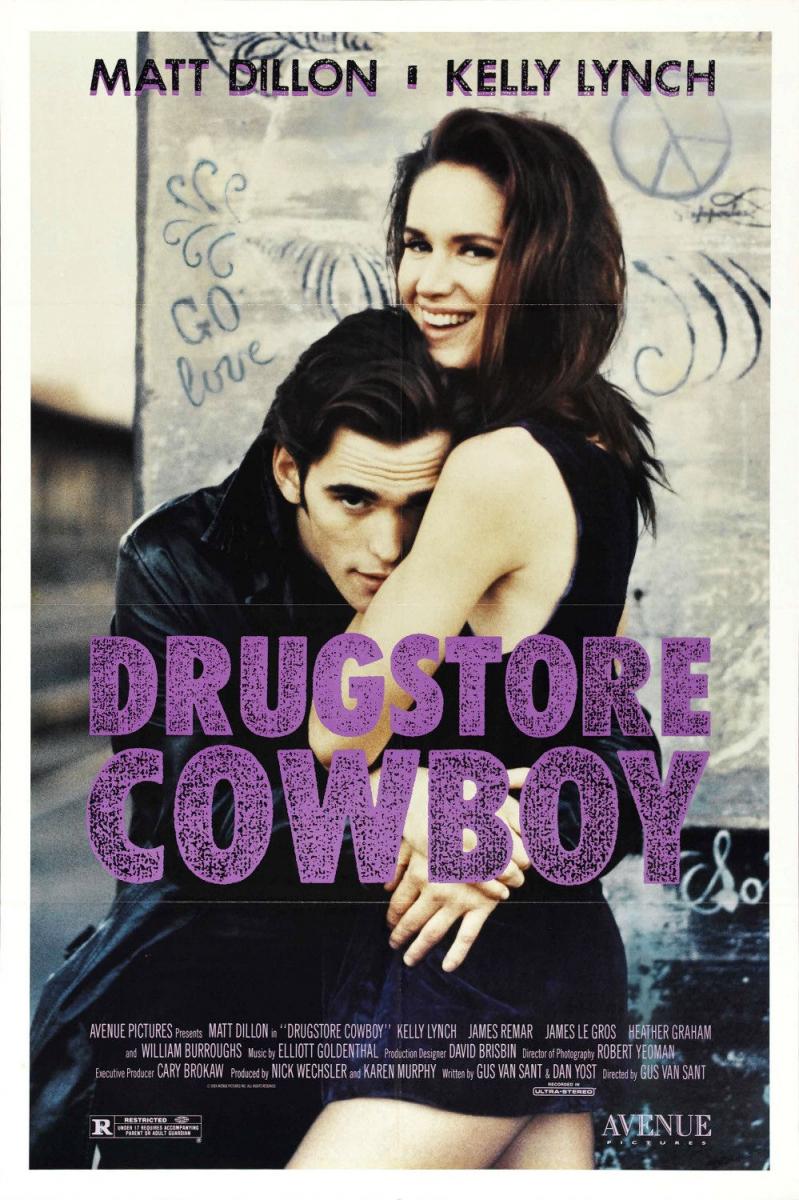
Drugstore Cowboy

(USA 1989)

“You won’t fuck me and I always have to drive.”

— Dianne Hughes

“If I ever see a hat on a bed in this house, man, like you’ll never see me again. I’m gone.”

“Show time!”

“Well, to begin with, nobody, and I mean nobody, can talk a junkie out of using. You can talk to ’em for years but sooner or later they’re gonna get ahold of something. Maybe it’s not dope. Maybe it’s booze, maybe it’s glue, maybe it’s gasoline. Maybe it’s a gunshot to the head. But something. Something to relieve the pressures of their everyday life, like having to tie their shoes.”

— Bob Hughes

“Narcotics have been systematically scapegoated and demonized. The idea that anyone can use drugs and escape a horrible fate is anathema to these idiots. I predict in the near future right-wingers will use drug hysteria as a pretext to set up an international police apparatus.”

— Fr. Murphy

I love everything about Drugstore Cowboy, the first film I ever saw by director Gus Van Sant. It’s the one that I view as his gold standard even after nearly 30 years. Funny, touching, and insightful in ways that have to be seen, it speaks to me. It probably always will. It’s a rare film that has it all: flawlessly executed from start to finish, it’s totally absorbing and entertaining yet still makes its points in a way that hits hard even after seeing it dozens of times.

Bad Bobby Hughes (Matt Dillon) — or just “Bob” — is the first one to tell you he’s a junkie. He and his wife, Dianne (Kelly Lynch), lead a small nomadic “crew” that consists of Rick (James LeGros) and his young girlfriend, Nadine (Heather Graham). The four of them spend their days getting high and devising elaborate — and amusing — schemes to rob drugs from pharmacies and hospitals. Then they go out and execute their mission.

Once they’ve made a score, they do the drugs they like, sell the ones they don’t, hang out doing little more than watching TV, and move onto another neighborhood somewhere else in Portland, Oregon, when they’ve either run out or overstayed their welcome, whichever comes first.

They’ve repeated the cycle so many times that cocky Detective Gentry (James Remar) and his men are on their trail. Bob manages to stay a step ahead, but it’s getting tougher. He sees that his luck is running out — and it’s not just because of the hex that Nadine inadvertently put on them by mentioning a dog (one thing about Bob: he’s a bit superstitious).

To outrun one such hex — and more realistically, because Bob runs out of ideas and doesn’t know what to do next — they hit the road, stuffing their drug stash in suitcases, shipping them on Greyhound buses, and following them by car. A string of bad luck and bad outcomes presents Bob with an epiphany — and a choice.

With both humor and compassion, Van Sant — and for his part, Dillon — tells a moving and curiously relatable story about people who aren’t necessarily bad, but they’ve allowed their lives to drift away from them. Here, it’s for drugs. They don’t always do the right thing, and often the members of this little family of outcasts are each other’s worst enemies. But they’re realistic. Dillon makes Bob so likable that I find myself rooting for him even when he’s making bad choices; despite his flaws, I like him enough that I can see myself having fun with him.

Drugstore Cowboy easily could’ve been a very different movie. It works because it’s not preachy or judgmental or hyperbolic. Based on a novel by real-life criminal and addict James Fogle (https://en.m.wikipedia.org/wiki/James_Fogle), Van Sant and Daniel Yost’s screenplay eschews melodrama for a decidedly objective and almost clinical approach, showing the joys of drugs in some visually well constructed sequences as well as the cost of addiction. The film does an excellent job showing how much work it is to maintain a habit. Throughout the movie, Dillon’s narration keeps the story grounded. Van Sant never sells out his characters’ humanity.

It doesn’t hurt that this film is loaded with spectacular performances all around, including those of Grace Zabriskie as Bob’s battleworn mother and William S. Burroughs as disgraced priest and fellow addict Fr. Tom Murphy. Robert Yeoman’s cinematography gives Drugstore Cowboy a drab, threadbare look that works well with Elliot Goldenthal’s moody score. Every element comes together to make this a truly remarkable film, definitely one of my favorites.

With Max Perlich, George Catalano, Janet Baumhover, Stephen Rutledge, Beah Richards, Robert Lee Pitchlynn, Ray Monge, Woody

Production: Avenue Pictures

Distribution: Avenue Pictures Productions (USA), Astral Films (Canada), Forum Distribution (France), Sandrew Film & Teater (Sweden), GAGA Communications (Japan)

102 minutes
Rated R

(MoviePlex) A+

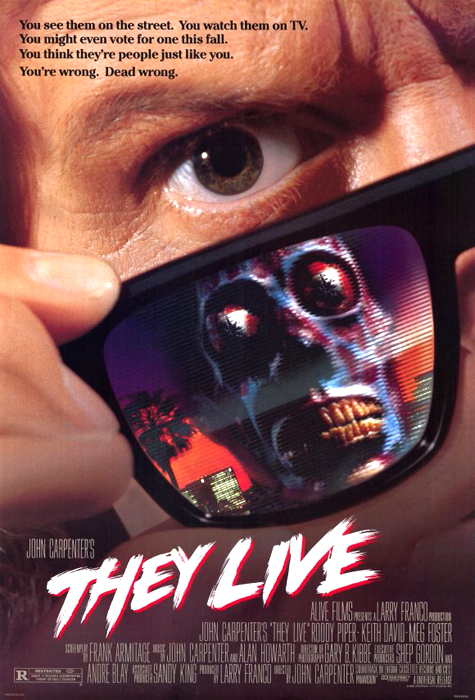
They Live

(USA 1988)

“I’ve come here to chew bubblegum and kick ass…and I’m all out of bubblegum.”

“I’m giving you the choice: either put on these glasses or eat that trashcan.”

“Brother, life’s a bitch. And she’s back in heat.”

— Nada

Director John Carpenter has done a few good pictures that probably will have an audience long after he’s gone; They Live isn’t one of them. At least, not in a good way. B-movie cult fodder all the way, They Live is a somewhat delayed and really heavy-handed reaction to ’80s conspicuous consumption. Based on Ray Nelson’s 1963 short story “Eight O’Clock in the Morning” and subsequent comic strip, Carpenter’s screenplay, written under the pseudonym Frank Armitage, is founded on a decent premise; it just doesn’t go where it could have.

Nada (Roddy Piper), a migrant construction worker who’s seen better days, picks up a job in downtown Los Angeles. He notices some weirdness going on with a television station that seems to be connected to a church across the lot where he and other homeless people have set up camp. His coworker Frank (Keith David) doesn’t want to hear about it. No one does.

One morning, Nada comes into possession of a pair of sunglasses. When he puts them on, he sees subliminal messages everywhere. A billboard with the tagline “We’re creating the transparent computing environment” says “Obey” with the glasses on. A travel ad beckoning, “Come to the Caribbean” says “Marry and reproduce.” “Men’s apparel” says “No independent thought.” Signs all around him order one to consume, conform, buy, watch TV, submit, sleep, do not question authority:

They Live Obey.jpg

Even the dollar bill has a different message: “This is your god.”

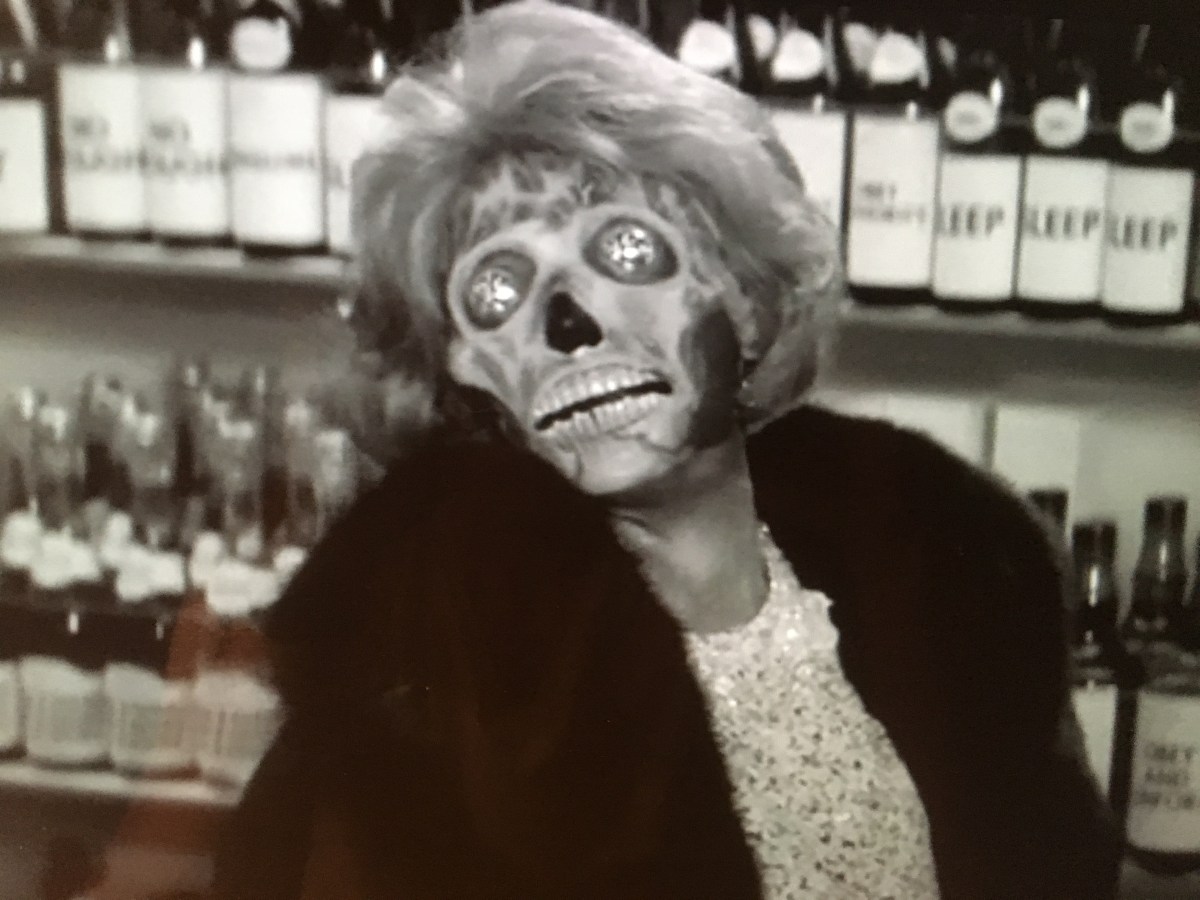
What’s worse, some people are not what they appear to be. At all. They aren’t even human — they’re skeletal reptiles, a kind of mutant species of Sleestaks or something:

They Live.JPG

What the hell is going on? Who are these things? What do they want? As Nada tells Frank, they ain’t from Cleveland.

I remember seeing They Live at the theater when it was new. It was okay. Three decades later, it’s still okay. It’s a lot sillier this time around, though. The whole thing gets off to a good enough start, but the momentum peters out just before midpoint. Carpenter — or anyone, for that matter — can get only so much mileage out of this story. They Live feels like 40 minutes of material stretched into more than twice that amount of time.

The denouement is not just predictable but anticlimactic, and the perspective here is adolescent at best. The lines are cringeworthy, falling painfully short of the Arnold Schwarzenegger zingers they aim to be. The acting is pretty bad, especially David and Meg Foster, both of whom are as stiff and lifeless as a dead gerbil. Surprisingly, Piper and his mullet are the best thing about They Live; Piper isn’t enough to carry it, though. And that wrestling scene in the alley is inane — misplaced, unnecessary, and too long, it adds nothing except maybe ten minutes to the running time.

The worst thing about They Live is that it seems Carpenter was serious — nothing here reads as tongue in cheek to me.

With George “Buck” Flower, Peter Jason, Raymond St. Jacques, Jason Robards III, Lucille Meredith, Norman Alden, Norm Wilson, Thelma Lee, Rezza Shan

Production: Alive Films, Larry Franco Productions

Distribution: Universal Pictures

94 minutes
Rated R

(iTunes rental) D+

http://www.theofficialjohncarpenter.com/they-live/

Good Time

(USA 2017)

Good Time is not a film to see for the plot. Written by Josh Safdie and Ronald Bronstein, the storyline is not all that novel, complicated, or interesting — in itself. I can sum it up in a single sentence: Queens bad boy Connie Nikas (Robert Pattinson) spends a night fleeing cops while trying to get his mentally handicapped younger brother, Nick (Benny Safdie), out of the mess he put him in after a bank robbery they commit goes sideways. It sounds like a comedy, but it most definitely is not.

Good Time is a movie to see for the mood it creates — and man, is it intense! More or less a character study, this could have been a disaster in someone else’s hands. As it is, the whole thing soars thanks to the directing by brothers Benny and Josh Safdie and the acting, which is all around great. Pattinson is particularly terrific — forget Twilight. I’ve heard comparisons to Al Pacino’s best work in the ’70s, and I’ve got to agree; Pattinson conveys a natural nervous energy just under the surface so well that you feel it watching him. I found myself more and more jittery and paranoid with every move and bad decision Connie makes and every character he encounters. I noticed hints of Dog Day Afternoon, Cruising, The Godfather, and even The Graduate in Pattinson’s performance.

Taking place almost entirely at night, the settings are familiar but eerie: a hospital, the crammed TV-lit apartment of a Jamaican immigrant (Gladys Mathon) and her weed smoking teenage granddaughter (Taliah Webster), an empty amusement park. Add a skittish techno score by Oneohtrix Point Never, a pallet of neon-colored light, and a nonstop chase, and you’ve got Good Time. Roller coaster ride or drug trip, take your pick — either way, this is a film that drags you along for the ride and zaps you, in a really satisfying way. I don’t know if Good Time is Oscar material, but it’s definitely memorable.

I almost missed Good Time, which opened for what appeared to be a very short limited run in Chicago. I made my own bad decision to see it Friday night after dinner with lots of cocktails. The film became a big blur that my drunk brain couldn’t handle. I went back for a Sunday matinee by myself. I left impressed, and actually pissed that I wasn’t present the first time I caught it.

With Jennifer Jason Leigh, Barkhad Abdi, Necro, Buddy Duress, Peter Verby, Saida Mansoor, Eric Paykert

Production: Elara Pictures, Rhea Films

Distribution: A24

99 minutes
Rated R

(AMC River East) B+

http://goodtime.movie

Kill, Baby…Kill! [Operation Fear] [Operazione paura]

(Italy 1966)

“Something in this town is supernatural. Tell me, why did they abandon the church? I’m scared. I almost think the devil’s here.”

— Monica

The second offering of a Mario Bava weekend double feature, Kill, Baby…Kill! is one of the director’s more commercially successful films. Many commentators have pointed out its influence on the horror genre and praised Bava’s gothic sensibilities, visuals, and use of irony. All good, I agree. Still, none of these things means Kill, Baby…Kill! is a great — or even a good — film.

In the early 20th Century, a coroner, Dr. Paul Eswai (Giacomo Rossi-Stuart), is en route to a remote village in Transylvania to perform an autopsy on a woman who died under mysterious circumstances. In a church — an abandoned one, no less, no doubt to provide a metaphor. The carriage driver, warning that this place is messed up, will only go to the edge of the village, not inside it.

Dr. Eswai finds the police inspector (Piero Lulli) at a local inn, where he is given instructions. When none of the superstitious and rather wan locals volunteer to help him with the autopsy, Monica Shuftan (Erika Blanc), a nurse of some sort who grew up there and just happens to be visiting the graves of her parents, steps up to assist.

During the autopsy, Dr. Eswai is puzzled to find a silver coin stuck in the woman’s heart. It’s a practice to thwart a local ghost that visits villagers in their sleep and puts a hex on them, making them commit suicide in ghastly ways — like jumping from heights and impaling themselves on iron posts.

Dr. Eswai runs into a creepy young thing in a white dress. He soon learns she’s the ghost of seven-year-old Melissa Graps (Valerio Valeri), who died 20 years before. She’s the little bugger who’s been freaking out everyone in the village for the last two decades. The doctor and Monica sense a spark, but first they must deal with this Melissa situation.

Romano Migliorini, Roberto Natale, and Bava all contributed to the screenplay. The story is unoriginal and silly, complete with cringeworthy dialogue and an actual sorceress (Fabienne Dalì). There’s an odd dub thing going on, too.

This being a Bava picture, though, Kill, Baby…Kill! works on primal instinct, here fear. Plus, it has its share of arresting visuals. The colors are vivid, though the palette is heavy on brown and green. The sets have a grimy, dilapidated medieval appearance to them, giving the look of a ghost story. There’s a cool scene where Dr. Eswai chases after Monica through a series of doors that keep taking him back to the same rooms — it’s delightfully dizzying.

Overall, Kill, Baby…Kill! is okay. It’s got Bava’s unique fingerprint all over it, and it’s fun to watch. It’s just not spectacular. Blood and Black Lace grabbed me; this did not, at least not for long. I hate the title — they should’ve kept Operation Fear.

With Luciano Catenacci (Max Lawrence), Micaela Esdra, Franca Dominici, Giuseppe Addobbati, Mirella Pamphili, Giana Vivaldi

Production: F.U.L. Films

Distribution: Internazionale Nembo, Distribuzione Importazione, Esportazione Film, Alpha (Germany), Europix Consolidated Corp. (USA), Astral Films (Canada), Metro-Goldwyn-Mayer

85 minutes
Rated PG

(Gene Siskel Film Center) C

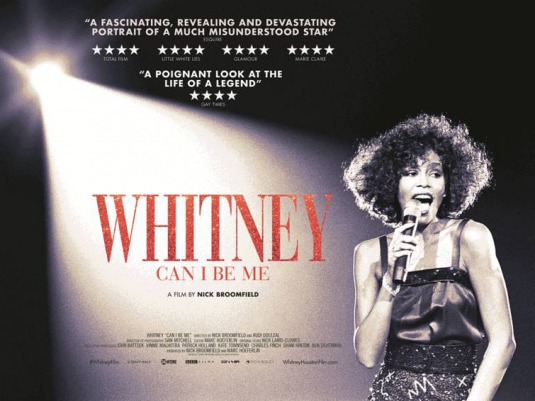
Whitney: Can I Be Me?

(UK / USA 2017)

Whitney Houston certainly needs no introduction, and I don’t need to remind anyone about her drug-fueled decline or her sad death five years ago. I saw her perform once when she toured for her first album, but I was never a fan. Still, I observed her career from the sidelines and know all her hits (and misses). To borrow from one of her songs, she almost had it all. Almost.

Co-director Nick Broomfield said that with Whitney: Can I Be Me?, he wanted to show another side of the story: “There was very little attempt to really understand where this was coming from or what it was about. I would like a lot of people to feel that there was a whole other way of looking at this.” (http://www.rollingstone.com/movies/features/whitney-houston-documentary-director-speaks-out-she-was-so-judged-w497676 ). It’s a good idea: fair and balanced, OK.

For better or for worse, Broomfield, who shares a directing credit with Rudi Dolezal for his footage from Houston’s 1999 My Love Is Your Love World Tour, takes a decidedly conventional and low key approach here. He eschews TMZ-like sensationalism, which is refreshing, even admirable. However, the finished product rings incomplete.

Broomfield shows Houston’s dirty laundry. We learn that she used drugs from adolescence. She wasn’t particularly polished. Her mother pushed her, hard. Her label, Arista, had a grand plan for her, and it specifically excluded drawing a black audience. Her BFF Robyn Crawford, who stayed involved with Houston’s career until the aforementioned 1999 tour, was (and still is) a lesbian, which led to rumors. Houston and Bobby Brown were in love, but it didn’t stop him from cheating on her — apparently, he preyed on Houston’s entourage. Crawford and Brown didn’t get along, which created tension. There was also that thing with Houston’s father that happened at the end of his life.

We gets hints and glimpses of what led to Houston’s downfall, but in the end the whole thing is shallow. Like her image throughout her career, Whitney: Can I Be Me? presents a sanitized or at least downplayed picture. Broomfield could’ve dug deeper. He was getting there with Houston’s former bodyguard, David Roberts, who claims that he was repeatedly ignored when he warned everyone around her that Houston was on a fatal trajectory. This documentary falls short; it’s flat and has nothing, shall we say, so emotional. It doesn’t reveal all that much. As a result, it isn’t all that moving.

Another biographical documentary about Houston is in the works (https://www.theguardian.com/film/2016/apr/28/kevin-macdonald-official-whitney-houston-documentary ) ( http://www.whitneyhouston.com/news/director-kevin-macdonald-whitney-houston-documentary/ ). So, there’s more to come. Let’s hope Kevin MacDonald’s version is more compelling.

With David Roberts, Cissy Houston, John Russell Houston Jr., Bobbi Kristina Brown, Bobby Brown, Robyn Crawford

Production: Lafayette Films, Passion Pictures, Showtime Networks

Distribution: Showtime (USA), British Broadcasting Corporation (BBC) (UK), Arsenal Filmverleih (Germany), Eagle Pictures (Italy), Periscoop Film (Netherlands)

105 minutes
Not rated

(Gene Siskel Film Center) C

http://www.sho.com/titles/3433528/whitney-can-i-be-me

Valley Girl

(USA 1983)

“Girls, we must fuck him.”

— Loryn


“Man, he’s like tripendicular, ya know?”

— Julie Richman


“Kings and queens, they don’t grow on trees.”

— Prom Teacher


“Well, fuck you, for sure, like totally!”

— Randy

“Bitchin’! Is this in 3D?” asks Tommy (Michael Bowen), whom no other Val dude can touch. It’s a fair question for a ticket taker wearing 3D glasses, I guess. “No,” responds Randy (Nicolas Cage) nonchalantly as he rips his ticket. “But your face is.” Burn!

I don’t know why Deborah Foreman isn’t on the poster, but I can’t help love Valley Girl. Directed by Martha Coolidge and written by Andrew Lane and Wayne Crawford, it’s a classic that always makes me smile. It’s not because it’s Nicolas Cage’s debut as Nicolas Cage (before Valley Girl, he was Nicolas Coppola). It’s not because it comes straight from the early ‘80s, or because it’s got a totally narly-ass soundtrack, or because of its awesome lines, or because it resonates, like, totally. It’s all of that. And more.

Well, like, it’s sushi, don’t you know? No one will mistake Valley Girl for anything but a product of its time. However, anyone can identify with the dilemma of Julie Richman (Foreman), who’s into Randy (Cage) because he’s not like all the other guys at school, but her friends don’t approve because, well, he’s not like all the other guys at school. He’s from the city — Hollywood, to be exact — and he’s new wave. Oh, the horror!

Randy sweeps Julie off her feet, taking her on a wild ride and introducing her to things you don’t get in the Valley. Her friends, shallow as they are, pressure her to drop Randy for Val dude Tommy (Bowen), who fits their idea of the right guy for Julie — never mind that they already dated and she broke it off because he made her feel “like an old chair or something.” Julie’s heart tells her not to do it. When her friends all but blacklist her, she capitulates. Spoiler alert: she’s not happy.

Randy’s heart is broken, but he won’t give up. He goes undercover, showing up literally everywhere Julie goes — drive-through diners, movie theaters, even camping out on her front lawn. Thanks to Randy’s bestie Fred (Cameron Dye), a plan to win Julie back comes together at her prom — which, incidentally, features Josie Cotton performing.

Part Rebel Without a CauseFast Times at Ridgemont HighGrease, and even The Graduate (Lee Purcell as Stacey’s mother is fantastic), Valley Girl is definitely romantic. It’s also fun and full of heart. The ending is predictable, but I wouldn’t have it any other way.

With Elizabeth Daily, Heidi Holicker, Michelle Meyrink, Tina Theberge, Richard Sanders, Colleen Camp, Frederic Forrest, David Ensor, Joanne Baron, Tony Markes, Camille Calvet, The Plimsouls

Production: Valley 9000

Distribution: Atlantic Releasing

99 minutes
Rated R

(Impact) B

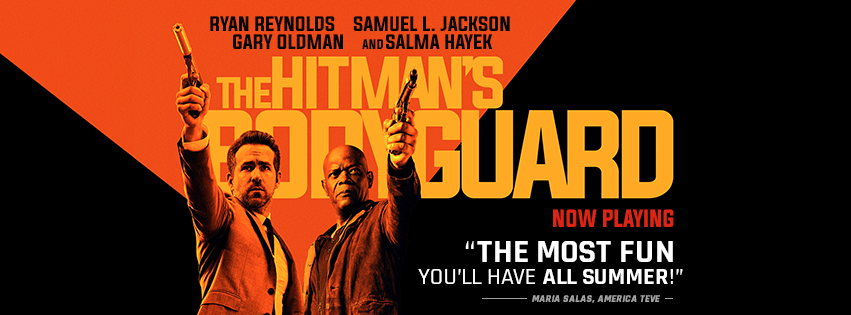
The Hitman’s Bodyguard

(USA 2017)

“Get Triggered,” commands one of the movie posters for Patrick Hughes’s The Hitman’s Bodyguard. I don’t know what that means here, but this film is a bit fluffy to trigger much more than some chuckles — after all the eyerolling, of course. That’s how it went for me.

Ryan Reynolds is Michael Bryce, a humiliated professional bodyguard whose career took a hit — get it? — after a client (Tsuwayuki Saotome) was shot and killed right in front of him. Now, he barely ekes out a living guarding low profile corporate executives addicted to speed. He operates out of his run down car, which is where he also lives (as evident from his “bathroom,” an empty water bottle). To make matters worse, Michael is still reeling from a breakup with Amelia (Élodie Yung), an Interpol agent he blames for his sad state.

Amelia is charged with a simple but very consequential mission: to deliver notorious hitman Darius Kincaid (Samuel L. Jackson) to the International Court of Justice at the Hague. Darius has agreed to testify against Vladislav Dukhovich (Gary Oldman), the depraved dictator of Belarus on trial for crimes against humanity. Unfortunately for the prosecution, Dukhovich has a stalwart and invincible army of goons that hunts and kills any witness who has any dirt on him. Darius is the prosecution’s last hope, and the clock is ticking.

When Amelia’s armored car is attacked by Dukhovich’s men, she and Darius go into hiding. She contacts Michael for a favor: to complete the mission and get the star witness to the Hague. She doesn’t tell him who the witness is, and it turns out that Michael and Darius have a history. It ain’t pretty.

Not surprisingly, The Hitman’s Bodyguard is light fare, a stock comedy/action quasi buddy flick. It’s a perfect summer movie; frankly, I’m not sure why it wasn’t released earlier. Tom O’Connor’s screenplay is repetitive, predictable, and loaded with F-bombs, but it’s fun and isn’t at all serious. Reynolds and Jackson have an amusing love/hate relationship filled with banter about everything from murder to love to pop music that wouldn’t be out of place in Pulp Fiction. In between their banter is nonstop action — car chases, explosions, shoot outs in helicopters and boats, cat and mouse games.

Jackson does what he does best: causes grief and cusses with force. Reynolds plays a good square with earnestness. If these two had better chemistry, The Hitman’s Bodyguard would be a more memorable film. Salma Hayek is the best thing about this movie: she’s dramatic and severe and hilarious as Sonia Kincaid, the streetwise but still crazy wife of Darius. Rotting away in an Amsterdam prison, she’s relentless about protesting the grave injustice done to her. She effortlessly steals every scene she’s in.

With Michael Gor, Tine Joustra, Yuri Kolokolnikov, Rod Hallett, Joaquim de Almeida, Kirsty Mitchell, Richard E. Grant

Production: Millennium Films, Cristal Pictures

Distribution: Lionsgate Films

118 minutes
Rated R

(ArcLight) C+

http://www.thehitmansbodyguard.movie/mobile/

Postcards from the Edge

(USA 1990)

“I’ll rinse these. I have Woolite in my purse. It’s handy for the road.”

— Doris Mann

Postcards from the Edge is, of course, Carrie Fisher’s semi-autobiographical novel about a floundering actress, Suzanne Vale (Meryl Streep), teetering on has-been status as she puts her life back together after a near fatal overdose. For her film adaptation, Fisher shifts the focus from the rehabilitation process to the relationship between Suzanne and her mother, legendary Hollywood superstar Doris Mann (Shirley MacLaine). It’s a good call: as last year’s documentary Bright Lights: Starring Carrie Fisher and Debbie Reynolds (https://moviebloke.com/tag/bright-lights-starring-carrie-fisher-and-debbie-reynolds/ ) demonstrated, Fisher and Reynolds were a solid and supportive albeit wacky team. Their relationship clearly offers ample fodder for this film.

Ably directed by Mike Nichols, Postcards from the Edge takes on addiction, family relationships, and show biz. In order to continue a film she’s working on, Vale must place herself under the care of a “responsible” adult — strictly for insurance purposes, a producer (Rob Reiner) assures her. That leaves her mother, who’s more than willing to help. In fact, it makes her beam all the more. So, Vale does what she must: she moves into her mother’s mansion in Beverly Hills.

Fisher might embellish a few things or flat out make shit up, like the sleeping pill story and her mother’s closet alcoholism. Maybe not. It doesn’t matter: Streep is excellent here, as is the entire cast. The real fun, though, is watching MacLaine emulate Reynolds. She has every tick and foible down perfectly. The homecoming party Doris throws for Suzanne and the is snarky, hilarious, and illuminating — I have the distinct impression that it really happened exactly the way it plays out here. Genius!

With Dennis Quaid, Gene Hackman, Richard Dreyfuss, Mary Wickes, Conrad Bain, Annette Bening, Simon Callow, Gary Morton, C. C. H. Pounder, Robin Bartlett, Barbara Garrick, Anthony Heald

Production: Columbia Pictures Corporation

Distribution: Columbia Pictures, Columbia TriStar Films

101 minutes
Rated R

(MoviePlex) B

http://www.sonypicturesmuseum.com/collection/719/postcards-from-the-edge

Léon Morin, Priest [Léon Morin, prêtre]

(France / Italy 1961)

When young widow Barny (Emmanuelle Riva) bursts into a confessional and tells the priest, Léon Morin (Jean-Paul Belmondo), that “religion is the opiate of the masses,” it’s pretty clear that director Jean-Pierre Melville isn’t going easy on us. For awhile, it’s not clear where he’s going at all with Léon Morin, Priest [Léon Morin, prêtre], a moody work that percolates with repressed sexuality while it dives into religion, philosophy, and politics.

The story, based on Béatrix Beck’s novel and set in a tiny town somewhere in the French Alps during the Italian occupation right before the Nazis took over, centers on Barny as her relationship with Fr. Morin develops and intensifies. She reveals that she’s a communist militant, possibly a lesbian, and Jewish by injection (i.e., her dead husband was a Jew). She tries to provoke him with her jabs at the Catholic Church, but Fr. Morin’s responses are measured and considered. She’s seduced.

It looks like something sexual is going to happen between them: he’s young and handsome, and she’s been without a man for so long that she’s lusting after a female coworker (Nicole Mirel). Once the two are alone behind the closed door of Fr. Morin’s office in a church tower, it happens: they engage in…discourse, discussing the tenets of Catholicism.

Léon Morin, Priest is low on action and heavy on dialogue, and as a result it often feels lethargic. All of the “important” discussions — the ones that advance the plot, anyway — occur in one room, which does nothing to accelerate the pace. The discussions involve dry topics like theology and philosophy and religious dogma.

However, Melville keeps it interesting with what’s going on in the background: he’s brutally frank about the casual and pervasive anti-Semitism, the lackadaisical Italian soldiers, and the callous efficiency of the Nazis. Riva and Belmondo smoulder, though the former’s performance is far more compelling. Amid the hasty baptisms of children and the desperate hiding of neighbors is the curiously amusing subplot about Fr. Morin having all the women of the village spellbound. It’s a light touch in an otherwise heavy film.

With Irène Tunc, Gisèle Grimm, Marco Behar, Monique Bertho, Marc Heyraud, Nina Grégoire, Monique Hennessy, Edith Loria, Micheline Schererre, Renée Liques, Simone Vannier, Lucienne Marchand

Production: Georges de Beauregard, Concordia Compagnia Cinematografica, Carlo Ponti

Distribution: Lux Compagnie Cinématographique de France, Ciné Vog Films (Belgium), Cineriz (Italy), Eurooppalainen Filmi (Finland), Rialto Pictures (USA)

130 minutes (restored version)
Not rated

(Gene Siskel Film Center) B-

Dunkirk

(USA / UK / France / Netherlands 2017)

I have mixed feelings about Christopher Nolan’s spectacular Dunkirk, a World War II military drama that has very little to do with battle. Told from three perspectives — land (“the mole”), sea, and air — the story here centers on an evacuation, that of British and allied soldiers from the beaches of Dunkirk, a fishing village in northern France at the Belgian border, over a ten-day period in late Spring 1940 (https://en.wikipedia.org/wiki/Dunkirk_evacuation).

I have to admit ignorance here: I knew nothing about the Dunkirk evacuation going into this film. Nolan doesn’t spend any time on background or what led to this point; instead, he just picks up with British soldier Tommy (Fionn Whitehead) fleeing German fire outside the beach. I wish I had known ahead of time because I would have done some research. I thought a better job could have been done telling the story.

The structure, jumping between the three perspectives, takes a little work to follow. What exactly is going on is unclear and confusing, and it creates a nice sense of claustrophobia and panic in many scenes — especially that boat scene. This is good. However, keeping track of the characters is a tough task not made any easier by giving all the soldiers the exact same black hair dye. I found it hard to relate to or care much about any of them because I was kept at arm’s length. I couldn’t get invested. While definitely not the same story, Dunkirk is a kind of a big budget Son of Saul — just not as good.

As a spectacle, though, Dunkirk is magnificent. Cinematographer Hoyte van Hoytema shot it on 70 millimeter film, and he packs this picture with gorgeous wide shots of the beach, the sea, and throngs of desperate soldiers. He beautifully captures the hopelessness of the situation with a drab palette of only a few army colors: greens, greys, blues, and cold whites that convey a chill I could see and feel. The sound is over the top loud. If nothing else, Dunkirk is total sensory overload. It’s worth seeing for that alone.

Side note: I’m not sure which is the bigger surprise here — that 1D’s Harry Styles actually isn’t terrible, or that Tom Hardy is hidden under aviator goggles for the entire film. The latter is a bummer. He’s so hot!

With Mark Rylance, Tom Glynn-Carney, Jack Lowden, Aneurin Barnard, James D’Arcy, Barry Keoghan, Kenneth Branagh, Cillian Murphy, Michael Caine

Production: Syncopy, Warner Brothers, Dombey Street Productions, Kaap Holland Film, Canal+, Ciné+, RatPac-Dune Entertainment

Distribution: Warner Brothers, Karo Premiere (Russia), NOS Audiovisuais (Portugal), Roadshow Entertainment (New Zealand), Roadshow Films (Australia)

106 minutes
Rated PG-13

(Music Box) C+

http://www.dunkirkmovie.com