Vibes

(USA 1988)

A day off of work is a good time to watch a DVD, so I picked Vibes. Cyndi Lauper and Jeff Goldblum are both talented performers with long careers sustained in large part by their quirky, so unusual personas (personae?); it stands to reason that each would have a good share of hits and misses—and they do. Vibes is definitely a miss for both of them—a huge one.

Vibes starts out, to use a Lauper song from another movie, good enough: two robbers in the Andes set up the backstory in a short opening. The action shifts to New York City, where psychics Sylvia Pickel (Lauper) and Nick Deezy (Goldblum) meet while participating in a study on paranormal abilities. The scene is promising: Nick can tell where objects have been by touching them, and Sylvia is a medium for a spirit named Louise. The exchanges between the two and their analysts are actually funny. Unfortunately, things slide steadily downhill from there. Con artist Harry Buscafusco (Peter Falk) shows up at Sylvia’s apartment at night and offers her a job under the guise of finding his lost son in Ecuador. Sylvia convinces Nick to join them. The adventure begins.

YAWN! Vibes is painful to watch—fucking painful. The writing sucks—the situations are unoriginal, the story is predictable, and the dialogue is dull. Lauper isn’t funny at all; she’s shrill, clearly inexperienced with acting, and downright grating with her over-exaggerated Queens shtick that she seriously toned down following this bomb (check out interviews of her from 1989 forward and her subsequent acting gigs if you don’t believe me). Aside from her first scene, she shines only when she’s using her voice for something other than reading lines—for example, singing a lullaby to villain Ingo (Googy Gress) and speaking in tongues when a spirit takes over her body after she touches a glowing pyramid that connects her to a past world. As usual, Goldblum’s timing is spot on; but he can only do so much with the material, which is so lame I doubt anyone could have saved it. A romance develops, and it’s laughable because there’s zero chemistry between Lauper and Goldblum—he doesn’t even seem to like her (and according to Lauper’s memoir, he didn’t). The whole thing is dismal.

Vibes initially sounded like a good idea: real actors, including Julian Sands and Elizabeth Peña, signed onto the project. Lowell Ganz and Babaloo Mandel—who had an established track record with comedies like Night Shift, Splash, and Spies Like Us in addition to episodes of sitcoms like The Odd Couple, Happy Days, and Laverne & Shirley—started (but didn’t finish) the script. It seemed like a good bet for a light summer comedy (it was released in July or August, as I recall). Vibes no doubt didn’t go as planned. It features some nice scenery, a young and unknown Steve Buscemi as Sylvia’s ex-boyfriend, and Lauper’s arguably underrated single “Hole in my Heart (All the Way to China)”—but that’s about it. I should’ve gone to a movie instead.

(Home via DVD) D-

https://www.sonymoviechannel.com/movies/vibes/details

Band of Robbers

(USA 2015)

Ever wonder what became of Tom Sawyer and Huckleberry Finn? Adam and Aaron Nee come up with an answer—in an updated setting—in Band of Robbers, a fresh, inspired, and downright cool take on Mark Twain’s classic characters.

After another stint in jail, Finn (Kyle Gallner) reunites with Sawyer (Adam Nee)—now a small town cop with questionable ethics, a distaste for his brother Sid (Eric Christian Olsen), and a serious Peter Pan complex—and their gang of odd ducks: Joe Harper (Matthew Gray Gubler), Ben Rogers (Hannibal Buress), and Tommy Barnes (Johnny Pemberton). Egged on by Muff Porter (Cooper Huckabee), a tragic old coot who sits in a nasty chair in a nasty motel room, Sawyer hatches a half-baked plan to snaffle a local treasure from Injun Joe (Stephen Lang), who they suspect stashes it in a pawn shop run by Dobbins (Creed Bratton, who most will recognize from The Office). Things don’t pan out according to plan, of course, sending Sawyer and Finn on one more adventure.

Band of Robbers is a light and entertaining adventure movie. I detest the word ‘cute’ to describe a movie, but that’s exactly what it is—and that’s a good thing. The film is nicely shot and effectively uses color and quick action to keep the mood light even when what’s unfolding is the opposite. The references to Twain’s characters are a bonus, and transplanting them to the current millennium works really well without watering them down; the characters in the film are true to the originals. Sure, liberties are taken—the exact location is never disclosed. A treasure map shows an unidentified winding river, and the scenery vaguely suggests Missouri. However, license plates only say “Drive Safely” and shots of what appear to be California hills in the background (not to mention desert terrain) belie any whiff of the Midwest. I understand the film borrows heavily from Wes Anderson’s Bottle Rocket; having never seen it, though, I can’t comment. Regardless, I was so interested in the story that none of this stuff bothered me.

There’s no profound statement here; in fact, a warning in Twain’s own words appears at the outset of the film: “persons attempting to find a moral in it will be banished.” If there’s a moral, it’s simply that everyone must eventually grow up—a sentiment apparent throughout the film. In the end, Band of Robbers is not the same story as The Adventures of Tom Sawyer or The Adventures of Huckleberry Finn; but if nothing else, it’s a testament to the timelessness and durability of Twain’s characters. That’s enough for me.

(Gene Siskel Film Center) B

http://www.bandofrobbersmovie.com

Peggy Guggenheim: Art Addict

(USA 2015)

If you were to pull out the chapters on modernism from an art history textbook and shuffle them together with Confidential magazine, the result no doubt would look a lot like Lisa Immordino Vreeman’s Peggy Guggenheim: Art Addict. Guggenheim led a colorful life—literally and figuratively—filled with art, sex, and a fair amount of darkness.

With audio from a tape recorded interview—Guggenheim’s last—presumed lost until found in a basement during the making of this film, Guggenheim herself in her clipped, matter-of-fact way discusses her childhood, her time in Paris during the 1920s, her abusive marriage to Laurence Vail that ended in divorce after seven years, her relationship with her two children, her sex life, and her entry into the art world. She hung out with the likes of Jean Cocteau, Man Ray, James Joyce, Ezra Pound, Salvador Dalí, Pablo Picasso, and Gertrude Stein. She tricked with, inter alia, Marcel Duchamp, John Holms (not a porn star), Samuel Beckett, and Max Ernst (to whom she was married for a short time). She was among the first to show many artists, including Vasily Kandinsky, Mark Rothko, Robert de Niro, Sr. (father of the actor), Arshile Gorky, and Jackson Pollock, whose “discovery” she was most proud to claim.

For all her antics, though, Guggenheim’s life was not all fun and games. Her father went down with the Titanic when she was 13 years old. Vail “hit” her. Holms, who she said was the love of her life (despite the fact that he was married), died after a routine hand surgery. She had seven abortions. She wound up estranged from her son, Sinbad, and her daughter, Pagette, died under mysterious circumstances at age 40. To top it all off, she had a nose job that didn’t turn out right; she never fixed it because the experience was too physically painful.

Immordino Vreeman does an excellent job balancing Guggenheim’s considerable achievements with salacious details of her life, giving just enough to keep us tuned in. The gossip doesn’t overshadow the fact that Guggenheim, however flawed, was a fascinating woman way ahead of her time. Illuminating, fun, and never a dull moment, I enjoyed Peggy Guggenheim: Art Addict very much.

(Music Box) B+

http://www.peggyguggenheimfilm.com

Rosenwald

(USA 2015)

“Rosenwald school” is a curious name that sounds like the Jewish equivalent of a Catholic Magdalene home, where unmarried pregnant girls of yore were tucked away to do laundry for nuns until they had their babies. It’s not; it was actually a number of schools for black children built in the American South during the early 20th Century. I never heard of these or the man whose name they bear, Julius Rosenwald. Biographer Aviva Kempner tells his story in a decidedly straightforward manner through photos, narration, clips, and interviews with descendants, historians, and Rosenwald school alums like Maya Angelou and Congressman John Lewis. At the end, we even hear from Rosenwald himself.

Born in Springfield, Illinois, where he lived across the street from the Lincoln home, Rosenwald—who considered himself “a member of a despised minority”—first made a name selling men’s clothes with his cousin. A series of fortuitous events resulted in a partnership with Sears Roebuck in Chicago in 1895. He got rich creating the Sears catalog, the Amazon of a hundred years ago, as one interviewee calls it. Motivated by a number of things—his friendship with Booker T. Washington, Chicago Sinai congregation rabbi Emil G. Hirsch, the Jewish concept of tikkun olam (“repair the world”), Washington’s Up From Slavery and William Henry Baldwin, Jr.’s An American Citizen, and a disturbing similarity between the persecution of blacks in the States, particularly the South, and that of Jews in Russia—he started a fund to build schools where the government apparently wouldn’t. He also offered money to build YMCAs in various cities.

Rosenwald’s funding scheme was unique: he paid a third of the cost, with the rest of the funding to be provided (or raised) by the community where the school or YMCA would be built. It worked, and more than 5,000 schools were built. Rosenwald didn’t stop there: he also contributed to housing in Chicago, established the Museum of Science and Industry, and set up a fund for artists and intellectuals. Recipients were in diverse disciplines and included Langston Hughes, Ralph Ellison, Katherine Dunham, Gordon Parks, Jacob Lawrence, Dr. Charles Drew, and even Woody Guthrie. Rosenwald is intriguing not just for its named subject but also for the subjects it gets into on the side: American civil rights, art, and Chicago history.

(Gene Siskel Film Center) B

http://www.rosenwaldfilm.org

The Big Short

(USA 2015)

I’m no economist, and, well…math is hard. I get that lax lending practices led to the housing market collapse in 2008, but I sure as hell don’t have a firm grasp on what else contributed to the financial meltdown. With The Big Short, writer and director Adam McKay takes on the courageous and potentially suicidal task of explaining it all, Schoolhouse Rock style—only hopped up on Adderall.

Based on the nonfiction exposé The Big Short: Inside the Doomsday Machine by Michael Lewis, The Big Short follows the intertwined stories of Michael Burry (Christian Bale), a socially inept Metallica-blaring doctor-turned-hedge fund-manager with Asperger’s, a glass eye, and a cyst on his face that bummed me out every time I saw him; douchebag Wall Street trader Jared Vennett (Ryan Gosling), who doubles as narrator; cynical, boorish, and fictitious Chicken Little hedge fund manager Mark Baum (Steve Carell) and his team; newbie investors Charlie Geller (John Magaro) and Jamie Shipley (Finn Wittrock); and retired banker Ben Rickert (Brad Pitt), who’s got no love for the business. In one way or another, they all aim to profit from mass calamity—and they succeed. The standouts here easily are Gosling and Carell, who have a natural chemistry and seem to have fun with their parts. Pitt, who plays psychos and goofballs better than anyone (e.g., True Romance, 12 Monkeys, Fight Club, Snatch—need I say more?), has a secondary role, but he’s awesome; I didn’t recognize him right away. Bale, on the other hand, is a bit much—to the point of being a downer.

The story involves dry, technical, and boring financial concepts, usually abbreviations: credit default swaps (CDS), collateralized debt obligations (CDOs), NINJA loans—not the stuff that typically generates emotion or drama. McKay uses a number of offbeat but smart gimmicks to explain the basics: celebrity cameos (Selena Gomez and Anthony Bourdain, to name two), demonstrations (a la Jenga), breaking character, songs and graphics. His approach does the trick, and it’s entertaining. Very much so. However, it’s not perfect: the pacing, though not as frenetic as Wolves of Wall Street, still wore me out by the end. Some questions remain in my mind—like how you can bet against something like the economy. It’s also still unclear how it all happened. To quote the movie, though, “[t]he truth is like poetry, and most people fucking hate poetry;” I think that’s the essence. One thing is certain: McKay is outraged; by showing us that the nonsense continues, he wants us to be, too.

(AMC River East) B-

http://www.thebigshortmovie.com/


The Danish Girl

(USA/UK 2015)

On paper, The Danish Girl has everything going for it: a sensationalist plot with real-life characters, weighty and timely subject matter, pretty scenery, nifty period clothes, a love story, and a nice dose of tragedy. Visually, it’s a beautiful film: cinematographer Danny Cohen gives it the soft, muted look of an impressionist painting; the interiors are as alluring as the exterior shots. The setting—the early 20th Century art scene in Copenhagen and Paris—evokes a sense of glamor and romance. The acting is okay for the most part, but Alicia Vikander is outstanding. Still, the sum here is no greater than its parts.

Based on David Ebershoff’s novel based on the life of Dutch artist Einar Wegener (Eddie Redmayne), the first known person to undergo sex reassignment surgery, and his wife, Gerda Gottlieb (Vikander), The Danish Girl is a good story even if it isn’t historically accurate. One day, Gottlieb asks Wegener to stand in for her model so she can finish a painting; she gives him a pair of panty hose, and he is immediately cozy in them. Thus begins Wegener’s road to becoming “Lili,” as christened by the couple’s friend, Ulla (Amber Heard). Lili becomes Gottlieb’s muse, showing up in her paintings. They sell. Lili accompanies Gottlieb to a ball as Wegener’s “cousin,” and everyone is fooled. Wasn’t that easy, isn’t she pretty in pink?

The Danish Girl is fictionalized, and as a result liberties are taken for time constraints, continuity, and drama. I get that. Nonetheless, this film doesn’t come off as genuine because it oversimplifies and sanitizes the issues it seems to want to bring to light and then gives them superficial treatment. Lili’s transition is too quick, and her adjustment—touched on but not explored—is seamless for today let alone 1926. Redmayne’s portrayal of Lili is silly: he bats his eyelashes and caresses his frocks with all the campy drama Johnny Depp mustered up wearing an angora sweater in Ed Wood. Lili looks like Molly Ringwald, right down to her stylish scarves—the real Lili looked like Oscar Wilde in a dress. Wegener and Gottlieb were more complicated and had a more complex and unconventional relationship. The truth here is so condensed and whitewashed that this might as well be a fairy tale.

The Danish Girl might make you cry, but it’s just not convincing even within the confines of a two-hour film. Too bad, because it could’ve been much more.

(ArcLight) C-

http://www.focusfeatures.com/the_danish_girl

The Overnight

(USA 2015)

Sex can be a funny topic with loads of material. The Overnight, a limited independent release from last summer, seems like a little gem. It opens promisingly with Taylor Schilling (Orange is the New Black) and Adam Scott (Parks and Recreation) in what just might be hands down (but not off) the most pathetic sex scene ever. It’s really funny, and gets us off to a good start. Sadly, the momentum doesn’t last long.

The couple just moved from Seattle to Los Angeles, and doesn’t know anyone. While at the park with their son, they meet Kurt (Jason Schwartzman), a goofy ageing hipster who sells water coolers by day and who we later learn also paints close up portraits of assholes—as in, anuses—and sells videos of his wife, Charlotte (Judith Godrèche), online. Kurt invites the couple over for a “play date” for their boys (he and Charlotte have a son the same age) that ends up looking more and more like a play date for the adults once the kids are asleep.

I wanted to like The Overnight, but I didn’t. It shows a few flickers of light: the characters are thrust into some palpably uncomfortable situations, including a weird penis dance by the pool (they’re prosthetics) and an even weirder hand job. One of the last scenes actually gets sexy for a hot moment. Unfortunately, though, the whole thing goes limp early on; the story never takes off and the situations just aren’t that wild. Sure, there’s full frontal nudity (albeit prosthetics), but there’s nothing edgy or clever about it. The problem is the writing: Patrick Brice either ran out of ideas or didn’t know where to go with the story. Intentionally or not, the wrap up puts out a moral position that rings, um, judgmental. I didn’t find The Overnight fresh or funny; I found it unimaginative and tedious the more it went on.

(Home via iTunes) C-

http://theovernight-movie.com


The Hateful Eight

(USA 2015)

The trailers piqued my interest but didn’t totally sell me, so I wasn’t sure about The Hateful Eight. My apprehension was unfounded: it’s gotdamn motherfucking Quentin Tarantino, all the motherfucking way, motherfucker. If that last sentence sounds good to you—and you read it how Jules Winnfield might say it—well, you’re in for a treat. I said, goddamn, god damn!

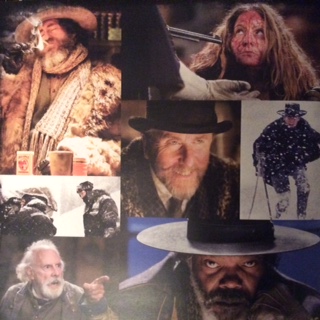
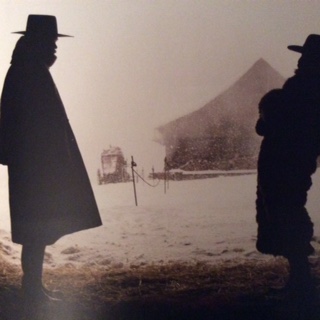
Traveling through Wyoming on the way to Red Rock not long after the Civil War, bounty hunter Major Marquis Warren (Samuel L. Jackson) is caught in the mountains just as a blizzard is a-brewing. He stops a stagecoach that happens to be carrying another bounty hunter, John “The Hangman” Ruth (Kurt Russell), and his captive, the lovely Daisy Domergue (Jennifer Jason Leigh)—who has blood on her face for nearly the entire film—and finagles a ride. Another guy, Chris Mannix (Walton Goggins), who claims to be en route to Red Rock to become sheriff, is thrown into the mix. The blizzard forces them to seek shelter at Minnie’s Haberdashery, where they join four strangers: “Mexican Bob” (Demian Bichir), smarmy Oswaldo Mobray (Tim Roth), quiet cowboy Joe Gage (Michael Madsen), and “The General” (Bruce Dern), a frail former Confederate soldier. Niceties, banter, and then expletives are exchanged until characters are killed off, Ten Little Indians style but with twists—Agatha Christie never blew anyone’s nuts off. Then again, Tarantino’s way of telling a story is completely his own.

True to form, Tarantino jams The Hateful Eight with memorable miscreants, snappy dialogue, and impossibly crazy cutthroat situations. The action here is intense and suspenseful, unfolding gradually and teasingly. The timing is out of sequence—no shock there. The plot gets thicker with each character that falls off, leaving questions begging for answers. Best of all, not a single performance is subpar and not a single character—except maybe Minnie’s helper—is superfluous. Russell and Dern stand out, but Jackson is a master scene-stealer—his delivery is so strong that you simply cannot turn away when he speaks. Channing Tatum makes a surprise appearance and gives an even more surprisingly impressive performance.

Well, let’s not start sucking each other’s dicks quite yet. The story has a hole or two, and the gore is so over the top it loses its impact at points. There’s the use of the ‘n’ word like a mere conjunction. Jason Leigh sounds annoyingly like Roseanne Barr. Oh yeah—more than eight characters actually appear, which a couple of times—namely when everyone is in the same small room—requires extra concentration to follow along. All that said, though, none of it detracts from enjoying the film. Yes, it lacks the elegance and grace of Kill Bill, my personal favorite, but The Hateful Eight is toward the top of Tarantino’s resume. I loved every minute—which did not seem like three hours.

Side note: the overall experience was one I’ve never had at a movie theater. Truly a bona fide “event,” the atmosphere was like a rock concert: the screening was sold out ahead of time, and the crowd was abuzz with excited fans taking pictures and chattering about other Tarantino films. Some had on Reservoir Dogs and Kill Bill tee shirts. The line to get in was all the way to the next block. Programs were provided. Shot on decadent 70-millimeter film, the Music Box showed The Hateful Eight on a brand spanking new screen it acquired for this special “roadshow engagement.” The price was double a normal ticket but oh so worth it.

The Hateful Eight ended my year of movies on a high note—I can’t think of a better director to release a new film to close out the year. To borrow from it, “Old Mary Todd is calling, so it must be time for bed.” Time will tell for sure, but I think this one belongs to the ages.

(Music Box) A+

http://thehatefuleight.com


image1     image3     image2     image4     image5     image6


Meet the Patels

(USA 2015)

Poking fun at cultural differences and the generation gap seems like an easy way to get a laugh, and maybe it is. Fortunately, it works in Meet the Patels, a genuinely funny documentary of one man’s search for love that becomes a family project. After breaking up with his Caucasian girlfriend of two years– a girlfriend he never mentioned to his immigrant parents– L.A. based comic Ravi Patel decides to try the traditional Indian system of hooking up: letting the parents arrange it. Why not? It worked for them, and his mother is known for her matchmaking skills.

Although we don’t see much of sister Geeta as she records everything, her presence is pervasive: she’s off-camera laughing mischievously, goading her brother and chiding him when he vacillates on dating matters. The real stars, however, are Patel’s parents, father Vasant and mother Champa, who fret endlessly over the fact that their children are approaching their thirties and are STILL single, as though this qualifies them as town lepers. Vasant goes so far as to declare, in all seriousness, that not getting married makes one “the biggest loser you can be.” They quickly put together Ravi’s “biodata,” which essentially is a dating resume, and forward biodatas of potential matches to him. They take him to weddings and give him pep talks. They send him all over the States to meet Indian girls. The results are amusing and illuminating. For example, I didn’t know “wheatish brown” is a thing to look for in a mate. I never heard that some skin tones and geographical areas are more desirable than others. I had no idea that many Patels prefer to marry other Patels.

Ravi’s deadpan “OMG” delivery is consistently fun, and animated bits interspersed throughout the film keep the mood light. In the end, it’s clear that no matter how disparate certain views may be, parents and their children can find a middle ground, adapt, and find happiness together. Meet the Patels is warm, relatable, and something pretty much anyone will find entertaining. I laughed a lot.

(Gene Siskel Film Center) B

http://www.meetthepatelsfilm.com

Christmas, Again

(USA 2015)

Nothing puts me in the Christmas spirit like a gloomy holiday story. Noel (Kentucker Audley) sells Christmas trees on a makeshift lot on a sidewalk in Brooklyn. He works an all-night 12-hour shift. He constantly has to ride his worker, Nick (Jason Shelton), and Nick’s girlfriend (Oona Roche) to get anything done. He fields petty questions and solves petty holiday problems for petty, self-absorbed customers. He sleeps and eats—I wouldn’t call it living—in a trailer on the street, where he survives on a diet of energy pills and antidepressants stashed in an Advent calendar. He buys scratch-off lottery tickets for fun. Oh yeah, he broke up with his girlfriend sometime in the last year. Noel seems lonely. Or is he just someone who doesn’t need the company of others?

One night while working, Noel comes across a woman, Lydia (Hannah Gross), passed out on a bench in a park. Their paths—and her jittery boyfriend’s—cross a few times, and that’s it. 

Christmas, Again probably is not going to end up being anyone’s favorite Christmas movie anytime soon, but it works on quite a few levels. More a string of quiet events than a full story, its real achievement is the mood it sets. Dolorous and blue, the camera moves slowly and blurs the background leaving only hints of cold colors. The cinematography (Sean Price Williams) is beautiful, making the shots literally an opaque blue. I loved the old distorted Christmas music that sounds like it’s playing from an AM radio, the Christmas lights permanently out of focus in the background, and the uneasy, unnatural, and sometimes suspenseful interactions between Noel and Lydia, both of whom are easy on the eyes. There’s a palpable sense of despondency that comes through here.

(Gene Siskel Film Center) B

http://www.xmasagain.com