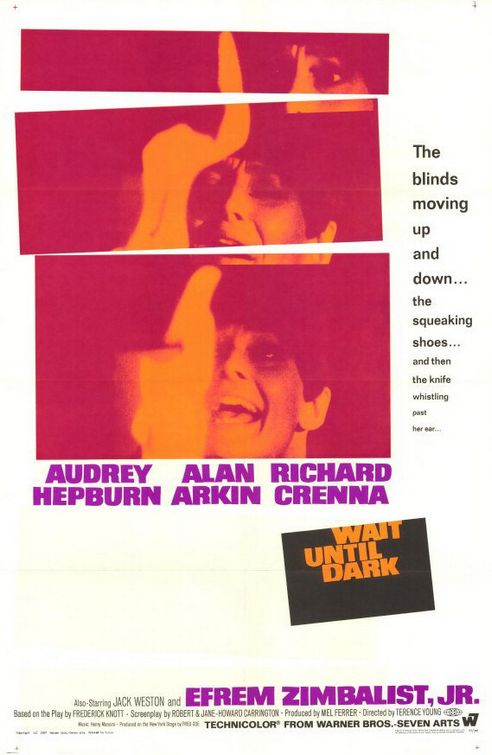
Wait Until Dark

(USA 1967)

A heroin smuggling ring. A creepy doll. A corpse. A blind woman alone in her basement apartment in the West Village. These are the elements of Wait Until Dark, a quaint and dingy little crime thriller adapted from Frederick Knott’s 1966 play by screenwriters Robert Carrington and Jane-Howard Carrington.

Suzy Hendrix (Audrey Hepburn) is the hapless gudgeon who, being blind, already has the proverbial wool over her eyes. Her husband, Sam (Efrem Zimbalist Jr.), comes home from a business trip with a doll that unbeknownst to him contains a hidden stash of heroin sewn into it. This does not bode well for Lisa (Samantha Jones), the glamorous and sexy stranger who asks him to hold it for her at JFK International Airport.

A case of mistaken identity leads a pair of small time crooks (Richard Crenna and Jack Weston) to Sam and Suzy’s apartment, where psychotic hooligan Harry Roat (Alan Arkin) coerces them into helping him find the doll—as soon as they dispose of a dead body. Nice. They devise an elaborately devious scam to recover the doll when they realize Suzy, who walks in on them, is blind.

Terence Young’s directing is certainly competent. I last saw this movie on some late night UHF station when I was a kid, and two things have stayed with me: a sense of severe claustrophobia as the story unfolds, and that fucking groovy apartment. The plot has flaws that strain credibility. For one thing, Suzy is far too unguarded for a New Yorker. Why doesn’t she lock her door? Roger Ebert pointed out this detail (http://www.rogerebert.com/reviews/wait-until-dark-1968). I didn’t obsess over it like he did, but I noticed it and thought the same thing. When Roat tells her he knows she has the doll, why doesn’t Suzy hand it over? Why does she tell Gloria (Julie Herrod) to meet Sam at the train station instead of going to the police? Why do the guys bother to put on disguises if Suzy can’t see them?

Despite these glaring issues, Young ultimately succeeds in bringing Wait Until Dark to a boil. It lives up to its hype: I saw people jump in their seats at the end. The acting here overcomes any shortcomings in plot. Hepburn is little more than a blind Holly Golightly, but at certain points she reminds me of Barbara Stanwyck screaming that she can’t wake up from a nightmare in, I think, The Night Walker. Weston is a little too bumbling, but Crenna and Arkin are chillingly menacing and foreboding even if they are silly by today’s standards (yeah, sunglasses at night went a long way making Corey Hart look tough). Henry Mancini’s eerie score is the clincher in setting the right mood.

A trivial point of interest: Suzy’s apartment is in the same block of rowhouses as the one used for the Huxtable residence on The Cosby Show (http://www.movie-locations.com/movies/w/Wait_Until_Dark.html#.WRU0W1LMyWY). The small street, St. Luke’s Place, has a bit of literary history, too (http://www.nytimes.com/1996/10/27/realestate/in-a-village-enclave-15-remarkable-rowhouses.html).

With Jean Del Val, Frank O’Brien

Production: Warner Brothers

Distribution: Warner Brothers/Seven Arts

108 minutes
Not rated

(Music Box) B-

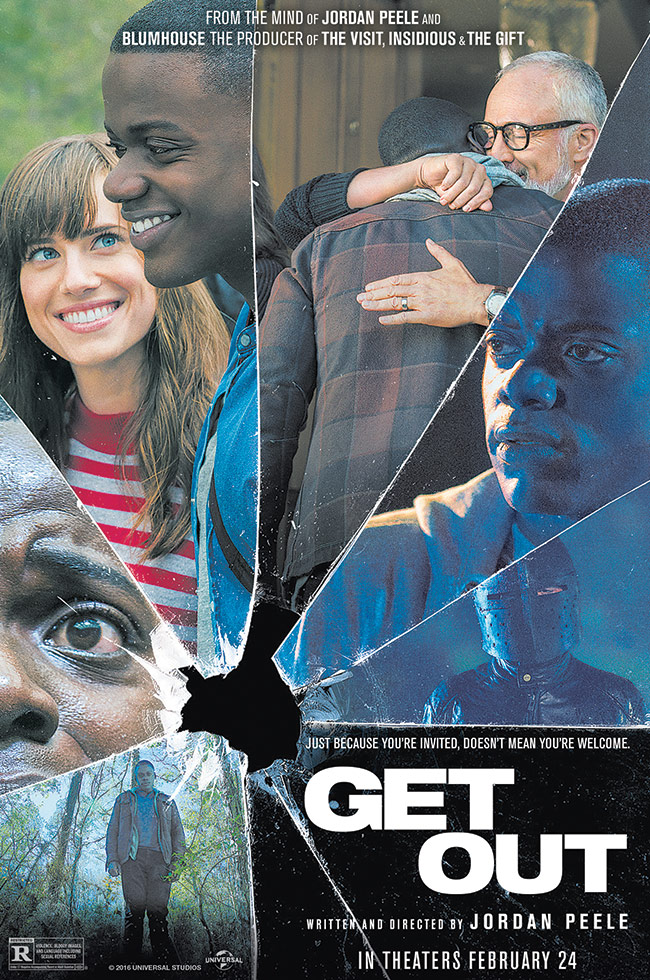
Get Out

(USA 2017)

I caught the hype surrounding Jordan Peele’s first feature length film, Get Out, a comedy horror flick that takes on race—specifically, the dynamics of white power and black subordination. He wrote the script and directed the film. I went into Get Out with some doubt and maybe trepidation about how it might come off. The concept is one that seems too easy to go horribly sideways.

I guess if anyone can pull it off, it’s Peele—and I’m relieved to report that he succeeds. With an oddly compelling mix of Guess Who’s Coming To Dinner, Meet the Parents, Nightmare on Elm Street, and The Stepford Wives, he takes on the cultural idiosyncrasies of Caucasian cultural dominance within the constructs of a horror flick. He’s got a lot of points to make, and he gets them across in a sharp but entertaining way. Like the best horror movies, Get Out makes you squirm—but it does so on multiple levels.

New York City photographer Chris (Daniel Kaluuya) is black. His girlfriend, Rose Arlington (Allison Williams), is white. She invites him on a weekend getaway to her parents’ home in upstate New York because, well, it’s time for him to meet the fam. Chris agrees, going into it nervously and not without personal baggage. His hyperactive best bud, Rod (Lil Rel Howery), a TSA agent who always expects the worst, is not helping.

Rose’s parents are, like the quiet town where they live, nice. Or at least welcoming. Dean (Bradley Whitford) drops silly slang, affects a bizarre accent, and praises President Obama. Missy (Catherine Keener) is more direct, asking pointed questions in a weird attempt to get to know Chris. It’s awkward and doesn’t quite break the ice, but it’s harmless. Right?

The family’s two longterm servants, maid Georgina (Betty Gabriel) and gardener Walter (Marcus Henderson), carry themselves like they’ve had lobotomies. Rose’s younger brother, Jeremy (Caleb Landry Jones), is, um, aggressively complimentary to Chris. On top of it, the Armitages’ neighbors are not quite right, obsessed with Chris and his virility.

During the first part of Get Out, Peele keeps things light but lets a sense of creepy unease simmer. The laughs are there, but like all of the characters coming and going from the house, something is off. He makes a major shift in tone once Missy insists on hypnotizing Chris, ostensibly to help him quit smoking. What was innocuous up to now becomes nefarious.

Ultimately, the evil here is not a monster hiding under the bed, but rather something more obvious that exists in broad daylight. I could have done without the bloody finale, but it works in the context of the film; Peele plays with genre, so I see why it’s here. Either way, Get Out is a bold move that pays off.

With Stephen Root, LaKeith Stanfield, Ashley LeConte Campbell, John Wilmot, Caren Larkey, Julie Ann Doan, Rutherford Cravens, Geraldine Singer, Yasuhiko Oyama, Richard Herd, Erika Alexander, Jeronimo Spinx, Ian Casselberry, Trey Burvant, Zailand Adams

Production: Blumhouse Productions, Monkeypaw Productions, QC Entertainment

Distribution: Universal Pictures

104 minutes
Rated R

(ArcLight) B

https://www.uphe.com/movies/get-out

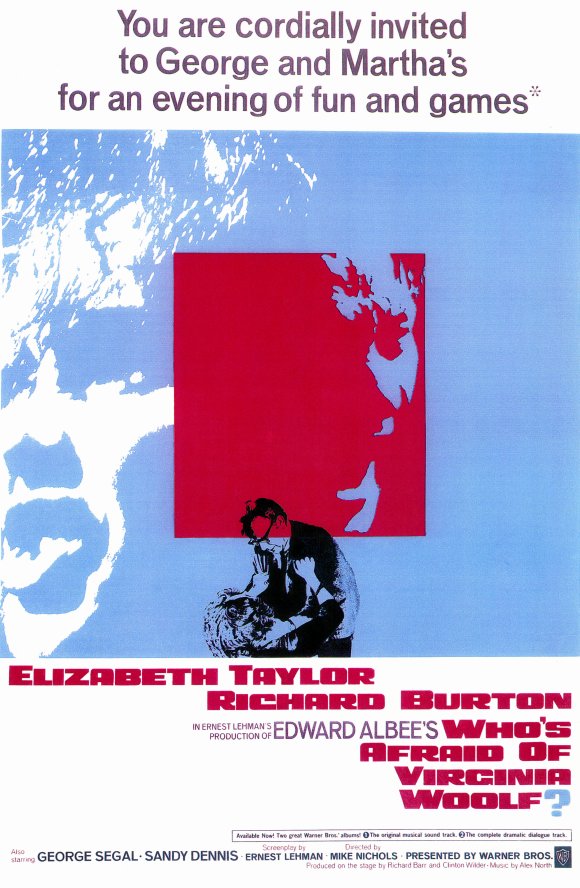
Who’s Afraid of Virginia Woolf?

(USA 1966)

Elizabeth Taylor. Richard Burton. Edward Albee. Even George Segal, who was kind of a fixture on NBC during the ’80s and ’90s. Need I say more? Probably not, but I will.

Director Mike Nichols and screenwriter Ernest Lehman stick pretty close to Albee’s 1962 play with their film adaptation of Who’s Afraid of Virginia Woolf?, and it’s hard to watch. Really hard. To be fair, though, it’s supposed to be, and that’s what makes it so good.

The promotional poster promises an evening of fun and games, but very little joy is to be found here, at least on the surface: all that marital baiting, sniping, and yelling is miserable. Fuck! It took me five or six false starts over a few years before I finally got into the film—and only with the help of a bottle of bourbon. Once I was in, though, I was hooked: watching this disastrous night unfold and all four characters unravel engrossed me desite the buzz I had going.

The oddly but appropriately named George (Burton), a history professor at a small East Coast university, and Martha (Taylor), the daughter of the school’s president, stumble home drunk from a faculty party, neither one listening to the other as they babble about nothing. Martha quotes Bette Davis, which ultimately reveals more about her viewpoint than any other comment she makes—and the woman can talk.

They babble and respond to each other half-heartedly. Martha tells George that she invited a young couple, a professor from another department and his wife, over for a drink. George is miffed, but there’s no time to react.

Enter Nick (Segal) and Honey (Sandy Dennis), a polite, young, good-looking couple that, as we learn, has their own set of problems. Martha and George pour drinks and pick at each other while Nick and Honey watch, uncomfortable at first, thinking maybe they shouldn’t be there. As the drinking continues, though, they’re pulled into the…drama? Turns out, they have more in common with each other than they think.

Here’s the thing about George and Martha: their marriage is dysfunctional, but they seem to operate well inside the confines of their explosive relationship—Martha brays and George stays, responding in a passive aggressive manner as he fixes them both another drink. Over and over and over again. Do they have any limits? It’s hard to say, partly because it’s never clear that we should take anything at face value: what we see is not necessarily what it is. That’s the genius of Who’s Afraid of Virginia Woolf. 

In 2013, the United States Library of Congress deemed Who’s Afraid of Virginia Woolf? “culturally, historically, or aesthetically significant” and selected it for preservation in the National Film Registry (https://www.loc.gov/programs/national-film-preservation-board/film-registry/complete-national-film-registry-listing/).

With Frank Flanagan, Agnes Flanagan

Production: Warner Brothers

Distribution: Warner Brothers

131 minutes
Not rated

(DVD purchase) A

The Tell-Tale Heart

(USA 1953)

I caught The Tell-Tale Heart as an extra at Music Box Theatre’s screening for Reel Film Day. Directed by Ted Parmelee and narrated by English actor James Mason, it’s a nifty modern take on Edgar Allan Poe’s famous 1843 short story about a murderer haunted by his victim’s heartbeat, which he hears from underneath the floorboards where he hid the body. Paul Julian’s design and Pat Matthews’s animation is shadowy and surreal, nicely depicting the horror and the madness of Poe’s classic. Boris Kremenliev’s score adds an eerie Twilight Zone feel.

This short has the distinction of being the first cartoon to earn an ‘X’ rating. However, it appears the rating, assigned by the British Board of Film Censors in the UK, had more to do with religion than obscenity (http://dangerousminds.net/comments/this_moody_1953_animation_of_edgar_allan_poes_the_tell-tale_heart_was_the_f). It had to be the dark occult nature of the story,  as there is nothing remotely sexual here.

In 2001, the United States Library of Congress deemed The Tell-Tale Heart “culturally, historically, or aesthetically significant” and selected it for preservation in the National Film Registry (https://www.loc.gov/programs/national-film-preservation-board/film-registry/complete-national-film-registry-listing/).

Production: United Productions of America

Distribution: Columbia Pictures

7 minutes
Not rated (USA)

(Music Box) A

Reel Film Day: A Celebration of 35mm Cinema

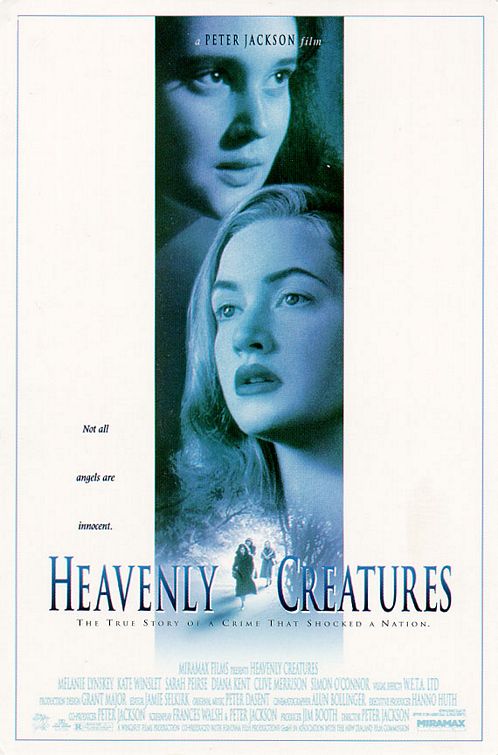
Heavenly Creatures

(New Zealand 1994)

“All the best people have bad chests and bone diseases. It’s all frightfully romantic!”

—Juliet Hulme

Forget Lord of the RingsHeavenly Creatures is Peter Jackson’s coolest film. Before big budget Hollywood blockbuster fantasy franchises, the New Zealand filmmaker wrote, produced, and directed offbeat small-scale gore and porn comedies like Bad Taste (1987), Meet the Feebles (1989), and Dead Alive (1993). I’d already seen that last one by the time Heavenly Creatures came out for a limited run (in the States, anyway) in the fall of 1994. I assumed it would be another messy splatterfest—described to me as a “lesbian murder flick,” what would you think? Turns out, that’s not quite what it is.

Far more than a “lesbian murder flick” or even a brilliant stepping stone to bigger and better things, Heavenly Creatures represents a turning point in Jackson’s career. It’s a rare example of flawless execution across the board. He brings together every element—narrative, character development, casting, visuals, special effects, dialogue, period costumes and sets—to create a real humdinger.

Christchurch, New Zealand, 1952: 14-year-old Yvonne Reiper (Melanie Lynskey), who goes by “Pauline,” is a messy-haired, brooding loner at an all-girl high school. In her first scene, she’s wearing a big scowl on her face at an assembly, not singing along with the rest of her classmates—not until the school’s headmaster (Darien Takle) catches her gaze and snaps her into line with a widening of her eyes. Pauline’s father (Simon O’Connor) manages a grocery market and her mother (Sarah Pierse) runs a room and board for college students out of their home.

WARNING: Potential spoilers ahead!

A new student is introduced during French class: Juliet Hulme (Kate Winslet), the privileged daughter of a reknown college professor (Clive Merrison) and a psychologist (Diana Kent). Juliet, who proclaims she’s “actually from England” and chooses the French name “Antoinette,” captures Pauline’s attention when she insults the teacher, Miss Waller (Elizabeth Moody), unleashing a hilarious hissy fit. The scene is, in a word, awesome to watch play out. Right after that, their art teacher, Mrs. Collins (Liz Mullane), pairs the girls for an assignment that Julia disregards; instead, she draws dragon-slaying St. George, depicting him in the likeness of Mario Lanza, “the world’s greatest tenor!” She doesn’t get around to drawing Pauline, her model. Mrs. Collins isn’t impressed, but Pauline is.

Thus begins the girls’ friendship. They bond over their similar pasts involving childhood disease and extended hospital stays, a penchant for drama, and a mutual distaste for their peers (and perhaps social issues that leave a void). Juliet is mischievous and romantic, which softens Pauline and gets her to open up. Sitting out gym, they giggle over sexy WWII pulp novels. They bike through the woods and strip to their underwear, dancing and singing. They hug a bum (played by Jackson himself) on the street. They hold weird rituals for celebrities they like. They make Plasticine models, write stories, and devise an elaborate royal family tree, building around themselves a fantasy medievalesque kingdom called Borovnia where all its inhabitants worship them. Their imaginary world blurs the bounds of reality as their friendship intensifies.

A string of troubles arises that threatens to separate Pauline and Juliet: tuberculosis, an extramarital affair, a divorce, South Africa, and a medical diagnosis of incurable homosexuality. The girls decide to run away to America, but they can’t secure a passport for Pauline. They devise another scheme to stay together, but it’s a risky one: kill Pauline’s mother.

Heavenly Creatures starts out sweet—it’s something of a typical teen movie at first—but it does a complete turnaround. Based on actual events, Jackson wrote the screenplay with Frances Walsh; the real story is sad but compelling, and the script is tight. The casting—married couple John and Ros Hubbard and the aforementioned Mullane—is genius: every single actor is terrific in his or her part, even the minor ones, and it makes Heavenly Creatures all the richer. Many of them turn up in Jackson’s later projects.

Lynskey and Winslet own their characters; I can’t imagine anyone else in their roles. They’re charming, silly, histrionic, desperate, deranged, and ultimately “stark raving mad”—and they portray all of it exceptionally well. They manage to keep the homosexual subtext from getting out of hand. You can tell from Winslet’s first scene—she walks in with that crazy look on her face—that she’s destined for more. She became a star after Heavenly Creatures in a way that Lynskey didn’t, but both are mesmerizing.

The scenes in Borovnia and the Fourth World are nothing short of spectacular. Actually, many of the visuals here are burned into my memory. Alun Bollinger’s camerawork and bleached palette lends a lovely dreamlike quality. Once things start to unravel for these “nice” girls, the whole thing shifts to a darker, more sinister tone. It’s an emotional downward spiral to the end—those splatter films serve Jackson well.

Heavenly Creatures hasn’t lost its luster after nearly 25 years. I lost track of how many times I’ve seen it, yet it continues to suck me in every single time. It’s one of my favorites.

With Gilbert Goldie, Jed Brophy, Peter Elliott, Kirsti Ferry, Ben Skjellerup, Jean Guérin, Stephen Reilly, Jessica Bradley, Alex Shirtcliffe-Scott

Production: WingNut Films, New Zealand Film Commission

Distribution: Miramax Films (USA)

109 minutes (director’s cut)
Rated R

(iTunes purchase) A

https://www.miramax.com/movie/heavenly-creatures/

https://www.facebook.com/heavenlycreaturesmovie

Elle

(France 2016)

Director Paul Verhoeven’s Elle doesn’t sound like a comedy: the central event of the film is a rape—a bloody, violent one at that. In fact, it’s the very first scene. Strangely, the opening credits warn us that what we are seeing is “a French comedy.” Really? I guess that explains it!

Michèle Leblanc (Isabelle Huppert) is raped in her dining room by a man in a ski mask while her green-eyed cat watches, detached and seemingly bored. China is smashed, furniture is toppled, blood is shed. After he leaves, Michèle cleans up the mess and resumes her life, ordering sushi delivery—a “holiday roll,” no less.

As the film proceeds, we learn a lot about Michèle. She’s the daughter of a famous mass murderer approaching parole. She’s a ballbusting owner of a video game company. Her staff, entirely young and male, either wants to sleep with her or murder her. Her son, Vincent (Jonas Bloquet), is totally whipped by a shrew (Alice Isaaz) who’s pregnant with a baby that clearly isn’t his. Her ex-husband (Charles Berling) is involved with a younger yoga instructor (Vimala Pons). Her mother (Judith Magre) is a high maintenance piece of work who carries on with men a third her age. Meanwhile, Michèle is having an affair with with Robert (Christian Berkel), the husband of her business partner (Anne Consigny).

Things get dicey when Michèle develops a thing for her neighbor, Patrick (Laurent Lafitte), a handsome banker married to a devout Catholic (Virginie Efira) who apparently won’t fuck him. Their flirtation messes with her head as she tries to figure out who raped her. She’s surrounded by men, and every one of them is suspect.

David Birke’s screen adaption of Philippe Djian’s novel Oh… is, in a word, warped. Elle plays with power, desire, sex, and of all things sympathy. Consistent with its character—a constant switcheroo you don’t know whether to trust or look away from—it’s not a sad affair. To the contrary, it’s daring, thrilling, irreverent, and totally fun. It shouldn’t work—I found myself questioning whether I should enjoy the film as much as I did—but it does. The execution of both the plot and the characters is clever—and Stéphane Fontaine’s cinematography, which nicely illustrates the psychological drama here, is flawless. If nothing else, Elle is a visually stunning film.

Iggy Pop’s “Lust for Life” plays at various points in Elle, suggesting a lot of contradictory things. I took it as ironic more than anything. Elle is not for everyone, but it’s a powerful statement for those who can handle it—the perfect film for Valentine’s Day.

With Lucas Prisor, Raphaël Lenglet, Arthur Mazet, Hugo Conzelmann

Production: SBS Productions, Pallas Film, France 2 Cinéma, Entre Chien et Loup, Canal+, France Télévisions, Orange Cinéma Séries, Casa Kafka Pictures, Proximus, Centre National de la Cinématographie, Filmförderungsanstalt

Distribution: SBS Distribution

130 minutes
Rated R

(Gene Siskel Film Center) B+

http://sonyclassics.com/elle/

Hacksaw Ridge

(USA/Australia 2016)

“Thou shalt not kill.”

—The Ten Commandments


“I don’t know how I’m gonna live with myself if I don’t stay true to what I believe.”

—Desmond Doss

Like him or not, Mel Gibson has what it takes to direct a massive Hollywood picture. Hacksaw Ridge, his first directorial job in a decade, demonstrates that much—just in case earlier films like Braveheart, The Passion of the Christ, and Apocalypto didn’t.

Hacksaw Ridge depicts the remarkable and true story of Desmond Doss (Andrew Garfield), the Lynchburg, Virginia, Seventh-day Adventist who served as a medic in the U.S. Army during World War II. His story is unique: he enlisted, but as a conscientous objector for religious reasons. Refusing to kill or carry a gun, he rescued 75 or so wounded soldiers from the field during the Battle of Okinawa (http://www.collegedale-americanlegion.org/Pages/DesmondTDoss.aspx). President Harry S. Truman awarded Doss the Congressional Medal of Honor in 1945, the first time such a high accolade was bestowed upon someone who never even discharged a weapon (https://en.wikipedia.org/wiki/Desmond_Doss).

From a technical standpoint, Hacksaw Ridge is pretty awesome. The story is a good one. The battle scenes are clearly the centerpiece: they’re loud and extremely graphic. The prosthetics are spot on realistic. Cinematographer Simon Duggan starts out with warm, almost sepia tones in the early civilian scenes, but as the setting moves onto the battlefield he ditches color in favor of a washed out black, green, and white palette. Shaky closeups, slow motion shots, blurry pans, and quick cuts create a sense of confusion as gunfire and explosions and human carnage take over the screen. Hacksaw Ridge is no Son of Saul (https://moviebloke.com/2016/02/11/son-of-saul-saul-fia/), but it still overwhelms the senses albeit in a distanced, staged blockbuster way.

Otherwise, Hacksaw Ridge didn’t impress me all that much. At its core, it’s a standard-issue war movie complete with a sugary subplot about the girl, Dorothy Schutte (Teresa Palmer), waiting for Doss to hurry up and get back home so they can get married, and lots of humorous if mawkish male bonding through nicknames, insults, physical attacks, and simply having each other’s back. There’s a military court scene, trite “war is hell, boys” lines, soldiers who freak out once they get on the battlefield, likable characters who perish, and of course the superhuman heroic deeds of Doss.

Most character background is given hurried and superficial treatment: Doss’s alcoholic veteran father (Hugo Weaving) and his bad experience in World War I, Doss and Dorothy’s quick courtship, even the failed attempts of Sgt. Howell (Vince Vaughn) and Cpt. Glover (Sam Worthington) to persuade Doss to leave the Army. Too bad, because a little more insight could have made the film stronger. A particularly glaring example is brother Hal (Nathaniel Buzolic), who simply vanishes once he shows up at the dinner table in uniform. What happens to him? Did I miss it?

I’m conflcited on the message here, but I guess that’s okay because frankly Hacksaw Ridge is a conflicted film. Gibson maintains that it’s an anti-war statement (http://www.christianpost.com/news/mel-gibson-hacksaw-ridge-is-an-anti-war-movie-170318/). Fine, but that’s hard to believe considering the disproportionate amount of time and resources given to overblown battle scenes. I’m not sure the film honors Doss or his pacifist convictions. Moreover, what sure seems like a blatant parallel to the so-called religious liberty movement is, in my view, misguided and hollow, especially when Doss’s faith is treated more or less as incidental. Hacksaw Ridge sustained my interest, but I would have appreciated a little more depth.

With Luke Bracey, Darcy Bryce, Rachel Griffiths, Firass Dirani, Michael Sheasby, Luke Pegler, Nico Cortez, Goran D. Kleut, Harry Greenwood, Damien Thomlinson, Ben O’Toole

Production: Pandemonium Films, Permut Productions, Vendian Entertainment, Kylin Pictures

Distribution: Summit Entertainment (USA)

139 minutes
Rated R

(ArcLight) C+

http://www.hacksawridge.movie

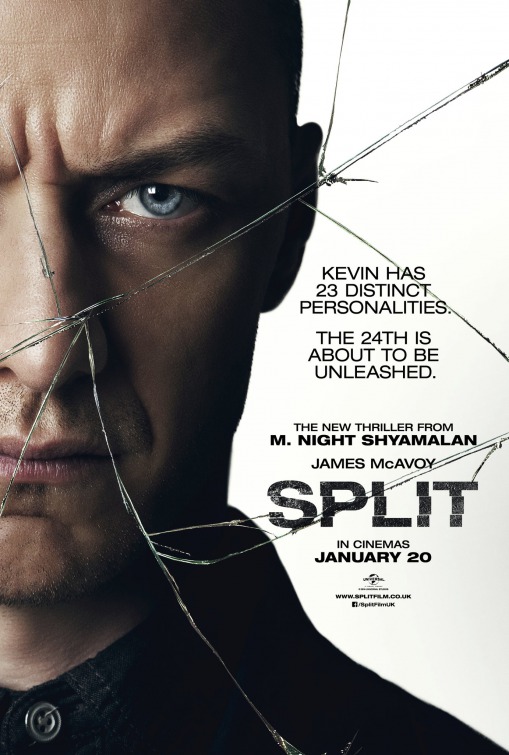
Split

(USA 2016)

Poor Kevin Wendell Crumb (James McAvoy). His mother (Rosemary Howard) abused him when he was a child, and he developed split personalities to deal with it. Now, he’s got a thing for watching underage girls dance naked. Dennis, the sternest of Kevin’s personalities, has asserted control and drives him to kidnap three teenage girls (Anya Taylor-Joy, Jessica Sula, and Haley Lu Richardson) leaving a birthday party at a lame Chuck E. Cheese place. He locks them up in a dungeon in his underground industrial hideout. Kevin is undergoing psychiatric care, but his doctor (Betty Buckley from Eight is Enough) senses something horribly amiss when she receives email from each of his 23 personalities seeking an urgent appointment. Kevin’s personalities prepare the girls for the arrival of “the Beast,” the last and most powerful personality. Only one of them is poised to survive.

WARNING: Potential spoilers ahead!

M. Night Shyamalan’s Split is, in a word, stupid. The story has potential, but it suffers a major breakdown pretty quickly. It’s more silly than scary. I found myself tracking horror movie clichés like a checklist and asking how many more can fit into the plot. I saw the so-called twists coming before they turned the corner. The reference to another movie at the end is mildly amusing, I guess, but not what I’d call clever. The parallel to one kidnapped girl’s childhood, shown in flashbacks, warrants a great big ‘whatever.’ The only thing Split has going for it is McAvoy, who emulates Jude Law doing an impression of Eminem impersonating Justin Timberlake. His characters are fun, particularly severe schoolmarm type Patricia (for whom McAvoy wears heels) and little boy Hedwig. However, even they get tiresome, coming off as a mishmosh of standup routines after awhile, like sticking all of the characters from Little Britain into one body.

I could make a lame comment about replacing “pl” with “h” in the title and getting a far more accurate name for this film, but I’ll just say I wasn’t impressed and leave it at that.

With Izzie Coffey, Sebastian Arcelus, Brad William Henke, Neal Huff, Bruce Willis

Production: Blinding Edge Pictures and Blumhouse Productions

Distribution: Universal Pictures

117 minutes
Rated PG-13

(ArcLight) D

http://www.splitmovie.com

Django Unchained

(USA 2012)

“The ‘D’ is silent, hillbilly!”

—Django

If anyone would take a stab at something that sounds as ridiculous and cringeworthy as tackling American slavery in a spaghetti Western, it’s Quentin Tarantino. “I want to do movies that deal with America’s horrible past with slavery and stuff, but do them like spaghetti Westerns, not like big issue movies,” he said, clearly referring to Django Unchained in a 2007 interview—five years before it came out. “I want to do them like they’re genre films, but they deal with everything that America has never dealt with because it’s ashamed of it.” (http://www.telegraph.co.uk/culture/film/starsandstories/3664742/Quentin-Tarantino-Im-proud-of-my-flop.html).

The title here references Sergio Corbucci’s 1966 film Django, an actual spaghetti Western in which the titular hero, a cowboy, is thrust into a row between Southern Klansmen and Mexican revolutionaries. In Django Unchained, the story starts in 1858—just a few years before the American Civil War. Django (Jamie Foxx) is a slave separated from his wife, the curiously named Broomhilda von Shaft (Kerry Washington), after they were caught trying to escape a plantation. He’s shackled to a group of slaves that the Speck brothers (James Remar and James Russo) are driving on foot to be sold.

Enter traveling dentist Dr. King Schultz (Christoph Waltz), a genteel German driving a wagon with a big wooden tooth on top of it. Schultz is actually a bounty hunter looking for the Brittle brothers—Big John (M.C. Gainey), Lil Raj (Cooper Huckabee), and Ellis (Doc Duhame)—who happen to be Django and Broomhilda’s former masters. He makes Django an offer he can’t refuse: help him find and kill the brothers, and Schultz will pay him, set him free, and help him find Broomhilda.

Django Unchained is structured in essentially three “episodes.” The first takes place in a one-horse town near El Paso, where Schultz provokes the ire of the townfolk, the sheriff (Don Stroud), and a U.S. Marshall (Tom Wopat). The second takes place on a plantation owned and operated by Spencer “Big Daddy” Bennett (Don Johnson—um, wow!). The last, longest, and most twisted takes place on another plantation in Mississippi, the bountiful Candie-Land, owned by charming but sadistic Calvin Candie (Leonardo DiCaprio) and operated by his shifty Uncle Tom house-slave, Stephen (Samuel L. Jackson).

Tarantino actually pulls off what he said he wanted to, and he does it quite well. Django Unchained could have been a really dark film like its immediate successor, The Hateful Eight. The two films have a lot in common. The tension—and there’s lots of it—built into the story is deliberately and profoundly slow in reaching a boil. Django Unchained certainly has Tarantino’s trademark violence, revenge theme, and liberal use of the ‘n’ word—116 times, a record for a film according to IMDB (http://www.imdb.com/title/tt1853728/trivia?ref_=tt_trv_trv). A few scenes are difficult to watch, the “Mandingo fight scene” being the worst for me. Unlike The Hateful Eight, though, the violence here is Tarantino’s typical flagrantly graphic cartoonish gore. He also shows a more conspicuous sense of humor—for example, Django and Broomhilda are ancestors of John Shaft of the Shaft franchise (https://www.google.com/amp/deadline.com/2012/07/django-unchained-a-shaft-prequel-so-says-quentin-tarantino-comic-con-301010/amp/).

Django Unchained is an unlikely and uncomfortable pairing of an ugly part of our collective past with absurdity, but it’s entertaining while still getting its point across: we’re still living with the aftermath. It’s the kind of film you mull over for a long time after you see it.

With Laura Cayouette, Jonah Hill, Walton Goggins, Dennis Christopher, Dana Gourrier, Nichole Galicia, Miriam F. Glover, Quentin Tarantino, Franco Nero, Russ Tamblyn, Bruce Dern, Misty Upham, Danièle Watts, Robert Carradine

Produced by The Weinstein Company, Columbia Pictures

Distributed by The Weinstein Company (North America), Sony Pictures Releasing (International)

165 minutes
Rated R

(iTunes rental) A-

http://www.unchainedmovie.com

The Handmaiden [Agassi]

(South Korea 2016)

“Where I come from, it’s illegal to be naive.”

—Sook-hee

I wasn’t sure what to expect from Park Chan-wook’s The Handmaiden [아가씨], but I’m glad I got to see it. One word: wow! A sexy, complex, and intriguing film to say the least, it’s a lavish visual and narrative cinematic experience. The trailer offers only a hint of what awaits.

Park wrote the screenplay, an adaptation of the 2002 novel Fingersmith by Welsh author Sarah Waters, with frequent collaborator Chung Seo-kyung. They change the setting from Victorian Era Britain to 1930s Korea when it was under Japanese colonial rule before the end of World War II. Confession: I did not read the book. The change is brilliant, though, resulting in something far more tense, exotic, and erotic than I imagine it would have been had they stuck to the original concept.

The Handmaiden is a cutthroat tale of power, sex, and deception in the same vein as Dangerous Liasons, though by no means is it the same story. The title refers to “Tamako” (Kim Tae-ri), a young common girl hired to serve as a maid to mysterious Japanese heiress Lady Hideko (Kim Min-hee). Lady Hideko’s authoritarian Uncle Kouzuki (Jo Jin-woong) runs the household, which has a crazy library of antique erotica and a basement used for punishment. The atmosphere is abusive and weird. So much so, in fact, that Lady Hideko’s aunt committed suicide—and she still hears her voice at night.

WARNING: Potential spoilers ahead!

“Tamako” has a secret: she’s really Sook-hee, a master pickpocket from a long line of con artists. Sook-hee is working with Fujiwara (Ha Jung-woo), a dashing con man, on an elaborate scam to bilk Lady Hideko out of her fortune. Fujiwara, posing as a Count, is wooing Lady Hideko into marriage, after which he plans to commit her to her an insane asylum and take off with her money. Fujiwara has a secret, too: he’s double dealing with Lady Hideko, who wants to get away from her uncle. Their plot involves getting married, cashing out her inheritance, and committing her illiterate maid under her name, after which Lady Hideko assumes the identity of “Tamako”—while keeping her money, of course.

The best-laid plans of mice and men gang aft agley, and nothing here is what it seems. Things get interesting and go another route when the two women’s relationship takes a sexual turn, and they like it.

The Handmaiden is an example of near perfect execution. The beginning and end are a little slow, but what’s in between is well worth the slightly draggy bookends. Divided into three parts, it tells the story from the different perpectives of the three scammers. We get more information with each part, and just when it looks like we know what’s coming—bam!, the proverbial rug is pulled out from underneath and the narrative goes somewhere else. The characters are really complex, and the acting here is excellent. The sex scenes are sensual but often have a humorous undertone. Chung Chung-hoon’s cinematography is rich and layered with thoughtful camerawork that adds a nice voyeuristic touch to the whole film, liberally using long shots and peeking through doors and around screens. This is a film you can easily get lost in.

144 minutes
Not rated

(Gene Siskel Film Center) B+

http://www.handmaidenmovie.com/showtimes