Ulysses (Luka Kain) is a quiet, delicate teen who lives in Queens and is just starting to figure out his sexual identity — it involves wearing panty hose under his jeans. When his father dies, he becomes the “man of the house.” Unfortunately, his mother (Margot Bingham), who works all the time, is already on edge because she caught him wearing her clothes. Ulysses shares a bedroom with his younger brother, Abe (Jaylin Fletcher), who knows that he’s still rummaging through mom’s closet on the sly and gives him shit for it. School is no respite because Ulysses’s classmates are jerks.
Enter stern Aunt Rose (Regina Taylor) to help at home while mom is away at work. She takes charge, usurping Ulysses and his mother as the master of the domain. She’s not about to have a dress-wearing freak around, so she pushes Ulysses toward the one cure she knows: the Lord.
Ulysses escapes to the Christopher Street Pier, where he meets a gang of “drag queens”: Ebony (MJ Rodriguez), Dijon (Indya Moore), and Heaven (Alexia Garcia). They take him to “Saturday Church,” a space in Greenwich Village where one night a week trans mother hen Joan (Kate Bornstein) offers a meal, a shower, clothes, perhaps a spot to vogue, and companionship to homeless LGBTQ kids. This is where Ulysses finds his groove.
Too bad mean Aunt Rose is waiting for him to come home.
Damon Cardasis’s first feature length film is a winning mix of Moonlight (https://moviebloke.com/2016/11/19/moonlight/ ), La La Land (https://moviebloke.com/2016/10/13/la-la-land/ ), and Tangerine (https://moviebloke.com/2015/07/28/tangerine/ ) with just the right splash of Paris is Burning (https://moviebloke.com/2016/08/26/paris-is-burning/ ). Saturday Church has some shortcomings, but the film oozes so much charm and warmth that I found it easy to forgive its flaws. Some of the songs and dance numbers are better than others — the song in the locker room and the other with Ulysses singing to his new boyfriend (Marquis Rodriguez) as they walk to the train stand out, especially when flower petals start falling. It’s really cool.
The acting is really good all around, but Kain is particularly awesome. He gives palpable tenderness and vulnerability to his character. The so called “drag queens” are not just fierce but downright touching. The way they save Ulysses is sweet. They make you long for a friend who has your back like they do. The story here totally sold me. I look forward to what’s next from Cardasis.
With Stephen Conrad Moore, Peter Y. Kim, Evander Duck Jr.
Production: Spring Pictures, Round Films
Distribution: Samuel Goldwyn Films
Screening introduced and followed by a live Q and A with Damen Cardasis
Richard “Dick” Nugent (Cary Grant) is a dashing, self-absorbed playboy charged with inciting a brawl at a nightclub. A self-employed artist, he shows up late for his hearing before priggish Judge Margaret Turner (Myrna Loy), who’s put off by his casual indifference. Nevertheless, she dismisses the case when she sees that the whole thing started with two floozies (Veda Ann Borg and Carol Hughes) fighting over him. With a slam of her gavel and an eyeroll, she sends Dick on his way, warning him to watch himself.
A free man, Dick heads straight to his next appointment: he’s the guest lecturn at a high school where Margaret’s dramatic 17-year-old sister, Susan (Shirley Temple), is a student. She attends the lecture, and is immediately smitten. Susan approaches Dick afterward and offers to, err, model for him. He’s noncommittal, clearly unaware that he’s dealing with a determined gal.
That evening, Susan gets all dolled up and sneaks out to Dick’s apartment, a spacious two-story downtown suite I’d kill to have. He’s not home, but she persuades the young doorman (Ian Bernard?) to let her up so she can wait for him. Naturally, she falls asleep on the davenport.
A big misunderstanding leads to Dick punching Margaret’s date, district attorney Tommy Chamberlain (Rudy Vallee), when they show up at his apartment to rescue Susan soon after he gets home and discovers her there. Dick is sent to the slammer, where court psychiatrist Dr. Matt Beemish (Ray Collins)—Margaret and Susan’s uncle—figures out what’s up. The good doctor proposes a “simple” solution: Dick agrees to date Susan, Margaret agrees to allow Susan to date Dick until her infatuation runs its course, and Tommy agrees to drop the assault charge. All three grudgingly agree to the plan. Hilarity ensues, especially as Dick and Margaret start digging each other—and Susan proves to be a real pain in the ass.
Penned by future TV creator/writer Sidney Sheldon (The Patty Duke Show, I Dream of Jeannie, and Hart to Hart), The Bachelor and the Bobby-Soxer is a solid textbook screwball comedy. It actually feels like a sitcom. Sheldon won an Oscar for Best Original Screenplay for this (https://www.oscars.org/oscars/ceremonies/1948), and I can see why: his script is light and fun, capitalizing on the generation gap between youth culture and, I guess, middle age. I doubt the story would fly today; the whole premise reads as creepy by 21st Century standards. For a more innocent time, though, it totally works. And it’s amusing.
Director Irving Reis straddles the line between silly and ridiculous without going overboard. Grant, Loy, and Temple all have better work under their belt, but each still gives a memorable performance here even if their characters and this fluffy film are forgettable. I heard some grumbling from others in the audience, but I enjoyed this for what it is—and it ain’t Citizen Kane.
One final word about the nitrate print I saw: it was stunning, exceeding my expectations. I had my doubts that black and white film would make me sing the praises of nitrate, but The Bachelor and the Bobby-Soxer made me a believer; the whites were luminescent and the blacks and greys were deep and complex. Lovely!
With Lillian Randolph, Harry Davenport, Johnny Sands, Don Beddoe, Dan Tobin, Ransom Sherman, William Bakewell, Irving Bacon, Dore Schary
High school senior track star Kevin (Graham Rogers) is livin’ the dream in his Mississippi small town: he’s handsome, athletic, and setting records in the state. He and his girlfriend, sweet Ellie (Stefanie Scott), are working on a way to end up in the same city for college next year so they can be together.
Kevin’s happiness implodes after a track meet one Saturday in the fall: his coach (Tim Roth) loses control of the bus carrying his entire team, which leads to an accident that kills everyone on board—including Ellie, who happens to be his coach’s daughter. The only reason Kevin isn’t on the bus is because he has to go somewhere with his parents after the meet.
Kevin deals with his grief and his guilt by running—a lot. And hard. He quickly discovers that he can “communicate” with Ellie during the runner’s high he gets toward the end of a sustained, hard run. The chance to be with her again makes him run faster and faster, more and more.
For some reason—maybe his whole class was on the track team, I don’t know—Kevin switches schools. His new principal (Peter Coyote) coerces him into joining the track team, and he participates grudgingly. Kevin doesn’t like his new school, his new coach (Billy Crudup), or Henny (Liana Liberato), the girl who follows him everywhere. On top of that, a running rival (Thomas Cocquerel) is giving him shit. It’s all getting in the way of his time with Ellie.
Based on Jeremy Jackson’s Life at These Speeds: A Novel, 1 Mile to You is not what I expected. It’s an underwhelming melodrama disguised as a sports tragedy. The plot is somewhat promising and the film has a few good scenes, but the story lacks intensity. I’m not sure whether the problem is Marc Novak’s screenplay or Leif Tilden’s directing, but the characters don’t fully develop and Kevin’s catharsis is given shallow treatment. The whole thing is dull. Plus, the special effects that tell us Kevin is in his trance are, in a word, cheesy.
Tilden has a lot of talent to work with, but he underutilizes everyone except Rogers and maybe Crudup. While I won’t be surprised to see Rogers in bigger and better things in the future, 1 Mile to You did not impress me.
With Melanie Lynskey, Ty Parker, Peter Holden, Elizabeth Canavan, Jaren Mitchell, Casey Groves
A line from an old Billy Idol song (“Hole in the Wall”) appropriately sums up the plot of playwright Ian MacAllister-McDonald’s charming and touching debut feature film Some Freaks:
“We were such an ugly pair,
The chameleon twins they’d stop and stare.
Lovers know when love has gone.
A black hole there where love was once the end.”
Rhode Island high school senior Matt Ledbetter (Thomas Mann), who has the unflattering nickname “Cyclops” because of the patch he wears over his fucked up eye, doesn’t fit in with his classmates. Awkward and unpopular and literally a freak, his only friend is schlubby neo-maxi-zoom-dweebie gay motormouth Elmo (Ely Henry), who seems eager to blow just about any guy—not that any guy is ever going to let him. Lucky Matt gets to hear all of Elmo’s fantasies in graphic detail as they play video games. Yipee.
A chubby new girl (Lily Mae Harrington) in thrift store clothes and green-streaked hair flirts with Matt in biology class. Matt doesn’t know what to make of her, but he’s obviously intrigued even though he’s all shy about it. She turns out to be Elmo’s cousin Jill, who’s staying with his family for the school year after some trouble at home in Oregon.
Jill and Matt get off to a rocky start when she overhears him crack a fat joke about her to Elmo. Despite her tough facade, cynical and insecure Jill is forgiving—she has no choice because she has a thing for Matt. The three of them start hanging out. To Elmo’s dismay, Matt and Jill fall for each other and start dating.
WARNING: Potential spoilers ahead!
The end of high school brings about a quandary neither starcrossed lover anticipated. Jill gets into college out West, leaving Matt behind on the East Coast. Thus begins their long distance relationship. They lead separate lives and make similar changes without telling each other: Matt gets a glass eye and starts working out while Jill gets a new wardrobe and goes on a diet. Suddenly normalized, Matt goes to a party and hits on chicks while Jill attracts the attention of frat boy hottie Patrick (Lachlan Buchanan), who went to high school with her. His mean girl pals were not very nice.
Matt and Jill’s metamorphoses clash when he visits her six months later and they discover that their natural connection is now strained and forced. What’s worse, they bring out something ugly in each other. Is this the death knell for their relationship?
Written and directed by MacAllister-McDonald, Some Freaks is impressive even with its flaws, especially for a first time full length feature. The story and the characters recall John Hughes and Todd Solondz, but this is by no means mere imitation or an update of either. I like MacAllister-McDonald’s straightforward and unsentimental view. Yes, much of what happens here is predictable; however, there are enough twists that I didn’t see coming to keep it interesting if not fresh. The actors put a lot of heart into their characters, and it shows—even Buchanan, whose Patrick is underdeveloped and not entirely believable.
I happened to see Some Freaks on April Fool’s Day with my teenage nephew. All things considered, I couldn’t have planned it better.
With Marin Ireland, John Thorsen, Sylvia Kates, Devon Caraway, Brian Semel, Nikki Massoud, Stephen Thorne, Shannon Hartman
Production: Half Jack Productions, Mountview Creative
Distribution: Good Deed Entertainment
Screening followed by a live Q and A with Ian MacAllister-McDonald, Lily Mae Harrington, and Ely Henry
Center of My World, director/screenwriter Jakob M. Erwa’s adaptation of German author Andreas Steinhöfel’s 1998 novel for young adults, is not a home run. Fortunately, though, Erwa knows how to extract enough charm, particularly from its two main actors, to downplay its shortcomings and proffer a respectable and enjoyable film.
17-year-old Phil (Louis Hofmann) lives with his mercurial, flighty mother, Glass (Sabine Timoteo), and his twin sister, Dianne (Ada Philine Stappenbeck), in a gorgeous house on the outskirts of town. This family isn’t exactly The Brady Bunch: Phil is gay, Dianne supposedly communicates with animals, and Glass can’t commit to a partner for very long. She won’t even tell her kids who their father is.
Phil notices some friction between the women of the house after he returns from summer camp. When school starts, his best friend, Kat (Svenja Jung), encourages him to go after mysterious new guy Nicholas (Jannik Schümann), a dreamy transfer student who looks like a cuter blue-eyed version of Lance Bass with his chiseled cheeks, luscious lips, and perfect hair. Supposedly, he likes boys. Phil finds out for sure in the locker room one afternoon—and it leads to a passionate affair, insecurity, and a weird bout of jealous competition with Kat.
Center of My World is a cute and engaging story. Erwa does a nice job showing how any kid, gay or otherwise, has a lot to deal with when it comes to sexuality. The Chaun Ngo’s cinematography is well done, employing a bright color pallette verging on artificial that plays really well against the small town setting with all its gardens and summer greenery. The acting is generally good. Schümann is really easy to just…gaze upon, I guess, but in a harmless Teen Beat way.
All that said, Center of My World would have been a much gutsier film, say, 15 years ago. It probably would have made a bigger impact then, too. It contains hints and echoes of things I’ve seen before. The characters are a bit hollow; some of them come off as half-baked, rendering their importance to the story tenuous or questionable. These two boys have sex a lot, which is great. However, the sex scenes here need work even with the full frontal we get. More in-your-face than sexy, they come off as gratuitous. I don’t know if Erwa was trying to be shocking, but it didn’t work if he was. It’s like watching two puppies go at it. I hope that’s not the intended result.
With Inka Friedrich, Sascha Alexander Geršak, Thomas Goritzki, Nina Proll, Clemens Rehbein
Production: Neue Schönhauser Filmproduktion, Prisma Film, Universum Film, mojo:pictures, Westdeutscher Rundfunk, Bayerischer Rundfunk, ARTE, Österreichischer Rundfunk
“Has he ever told you about his friend Frank, the giant bunny rabbit?”
—Dr. Lilian Thurman
“Every living creature on earth dies alone.”
—Grandma Death
Donnie Darko, a period piece set during a time I remember quite well—October 1988, the second full month of my college freshman year and the height of the Bush-Dukakis presidential election—has a great moody soundtrack that includes the likes of Tears for Fears, Joy Division, the Church, Duran Duran, and of course Echo and the Bunnymen. Even if it would have stuck out like a sore thumb, a song more fitting with the theme would have been Cher’s “If I Could Turn Back Time.”
October 2, 1988: troubled and highly medicated loner Donnie Darko (Jake Gyllenhaal), a middle class teen in suburban Middlesex, Virginia, sleepwalks outside of his house and meets Frank (James Duval), a new “friend.” Frank is a guy in a creepy rabbit suit—he looks like he was plucked from the cover of a heavy metal album. Frank tells Donnie that the world is coming to an end—in exactly 28 days, 6 hours, 42 minutes, and 12 seconds.
Thus begins the apocalyptic timewarping adventure of Donnie Darko. After being rudely awakened on a golf course the next morning, Donnie lumbers home in a daze to discover that a jet engine fell from the sky and crashed into his bedroom. His family, obviously already having assumed the worst, is shocked but relieved to see him approaching from the street—except maybe his mother (Mary McDonnell). Federal investigators can’t trace where the engine came from.
At school, a new student, Gretchen (Jena Malone), interrupts Donnie’s English class—taught by the young and snarky Ms. Pomeroy (Drew Barrymore). They’re discussing their reading assignment, Graham Greene’s short story “The Destructors.” Gretchen asks where she should sit, and Ms. Pomeroy directs her “next to the boy you think is the cutest.” Gretchen sits next to Donnie. Duh!
Donnie and Gretchen dig each other, which is a ray of light to his psychiatrist, Dr. Thurman (Katharine Ross). The doctor has been concerned about Donnie’s “hallucinations” of Frank, as well as some of his erratic behavior. Donnie is growing more and more obsessed with a senile elderly neighbor he and his friends nicknamed “Grandma Death” (Patience Cleveland) and a book about time travel. Everything comes to a head at a party Donnie and his sister Elizabeth (Maggie Gyllenhaal) throw while their parents are out of town on Halloween—which is 28 days from where this all started.
Simultaneously funny, foreboding, weird, and utterly thought-provoking, I can see why Donnie Darko has the following it does. Director and screenwriter Richard Kelly comes up with something unlike anything else I’ve ever seen. It’s a winning mix of teen comedy, science fiction, and fantasy. I caught an anniversary screening with my nephew, and this film is as fresh as when I first saw it in 2002. Loaded with indelible imagery, symbolism, ’80s pop cultural references, and clever narrative loopbacks, I find Donnie Darko‘s greatest asset to be its open-ended mystery; what exactly happens is left for the viewer to figure out. A quick Google search pulls up ample musings of the meaning of this film. I’ve seen this a few times, and I’m not sure.
Aside from the plot, the characters and the casting are terrific. Both Gyllenhaals are great, and you can actually see they’re both destined for more. Patrick Swayze is awesome as motivational speaker Jim Cunningham, but Beth Grant takes the cake here as passive-aggressive bitch Kitty Farmer. Oh yeah, this is also Seth Rogen’s first onscreen role—see if you can spot him.
“I’m the idiot, you’re the screw up, and we are all losers,” sums up Empire Records general manager Joe (Anthony LaPaglia) when he realizes that clerk Lucas (Rory Cochrane) blew the store’s receipts in Atlantic City the night before, which incidentally was the first time Joe let him close shop. His heart was in the right place: Lucas wanted to raise capital to buy the store before owner Mitchell (Ben Bode) sells it to a lame corporate chain called Music Town. Empire Records, you see, is more than a retail outlet: it’s a haven for floundering misfits, including a young shoplifter (Brendon Sexton) who goes by “Warren Beatty.”
Empire Records was a box office bomb (http://www.boxofficemojo.com/movies/?id=empirerecords.htm). Carol Heikkinen’s script is earnest in its desire to (I guess) reveal some revelation about ’90s youth, but the plot is all too predictable, coming off as a third-rate The Breakfast Club. The cast, though, is impressive; loaded with professionals (Debi Mazar and Maxwell Caulfield) and future stars like Renée Zellweger and Liv Tyler, the actors collectively ooze a credible chemistry. Director Allan Moyle pulls some decent performances out of them. A playfully snarky sense of humor about American culture pervades this film, evident in such nifty devices as “Rex Manning Day” and a dream sequence involving Gwar.
Empire Records is very much a product of its time, but that’s what makes it interesting to watch now. This no doubt is why it was selected as the third screening of Chicago International Film Festival’s Totally ’90s series.
With Robin Tunney, Johnny Whitworth, James “Kimo” Wills, Ethan Embry, Coyote Shivers
Production: Monarchy Enterprises B.V., New Regency Pictures, Regency Entertainment, Warner Brothers
“All the best people have bad chests and bone diseases. It’s all frightfully romantic!”
—Juliet Hulme
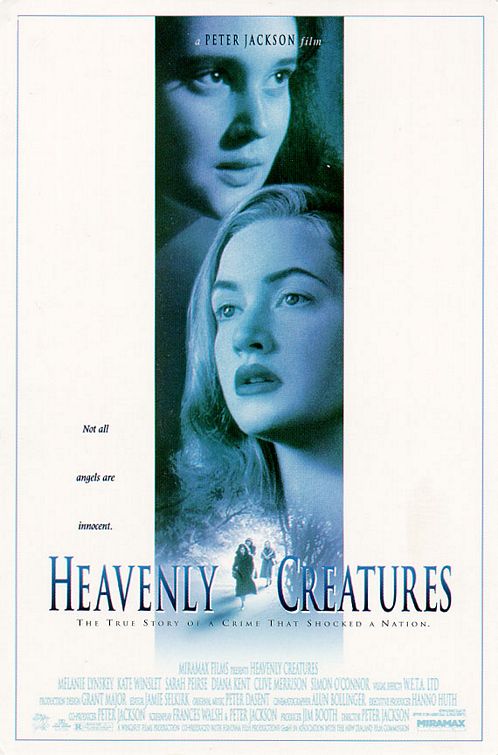
Forget Lord of the Rings—Heavenly Creatures is Peter Jackson’s coolest film. Before big budget Hollywood blockbuster fantasy franchises, the New Zealand filmmaker wrote, produced, and directed offbeat small-scale gore and porn comedies like Bad Taste (1987), Meet the Feebles (1989), and Dead Alive (1993). I’d already seen that last one by the time Heavenly Creatures came out for a limited run (in the States, anyway) in the fall of 1994. I assumed it would be another messy splatterfest—described to me as a “lesbian murder flick,” what would you think? Turns out, that’s not quite what it is.
Far more than a “lesbian murder flick” or even a brilliant stepping stone to bigger and better things, Heavenly Creatures represents a turning point in Jackson’s career. It’s a rare example of flawless execution across the board. He brings together every element—narrative, character development, casting, visuals, special effects, dialogue, period costumes and sets—to create a real humdinger.
Christchurch, New Zealand, 1952: 14-year-old Yvonne Reiper (Melanie Lynskey), who goes by “Pauline,” is a messy-haired, brooding loner at an all-girl high school. In her first scene, she’s wearing a big scowl on her face at an assembly, not singing along with the rest of her classmates—not until the school’s headmaster (Darien Takle) catches her gaze and snaps her into line with a widening of her eyes. Pauline’s father (Simon O’Connor) manages a grocery market and her mother (Sarah Pierse) runs a room and board for college students out of their home.
WARNING: Potential spoilers ahead!
A new student is introduced during French class: Juliet Hulme (Kate Winslet), the privileged daughter of a reknown college professor (Clive Merrison) and a psychologist (Diana Kent). Juliet, who proclaims she’s “actually from England” and chooses the French name “Antoinette,” captures Pauline’s attention when she insults the teacher, Miss Waller (Elizabeth Moody), unleashing a hilarious hissy fit. The scene is, in a word, awesome to watch play out. Right after that, their art teacher, Mrs. Collins (Liz Mullane), pairs the girls for an assignment that Julia disregards; instead, she draws dragon-slaying St. George, depicting him in the likeness of Mario Lanza, “the world’s greatest tenor!” She doesn’t get around to drawing Pauline, her model. Mrs. Collins isn’t impressed, but Pauline is.
Thus begins the girls’ friendship. They bond over their similar pasts involving childhood disease and extended hospital stays, a penchant for drama, and a mutual distaste for their peers (and perhaps social issues that leave a void). Juliet is mischievous and romantic, which softens Pauline and gets her to open up. Sitting out gym, they giggle over sexy WWII pulp novels. They bike through the woods and strip to their underwear, dancing and singing. They hug a bum (played by Jackson himself) on the street. They hold weird rituals for celebrities they like. They make Plasticine models, write stories, and devise an elaborate royal family tree, building around themselves a fantasy medievalesque kingdom called Borovnia where all its inhabitants worship them. Their imaginary world blurs the bounds of reality as their friendship intensifies.
A string of troubles arises that threatens to separate Pauline and Juliet: tuberculosis, an extramarital affair, a divorce, South Africa, and a medical diagnosis of incurable homosexuality. The girls decide to run away to America, but they can’t secure a passport for Pauline. They devise another scheme to stay together, but it’s a risky one: kill Pauline’s mother.
Heavenly Creatures starts out sweet—it’s something of a typical teen movie at first—but it does a complete turnaround. Based on actual events, Jackson wrote the screenplay with Frances Walsh; the real story is sad but compelling, and the script is tight. The casting—married couple John and Ros Hubbard and the aforementioned Mullane—is genius: every single actor is terrific in his or her part, even the minor ones, and it makes Heavenly Creatures all the richer. Many of them turn up in Jackson’s later projects.
Lynskey and Winslet own their characters; I can’t imagine anyone else in their roles. They’re charming, silly, histrionic, desperate, deranged, and ultimately “stark raving mad”—and they portray all of it exceptionally well. They manage to keep the homosexual subtext from getting out of hand. You can tell from Winslet’s first scene—she walks in with that crazy look on her face—that she’s destined for more. She became a star after Heavenly Creatures in a way that Lynskey didn’t, but both are mesmerizing.
The scenes in Borovnia and the Fourth World are nothing short of spectacular. Actually, many of the visuals here are burned into my memory. Alun Bollinger’s camerawork and bleached palette lends a lovely dreamlike quality. Once things start to unravel for these “nice” girls, the whole thing shifts to a darker, more sinister tone. It’s an emotional downward spiral to the end—those splatter films serve Jackson well.
Heavenly Creatures hasn’t lost its luster after nearly 25 years. I lost track of how many times I’ve seen it, yet it continues to suck me in every single time. It’s one of my favorites.
With Gilbert Goldie, Jed Brophy, Peter Elliott, Kirsti Ferry, Ben Skjellerup, Jean Guérin, Stephen Reilly, Jessica Bradley, Alex Shirtcliffe-Scott
Production: WingNut Films, New Zealand Film Commission
As teen comedies go, the ’90s were a teenage wasteland. Sure, there were a few classics: Dazed and Confused, Clueless, Election, and American Pie immediately come to mind. That’s really about it. Can’t Hardly Wait, the second film of Chicago International Film Festival’s Totally ’90s series, is a typical specimen from the decade: it has some moments, but overall it’s either bland or reductive. Frankly, I don’t even remember it in theaters, which probably says all I need to know.
The setting is a huge kegger in a Los Angeles suburb the night of graduation. Leading man Preston Meyers (Ethan Embry), a sensitive dork, has longed for class babe Amanda Beckett (Jennifer Love Hewitt) ever since he first laid eyes on her during freshman year: he knew they were destined to be together when he noticed the same strawberry Pop Tarts in her bag that he had in his. She went for Mike Dexter (Peter Facinelli), a jock, instead; they dated all through high school. Word on the street is, Mike dumped Amanda. Intrigued, Preston persuades his snarky and derisive bestie Denise Fleming (Lauren Ambrose), certainly no woo-woo girl, to accompany him.
Meanwhile, class geek William Lichter (Charles R. Korsmo), who looks like a deranged Harry Potter, shows up to exact revenge against Mike, his lifelong nemesis. Mike, who dumped Amanda so he could be free to sleep around all summer, isn’t having fun—he’s preoccupied reconsidering his decision. While Preston chases after Amanda to give her a letter in which he spills his guts, Denise gets locked into a secluded bathroom with wannabe gangsta/raver Kenny Fisher (Seth Green), who wears big sneakers and goggles and thinks he’s a stud but isn’t.
Co-directors and screenwriters Harry Elfont and Deborah Kaplan clearly watched a ton of ’70s and ’80s teen flicks. They have good ideas, but I’ve seen them done before and done better. The only storyline that really interested me was the one with Denise and Kenny in the bathroom. And I love Seth Green. Other than that, the situations and the dialogue here lack any snap or punch. It’s all pretty flat.
This is not to say I hated Can’t Hardly Wait; I didn’t. I just didn’t love it. It was merely okay. I consider myself a teen movie aficionado, and this did not move me. The soundtrack is way better.
With Michelle Brookhurst, Alexander Martin, Erik Palladino, Channon Roe, Sean Patrick Thomas, Freddy Rodríguez, Joel Michaely, Jay Paulson, Jason Segel (in his first appearance onscreen), Selma Blair, Jerry O’Connell
Production: Columbia Pictures Corporation, A Tall Trees Production
“Searching for a boy in high school is as useless as searching for meaning in a Pauly Shore movie.”
—Cher Horowitz
The first screening of Chicago International Film Festival’s Totally ’90s series is Clueless, a sort of link between ’80s classics like Valley Girl and Heathers and later films like Election, 10 Things I Hate About You, Mean Girls, and even Fox’s current television series Scream Queens. Adapted from Jane Austen’s Emma, which I haven’t read and probably never will, Clueless transmits the novel’s heroine across time and space from outside London in the early Nineteenth Century to Beverly Hills in the late Twentieth. It’s a cute idea that works—I didn’t know until this screening that the story is 200 years old. As if!
“Hymenally challenged” (i.e., virgin) 16 year old California girl Cher Horowitz (Alicia Silverstone) is vain, popular, and rich. Perhaps not surprisingly, she’s incredibly superficial, even if she means well. Her mother died in “a freak accident during a routine liposuction,” leaving her father, brass-balled Type A litigator Mel (Dan Hedaya), to raise her. When Cher gets a bad report card, she enlists her bestie Dionne (Stacey Dash), a hip black version of herself, to help fix up two nerdy tough-grading teachers, Mr. Hall (Wallace Shawn) and Miss Geist (Twink Caplan). Her plan is simple: she wants to get them laid so they’ll chill out and be receptive to negotiating her grades. Meanwhile, Cher adopts a new student, “tragically unhip” druggie tomboy Tai (Brittany Murphy) as a pet project: Cher plans to make Tai more like Cher. Duh. Semi-crunchy, socially conscious stepbrother Josh (Paul Rudd) does not approve of Cher’s antics.
Written and directed by Fast Times at Ridgemont High‘s Amy Heckerling, Clueless feels like an ’80s throwback, but it’s still a lot of fun. Loaded with great zingers and one-liners, I laughed a lot. It also has a ton of references to ’90s pop culture that clearly date the film (Luke Perry? Snapple? A Cranberries CD?! Egads!). Clueless lacks a ceratin bite that makes “mean girl” flicks so, well, biting. I guess a large part is because Cher and Dionne aren’t really mean girls; they’re actually pretty naive. After all, it takes Cher awhile to figure out that Christian (Justin Walker), the guy she lusts after, is a friend of Dorothy. Hello?
With Julie Brown, Jeremy Sisto, Breckin Meyer, Donald Faison, Elisa Donovan









 moviebloke