Love & Anarchy [Film d’amore e d’anarchia, ovvero ‘stamattina alle 10 in via dei Fiori nella nota casa di tolleranza…’]

(Italy/France 1973)

The premise of Lina Wertmüller’s Love & Anarchy [Film d’amore e d’anarchia, ovvero ‘stamattina alle 10 in via dei Fiori nella nota casa di tolleranza…’] has the ring of something from Federico Fellini or maybe Pedro Almodóvar (though Fellini makes a lot more sense because she actually worked as his assistant for a spell).

Freckly yokel farmer Tunin (Giancarlo Giannini) learns that his friend was murdered. Why? Because he was an anarchist who was plotting to assassinate “ll Duce” Benito Mussolini. What’s more, Mussolini’s fascist police killed him. To avenge his friend’s death, Tunin takes up his cause.

Tunin ends up at a brothel in Rome. He spends a night with Salomè (Mariangela Melato), who reveals that she’s a co-conspirator for her own reasons. As the story progresses, it becomes clear that the coup is a harebrained idea.

Salomè takes Tunin to a rural spot just outside Rome with her and another prostitute, Tripolina (Lina Polito). Salomè distracts Spatoletti (Eros Pagni), the head of Mussolini’s police, while Tunin checks out the area; they then devise a plan to execute the mission.

Meanwhile, Tunin and Tripolina fall in love. Convinced that he isn’t going to make it past the assassination alive, he persuades Tripolina to spend the next two days with him.

The same radical spunk that Wertmüller exhibits in The Seduction of Mimi is just as prevalent in Love & Anarchy; this film is loaded with decadent, sexy hijinks. However, it also its share of some really tender moments—that surprised me. Love & Anarchy turns out devastatingly sad—I left the theater literally bummed out. For all its ridiculous sociopolitical and sexual shenanigans, it’s a far more powerful film.

With Pina Cei, Elena Fiore, Giuliana Calandra, Isa Bellini, Isa Danieli, Enrica Bonaccorti, Anna Bonaiuto, Anita Branzanti, Maria Sciacca, Anna Melato, Gea Linchi, Anna Stivala, Roberto Herlitzka

Production: Euro International Film, Labrador Films

Distribution: Peppercorn-Wormser, Kino Lorber

120 minutes
Not rated

(Gene Siskel Film Center) B

https://www.kinolorber.com/film/view/id/1306

The Seduction of Mimi [Mimì metallurgico ferito nell’onore]

(Italy 1972)

I never heard of Lina Wertmüller until a retrospective of her work showed at a theater near me. The Seduction of Mimi [Mimì metallurgico ferito nell’onore] is an excellent starting point because it’s a textbook example of her style and the themes that inspire her. Plus, it’s an entertaining movie.

Mimi (Giancarlo Giannini) is a laborer in Sicily. His trouble begins after he votes for the communist candidate in a local election—his employer has been pushing its employees to vote for the mafia candidate. The ballot is supposed to be secret, but Mimi learns that it isn’t when he’s fired. Fearing that things will get complicated, he leaves his wife, Rosalia (Agostina Belli), behind and skips town.

Mimi ends up in Turin, where he finds work on an illegal construction site. He witnesses an on-the-job fatality and proves to be a problem when he learns that the mafia bosses running the job plan to dump the body. To keep him quiet, they place him in a union job at a factory.

It isn’t long before Mimi meets the alluring Fiorella (Mariangela Melato) selling sweaters on the street. He’s hooked on her; in fact, he knocks her up and she gives birth to a son. This is where The Seduction of Mimi gets really fun. Mimi is promoted to a management position back in Sicily. Naturally, he brings Fiorella and the baby with him. He’s protective of his new family and paranoid that Rosalia will find out about it, so he leads a thorny double life that…let’s just say doesn’t end well.

The Seduction of Mimi is rough, moving along like an episode of The Benny Hill Show. It’s compelling nonetheless because it has a certain elegance. Wertmüller is known for mixing sex, class, and politics. It’s a tricky feat, but she manages to pull it off while keeping The Seduction of Mimi totally amusing even by today’s standards. The stuff with the mafia and the gay rumor that gets out because Mimi won’t have sex with Rosalia are both hilarious. The whole revenge subplot that involves getting Amalia (Elena Fiore) pregnant is brilliant on so many levels, and that scene at the end where all of Mimi’s children clamor for him calling him “Papa!” is perfect. Giannini with his bug-eyed Chaplinesque faces looks crazy throughout this film, nicely underscoring the insanity of his situation. I smiled a lot during this film.

With Turi Ferro, Luigi Diberti, Tuccio Musumeci, Ignazio Pappalardo, Gianfranco Barra, Livia Giampalmo

Production: Euro International Film

Distribution: New Line Cinema (USA), Kino Lorber

121 minutes
Rated R

(Gene Siskel Film Center) B

https://www.kinolorber.com/film/theseductionofmimi

https://youtu.be/gI1C1gy-D1c

The Strike [Siréna]

(Czechoslovakia 1947)

Based on the novel Sirená by Marie Majerová, a communist and feminist Czech author prolific before World War II (https://en.wikipedia.org/wiki/Marie_Majerová), Karel Steklý’s The Strike follows the Hudcový family during a mine workers’ strike outside Prague in the late 19th Century. Hudec (Ladislav Boháč) is a sort of foreman at a mine. His job makes him miserable, which is apparent from his drinking. He finds himself caught between the mine’s owner and the discontented, sorely underpaid workers that include his son Rudolf (Oleg Reif). Hudec tries to straddle the line between the two but ultimately joins the workers when pushed by his determined wife, Hudcová (Marie Vásová), who seems like she’s always hungry. The cost is devastating, especially for their preteen daughter Emča (Pavla Sucha).

Though not as elegant, The Strike recalls Metropolis (https://moviebloke.com/2015/09/12/metropolis/) both thematically and visually. Jaroslav Tuzar’s stark and grimy cinematography nicely highlights the plight of the workers, and it looks great in black and white. Nothing here is nuanced, though: the narrative is coarse and blunt, the acting is total amateur hour, and the moral is in-your-face. Still, The Strike is remarkable for its earnestness; the workers plotting a revolt, their riot, and the town police and corrupt mayor (Josef Benátský) standing behind the mine over the workers certainly all ring true and timely. It kept my interest all the way through.

I never heard of Steklý or The Strike or anyone involved with this picture until I saw it 70 years after its release. I’m not sure it ever enjoyed international distribution—I can’t find a trailer for it—and I can guess why: a dour postwar propaganda film, it likely would have turned off audiences with its Reefer Madness-like approach to capitalism and communism that seems to argue for the latter. Viewing it today, I saw it as an eerily accidental warning of what happens when the middle class disappears.

With Josef Bek, Josef Dekoj, Nadezda Gajerová, Vera Kalendová Bedrich Karen, Lída Matousková

Production: Ceskoslovenský Státní Film

Distribution:

77 minutes
Not rated

(Dryden Theatre) C

Nitrate Picture Show

Exodus: Sounds of the Great Migration [Sounds of Exodus: An Ode to the Great Migration]

(USA 2016)

Chicago filmmaker Lonnie Edwards made some waves with his 2015 documentary A Ferguson Story, which delved into some of the events following Officer Darren Wilson’s deadly shooting of unarmed black teen Michael Brown in Ferguson, Missouri. The subject of Exodus: Sounds of the Great Migration isn’t as heavy or bleak, but it’s every bit as intriguing.

Exodus: Sounds of the Great Migration is a smooth, flashy short film that honors the music and dance forms that black Americans brought to other parts of the country, mostly industrialized cities, through the Great Migration from the South during the first half of the 20th Century. In just a few minutes, Edwards demonstrates how both assimilated into urban life and continue to shape modern culture. I couldn’t find credits, but the guy tap dancing in the stairwell stood out; his taps are downright melodious.

Production: 11 Dollar Bill

Distribution:

4 minutes
Not rated

(The Chop Shop/1st Ward) B

CIMMfest

https://www.soundsofexodus.com

Odyssey of a Dropout

(USA 1966)

Odyssey of a Dropout is a black and white educational film shot on 16-millimeter that dramatizes the plight of the American high school dropout. I’ve found only very limited information about it online, and none of it lists the cast or the crew. As far as I can tell, this film is not available anywhere, but you can view other films of the same ilk here:

https://archive.org/details/coronet_instructional_videos?sort=titleSorter

If these films are anything like Odyssey of a Dropout—and perusing the titles suggests they are—it’s worth a diversion. Appropriately, Odyssey of a Dropout follows one teenage boy through his day after he drops out of school. He meanders aimlessly, going from a diner to a park to a pool hall. He hasn’t told his parents or his girlfriend, and it doesn’t appear that he’s having any fun—which is precisely the point.

Melodramatic and totally moralistic, this heavyhanded little number does a great job painting a hopelessly dire picture for those who don’t finish high school. So, it serves its purpose even if it borders on propaganda. Aside from that, it’s a neat time capsule; loaded with exterior street scenes and youngsters clad in clothes of the day, it documents small town America in a visually authentic way. I’d like to find this and see it again.

Production: Coronet Films

Distribution: Coronet Films

18 minutes
Not rated

(The Auditorium at Northeastern Illinois University) B-

Chicago Film Society

Get Out

(USA 2017)

I caught the hype surrounding Jordan Peele’s first feature length film, Get Out, a comedy horror flick that takes on race—specifically, the dynamics of white power and black subordination. He wrote the script and directed the film. I went into Get Out with some doubt and maybe trepidation about how it might come off. The concept is one that seems too easy to go horribly sideways.

I guess if anyone can pull it off, it’s Peele—and I’m relieved to report that he succeeds. With an oddly compelling mix of Guess Who’s Coming To Dinner, Meet the Parents, Nightmare on Elm Street, and The Stepford Wives, he takes on the cultural idiosyncrasies of Caucasian cultural dominance within the constructs of a horror flick. He’s got a lot of points to make, and he gets them across in a sharp but entertaining way. Like the best horror movies, Get Out makes you squirm—but it does so on multiple levels.

New York City photographer Chris (Daniel Kaluuya) is black. His girlfriend, Rose Arlington (Allison Williams), is white. She invites him on a weekend getaway to her parents’ home in upstate New York because, well, it’s time for him to meet the fam. Chris agrees, going into it nervously and not without personal baggage. His hyperactive best bud, Rod (Lil Rel Howery), a TSA agent who always expects the worst, is not helping.

Rose’s parents are, like the quiet town where they live, nice. Or at least welcoming. Dean (Bradley Whitford) drops silly slang, affects a bizarre accent, and praises President Obama. Missy (Catherine Keener) is more direct, asking pointed questions in a weird attempt to get to know Chris. It’s awkward and doesn’t quite break the ice, but it’s harmless. Right?

The family’s two longterm servants, maid Georgina (Betty Gabriel) and gardener Walter (Marcus Henderson), carry themselves like they’ve had lobotomies. Rose’s younger brother, Jeremy (Caleb Landry Jones), is, um, aggressively complimentary to Chris. On top of it, the Armitages’ neighbors are not quite right, obsessed with Chris and his virility.

During the first part of Get Out, Peele keeps things light but lets a sense of creepy unease simmer. The laughs are there, but like all of the characters coming and going from the house, something is off. He makes a major shift in tone once Missy insists on hypnotizing Chris, ostensibly to help him quit smoking. What was innocuous up to now becomes nefarious.

Ultimately, the evil here is not a monster hiding under the bed, but rather something more obvious that exists in broad daylight. I could have done without the bloody finale, but it works in the context of the film; Peele plays with genre, so I see why it’s here. Either way, Get Out is a bold move that pays off.

With Stephen Root, LaKeith Stanfield, Ashley LeConte Campbell, John Wilmot, Caren Larkey, Julie Ann Doan, Rutherford Cravens, Geraldine Singer, Yasuhiko Oyama, Richard Herd, Erika Alexander, Jeronimo Spinx, Ian Casselberry, Trey Burvant, Zailand Adams

Production: Blumhouse Productions, Monkeypaw Productions, QC Entertainment

Distribution: Universal Pictures

104 minutes
Rated R

(ArcLight) B

https://www.uphe.com/movies/get-out

https://youtu.be/A2JbO9lnVLE

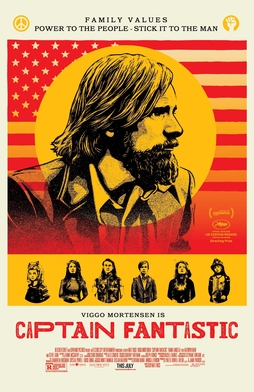
Captain Fantastic

(USA 2016)

Captain Fantastic came out last summer, and I wanted to see it then. I must confess, the cast interested me more than the plot.

Viggo Mortensen is the aptly named Ben Cash, a long disenfranchised survivalist who is, like, so over American capitalism and politics. He and his wife, Leslie (Trin Miller), shown almost entirely in flashback, decide to raise their six kids—three boys and three girls—off the grid in the mountain wilderness of Washington State. Removed from society, Ben and Leslie teach their kids everything from logic and philosophy to hunting and gathering to Norman Mailer and Guns ‘n’ Roses. They do it all without iPhones or religion. Kudos to that!

Nothing is perfect: Leslie suddenly dies, forcing Ben to take his feral kids into the outside 21st Century world for the first time, ever—which calls everything they planned for their family into question.

Director and screenwriter Matt Ross poses some interesting questions about society, conformity, and the social contract in a provocative and often lighthearted way. However, Captain Fantastic is not terribly surprising, which is why it doesn’t work as well as it could. At heart, it’s a standard fish out of water dramedy. Frankly, I spotted every “twist” coming before it got to me: the cop (Rex Young) who pulls over their Partridge Family van, the mildly blasphemous excuse that saves the day, the family’s visit to the supermarket, their reaction to their extended family (and vice versa), that lame scene in which Ben’s sister-in-law (Kathryn Hahn) calls him out onto the carpet for his choices and his youngest daughter (Shree Crooks) recites the Constitution to prove her wrong, eldest son Bo (George MacKay) proposing to the first girl who gives him attention—a trailer park teen queen (Erin Moriarty)—and the colleges he manages to get into, the “situation” that requires modern medical attention. Meh.

For all its grandiose intentions to take on the establishment, Captain Fantastic actually relies on a rather orthodox and pedestrian approach to make its point. Maybe that is its point, that you can’t escape society. It doesn’t mater: this story is predictable and sentimental, two things that never bode well. I expected more than Spokane Swiss Family Brady Bunch, which is essentially what this is. The one thing that saves this film from total mediocrity is the acting, which is great all around.

With Frank Langella, Ann Dowd, Samantha Isler, Annalise Basso, Nicholas Hamilton, Charlie Shotwell, Steve Zahn, Elijah Stevenson, Teddy Van Ee

Production: Electric City Entertainment, ShivHans Pictures

Distribution: Bleecker Street, Universal Pictures

118 minutes
Rated R

(iTunes rental) C

http://www.bleeckerstreetmedia.com/captainfantastic

Fences

(USA 2016)

The quintessential American dream home is usually depicted with a white picket fence surrounding it, the fence symbolizing a certain idyllic middle class coziness. That’s not what trash collector Troy Maxson (Denzel Washington, who doubles as director) sees when he imagines the fence he’s building in his backyard in 1950s Pittsburgh; his fence is more practical and nefarious, intended to keep his family in and his demons out.

August Wilson’s Fences starts out on a bright note: like Johnny Kemp, Troy just got paid and it’s Friday night. He’s walking home from work with his bestie, Bono (Stephen McKinley Henderson), for a drink in the backyard. Troy is jovial, recounting a confrontation with a superior (Christopher Mele) about his job assignment and singing the praises of his wife, Rose (Viola Davis). She takes a break from making dinner and steps outside, and he’s playful. All appears to be well.

The mood doesn’t stay bright for long: Troy gets mean when he drinks. The presence of his sons—Lyons (Russell Hornsby), a late-thirties jazz musician, and Cory (Jovan Adepo), a high school student—seems to worsen his mood. This is the Troy who occupies the rest of the story; he grows increasingly officious toward Cory after Rose tells him a college recruiter is wooing Cory with a football scholarship.

Troy is bitter, petty, and conflicted. He’s protective yet jealous of Cory; he loves Rose with all his heart, yet he betrays her in the worst way. Clearly a victim of circumstance, he exhibits the effects of a cycle of defeat: drinking, adultery, and resentment. Although Fences is not the same story, Troy has a lot in common with Willy Loman, the protagonist of Arthur Miller’s Death of a Salesman. Despite their societal differences, both characters failed to achieve the American dream and carry a weighty rancor because of it—the worst of it coming from within. Where Loman faces obsolescence, Troy faces never having reached a position in which he was valued in the first place. His big moment was playing baseball in the Negro league for a few years when he was young; he never had an opportunity to move onto the majors because, he says, the nation just wasn’t ready for it (don’t even bring up Jackie Robinson).

Fences is very much about the drama inside the characters rather than around them. Washington, who with Davis performed the play on Broadway in 2010, takes a straightforward approach. Aside from some period sets and costumes, he foregoes frills in favor of character and dialogue. As a result, Fences is like watching a play; the slow pace and relative lack of action will not appeal to everyone, but the intensity of the performances—every one of them rock solid and (ugh, I really hate this word, but it’s accurate) electrifying—is all I need.

Race is inextricable from Troy’s story, but Fences digs deeper than that. An awful lot is going on here—themes of family, duty, respect, and forgiveness resonate with me (and probably most people). Wilson once commented in an interview with The Paris Review that  “[b]y looking at Troy’s life, white people find out that the content of this black garbage man’s life is affected by the same things—love, honor, beauty, betrayal, duty. Recognizing that these things are as much part of his life as theirs can affect how they think about and deal with black people in their lives.” (https://www.theparisreview.org/interviews/839/august-wilson-the-art-of-theater-no-14-august-wilson). Whether the timing was planned or incidental, Fences is timely: despite the many advances that people of color have made since Troy’s world—including but certainly not limited to the first black president—things in the States today seem to be regressing. It’s disheartening to watch.

I never read any of his work, but I’ve known about Wilson for a long time not just from college literature and drama classes that mentioned him but also from productions of a few of his plays at the Goodman over the last decade. I’m embarrassed to say that Washington’s film adaptation of Fences is my first and only experience with the playwright. I loved it. Fences is one of ten plays in Wilson’s Pittsburgh Cycle, depicting the black experience in America during each decade of the 20th Century (http://www.august-wilson-theatre.com/plays.php). Washington signed on to the rather ambitious project of producing nine of them (http://www.npr.org/2016/12/25/506617435/denzel-washington-and-viola-davis-on-adapting-fences-and-honoring-august-wilson). I guess I’ll have a chance to see more.

139 minutes
Rated PG-13

(AMC River East) A-

http://www.fencesmovie.com

Who’s Gonna Love Me Now? [Mi yohav otti akhshav?]

(Israel/UK 2016)

Barak and Tomer Heymann’s warm documentary, Who’s Gonna Love Me Now?, takes its title from the first thought that crossed subject Saar Maoz’s mind when he received his HIV diagnosis. A likable middle-aged gay guy (he turns 40 during the course of the film), Maoz relocated to London almost two decades ago after he was kicked out his kibbutz in Israel for being gay. It’s been a source of embarrassment for his religious family, whose respect Maoz seems to have lost. He sets out to change that, going back home and confronting his parents and his siblings. He has to get past their fears, their misconceptions about homosexuality and HIV, and worst of all their judgments of him.

Maoz, who sings in the London Gay Men’s Chorus, is oddly charismatic. Relatively unassuming, he leads a seemingly quiet life and doesn’t exactly stand out from the crowd; in fact, he blends in with the other men in virtually every scene with the Chorus (save for one—I won’t say what it’s about). He’s decent, honest, open, and has a good sense of humor with an imperfect past, all of which probably explain his charm. He could be anyone you know, including yourself. I must admit, I related to him on many levels here: his conflicted feelings about his religion, moving away from home and coming out, his sense of distance with some of his family, filling a void with partying in the early 2000s, being alone for a long period of time. He doesn’t come across as regretful or pitiable, just reflective and forward-focused. Filmed over the course of about five years, the best scenes are the ones with his mother, his father, and an argument in a restaurant with his brother. Who’s Gonna Love Me Now? is an often funny and sometimes heavy reminder that home is where you can be yourself, for better or for worse.

Screening followed by a live discussion with Saar Maoz

84 minutes
Not rated

(AMC River East) B-

Chicago International Film Festival

http://heymannfilms.com/film/whos-gonna-love-me-now/