Wait Until Dark

(USA 1967)

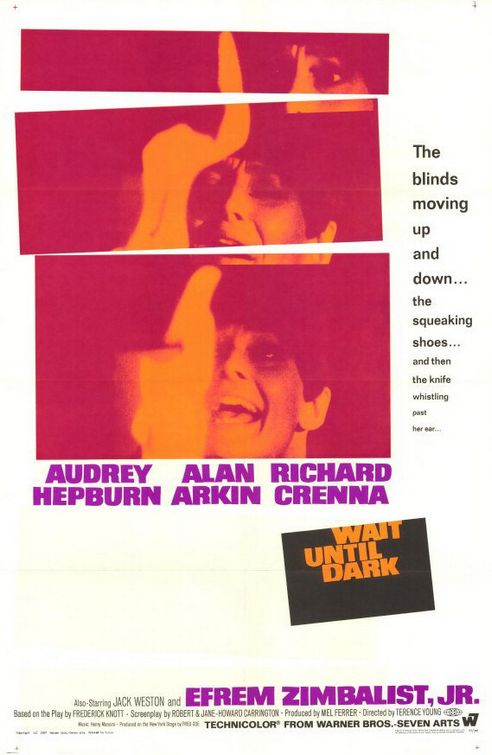
A heroin smuggling ring. A creepy doll. A corpse. A blind woman alone in her basement apartment in the West Village. These are the elements of Wait Until Dark, a quaint and dingy little crime thriller adapted from Frederick Knott’s 1966 play by screenwriters Robert Carrington and Jane-Howard Carrington.

Suzy Hendrix (Audrey Hepburn) is the hapless gudgeon who, being blind, already has the proverbial wool over her eyes. Her husband, Sam (Efrem Zimbalist Jr.), comes home from a business trip with a doll that unbeknownst to him contains a hidden stash of heroin sewn into it. This does not bode well for Lisa (Samantha Jones), the glamorous and sexy stranger who asks him to hold it for her at JFK International Airport.

A case of mistaken identity leads a pair of small time crooks (Richard Crenna and Jack Weston) to Sam and Suzy’s apartment, where psychotic hooligan Harry Roat (Alan Arkin) coerces them into helping him find the doll—as soon as they dispose of a dead body. Nice. They devise an elaborately devious scam to recover the doll when they realize Suzy, who walks in on them, is blind.

Terence Young’s directing is certainly competent. I last saw this movie on some late night UHF station when I was a kid, and two things have stayed with me: a sense of severe claustrophobia as the story unfolds, and that fucking groovy apartment. The plot has flaws that strain credibility. For one thing, Suzy is far too unguarded for a New Yorker. Why doesn’t she lock her door? Roger Ebert pointed out this detail (http://www.rogerebert.com/reviews/wait-until-dark-1968). I didn’t obsess over it like he did, but I noticed it and thought the same thing. When Roat tells her he knows she has the doll, why doesn’t Suzy hand it over? Why does she tell Gloria (Julie Herrod) to meet Sam at the train station instead of going to the police? Why do the guys bother to put on disguises if Suzy can’t see them?

Despite these glaring issues, Young ultimately succeeds in bringing Wait Until Dark to a boil. It lives up to its hype: I saw people jump in their seats at the end. The acting here overcomes any shortcomings in plot. Hepburn is little more than a blind Holly Golightly, but at certain points she reminds me of Barbara Stanwyck screaming that she can’t wake up from a nightmare in, I think, The Night Walker. Weston is a little too bumbling, but Crenna and Arkin are chillingly menacing and foreboding even if they are silly by today’s standards (yeah, sunglasses at night went a long way making Corey Hart look tough). Henry Mancini’s eerie score is the clincher in setting the right mood.

A trivial point of interest: Suzy’s apartment is in the same block of rowhouses as the one used for the Huxtable residence on The Cosby Show (http://www.movie-locations.com/movies/w/Wait_Until_Dark.html#.WRU0W1LMyWY). The small street, St. Luke’s Place, has a bit of literary history, too (http://www.nytimes.com/1996/10/27/realestate/in-a-village-enclave-15-remarkable-rowhouses.html).

With Jean Del Val, Frank O’Brien

Production: Warner Brothers

Distribution: Warner Brothers/Seven Arts

108 minutes
Not rated

(Music Box) B-

Who’s Afraid of Virginia Woolf?

(USA 1966)

Elizabeth Taylor. Richard Burton. Edward Albee. Even George Segal, who was kind of a fixture on NBC during the ’80s and ’90s. Need I say more? Probably not, but I will.

Director Mike Nichols and screenwriter Ernest Lehman stick pretty close to Albee’s 1962 play with their film adaptation of Who’s Afraid of Virginia Woolf?, and it’s hard to watch. Really hard. To be fair, though, it’s supposed to be, and that’s what makes it so good.

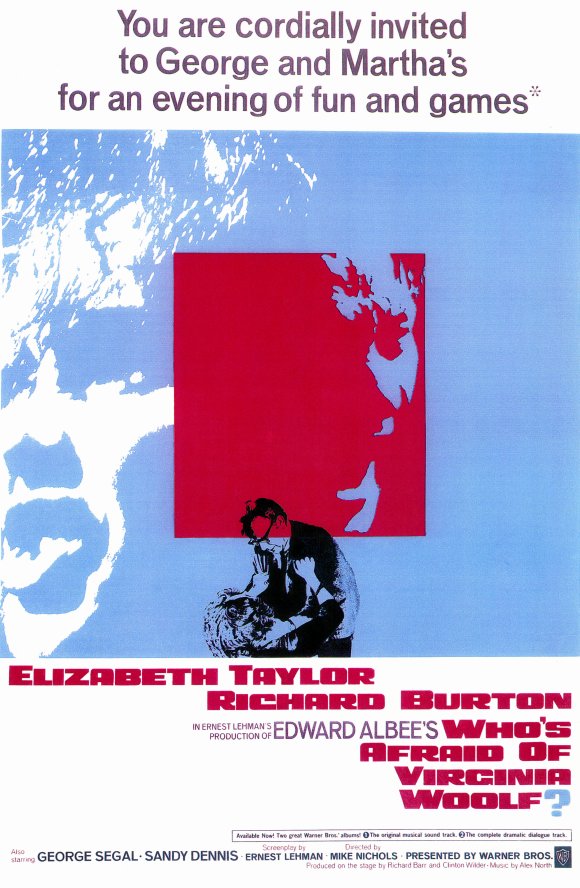
The promotional poster promises an evening of fun and games, but very little joy is to be found here, at least on the surface: all that marital baiting, sniping, and yelling is miserable. Fuck! It took me five or six false starts over a few years before I finally got into the film—and only with the help of a bottle of bourbon. Once I was in, though, I was hooked: watching this disastrous night unfold and all four characters unravel engrossed me desite the buzz I had going.

The oddly but appropriately named George (Burton), a history professor at a small East Coast university, and Martha (Taylor), the daughter of the school’s president, stumble home drunk from a faculty party, neither one listening to the other as they babble about nothing. Martha quotes Bette Davis, which ultimately reveals more about her viewpoint than any other comment she makes—and the woman can talk.

They babble and respond to each other half-heartedly. Martha tells George that she invited a young couple, a professor from another department and his wife, over for a drink. George is miffed, but there’s no time to react.

Enter Nick (Segal) and Honey (Sandy Dennis), a polite, young, good-looking couple that, as we learn, has their own set of problems. Martha and George pour drinks and pick at each other while Nick and Honey watch, uncomfortable at first, thinking maybe they shouldn’t be there. As the drinking continues, though, they’re pulled into the…drama? Turns out, they have more in common with each other than they think.

Here’s the thing about George and Martha: their marriage is dysfunctional, but they seem to operate well inside the confines of their explosive relationship—Martha brays and George stays, responding in a passive aggressive manner as he fixes them both another drink. Over and over and over again. Do they have any limits? It’s hard to say, partly because it’s never clear that we should take anything at face value: what we see is not necessarily what it is. That’s the genius of Who’s Afraid of Virginia Woolf. 

In 2013, the United States Library of Congress deemed Who’s Afraid of Virginia Woolf? “culturally, historically, or aesthetically significant” and selected it for preservation in the National Film Registry (https://www.loc.gov/programs/national-film-preservation-board/film-registry/complete-national-film-registry-listing/).

With Frank Flanagan, Agnes Flanagan

Production: Warner Brothers

Distribution: Warner Brothers

131 minutes
Not rated

(DVD purchase) A

Hidden Figures

(USA 2016)

Houston, do you read me: NASA employed black people in its infancy during the early Sixties. What’s more, NASA’s first major project, Mercury, probably wouldn’t have gotten off the ground without three black female “computers,” or mathematicians, whose efforts literally put John Glenn and Friendship 7 into orbit. The result was a serious boost in American morale during the race against the Soviets into space and a boon to the Space Program under President Kennedy. So, with its historically significant and truly enlightening subject matter, what most caught me off guard about Hidden Figures is its tone, which is light, upbeat, cute, and often comical. While not in itself a bad thing, it’s not what I expected.

Unfortunately, that’s about all Hidden Figures offers that I didn’t expect. I’m not saying I didn’t enjoy this film; I did. It’s a great story about remarkable people who actually lived. According to one subject, their real stories are not far off from this film (http://www.latimes.com/science/sciencenow/la-sci-sn-hidden-figures-katherine-johnson-20170109-story.html). Taraji P. Henson plays Katherine Johnson, a recently widowed math whiz who works for NASA in Virginia, as a bookish nerd complete with glasses that keep sliding down her nose. She and her coworkers, smart and sassy Dorothy Vaughan (Octavia Spencer) and fiery and coquettish Mary Jackson (Janelle Monáe), quietly but forcefully demonstate their worth in an environment that doesn’t treat them as equals. While Katherine lugs binders and a calculator back and forth between her desk and the “colored” rest room clear across campus to figure out arcs and other shit I sure can’t, Dorothy teaches herself how to operate the new IBM that not even IBM technicians can set up correctly and Mary pushes her way into engineering classes at night in an all white, all male school. Director Theodore Melfi does a really nice job demonstrating institutionalized racism and sexism through characters who may not have anything against black people or women—as administrator Vivian Michael (Kristen Dunst) curtly tells Dorothy in one scene and unwilling research partner, Paul Stafford (Jim Parsons), makes clear to Katherine in another scene by redacting her name from a joint report they both wrote—but don’t recognize the issue.

Despite its merits, I found Hidden Figures to be slightly more sophisticated than a Lifetime movie. Melfi, who with Allison Schroeder adapted the screenplay from Margot Lee Shetterly’s book of the same name, takes a pretty basic approach to the material. It’s so easy—obvious, even—to gage where the story is headed. John Glenn (Glen Powell) sings Katherine’s praises while a love interest develops for her in handsome Col. Jim (Mahershala Ali). So cute. Hidden Figures gets into civil rights issues, but only on a superficial level. There are a few overdone Oscar grabs, like a scene between Katherine and her boss, Al Harrison (Kevin Costner), that ends with him smashing the sign outside the “colored” ladies’ rest room, but no true show stoppers. Frankly, though, most of the actors here have appeared in better movies. Too bad, because this could’ve been a great film instead of just an okay one. Hidden Figures doesn’t quite do its trailblazing subjects justice.

127 minutes
Rated PG

(AMC River East) C+

http://www.foxmovies.com/movies/hidden-figures

Jackie

(USA 2016)

“Brookline is no place to bury a president.”

—Jackie Kennedy (allegedly)

Jacqueline Bouvier Kennedy: her name conjures up specific images—pink Chanel, a pillbox hat, pearls, big sunglasses, all illuminated by her unshakable poise. Jackie, the new biopic by Peruvian director Pablo Larraín, portrays the iconic former First Lady in a light I didn’t quite expect: strategic. While it certainly isn’t flattering, it doesn’t come off as negative, either.

Taking place over the days following the assassination of J.F.K. (Caspar Phillipson), Jackie is essentially a character study that follows Mrs. Kennedy (Natalie Portman) as she steadies and readies herself for both her husband’s funeral and the changes that lie ahead for her and her children (Sunnie Pelant, Aiden and Brody Weinberg). In the midst of her grief, she carefully and with an earnest sense of purpose culls various elements to assemble her husband’s legacy—which she begins with Abraham Lincoln’s funeral procession.

From a technical standpoint, Jackie is impressive. Stéphane Fontaine’s cinematography is lovely, using a pallet of drab, saturated tones that calls to mind Kodak snapshots from the time period to create a somber look that reads clearly as November. He offsets this visual effect nicely with splashes of vivid reds. If nothing else, Jackie is a pretty movie. Structured with split time sequences that go backward and forward, the attention to detail is excellent: the film does a great job reproducing not just the White House and Mrs. Kennedy’s 1962 televised tour of it, but the early ’60s generally. Portman plays her part capably; she’s convincing as Mrs. Kennedy despite her annoying tendency to overdo the drama.

That’s about it for the positive. For all the pains Jackie takes to look and play out perfect, it gets a lot wrong. Those New England accents aren’t quite right, and none of the actors seem able to stick with them. Peter Sarsgaard is epically miscast as Bobby Kennedy, whom he doesn’t even try to emulate. I didn’t realize who he is until well into the film. It’s no secret that Mrs. Kennedy smoked, but popping pills and drinking as she gets dressed in the morning? And telling a priest (John Hurt) that she should’ve been a shop girl or a stenographer? I doubt it. The graphic scene of J.F.K.’s assassination, stuck in somewhere past the middle of the film well after a harrowing and far more effective scene of Mrs. Kennedy staring into a mirror and wiping blood off her face, is completely unnecessary; it comes off as a crude way to shock the audience—I jumped in my seat when I saw it, but not in a good way. The sloppy appearance and condescendingly bored demeanor of the reporter (Billy Crudup) is bizarre; sitting there in his Oxford with his tie undone as he interviews Mrs. Kennedy, I couldn’t help but wonder if in reality she would’ve opened up to him let alone allowed him into her home. He may be handsome, but his entire presence bummed me out.

The “psychological portrait” approach is mildly interesting for a little while, but the intrigue wears off. Jackie is nothing insightful, groundbreaking, or thought provoking. It could have been far more compelling considering its subject—this is total Oscar fodder, but it’s done so dully. I hope Larraín’s other new biopic, Neruda, is better.

100 minutes
Rated R

(Landmark Century) C-

http://www.foxsearchlight.com/jackie/

Breakfast at Tiffany’s

(USA 1961)

“You musn’t give your heart to a wild thing. The more you do, the stronger they get, until they’re strong enough to run into the woods or fly into a tree. And then to a higher tree, and then to the sky.”

—Holly Golightly

So, “Audrey Hepburn is having breakfast at Tiffany’s”?! Why, yes, I would love to join her!

When Fathom Events, Turner Classic Movies, and Paramount Pictures invited me to “fall in love again” for a special 55th anniversary screening of Breakfast at Tiffany’s in a select theater near me, well, I couldn’t say no. Until now, I’ve only seen it on my television or computer screen.

I admit, I’m a sucker for this film—even though it’s not the kind of thing I usually go for, and Mickey Rooney as Mr. Yunioshi was a terrible idea even if many films of the era did the same thing to get a big name involved. Whatever. I’ve never met anyone who didn’t like this film. Directed by Blake Edwards and adapted for the screen by George Axelrod, Breakfast at Tiffany’s is a fine midcentury fairy tale. Set in Manhattan, Holly Golightly (Hepburn) leads a life full of the very trappings I imagined myself having as an adult: a cool apartment in a big city, great clothes, wicked accessories, lots of fashionable friends and acquaintances, wild parties, drinks all the time, travel plans, and generally risqué fun and fabulousness. I have some of them.

What’s brilliant about this story, though—and probably why it appeals to me—is its dark side. Nothing here is what it seems: what we see is a ruse—to use the words of O.J. Berman (Martin Balsam), Holly is a phony. Her life is phony. She puts on an act. It’s more than simply running away from her past, represented by ex-husband Doc (Buddy Ebsen) and his references to her former self, Lulamae. She’s not the naïve eccentric she would have everyone believe she is. She’s also not the high society sophisticate she presents, either: the apostrophe ‘s’ she adds to the name of her ideal escape (the store is called “Tiffany & Co.”) gives her away. Frankly, she’s not even true call girl material, however downplayed that part of her personality is (we’re only told that she gets fifty bucks for the powder room).

Like her dark sunglasses and the Halloween mask she steals from the five and dime with fellow phony Paul Varjak (George Peppard), Holly’s working a facade she hides behind. Holly is a product of Lulamae’s imagination; she left behind her life in Tulip, Texas, for a bigger, more exciting one. The problem is, she doesn’t seem to know exactly what she wants, bouncing carefreely from one half-baked plan to another. She’s afraid to commit to anything because doing so puts her in a vulnerable position. Why else would one call her cat, “Cat” (Orangie)? Oh, the poor slob without a name!

At the end of the story, Cat represents something different. Holly throws him out of the cab into the rain in a “bad” neighborhood. She realizes that she wants to belong somewhere, to someone. Ummm…Paul? I know Truman Capote wrote a different ending, and I tend to disdain a neat, happy Hollywood ending; but here, it’s perfect. I can’t see a better way to end this story. Sorry, Mr. Capote.

Three more things: Patricia Neal is fantastic as stylish girl “2E.” Henry Mancini’s score is the cherry on the top of this sundae—mmmmm! If I ever have two dogs, I’m naming them Sally Tomato (Alan Reed, who went on to be the voice of Fred Flintstone) and Mr. O’Shaunessy (Joseph J. Greene).

In 2012, the United States Library of Congress deemed Breakfast at Tiffany’s “culturally, historically, or aesthetically significant” and selected it for preservation in the National Film Registry (https://www.loc.gov/programs/national-film-preservation-board/film-registry/complete-national-film-registry-listing/).

114 minutes
Not rated

(Evanston Century) A

Fathom Events

Tower

(USA 2016)

On August 1, 1966, Charles Whitman, an engineering student at the University of Texas, Austin, killed his mother and his wife before taking over the observation deck of the 30-story Main Building on campus (“The Tower”). Known as the infamous “Texas Tower Sniper,” he then shot random passers-by on the mall below, terrorizing the campus for over an hour and a half. When it was over, 17 victims including him were dead and dozens were wounded (https://en.wikipedia.org/wiki/Charles_Whitman). Quite possibly the first mass shooting on a school campus in the United States—and definitely the first of this magnitude—the event resonates nearly 50 years later.

Keith Maitland’s Tower is a sort of oral history of this tragic day, and it’s compelling from the outset. I may seem to be stating the obvious here—how could the story of such an event be anything but compelling? I haven’t mentioned that the whole thing is animated—as in, a cartoon. I must admit that I was skeptical. Turning a combination of archival footage and reenactments into rotoscopes that have an offbeat King of the Hill quality sounds dubiously unfitting for many reasons. Nonetheless, Tower works unsparingly well.

With barely a mention of Whitman—his name comes up toward the end, and only incidentally—Maitland chooses to focus on those caught in the confusion. He doesn’t say who is shooting or why, putting viewers into the thick of it. He let’s survivors, heroes, and witnesses narrate their ordeals: what they were doing, who was with them, and what happened to them. Claire Wilson (Violett Beane), a pregnant teenager who was the first one shot on campus, tells about seeing her boyfriend, Thomas Eckman, die right next to her and losing her baby while she lied in a pool of her blood on the hot concrete. She also talks about the woman, Rita Starpattern (Josephine McAdam), who played dead to stay with her and keep her conscious until help could get to her. Aleck Hernandez (Aldo Ordoñez) tells about being shot in the shoulder while delivering newspapers with his cousin riding on his bicyle with him. Allen Crum (Chris Doubek), a middleaged bookstore employee, tells about dodging bullets to help a victim on the ground and winding up on the observation deck while Whitman was still shooting. Austin police officers Houston McCoy (Blair Jackson) and Ramiro Martinez (Louie Arnette) talk separately about their roles in bringing down Whitman.

Each account is unflinchingly brutal with lots of personal detail. The animation is an odd but effective way to bring us close to the action in a way that otherwise wouldn’t happen. Considering how it’s presented, Tower is surprisingly emotional and personal. I haven’t seen a documentary like this before.

96 minutes
Not rated

(Music Box) B-

http://towerdocumentary.com

Hairspray

(USA 1988)

“Mama, welcome to the Sixties.”

—Tracy Turnblad

Tracy Turnblad (Ricki Lake) is fucking fabulous, and all of Baltimore knows it! The humble hair-hopping heroine of the kitschy-sixties John Waters classic Hairspray is lower middle class and fat—or as she puts it, “pleasantly plump.” Her parents are clueless and preoccupied with their own drab lot in life: mother Edna (Divine) irons constantly and father Wilbur (Jerry Stiller) owns a joke shop below their dingy little apartment. Tracy’s best friend, Penny Pingleton (Leslie Ann Powers), is positively nerdy—not to mention permanently punished.

None of it stands in Tracy’s way of getting what she wants, whether it’s a slot as a regular on a teen dance program on local television, the hottest guy on the show (Michael St. Gerard), or racial integration. She’s a modern kind of girl—she’ll swim in an integrated pool and support the right of “colored” kids to have more screen time than just on designated “Negro Day” on the last Thursday of every month. Tracy is the height of teen fashion: all ratted up like a teenage Jezebel, no one rocks a sleeveless frock, a plaid skirt, or a pastel pink cockroach gown quite like she does. It should be no surprise that she’s got a modeling gig. And on top of it, the girl can move! Who wouldn’t want to be her?

Tracy’s self-assurance provokes the ire of teachers and mean girls alike, especially rival regular and stuck up little spastic Amber Von Tussle (Colleen Fitzpatrick) and her pageant winning mother, “Miss Soft Crab 1945” Velma (Debbie Harry). Tracy commands attention; when Amber gossips about her and sneers, “Tracy Turnblad is a whore,” she reveals the extent of her own intimidation. You know her, come on, rip her to shreds.

Hairspray has John Waters’s trademark demented sense of humor all over it, and stars regulars like Divine and Mink Stole. However, it marked a shift for Waters into mainstream territory (he started with Polyester, but that one is still a bit weird and definitely not as accessible). It’s no shock that it’s his biggest hit. Like his other leading ladies, Tracy is strong; what’s different, though, is that nothing about her despicable—a first for him. In fact, she’s probably the only lead in a Waters film who’s downright admirable. Her confidence is solid, and her heart is always in the right place. Hairspray makes being an outcast look glamorous and accomplished in a way none of his other films do.

I saw Hairspray the first time in a dorm room during my freshman year of college: we rented a copy on VHS tape, which honestly sounds more quaint now than The Corny Collins Show looked to me back then. I’ve seen Hairspray more times than I can count, and I never get tired of it. I’m apparently not the only one, as the multiple remakes and reboots demonstrate. None of them can touch the original. How could anything top Sonny Bono as a dad, or Pia Zadora as a beatnik chick going on about Odetta while Ric Ocasek paints behind her and utters his one-word line: “reefer!”

92 minutes
Rated PG

(Home via iTunes) B+

http://www.dreamlandnews.com/films/hairspray.shtml

Eye of the Cat

(USA 1969)

Ailurophobia, the irrational fear of felines, forms the basis for Eye of the Cat, a nifty little throwaway from the late Sixties. Despite what its trailer suggests, it’s not an outright horror film—it’s a suspense thriller that relies heavily on psychological tension, very much like Hitchcock did. This isn’t surprising: screenwriter Joseph Stefano previously penned Psycho. Those familiar with Hitchcock will notice a slight feel of Rope and The Birds. Plus, the external shots of San Francisco strongly recall Vertigo.

The plot rings familiar: cosmetologist Kassia Lancaster (Gayle Hunnicutt), whose name “sounds like a prison door slamming shut,” mysteriously and abruptly recruits philandering Wylie (big-eyed Michael Sarrazin) to help her execute a plot to get his rich and ailing stepmother, “Aunt” Danny (Eleanor Parker), to put him back in her will as her sole heir—and then kill her. Wylie’s brother, Luke (Tim Henry), lives with Aunt Danny and is getting in the way. There’s another problem: Wylie has a bad case of ailurophobia, and Aunt Danny’s house is loaded with cats.

Eye of the Cat‘s sum is greater than its parts, and overall I enjoyed this one quite a bit. The title and opening sequence are cool: the animated outline of a housecat slinks over scenes of San Francisco and gives way to split screens that start the story. Stefano and director David Lowell Rich are refreshingly frank and downright casual with their attitude toward and treatment of sex and drugs: nothing is merely implied here. In his first scene, Kassia yanks Wylie naked out of bed—away from the naked woman still next to him. There are references to having sex, they say “have sex,” and they actually do have sex in a few scenes. One unsettling scene between Wylie and Danny in the latter’s bed alludes to a past liason. Later, Wylie and Kassia go to a dope bar on a boat and smoke a joint. One of the patrons at the bar makes a joke about his own homosexuality, which may be one of the earliest openly gay characters I’ve seen.

All four actors, even Parker, possess an effortless and elegant allure. Sarrazin and Henry are hot, and they both have shirtless scenes. Hunnicutt is absolutely gorgeous in her smart skirts and big hair. Lowell Rich builds tension nicely, getting the actors to walk a very fine line between serious horror and camp, something most evident in a brilliant scene involving Danny on a hill in her wheelchair. Lalo Schifrin’s ominous score adds greatly to the mood here.

Except for a solitary orange tabby that clearly has Danny’s back, the cats—an overwhelming throng of them—curiously disappear after the story is set up, and don’t return until the climax. The film ends in a ridiculously horrific way—so bad, I laughed out loud with most of the audience. It’s a pity Eye of the Cat is not available for download or on DVD. It’s a fun movie.

102 minutes
Rated M

(Music Box) B-

Music Box of Horrors

Winter of the Witch

(USA 1970)

I never heard of this nifty gem of a short until I saw it, but it’s apparently quite big with Gen X. I can see why: a precursor to Alice Doesn’t Live Here Anymore and Scooby Doo with Bewitched and The Addams Family thrown in, it’s about a single mother (Anna Strasberg) who skips town (Manhattan) in her VW Bug with her young son, Nicky (Roger Morgan), and buys a dilapidated old Victorian mansion in the boonies for cheap. Real cheap: $400 cheap. Turns out, there’s a catch: the place is haunted by a gloomy and depressed 300-year old witch (Hermione Gingold) who’s given up on the world.

Adapted from the book Old Black Witch by Wende and Harry Devlin, screenwriter and director Gerald Herman turns in something unintentionally impressive. I can see why this is such a hit with members of my generation. Aside from a few nouveau social issues for the time (a single parent and a vaguely gay little boy) and the mysterious untold backstory of this mother-son team, Winter of the Witch is really fucking weird. What kid’s story mixes the occult and “magic pancakes” laced with something no one will identify? The damned pancakes make everyone who eats them happy, so… The quality of the film is cheap and eerie, adding to the mood. Plus, Burgess Meredith narrates.

Winter of the Witch is roughly the length of a sitcom episode, which makes me think it was a pilot that didn’t get picked up. Regardless, I love it! See for yourself below.

24 minutes
Not rated

(Music Box) B+

Music Box of Horrors

Any Number Can Win [Melodie en Sous-Sol]

(France 1963)

I approach “heist” movies with hesitation—they tend to be silly, formulaic affairs. As a fan of midcentury Italian and French film, though, Any Number Can Win caught my eye. The promotional blurb I read persuaded me to give it a shot. I’m glad I did.

Charles (Jean Cabin) is a gruff career criminal who just got out of the joint. His wife (Viviane Romance) wants to retire and play it straight, but he insists on one last job: knocking off a casino in Cannes. He recruits Francis (Alain Delon), a petty thief he met in prison, and Francis’s brother-in-law, Louis (Maurice Biraud), a simple mechanic who really has no business participating in a scheme like this. The plan calls for Francis, posing as a high-rolling playboy, to stay at the casino for a week; his job is to scope out an entrance to the elevator shaft backstage that leads to the vault where the money is kept.

Once Francis arrives, he’s immediately smitten with Cannes: hanging out at the pool, driving a cool car, chatting up beautiful girls over cocktails, hitting night clubs, ordering room service. He hooks up with a dancer, Brigitte (Carla Marlier), as a means to an end—but he gets caught up in the melodrama of their fling and the glamorous life he’s gotten himself into. His dalliance threatens to derail the entire operation.

Any Number Can Win gets off to a shaky start—it’s so slow that I began to doze off. Director Henri Vernuil picks up the pace once Francis gets to Cannes and steadily builds momentum and suspense as the story progresses. I got more and more anxious watching the plan come to fruition, excited to see what happens next. A great jazz score orchestrated by Jean Gitton punctuates the action nicely. The early Sixties French Riviera setting—palm trees, lights, and nouveau-meets-modern architecture—is dazzling in black and white. Delon fits perfectly with his smoldering, polished looks. The ending is one of the most memorable I’ve ever seen: floating cash, that’s all I’ll say.

118 minutes
Not rated

(Gene Siskel Film Center) B

https://youtu.be/lWsGuQwyKbA