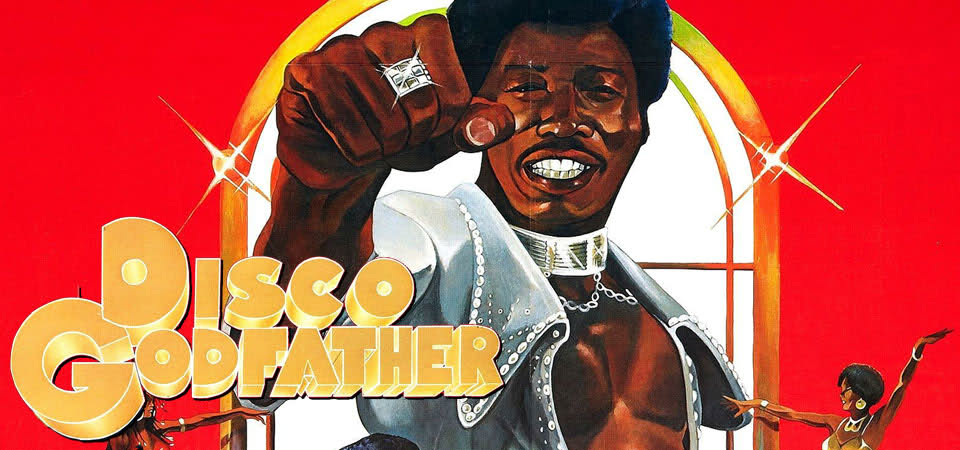
Dear God the Father! Some movies are so terrible, you love them for everything wrong with them—what’s bad is exactly what endears them. Other movies…well, they’re just terrible. It’s a thin line. Sadly, Disco Godfather falls into the latter category.
J. Robert Wagoner and Cliff Roquemore’s screenplay stars Rudy Ray Moore as Tucker Williams, an L.A. cop-turned-DJ at the trashy-ass Blueberry Hill Disco, which looks like a repurposed Denny’s. The plot involves Williams’s nephew, Bucky (Julius J. Carry III), who’s gotten hooked on “angel dust.”
One word: YAWN! What were they thinking? Disco Godfather is so boring, I’d rather watch reruns of 2 Broke Girls. The only thing that saves it from total failure is the wardrobe—Felice Hurtes, Jimmy Lynch, and Kimberly Sizemore deserve major kudos for finding the cool Goodwill stores. Fuck this bullshit: watch Dolemite and call it a day. They could have tried a little harder here.
With Carol Speed, Jimmy Lynch, Jerry Jones, Lady Reed, Hawthorne James, Frank Finn, Julius J. Carry III, Bishop Pat Patterson, Pucci Jhones, Howard Jackson, Yetta Collier, Pat Washington, Doc Watson, Leroy Daniels, Melvin Smith, Ronny Harris, Dolorise Parr, John Casino, Keith David
The premise of Lina Wertmüller’s Love & Anarchy [Film d’amore e d’anarchia, ovvero ‘stamattina alle 10 in via dei Fiori nella nota casa di tolleranza…’] has the ring of something from Federico Fellini or maybe Pedro Almodóvar (though Fellini makes a lot more sense because she actually worked as his assistant for a spell).
Freckly yokel farmer Tunin (Giancarlo Giannini) learns that his friend was murdered. Why? Because he was an anarchist who was plotting to assassinate “ll Duce” Benito Mussolini. What’s more, Mussolini’s fascist police killed him. To avenge his friend’s death, Tunin takes up his cause.
Tunin ends up at a brothel in Rome. He spends a night with Salomè (Mariangela Melato), who reveals that she’s a co-conspirator for her own reasons. As the story progresses, it becomes clear that the coup is a harebrained idea.
Salomè takes Tunin to a rural spot just outside Rome with her and another prostitute, Tripolina (Lina Polito). Salomè distracts Spatoletti (Eros Pagni), the head of Mussolini’s police, while Tunin checks out the area; they then devise a plan to execute the mission.
Meanwhile, Tunin and Tripolina fall in love. Convinced that he isn’t going to make it past the assassination alive, he persuades Tripolina to spend the next two days with him.
The same radical spunk that Wertmüller exhibits in The Seduction of Mimi is just as prevalent in Love & Anarchy; this film is loaded with decadent, sexy hijinks. However, it also its share of some really tender moments—that surprised me. Love & Anarchy turns out devastatingly sad—I left the theater literally bummed out. For all its ridiculous sociopolitical and sexual shenanigans, it’s a far more powerful film.
With Pina Cei, Elena Fiore, Giuliana Calandra, Isa Bellini, Isa Danieli, Enrica Bonaccorti, Anna Bonaiuto, Anita Branzanti, Maria Sciacca, Anna Melato, Gea Linchi, Anna Stivala, Roberto Herlitzka
Production: Euro International Film, Labrador Films
I never heard of Lina Wertmüller until a retrospective of her work showed at a theater near me. The Seduction of Mimi [Mimì metallurgico ferito nell’onore] is an excellent starting point because it’s a textbook example of her style and the themes that inspire her. Plus, it’s an entertaining movie.
Mimi (Giancarlo Giannini) is a laborer in Sicily. His trouble begins after he votes for the communist candidate in a local election—his employer has been pushing its employees to vote for the mafia candidate. The ballot is supposed to be secret, but Mimi learns that it isn’t when he’s fired. Fearing that things will get complicated, he leaves his wife, Rosalia (Agostina Belli), behind and skips town.
Mimi ends up in Turin, where he finds work on an illegal construction site. He witnesses an on-the-job fatality and proves to be a problem when he learns that the mafia bosses running the job plan to dump the body. To keep him quiet, they place him in a union job at a factory.
It isn’t long before Mimi meets the alluring Fiorella (Mariangela Melato) selling sweaters on the street. He’s hooked on her; in fact, he knocks her up and she gives birth to a son. This is where The Seduction of Mimi gets really fun. Mimi is promoted to a management position back in Sicily. Naturally, he brings Fiorella and the baby with him. He’s protective of his new family and paranoid that Rosalia will find out about it, so he leads a thorny double life that…let’s just say doesn’t end well.
The Seduction of Mimi is rough, moving along like an episode of The Benny Hill Show. It’s compelling nonetheless because it has a certain elegance. Wertmüller is known for mixing sex, class, and politics. It’s a tricky feat, but she manages to pull it off while keeping The Seduction of Mimi totally amusing even by today’s standards. The stuff with the mafia and the gay rumor that gets out because Mimi won’t have sex with Rosalia are both hilarious. The whole revenge subplot that involves getting Amalia (Elena Fiore) pregnant is brilliant on so many levels, and that scene at the end where all of Mimi’s children clamor for him calling him “Papa!” is perfect. Giannini with his bug-eyed Chaplinesque faces looks crazy throughout this film, nicely underscoring the insanity of his situation. I smiled a lot during this film.
With Turi Ferro, Luigi Diberti, Tuccio Musumeci, Ignazio Pappalardo, Gianfranco Barra, Livia Giampalmo
“That’s what I do. I fuck. And it made me eight million dollars.”
—Rebecca Carlson
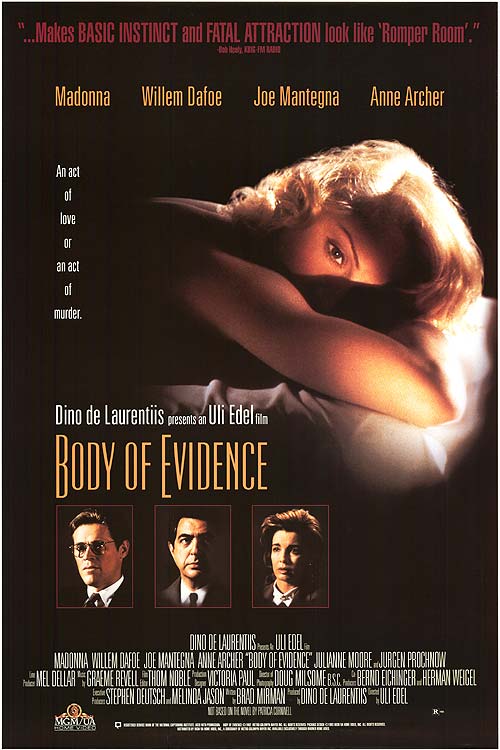
As true blue a Madonna fan as I am, I haven’t bothered to see a considerable number of her movies. Uli Edel’s Body of Evidence is one of them (she has top billing here, so yes, it’s a Madonna movie). On a ridiculously cold and rainy Saturday night, I decided to change that when I saw it showing on cable. Now that I’ve seen it, what surprised me most about Body of Evidence is that it’s actually not that bad. To be clear, it’s not good—it’s fluffy erotic fromage designed to be “provocative,” a sort of lame Basic Instinct (as if that’s a good movie)—but it’s not quite the disaster I expected.
Madonna is Rebecca Carlson, a femme fatale accused of slipping cocaine into her older lover’s nasal spray and “fucking him to death”—i.e., arousing him to the point of inducing a fatal heart attack. Willem Dafoe is her defense attorney. Of course, he gets involved with her despite his happy marriage to Julianne Moore.
Brad Mirman’s writing is pretty basic; his script feels a lot like a Law & Order episode, skipping through real life things like discovery and motions in limine to get right to the court stuff. I half-expected to hear that clang sound between scenes. His dialogue is often silly and, as demonstrated above, at times cringeworthy.
The promotional poster for Body of Evidence promises to make Fatal Attraction and the aforementioned Basic Instinct “look like Romper Room;” it doesn’t. The candle wax scene is kinda hot, but that’s it. The cast is impressive, but sadly no one gives a remarkable performance. Moore’s role, one of her first in a major studio release, is so small it’s background. Madonna pretty much plays Dita, her alterego from her Erotica album and Sex book, both of which came out just a few months before Body of Evidence. Her acting isn’t good, but somehow she comes off slightly less wooden than any character from her earlier movies, even A League of Their Own. Her look is exactly the same as in the video for “Bad Girl.” I’m not sure what Dafoe or Joe Mantegna, both good actors, saw in this project.
Body of Evidence is ultimately a forgettable snooze of a film. If it’s offensive at all, it’s because it’s boring.
With Anne Archer, Lillian Lehman, Stan Shaw, Charles Hallahan, Mark Rolston, Jürgen Prochnow, Frank Langella
Production: Dino De Laurentiis Communications, Neue Constantin Films
Distribution: Metro-Goldwyn-Mayer (USA), Guild Film Distribution (UK)
I never saw Wild at Heart until now. Some of the points raised by its detractors are valid, but I still liked it for the same things that made them hate it. Erratic, vulgar, and really sweet, it’s offputting yet compelling and—surprise!—it has a happy ending.
An atypically straightforward narrative for a Lynch project, Wild at Heart is a decidedly deranged, bloody road movie/romance/thriller based on Barry Gifford’s novel of the same name. Upon his release from a North Carolina prison after serving time for murder—never mind that it was self-defense—Sailor Ripley (Nicolas Cage) exits the jailhouse to find his lover, Lula Pace Fortune (Laura Dern), waiting for him outside in the sunlight with his snakeskin jacket, the symbol of his individuality and his belief in personal freedom. They spend some time catching up in a motel room and at a speedmetal concert before they decide to blow off his parole and take off for California.
Meanwhile, Lula’s mother, Southern lady Marietta (Diane Ladd), is making plans of her own—and they involve her private detective boyfriend (Harry Dean Stanton) and a hit man (J. E. Freeman) who’s got Sailor as his target. A bad omen detours the starcrossed lovers to Big Tuna, Texas, where they unwittingly plant themselves smack in the middle of a bad situation that looks to be turning deadly fast.
OK, I’ve seen versions of this same story before. The plot is familiar and for the most part implausible—not to mention really, really thin at times. Lynch goes overboard with his depiction of sex, violence, and gore—even though they all have a place here. None of this matters, though, because the characters, which are both the focus and the strength of the film, are fantastic.
As usual, the casting is stellar. Cage is at his best here, working that edgy deadpan earnest manic thing he did so well in his early films. Dern is flawless as a sweet Southern girl who’s found her place with bad boy Sailor, everyone else be damned. Willem Dafoe is super creepy as hayseed bad guy Bobby Peru—those teeth! Above them all, however, is Ladd, who’s fucking fabulous even with her face covered in red lipstick. She’s vengeful at times, remorseful at others; but all the while, a perfect lady. She shines here. There’s a reason she was nominated for an Oscar for her performance (https://www.oscars.org/oscars/ceremonies/1991). This film works because the actors give it their all.
Wild at Heart is loaded with Lynch’s trademark what-the-fuck weirdness—a man at a bar quacking like a duck (you read that correctly) and cousin “Jingle Dell” (Crispin Glover) sitting on the floor in the bathroom screaming for Christmas or standing at the counter in the dark making a hundred sandwiches for lunch are bizarre moments even by Lynchian standards. There’s a lot more to it, though. I love the theme of finding a happy place in the midst of horrible things happening. I love all the references to various staples of Americana—cowboys, cars, highways, Elvis Presley, and my favorite, The Wizard of Oz. I love that underneath it all is a touching love story that we can all relate to.
What I find most interesting, though, is that so many things about Wild at Heart scream Quentin Tarantino, yet he had nothing to do with it. In fact, it came out two years before Tarantino’s first major film, Reservoir Dogs. I never thought of David Lynch as an influence on him, but Wild at Heart makes me wonder.
Side note: Wild at Heart is a rated R movie. For the screening I attended, however, I was lucky enough to catch an unreleased rated X version. The X rating was no doubt due to the graphic violence—it wasn’t the sex scenes. The print was in bad shape, all scratchy and beat up, but it was totally worth it to see an X-rated Lynch film.
With W. Morgan Sheppard, Grace Zabriskie, Isabella Rossellini, Sherilyn Fenn, Sheryl Lee
Production: PolyGram Filmed Entertainment, Propaganda Films
Distribution: Manifesto Film Sales, The Samuel Goldwyn Company (USA), Palace Pictures (UK), Bac Films (France), Cineplex Odeon Films (Canada), Finnkino (Finland), Hoyts Distribution (Australia), Háskólabíó (Iceland), Meteor Film Productions (Netherlands), Sandrew Film & Teater (Sweden), Solopan (Poland)
Sweet but not exactly savvy Brazilian stuntman Caco (Felipe Rocha) finds out the hard way that nice guys finish last. He surprises his girlfriend, Julia (Leandra Leal), at the restaurant where she works: all set to propose, he stumbles upon her and her boss in flagrante delicto in the pantry. Her boss, arrogant macho celebrity chef Facundo (Adrián Navarro), isn’t just hot, rich, and famous—he’s also Argentinian, which adds insult to injury.
Caco’s stunted party boy buddy Vadão (Daniel Furlan) does what any brah would under the circumstances: he takes Caco out to get wasted. While they’re out, Vadão surmises that what Caco needs to forget Julia is a roadtrip to Argentina to bag as many Argentinian babes as possible. It’s a weird way to get back at her and Facundo. Caco emphatically declines—that is, until he sees Julia’s Facebook post saying she’s moving to Buenos Aires with Facundo. He changes his mind but doesn’t tell Vadão why. They take off in a yellow Chevy Opala from the ’70s.
Honestly, I’ve seen this road movie many times before. Even so, I enjoyed El Revenge; director and cowriter Fernando Fraiha has a lot of fun with broken hearts, national pride, and fútbol (a.k.a. soccer) rivalries. The script isn’t the most original but the adventures are still entertaining: a customs agent who looks like Bruce Willis confiscates Vadão’s supply of Viagra, a beautiful woman (Aylin Prandi) walks in on Caco while his pants are in the washer in a motel laundry room, the car breaks down after the guys pick up a hitchhiking bride (Ana Pauls), and they share a competitive ride to the airport with a van full of condescending soccer fans. Raindrops can’t keep falling on Caco’s head forever, can they?
“I don’t think you’re very amusing, Lieutenant…Whatever-Your-Problem-Is.”
—Norah Dain
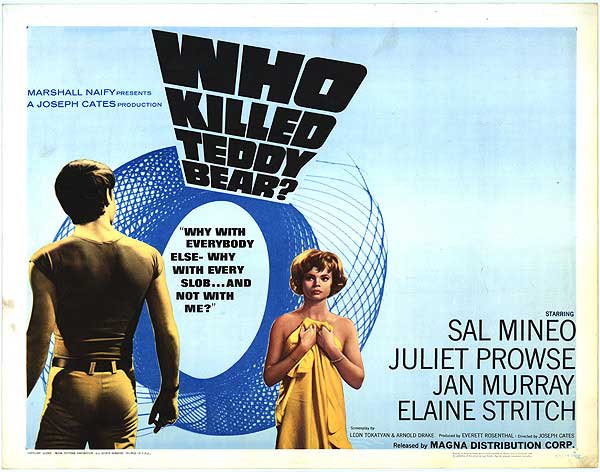
Who Killed Teddy Bear is so far one of the more interesting films I’ve seen this year, which is odd because it’s more than 50 years old. A surprisingly good story and movie, everything about it shines despite its bleak subject matter and an obviously low budget.
The film opens with a little girl who seems to be getting away from something unsettling she just observed. She falls down a set of stairs in the dark. It’s a curious opening, but she ties into the story later.
Cut to mid-sixties Manhattan: Norah Dain (Juliet Prowse) is an aspiring actress who works as a “disc jockey” at a nightclub. She lives alone in a cute three flat. It’s bad enough that she’s getting obscene phone calls from an unknown weirdo, but what’s worse is that he implies he’s watching her.
Enter detective Lt. Dave Madden (Jan Murray) to investigate Norah’s case. His wife was raped and murdered on the streets of New York City. He comes off as part father and part priest, and he takes a special interest in Norah that verges on disturbing. Indeed, he drops in all the time, he secretly records their conversations, and he keeps telling her that he could be the caller. At home, he’s obsessed with “studying” pornography and perverts, which has a distorting effect on his 10-year-old daughter (Diane Moore).
WARNING: Potential spoilers ahead!
We soon learn that Lt. Madden actually isn’t the caller; Lawrence Sherman (Sal Mineo), who works as a busboy with Norah, is. Lawrence has a lot of issues. Awkward and aloof, he lives in a sad, dank apartment with his younger sister, Edie (Margot Bennett). Edie has brain damage and hasn’t developed beyond a child. Their parents died, leaving Lawrence to take care of her. And he does, but he harbors resentment.
On top of all this, Lawrence is incapable of a normal romantic relationship because of his guilt over his sister. He deals with his sexual frustration at adult bookstores and movie theaters in Times Square, and it apparently works until Norah comes along. His obsession with her takes him down a road of murder and ruin.
Directed by Joseph Cates, Who Killed Teddy Bear has a high creepy-icky factor, and it’s absolutely wonderful. Mineo is brooding and sexy, and Lawrence is compelling in the same fucked up way as Travis Bickle in Taxi Driver. Norah and Lawrence don’t have all that many scenes together, but she’s nice to him when they do. This makes their scenes percolate with tension, particularly one at a pool in a gym. We know the whole thing is not going to end well, and Cates slowly but steadily gets us to a nasty climax. To add to the perversion, screenwriters Arnold Drake and Leon Tokatyan drop in little bombshells like incest and lesbian passes. Joseph Brun’s camerawork is lovely, especially in the night scenes; shooting on location in New York City, he cloaks the actors in shadows and neon light in a way that nicely underscores their solitude.
Interesting trivia: a young Dan Travanty, who plays a small part as a nightclub employee, went on to star in Hill Street Blues.
This film has been cut and recut many times over the years, at least once for British television. I’m pretty sure the screening I attended was the original uncut version.
With Elaine Stritch, Tom Aldredge, Frank Campanella, Rex Everhart, Bruce Glover, Casey Townsend
Production: Phillips Productions
Distribution: Magna Corporation, BijouFlix Releasing
94 minutes
Not rated
(The Auditorium at Northeastern Illinois University) A
Center of My World, director/screenwriter Jakob M. Erwa’s adaptation of German author Andreas Steinhöfel’s 1998 novel for young adults, is not a home run. Fortunately, though, Erwa knows how to extract enough charm, particularly from its two main actors, to downplay its shortcomings and proffer a respectable and enjoyable film.
17-year-old Phil (Louis Hofmann) lives with his mercurial, flighty mother, Glass (Sabine Timoteo), and his twin sister, Dianne (Ada Philine Stappenbeck), in a gorgeous house on the outskirts of town. This family isn’t exactly The Brady Bunch: Phil is gay, Dianne supposedly communicates with animals, and Glass can’t commit to a partner for very long. She won’t even tell her kids who their father is.
Phil notices some friction between the women of the house after he returns from summer camp. When school starts, his best friend, Kat (Svenja Jung), encourages him to go after mysterious new guy Nicholas (Jannik Schümann), a dreamy transfer student who looks like a cuter blue-eyed version of Lance Bass with his chiseled cheeks, luscious lips, and perfect hair. Supposedly, he likes boys. Phil finds out for sure in the locker room one afternoon—and it leads to a passionate affair, insecurity, and a weird bout of jealous competition with Kat.
Center of My World is a cute and engaging story. Erwa does a nice job showing how any kid, gay or otherwise, has a lot to deal with when it comes to sexuality. The Chaun Ngo’s cinematography is well done, employing a bright color pallette verging on artificial that plays really well against the small town setting with all its gardens and summer greenery. The acting is generally good. Schümann is really easy to just…gaze upon, I guess, but in a harmless Teen Beat way.
All that said, Center of My World would have been a much gutsier film, say, 15 years ago. It probably would have made a bigger impact then, too. It contains hints and echoes of things I’ve seen before. The characters are a bit hollow; some of them come off as half-baked, rendering their importance to the story tenuous or questionable. These two boys have sex a lot, which is great. However, the sex scenes here need work even with the full frontal we get. More in-your-face than sexy, they come off as gratuitous. I don’t know if Erwa was trying to be shocking, but it didn’t work if he was. It’s like watching two puppies go at it. I hope that’s not the intended result.
With Inka Friedrich, Sascha Alexander Geršak, Thomas Goritzki, Nina Proll, Clemens Rehbein
Production: Neue Schönhauser Filmproduktion, Prisma Film, Universum Film, mojo:pictures, Westdeutscher Rundfunk, Bayerischer Rundfunk, ARTE, Österreichischer Rundfunk
“I’m the idiot, you’re the screw up, and we are all losers,” sums up Empire Records general manager Joe (Anthony LaPaglia) when he realizes that clerk Lucas (Rory Cochrane) blew the store’s receipts in Atlantic City the night before, which incidentally was the first time Joe let him close shop. His heart was in the right place: Lucas wanted to raise capital to buy the store before owner Mitchell (Ben Bode) sells it to a lame corporate chain called Music Town. Empire Records, you see, is more than a retail outlet: it’s a haven for floundering misfits, including a young shoplifter (Brendon Sexton) who goes by “Warren Beatty.”
Empire Records was a box office bomb (http://www.boxofficemojo.com/movies/?id=empirerecords.htm). Carol Heikkinen’s script is earnest in its desire to (I guess) reveal some revelation about ’90s youth, but the plot is all too predictable, coming off as a third-rate The Breakfast Club. The cast, though, is impressive; loaded with professionals (Debi Mazar and Maxwell Caulfield) and future stars like Renée Zellweger and Liv Tyler, the actors collectively ooze a credible chemistry. Director Allan Moyle pulls some decent performances out of them. A playfully snarky sense of humor about American culture pervades this film, evident in such nifty devices as “Rex Manning Day” and a dream sequence involving Gwar.
Empire Records is very much a product of its time, but that’s what makes it interesting to watch now. This no doubt is why it was selected as the third screening of Chicago International Film Festival’s Totally ’90s series.
With Robin Tunney, Johnny Whitworth, James “Kimo” Wills, Ethan Embry, Coyote Shivers
Production: Monarchy Enterprises B.V., New Regency Pictures, Regency Entertainment, Warner Brothers
“I just thought Marcus would be different. I mean, he’s got C.P.”
—Vi
I get why Todd Solondz doesn’t appeal to everyone: his outlook isn’t warm and fuzzy, his characters aren’t heroic or even admirable, and his blunt, unflattering and brutal honesty is easy to misinterpret as cruel or tasteless. To all that, I shrug; his films don’t put the viewer at ease, and that’s exactly what draws me to him. A master of the uncomfortable, he shines a light on subjects that are hard to discuss in mixed company if not off limits altogether. And he’s not moralistic about it—he leaves it to the viewer to arrive at his or her own conclusions. His moral ambiguity is perhaps the strongest characteristic of his work, and I suspect it more than anything makes people cringe because, well, it’s confusing. They don’t know what to think.
So be it. Barring one scene in Happiness that scarred me forever, Solondz’s fourth film, Storytelling, is probably his most uncomfortable—it opens with Vi (Selma Blair) riding Marcus (Leo Fitzpatrick, who played Telly in Kids), a classmate crippled from cerebral palsy. Comprised of two unconnected storylines, “Fiction” and “Non Fiction,” Solondz pulls out a broad range of societal taboos—American ones, anyway. I won’t go through them here like a grocery list, but they all involve sex and/or abuse of power.
The first and shorter story, “Fiction,” is about the aforementioned Vi, a wannabe writer who probably doesn’t belong in the writing class she’s taking. The class is taught by Pulitzer Prize winning Gary Scott (Robert Wisdom), an imposing egomaniac author who’s also a black man. His critiques of his students’ work is harsh—except when it comes to Catherine (Aleksa Palladino), a bookish pseudointellectual who looks like she’s into S&M. Guess what happens when Vi finds herself in a bar with Scott, and an opportunity to go home with him presents itself? You’ll have to read the book—or in this case the writing assignment, as Vi does what any writer would: she writes about the experience.
The second—and longer—story, “Non Fiction,” is about unsuccessful schlub Toby Oxman (Paul Giamati), a floundering self-proclaimed documentary filmmaker, as he sets out to make an exposé on the everyday American teenager. The problem is, he can’t find a subject. Enter slackerish pothead Scooby Livingston (Steven Weber) and his dysfunctional family led by father Marty (John Goodman). A series of unplanned mishaps threatens to derail the whole project, until one morbid event turns the whole thing around. Belle and Sebastian proves a nice choice for the music.
Storytelling is not quite as intriguing as Welcome to the Dollhouse or Happiness, but it’s still quintessential Solondz. The lines here are quotable gold—particularly the exchanges between Scooby’s youngest brother, Mikey (Jonathan Osser), and the Livingstons’ housekeeper, Consuela (Lupe Ontiveros), which are nothing short of awesome. I love that Solondz calls out his critics—it’s the film equivalent of Madonna’s “Human Nature.” “Fiction” is definitely the more impactful of the two segments, but that’s because “Non Fiction” is just too long and meandering for its own good; it peters out around two-thirds of the way through. Storytelling doesn’t immediately come to mind when Solondz’s name comes up, but parts of it will definitely haunt you. Unlike his other films, I’m not sure what to make of this one.








 moviebloke