Love & Anarchy [Film d’amore e d’anarchia, ovvero ‘stamattina alle 10 in via dei Fiori nella nota casa di tolleranza…’]

(Italy/France 1973)

The premise of Lina Wertmüller’s Love & Anarchy [Film d’amore e d’anarchia, ovvero ‘stamattina alle 10 in via dei Fiori nella nota casa di tolleranza…’] has the ring of something from Federico Fellini or maybe Pedro Almodóvar (though Fellini makes a lot more sense because she actually worked as his assistant for a spell).

Freckly yokel farmer Tunin (Giancarlo Giannini) learns that his friend was murdered. Why? Because he was an anarchist who was plotting to assassinate “ll Duce” Benito Mussolini. What’s more, Mussolini’s fascist police killed him. To avenge his friend’s death, Tunin takes up his cause.

Tunin ends up at a brothel in Rome. He spends a night with Salomè (Mariangela Melato), who reveals that she’s a co-conspirator for her own reasons. As the story progresses, it becomes clear that the coup is a harebrained idea.

Salomè takes Tunin to a rural spot just outside Rome with her and another prostitute, Tripolina (Lina Polito). Salomè distracts Spatoletti (Eros Pagni), the head of Mussolini’s police, while Tunin checks out the area; they then devise a plan to execute the mission.

Meanwhile, Tunin and Tripolina fall in love. Convinced that he isn’t going to make it past the assassination alive, he persuades Tripolina to spend the next two days with him.

The same radical spunk that Wertmüller exhibits in The Seduction of Mimi is just as prevalent in Love & Anarchy; this film is loaded with decadent, sexy hijinks. However, it also its share of some really tender moments—that surprised me. Love & Anarchy turns out devastatingly sad—I left the theater literally bummed out. For all its ridiculous sociopolitical and sexual shenanigans, it’s a far more powerful film.

With Pina Cei, Elena Fiore, Giuliana Calandra, Isa Bellini, Isa Danieli, Enrica Bonaccorti, Anna Bonaiuto, Anita Branzanti, Maria Sciacca, Anna Melato, Gea Linchi, Anna Stivala, Roberto Herlitzka

Production: Euro International Film, Labrador Films

Distribution: Peppercorn-Wormser, Kino Lorber

120 minutes
Not rated

(Gene Siskel Film Center) B

https://www.kinolorber.com/film/view/id/1306

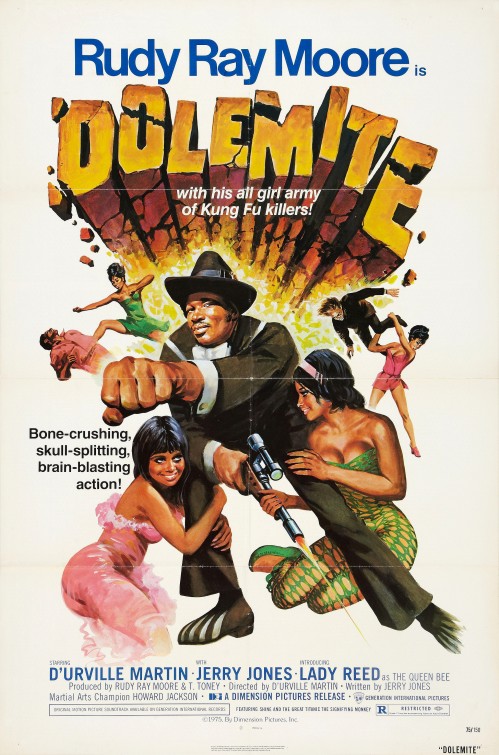
Dolemite

(USA 1975)

Dolemite (Rudy Ray Moore) is his name, and fuckin’ up mutha fuckas is his game!

He’s the baddest pimp around—well, around Los Angeles, anyway—and he looks every bit the part. Dolemite owns a nightclub and whorehouse but he’s doing time on a drug beef. Maybe it’s bogus, maybe not. Maybe some bad cops set him up, maybe it was archenemy Willie Green (D’Urville Martin), who took over the club and is running shit now. Either way, mother pimp Queen Bee (Lady Reed) and Dolemite’s army of ass-kickin’ kung fu hookers are none too happy about it.

To get out of the big house, Dolemite makes a deal with the po-po, Agent Blakeley (Jerry Jones), to, I think, help clean up his old hood. Dolemite uses this as an opportunity to exact revenge on Green and reclaim his, um, stature in the community.  Along the way, he kicks a lot of ass, takes on two crooked cokehead cops—Mitchell (John Kerry) and White—and gets laid. A lot. He even cuss raps at the end.

Dolemite is not a movie to see because it’s a work of art. On the contrary, it’s terrible. But that’s what makes it so much fun to watch—that’s why it’s a cult classic. Like a lot of things before the late ’80s, it’s not P.C. (i.e., politically correct)—as if that isn’t obvious from the movie poster. The directing by Martin, which probably explains why he has so little screen time, is sloppy. You can count the number of times boom mics pop in. The fight scenes are laughable—Dolemite knocks people out barely lifting a finger (or here,  leg) and sometimes without even touching them. Don’t even get me going on the martial arts stuff!

The plot is confusing and watered down. Jones wrote the screenplay with Moore, and the writing is just bad. I admit, I watched it drunk this time, but I’ve seen Dolemite before while sober. No difference. The events are scattered and at points seem random. The characters are colorful—shady Reverend Gibbs (West Gale), a possible parody of former Chicago leader Mayor Daley (Monte “Hy” Pike), the clearly trippin’ Hamburger Pimp (Vainus Rackstraw), and the many fox females—wander in and out, often without any reason.

Despite all that, Dolemite unquestionably has a charm of its own. Moore likes to rhyme, and he punctuates pretty much every sentence with “mutha FUCKA!” His crib is rent-to-own fabulous—check it out:

Dolemite set 2.jpg

Dolemite set 1.png

The wardrobe looks like it was borrowed from the Salvation Army. The climax at the nightclub goes on longer than it should but is still a showstopper. The soundtrack is a trip. If nothing else—and there is nothing else—Dolemite is a good time.

With Brenda DeLong, Terri Mosley, Marilyn Shaw, Lynell Smith, Vera Howard, Joy Martin, Jana Bisbing, Brenda Banks, Pat Haywood, René Van Clief, Pat Jones, Lola Mayo, Charlene Soulter, Liz Sample, Karolynn Hill, Dino Washington, Johnny J. Brown, Cardella Di Milo

Production: Comedian International Enterprise Productions (C.I.E.)

Distribution: Dimension Pictures, Xenon Pictures

90 minutes
Rated R

(DVD) C-

http://xenonpictures.com/wp/dolemite/

http://www.shockingimages.com/dolemite/films/dolemite.php

The Seduction of Mimi [Mimì metallurgico ferito nell’onore]

(Italy 1972)

I never heard of Lina Wertmüller until a retrospective of her work showed at a theater near me. The Seduction of Mimi [Mimì metallurgico ferito nell’onore] is an excellent starting point because it’s a textbook example of her style and the themes that inspire her. Plus, it’s an entertaining movie.

Mimi (Giancarlo Giannini) is a laborer in Sicily. His trouble begins after he votes for the communist candidate in a local election—his employer has been pushing its employees to vote for the mafia candidate. The ballot is supposed to be secret, but Mimi learns that it isn’t when he’s fired. Fearing that things will get complicated, he leaves his wife, Rosalia (Agostina Belli), behind and skips town.

Mimi ends up in Turin, where he finds work on an illegal construction site. He witnesses an on-the-job fatality and proves to be a problem when he learns that the mafia bosses running the job plan to dump the body. To keep him quiet, they place him in a union job at a factory.

It isn’t long before Mimi meets the alluring Fiorella (Mariangela Melato) selling sweaters on the street. He’s hooked on her; in fact, he knocks her up and she gives birth to a son. This is where The Seduction of Mimi gets really fun. Mimi is promoted to a management position back in Sicily. Naturally, he brings Fiorella and the baby with him. He’s protective of his new family and paranoid that Rosalia will find out about it, so he leads a thorny double life that…let’s just say doesn’t end well.

The Seduction of Mimi is rough, moving along like an episode of The Benny Hill Show. It’s compelling nonetheless because it has a certain elegance. Wertmüller is known for mixing sex, class, and politics. It’s a tricky feat, but she manages to pull it off while keeping The Seduction of Mimi totally amusing even by today’s standards. The stuff with the mafia and the gay rumor that gets out because Mimi won’t have sex with Rosalia are both hilarious. The whole revenge subplot that involves getting Amalia (Elena Fiore) pregnant is brilliant on so many levels, and that scene at the end where all of Mimi’s children clamor for him calling him “Papa!” is perfect. Giannini with his bug-eyed Chaplinesque faces looks crazy throughout this film, nicely underscoring the insanity of his situation. I smiled a lot during this film.

With Turi Ferro, Luigi Diberti, Tuccio Musumeci, Ignazio Pappalardo, Gianfranco Barra, Livia Giampalmo

Production: Euro International Film

Distribution: New Line Cinema (USA), Kino Lorber

121 minutes
Rated R

(Gene Siskel Film Center) B

https://www.kinolorber.com/film/theseductionofmimi

https://youtu.be/gI1C1gy-D1c

20th Century Women

(USA 2016)

“We are at a turning point in our history.”

—President Jimmy Carter

I was a little kid in the Seventies, but I have many indelibly vivid memories of the decade: huge cars, gas lines, expensive meat, hijacked planes, Sanka and Sweet’N Low, smoking everywhere, hard rock, punk rock, disco, macrame, spider plants, the Bicentennial, Sky Lab, Victoriana (we had Mucha posters in our mustard-colored kitchen), that strange Holly Hobby aesthetic. It seems like it all changed immediately when Reagan took office in 1981.

20th Century Women captures a slice of American life on that unique, unremembered and largely disowned cusp. Set as a flashback to 1979 with voiceovers that repeatedly remind us that we’re looking backward, the film is a rather remarkable time capsule. The story is simple: Dorothea (Annette Bening) is my grandparents’ age (born in 1924). She had her only son, Jamie (Lucas Jade Zumann), late in life—i.e., over age 40. She’s been divorecd for a few years, which was fine until Jamie hit puberty. Now, she needs help understanding him. She enlists his two closest allies—Julie (Elle Fanning), whose pants he wants to get into, and Abbie (Greta Gerwig), a postpunk fuckup—to help her figure him out.

Loosely based on actual events from director and writer Mike Mills’s childhood, 20th Century Women is fun to watch. Growing up in a house of females myself, I relate to a lot of his experiences. I loved all the Talking Heads, too. Oh!—and Siouxsie and the Banshees! That said, this film borders on overbearing with its nostalgia. It could’ve been so much better—the material and the talent are both there, but Mills goes for easy returns that don’t pay off. The story falls flat. Perhaps a quote from Bening in an earlier film, the superior and far more interesting Running with Scissors, succinctly sums up my problem here: “It’s shit, Fern. It’s sentimental. It’s emotionally dishonest. It implodes into nothingness.”

I wasn’t bored, and I didn’t hate 20th Century Women. But I’m never going to see this movie again. Too bad, because the acting is great. It’s a misfire due to its execution. It seemed like a good idea at the time.

Also starring Billy Crudup, Vitaly Andrew LeBeau, Curran Walters, Toni Christopher, Jimmy Carter (public domain footage)

Produced by Annapurna Pictures, Archer Gray, and Modern People

Distributed by A24

119 minutes
Rated R

(Landmark Century) C

http://20thcenturywomen-movie.com

Sad Vacation: the Last Days of Sid and Nancy

(USA 2016)

It doesn’t get more P.R. (“punk rock”) than the final days of Sid Vicious and Nancy Spungen, the notorious and dysfunctional so-called “Romeo and Juliet of punk”—frankly, I’ve always viewed them as not too far off from John and Yoko, but I digress. Two messy heroin junkies, they bounced around for most of 1978 after the Sex Pistols disbanded. In September, they landed in Manhattan, where they rented a room at the Chelsea Hotel and Nancy appointed herself Sid’s manager. A month later, she ended up slumped next to the toilet in their room, dead from a stab wound to the abdomen (though she had multiple shallow stabs all over). Sid was arrested and allegedly confessed to her murder. While out of prison on bail, he died of a heroin overdose—some claim accidentally administered by his mother, others claim suicide—just four months later.

Danny Garcia’s Sad Vacation, a straight-to-video release coming out almost exactly 30 years after Alex Cox’s biopic Sid and Nancy, revisits these legendary rock and roll deaths. Interviewing many a soul who was there—Steve “Roadent” Conolly, Kenny “Stinker” Gordon, Hellin Killer, Walter Lure, Howie Pyro, Cynthia Ross, Gaye Black, Phyllis Stein, and Sylvain Sylvain to name a few—Garcia presents the facts, which are conflicting and not at all clear. Although Sad Vacation covers a little history of the punk movement, Malcolm McLaren, and the Sex Pistols, the focus is assiduously on what happened at the Chelsea. Narrated by Fun Lovin’ Criminals front man Huey Morgan, Sad Vacation takes on the tone of a crime documentary, laying out evidence and showing the holes in it. Not surprisingly, Garcia reveals some of the “eight thousand or so” conspiracy theories surrounding the murder, with those who knew the couple speculating on who really killed Nancy. Many point to Rockets Redglare, a drug dealer and bodyguard who worked for them. Redglare, who went on to appear in a number of films you’ve actually seen, died in 2001 (https://en.m.wikipedia.org/wiki/Rockets_Redglare).

Sad Vacation is not essential viewing; it doesn’t uncover anything new, raise any points that haven’t been raised before, or even pick a theory to endorse. It concludes that no one will ever know what happened. Big wow. That said, Garcia succeeds in showing that Sid and Nancy were kids—flawed ones, but still. After hearing words like “mess,” “dysfunctional,” and “destructive” to describe their relationship, it’s sweet to learn that his ashes were spread on her grave because they couldn’t be buried together. Now that’s P.R.

94 minutes
Not rated

(Home via iTunes) C

https://m.facebook.com/sadvacationdocumentary/

http://www.chipbakerfilms.com

The Brady Bunch Movie

(USA 1995)

“Marcia did it again! Marcia, Marcia, Marcia!”

—Jan Brady

After the announcement of Florence Henderson’s death on Thanksgiving, it seemed appropriate to honor her memory by spending some time with the character for whom she’ll always be remembered: Carol Brady. I chose not to watch episodes of the sitcom but something else she was in, and The Brady Bunch Movie fit the bill. Although she doesn’t play her iconic character here, Henderson still makes a cameo as Carol’s mother.

The Brady Bunch Movie has about as much depth as the show—less, actually. It doesn’t matter, though, because it’s a divinely groovy tribute to the series, tongue firmly in cheek. Set in the mid ’90s when it came out, the world has changed—but the Bradys, fixed in the ’70s, haven’t. The plot revolves around previously unseen shady next door neighbor Larry Dittmeyer (Michael McKean) and his underhanded plot to get the Bradys out of their home, which they don’t want to sell. Much of the humor comes from the anachronistic nature of the family, especially interesting to watch now that we’re as far in time from the movie as the movie is from the series. Again, the world has changed.

The Brady Bunch Movie captures everything lovably goofy about the series, and does so better than any other movie based on a television show. Deborah Aquila’s casting is genius; every single actor here nails his or her character’s idiosyncrasies. Shelley Long’s Carol is uncanny. Christine Taylor is a dead ringer for Maureen McCormick—it’s actually creepy. Jennifer Elise Cox is amazing as Jan, playing up Eve Plumb’s weird mannerisms and way of speaking as psychotic. Henriette Mantel acts exactly like Ann B. Davis as Alice, right down to her comic beat and the face she makes when she says her punchline. Indeed, casting other sitcom stars like McKean (Laverne & Shirley) and Jean Smart (Designing Women) as the Dittmeyers is a subtle yet wickedly snarky touch. RuPaul makes a bizarre appearance as a guidance counselor. Practically obligatory cameos by Barry Williams, Christopher Knight, and Davis are wacky and good-natured without coming off as desperate.

Director Betty Thomas keeps the pace quick and the lines flying, one right after another. The script is packed with references to quintessential episodes: Jan’s wig and glasses, Marcia’s nose, Greg’s “Johnny Bravo” song (“clowns never laughed before, beanstalks never grew”), Peter’s changing voice, Cindy’s tattling, even Davy Jones singing “Girl” with the Monkees. Fucking brilliant! The script crams an impressive number of lines from the series into an hour and a half.

The Brady Bunch Movie is a fun tribute to a show everyone knows—everyone born between the late 1950s and maybe early to mid 1980s, anyway. I laughed my ass off when I saw it during its original run, and I laughed my ass off again this time. Perhaps one day I’ll bring myself to see A Very Brady Sequel. Rest in peace, Ms. Henderson—I’ll always remember you fondly.

90 minutes
Rated PG-13

(Home via iTunes) B

Christine

(USA 2016)

“In keeping with Channel 40’s policy of bringing you the latest in ‘blood and guts’ and in living color, you are going to see another first—attempted suicide.”

—Christine Chubbuck

During the summer of 1974, local television reporter Christine Chubbuck shot herself in the head on the air while presenting a live news segment at a small station in Sarasota, Florida. I’m not spoiling anything by saying Christine leads up to this jarring moment, but screenwriter Craig Shilowich and director Antonio Campos apparently aim to demonstrate why it happened. A dispositive answer never comes—it could have been a number of reasons, as the film suggests—but that’s because no one but Chubbuck knows for sure. Christine isn’t really about this singular moment, anyway—it’s an intense, sometimes humorous but thoroughly wrenching character study of the solitary woman behind it.

The first time we see Chubbuck (Rebecca Hall) is, appropriately, on a TV monitor: she’s alone in a room interviewing an imaginary Richard Nixon, aggressively grilling him on Watergate. She watches herself, taking notes on how she looks and sounds. She asks a passing colleague about her performance, probing as to whether she comes off as warm and human. This scene succinctly sets up Chubbuck’s dilemma: she wants to be a real journalist going after important newsworthy stories, not the fluff pieces about chickens she usually covers. The problem is, she doesn’t come off quite right: she’s awkward, brusque, combative, and not particularly “feminine,” characteristics that she’s all too aware thwart her chances of improving her lot with a spot as an anchor in a larger market.

Chubbuck lives with her mother (J. Smith-Cameron) and pines for a colleague, anchorman George (Michael C. Hall). She’s an idealist who fights her toxic boss (Tracy Letts) as he pushes to sensationalize the news for the sake of higher ratings. She’s obsessed with her work, which is increasingly unfulfilling. She’s also privately coming undone, something crystal clear from her depressed tendencies, wild mood swings, and bitter resentments toward others she thinks have it better in one way or another than she does.

The cast is spectacular, but it’s no surprise that Hall (Rebecca, not Michael C.) carries Christine—she has to. Hall owns the role: her performance is flawlessly mesmerizing. Resembling a severe Olive Oyl crossed with Wednesday Addams, she deftly uses body language and posture to convey Chubbuck’s uneasy and awkward intensity. Hall slowly and deliberately brings Chubbuck’s frustrations—with her boss, her career, and herself—to a rolling boil. The tone here is clinically journalistic, with the facts of Chubbuck’s situation laid out one by one and offered into evidence for the viewer to make what he or she will of them.

As I watched, I expected Christine to make some profound statement—something about the integrity of “news” in America, gender equality, idealism versus reality, mental health, all of the above. It plants the seeds, but it doesn’t quite get there—it’s either noncommittal or too subtle, I can’t tell which. About halfway through, I realized I wasn’t catching a clear message or a moral. Maybe there isn’t one. A reference to The Mary Tyler Moore Show can be interpreted as irony or cynicism, and it exemplifies Christine‘s ambiguous motive. The film has the feint whiff of exploitation, yet it still tells a lot about Christine Chubbuck and what pushed her over the edge. Christine is respectful to who she was, depicting her as far more than her final moment: she was smart, her peers respected her, she volunteered as a performer at a children’s hospital, and she struggled with many demons. If the actual event played out the way it does in this film, it was a chillingly snarky, mean way to make a point. If nothing else, Christine shows what depression can do to a person.

115 minutes
Rated R

(AMC River East) B

Chicago International Film Festival

Winter of the Witch

(USA 1970)

I never heard of this nifty gem of a short until I saw it, but it’s apparently quite big with Gen X. I can see why: a precursor to Alice Doesn’t Live Here Anymore and Scooby Doo with Bewitched and The Addams Family thrown in, it’s about a single mother (Anna Strasberg) who skips town (Manhattan) in her VW Bug with her young son, Nicky (Roger Morgan), and buys a dilapidated old Victorian mansion in the boonies for cheap. Real cheap: $400 cheap. Turns out, there’s a catch: the place is haunted by a gloomy and depressed 300-year old witch (Hermione Gingold) who’s given up on the world.

Adapted from the book Old Black Witch by Wende and Harry Devlin, screenwriter and director Gerald Herman turns in something unintentionally impressive. I can see why this is such a hit with members of my generation. Aside from a few nouveau social issues for the time (a single parent and a vaguely gay little boy) and the mysterious untold backstory of this mother-son team, Winter of the Witch is really fucking weird. What kid’s story mixes the occult and “magic pancakes” laced with something no one will identify? The damned pancakes make everyone who eats them happy, so… The quality of the film is cheap and eerie, adding to the mood. Plus, Burgess Meredith narrates.

Winter of the Witch is roughly the length of a sitcom episode, which makes me think it was a pilot that didn’t get picked up. Regardless, I love it! See for yourself below.

24 minutes
Not rated

(Music Box) B+

Music Box of Horrors

Annie Hall

(USA 1977)

“A relationship, I think, is like a shark. It has to constantly move forward or it dies. And I think what we got on our hands is a dead shark.”

“You know, this guy goes to his psychiatrist and says, ‘Doc, my brother’s crazy. He thinks he’s a chicken.’ And the doctor says, ‘Well why don’t you turn him in?’ The guy says, ‘I would, but I need the eggs.’ Well, I guess that’s pretty much now how I feel about relationships: you know, they’re totally irrational and crazy and absurd, but I guess we keep going through it because most of us need the eggs.”

—Alvy Singer

Classic Woody Allen is an acquired taste, kind of like gefilte fish: too weird and off putting to appreciate right off the bat, you find that you actually look forward to his annual appearance once you get what he’s about. There’s no way around it: Woody Allen is for the urban set.

Annie Hall is hands down my favorite Woody Allen film, at least out of the ones I’ve seen—and I haven’t seen them all. It’s everything that makes a Woody Allen film great: lots of nervous banter, self-deprication, uncomfortable situations (usually but not always related to sex), an obsession with manners and etiquette, and hilariously pointed observations on the absurdities of modern life. It sounds like Seinfeld, but Allen was first.

The plot is simple enough: Alvy Singer (Allen) examines his relationship with Annie Hall (Diane Keaton), an aspiring Manhattan singer and photographer. They play a cat-and-mouse game because neither wants to make the first move. Alvy and Annie are awkward and bizarre, but I still found myself rooting for both of them. The relationship doesn’t work out, but it’s really something while it lasts. Along the way are small, sublime parts for Carol Kane, Shelley Duvall, Jeff Goldblum, and Christopher Walken.

Annie Hall stands out even as a Woody Allen film, and for an obvious reason. Underneath its entertaining and brilliant storytelling, underneath its many bells and whistles—subtitled subtext, a cartoon segment, and cameos by Marshall McLuhan, Paul Simon, and the Evil Queen from Snow White? Fuck yeah!—is a poignant reality: people change. For all its warmth and wit, Annie Hall spends more time showing its protagonists fall out of love than in it. Rich and layered, it’s funny yet wrenchingly accurate. While we laugh out loud, it plays on our worst fears—none of us wants to end up where Alvy and Annie do.

In 1992, the United States Library of Congress deemed Annie Hall “culturally, historically, or aesthetically significant” and selected it for preservation in the National Film Registry (https://www.loc.gov/programs/national-film-preservation-board/film-registry/complete-national-film-registry-listing/).

96 minutes
Rated PG

(Music Box) A

http://www.woodyallen.com

Play It Again, Sam

(USA 1972)

“It’s from Casablanca. I’ve waited my whole life to say it!”

—Allan

Play It Again, Sam is a rare Woody Allen film that he wrote and starred in but did not direct; it’s only his second such screenplay (http://www.ibtimes.com/8-films-woody-allen-acted-didnt-direct-video-1386755). Herbert Ross directed this film adaption of Allen’s play of the same name. Interestingly, it’s set in San Francisco, not New York or Los Angeles.

Allan Felix (Allen) is a neurotic film critic whose flaky wife (Susan Anspach) just left him. All on his own in their small apartment crammed with his film memorabilia, he’s understandably out of sorts and depressed; being Woody Allen, though, it’s a hundred times worse than anyone else, which makes it funny. His friends Dick (Tony Roberts) and Linda (Diane Keaton), a married couple, encourage him to meet new women, even going so far as setting him up on a date (Jennifer Salt). It’s not working because, well, his neurotic tendencies undermine his efforts—breaking record albums, spilling drinks, knocking down furniture, getting beat up. Not even the ghost of Humphrey Bogart (Jerry Lacy) popping up here and there to offer advice on babes helps. Allan crosses a line when he falls for Linda—and Dick catches a whiff of something going on.

Play It Again, Sam is typical Woody Allen—need I say more? He’s relatably cringeworthy, which is his gift. I loved Linda’s “I love dick” speech and Allen’s date with hot redhead Jennifer (Viva). All the references to Casablanca are fun. The story is a bit predictable, but the characters here keep the film enjoyable. So do the situations, which are just silly enough to remain believable without going too far.

83 minutes
Rated PG

(MoviePlex) B