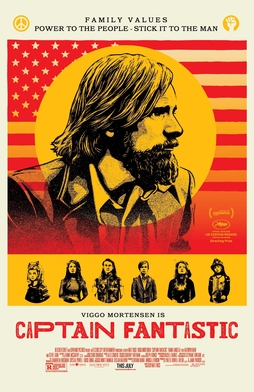
Captain Fantastic

(USA 2016)

Captain Fantastic came out last summer, and I wanted to see it then. I must confess, the cast interested me more than the plot.

Viggo Mortensen is the aptly named Ben Cash, a long disenfranchised survivalist who is, like, so over American capitalism and politics. He and his wife, Leslie (Trin Miller), shown almost entirely in flashback, decide to raise their six kids—three boys and three girls—off the grid in the mountain wilderness of Washington State. Removed from society, Ben and Leslie teach their kids everything from logic and philosophy to hunting and gathering to Norman Mailer and Guns ‘n’ Roses. They do it all without iPhones or religion. Kudos to that!

Nothing is perfect: Leslie suddenly dies, forcing Ben to take his feral kids into the outside 21st Century world for the first time, ever—which calls everything they planned for their family into question.

Director and screenwriter Matt Ross poses some interesting questions about society, conformity, and the social contract in a provocative and often lighthearted way. However, Captain Fantastic is not terribly surprising, which is why it doesn’t work as well as it could. At heart, it’s a standard fish out of water dramedy. Frankly, I spotted every “twist” coming before it got to me: the cop (Rex Young) who pulls over their Partridge Family van, the mildly blasphemous excuse that saves the day, the family’s visit to the supermarket, their reaction to their extended family (and vice versa), that lame scene in which Ben’s sister-in-law (Kathryn Hahn) calls him out onto the carpet for his choices and his youngest daughter (Shree Crooks) recites the Constitution to prove her wrong, eldest son Bo (George MacKay) proposing to the first girl who gives him attention—a trailer park teen queen (Erin Moriarty)—and the colleges he manages to get into, the “situation” that requires modern medical attention. Meh.

For all its grandiose intentions to take on the establishment, Captain Fantastic actually relies on a rather orthodox and pedestrian approach to make its point. Maybe that is its point, that you can’t escape society. It doesn’t mater: this story is predictable and sentimental, two things that never bode well. I expected more than Spokane Swiss Family Brady Bunch, which is essentially what this is. The one thing that saves this film from total mediocrity is the acting, which is great all around.

With Frank Langella, Ann Dowd, Samantha Isler, Annalise Basso, Nicholas Hamilton, Charlie Shotwell, Steve Zahn, Elijah Stevenson, Teddy Van Ee

Production: Electric City Entertainment, ShivHans Pictures

Distribution: Bleecker Street, Universal Pictures

118 minutes
Rated R

(iTunes rental) C

http://www.bleeckerstreetmedia.com/captainfantastic

Clueless

(USA 1995)

“Searching for a boy in high school is as useless as searching for meaning in a Pauly Shore movie.”

—Cher Horowitz

The first screening of Chicago International Film Festival’s Totally ’90s series is Clueless, a sort of link between ’80s classics like Valley Girl and Heathers and later films like Election, 10 Things I Hate About You, Mean Girls, and even Fox’s current television series Scream Queens. Adapted from Jane Austen’s Emma, which I haven’t read and probably never will, Clueless transmits the novel’s heroine across time and space from outside London in the early Nineteenth Century to Beverly Hills in the late Twentieth. It’s a cute idea that works—I didn’t know until this screening that the story is 200 years old. As if!

“Hymenally challenged” (i.e., virgin) 16 year old California girl Cher Horowitz (Alicia Silverstone) is vain, popular, and rich. Perhaps not surprisingly, she’s incredibly superficial, even if she means well. Her mother died in “a freak accident during a routine liposuction,” leaving her father, brass-balled Type A litigator Mel (Dan Hedaya), to raise her. When Cher gets a bad report card, she enlists her bestie Dionne (Stacey Dash), a hip black version of herself, to help fix up two nerdy tough-grading teachers, Mr. Hall (Wallace Shawn) and Miss Geist (Twink Caplan). Her plan is simple: she wants to get them laid so they’ll chill out and be receptive to negotiating her grades. Meanwhile, Cher adopts a new student, “tragically unhip” druggie tomboy Tai (Brittany Murphy) as a pet project: Cher plans to make Tai more like Cher. Duh. Semi-crunchy, socially conscious stepbrother Josh (Paul Rudd) does not approve of Cher’s antics.

Written and directed by Fast Times at Ridgemont High‘s Amy Heckerling, Clueless feels like an ’80s throwback, but it’s still a lot of fun. Loaded with great zingers and one-liners, I laughed a lot. It also has a ton of references to ’90s pop culture that clearly date the film (Luke Perry? Snapple? A Cranberries CD?! Egads!). Clueless lacks a ceratin bite that makes “mean girl” flicks so, well, biting. I guess a large part is because Cher and Dionne aren’t really mean girls; they’re actually pretty naive. After all, it takes Cher awhile to figure out that Christian (Justin Walker), the guy she lusts after, is a friend of Dorothy. Hello?

With Julie Brown, Jeremy Sisto, Breckin Meyer, Donald Faison, Elisa Donovan

Production: Paramount Pictures

Distribution: Paramount Pictures (USA)

97 minutes
Rated PG-13

(Public Chicago) B-

Chicago International Film Festival

https://www.facebook.com/CluelessMovie

Popstar: Never Stop Never Stopping

(USA 2016)

One of the best things to come from Saturday Night Live has to be its Digital Shorts segment. With titles like “Laser Cats!,” “Please Don’t Cut My Testicles,” “Jizz in My Pants,” and of course “Dick in a Box” and its follow up, “Motherlover,” the angle was decidedly crass and juvenile—high school boy stuff loaded with potty, sex, and to a lesser degree drug humor with the occasional reference to geek fodder, usually some work of the science fiction or fantasy genre. Written and produced by The Lonely Island—comedy trio Jorma Taccone, Akiva Schaffer, and Andy Samberg—the genius lied in the creators’ astute balance of pop cultural literacy, musical aptitude, and complete absurdism. Generally performed as music videos for rap and pop songs so spot on they sounded real, Digital Shorts attracted the likes of Steve Martin, Natalie Portman, Lady Gaga, Betty White, and of course Justin Timberlake.

In Popstar: Never Stop Never Stopping, The Lonely Island expands its formula into a feature length film, playing former members of Style Boyz, a boy band whose biggest hit was “The Donkey Roll” (https://youtu.be/-mRVK8-XfEU). After a rift over credit, the Boyz break up and go their separate ways. Lawrence (Schaffer) and Owen (Taccone) fail to duplicate their success, but narcissistic and dubiously talented frontman Conner Friel (Samberg) has a huge blockbuster with his solo album Thriller, Also. The film, done as a mockumentary very much in the style of This Is Spinal Tap!, picks up just as Conner’s followup, Connquest, is about to “drop” (i.e, be released). A huge media blitz including a tour is in the works. When Connquest fails to live up to its predecessor, all signs point to a Style Boyz reunion—but can that happen?

Popstar makes it abundantly clear why The Lonely Island’s brand of humor works as shorts: it simply can’t sustain a movie. With Popstar, they nail the excess, the ego, and the emptiness of the entertainment biz. Tim Meadows as Conner’s manager and Sarah Silverman as his publicist are awesome, simultaneously informing, persuading, and babysitting Conner while constantly stroking his ego. The songs sound real. Conner’s show, complete with backup dancers and a deejay, looks authentic. Some of the scenes are pretty damned funny, including one where Conner is forced to autograph a fan’s, um, junk (props for getting it through the window of the limo). It’s amusing to see real popstars like Questlove, Usher, 50 Cent, and Ringo Starr (not to mention bitch on wheels Simon Cowell) gush in fake interviews over something so obviously lame as Style Boyz and Conner. It’s fun to see P!nk, Adam Levine, and Michael Bolton perform with Conner—and “Equal Rights” (with P!nk) is a hilarious, cheerful spoof of Macklemore & Ryan Lewis’s “Same Love.” Seal and Mariah Carey make gracious cameos that show they can take a joke. This is all good. The problem is, Popstar is essentially a string of dumb gags. Unlike This Is Spinal Tap!, it gets tiresome, fast. I lost interest after a little while; the characters and the jokes are too thin to carry Popstar all the way. Even Timberlake, whose appearances with The Lonely Island have always been funny, is an uncharacteristic yawn as Conner’s chef. Meh.

Curiously, the best song for this film was deleted: https://youtu.be/t3jKtjgRZQY. Seeing it as a short probably is best, anyway.

Also starring Maya Rudolph, Joan Cusack, Imogen Poots, Chris Redd, Edgar Blackmon, James Buckley, Ashley Moore, Bill Hader, Will Forte, Will Arnett, Carrie Underwood, Nas, Akon, Big Boy, D.J. Khaled, Danger Mouse, Pharrell Williams, Jimmy Fallon, Martin Sheen, Snoop Dog, Weird Al Yankovic

Produced by Perfect World Pictures, Apatow Company, and The Lonely Island

Distributed by Universal Pictures

87 minutes
Rated R

(iTunes rental) D+

https://www.uphe.com/movies/popstar-never-stop-never-stopping

The Brady Bunch Movie

(USA 1995)

“Marcia did it again! Marcia, Marcia, Marcia!”

—Jan Brady

After the announcement of Florence Henderson’s death on Thanksgiving, it seemed appropriate to honor her memory by spending some time with the character for whom she’ll always be remembered: Carol Brady. I chose not to watch episodes of the sitcom but something else she was in, and The Brady Bunch Movie fit the bill. Although she doesn’t play her iconic character here, Henderson still makes a cameo as Carol’s mother.

The Brady Bunch Movie has about as much depth as the show—less, actually. It doesn’t matter, though, because it’s a divinely groovy tribute to the series, tongue firmly in cheek. Set in the mid ’90s when it came out, the world has changed—but the Bradys, fixed in the ’70s, haven’t. The plot revolves around previously unseen shady next door neighbor Larry Dittmeyer (Michael McKean) and his underhanded plot to get the Bradys out of their home, which they don’t want to sell. Much of the humor comes from the anachronistic nature of the family, especially interesting to watch now that we’re as far in time from the movie as the movie is from the series. Again, the world has changed.

The Brady Bunch Movie captures everything lovably goofy about the series, and does so better than any other movie based on a television show. Deborah Aquila’s casting is genius; every single actor here nails his or her character’s idiosyncrasies. Shelley Long’s Carol is uncanny. Christine Taylor is a dead ringer for Maureen McCormick—it’s actually creepy. Jennifer Elise Cox is amazing as Jan, playing up Eve Plumb’s weird mannerisms and way of speaking as psychotic. Henriette Mantel acts exactly like Ann B. Davis as Alice, right down to her comic beat and the face she makes when she says her punchline. Indeed, casting other sitcom stars like McKean (Laverne & Shirley) and Jean Smart (Designing Women) as the Dittmeyers is a subtle yet wickedly snarky touch. RuPaul makes a bizarre appearance as a guidance counselor. Practically obligatory cameos by Barry Williams, Christopher Knight, and Davis are wacky and good-natured without coming off as desperate.

Director Betty Thomas keeps the pace quick and the lines flying, one right after another. The script is packed with references to quintessential episodes: Jan’s wig and glasses, Marcia’s nose, Greg’s “Johnny Bravo” song (“clowns never laughed before, beanstalks never grew”), Peter’s changing voice, Cindy’s tattling, even Davy Jones singing “Girl” with the Monkees. Fucking brilliant! The script crams an impressive number of lines from the series into an hour and a half.

The Brady Bunch Movie is a fun tribute to a show everyone knows—everyone born between the late 1950s and maybe early to mid 1980s, anyway. I laughed my ass off when I saw it during its original run, and I laughed my ass off again this time. Perhaps one day I’ll bring myself to see A Very Brady Sequel. Rest in peace, Ms. Henderson—I’ll always remember you fondly.

90 minutes
Rated PG-13

(Home via iTunes) B

Choke

(USA 2008)

“We let the world tell us whether we’re saints or sex addicts. Sane or insane. Heroes or victims. Whether we’re good mothers, or loving sons. But we can decide for ourselves. As a certain wise fugitive once told me, sometimes it’s not important which way you jump—just that you jump.”

—Victor Mancini

I’m not sure why more Chuck Palahniuk novels haven’t been made into movies—his style might not be for everyone, but his stories and characters certainly lend themselves to film. Easily. As it stands, two of his novels have been adapted for the screen: Fight Club, which most probably know because of its stars (Brad Pitt, Edward Norton, Helena Bonham Carter, even Meat Loaf) and director (David Fincher); and Choke, which is relatively unknown—likely because it’s a much lower key (and lower budget) project. I recently learned that Palahniuk has something new coming out—a coloring book called Bait—and it got me thinking about him. On a rainy morning, I downloaded Choke, which I saw one time during its short original theatrical run almost exactly eight years ago. I was thrilled when it finally came out then, and I wanted to see how it reads now. Overall, the film works despite some minor bugs, but the story is still more satisfying as a novel.

Director and screenwriter Clark Gregg—who also has a minor role in Choke—is faithful to the book. Victor Mancini (Sam Rockwell) is a despicable mess. A medical school dropout, he’s a sex addict who hooks up with pretty much anyone who will have him. Possibly his most disturbing partner is Nico (Paz De La Huerta), a fellow member of his sex addiction support group, who disappears from meetings with him to have filthy (and in this film, very graphic) rest room sex down the hall. Victor supports himself as a tour guide of sorts in a colonial-themed park by day and faking choking episodes at restaurants by night. Long ago, he devised an elaborate scam to elicit pity—and money—from the people who save him. He uses the funds to finance his mother, Ida’s (Anjelica Huston), residency at a Catholic mental hospital, where she’s suffering from a form of dimentia and dying. Her doctor, Paige (Kelly Macdonald), has a crazy plan that might save her—if only Victor wasn’t falling for Paige.

The book is usually better than the movie, and Choke is no exception. Like all of Palahniuk’s novels, there’s a lot going on. Gregg makes an artistic choice to emphasize the subplot involving Victor’s mother and their relationship, apparently to unpeel Victor’s many layers. It’s a good idea, but it ends up downplaying other plot elements (and sometimes omitting plot developments)—like the choking scenes, some of the sex addiction, and things at work—and as a result they seem superfluous in the film. Victor comes off as hollow, more case study than character. The casting is really good, though—Brad William Henke is totally likeble as affable chronic masturbator Denny, Gillian Jacobs is dippy smart as stripper Cherry Daquiri, and Heather Burns is wonderfully cunty as Gwen, Victor’s online hookup with the rape fantasy and the silk bedspread. Actually, these three are along the lines of what I pictured when I read the book. Joel Grey makes an odd but well placed appearance as a support group leader. I love that Gregg keeps Victor in a pathetic light and toys with the theme of salvation, and I’m relieved that he doesn’t change the ending and save anyone. The great thing about Palahniuk is that he’s not sentimental, which Gregg honors.

I’ve heard through the years that many of Palahniuk’s books are being adapted for film (or in one case, television): Invisible Monsters (http://www.slashfilm.com/director-hired-chuck-palahniuks-invisible-monsters/), Rant (http://www.slashfilm.com/james-franco-options-chuck-palahniuk-rant-movie/), Survivor (http://collider.com/chuck-palahniuk-survivor-tv-series-jim-uhls/), Haunted (http://www.joblo.com/movie-news/financing-has-finally-come-through-for-the-adaptation-of-chuck-palahniuks-haunted), Snuff (http://www.moviefone.com/2011/02/09/chuck-palahniuk-snuff-film/), and Lullaby (http://chuckpalahniuk.net/news/lullaby-kickstarter-campaign-reaches-surpasses-its-goal). So far, none have come to fruition, so I’ll believe it when I see it. If nine years (the length between Fight Club and Choke) is an indicator, then next year we should see something—my guess is Lullaby.

92 minutes
Rated R

(Home via iTunes) B

Weird Science

(USA 1985)

“So, what would you little maniacs like to do first?”

—Lisa

No one can accuse John Hughes of being highbrow with Weird Science, his farcical teenage male fantasy flick. The concept is ridiculously pedestrian: Gary (Anthony Michael Hall) and Wyatt (Ilan Mitchell-Smith), two high school “donkey dicks” who “couldn’t get laid in a morgue,” create an impossibly hot woman (Kelly LeBrock) using their computer and a Barbie doll—where exactly the latter came from isn’t clear. They name their creation Lisa and hope to put her to use for something—they’re not quite sure what. Turns out, Lisa has her own plans for them. Hilarity ensues.

It might sound awful: Weird Science is silly, indulgent, and crass. What sets it apart from other dumb films of the same ilk is that it actually has a heart. Plus, it’s funny. LeBrock is cheeky, charming, warm, and wry here; she knows exactly when to be flirty and when to be more motherly. She puts forth sincerity in her affection for Gary and Wyatt; the way her voice wavers at their parting scene is more touching than she has any business being in a film like this. Bill Paxton is hilarious as Chet, Wyatt’s militant abusive older brother—”he’s kind of an asshole.” His delivery is downright inspiring—that “greazy pork sandwich served in a dirty ashtray” line gets a snicker out of me every time, as does pretty much everything he says. The scene with Gary’s parents (Britt Leach and Barbara Lang) is classic boy humor. Even Robert Downey, Jr. and Robert Rusler are awesome in their smaller roles as tormentors. I love that Hughes incorporates elements from other movies, Mad Max: The Road Warrior and Return of the Jedi to name two. Even the (hopefully) tongue-in-cheek cheesy special effects fit. Bonus: Oingo Boingo. Somehow, Weird Science‘s utter juvenile goofiness is totally endearing. Be careful what you wish for—you just might get it.

94 minutes
Rated PG-13

(Home via iTunes) B-

The Noble Family [We Are the Nobles] [Nosotros los Nobles]

(Mexico 2013)

I don’t get many opportunities to see Mexican films, which is strange considering the huge Mexican population in Chicago. I tend to like the ones I see, though—a lot. Generally speaking, the storytelling in Mexican films often has a distinct breeziness to it, and the humor a wry and dark undertone with some weight. It’s a different experience than, say, a Pedro Almodóvar film.

The Noble Family is no exception. It’s a cute riches-to-rags story about appreciating the value of money and all that goes with it. Germán Noble (Gonzalo Vega) is a wealthy businessman who built a financial empire. His wife died years ago—“May God keep her close to Him”—leaving Germán to raise his three children on his own with the help of a housekeeper (Mary Paz Mata). He’s taken aback when he notices how they live their lives: his dumb elder son, Javi (Luis Gerardo Méndez), blows money on lame ideas for businesses and on partying; his spoiled daughter, Bárbara (Karla Souza), demands everyone jump when she says so, including her father when she reveals her intention to marry a shady gold digger (Carlos Gascón); and his younger son, hipster Charlie (Juan Pablo Gil), just got expelled from university after he was caught having sex with a teacher in her office. None of them are good at anything—or particularly gracious.

Germán suffers a minor heart attack when he sees how much money his kids are spending. He devises a plan to teach them a lesson—he orchestrates a takedown of his empire, which he claims is due to union troubles and an embezzling business partner (Mario Haddad). The Nobles flee to a ghetto in Mexico City to hide out in a run-down house that Germán’s father owned. For the first time, the kids have to support themselves—which means they have to get jobs. Unbeknownst to him, a lesson awaits Germán as well.

Directed by Gary Alazraki, The Noble Family is a fun satire of rich kids. It’s not mean-spirited, but it makes some serious points about social class, racism, and working hard. The characters are great—all three kids are convincing as fish out of water, especially snippy Bárbara and her constant griping, disdainfully comparing her surroundings to Venezuela, Cuba, even Thailand. Lucho (Ianis Guerrero) is a relatable catalyst, getting the kids jobs and showing them how to take care of business. A subtle subplot involving a cat plays into the moral of the story—no doubt because one of the film’s backers is Whiskas cat food. Weird.

The second highest grossing film in Mexican history (http://variety.com/2016/film/global/mexico-local-movies-hits-nosotros-los-nobles-eugenio-derbez-1201846931/), The Noble Family is a well-done straightforward comedy. It’s a bit predictable, but I still enjoyed it. It’s a lot of fun.

108 minutes
Rated PG-13

(Chicago Cultural Center) B

Chicago International Film Festival

http://www.nosotroslosnobles.com

Medusa: Dare to Be Truthful

(USA 1991)

“Brooke Shields. Dawber, Pam. Personality of Spam. Christie Brinkley. Brosnan, Pierce. Bland and boring, something fierce. Wilson Philips love to sing and wreck the cover of a magazine. Daniel Quayle’s brain is gone. Debbie Gibson gives good yawn.”

—Medusa, “Vague”


“You don’t understand. If I use a smaller penis it would be compromising my artistic integrity.”

“Come on, suck my toes in my documentary. Nobody’s done that yet!”

—Medusa

Made for Showtime, Medusa: Dare to Be Truthful is comedian-turned-MTV “personality” (not the late ’80s hipster V.J. with the identical name) Julie Brown’s scathing spoof of Madonna’s Truth or Dare (https://moviebloke.com/2016/08/26/truth-or-dare-in-bed-with-madonna/)—not to mention the icon herself. The whole thing is juvenile, mean, and absolutely hilarious. At just under an hour, it’s over right before the joke is.

Brown is Medusa, a bratty, self-obsessed, controversial, overhyped, oversexed, and very much untalented pop star. She’s making an explosive “no holds barred” documentary of her Blonde Leading the Blonde World Tour, a sordid affair that relies on sleaze and controversy to hide the fact that her work is so…well, vapid. Did I mention the tour takes place over five days?

Lifting sets, costumes—including conebras, that fluffy pink negligee, and the I Dream of Jeannie clipon ponytail—and dance routines right out of Madonna’s Blond Ambition Tour, Brown doesn’t miss a beat; she nails the overdone hamminess Madonna exhibits throughout Truth or Dare. Masturbating on a red velvet bed? Check. Visiting a deceased family member at the cemetery? Check—although here, it’s a pet cemetery where a dog whose name she can’t remember is laid to rest. Totally ragging on a celebrity who compliments her performance after a show? Check—here, it’s Bobcat Goldthwait. Giving head to an inanimate object? Check—here, it’s a watermelon, not a bottle of Evian.

Gay dancers (Sergio Carbajal, Thomas Halstead, Stanley DeSantis) fawn all over her, she screams at her manager (Chris Elliott) and her crew, and ex-husband Shane Pencil (Donal Logue) can’t deal with her antics. Kathy Griffin plays a backup singer. Plus, Brown gives us dead-on song ripoffs like “Expose Yourself,” “Like a Video,” and “Vague.” Fucking brilliant!

According to Wikipedia, Madonna sent Brown a gift after she saw this—a half-finished bottle of warm champagne (https://en.wikipedia.org/wiki/Medusa:_Dare_to_Be_Truthful).

51 minutes
Not rated

(YouTube) B+

Director’s Cut

(USA 2016)

Yeah…this. Hmmm. Herbert Blount (Penn Jillette) is a weird crowdfunding stalker obsessed with actress Missi Pyle, playing herself, who costars in a low budget crime-gore “movie” with Harry Hamlin and a guy named Reed (Hayes MacArthur). Blount, who is given behind-the-scenes access because he used his PayPal account to donate a large sum of money to the project, is seduced by the artistic process and secretly hijacks the film to make his own version: he wants Pyle front and center. He undermines the director (Adam Rifken), steals footage, and kidnaps Pyle to shoot new scenes with her in his basement.

A movie within a fake movie (Knocked Off), Director’s Cut is a satire of the film industry, celebrity, and the changing role of the audience. Directed for real by Rifken, it exhibits some competent technical handiwork: Knocked Off, little more than a CSI episode, looks professional right down to its angles, cuts, and color grade. A slew of cameos—some, like Jillette, former contestants of Celebrity Apprentice (Gilbert Godfrey, Lisa Rinna)—adds a smart lighthearted touch. Jillette’s longtime partner in magic, Raymond Joseph Teller, makes a fun though not exactly unexpected appearance. Pyle’s diva tantrums “off screen” are amusing. The film makes interesting and timely points about the dangers of giving artistic input and access to the general public and obsessed fans: even in an era where the tools of the trade are readily available to virtually anyone, not everyone can (or should attempt to) make a movie.

Director’s Cut just doesn’t cut it. Sadly, Jillette himself is the most disappointing thing about it. He doesn’t pull off creepy; his gentle, dulcet voice bantering lame “commentary”—like in a bonus feature of a DVD (get it?)—undermines that. Worse, his terrible “acting,” the oddly tame scenes he stages with Pyle, and his crude homemade edits of his version of the film paint him as a harmless grandfatherly dolt more than anything. The gimmick here wears out before the movie is even half over. Director’s Cut has good ideas, but it’s just not funny.

83 minutes
Not rated

(Gene Siskel Film Center) D-

https://makepennbad.com

The Lobster

(Ireland/UK/Greece 2015)

“Now the fact that you will turn into an animal if you fail to fall in love with someone during your stay here is not something that should upset you or get you down. Just think, as an animal you’ll have a second chance to find a companion. But, even then, you must be careful; you need to choose a companion that is a similar type of animal to you. A wolf and a penguin could never live together, nor could a camel and a hippopotamus. That would be absurd.”

—Hotel Manager

Every now and then, a film so wonderfully unique comes along that you just don’t know what exactly to make of it until you take some time to digest it (I took all summer to write and post this entry). The Lobster is such a film. It’s not going to appeal to everyone—it’s a dark, subtle, absurd, uncomfortable, irreverent, and totally open-ended satire of the desire to be “in a relationship.” None of this is the stuff of a summer movie, but I loved it precisely because of these qualities. So far, The Lobster is easily my favorite film I’ve seen this year—released in Europe last fall, it crossed the Atlantic just this past spring.

In the not-so-distant future in a not-so-distant society, being single is against the law. Regardless of the reason for their singularity (death of a spouse, divorce, being dumped), unattached adults must check into a certain hotel designated for singles and find a suitable match, verified and approved by the hotel manager (Olivia Colman), within 45 days. Everything is regimented with meal times, active learning exercises, forced social events, and a strict prohibition on masturbation (though one form of sex with the housekeeping staff is required). “Guests” can buy additional time by shooting “loners”—rogue outlaw singles who escaped to the woods—on daily hunting excursions that resemble Hunger Games. Those who fail to find someone before their time runs out are transformed into the animal of their choice, selected during their initial processing, and banished to the woods.

The Lobster’s protagonist, mild-mannered David (Colin Farrell), finds himself at the hotel, his brother, Bob—now a dog—in tow, after the end of his marriage. He chooses a lobster as his animal because “lobsters live for over one hundred years, are blue-blooded like aristocrats, and stay fertile all their lives.” He also likes the sea.

WARNING: Potential spoilers ahead!

The Lobster is essentially divided into two acts: the first in the hotel and the second in the woods. David connects with fellow guests the Lisping Man (John C. Reilly) and the Limping Man (Ben Wishaw). David notices that the guests there tend seek others like themselves—except for Heartless Woman (Angeliki Papoulia), an emotionless femmebot who seeks out no one but has a seemingly infinite amount of time left thanks to her ruthless archery skills. David decides to go for her, which leads him to the woods. There, he meets the Short Sighted Woman (Rachel Weisz), who is near-sighted like he is. They connect, but the militaristic Loner Leader (Léa Seydoux) forbids all romance—punishable by mutilation. “We dance alone,” she tells David as she hands him an iPod. “That’s why we only play electronic music.”

Written by Yorgos Lanthimos and Efthimis Filippou, the screenplay feels like a Chuck Palahniuk novel. The story is so bizarre and far fetched that it seems silly on paper, but proves incredibly powerful once in motion—in the same way that Being John Malkovich, another film I love that requires the same suspension of disbelief, didn’t sound like much to me before I saw it. Lanthimos has a taste for sadness and the macabre, and he liberally infuses The Lobster with both. He doesn’t take a dim view of relationships, but he notices the dim things people do to have one. The cinematography by Thimios Bakatakis is fabulously drab, with a cool, monotonous, faded color palette that creates a sense of distance and evokes a sense of resignation. Classical music plays throughout to add a kind of Clockwork Orange weirdness to the whole thing.

Despite the mood here, the story turns out to be oddly beautiful. Farrell gives one of his best performances—he drops all his rakish charm to become a colorless, big-bellied middle-aged schlub I found myself rooting for with each predicament he gets into. The inability of David and the Short Sighted Girl to express their feelings for each other is damn near heartbreaking. The entire cast is outstanding, and not a single character is superfluous. The second act is noticeably slower than the first, and perhaps could have been shorter than it is. Regardless, the momentum continues to build to a brilliantly ironic ending that comes about through David’s nearsightedness.

The Lobster doesn’t resolve in the end, which is my favorite thing about it. The viewer is left to decide what happens—and I’ve already discussed different opinions others have about whether David did, or didn’t. It’s the kind of film that lingers on in your memory and forces you think about it even though you’ll never know for sure.

Side note: the film’s website has a quiz that determines your suitable animal. Mine were an elephant, a horse (which finds pleasure in carrots, music, and oral sex), and a water bear. I chose a horse, of course.

119 minutes
Rated R

(ArcLight) A-

http://thelobster-movie.com


horse_poster