Quiz Show

(USA 1994)

“Cheating on a quiz show? That’s sort of like plagiarizing a comic strip.”

—Mark Van Doren


The quiz show scandal of the late 1950s doesn’t sound like a riveting topic for a film, but that’s exactly what it is in Quiz Show, Robert Redford’s fourth directing gig. Every aspect of this film is spectacularly elegant, starting with Bobby Darin crooning “Mack the Knife” as the opening credits roll over shots of armored security guards transferring sealed questions and answers from a bank vault to a studio. Quiz Show is a modern morality play with lots of style.

It’s 1958, and NBC’s Twenty-One is the biggest game show in America. Homely goofball Herbert Stempel (John Turturro) of Queens is a surprise celebrity after an unprecedented winning streak, but the show’s ratings have “plateaued.” The show’s sponsor, Geritol, is ready for a change. So are producers Dan Enright (David Paymer) and Albert Freedman (Hank Azaria), who decide that a charismatic, television-ready new contestant is what the show needs.

WASPy college professor Charles Van Doren (Ralph Fiennes) happens to audition for another NBC game show, the less popular Tic Tac Dough. Handsome, polished, and hailing from an eminent intellectual family, “Charlie” fits the bill for Enright and Freedman’s vision.

Enright takes Stempel out for a steak dinner and asks him to “take a dive,” or purposely lose to Van Doren, on an upcoming show. Predictably, this isn’t something Stempel wants to do—at least, not without something in return. Enright fails to deliver on purposely vague promises, and Stempel publicly calls Twenty-One a fraud, saying it’s rigged. A judge seals the findings of a grand jury investigation, which gets some very minor press: a blurb in the paper. It catches the attention of ladder climbing Richard “Dick” Goodwin (Rob Morrow), a lawyer with the House Legislative Oversight Subcommittee in Washington, D.C., who plans to “put TV on trial.”

Quiz Show didn’t set the box office on fire during its original run, which is really odd (http://www.boxofficemojo.com/yearly/chart/?yr=1994). No matter, because it’s a fine drama. Based on the book Remembering America: A Voice From the Sixties by the real Richard Goodwin, Paul Attanasio’s screenplay is meticulously calibrated and cerebral, rich with strong characters, intertwined dilemmas, a fascinating plot, and a plethora of Fifties pop cultural references without nostalgia. Redford’s pacing is excellent: he sets up the story slowly then knocks down each character one after another. He draws superb performances out of the actors, too. The literary repartee between Van Doren and his genteel father, Mark (Paul Scofield), is one of the best things about this film. A wry and subtle sense of humor keeps the story exuberant: Martin Scorsese is great as fast talking Geritol CEO Martin Rittenhome, and Christopher McDonald makes an awesome Jack Barry.

Sure, Quiz Show isn’t an “exact word” historical documentary; Redford and Attanasio took some license. However, the result is an excellent depiction of good versus evil, not just in the television industry but in corporate America altogether. There’s not a lull or a dull moment here. The only criticism I have is Morrow’s unconvincing Boston accent; that can go. Everything else, though, is brilliant. Enright’s son, Don, wrote a piece about Quiz Show for the L.A. Times (http://articles.latimes.com/1994-09-19/entertainment/ca-40429_1_quiz-show); it’s another view worth considering.

With Mira Sorvino, Johann Carlo, Elizabeth Wilson, Allan Rich, Griffin Dunne

Production: Hollywood Pictures

Distribution: Buena Vista Pictures

133 minutes
Rated PG-13

(DVD/iTunes purchase) A

TwentyOne Pic

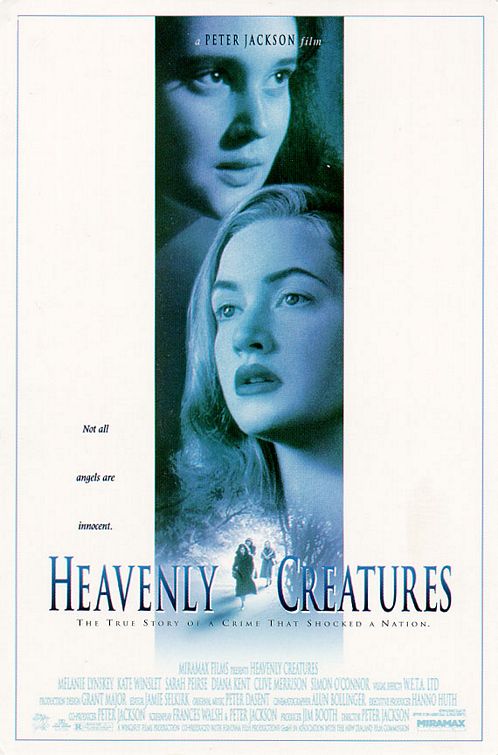
Heavenly Creatures

(New Zealand 1994)

“All the best people have bad chests and bone diseases. It’s all frightfully romantic!”

—Juliet Hulme

Forget Lord of the RingsHeavenly Creatures is Peter Jackson’s coolest film. Before big budget Hollywood blockbuster fantasy franchises, the New Zealand filmmaker wrote, produced, and directed offbeat small-scale gore and porn comedies like Bad Taste (1987), Meet the Feebles (1989), and Dead Alive (1993). I’d already seen that last one by the time Heavenly Creatures came out for a limited run (in the States, anyway) in the fall of 1994. I assumed it would be another messy splatterfest—described to me as a “lesbian murder flick,” what would you think? Turns out, that’s not quite what it is.

Far more than a “lesbian murder flick” or even a brilliant stepping stone to bigger and better things, Heavenly Creatures represents a turning point in Jackson’s career. It’s a rare example of flawless execution across the board. He brings together every element—narrative, character development, casting, visuals, special effects, dialogue, period costumes and sets—to create a real humdinger.

Christchurch, New Zealand, 1952: 14-year-old Yvonne Reiper (Melanie Lynskey), who goes by “Pauline,” is a messy-haired, brooding loner at an all-girl high school. In her first scene, she’s wearing a big scowl on her face at an assembly, not singing along with the rest of her classmates—not until the school’s headmaster (Darien Takle) catches her gaze and snaps her into line with a widening of her eyes. Pauline’s father (Simon O’Connor) manages a grocery market and her mother (Sarah Pierse) runs a room and board for college students out of their home.

WARNING: Potential spoilers ahead!

A new student is introduced during French class: Juliet Hulme (Kate Winslet), the privileged daughter of a reknown college professor (Clive Merrison) and a psychologist (Diana Kent). Juliet, who proclaims she’s “actually from England” and chooses the French name “Antoinette,” captures Pauline’s attention when she insults the teacher, Miss Waller (Elizabeth Moody), unleashing a hilarious hissy fit. The scene is, in a word, awesome to watch play out. Right after that, their art teacher, Mrs. Collins (Liz Mullane), pairs the girls for an assignment that Julia disregards; instead, she draws dragon-slaying St. George, depicting him in the likeness of Mario Lanza, “the world’s greatest tenor!” She doesn’t get around to drawing Pauline, her model. Mrs. Collins isn’t impressed, but Pauline is.

Thus begins the girls’ friendship. They bond over their similar pasts involving childhood disease and extended hospital stays, a penchant for drama, and a mutual distaste for their peers (and perhaps social issues that leave a void). Juliet is mischievous and romantic, which softens Pauline and gets her to open up. Sitting out gym, they giggle over sexy WWII pulp novels. They bike through the woods and strip to their underwear, dancing and singing. They hug a bum (played by Jackson himself) on the street. They hold weird rituals for celebrities they like. They make Plasticine models, write stories, and devise an elaborate royal family tree, building around themselves a fantasy medievalesque kingdom called Borovnia where all its inhabitants worship them. Their imaginary world blurs the bounds of reality as their friendship intensifies.

A string of troubles arises that threatens to separate Pauline and Juliet: tuberculosis, an extramarital affair, a divorce, South Africa, and a medical diagnosis of incurable homosexuality. The girls decide to run away to America, but they can’t secure a passport for Pauline. They devise another scheme to stay together, but it’s a risky one: kill Pauline’s mother.

Heavenly Creatures starts out sweet—it’s something of a typical teen movie at first—but it does a complete turnaround. Based on actual events, Jackson wrote the screenplay with Frances Walsh; the real story is sad but compelling, and the script is tight. The casting—married couple John and Ros Hubbard and the aforementioned Mullane—is genius: every single actor is terrific in his or her part, even the minor ones, and it makes Heavenly Creatures all the richer. Many of them turn up in Jackson’s later projects.

Lynskey and Winslet own their characters; I can’t imagine anyone else in their roles. They’re charming, silly, histrionic, desperate, deranged, and ultimately “stark raving mad”—and they portray all of it exceptionally well. They manage to keep the homosexual subtext from getting out of hand. You can tell from Winslet’s first scene—she walks in with that crazy look on her face—that she’s destined for more. She became a star after Heavenly Creatures in a way that Lynskey didn’t, but both are mesmerizing.

The scenes in Borovnia and the Fourth World are nothing short of spectacular. Actually, many of the visuals here are burned into my memory. Alun Bollinger’s camerawork and bleached palette lends a lovely dreamlike quality. Once things start to unravel for these “nice” girls, the whole thing shifts to a darker, more sinister tone. It’s an emotional downward spiral to the end—those splatter films serve Jackson well.

Heavenly Creatures hasn’t lost its luster after nearly 25 years. I lost track of how many times I’ve seen it, yet it continues to suck me in every single time. It’s one of my favorites.

With Gilbert Goldie, Jed Brophy, Peter Elliott, Kirsti Ferry, Ben Skjellerup, Jean Guérin, Stephen Reilly, Jessica Bradley, Alex Shirtcliffe-Scott

Production: WingNut Films, New Zealand Film Commission

Distribution: Miramax Films (USA)

109 minutes (director’s cut)
Rated R

(iTunes purchase) A

https://www.miramax.com/movie/heavenly-creatures/

https://www.facebook.com/heavenlycreaturesmovie

Hacksaw Ridge

(USA/Australia 2016)

“Thou shalt not kill.”

—The Ten Commandments


“I don’t know how I’m gonna live with myself if I don’t stay true to what I believe.”

—Desmond Doss

Like him or not, Mel Gibson has what it takes to direct a massive Hollywood picture. Hacksaw Ridge, his first directorial job in a decade, demonstrates that much—just in case earlier films like Braveheart, The Passion of the Christ, and Apocalypto didn’t.

Hacksaw Ridge depicts the remarkable and true story of Desmond Doss (Andrew Garfield), the Lynchburg, Virginia, Seventh-day Adventist who served as a medic in the U.S. Army during World War II. His story is unique: he enlisted, but as a conscientous objector for religious reasons. Refusing to kill or carry a gun, he rescued 75 or so wounded soldiers from the field during the Battle of Okinawa (http://www.collegedale-americanlegion.org/Pages/DesmondTDoss.aspx). President Harry S. Truman awarded Doss the Congressional Medal of Honor in 1945, the first time such a high accolade was bestowed upon someone who never even discharged a weapon (https://en.wikipedia.org/wiki/Desmond_Doss).

From a technical standpoint, Hacksaw Ridge is pretty awesome. The story is a good one. The battle scenes are clearly the centerpiece: they’re loud and extremely graphic. The prosthetics are spot on realistic. Cinematographer Simon Duggan starts out with warm, almost sepia tones in the early civilian scenes, but as the setting moves onto the battlefield he ditches color in favor of a washed out black, green, and white palette. Shaky closeups, slow motion shots, blurry pans, and quick cuts create a sense of confusion as gunfire and explosions and human carnage take over the screen. Hacksaw Ridge is no Son of Saul (https://moviebloke.com/2016/02/11/son-of-saul-saul-fia/), but it still overwhelms the senses albeit in a distanced, staged blockbuster way.

Otherwise, Hacksaw Ridge didn’t impress me all that much. At its core, it’s a standard-issue war movie complete with a sugary subplot about the girl, Dorothy Schutte (Teresa Palmer), waiting for Doss to hurry up and get back home so they can get married, and lots of humorous if mawkish male bonding through nicknames, insults, physical attacks, and simply having each other’s back. There’s a military court scene, trite “war is hell, boys” lines, soldiers who freak out once they get on the battlefield, likable characters who perish, and of course the superhuman heroic deeds of Doss.

Most character background is given hurried and superficial treatment: Doss’s alcoholic veteran father (Hugo Weaving) and his bad experience in World War I, Doss and Dorothy’s quick courtship, even the failed attempts of Sgt. Howell (Vince Vaughn) and Cpt. Glover (Sam Worthington) to persuade Doss to leave the Army. Too bad, because a little more insight could have made the film stronger. A particularly glaring example is brother Hal (Nathaniel Buzolic), who simply vanishes once he shows up at the dinner table in uniform. What happens to him? Did I miss it?

I’m conflcited on the message here, but I guess that’s okay because frankly Hacksaw Ridge is a conflicted film. Gibson maintains that it’s an anti-war statement (http://www.christianpost.com/news/mel-gibson-hacksaw-ridge-is-an-anti-war-movie-170318/). Fine, but that’s hard to believe considering the disproportionate amount of time and resources given to overblown battle scenes. I’m not sure the film honors Doss or his pacifist convictions. Moreover, what sure seems like a blatant parallel to the so-called religious liberty movement is, in my view, misguided and hollow, especially when Doss’s faith is treated more or less as incidental. Hacksaw Ridge sustained my interest, but I would have appreciated a little more depth.

With Luke Bracey, Darcy Bryce, Rachel Griffiths, Firass Dirani, Michael Sheasby, Luke Pegler, Nico Cortez, Goran D. Kleut, Harry Greenwood, Damien Thomlinson, Ben O’Toole

Production: Pandemonium Films, Permut Productions, Vendian Entertainment, Kylin Pictures

Distribution: Summit Entertainment (USA)

139 minutes
Rated R

(ArcLight) C+

http://www.hacksawridge.movie

Gold

(USA 2016)

“The taste of it on your tongue, the feel of it on your fingers—it’s like a drug.”

—Mike Acosta

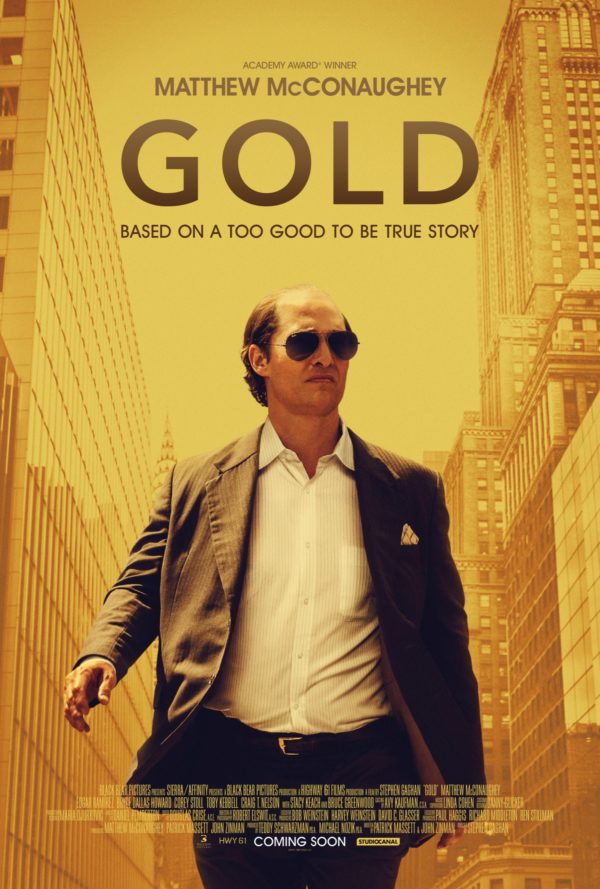
Not everything gold glitters; such is the case with Stephen Gaghan’s Gold, his first film since the acclaimed Syriana over a decade ago. Matthew McConaughey is Kenny Wells, a redneck businessman running his collapsing mining company from a smoke-filled tavern in Reno, Nevada, in 1988. Acting on little more than gut and some pawn shop cash from hocking gifts he gave his girlfriend (Bryce Dallas Howard) in better days shown as the movie opens, he abruptly heads to Indonesia to track down geologist Mike Acosta (Édgar Ramírez) to find a gold mine.

Their first meeting doesn’t go well at all. Looking like he stepped out of Banana Republic when it was a safari store in the ’80s, Acosta is shrewd, rugged, and quite experienced. Balding and sweaty Wells, with his jagged teeth and paunch, is sloppy and desperate. He reads as broke. Unimpressed, Acosta passes when Wells suggests they partner up—until the latter raises $200,000 for the proposed venture. After a series of miscalculations and mishaps (including a bout with malaria), they hit the jackpot in the middle of a jungle. Suddenly, the same banks and big investors that turned up their nose at Wells before want in on the action.

Gold isn’t a bad movie, but it’s not the impressive work it wants to be. The pace is fine, but the plot twists are unsurprising if not downright predictable. The problem is that I’ve seen this story before, and recently: mainstream films like The Big Short (https://moviebloke.wordpress.com/2016/01/03/the-big-short/), The Wolf of Wall Street, and American Hustle deal with the same themes in a similar manner. I’ve seen McConaughey be the same character, too. The curious statement “inspired by a true story” after the opening credits is the cue to something I found disappointing: Gold is a fictionalized account of a true story, changed enough that I guess it can’t claim to be “based on” reality. I’m not sure where that line is drawn, but it turns out much of the story is made up (http://www.financialpost.com/m/search/blog.html?b=business.financialpost.com/news/mining/gold-the-movie-about-the-bre-x-mining-scandal-that-isnt-about-bre-x&q=Bre). Plus, it’s never a good sign when the music in a film—here, artists ranging from Orange Juice to New Order and Joy Division to the Pixies and a new song by Iggy Pop and Danger Mouse—elicits the most enthusiastic response from me. Overall, meh.

Also starring Corey Stoll, Toby Kebbell, Craig T. Nelson, Stacy Keach, Rachael Taylor, Joshua Harto, and Timothy Simons

Produced by Boies/Schiller Films, Black Bear Pictures, and Highway 61 Films

Distributed by TWC-Dimension

121 minutes
Rated R

(AMC River East) C

http://gold-film.com


Hidden Figures

(USA 2016)

Houston, do you read me: NASA employed black people in its infancy during the early Sixties. What’s more, NASA’s first major project, Mercury, probably wouldn’t have gotten off the ground without three black female “computers,” or mathematicians, whose efforts literally put John Glenn and Friendship 7 into orbit. The result was a serious boost in American morale during the race against the Soviets into space and a boon to the Space Program under President Kennedy. So, with its historically significant and truly enlightening subject matter, what most caught me off guard about Hidden Figures is its tone, which is light, upbeat, cute, and often comical. While not in itself a bad thing, it’s not what I expected.

Unfortunately, that’s about all Hidden Figures offers that I didn’t expect. I’m not saying I didn’t enjoy this film; I did. It’s a great story about remarkable people who actually lived. According to one subject, their real stories are not far off from this film (http://www.latimes.com/science/sciencenow/la-sci-sn-hidden-figures-katherine-johnson-20170109-story.html). Taraji P. Henson plays Katherine Johnson, a recently widowed math whiz who works for NASA in Virginia, as a bookish nerd complete with glasses that keep sliding down her nose. She and her coworkers, smart and sassy Dorothy Vaughan (Octavia Spencer) and fiery and coquettish Mary Jackson (Janelle Monáe), quietly but forcefully demonstate their worth in an environment that doesn’t treat them as equals. While Katherine lugs binders and a calculator back and forth between her desk and the “colored” rest room clear across campus to figure out arcs and other shit I sure can’t, Dorothy teaches herself how to operate the new IBM that not even IBM technicians can set up correctly and Mary pushes her way into engineering classes at night in an all white, all male school. Director Theodore Melfi does a really nice job demonstrating institutionalized racism and sexism through characters who may not have anything against black people or women—as administrator Vivian Michael (Kristen Dunst) curtly tells Dorothy in one scene and unwilling research partner, Paul Stafford (Jim Parsons), makes clear to Katherine in another scene by redacting her name from a joint report they both wrote—but don’t recognize the issue.

Despite its merits, I found Hidden Figures to be slightly more sophisticated than a Lifetime movie. Melfi, who with Allison Schroeder adapted the screenplay from Margot Lee Shetterly’s book of the same name, takes a pretty basic approach to the material. It’s so easy—obvious, even—to gage where the story is headed. John Glenn (Glen Powell) sings Katherine’s praises while a love interest develops for her in handsome Col. Jim (Mahershala Ali). So cute. Hidden Figures gets into civil rights issues, but only on a superficial level. There are a few overdone Oscar grabs, like a scene between Katherine and her boss, Al Harrison (Kevin Costner), that ends with him smashing the sign outside the “colored” ladies’ rest room, but no true show stoppers. Frankly, though, most of the actors here have appeared in better movies. Too bad, because this could’ve been a great film instead of just an okay one. Hidden Figures doesn’t quite do its trailblazing subjects justice.

127 minutes
Rated PG

(AMC River East) C+

http://www.foxmovies.com/movies/hidden-figures

Jackie

(USA 2016)

“Brookline is no place to bury a president.”

—Jackie Kennedy (allegedly)

Jacqueline Bouvier Kennedy: her name conjures up specific images—pink Chanel, a pillbox hat, pearls, big sunglasses, all illuminated by her unshakable poise. Jackie, the new biopic by Peruvian director Pablo Larraín, portrays the iconic former First Lady in a light I didn’t quite expect: strategic. While it certainly isn’t flattering, it doesn’t come off as negative, either.

Taking place over the days following the assassination of J.F.K. (Caspar Phillipson), Jackie is essentially a character study that follows Mrs. Kennedy (Natalie Portman) as she steadies and readies herself for both her husband’s funeral and the changes that lie ahead for her and her children (Sunnie Pelant, Aiden and Brody Weinberg). In the midst of her grief, she carefully and with an earnest sense of purpose culls various elements to assemble her husband’s legacy—which she begins with Abraham Lincoln’s funeral procession.

From a technical standpoint, Jackie is impressive. Stéphane Fontaine’s cinematography is lovely, using a pallet of drab, saturated tones that calls to mind Kodak snapshots from the time period to create a somber look that reads clearly as November. He offsets this visual effect nicely with splashes of vivid reds. If nothing else, Jackie is a pretty movie. Structured with split time sequences that go backward and forward, the attention to detail is excellent: the film does a great job reproducing not just the White House and Mrs. Kennedy’s 1962 televised tour of it, but the early ’60s generally. Portman plays her part capably; she’s convincing as Mrs. Kennedy despite her annoying tendency to overdo the drama.

That’s about it for the positive. For all the pains Jackie takes to look and play out perfect, it gets a lot wrong. Those New England accents aren’t quite right, and none of the actors seem able to stick with them. Peter Sarsgaard is epically miscast as Bobby Kennedy, whom he doesn’t even try to emulate. I didn’t realize who he is until well into the film. It’s no secret that Mrs. Kennedy smoked, but popping pills and drinking as she gets dressed in the morning? And telling a priest (John Hurt) that she should’ve been a shop girl or a stenographer? I doubt it. The graphic scene of J.F.K.’s assassination, stuck in somewhere past the middle of the film well after a harrowing and far more effective scene of Mrs. Kennedy staring into a mirror and wiping blood off her face, is completely unnecessary; it comes off as a crude way to shock the audience—I jumped in my seat when I saw it, but not in a good way. The sloppy appearance and condescendingly bored demeanor of the reporter (Billy Crudup) is bizarre; sitting there in his Oxford with his tie undone as he interviews Mrs. Kennedy, I couldn’t help but wonder if in reality she would’ve opened up to him let alone allowed him into her home. He may be handsome, but his entire presence bummed me out.

The “psychological portrait” approach is mildly interesting for a little while, but the intrigue wears off. Jackie is nothing insightful, groundbreaking, or thought provoking. It could have been far more compelling considering its subject—this is total Oscar fodder, but it’s done so dully. I hope Larraín’s other new biopic, Neruda, is better.

100 minutes
Rated R

(Landmark Century) C-

http://www.foxsearchlight.com/jackie/

Sad Vacation: the Last Days of Sid and Nancy

(USA 2016)

It doesn’t get more P.R. (“punk rock”) than the final days of Sid Vicious and Nancy Spungen, the notorious and dysfunctional so-called “Romeo and Juliet of punk”—frankly, I’ve always viewed them as not too far off from John and Yoko, but I digress. Two messy heroin junkies, they bounced around for most of 1978 after the Sex Pistols disbanded. In September, they landed in Manhattan, where they rented a room at the Chelsea Hotel and Nancy appointed herself Sid’s manager. A month later, she ended up slumped next to the toilet in their room, dead from a stab wound to the abdomen (though she had multiple shallow stabs all over). Sid was arrested and allegedly confessed to her murder. While out of prison on bail, he died of a heroin overdose—some claim accidentally administered by his mother, others claim suicide—just four months later.

Danny Garcia’s Sad Vacation, a straight-to-video release coming out almost exactly 30 years after Alex Cox’s biopic Sid and Nancy, revisits these legendary rock and roll deaths. Interviewing many a soul who was there—Steve “Roadent” Conolly, Kenny “Stinker” Gordon, Hellin Killer, Walter Lure, Howie Pyro, Cynthia Ross, Gaye Black, Phyllis Stein, and Sylvain Sylvain to name a few—Garcia presents the facts, which are conflicting and not at all clear. Although Sad Vacation covers a little history of the punk movement, Malcolm McLaren, and the Sex Pistols, the focus is assiduously on what happened at the Chelsea. Narrated by Fun Lovin’ Criminals front man Huey Morgan, Sad Vacation takes on the tone of a crime documentary, laying out evidence and showing the holes in it. Not surprisingly, Garcia reveals some of the “eight thousand or so” conspiracy theories surrounding the murder, with those who knew the couple speculating on who really killed Nancy. Many point to Rockets Redglare, a drug dealer and bodyguard who worked for them. Redglare, who went on to appear in a number of films you’ve actually seen, died in 2001 (https://en.m.wikipedia.org/wiki/Rockets_Redglare).

Sad Vacation is not essential viewing; it doesn’t uncover anything new, raise any points that haven’t been raised before, or even pick a theory to endorse. It concludes that no one will ever know what happened. Big wow. That said, Garcia succeeds in showing that Sid and Nancy were kids—flawed ones, but still. After hearing words like “mess,” “dysfunctional,” and “destructive” to describe their relationship, it’s sweet to learn that his ashes were spread on her grave because they couldn’t be buried together. Now that’s P.R.

94 minutes
Not rated

(Home via iTunes) C

https://m.facebook.com/sadvacationdocumentary/

http://www.chipbakerfilms.com

King Cobra

(USA 2016)

Well now, Justin Kelly’s King Cobra looks like a film with some serious bang: it depicts the salacious, sensational, and supposedly true story of tres popular real-life gay porn actor Sean Lockhart b/k/a Brent Corrigan’s messy entry into the porn industry. Packing loads of scandal and suspense, it comes with a denouncement of sorts from Lockhart himself (https://www.google.com/amp/www.gaystarnews.com/article/brent-corrigan-condemns-gay-drama-king-cobra-bastardising-story-life/amp/?client=safari). Oh, and the money shot: a wad of bona fide Hollywood stars all in on the action. Hot yet? Not so fast, Jack: if there’s one thing I’ve learned from many an opportunity to view gay porn, it’s that looks are deceiving and the movies rarely live up to their promise. Assessing King Cobra therefore demands some deeper probing to get to the bottom of it.

Taken from Andrew E. Stoner and Peter A. Conway’s true crime exposé Cobra Killer: Gay Porn, Murder, and the Manhunt to Bring the Killers to Justice, Kelly’s screenplay gets into the real 2007 murder of Bryan Kocis, the owner and operator of Cobra Video, a real gay porn production company. As such, it makes sense that Kelly doesn’t focus on Corrigan as much as he does on Stephen (Christian Slater), a thinly fictionalized version of Kocis. A forty-something professional photographer turned producer of twink skin flicks, Stephen “discovers” Lockhart (Garrett Clayton) and signs him to make videos in a room of his suburban home in Dallas Township, Pennsylvania. Lockhart becomes Brent Corrigan, a name he plucks from the phone book, and proves to be an internet superstar as a bareback bottom. Things are strained—Stephen is clearly smitten with Lockhart, who moves in with him and does menial chores like yard work and scrubbing toilets around the house shirtless when he’s not shooting porn. Plus, Stephen is doughy and creepy. Lockhart realizes he’s being exploited and sees his potential to make a lot more money on his own. The shit hits the fan when he walks away from his contract with Cobra only to find that he can’t use his porn name because Stephen trademarked it.

Enter psychotic couple Harlow (Keegan Allen), a porn actor and rent boy, and his intense, overbearing boyfriend, Joe Kerekes (James Franco), owner of Viper Boyz, a smaller porn production company. Kerekes is a half million dollars in debt thanks to their ridiculously expensive lifestyle, which is starting to disintegrate. He’s got an idea for a sure moneymaker: Harlow and Corrigan together in a porn. They meet Lockhart, who wants to work with them but can’t use his lucrative name. Desperate to make it happen, they come up with a way to solve Lockhart’s dilemma: get rid of Stephen.

Although I didn’t love it, King Cobra is not terrible. In fact, it’s a noticeable improvement over Kelly’s first film, last year’s I Am Michael (https://moviebloke.wordpress.com/2015/10/24/i-am-michael/). That said, it still suffers from the same deficiencies. If anything, it feels underdeveloped. The two subplots—the storyline with Stephen and Lockhart, and the one with Joe and Harlow—take too long to intersect; when they do, King Cobra devolves into a gay slasher flick. Ho hum. Molly Ringwald and Alicia Silverstone are okay in their roles as Stephen’s sister and Lockhart’s mother, respectively. However, their characters are superfluous and don’t fit into the story—it’s as though they’re dropped in just to give the actors a part in the film so their names can be included on the poster. Oh yeah: another film with Franco playing a gay guy, only this time he gets his butt plowed. Big wow. For a film about the gay porn industry, King Cobra is shy about nudity; it comes off as sanitized cable soft core lite. It’s not even the whole true story; Rolling Stone ran a story about the murder of Kocis in a September 2007 issue: http://www.rollingstone.com/culture/features/death-of-a-porn-king-20070920. Kelly takes some generous artistic license, leaving out parts of what happened (and thus arousing the real Lockhart’s ire).

Kelly’s script is so overboard on gay clichés that it rings hollow. Just as he did in I Am Michael, he again gives superficial treatment to his characters here and doesn’t quite get into their heads, leaving them flat—though he does a better job with Stephen and to a somewhat lesser degree Lockhart. Kelly seems drawn to the dark side of the gays, and I won’t fault him for that. However, his way of portraying this dark side is amateurish and uninformed, recalling films like Cruising and Basic Instinct. Having seen the only two films he’s made, I have to wonder whether he knows any gay people.

I’ll end this on a positive note: Clayton is the real star of this picture. He plays Lockhart as a diva hustler, one with an agenda that no one is getting in the way of. He’s pouty, arrogant, bitchy, so stuck on himself, and unapologetic about it all. He’s brilliant! The scene where a makeup artist touches up his butt says it all.

92 minutes
Not rated

(Home via iTunes) C-

http://www.ifcfilms.com/films/king-cobra

http://gowatchit.com/microsite/4274?gwi_origin=tracking_link&gwi_origin_context=microsite#upcoming_theaters-11402

Tower

(USA 2016)

On August 1, 1966, Charles Whitman, an engineering student at the University of Texas, Austin, killed his mother and his wife before taking over the observation deck of the 30-story Main Building on campus (“The Tower”). Known as the infamous “Texas Tower Sniper,” he then shot random passers-by on the mall below, terrorizing the campus for over an hour and a half. When it was over, 17 victims including him were dead and dozens were wounded (https://en.wikipedia.org/wiki/Charles_Whitman). Quite possibly the first mass shooting on a school campus in the United States—and definitely the first of this magnitude—the event resonates nearly 50 years later.

Keith Maitland’s Tower is a sort of oral history of this tragic day, and it’s compelling from the outset. I may seem to be stating the obvious here—how could the story of such an event be anything but compelling? I haven’t mentioned that the whole thing is animated—as in, a cartoon. I must admit that I was skeptical. Turning a combination of archival footage and reenactments into rotoscopes that have an offbeat King of the Hill quality sounds dubiously unfitting for many reasons. Nonetheless, Tower works unsparingly well.

With barely a mention of Whitman—his name comes up toward the end, and only incidentally—Maitland chooses to focus on those caught in the confusion. He doesn’t say who is shooting or why, putting viewers into the thick of it. He let’s survivors, heroes, and witnesses narrate their ordeals: what they were doing, who was with them, and what happened to them. Claire Wilson (Violett Beane), a pregnant teenager who was the first one shot on campus, tells about seeing her boyfriend, Thomas Eckman, die right next to her and losing her baby while she lied in a pool of her blood on the hot concrete. She also talks about the woman, Rita Starpattern (Josephine McAdam), who played dead to stay with her and keep her conscious until help could get to her. Aleck Hernandez (Aldo Ordoñez) tells about being shot in the shoulder while delivering newspapers with his cousin riding on his bicyle with him. Allen Crum (Chris Doubek), a middleaged bookstore employee, tells about dodging bullets to help a victim on the ground and winding up on the observation deck while Whitman was still shooting. Austin police officers Houston McCoy (Blair Jackson) and Ramiro Martinez (Louie Arnette) talk separately about their roles in bringing down Whitman.

Each account is unflinchingly brutal with lots of personal detail. The animation is an odd but effective way to bring us close to the action in a way that otherwise wouldn’t happen. Considering how it’s presented, Tower is surprisingly emotional and personal. I haven’t seen a documentary like this before.

96 minutes
Not rated

(Music Box) B-

http://towerdocumentary.com

Christine

(USA 2016)

“In keeping with Channel 40’s policy of bringing you the latest in ‘blood and guts’ and in living color, you are going to see another first—attempted suicide.”

—Christine Chubbuck

During the summer of 1974, local television reporter Christine Chubbuck shot herself in the head on the air while presenting a live news segment at a small station in Sarasota, Florida. I’m not spoiling anything by saying Christine leads up to this jarring moment, but screenwriter Craig Shilowich and director Antonio Campos apparently aim to demonstrate why it happened. A dispositive answer never comes—it could have been a number of reasons, as the film suggests—but that’s because no one but Chubbuck knows for sure. Christine isn’t really about this singular moment, anyway—it’s an intense, sometimes humorous but thoroughly wrenching character study of the solitary woman behind it.

The first time we see Chubbuck (Rebecca Hall) is, appropriately, on a TV monitor: she’s alone in a room interviewing an imaginary Richard Nixon, aggressively grilling him on Watergate. She watches herself, taking notes on how she looks and sounds. She asks a passing colleague about her performance, probing as to whether she comes off as warm and human. This scene succinctly sets up Chubbuck’s dilemma: she wants to be a real journalist going after important newsworthy stories, not the fluff pieces about chickens she usually covers. The problem is, she doesn’t come off quite right: she’s awkward, brusque, combative, and not particularly “feminine,” characteristics that she’s all too aware thwart her chances of improving her lot with a spot as an anchor in a larger market.

Chubbuck lives with her mother (J. Smith-Cameron) and pines for a colleague, anchorman George (Michael C. Hall). She’s an idealist who fights her toxic boss (Tracy Letts) as he pushes to sensationalize the news for the sake of higher ratings. She’s obsessed with her work, which is increasingly unfulfilling. She’s also privately coming undone, something crystal clear from her depressed tendencies, wild mood swings, and bitter resentments toward others she thinks have it better in one way or another than she does.

The cast is spectacular, but it’s no surprise that Hall (Rebecca, not Michael C.) carries Christine—she has to. Hall owns the role: her performance is flawlessly mesmerizing. Resembling a severe Olive Oyl crossed with Wednesday Addams, she deftly uses body language and posture to convey Chubbuck’s uneasy and awkward intensity. Hall slowly and deliberately brings Chubbuck’s frustrations—with her boss, her career, and herself—to a rolling boil. The tone here is clinically journalistic, with the facts of Chubbuck’s situation laid out one by one and offered into evidence for the viewer to make what he or she will of them.

As I watched, I expected Christine to make some profound statement—something about the integrity of “news” in America, gender equality, idealism versus reality, mental health, all of the above. It plants the seeds, but it doesn’t quite get there—it’s either noncommittal or too subtle, I can’t tell which. About halfway through, I realized I wasn’t catching a clear message or a moral. Maybe there isn’t one. A reference to The Mary Tyler Moore Show can be interpreted as irony or cynicism, and it exemplifies Christine‘s ambiguous motive. The film has the feint whiff of exploitation, yet it still tells a lot about Christine Chubbuck and what pushed her over the edge. Christine is respectful to who she was, depicting her as far more than her final moment: she was smart, her peers respected her, she volunteered as a performer at a children’s hospital, and she struggled with many demons. If the actual event played out the way it does in this film, it was a chillingly snarky, mean way to make a point. If nothing else, Christine shows what depression can do to a person.

115 minutes
Rated R

(AMC River East) B

Chicago International Film Festival