Footnotes [Sue quell pied danser]

(France 2016)

The second film of a holiday double feature date, Footnotes [Sue quell pied danser], is a cute little Marxist musical about the trials and tribulations of the working class in rural France. The story follows millennial Julie (Pauline Etienne), who snags a job at a factory for a high end shoe designer, Jacques Couture. The job has potential to become permanent, which sounds good to her — she was “downsized” from her job at a shoe store before that, and it took awhile to find another one.

Unbeknownst to Julie — or anyone else in the factory for that matter — the company’s ruthlessly corporate CEO, Xavier (Loïc Corbery), plans to move production to China because it’s cheaper. The factory manager, Félicien (François Morel), is trying to dissuade him. The gals on the production line read about it in the paper, though, and plan a strike. In her first week on the job, Julie finds herself pushed to pick sides, which gets in the way of her budding romance with charming and strapping delivery driver Samy (Olivier Chantreau).

More London Road (https://moviebloke.com/2016/09/21/london-road/) than La La Land (https://moviebloke.com/2016/10/13/la-la-land/), Footnotes is pleasant and entertaining even if it doesn’t quite take off. Cowriters-directors Paul Calori and Kostia Testut keep it light, obviously borrowing from classic Hollywood musicals of the ’40s and ’50s. The songs are about crappy jobs, taking pride in one’s work, making ends meet, organizing into collective bargaining unit, and striving for a better life. The lyrics are fun, but the samba-flavored tunes are otherwise bland and forgettable. So is the choreography, which except for one scene (it involves bright Kinky Boots red shoes) is clumsy and lackluster.

Come to think of it, so are the sets. As would be expected, much of the action takes place in big industrial spaces. Nothing is done to emphasize anything about them; they stay in the background. It’s a huge contrast to a movie like Office (https://moviebloke.com/2015/12/09/office-hua-li-shang-ban-zu/), which went over the top highlighting the size and scope and efficiency of the office building where it took place, and even had at its center a huge clock as if to say “time is money.” Nothing like that here. Frustratingly, the decision Julie makes at the end totally throws off what the story gets at and seems to build toward the entire time.

I wanted to love Footnotes. I didn’t. A little more pizzazz would’ve been a huge improvement.

With Julie Victor, Clémentine Yelnik, Vladimir Granov, Laure Crochet-Sernieclaes, Elodie Escarmelle, Nuch Grenet, Eve Hanus, Valérie Layani, Valérie Masset, Michèle Prélonge, Sophie Tabakov, Yasmine Youcef, Jazmin Londoño Castañeda, Paul Laffont

Production: Loin Derrière L’Oural, France 3 Cinéma, Région Rhône-Alpes, La Banque Postale Image 9

Distribution: Rézo Films (France), Monument Releasing (USA / Canada), Longride (Japan)

85 minutes
Not rated

(Gene Siskel Film Center) C

https://www.footnotesfilm.com

Whitney: Can I Be Me?

(UK / USA 2017)

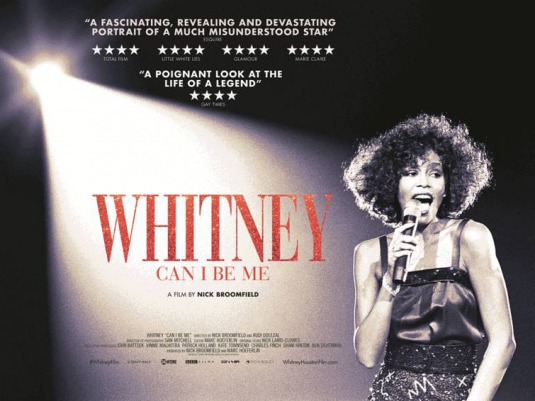
Whitney Houston certainly needs no introduction, and I don’t need to remind anyone about her drug-fueled decline or her sad death five years ago. I saw her perform once when she toured for her first album, but I was never a fan. Still, I observed her career from the sidelines and know all her hits (and misses). To borrow from one of her songs, she almost had it all. Almost.

Co-director Nick Broomfield said that with Whitney: Can I Be Me?, he wanted to show another side of the story: “There was very little attempt to really understand where this was coming from or what it was about. I would like a lot of people to feel that there was a whole other way of looking at this.” (http://www.rollingstone.com/movies/features/whitney-houston-documentary-director-speaks-out-she-was-so-judged-w497676 ). It’s a good idea: fair and balanced, OK.

For better or for worse, Broomfield, who shares a directing credit with Rudi Dolezal for his footage from Houston’s 1999 My Love Is Your Love World Tour, takes a decidedly conventional and low key approach here. He eschews TMZ-like sensationalism, which is refreshing, even admirable. However, the finished product rings incomplete.

Broomfield shows Houston’s dirty laundry. We learn that she used drugs from adolescence. She wasn’t particularly polished. Her mother pushed her, hard. Her label, Arista, had a grand plan for her, and it specifically excluded drawing a black audience. Her BFF Robyn Crawford, who stayed involved with Houston’s career until the aforementioned 1999 tour, was (and still is) a lesbian, which led to rumors. Houston and Bobby Brown were in love, but it didn’t stop him from cheating on her — apparently, he preyed on Houston’s entourage. Crawford and Brown didn’t get along, which created tension. There was also that thing with Houston’s father that happened at the end of his life.

We gets hints and glimpses of what led to Houston’s downfall, but in the end the whole thing is shallow. Like her image throughout her career, Whitney: Can I Be Me? presents a sanitized or at least downplayed picture. Broomfield could’ve dug deeper. He was getting there with Houston’s former bodyguard, David Roberts, who claims that he was repeatedly ignored when he warned everyone around her that Houston was on a fatal trajectory. This documentary falls short; it’s flat and has nothing, shall we say, so emotional. It doesn’t reveal all that much. As a result, it isn’t all that moving.

Another biographical documentary about Houston is in the works (https://www.theguardian.com/film/2016/apr/28/kevin-macdonald-official-whitney-houston-documentary ) ( http://www.whitneyhouston.com/news/director-kevin-macdonald-whitney-houston-documentary/ ). So, there’s more to come. Let’s hope Kevin MacDonald’s version is more compelling.

With David Roberts, Cissy Houston, John Russell Houston Jr., Bobbi Kristina Brown, Bobby Brown, Robyn Crawford

Production: Lafayette Films, Passion Pictures, Showtime Networks

Distribution: Showtime (USA), British Broadcasting Corporation (BBC) (UK), Arsenal Filmverleih (Germany), Eagle Pictures (Italy), Periscoop Film (Netherlands)

105 minutes
Not rated

(Gene Siskel Film Center) C
http://www.sho.com/titles/3433528/whitney-can-i-be-me

Valley Girl

(USA 1983)

“Girls, we must fuck him.”

— Loryn


“Man, he’s like tripendicular, ya know?”

— Julie Richman


“Kings and queens, they don’t grow on trees.”

— Prom Teacher


“Well, fuck you, for sure, like totally!”

— Randy

“Bitchin’! Is this in 3D?” asks Tommy (Michael Bowen), whom no other Val dude can touch. It’s a fair question for a ticket taker wearing 3D glasses, I guess. “No,” responds Randy (Nicolas Cage) nonchalantly as he rips his ticket. “But your face is.” Burn!

I don’t know why Deborah Foreman isn’t on the poster, but I can’t help love Valley Girl. Directed by Martha Coolidge and written by Andrew Lane and Wayne Crawford, it’s a classic that always makes me smile. It’s not because it’s Nicolas Cage’s debut as Nicolas Cage (before Valley Girl, he was Nicolas Coppola). It’s not because it comes straight from the early ‘80s, or because it’s got a totally narly-ass soundtrack, or because of its awesome lines, or because it resonates, like, totally. It’s all of that. And more.

Well, like, it’s sushi, don’t you know? No one will mistake Valley Girl for anything but a product of its time. However, anyone can identify with the dilemma of Julie Richman (Foreman), who’s into Randy (Cage) because he’s not like all the other guys at school, but her friends don’t approve because, well, he’s not like all the other guys at school. He’s from the city — Hollywood, to be exact — and he’s new wave. Oh, the horror!

Randy sweeps Julie off her feet, taking her on a wild ride and introducing her to things you don’t get in the Valley. Her friends, shallow as they are, pressure her to drop Randy for Val dude Tommy (Bowen), who fits their idea of the right guy for Julie — never mind that they already dated and she broke it off because he made her feel “like an old chair or something.” Julie’s heart tells her not to do it. When her friends all but blacklist her, she capitulates. Spoiler alert: she’s not happy.

Randy’s heart is broken, but he won’t give up. He goes undercover, showing up literally everywhere Julie goes — drive-through diners, movie theaters, even camping out on her front lawn. Thanks to Randy’s bestie Fred (Cameron Dye), a plan to win Julie back comes together at her prom — which, incidentally, features Josie Cotton performing.

Part Rebel Without a CauseFast Times at Ridgemont HighGrease, and even The Graduate (Lee Purcell as Stacey’s mother is fantastic), Valley Girl is definitely romantic. It’s also fun and full of heart. The ending is predictable, but I wouldn’t have it any other way.

With Elizabeth Daily, Heidi Holicker, Michelle Meyrink, Tina Theberge, Richard Sanders, Colleen Camp, Frederic Forrest, David Ensor, Joanne Baron, Tony Markes, Camille Calvet, The Plimsouls

Production: Valley 9000

Distribution: Atlantic Releasing

99 minutes
Rated R

(Impact) B

Marie Antoinette

(USA/France 2006)

“This, Madame, is Versailles.”

—Comtesse de Noailles

If her take on Marie Antoinette is any clue, Sofia Coppola loves postpunk ’80s British bands like Siouxsie and the Banshees, the Cure, New Order, and New Romantic frontrunners Adam and the Ants and Bow Wow Wow. So do I. This in all likelihood is what drew me to Marie Antoinette: with three Bow Wow Wow songs (two remixed by My Bloody Valentine’s Kevin Shields), big hair, and a real MTV sensibility, its appeal to me is, well, a piece of cake.

All that is only part of the story. What really makes me love Marie Antionette is the sympathetic angle Coppola takes with this infamous character. Based on Antonia Fraser’s biography Marie Antoinette: The Journey, the first half of the movie is about the difficulties Marie (Kirsten Dunst) faces adapting to her new French surroundings and getting her new husband, Louis XVI (Jason Schwartzman, Coppola’s cousin), to consummate their marriage. She fails, and of course everyone blames her—even her mother (Marianne Faithfull). When she’s had enough, she says “fuck it” and becomes a full on rock star. This is where things get interesting.

Colorful and elaborate, Marie Antionette is not profound. So what? Lance Acord’s music video cinematography is perfect for what Coppola is going for; bordering on sensory overload, this film is busy, clever, and fun to watch. I know better than to take it as a history lesson.

With Judy Davis, Rip Torn, Rose Byrne, Asia Argento, Molly Shannon, Shirley Henderson, Danny Huston, Mary Nighy, Jamie Dornan, Steve Coogan, Tom Hardy

Production: Pricel, Tohokushinsha Film Corporation (TFC), American Zoetrope, Pathé, Commission du Film France, Commission du Film Île-de-France

Distribution: Columbia Pictures, Sony Pictures

123 minutes
Rated PG-13

(iTunes rental) B-

http://www.sonypictures.com/movies/marieantoinette2006feature/

The Adventures of Priscilla, Queen of the Desert

(Australia 1994)

The “road movie” is a subgenre that I think of as an American convention. They tend to involve younger people on a quest for something, perhaps a race (The Cannonball Run), a chase (Convoy), a new life (Alice Doesn’t Live Here Anymore), a vacation (National Lampoon’s Vacation), a mission (Pee-Wee’s Big Adventure), or or just getting laid (Losin’ It). They don’t usually involve gay men or drag performers or Australians for that matter, which makes The Adventures of Priscilla, Queen of the Desert rather compelling for its subversiveness if nothing else.

True, the world had seen a road movie with gay characters before (My Own Private Idaho, which predates this one by three years, comes to mind) and Australians (Roadgames, Backroads). However, The Adventures of Priscilla, Queen of the Desert is different. It’s every bit as fierce as Mad Max, but it’s fabulously fun—as though a team of drag queens tossed a bunch of glitter and disco (and CeCe Peniston) into the mix.

Anthony “Tick” Belrose a.k.a. Mitzi Del Bra (Hugo Weaving) is a drag performer in Sydney who accepts an offer to perform at a casino resort operated by his estranged wife, Marion (Sarah Chadwick), in remote Alice Springs—in the middle of the continent. He gets his buds Bernadette Bassinger (Terence Stamp), a recently widowed transgender woman, and Adam Whitely (Guy Pearce), an obnoxious younger queen whose drag name is Felicia Jollygoodfellow, to join him.

They hit the road in a huge silver tour bus that they christen “Priscilla, Queen of the Desert” and embark on a journey through the desert. A clan of Aboriginals is very welcoming, allowing the three to perform for them. Not everyone is nice, though, which they soon discover when some outbackass bumpkins spraypaint “AIDS Fuckers Go Home” across the side of the bus.

The three contend with the bus breaking down, a homophobic gang, what appears to be an inescapable bar brawl, and secrets—quite a few secrets. Some of the stuff that happens is predictable, but writer and director Stephan Elliott manages to keep the whole thing fresh because he infuses some great conflict and character development into the narrative. Bernadette’s subplot, a soul searching midlife “where do I go from here” kind of existential crisis, is probably the most interesting part of the movie. The acting—Weaving and Pearce (who looks like a cross between Brad Pitt and Mark Wahlberg) for sure, but especially Stamp—is moving for something that appears to be heading toward frivolous and campy territory. It doesn’t quite stop there. What the characters all end up with is something maybe none of us saw coming: acceptance.

What makes The Adventures of Priscilla, Queen of the Desert so great, still, is that it’s full of surprises.

With Rebel Russell, John Casey, June Marie Bennett, Murray Davies, Frank Cornelius, Bob Boyce, Leighton Picken, Maria Kmet, Joseph Kmet, Alan Dargin, Bill Hunter, Julia Cortez, Daniel Kellie, Hannah Corbett, Trevor Barrie, Ken Radley, Mark Holmes

Production: PolyGram Filmed Entertainment, Specific Films

Distribution: Gramercy Pictures, Roadshow Films

104 minutes
Rated R

(DVD purchase) B-

Phantom of the Opera

(USA 1943)

I confess, I rolled my eyes when I found out that a print of Phantom of the Opera was chosen for a screening at the Nitrate Picture Show. I was totally unenthusiastic about seeing yet another version of something I’ve already seen more times than I care to admit. The trailer calls it “[a] story the world can never forget,” but that’s only because Gaston Leroux’s damned story won’t go away.

As it turns out, I quite enjoyed Arthur Lubin’s version. He switches gears with Eric Taylor and Samuel Hoffenstein’s screenplay, ditching horror in favor of romance and melodrama. In the process, he brings a really nice camp factor to the whole thing—I didn’t expect that. His version is a sillier, more fun soapy affair than what I’m used to.

Claude Rains is sympathetic as Erique Claudin, the downsized middle-aged composer who becomes the masked phantom after his publisher (Miles Mander) “steals” his new composition. One of my favorite moments of the entire film is the publisher’s exasperated secretary (Renee Carson) throwing acid from a baking pan in Claudin’s face. It’s so bizarre, it’s actually funny. Even with his acid face, Claudin has a crazy plan for making beautiful young soprano Christine Dubois (Susanna Foster) a star, even if she’ll never return his love. Her female rivalry with diva Biancarolli (Jane Farrar) stews while Anatole (Nelson Eddy), the baritone knight in shining armor, combs the Paris Opera House for the malformed monster (that would be Claudin) who murders anyone in his way. Things get dicier the closer Anatole gets to Claudin.

Phantom of the Opera is a treat for the senses, which makes it perfect for a nitrate print. A rich Technicolor dream, it won Oscars for cinematography (W. Howard Greene and Hal Mohr) and art direction (John B. Goodman, Alexander Golitzen, Russell A. Gausman, and Ira S. Webb) (https://www.oscars.org/oscars/ceremonies/1944). Edward Ward’s score is lovely.

With Edgar Barrier, Leo Carrillo, J. Edward Bromberg, Fritz Feld, Frank Puglia, Steven Geray, Barbara Everest, Hume Cronyn, Elvira Curci, Kate Lawson

Production: Universal Pictures

Distribution: Universal Pictures (USA), General Film Distributors (GFD) (UK), Motion Picture Export Association (MPEA) (Netherlands), Realart Pictures Inc. (USA), Universal Filmverleih (West Germany)

92 minutes
Not rated

(Dryden Theatre) B-

Nitrate Picture Show

Finding Joseph I: The HR from Bad Brains Documentary

(USA/Jamaica 2016)

How low can a punk get? Director James Lathos gives a pretty good idea with Finding Joseph I: The HR from Bad Brains Documentary, a sympathetic if sensationalistic picture of the ups and downs of punk/reggae frontman Paul “H.R.” Hudson, also known by his Jamaican name Joseph I. The film is a companion of sorts to Finding Joseph I: An Oral History of H.R. from Bad Brains by Lathos and Howie Abrams.

Lathos lays out essential information about Hudson’s unconventional and rather nomadic upbringing, his path to the limelight via the ’80s D.C. punk scene, and his spiritual journey. That last part sounds wretchedly dull, but it’s not: Hudson became a Rastafarian, and his music reflected it. The problem is, he also started to unravel around the same time, frequently leaving and rejoining Bad Brains like a dreadlocked Ross Perot.

Sure, there are early live performances that are obligatory in a documentary like Finding Joseph I; fortunately, they’re also pretty damned cool. Many of Hudson’s contemporaries offer insightful, astute, and often entertaining commentary. If he doesn’t avoid nostalgia, Lathos at least doesn’t get sappy. Smart.

All that said, I found the whole thing disconcertingly exploitative. I appreciate that somewhere in here is a point about mental health. Frankly, though, it could have been advanced without making Hudson look like such a hopeless freak. I doubt it was intentional, as this really does come off as a labor of love and not mean-spirited. Nonetheless, Finding Joseph I has an insidious ring to it.

With Earl Hudson, Ras Michael, Guy Oseary, Vernon Reid, Corey Glover, Duff McKagan, Ahmir-Khalib Thompson, Sonny Sandoval, Cro-Mags, Chino Moreno, Deftones, Fishbone, Sublime, The Wailers, Englishman, Chuck Treece, Rakaa Iriscience, Alec MacKaye, Ian MacKaye, Saul Williams, Opie Ortiz

Production: Giraffe Productions, Small Axe Films

Distribution: Small Axe Films

Screening followed by a live Q and A with Jay Mohr

92 minutes
Not rated

(The Chop Shop/1st Ward) C+

CIMMfest

http://hrdocumentary.com

Exodus: Sounds of the Great Migration [Sounds of Exodus: An Ode to the Great Migration]

(USA 2016)

Chicago filmmaker Lonnie Edwards made some waves with his 2015 documentary A Ferguson Story, which delved into some of the events following Officer Darren Wilson’s deadly shooting of unarmed black teen Michael Brown in Ferguson, Missouri. The subject of Exodus: Sounds of the Great Migration isn’t as heavy or bleak, but it’s every bit as intriguing.

Exodus: Sounds of the Great Migration is a smooth, flashy short film that honors the music and dance forms that black Americans brought to other parts of the country, mostly industrialized cities, through the Great Migration from the South during the first half of the 20th Century. In just a few minutes, Edwards demonstrates how both assimilated into urban life and continue to shape modern culture. I couldn’t find credits, but the guy tap dancing in the stairwell stood out; his taps are downright melodious.

Production: 11 Dollar Bill

Distribution:

4 minutes
Not rated

(The Chop Shop/1st Ward) B

CIMMfest

https://www.soundsofexodus.com

Empire Records

(USA 1995)

“I’m the idiot, you’re the screw up, and we are all losers,” sums up Empire Records general manager Joe (Anthony LaPaglia) when he realizes that clerk Lucas (Rory Cochrane) blew the store’s receipts in Atlantic City the night before, which incidentally was the first time Joe let him close shop. His heart was in the right place: Lucas wanted to raise capital to buy the store before owner Mitchell (Ben Bode) sells it to a lame corporate chain called Music Town. Empire Records, you see, is more than a retail outlet: it’s a haven for floundering misfits, including a young shoplifter (Brendon Sexton) who goes by “Warren Beatty.”

Empire Records was a box office bomb (http://www.boxofficemojo.com/movies/?id=empirerecords.htm). Carol Heikkinen’s script is earnest in its desire to (I guess) reveal some revelation about ’90s youth, but the plot is all too predictable, coming off as a third-rate The Breakfast Club. The cast, though, is impressive; loaded with professionals (Debi Mazar and Maxwell Caulfield) and future stars like Renée Zellweger and Liv Tyler, the actors collectively ooze a credible chemistry. Director Allan Moyle pulls some decent performances out of them. A playfully snarky sense of humor about American culture pervades this film, evident in such nifty devices as “Rex Manning Day” and a dream sequence involving Gwar.

Empire Records is very much a product of its time, but that’s what makes it interesting to watch now. This no doubt is why it was selected as the third screening of Chicago International Film Festival’s Totally ’90s series.

With Robin Tunney, Johnny Whitworth, James “Kimo” Wills, Ethan Embry, Coyote Shivers

Production: Monarchy Enterprises B.V., New Regency Pictures, Regency Entertainment, Warner Brothers

Distribution: Warner Brothers

90 minutes
Rated PG-13

(Public Chicago) C+

Chicago International Film Festival

Who’s That Girl

(USA 1987)

“You gotta see me spend money to really appreciate me.”

—Nikki Finn

“¿Quién es esa niña?” asks the buoyant but trite title song, which topped the Billboard Hot 100 charts for a week during the summer of 1987. We all know the answer: it’s Madonna, of course. Perhaps a better question is, what happened with this movie?

Madonna is Nikki Finn, a playful gumcracking ex-con who just got out of jail serving time for a crime she didn’t commit. She’s rough around the edges but dead serious about her mission: she’s determined to find out who framed her for the murder of her boyfriend, Johnny.

Enter uptight humorless yuppie tax attorney Loudon Trott (Griffin Dunne), who works for Manhattan mogul Simon Worthington (John McMartin) and is about to marry his daughter, Wendy (Haviland Morris). Louden is charged with the task of picking up Nikki from the pen and making sure she gets on a bus to Philadelphia. Surprise: it’s not that easy with someone like darling Nikki, which becomes abundantly clear to Louden over the next 24 hours. Talk about causing a commotion.

Originally titled Slammer, Who’s That Girl is an homage of sorts to the screwball comedies of the 1930s and 1940s. It’s a total “summer movie.” Written by Andrew Smith and Ken Finkleman, and directed by James Foley, it shows glimpses of some okay ideas. It’s supposed to be fun, and to a degree it is. Madonna and Dunne concoct a believable chemistry, I’ll give them that. Dunne is a great straight guy, on par with his performance in After Hours. The problem is, Who’s That Girl just isn’t very funny. The jokes are lame, the laughs are far and few between, and the plot is predictable. The whole thing loses steam about halfway through. Murray the cougar (Murray) is a pointless gimmick that, sadly, doesn’t add anything.

The animated opening sequence is cool (and parts of it ended up in the music video for “Who’s That Girl”). The soundtrack is better than the film. Overall, though, Who’s That Girl is a pretty uninspired work. I love Madonna and I ran to the theater when this came out. I was underwhelmed then; after waiting almost 30 years to see it again, I’m underwhelmed now. Fun fact, though: Stanley Tucci and Mike Starr both have minor roles as dockworkers.

With Coati Mundi, Dennis Burkley, James Dietz, Bibi Besch, John Mills, Robert Swan, Drew Pillsbury, Liz Sheridan

Production: Guber-Peters Company

Distribution: Warner Brothers

92 minutes
Rated PG

(iTunes purchase) D+

https://youtu.be/Zi8U2S-2-Cc