Barak and Tomer Heymann’s warm documentary, Who’s Gonna Love Me Now?, takes its title from the first thought that crossed subject Saar Maoz’s mind when he received his HIV diagnosis. A likable middle-aged gay guy (he turns 40 during the course of the film), Maoz relocated to London almost two decades ago after he was kicked out his kibbutz in Israel for being gay. It’s been a source of embarrassment for his religious family, whose respect Maoz seems to have lost. He sets out to change that, going back home and confronting his parents and his siblings. He has to get past their fears, their misconceptions about homosexuality and HIV, and worst of all their judgments of him.
Maoz, who sings in the London Gay Men’s Chorus, is oddly charismatic. Relatively unassuming, he leads a seemingly quiet life and doesn’t exactly stand out from the crowd; in fact, he blends in with the other men in virtually every scene with the Chorus (save for one—I won’t say what it’s about). He’s decent, honest, open, and has a good sense of humor with an imperfect past, all of which probably explain his charm. He could be anyone you know, including yourself. I must admit, I related to him on many levels here: his conflicted feelings about his religion, moving away from home and coming out, his sense of distance with some of his family, filling a void with partying in the early 2000s, being alone for a long period of time. He doesn’t come across as regretful or pitiable, just reflective and forward-focused. Filmed over the course of about five years, the best scenes are the ones with his mother, his father, and an argument in a restaurant with his brother. Who’s Gonna Love Me Now? is an often funny and sometimes heavy reminder that home is where you can be yourself, for better or for worse.
Screening followed by a live discussion with Saar Maoz
“Clubbing” in the late ’80s and early ’90s was about having fun, being seen, getting some attention when you could, and simply being fabulous. I was already past my clubbing days (or nights) and into raves when I read something about the horrific murder and dismemberment of a club kid in New York City in 1996. It hit home, albeit in a small way: not a club kid myself, some of my friends had been—or at least they were club kid lite—and I was familiar with the scene, which wasn’t violent. I followed the story for a little while but didn’t keep up to see what eventually happened—I was busy doing other stuff, like getting my shit together to go to law school and move somewhere else. The incident wasn’t front page news. A few years later, a friend gave me a copy of Disco Bloodbath by James St. James. I was floored to discover that it chronicled the story I started to follow. I absolutely loved the book—even with a drug fueled murder at its climax, it’s an irresistible mix of club queen adventures, flip observations, dish, dirt, and even a dash of nostalgia. Plus, it’s well written. I devoured it over a few days on the beach in Puerto Vallarta.
Party Monster is Fenton Bailey and Randy Barbato’s film adaptation of St. James’s memoir. They take some liberties—they aren’t totally by the book and some of the music isn’t quite right—but they still manage to brilliantly capture the look and feel of those days and that scene. The cast members, known and unknown, are excellent: Seth Green, Macaulay Culkin, Dylan McDermott, Wilmer Valderrama, Wilson Cruz, Justin Hagan, Chloë Sevigny, even Marilyn Manson. John Stamos makes a cameo as a talk show host with actual club kids, including Amanda Lepore, Richie Rich, and Walt Paper (who oddly enough I knew briefly in undergrad). Green and Culkin have a natural chemistry as friends and foes—one of my favorite scenes is James (Green) showing Michael (Culkin) how to work a room at a Dunkin Donuts knockoff. The thing I love about the movie is how fun this world is—parties, costumes, Disco 2000, ordering burgers for 300 clubgoers at a fast food chain, piling into the back of a semi with a guy in a chicken suit, even doing drugs. The genius of the film is that, like the book, it makes me want to be a part of this world despite its flaws and the tragic ending.
“Opulence. O, P, U, L, E, N, C, E, opulence. You own everything. Everything is yours!”
—Junior LaBeija
Before The Crying Game and Transamerica, RuPaul’s Drag Race, Bruce/Caitlyn Jenner, and Scissor Sisters’ “Let’s Have a Kiki,” there was Paris Is Burning. I first saw it at a screening on my college campus, I think, when it was fairly new—I remember a double feature with Madonna’s Truth or Dare, so it had to be summer or fall 1991. I’ve since seen it countless times. It’s one of the films I quote most. I love it, even as it turns 25 years old. It is, in two words, fucking fabulous!
Shot in 1987 with a short check in three years later, Paris Is Burning is ostensibly a documentary about the Harlem nightlife ball culture (pronounced “boo-wall” by most here). The film takes its name from one said ball, a rather clandestine affair held in a shabby party hall somewhere near Lexington/125. A world unto itself, ball culture was loaded with costumes, wild dancing, attitude, hierarchy, and tons of rules. There was blood, sweat, tears, and fighting—but there was also community and (for some) glory. As one subject, Willie Ninja, informs us, the balls may have been long and drawn out, but they were never boring. Amen! This is clear.
Much to her credit, director Jennie Livingston goes—excuse how this sounds—beyond the balls, getting into the daily challenges not only gay men and drag queens faced, but also actual bona fide transgender women. This was probably the first exposure I had to that. I mean, being gay in the Reagan Era was bad enough: if you weren’t destined to live a long and lonely life in the closet, you were going to get AIDS. Either way, the only thing straight about you was your road to hell. Transgender was…something else altogether. America was not ready for it when Paris is Burning came out, which makes it all the more remarkable.
Paris Is Burning is a big middle finger to all that thinking. While not everyone subscribed to that view, Paris Is Burning was the first film to show a lifestyle like this in a positive light. It was effective; it showed how fun and liberating it could be to walk a ball, fake tits or not. Hey babe, take a walk on the wild side. Damned fun! No wonder Madonna co-opted vogueing and snagged two Xtravaganzas for her tour.
Although there are undertones of sadness throughout, every person in this film is a hero. They were courageous simply living their lives how they did, when they did. The key was a mix of self confidence and major guts. Dorian Corey gave me a crash course on reading and shade. Pepper LaBeija showed me that living the good life takes more than money. Venus Xtravaganza showed me that life is a negotiation. Whatever category you choose, you better work it!
Sadly, the era and the players of Paris Is Burning are long gone, but their spirit doesn’t just live on—it thrives. Paris Is Burning and its subjects are legendary.
Side note: everything has its dark side. This is a perfect example: http://dangerousminds.net/comments/dorian_corey_the_drag_queen_had_a_mummy_in_her_closet
In 2016, the United States Library of Congress deemed Paris Is Burning “culturally, historically, or aesthetically significant” and selected it for preservation in the National Film Registry.
“I do not endorse a way of life but describe one, and the audience is left to make its own decisions and judgments.”
“Even when I feel like shit, they still love me.”
“Yeah. It ain’t all fucking hunky-dory.”
“I know I’m not the best singer and I know I’m not the best dancer, but I’m not interested in that. I’m interested in pushing people’s buttons, in being provocative and in being political.”
—Madonna
In Richard Linklater’s Slacker—released the same year—an Austin, Texas, townie (Teresa Taylor) hocks a jar she claims is a “Madonna pap smear,” talking it up as an item “closer to the rock god than just a poster.” Up close and personal, that’s essentially what Truth or Dare is: a Madonna pap smear, figuratively speaking.
Truth or Dare is Madonna showing us all how cool she is. It encapsulates an exceptionally interesting time—the best time for her to do something like this, as proven by her later tour documentary, the painfully dull I’m Going to Tell You a Secret, in 2006. Certainly no run of the mill performer, it’s only fitting that Truth or Dare is no run of the mill concert film. Shot at the zenith of her career during the Blond Ambition Tour in 1990—a banner year for an artist with a long track record of controversy and success—Madonna allows director Alek Keshishian unprecedented (though not complete) access behind the scenes, and he in turn gives viewers a lot of juicy nuggets to feast on. For fans, Keshishian shows that Madonna really is—or was—all that, and more: she’s snappy, saucy, snide, mischievous, rebellious, witty, tough, and through it all ridiculosly entertaining (and I imagine a lot of fun if you’re on her good side).
The live stuff is superb. Keshishian picks all the showstoppers from Madonna’s most iconic tour: “Express Yourself,” “Holiday,” “Vogue,” a what-the-fuck version of “Like a Virgin” inspired by an ancient Egyptian orgy, and my favorite despite its unfortunate truncation, a Bob Fosse meets A Clockwork Orange take on “Keep it Together.” Views from both the floor and onstage present the show in all its over-the-top glory. Using color in an otherwise black and white film makes the live pieces all the more special.
The backstage shots on tour—the nightly prayers, the stress and snafus, the post show parties—are even better. The shade Madonna thows at other celebrities—Oprah Winfrey, Belinda Carlisle, Zsa Zsa Gabor, and of course Kevin Costner—is uncalled for but hilarious, sometimes uncomfortably so. Personal events like her spat with Warren Beatty before the Dick Tracy opening in Orlando (she calls him an “asshole”), a phone call with her father to arrange tickets for a show in Detroit, meeting a childhood friend, even attending Pedro Almodóvar’s party in Madrid all uncover multiple sides of Madonna.
But Keshishian goes deeper (and deeper): for every cringeworthy contrived scene that rings hollow—like visiting the cemetery to see her mother’s grave—is an honest one revealing the flawed and complicated person Madonna is. My favorite moments in Truth or Dare are the small events that show her human side. She’s generous with her dancers and her family—the scene where she sings “Happy Birthday” to her father onstage is precious. Her conversation with Sandra Bernhard where she admits she’s bored is illuminating and oddly relatable. I still find her comment that “everyone talks about how fame changes a person, but they never talk about how fame changes the people around them” her most poignant statement—and Keshishian demonstrates what she means. Often, Madonna doesn’t have it all under control: it rains on the Asian leg of her outdoor tour, her headset keeps shorting out during a concert, the police pop up to arrest her at her show in Toronto, her brother Martin doesn’t show up at her hotel suite when he’s supposed to, her throat gives out, a member of her entourage is drugged and assaulted, a dancer (Oliver Crumes) goes AWOL. These scenes stand out because they reveal a lot about how Madonna handles tough situations—and she’s not always good at it. Moreover, she doesn’t have everything she wants: phone messages, Antonio Banderas, Slam and Gabriel, to name a few.
Madonna has admitted she was shady and a horribe brat in Truth or Dare (http://www.ew.com/article/2015/08/07/madonna-truth-or-dare). What makes it richer and more thorough, though, is that the focus is not solely on her. Madonna’s dancers are given ample space to show who they are and let some of their stories come out. Bringing out their homosexuality, especially during the age of AIDS, is a bold move that points to the topics and issues that clearly color(ed) her work. Truth or Dare got me to see Madonna more as a performance artist than a pop star.
There are loads of truly fun moments here. Plus, we get to see a flash of her boobs. In the end, Madonna shows us a good time but still leaves us asking, who’s that girl? It’s a strategy that’s served her well throughout her career.
Kudos to screenwriter and codirector Brian O’Donnell for his first film, Akron. After a great setup, he throws in a crazy plot twist and completely changes the trajectory of the story: what starts out as a sweet, almost too cute romance turns into something weird, dark, and potentially calamitous. The drama here slowly simmers to a boil and starts to bubble over. O’Donnell treats a gay relationship as incidental and not something strange; it’s a given from the outset. Plus, he makes the city of Akron a major character without becoming a cheerleader.
Benny (Matthew Frias), a student at the University of Akron, meets another student, Christopher (Edmund Donovan), at a pick up football game. They start dating, and Christopher invites Benny on a road trip to Florida to meet his mother (Amy da Luz) over sping break. While waiting for him on the morning they head out, Benny’s mother (Andrea Burns) mentions to Christopher that Benny had an older brother who died when they were both kids. Christopher realizes that he and his mother are connected to the tragedy.
As much as I liked Akron—and there is quite a bit here to like—it has problems. The opening scene, which takes place a decade or more before the story, is confusing; no hints are given to tip us off that we are in the past. The scene is shot in a grocery store parking lot with current cars and license plates. It threw me off, and it took me awhile to realize that this scene occurred a long time ago. It’s a critical piece of the story, so it should have been done more carefully. For the most part, the acting is good; however, Benny’s mother is a Latina-lite Stepford wife who ultimately comes off as one-dimensional caricature rather than a fully developed character. Burns overdoes the doting mom thing. Particularly annoying is her peppering her speech with basic Spanish words that everyone knows; it doesn’t ring authentic because she’s whiter than Christopher. Sadly, the story fizzles in the end; the resolution is too fast and too neat, and some of the characters—especially Benny’s father (Joseph Melendez) and sister (Isabel Rose Machado)—get lost in the melodrama. I could have done without the sensitive folky score.
Akron isn’t a bad film. It could’ve been a lot more interesting, though—it certainly has the elements. It ultimately doesn’t meet is potential.
The title is misleading: Henry Gamble (Cole Doman), teenaged son of a preacher man, is definitely having a birthday party—a pool party, no less. It’s an all-day affair for an Evangelical crowd, and it continues into the night. A lot more than cake, ice cream, swimming, and Jesus is going on here, though. Henry Gamble’s Birthday Party is much more complex and interesting than it may appear at first blush.
The opening scene is brilliant even if it is weird, and it shows exactly what Henry is going through: he’s lusting after his buddy, Gabe (Joe Keery), who just slept over. Henry’s sister, Autumn (Nina Ganet), home from her freshman year at a Christian college, is dealing with her lost virginity and possibly unresolved feelings for and mixed signals from the guy she gave it to, Aaron (Tyler Ross). Henry’s parents, Bob (Pat Healy) and Kat (Elizabeth Laidlaw), are recovering from a disruptive event involving the deceased husband of neighbor and fellow churchgoer Rose Matthews (Meg Thalken) and contemplating a separation, something that probably doesn’t bode well for Bob’s career. Meanwhile, Rose, who clearly misses her husband, seems to have taken up drinking, and her son Ricky (Patrick Andrews) has other issues altogether.
Henry Gamble’s Birthday Party is not what I expected—a very good thing. It’s about the secret matters that go on in private, how we face or avoid them, and the facades we all put up to keep them private. It definitely gets at Henry’s queer longings and raises some gay issues, but it’s not what I would call a “queer” movie. Its subject matter is broader than that. It’s not even focused on Henry—his family members, friends, and even secondary characters are all going through one thing or another: Logan (Daniel Kyri) is black and “questioning” if not gay in a homophobic white world, pastor Larry Montgomery (Steppenwolf member Francis Guinan) is questioning his faith and looking for an escape, and his wife, Bonnie (Hanna Dworkin), is repeatedly disappointed by the sagging morals of those around her. This is a smartly culled ensemble of realistic characters, each discovering himself or herself—much like Henry.
I enjoyed this film a lot more than I thought I would. Laced with sexuality, it manages to maintain both an honesty and an innocence that work really well. The acting, mostly but not entirely by newcomers, is surprisingly good—particularly Doman and Kyri, who play their parts with a winning uneasiness. Laidlaw is awesome as Henry’s mother, and she subtly defies what one might expect an Evangelical Christian mother to be. Writer/director Stephen Cone creates relatable, memorable characters—they’re all flawed and inconsistent, yet he approaches each of them with tenderness and leaves their dignity intact. A killer new wave inspired soundtrack scores major cool points. Henry Gamble’s Birthday Party has the flavor of a John Hughes film—it was even filmed in Lake Forest on Chicago’s North Shore—but it stands on its own. Everyone here has a story, and each story makes for an absorbing film.
Some may find it hard to imagine today, but it wasn’t long ago when being gay was not acceptable in America– not even in “Hollyweird,” as Tab Hunter’s autobiography demonstrates. Tab Hunter Confidential is an interesting and entertaining albeit innocuous slice of what life was once like.
Hunter (real name: Art Kelm) discusses with candor and good humor his rise, fall, and personal life in the closet. He is open but definitely guarded: he treads lightly, ostensibly in the interest of privacy. He’s rather gingerly, too: he doesn’t say he slept with anyone, he says he “went up to his room;” he doesn’t say he dated, he says “we were together.” You get the idea. Appearances from celebrities popular in his day– Debbie Reynolds, Connie Stevens, and Mother Superior Dolores Hart (yes, a starlet turned nun)– round out his story and convey how well-liked he was, and still is.
Co-produced by his partner of three decades, Allan Glaser, Tab Hunter Confidential is not exactly the tell-all the title implies. It shares some great anecdotes and Golden Age Hollywood gossip, but no bombshells. Those seeking salacious details will be disappointed. The many images of young Hunter, however, make up for the lack of sleaze.
In the late Nineties and early 2000s, I picked up XY Magazine whenever I saw it on the news rack, usually at Borders, Tower Records, or Unabridged. It was a sort of gay culture Sassy meets Star Hits—I’m showing my age here, I know. Unbeknownst to me, XY contributor Michael Glatze went from “out” in San Francisco to poster boy for Evangelical conversion therapy in a matter of years. This film chronicles his seemingly bizarre change of heart.
I Am Michael has the makings of a winner: a complicated and interesting true story, a star cast, and timely subject matter. Sadly, it’s a big disappointment. James Franco is just okay as Glatze—never mind that his real-life sexual ambiguity rings tired these days. However true to life the events in the film may be, so many gay cliches—circuit parties, techno music, three-ways, drugs, fake blonde hair—are thrown in that it feels flat, hollow, and insulting after awhile. Worse, cowriter/director Justin Kelly gives short, superficial treatment to what drives Glatze’s metamorphosis; he provides a basic explanation but fails to get inside the guy’s head in any meaningful way. On top of all that, the film has the cheap look of a made-for-television movie. Surely, a gay can do better than this.
On the positive side, Zachary Quinto as Glatze’s suffering partner, Bennet, is great; he expertly builds his character’s frustration and weariness with Glatze’s constant angst and Bible diving while remaining tender when he needs to (for example, as he does when Glatze calls him out of the blue). Emma Roberts as Rebekah, the girl Glatze meets at Bible school and eventually marries, is also great; she plays a “nice girl” really well, and she makes us feel her confused uneasiness with his past. Both are memorable high points in a forgettable film.
An informative and amusing exploration of the “gay voice,” that effeminate and often annoying over-the-top stereotypical way that so many gay men speak—and that one man (David Thorpe) wants to change. Thorpe looks to speech therapy and academia but mostly pop culture for answers, enlisting gay celebrities like Dan Savage, George Takei, and Tim Gunn along the way. Their responses reveal the conflicted attitudes gay men hold toward masculinity and identity.
Despite its merits, Do I Sound Gay? ultimately underwhelmed me. It provided useful tidbits of information, but nothing solid or groundbreaking.
A day in the life of two transgender prostitutes, Sin-Dee (Kitana Kiki Rodriguez) and Alexandra (Mya Taylor) of West Hollywood. Sin-Dee just got out of jail and is trying to tack down her fiancé/pimp, Chester (James Ransone), who failed to pick her up. Fellow trans hooker Alexandra lets out of the bag that Chester has been shacking up with a real girl (Mickey O’Hagen) while Sin-Dee was in the slammer. Sin-Dee shifts her plan and sets out to kidnap her. Did I mention it’s Christmas Eve? Thrown into all this is Armenian cab driver Razmik (Karren Karagulian), who is married and has a thing for Alexandra. Where is all this going?
Tangerine gets off to a shaky start, but director Sean Baker lets his characters develop into full-fledged people as the film rolls on and ultimately proves to be a beautiful story. With a pervading sense of loneliness, it makes a point about survival and needing to rely on others to do it. No man (or woman) is an island.
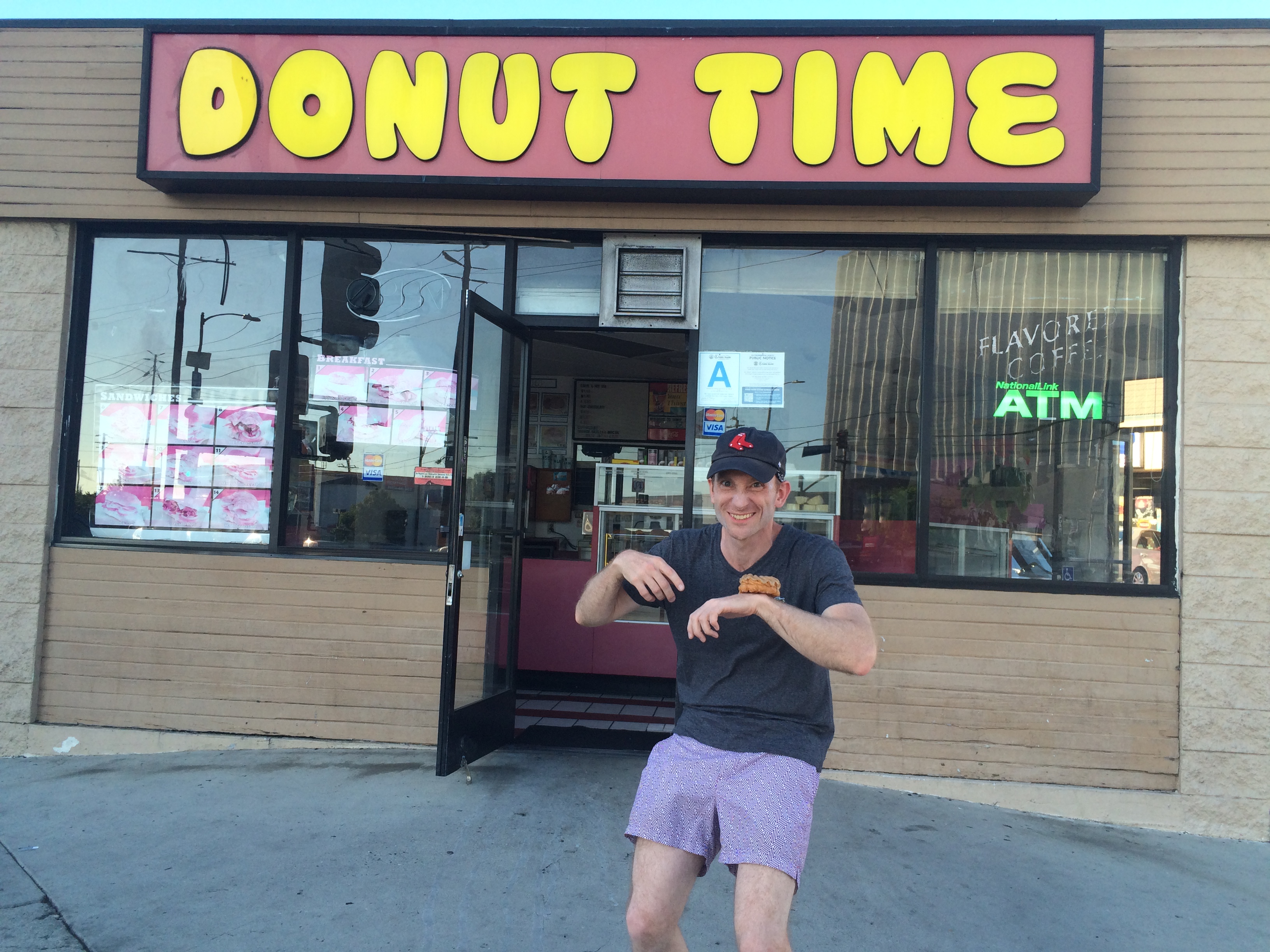
Footnote: I tracked down Donut Time, the donut shop where much of the action in Tangerine takes place. It’s located at 6785 Santa Monica Blvd. at the corner of Highland. I used the ATM and bought a cruller. It was awesome.


 moviebloke