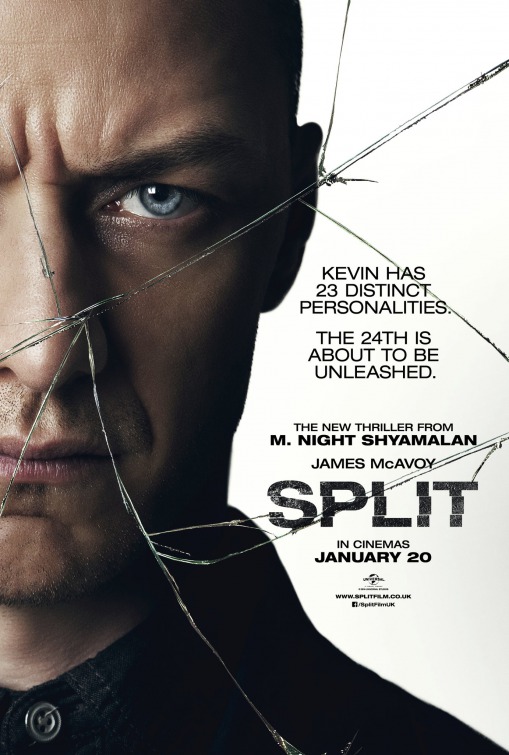
Poor Kevin Wendell Crumb (James McAvoy). His mother (Rosemary Howard) abused him when he was a child, and he developed split personalities to deal with it. Now, he’s got a thing for watching underage girls dance naked. Dennis, the sternest of Kevin’s personalities, has asserted control and drives him to kidnap three teenage girls (Anya Taylor-Joy, Jessica Sula, and Haley Lu Richardson) leaving a birthday party at a lame Chuck E. Cheese place. He locks them up in a dungeon in his underground industrial hideout. Kevin is undergoing psychiatric care, but his doctor (Betty Buckley from Eight is Enough) senses something horribly amiss when she receives email from each of his 23 personalities seeking an urgent appointment. Kevin’s personalities prepare the girls for the arrival of “the Beast,” the last and most powerful personality. Only one of them is poised to survive.
WARNING: Potential spoilers ahead!
M. Night Shyamalan’s Split is, in a word, stupid. The story has potential, but it suffers a major breakdown pretty quickly. It’s more silly than scary. I found myself tracking horror movie clichés like a checklist and asking how many more can fit into the plot. I saw the so-called twists coming before they turned the corner. The reference to another movie at the end is mildly amusing, I guess, but not what I’d call clever. The parallel to one kidnapped girl’s childhood, shown in flashbacks, warrants a great big ‘whatever.’ The only thing Split has going for it is McAvoy, who emulates Jude Law doing an impression of Eminem impersonating Justin Timberlake. His characters are fun, particularly severe schoolmarm type Patricia (for whom McAvoy wears heels) and little boy Hedwig. However, even they get tiresome, coming off as a mishmosh of standup routines after awhile, like sticking all of the characters from Little Britain into one body.
I could make a lame comment about replacing “pl” with “h” in the title and getting a far more accurate name for this film, but I’ll just say I wasn’t impressed and leave it at that.
With Izzie Coffey, Sebastian Arcelus, Brad William Henke, Neal Huff, Bruce Willis
Production: Blinding Edge Pictures and Blumhouse Productions
I wish I could play Bronski Beat’s “Smalltown Boy” for Closet Monster‘s protagonist, Oscar Madly (Connor Jessup), because the lyrics say something he needs to hear: the answers you seek and the love that you need will never be found at home. Sigh.
When young Oscar (Jack Fulton) is a wee lad of maybe seven or eight, his parents give him a hamster (played by four different actors: Chunk, Mama, Blood Thirsty, and Buffy #1). The gift, it turns out, is intended to take the sting out of their explosive announcement: his mother (Joanne Kelly) is leaving his father, Peter (Aaron Abrams). It doesn’t take long to see why, as Peter is an oppressive loose cannon. Oscar stays with his father and quietly retreats into his own world where his new furry friend, Buffy, becomes his companion and has a way of expressing what Oscar is feeling (Isabella Rossellini, of all people, provides Buffy’s voice).
One afternoon after school, Oscar follows a group of older teenage boys into a cemetery. Unbeknownst to them, he watches from behind a tree as they barbarously attack another boy—presumably a gay one—with a rusty iron rod. Immediately after, Oscar notices his father is a toxic alpha male asshole. Determined to prevent something horrible from happening to him, he jumps into survival mode and starts doing “guy” things.
Cut to a decade later: Oscar (Jessup) is into creating monsters with makeup and prosthetics, practicing in his treehouse on his friend Gemma (Sofia Banzhaf), an aspiring model who carries a torch for him. They both just finished high school. Oscar bides his time that summer working as a stockboy at a home improvement store while waiting for an acceptance letter from a school with a design program for cinematic special effects to which he’s applied. He’s completely beside himself when a new employee named Wilder (Aliocha Schneider) shows up and asks to borrow his work shirt. Wilder is cool, sexy, and has a way of transmitting ambiguous sexual signs—causing Oscar severe stomachaches and visions of that iron rod.
Writer and director Stephen Dunn’s first feature threw me for a loop, in a really good way. Closet Monster is packed with gay coming of age clichés, but it still stands on its own. Oscar’s homosexuality is more than incidental, but it’s no dark secret; Oscar knows he’s gay and he doesn’t seem to be ashamed of it, even if dealing with it is tricky. The cast here is excellent, particularly the exchanges between Jessup and Schneider (not to marginalize the other actors). Dunn exhibits a dinstinctive style both in how he tells his story and how he shows it. From a narrative standpoint, he concocts a compelling mix of comedy, teen drama, fantasy, horror, gore, and psychological intrigue. The tension between Oscar and Peter is palpable, simmering from a quiet friction to an all-out eruption.
Dunn’s visuals are even better: vivid, surreal imagery of iron rods popping out of Oscar and vomiting nuts and bolts into a sink, they indelibly illustrate what’s going on in his head. Peppered with retro electronica, I pick up a certain late ’80s/’90s vibe here; indeed, Dunn’s aesthetic reminds me of David Fincher, Spike Jonze, Michel Gondry, and to a lesser extent Anton Corbijn, all of whom started out doing music videos. Dunn’s sensibility is similar to another young director, Xander Robin (Are We Not Cats) (https://moviebloke.wordpress.com/2016/10/15/are-we-not-cats/), though Dunn is not as dark. Closet Monster has a few shortcomings, but overall it gels nicely into a totally satisfying film.
“Sometimes horrible things happen quite naturally.”
“It’s all so horrible, you know, the nightmare of childhood. And it only gets worse. One day you’ll wake up, and you’ll be past it. Your beautiful skin will wrinkle and shrivel up. You’ll lose your hair, your sight, your memory. Your blood will thicken, teeth turn yellow and loose. You will start to stink and fart, and all your friends will be dead. You’ll succumb to arthritis, angina, senile dementia. You’ll piss yourself, shit yourself, drool at the mouth. Just pray that when this happens, you’ve got someone to love you. Because if you’re loved, you’ll still be young.”
—Dolphin Blue
British playwright and occasional film director Philip Ridley’s first picture, The Reflecting Skin, is a wickedly devious bait and switch. It opens downright beautifully with seemingly precious eight-year-old Seth Dove (Jeremy Cooper) walking through an unnaturally radiant golden field of wheat carrying a huge frog to his friends, Eben (Codie Lucas Wilbee) and Kim (Evan Hall), who are waiting for him on the side of a rural dirt road. The idyllic scene, which could be straight from a Norman Rockwell or Edward Hopper painting or maybe even a Mark Twain novel, immediately takes a seriously twisted turn when one of them sticks a straw in the frog’s butt and inflates it. The tone is set: as Ridley himself admitted, “the opening of the film deliberately dupes you into thinking you’re going to watch Little House on the Prairie, and then it suddenly becomes The Texas Chainsaw Massacre with reptiles” (http://thepeoplesmovies.com/2015/12/the-reflecting-skin-philip-ridley-interview/). Ummm, yeah.
Poor Seth: his name rhymes with death, which is all around him and it’s tearing his world apart—he doesn’t even realize it. The adults in his life seem incapable of explaining any of it to him. He lives in a crumbling old farm house next to the gas station that his henpecked father, Luke (Duncan Fraser), operates in an isolated prairie town somewhere in Idaho (a fact I picked up from a state trooper’s uniform) in the 1950s. Maybe the town has seen better days, but probably not. A group of handsome greasers in a big black Cadillac comes into the station for a fill up. The creepy driver (Jason Wolfe) asks Seth a few weird questions and promises to see him soon before driving away.
WARNING: Potential spoilers ahead!
The aforementioned frog was the unfortunate pawn in an awful prank involving one of the Doves’ neighbors, a glum and taciturn English widow with the spectacular name Dolphin Blue (Lindsay Duncan). Seth’s mother, Ruth (Sheila Moore), a raving termagant obsessed with the smell of gasoline in her house, makes him go apologize to her. It’s a weird exchange: Dolphin relates that she used to burn cats when she was little and shows Seth a box containing her dead husband’s teeth, hair, and cologne before she breaks down, sending Seth running away with a harpoon. Soon after, Eben disappears. Seth blames Dolphin, whom he concludes is a vampire in part because she looks like the one on the cover of a pulp novel his father is reading. The police, particularly cynical Sheriff Ticker (Robert Koons), think otherwise: they blame Luke because of a past transgression. Feeling backed into a corner, Luke eventually immerses himself in gasoline and sets himself on fire.
Seth’s older brother, Cameron (Viggo Mortensen), comes home from the military, where he’s serving on a mission in the Pacific. Cameron meets Dolphin at the cemetery—a spark ignites, and they start spending time together. Seth is horrified when his brother tells him he’s sick: he’s losing weight, his hair is falling out, and something is going on with his teeth. Seth again blames Dolphin, who he thinks is turning Cameron into a vampire (although Cameron reveals what’s really going on when he breaks out a photo of a Japanese baby whose skin turned silver from an atomic bomb). After catching an intimate moment while spying on the budding lovebirds, Seth observes the guys in the Cadillac snatch Kim.
“Innocence can be hell,” is the last thing Dolphin says to Seth before she accepts a ride into town from the black Cadillac.
The Reflecting Skin makes a simple point: children will use their imagination to fill in the blanks of what they don’t understand. The story is told through Seth’s eyes, and his conclusions are often bizzare but he arrives at them using what little he has to work with (that whole deal with the fetus he finds in a barn and rationalizes is Eben—yuck!). As Ridley explained, “it’s a kind of remembered fantasy of childhood; it’s being told by an unreliable, possibly psychotic narrator; objects are used symbolically; there’s this huge kind of nightmare journey through one mythical childhood” (http://thepeoplesmovies.com/2015/12/the-reflecting-skin-philip-ridley-interview/).
The way he illustrates his point is fascinating. Everything about the story is horrible. With an approach worthy of David Lynch, Ridley takes a hodgepodge of characters—vampires, religious zealots, suspicious small town law men—and throws them into this weird mix of the macabre, sexual perversion, punishment, and subtle dark humor. His use of symbolism is liberal to say the least. The story is meticulously plotted: every character, scene, and little event is in here for a reason.
This is all underneath Dick Pope’s gorgeous cinematography, which is loaded with vibrant colors and a beautifully fine-tuned attention to detail: the vastness of the wheat fields, the crazy black hair of both brothers, the flies that are always present. Nearly 30 years on, The Reflecting Skin still looks arresting; in fact, it’s one of the most beautiful looking movies I’ve ever seen. Nick Bicât’s heavy and haunting baroque-inspired score is a perfect fit. The overall result is wonderfully dreamy and surreal, yet we definitely sympathize with Seth—probably because we all know that childhood does in fact suck. He’s grounded in reality.
I would be remiss not to mention the acting, which is all around superb. I doubt this film would work with lesser talent.
A dearly departed old friend of mine introduced me to The Reflecting Skin in 1993 or 1994. I’ve never had an opportunity to see it on the big screen, which is a pity because this is one film clearly meant to be seen in a theater. For years, I had a shitty VHS copy and recently found it on DVD. It’s not an easy film to find, but it’s totally worth the effort.
Lenny Freeman (Jim O’Heir) is a wussy ageing milksop who quits his job as an accountant to pursue a career in standup comedy after his mother (Barbo K. Adler) dies. The problems with his plan are numerous. For one, his idea of comedy comes from old radio greats of the 1930s and 1940s—hardly cutting edge or relevant stuff. Further, Lenny has led a sheltered life with his mother. He’s naive. He has no confidence. He isn’t funny. He isn’t particularly perceptive: he doesn’t quite get it when, say, he’s being insulted or threatened. To make matters worse, he’s never even performed for an audience.
Driving from Peoria, Illinois, to Las Vegas in his mother’s 1950s Olds, Lenny picks up a shady hitchhiker (Andrew J. West)— aptly and cornily named “Hitch”—who claims to manage comedians and offers to get Lenny on the very TV show for which he’s on his way to an audition. They make a contract, and Hitch takes Lenny to The Yuck Stop, a desert roadside club in fictitious Lamb Bone, Nevada, to test his material at open mic night. Spoiler alert: Lenny sucks, and the rough crowd is vicious.
Somehow, the corpse of the nastiest heckler (Danny Belrose) is inside Lenny’s trunk in the morning. Lenny thinks he killed him and spends all day in the desert unsuccessfully attempting to dump the body. Hitch pushes Lenny—unglued and soaked in sweat and blood—back onto the Yuck Stop stage, where he confesses to the murder. The crowd takes it as schtick, and this time loves Lenny. Thus begins a killing spree that benefits Lenny’s act more and more with each murder.
Screenwriter and first time director Ned Crowley is onto a good idea with Middle Man, an exploration of selling one’s soul for the spotlight. He references the Coen Brothers, David Lynch’s Blue Velvet, David Fincher’s Fight Club, and perhaps in a sense Alfred Hitchcock’s Rope. I particularly love sick jokes and dark humor, and Crowley liberally applies both throughout. The execution here is uneven, though. The dialogue really shines, but some characters are disproportionately more interesting than others. Hitch’s motive is probably ambiguous on purpose, but it nagged me and got in the way of fully enjoying the film. Most unfortunately, main character Lenny gets old after awhile. Watching his confidence soar in a romantic subplot with his rival standup’s girlfriend, Grail (Anne Dudek), starts out well enough but soon fizzles badly.
Middle Man takes a decidedly sinister turn about 20 minutes before its ending, which is predictable and not as weird or harrowing as Crowley might have intended. Overall, though, this is a respectable debut that doesn’t take itself too seriously—that’s the most refreshing thing about it.
Screening followed by a live discussion with director Ned Crowley and actor Jim O’Heir.
Ailurophobia, the irrational fear of felines, forms the basis for Eye of the Cat, a nifty little throwaway from the late Sixties. Despite what its trailer suggests, it’s not an outright horror film—it’s a suspense thriller that relies heavily on psychological tension, very much like Hitchcock did. This isn’t surprising: screenwriter Joseph Stefano previously penned Psycho. Those familiar with Hitchcock will notice a slight feel of Rope and The Birds. Plus, the external shots of San Francisco strongly recall Vertigo.
The plot rings familiar: cosmetologist Kassia Lancaster (Gayle Hunnicutt), whose name “sounds like a prison door slamming shut,” mysteriously and abruptly recruits philandering Wylie (big-eyed Michael Sarrazin) to help her execute a plot to get his rich and ailing stepmother, “Aunt” Danny (Eleanor Parker), to put him back in her will as her sole heir—and then kill her. Wylie’s brother, Luke (Tim Henry), lives with Aunt Danny and is getting in the way. There’s another problem: Wylie has a bad case of ailurophobia, and Aunt Danny’s house is loaded with cats.
Eye of the Cat‘s sum is greater than its parts, and overall I enjoyed this one quite a bit. The title and opening sequence are cool: the animated outline of a housecat slinks over scenes of San Francisco and gives way to split screens that start the story. Stefano and director David Lowell Rich are refreshingly frank and downright casual with their attitude toward and treatment of sex and drugs: nothing is merely implied here. In his first scene, Kassia yanks Wylie naked out of bed—away from the naked woman still next to him. There are references to having sex, they say “have sex,” and they actually do have sex in a few scenes. One unsettling scene between Wylie and Danny in the latter’s bed alludes to a past liason. Later, Wylie and Kassia go to a dope bar on a boat and smoke a joint. One of the patrons at the bar makes a joke about his own homosexuality, which may be one of the earliest openly gay characters I’ve seen.
All four actors, even Parker, possess an effortless and elegant allure. Sarrazin and Henry are hot, and they both have shirtless scenes. Hunnicutt is absolutely gorgeous in her smart skirts and big hair. Lowell Rich builds tension nicely, getting the actors to walk a very fine line between serious horror and camp, something most evident in a brilliant scene involving Danny on a hill in her wheelchair. Lalo Schifrin’s ominous score adds greatly to the mood here.
Except for a solitary orange tabby that clearly has Danny’s back, the cats—an overwhelming throng of them—curiously disappear after the story is set up, and don’t return until the climax. The film ends in a ridiculously horrific way—so bad, I laughed out loud with most of the audience. It’s a pity Eye of the Cat is not available for download or on DVD. It’s a fun movie.
I never heard of Eyes of Fire or anyone involved in it until it appeared on the roster for a local horror film festival. Featuring a team of inconsequentials—writer and director Avery Crounse completed two more projects I never heard of after this and most of the actors continued on to television roles—it’s a low budget fantasy/horror flick relegated to obscurity. It’s no wonder why.
Set in 1750 colonial America and told in flashback, Eyes of Fire follows vain and flighty missionary Will Smythe (Dennis Lipscomb), his small flock of devotees that includes his mistress, Eloise (Rebecca Stanley), and a ginger named Leah (Karlene Crockett) who everyone thinks is insane but is really a fairie, and Eloise’s estranged husband, Marion Dalton (Guy Boyd), as they stumble through the Eastern Woodlands looking for a safe haven. To escape attacking Shawnee natives, Dalton leads the group into a valley that Smythe takes to be “the promised land” and settles into the abandoned campsite there. Dalton is uneasy about staying. Leah also senses something amiss and starts seeing spirits—sometimes they’re clothed, sometimes they’re naked and covered in mud. They don’t look happy. An orphaned native girl (Rose Preston) appears on Smythe’s doorstep, and he takes her in to convert her to Christianity. Immediately, strange things start happening: Fanny (Sally Klein) disappears and is found in a coma, Meg (Erin Buchanan) is found hanging upside down from a tree, and a rotten skeleton pops up out of the dirt. !!! Leah figures out what’s going on: a devil-witch is trying to steal their souls and trap them all in the trees in the forest. Can she and Dalton stop the madness?
I’d be lying if I said Eyes of Fire isn’t silly. It takes itself so seriously, too. The story is easy to follow, but Crounse packs an awful lot into it: folklore, witchcraft, the supernatural, colonialism, ethnic superiority, religion, morality. Whatever points he makes are lost in cheesy special effects—lots of Tesla lightning, negative images, and distorted sounds. The trees have gruesome faces, and at one point they all puke bilge. The devil-witch looks like Captain Caveman made out of twigs. It all warrants a great big “whatever.” Even with its low-budget giveaways, though, I found this film weirdly fascinating—it plods along slowly but somehow kept me engaged. The simple stuff works best—the scene in the forest with white feathers covering the entrance to the valley (repeated later with pages torn out of Smythe’s books and spread all over the campsite) is beautifully ominous and visually arresting. Too bad there isn’t more of it.
Focused on romance, pleasure, and pain, screenwriter and director Xander Robin’s feature length debut, Are We Not Cats, is a stylishly edgy, wry, and quirky delight. Eli (Michael Patrick Nicholson) is neither ambitious nor grounded. In the span of a few hours, he loses his girl (really his f-bud, but he didn’t quite get that), his job as a garbage collector, and his home when his Russian immigrant parents abruptly inform him that they sold their house and are moving to Arizona. “Visit us!” his mother chirps right after his father bribes him with a delivery truck to get out that night.
After moving into the back of the truck, crashing and showering wherever he can, and driving around aimlessly, Eli picks up a one-off job delivering a motor to a junkyard. There, he stumbles upon knitcapped Kyle (Michael Godere), who introduces him to a toxic elixir, a feral underground scene in a basement, and his impish feline girlfriend, Anya (Chelsea LJ Lopez). Eli is smitten. He stalks Anya, who doesn’t seem to mind. He discovers that they share a similar nervous habit: he pulls his hair out and she eats hair. Anya’s magnetism pulls Eli down a dark path he isn’t quite equipped to travel.
Are We Not Cats is uneven, but what it lacks in consistency and depth it makes up for in style. Robin has a wicked dark, offbeat sense of humor. His camerawork is sharp, nimble, and has a certain momentum to it. The locations—a junkyard, a disused barn, an empty diner—work beautifully with the bleak, snow covered landscapes to underscore Eli’s resigned state of mind. Robin contrasts this with colorfully vivid and cozy scenes with Anya, who possesses a flair for clutter. Matt Clegg’s druggy, dreamlike cinematography is flat where it should be, and brighter and more dimensional where it needs to be. The story sags a bit toward the end, but the film’s brevity mitigates this problem. Nicholson’s passive and forlorn take on his scruffy character is deftly balanced; somehow, he keeps Eli sympathetic despite the fact that his hapless demeanor, lack of social skills and boundaries, and sleepy purposelessness are turnoffs. The soundtrack, consisting almost entirely of old Seventies soul tunes, is as much a character as anyone; the music contributes its own warmth and personality that literally makes this film sing.
Screening followed by a live Q and A with Xander Robin and Michael Patrick Nicholson.
I’ve seen A Nightmare on Elm Street twice: once as a teenager and once as a middle-aged adult. I can say with authority: no matter how you slice it, this movie sucks.
The plot sounds like a good idea: a knife-fingered ruffian in a tacky striped sweater reminiscent of the original PBS children’s show Zoom haunts teenagers in their dreams and kills them in their sleep. The problem is, A Nightmare on Elm Street just isn’t scary. It’s silly. Dumb, even. One by one, a bunch of kids gets offed by Freddy Krueger (Robert Englund in the role of a lifetime). There’s a really cool scene of a blood geyser spurting from a bed. Heather Langenkamp’s overacting is amazingly bad. There’s that gorgeously diabolical line, “I’m your boyfriend now, Nancy” followed by a tongue coming out of the receiver (never mind that the phone’s unplugged). A young, dumb, and full of you-know-what Johnny Depp is here, all dolled up in an incredibly gay softcore porn outfit. Bizarre. Nancy’s weirdo vodka-lush mother (Ronee Blakley) adds some much needed comic relief—that final scene! Oh, and that catchy nursery rhyme. Other than that, though, this is tedious slasher stuff warmed over from the ’70s but with a slicker ’80s look. I mean, fuck, do we really need that clanking noise to cue us in that Freddy’s coming? Every time? We get it.
Watching it, one is dumbfounded knowing that A Nightmare on Elm Street spawned an entire franchise let alone a sequel. Sure, it’s got kitsch value, and everyone knows this movie so the late Wes Craven did something right. I’m just not sure what. To be fair, I was well aware of what I was getting into here, so I can’t complain about the experience; I already knew this is bad. I’m glad the theater has a bar and we went early as a group to load up on liquor (not vodka) before siting down—that made it fun for a midnight screening.
Yeah…this. Hmmm. Herbert Blount (Penn Jillette) is a weird crowdfunding stalker obsessed with actress Missi Pyle, playing herself, who costars in a low budget crime-gore “movie” with Harry Hamlin and a guy named Reed (Hayes MacArthur). Blount, who is given behind-the-scenes access because he used his PayPal account to donate a large sum of money to the project, is seduced by the artistic process and secretly hijacks the film to make his own version: he wants Pyle front and center. He undermines the director (Adam Rifken), steals footage, and kidnaps Pyle to shoot new scenes with her in his basement.
A movie within a fake movie (Knocked Off), Director’s Cut is a satire of the film industry, celebrity, and the changing role of the audience. Directed for real by Rifken, it exhibits some competent technical handiwork: Knocked Off, little more than a CSI episode, looks professional right down to its angles, cuts, and color grade. A slew of cameos—some, like Jillette, former contestants of Celebrity Apprentice (Gilbert Godfrey, Lisa Rinna)—adds a smart lighthearted touch. Jillette’s longtime partner in magic, Raymond Joseph Teller, makes a fun though not exactly unexpected appearance. Pyle’s diva tantrums “off screen” are amusing. The film makes interesting and timely points about the dangers of giving artistic input and access to the general public and obsessed fans: even in an era where the tools of the trade are readily available to virtually anyone, not everyone can (or should attempt to) make a movie.
Director’s Cut just doesn’t cut it. Sadly, Jillette himself is the most disappointing thing about it. He doesn’t pull off creepy; his gentle, dulcet voice bantering lame “commentary”—like in a bonus feature of a DVD (get it?)—undermines that. Worse, his terrible “acting,” the oddly tame scenes he stages with Pyle, and his crude homemade edits of his version of the film paint him as a harmless grandfatherly dolt more than anything. The gimmick here wears out before the movie is even half over. Director’s Cut has good ideas, but it’s just not funny.
What would life be like in the 21st Century if humans never evolved beyond apes? How would our human qualities, good and bad, play out? Are humans any different from other animals? Director/screenwriter/actor Steve Oram illustrates his answer to these deep questions with Aaaaaaaah!, a project that sounds fascinating on paper but turns out to be anything but.
Following a group of modern primates (Julian Barratt, Noel Fielding, Lucy Honigman, Tom Meeten, Oram, Julian Rhind-Tutt, and Toyah Willcox), Aaaaaaaah! is an hour and a half of grunting, fighting over food and mates, flashing body parts, openly masturbating and having sex, peeing and pooping on stuff, and generally establishing dominance with gratuitous gore peppered throughout. The plot, flimsy and hard to follow, isn’t funny, witty, engaging, interesting, or thought provoking. It’s terrible, like a bad inside joke I’m not a part of or an even worse art film. I couldn’t wait for this to end.
Aaaaaaaah! very well may be the worst movie I’ve ever seen. EVER. It fails on every single level. Waiting to enter the theater, I overheard someone in line behind me compare Oram to early John Waters and Andy Warhol. Um, no—those guys both had a wit that Oram lacks, at least from what I can tell here. A better title would have been Uuuuuuuugh!


 moviebloke