Heart Like a Wheel

(USA 1983)

“Trying to make us damned…golf!

—Connie Kalitta

Heart Like a Wheel is the kind of movie you see on late night TV: a mildly amusing true story about someone you’ve never heard of and her struggle to overcome adversity and maybe find herself in the process. In this case, that someone is Shirley Muldowney (Bonnie Bedelia), later known as “Cha Cha,” a 1960s housewife who became the first woman to obtain a license from the National Hot Rod Association (NHRA) and the first person ever to win two and then three Top Fuel titles (https://en.wikipedia.org/wiki/Shirley_Muldowney). Her struggle consists of establishing herself as a serious dragster. The adversity, well, that’s the sexist all-male drag race scene. You might say the whole thing is a drag.

One night, Shirley’s mechanic husband, Jack (Leo Rossi), lets her race his sports car on the street. She beats Jack’s rival and discovers that she digs the thrill of drag racing. Soon, she’s hanging out at the racetrack, where she meets Connie Kalitta (Beau Bridges), a veteran racer and womanizer. Jealous of her success, Jack leaves Shirley to her own devices.

I picked up Heart Like a Wheel for one reason, and one reason only: I read that My Life with the Thrill Kill Kult sampled this movie in a song or two. Overall, it’s a mixed bag, but I was pleasantly surprised to find that it’s better than mediocre. The acting is good. Ken Friedman’s screenplay is competent if not exactly deep, peppered with some snappy dialogue. When a skeezy reporter (Martin Casella) asks Shirley what a beautiful girl like her is doing at a racetrack, for example, her one-word response is casual, bored, and totally fucking awesome: “Winning.” Director Jonathan Kaplan stages realistic fight scenes, particularly between Connie and Shirley’s teenage son, John (played by a young Anthony Edwards). He even throws in a couple of real racers (Steve Evans and Sam Posey) and fire. It was nominated for an Academy Award for costume design (https://www.oscars.org/oscars/ceremonies/1984). The whole thing comes off like a soap opera, but it works. I never did catch those samples, though.

Bonus: the DVD I have includes trailers for four other films, The Turning Point, Kenny & Company, Rhinestone with Dolly Parton and Sylvester Stallone, and Six Pack with Kenny Rogers and Anthony Michael Hall. They all look as awful as “Born to Win” by Jill Michaels, the Heart Like a Wheel theme song.

With Hoyt Axton, Creed Bratton, Tiffany Brissette, Michael Cavanaugh, Diane Delano, Mitzi Hoag, Nora Heflin, Brandon Brent Williams

Production: Aurora Productions

Distribution: 20th Century Fox

113 minutes
Rated PG

(DVD purchase) C

All About Eve

(USA 1950)

“Fasten your seatbelts, it’s going to be a bumpy night.”

—Margo Channing

That iconic line succinctly captures the essence of Joseph L. Mankiewicz’s All About Eve, a sharp commentary on the treacherous relationship between female ambition and the American obsession with youth that still rings—and stings—true nearly 70 years later.

Based on Mary Orr’s short story The Wisdom of Eve, Bette Davis is Broadway legend Margo Channing, who’s turning 40 and sees doors closing in her professional and personal life. One rainy night, Karen Richards (Celeste Holm), Margo’s bestie, happens upon a young starstruck fan waiting backstage to meet Margo after a performance of her latest play, the aptly titled Aged in Wood. The fan, of course, is wide-eyed Eve Harrington (Anne Baxter), a mousy but well-spoken girl in an oversized trenchcoat who says she followed Margo from San Francisco to New York City and has seen every performance of the play—from the back of the house.

Karen, whose husband is none other than playwright Lloyd Richards (Hugh Marlowe), Margo’s frequent collaborator and author of Aged in Wood, brings Eve into Margo’s dressing room to meet her. Lloyd is there, along with Margo’s fiancé, director Bill Simpson (Gary Merrill), and her crusty sharp-tongued maid, Birdie (Thelma Ritter). Eve wins over everyone in the room with her poignant backstory about a poor midwestern upbringing on a farm, a husband killed in the War, and a humble stiff upper lip. Everyone, that is, except Birdie—she smells a rat.

Margo takes Eve under her wing as her personal assistant. Eve quickly proves to be an ace at organizing Margo’s affairs—and sneaking herself squarely into the middle of them. She aligns with caustic theater critic Addison DeWitt (George Sanders), who like Birdie doesn’t buy what Eve puts out there but unlike Birdie sees a mutual opportunity. Things sour all around when Margo learns that her producer, Max Fabian (Gregory Ratoff), designates Eve as her understudy without consulting her first.

Often compared to Sunset Boulevard for a variety of reasons, All About Eve is not as dark or campy but is way bitchier. From a technical standpoint, the script is tighter, the production more sophisticated, and the story a lot wittier. All things considered, it’s way more fun and has held up quite well—sure, the voiceovers are overdramatic, but these are theater people so it fits. I found it particularly interesting to see this film again right around the beginning of the FX series Feud, which not only is half about Davis but elaborates on the same issues that All About Eve raises. It underscores much of what Davis said about the industry in interviews late in her life.

None of the men here have any reason to worry about their age; for all of them, their success has nothing to do with how old they are or even how they look (their thing is power, but that’s another discussion). The women, on the other hand, constantly struggle to secure and then maintain their positions—and they’re ruthless about it. Eve earns the acting award she gets at the end (which is really the beginning): she fools everyone to manipulate them into giving her what she wants. It’s clear that sooner than later, she’ll be right where Margo is, for better but more likely for worse.

In one of her earlier roles, Marilyn Monroe makes an amusingly memorable appearance as dippy starlet Miss Casswell, who’s trying to catch a break. She’s got the best line of all: “I don’t want to make trouble. All I want is a drink.” Amen!

In 1990, the United States Library of Congress deemed All About Eve “culturally, historically, or aesthetically significant” and selected it for preservation in the National Film Registry (https://www.loc.gov/programs/national-film-preservation-board/film-registry/complete-national-film-registry-listing/).

With Barbara Bates, Craig Hill, Helen Mowery, Steven Geray

Production: 20th Century Fox

Distribution: 20th Century Fox

138 minutes
Not rated

(AMC River East) A

Fathom Events

20th Century Women

(USA 2016)

“We are at a turning point in our history.”

—President Jimmy Carter

I was a little kid in the Seventies, but I have many indelibly vivid memories of the decade: huge cars, gas lines, expensive meat, hijacked planes, Sanka and Sweet’N Low, smoking everywhere, hard rock, punk rock, disco, macrame, spider plants, the Bicentennial, Sky Lab, Victoriana (we had Mucha posters in our mustard-colored kitchen), that strange Holly Hobby aesthetic. It seems like it all changed immediately when Reagan took office in 1981.

20th Century Women captures a slice of American life on that unique, unremembered and largely disowned cusp. Set as a flashback to 1979 with voiceovers that repeatedly remind us that we’re looking backward, the film is a rather remarkable time capsule. The story is simple: Dorothea (Annette Bening) is my grandparents’ age (born in 1924). She had her only son, Jamie (Lucas Jade Zumann), late in life—i.e., over age 40. She’s been divorecd for a few years, which was fine until Jamie hit puberty. Now, she needs help understanding him. She enlists his two closest allies—Julie (Elle Fanning), whose pants he wants to get into, and Abbie (Greta Gerwig), a postpunk fuckup—to help her figure him out.

Loosely based on actual events from director and writer Mike Mills’s childhood, 20th Century Women is fun to watch. Growing up in a house of females myself, I relate to a lot of his experiences. I loved all the Talking Heads, too. Oh!—and Siouxsie and the Banshees! That said, this film borders on overbearing with its nostalgia. It could’ve been so much better—the material and the talent are both there, but Mills goes for easy returns that don’t pay off. The story falls flat. Perhaps a quote from Bening in an earlier film, the superior and far more interesting Running with Scissors, succinctly sums up my problem here: “It’s shit, Fern. It’s sentimental. It’s emotionally dishonest. It implodes into nothingness.”

I wasn’t bored, and I didn’t hate 20th Century Women. But I’m never going to see this movie again. Too bad, because the acting is great. It’s a misfire due to its execution. It seemed like a good idea at the time.

Also starring Billy Crudup, Vitaly Andrew LeBeau, Curran Walters, Toni Christopher, Jimmy Carter (public domain footage)

Produced by Annapurna Pictures, Archer Gray, and Modern People

Distributed by A24

119 minutes
Rated R

(Landmark Century) C

http://20thcenturywomen-movie.com

Hidden Figures

(USA 2016)

Houston, do you read me: NASA employed black people in its infancy during the early Sixties. What’s more, NASA’s first major project, Mercury, probably wouldn’t have gotten off the ground without three black female “computers,” or mathematicians, whose efforts literally put John Glenn and Friendship 7 into orbit. The result was a serious boost in American morale during the race against the Soviets into space and a boon to the Space Program under President Kennedy. So, with its historically significant and truly enlightening subject matter, what most caught me off guard about Hidden Figures is its tone, which is light, upbeat, cute, and often comical. While not in itself a bad thing, it’s not what I expected.

Unfortunately, that’s about all Hidden Figures offers that I didn’t expect. I’m not saying I didn’t enjoy this film; I did. It’s a great story about remarkable people who actually lived. According to one subject, their real stories are not far off from this film (http://www.latimes.com/science/sciencenow/la-sci-sn-hidden-figures-katherine-johnson-20170109-story.html). Taraji P. Henson plays Katherine Johnson, a recently widowed math whiz who works for NASA in Virginia, as a bookish nerd complete with glasses that keep sliding down her nose. She and her coworkers, smart and sassy Dorothy Vaughan (Octavia Spencer) and fiery and coquettish Mary Jackson (Janelle Monáe), quietly but forcefully demonstate their worth in an environment that doesn’t treat them as equals. While Katherine lugs binders and a calculator back and forth between her desk and the “colored” rest room clear across campus to figure out arcs and other shit I sure can’t, Dorothy teaches herself how to operate the new IBM that not even IBM technicians can set up correctly and Mary pushes her way into engineering classes at night in an all white, all male school. Director Theodore Melfi does a really nice job demonstrating institutionalized racism and sexism through characters who may not have anything against black people or women—as administrator Vivian Michael (Kristen Dunst) curtly tells Dorothy in one scene and unwilling research partner, Paul Stafford (Jim Parsons), makes clear to Katherine in another scene by redacting her name from a joint report they both wrote—but don’t recognize the issue.

Despite its merits, I found Hidden Figures to be slightly more sophisticated than a Lifetime movie. Melfi, who with Allison Schroeder adapted the screenplay from Margot Lee Shetterly’s book of the same name, takes a pretty basic approach to the material. It’s so easy—obvious, even—to gage where the story is headed. John Glenn (Glen Powell) sings Katherine’s praises while a love interest develops for her in handsome Col. Jim (Mahershala Ali). So cute. Hidden Figures gets into civil rights issues, but only on a superficial level. There are a few overdone Oscar grabs, like a scene between Katherine and her boss, Al Harrison (Kevin Costner), that ends with him smashing the sign outside the “colored” ladies’ rest room, but no true show stoppers. Frankly, though, most of the actors here have appeared in better movies. Too bad, because this could’ve been a great film instead of just an okay one. Hidden Figures doesn’t quite do its trailblazing subjects justice.

127 minutes
Rated PG

(AMC River East) C+

http://www.foxmovies.com/movies/hidden-figures

Paris Is Burning

(USA 1991)

“Opulence. O, P, U, L, E, N, C, E, opulence. You own everything. Everything is yours!”

—Junior LaBeija

Before The Crying Game and Transamerica, RuPaul’s Drag Race, Bruce/Caitlyn Jenner, and Scissor Sisters’ “Let’s Have a Kiki,” there was Paris Is Burning. I first saw it at a screening on my college campus, I think, when it was fairly new—I remember a double feature with Madonna’s Truth or Dare, so it had to be summer or fall 1991. I’ve since seen it countless times. It’s one of the films I quote most. I love it, even as it turns 25 years old. It is, in two words, fucking fabulous!

Shot in 1987 with a short check in three years later, Paris Is Burning is ostensibly a documentary about the Harlem nightlife ball culture (pronounced “boo-wall” by most here). The film takes its name from one said ball, a rather clandestine affair held in a shabby party hall somewhere near Lexington/125. A world unto itself, ball culture was loaded with costumes, wild dancing, attitude, hierarchy, and tons of rules. There was blood, sweat, tears, and fighting—but there was also community and (for some) glory. As one subject, Willie Ninja, informs us, the balls may have been long and drawn out, but they were never boring. Amen! This is clear.

Much to her credit, director Jennie Livingston goes—excuse how this sounds—beyond the balls, getting into the daily challenges not only gay men and drag queens faced, but also actual bona fide transgender women. This was probably the first exposure I had to that. I mean, being gay in the Reagan Era was bad enough: if you weren’t destined to live a long and lonely life in the closet, you were going to get AIDS. Either way, the only thing straight about you was your road to hell. Transgender was…something else altogether. America was not ready for it when Paris is Burning came out, which makes it all the more remarkable.

Paris Is Burning is a big middle finger to all that thinking. While not everyone subscribed to that view, Paris Is Burning was the first film to show a lifestyle like this in a positive light. It was effective; it showed how fun and liberating it could be to walk a ball, fake tits or not. Hey babe, take a walk on the wild side. Damned fun! No wonder Madonna co-opted vogueing and snagged two Xtravaganzas for her tour.

Although there are undertones of sadness throughout, every person in this film is a hero. They were courageous simply living their lives how they did, when they did. The key was a mix of self confidence and major guts. Dorian Corey gave me a crash course on reading and shade. Pepper LaBeija showed me that living the good life takes more than money. Venus Xtravaganza showed me that life is a negotiation. Whatever category you choose, you better work it!

Sadly, the era and the players of Paris Is Burning are long gone, but their spirit doesn’t just live on—it thrives. Paris Is Burning and its subjects are legendary.

Side note: everything has its dark side. This is a perfect example: http://dangerousminds.net/comments/dorian_corey_the_drag_queen_had_a_mummy_in_her_closet

In 2016, the United States Library of Congress deemed Paris Is Burning “culturally, historically, or aesthetically significant” and selected it for preservation in the National Film Registry.

71 minutes
Rated R

(Home via iTunes) A

http://www.jennielivingston.com/paris-is-burning

The Danish Girl

(USA/UK 2015)

On paper, The Danish Girl has everything going for it: a sensationalist plot with real-life characters, weighty and timely subject matter, pretty scenery, nifty period clothes, a love story, and a nice dose of tragedy. Visually, it’s a beautiful film: cinematographer Danny Cohen gives it the soft, muted look of an impressionist painting; the interiors are as alluring as the exterior shots. The setting—the early 20th Century art scene in Copenhagen and Paris—evokes a sense of glamor and romance. The acting is okay for the most part, but Alicia Vikander is outstanding. Still, the sum here is no greater than its parts.

Based on David Ebershoff’s novel based on the life of Dutch artist Einar Wegener (Eddie Redmayne), the first known person to undergo sex reassignment surgery, and his wife, Gerda Gottlieb (Vikander), The Danish Girl is a good story even if it isn’t historically accurate. One day, Gottlieb asks Wegener to stand in for her model so she can finish a painting; she gives him a pair of panty hose, and he is immediately cozy in them. Thus begins Wegener’s road to becoming “Lili,” as christened by the couple’s friend, Ulla (Amber Heard). Lili becomes Gottlieb’s muse, showing up in her paintings. They sell. Lili accompanies Gottlieb to a ball as Wegener’s “cousin,” and everyone is fooled. Wasn’t that easy, isn’t she pretty in pink?

The Danish Girl is fictionalized, and as a result liberties are taken for time constraints, continuity, and drama. I get that. Nonetheless, this film doesn’t come off as genuine because it oversimplifies and sanitizes the issues it seems to want to bring to light and then gives them superficial treatment. Lili’s transition is too quick, and her adjustment—touched on but not explored—is seamless for today let alone 1926. Redmayne’s portrayal of Lili is silly: he bats his eyelashes and caresses his frocks with all the campy drama Johnny Depp mustered up wearing an angora sweater in Ed Wood. Lili looks like Molly Ringwald, right down to her stylish scarves—the real Lili looked like Oscar Wilde in a dress. Wegener and Gottlieb were more complicated and had a more complex and unconventional relationship. The truth here is so condensed and whitewashed that this might as well be a fairy tale.

The Danish Girl might make you cry, but it’s just not convincing even within the confines of a two-hour film. Too bad, because it could’ve been much more.

(ArcLight) C-

http://www.focusfeatures.com/the_danish_girl

http://youtu.be/EsrXatXWuXM

Do I Sound Gay?

(USA 2015)

An informative and amusing exploration of the “gay voice,” that effeminate and often annoying over-the-top stereotypical way that so many gay men speak—and that one man (David Thorpe) wants to change. Thorpe looks to speech therapy and academia but mostly pop culture for answers, enlisting gay celebrities like Dan Savage, George Takei, and Tim Gunn along the way. Their responses reveal the conflicted attitudes gay men hold toward masculinity and identity.

Despite its merits, Do I Sound Gay? ultimately underwhelmed me. It provided useful tidbits of information, but nothing solid or groundbreaking.

(Gene Siskel Film Center) C

http://www.doisoundgay.com

Tangerine

(USA 2015)

A day in the life of two transgender prostitutes, Sin-Dee (Kitana Kiki Rodriguez) and Alexandra (Mya Taylor) of West Hollywood. Sin-Dee just got out of jail and is trying to tack down her fiancé/pimp, Chester (James Ransone), who failed to pick her up. Fellow trans hooker Alexandra lets out of the bag that Chester has been shacking up with a real girl (Mickey O’Hagen) while Sin-Dee was in the slammer. Sin-Dee shifts her plan and sets out to kidnap her. Did I mention it’s Christmas Eve? Thrown into all this is Armenian cab driver Razmik (Karren Karagulian), who is married and has a thing for Alexandra. Where is all this going?

Tangerine gets off to a shaky start, but director Sean Baker lets his characters develop into full-fledged people as the film rolls on and ultimately proves to be a beautiful story. With a pervading sense of loneliness, it makes a point about survival and needing to rely on others to do it. No man (or woman) is an island.

(Music Box) B

http://www.magpictures.com/tangerine/

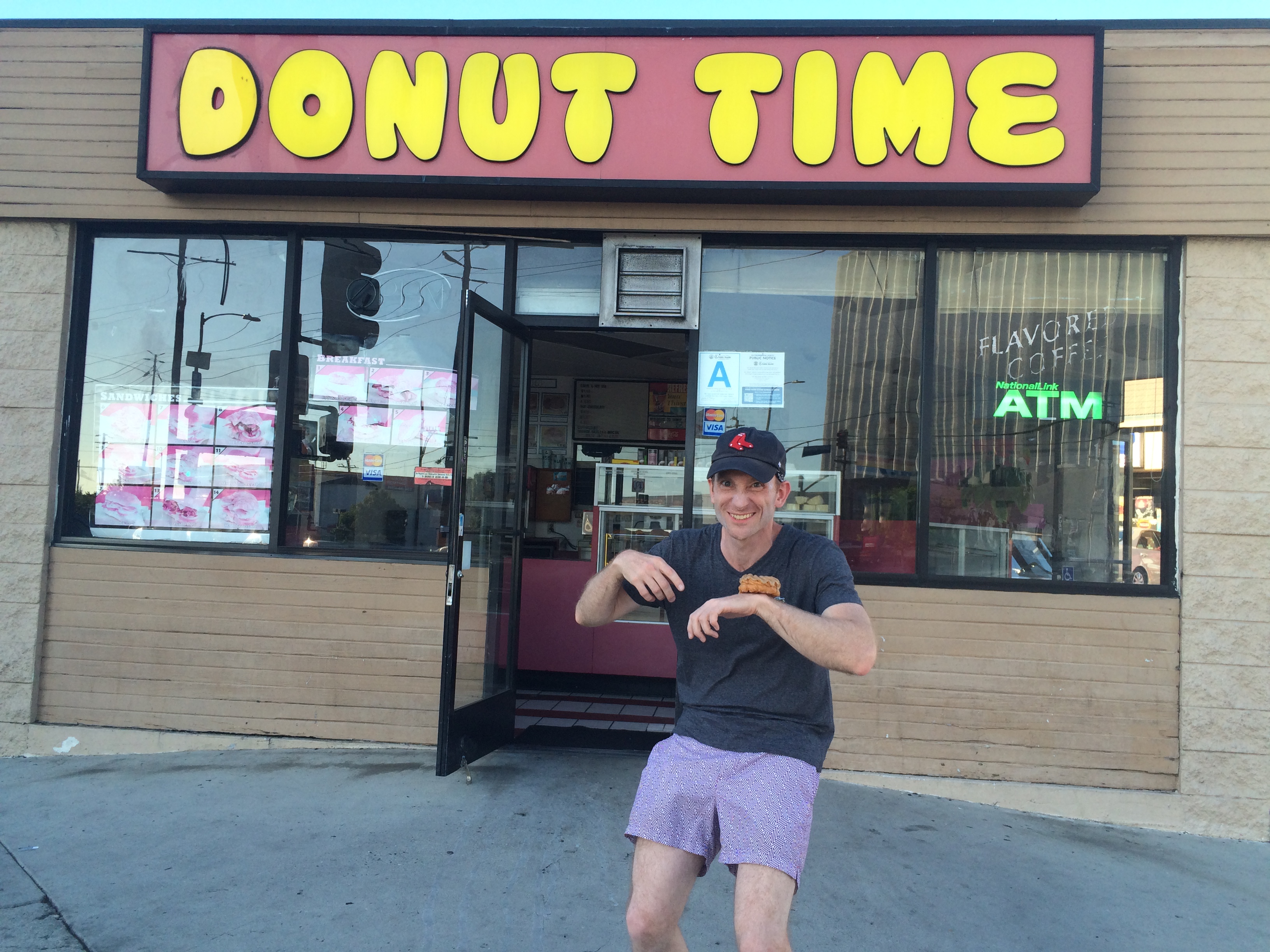
Footnote: I tracked down Donut Time, the donut shop where much of the action in Tangerine takes place. It’s located at 6785 Santa Monica Blvd. at the corner of Highland. I used the ATM and bought a cruller. It was awesome.

IMG_6293

She’s Beautiful When She’s Angry

(USA 2014)

Mary Dore’s documentary about the rise, dissipation, and resurgence of women’s liberation paints a broad (no pun intended) picture of the movement itself while honing in on the many factions within it—lesbians, black chicks, even witches. Thorough, balanced, and fun, Dore’s ultimate point, sadly, is that American society has pretty much come full circle retrograde on many women’s issues like abortion and childcare. Not a dull moment, and well worth the time spent seeing it.

(Music Box) B+

http://www.shesbeautifulwhenshesangry.com