Paterson

(USA 2016)

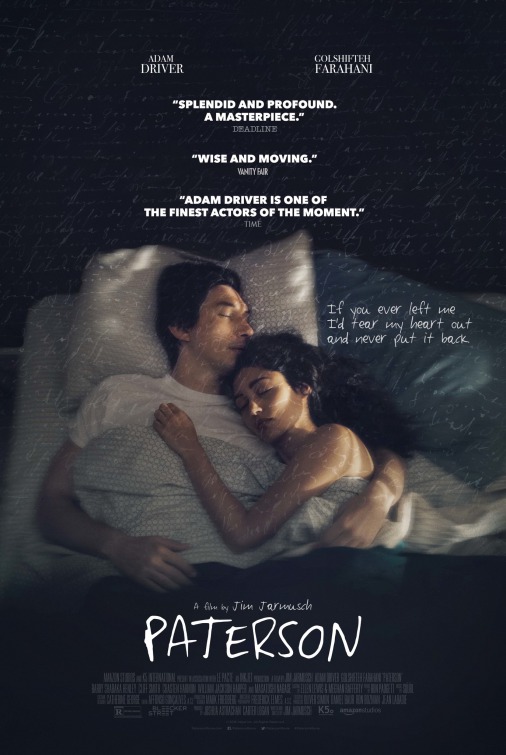
Not a lot happens in Jim Jarmusch’s new film Paterson—it is, to borrow from Seinfeld, a show about nothing. Starting on a random Monday, the story follows Paterson (Adam Driver)—a Paterson, New Jersey, city bus driver and closet (or in this case, basement) poet—through his daily routine for a whole week. He finds inspiration in the simplest things: passengers, barflies, Ohio Blue Tip matches. He works it all into his “secret notebook” of poetry, scribbled in sidebars onscreen. Some of it is interesting, some not so much.

Jarmusch throws a lot out there: never mind the recurring parallels between Paterson and those he encounters—there’s imagery of twins, waterfalls, circles, and fireballs. Attempting to infer a weighty point in all of it, though, is probably an exercise in futility; this is fluid stream of consciousness. The story is more a string of vignettes: Paterson’s wife, Laura (Golshifteh Farahani), orders a guitar online and later serves Brussels sprout and cheddar pie for dinner; the bus Paterson drives breaks down; a situation arises in the bar where Paterson has a beer every night when he walks his wife’s dog, Marvin (Nellie, who, sadly, passed away before Paterson came out: http://www.indiewire.com/2016/05/the-2016-palm-dog-posthumously-awarded-to-nellie-the-dog-from-jim-jarmuschs-paterson-289094/).

The characters Paterson encounters are plentiful and colorful: defeatist coworker Donny (Rizwan Manji); a rapper (Method Man) in a laundromat; a young poet (Sterling Jerins) waiting for her mother in the bus yard; Marie (Chasten Harmon) and her sensitive beau, Everett (William Jackson Harper), whom she’s trying to dump; a nameless gangbanger (Luis Da Silva, Jr.) who warns Paterson about dog-jacking (not that it stops him from tying Marvin to a spigot outside the bar every night); anarchists, old ladies, and braggarts on the bus.

Perhaps the most accomplished thing about Paterson is its rhythm: the plot moves slowly but in a purposely metered fashion. Cinematographer Frederick Elmes creates a dreamy and downright poetic look. The relationship between Paterson and the world has its own set of rules. This film reminds me of Dead Man, which I haven’t seen in two decades: quietly contemplating routine and rut, Paterson ultimately celebrates the poetry in the mundane. The unnamed traveler and angel (Masatoshi Nagase) at the end literally gives us the “a-ha” moment. With nearly no outside sound, not even music, I thought of one thing: if James Joyce’s Ulysses were made into a movie, it would feel a lot like this. Unlike Leopold Bloom, though, Paterson’s wife isn’t cheating on him, and no one except Marvin seems to mind his presence.

Side note: for some reason, the screening I caught included Spanish subtitles, unintentionally adding another layer of what-the-fuck. Paterson is not a movie for everyone, but I definitely see a following here. I liked it.

Also starring Barry Shabaka Henley, Trevor Parham, Troy T. Parham, Kara Hayward, Jared Gilman, Johnnie Mae.

Produced by K5 International, Le Pacte, Animal Kingdom, and Inkjet Productions

Distributed by Bleeker Street Media and Amazon Studios

118 minutes
Rated R

(Landmark Century) B-

http://www.bleeckerstreetmedia.com/paterson

The Brand New Testament [Le tout nouveau testament]

(Belgium/France/Luxembourg 2015)

Joan Osborne once posed the question, “What if God was one of us, just a slob like one of us?” In Jaco Van Dormael’s The Brand New Testament, God (Benoît Poelvoorde) is a sloppy, angry middle-aged white guy with a very plain wife (Yolande Moreau). They live in a dark apartment in Brussels, where He works from home (she’s a homemaker with a thing for collecting baseball cards). His job is pretty easy: to heap misery onto the human race, which He watches over on a computer in a room with a card catalog that stretches to the sky. God’s preteen daughter, Ea (Pili Groyne), is not impressed with Him or His arrogant, authoritarian, and sadistic ways. Inspired by her brother “JC” (David Murgia), who tells her how to get out of the apartment through the washing machine, Ea hatches a plan to revise the way things work and hopefully make the world a better place: while Our Father is asleep on the couch, she sends a text message to everyone on Earth that reveals the date and exact time of their death, locks God’s computer, and runs away from home in search of six apostles to tell their stories—the Brand New Testament.

This film could have made a weighty statement, but it doesn’t. Instead, The Brand New Testament, executed with a hefty dose of fantasy and fabulism, is a fluffy affair. While all six apostles lack something—love, passion, an arm—they’re comical despite their sadness. Some of their subplots are better than others, particularly Aurélie (Laura Verlinden), a beautiful woman with a secret, and Willy (Romain Gelin), a young boy with cancer who wants to be a girl. Catherine Deneuve plays a neglected and bored housewife, and it’s truly surreal to see her in a role where she gets fucked by a street gigolo (Bilal Aya) and ends up leaving her husband (Johan Leysen) for a gorilla (Kiko Mirales). That’s right, a gorilla. Clever Biblical references, especially to the numbers 12 and 18, are generously sprinkled throughout the script. There’s even a point in here about gender politics. For all its charms, though, The Brand New Testament is a much better concept than a finished product.

112 minutes
Not rated

(Music Box) C

http://www.musicboxfilms.com/the-brand-new-testament-movies-143.php

Amélie [Le Fabuleux Destin d’Amélie Poulain]

(France/Germany 2001)

“I like to look for things no one else catches.”

—Amélie Poulain

The Associate Board of Chicago International Film Festival presented a special screening of Jean-Pierre Jeunet’s Amélie, a sumptuous, romantic fantasy of a film that looks as good as it feels. I’ve seen it many times. It’s unrealistic, maybe even a bit silly; yet, it always leaves me smiling. I couldn’t pass up the chance to see it again.

Young Amélie Poulain (Flora Guiet) has a lonely childhood: her odd parents are overreactive, overprotective, and emotionally distant, preferring to rearrange the contents of their toolbox and purse than pay much attention to her. It’s so bad that her heart races when her father, Raphaël (Rufus), a physican, touches her during her annual checkup—a narrator (André Dussollier) explains that all she wants is a hug.

Her father misdiagnoses Amélie with a heart condition. As a result, she’s kept inside from the world and homeschooled by her mother, Amandine (Lorella Cravotta), a rather hysterical woman with a nervous tic in her eye. Amélie retreats into her imagination to deal with it all. Her home environment is so stifling, it makes her pet goldfish, Blubber, jump out of its bowl in multiple suicide attempts. A separate suicide at Notre-Dame, this one successful, changes Amélie’s life, leaving her father to raise her alone without any siblings, which her mother apparently wanted for her. C’est la vie.

Fast forward to 1997: grown up Amélie (Audrey Tautou) is a stylish but shy waitress at a café in the 18th Arrondissement of Paris—artsy Montmartre. While home alone (as usual) in her flat one evening—August 31, 1997—a TV news report of Princess Diana and Dodi Fayed’s fatal car accident jolts Amélie, causing a chain reaction that leads her directly to a rusty box of a boy’s trinkets from the 1950s hidden in her bathroom wall. She discerns the identity of the family who lived in her flat back then and devises an elaborate scheme to reunite the boy, now an older man (Maurice Bénichot), with his “treasures” while staying completely anonymous and out of view. It works, bringing happiness to him and in the process to Amélie.

Thrilled with her accomplishment, she decides that her life’s work will be making others happy—in her own amusingly roundabout, always off to the side way. Amélie, you see, prefers to be invisible. She describes what she sees to a blind man (Jean Darie), kidnaps her father’s garden gnome to inspire him to travel, mails a bunch of fake love letters to her landlord (Yolande Moreau) whose husband abandoned her decades ago, and fixes up a hypochondriac coworker (Isabelle Nanty) with a volatile café patron (Dominique Pinon) who just got dumped.

Amélie’s covert approach goes swimmingly for others, but not so much for her own happiness—something she discovers once she encounters Nino Quincampoix (Mathieu Kassovitz), a handsome and quirky stranger who works at a porn shop and collects discarded photos from a photo booth at Gare de l’Est. Amélie can’t bring herself to show herself to Nino, let alone speak to him through a door. Can her neighbor, “the Glass Man” (Serge Merlin), talk some sense into her?

Everything about Amélie dazzles. Just like earlier films Delicatessen and The City of Lost Children, Amélie is a treat, showcasing Jeunet’s distinct buoyantly surreal visual and narrative style. He’s more sophisticated here, though. He throws in offbeat narrative sidebars that tell about his characters. With wide shots, unexpected angles, a pallet of vividly dark colors, and a mix of elements from different decades, he concocts an idealized version of Paris that highlights all that makes it romantic and dreamy. It works well with Bruno Delbonnel’s cinematography, which has a cool sepiatone air to it. My favorite shot is the one of Amélie literally dissolving into a puddle of water.

Tatou is wonderfully mischievous, emulating both Audrey Hepburn in Breakfast at Tiffany’s and Tinkerbell. You can’t help but fall for her as she turns the mundane into magnifique. Kassovitz, who comes off as a weirdo at first, capably metamorphoses Nino into a go-getter who turns out to be a great match for Amélie. Plus, he’s easy on the eyes.

122 minutes
Rated R

(Public Chicago) A

Chicago International Film Festival

http://www.miramax.com/movie/amelie/

Closet Monster

(Canada 2016)

I wish I could play Bronski Beat’s “Smalltown Boy” for Closet Monster‘s protagonist, Oscar Madly (Connor Jessup), because the lyrics say something he needs to hear: the answers you seek and the love that you need will never be found at home. Sigh.

When young Oscar (Jack Fulton) is a wee lad of maybe seven or eight, his parents give him a hamster (played by four different actors: Chunk, Mama, Blood Thirsty, and Buffy #1). The gift, it turns out, is intended to take the sting out of their explosive announcement: his mother (Joanne Kelly) is leaving his father, Peter (Aaron Abrams). It doesn’t take long to see why, as Peter is an oppressive loose cannon. Oscar stays with his father and quietly retreats into his own world where his new furry friend, Buffy, becomes his companion and has a way of expressing what Oscar is feeling (Isabella Rossellini, of all people, provides Buffy’s voice).

One afternoon after school, Oscar follows a group of older teenage boys into a cemetery. Unbeknownst to them, he watches from behind a tree as they barbarously attack another boy—presumably a gay one—with a rusty iron rod. Immediately after, Oscar notices his father is a toxic alpha male asshole. Determined to prevent something horrible from happening to him, he jumps into survival mode and starts doing “guy” things.

Cut to a decade later: Oscar (Jessup) is into creating monsters with makeup and prosthetics, practicing in his treehouse on his friend Gemma (Sofia Banzhaf), an aspiring model who carries a torch for him. They both just finished high school. Oscar bides his time that summer working as a stockboy at a home improvement store while waiting for an acceptance letter from a school with a design program for cinematic special effects to which he’s applied. He’s completely beside himself when a new employee named Wilder (Aliocha Schneider) shows up and asks to borrow his work shirt. Wilder is cool, sexy, and has a way of transmitting ambiguous sexual signs—causing Oscar severe stomachaches and visions of that iron rod.

Writer and director Stephen Dunn’s first feature threw me for a loop, in a really good way. Closet Monster is packed with gay coming of age clichés, but it still stands on its own. Oscar’s homosexuality is more than incidental, but it’s no dark secret; Oscar knows he’s gay and he doesn’t seem to be ashamed of it, even if dealing with it is tricky. The cast here is excellent, particularly the exchanges between Jessup and Schneider (not to marginalize the other actors). Dunn exhibits a dinstinctive style both in how he tells his story and how he shows it. From a narrative standpoint, he concocts a compelling mix of comedy, teen drama, fantasy, horror, gore, and psychological intrigue. The tension between Oscar and Peter is palpable, simmering from a quiet friction to an all-out eruption.

Dunn’s visuals are even better: vivid, surreal imagery of iron rods popping out of Oscar and vomiting nuts and bolts into a sink, they indelibly illustrate what’s going on in his head. Peppered with retro electronica, I pick up a certain late ’80s/’90s vibe here; indeed, Dunn’s aesthetic reminds me of David Fincher, Spike Jonze, Michel Gondry, and to a lesser extent Anton Corbijn, all of whom started out doing music videos. Dunn’s sensibility is similar to another young director, Xander Robin (Are We Not Cats) (https://moviebloke.wordpress.com/2016/10/15/are-we-not-cats/), though Dunn is not as dark. Closet Monster has a few shortcomings, but overall it gels nicely into a totally satisfying film.

90 minutes
Not rated

(Facets) B

http://rhombusmedia.com/film/closet-monster/

http://www.strandreleasing.com/films/closet-monster/

https://youtu.be/RTgM1e8w05g

Eyes of Fire

(USA 1983)

I never heard of Eyes of Fire or anyone involved in it until it appeared on the roster for a local horror film festival. Featuring a team of inconsequentials—writer and director Avery Crounse completed two more projects I never heard of after this and most of the actors continued on to television roles—it’s a low budget fantasy/horror flick relegated to obscurity. It’s no wonder why.

Set in 1750 colonial America and told in flashback, Eyes of Fire follows vain and flighty missionary Will Smythe (Dennis Lipscomb), his small flock of devotees that includes his mistress, Eloise (Rebecca Stanley), and a ginger named Leah (Karlene Crockett) who everyone thinks is insane but is really a fairie, and Eloise’s estranged husband, Marion Dalton (Guy Boyd), as they stumble through the Eastern Woodlands looking for a safe haven. To escape attacking Shawnee natives, Dalton leads the group into a valley that Smythe takes to be “the promised land” and settles into the abandoned campsite there. Dalton is uneasy about staying. Leah also senses something amiss and starts seeing spirits—sometimes they’re clothed, sometimes they’re naked and covered in mud. They don’t look happy. An orphaned native girl (Rose Preston) appears on Smythe’s doorstep, and he takes her in to convert her to Christianity. Immediately, strange things start happening: Fanny (Sally Klein) disappears and is found in a coma, Meg (Erin Buchanan) is found hanging upside down from a tree, and a rotten skeleton pops up out of the dirt. !!! Leah figures out what’s going on: a devil-witch is trying to steal their souls and trap them all in the trees in the forest. Can she and Dalton stop the madness?

I’d be lying if I said Eyes of Fire isn’t silly. It takes itself so seriously, too. The story is easy to follow, but Crounse packs an awful lot into it: folklore, witchcraft, the supernatural, colonialism, ethnic superiority, religion, morality. Whatever points he makes are lost in cheesy special effects—lots of Tesla lightning, negative images, and distorted sounds. The trees have gruesome faces, and at one point they all puke bilge. The devil-witch looks like Captain Caveman made out of twigs. It all warrants a great big “whatever.” Even with its low-budget giveaways, though, I found this film weirdly fascinating—it plods along slowly but somehow kept me engaged. The simple stuff works best—the scene in the forest with white feathers covering the entrance to the valley (repeated later with pages torn out of Smythe’s books and spread all over the campsite) is beautifully ominous and visually arresting. Too bad there isn’t more of it.

86 minutes
Rated R

(Music Box) C-

Music Box of Horrors

https://youtu.be/BdSILmOWwDQ

Weird Science

(USA 1985)

“So, what would you little maniacs like to do first?”

—Lisa

No one can accuse John Hughes of being highbrow with Weird Science, his farcical teenage male fantasy flick. The concept is ridiculously pedestrian: Gary (Anthony Michael Hall) and Wyatt (Ilan Mitchell-Smith), two high school “donkey dicks” who “couldn’t get laid in a morgue,” create an impossibly hot woman (Kelly LeBrock) using their computer and a Barbie doll—where exactly the latter came from isn’t clear. They name their creation Lisa and hope to put her to use for something—they’re not quite sure what. Turns out, Lisa has her own plans for them. Hilarity ensues.

It might sound awful: Weird Science is silly, indulgent, and crass. What sets it apart from other dumb films of the same ilk is that it actually has a heart. Plus, it’s funny. LeBrock is cheeky, charming, warm, and wry here; she knows exactly when to be flirty and when to be more motherly. She puts forth sincerity in her affection for Gary and Wyatt; the way her voice wavers at their parting scene is more touching than she has any business being in a film like this. Bill Paxton is hilarious as Chet, Wyatt’s militant abusive older brother—”he’s kind of an asshole.” His delivery is downright inspiring—that “greazy pork sandwich served in a dirty ashtray” line gets a snicker out of me every time, as does pretty much everything he says. The scene with Gary’s parents (Britt Leach and Barbara Lang) is classic boy humor. Even Robert Downey, Jr. and Robert Rusler are awesome in their smaller roles as tormentors. I love that Hughes incorporates elements from other movies, Mad Max: The Road Warrior and Return of the Jedi to name two. Even the (hopefully) tongue-in-cheek cheesy special effects fit. Bonus: Oingo Boingo. Somehow, Weird Science‘s utter juvenile goofiness is totally endearing. Be careful what you wish for—you just might get it.

94 minutes
Rated PG-13

(Home via iTunes) B-

Swiss Army Man

(USA 2016)

The premise of Swiss Army Man is bizarre: Hank (Paul Dano), starving and bored, is stranded on a tiny deserted island. Just as he is about to off himself, he sees a corpse (Daniel Radcliffe) in a suit wash up on the beach. It moves. It squirts water out of its butt. It talks! It has strange powers. Hank names it Manny, and the two set off to find their way home. The previews sold me, so I saw it the night it opened in Chicago.

Swiss Army Man is a strange and perplexing film. Never mind that one of the main characters is a decomposing stiff with a raging boner, a leaky ass, and a fucked up eye—as if that’s not disturbing enough. It’s impossible to discern what’s happening in reality and what’s happening in Hank’s head. The whole thing is a cross between a kid’s story and a hallucination; director Dan Kwan is so vague and hazy that even after a week mulling it over, I have no idea what happened let alone what the film is about. A girl named Sarah (Mary Elizabeth Winstead) is involved, a grizzly bear makes an appearance, and the guys bond. Hank can’t masturbate because it makes him remember his dead mother, and his father (Richard Gross) is indifferent to him. Mmmkay.

Somewhere amid the references to Jurassic Park and all the fart, poop, and dick jokes is a point. Friendship saves? Know yourself? Take risks and live life? I honsetly don’t know.

97 minutes
Rated R

(ArcLight) C+

http://swissarmyman.com

Ferris Bueller’s Day Off

(USA 1986)

“Life moves pretty fast. If you don’t stop and look around once in awhile, you could miss it.”

—Ferris Bueller

I caught a 30th anniversary screening of Ferris Bueller’s Day Off—what a treat to see it on the big screen again! The first time I saw this was with my mother and grandmother on a school night during its original run—that says a lot about its appeal. I had no idea that John Hughes wrote the screenplay in less than a week, or that it was his “love letter to Chicago” however readily apparent that is now, or that it was one of the top ten grossing films of 1986 (https://en.wikipedia.org/wiki/Ferris_Bueller%27s_Day_Off). I do know that it’s one of his best films, and in my opinion his last truly great one.

Where to begin? Ferris Bueller’s Day Off is damn near perfect. An exquisite balance of Weird Science fluff and The Breakfast Club heaviness, it’s a fun escape fantasy anyone can relate to—calling in sick and hitting the city—that isn’t mindless. This film is hilarious, poignant in places, subversive, and in many ways so over the top, but it doesn’t insult your intelligence. The story’s holy trinity—mischievous Ferris (Matthew Broderick), quick-witted Sloane (Mia Sara), and high-strung jittery Cameron (Alan Ruck)—are spot on realistic. They’re downright cool—I’d hang out with them. Indeed, Ferris is enviable—admit it, you wanted to be him. I know I did.

The film is an interminable string of iconic scenes and lines: Ferris’s opening monologue, Ben Stein taking roll call (“Bueller? Bueller? Bueller?”), school secretary Grace (Edie McClurg) explaining to principal Ed Rooney (Jeffrey Jones) that Ferris “is a righteous dude,” Cameron’s prank call to Rooney (“Pardon my French, but you’re an asshole”), the Ferrari, the Art Institute, “Twist and Shout,” the restaurant (“The Sausage King of Chicago?”), Wrigley Field, the singing telegram, “Save Ferris,” hateful Jeanie Bueller (Jennifer Grey), Rooney’s bus ride home, and being sent home at the end of the credits. Interspersed is weighty stuff like Ferris’s realization that he and Sloane probably won’t be together after high school ends and Cameron’s meltdown—none of it out of place or trite in the context of the film. I can watch Ferris Bueller’s Day Off over and over, and never get tired of it because it’s multilayered and always brings a smile to my face.

As for Hughes’s love letter to Chicago, I must say that living here, it’s strangely satisfying to walk down the street on any given day and encounter a setting—a corner, a street, a building—that I recognize from an iconic movie that to this day I love. If you have the means, I highly recommend picking it up.

In 2014, the United States Library of Congress deemed Ferris Bueller’s Day Off “culturally, historically, or aesthetically significant” and selected it for preservation in the National Film Registry (https://www.loc.gov/programs/national-film-preservation-board/film-registry/complete-national-film-registry-listing/).

103 minutes
Rated PG-13

(Brew & View at The Vic) A

https://youtu.be/R-P6p86px6U

The Rocky Horror Picture Show

(UK/USA 1975)

“I, Robert Sabetto,
Pledge allegiance
To the lips
Of The Rocky Horror Picture Show
And to the decadence
For which it stands
One movie, under Richard O’Brien
With sensuous daydreams, erotic nightmares, and sins of the flesh for all.”

—The Rocky Pledge of Allegiance

Through high school and into college, a sure bet on a Saturday night was that two films would be playing at midnight: Pink Floyd’s The Wall and The Rocky Horror Picture Show. Every. Damned. Weekend. In the case of Rocky Horror, it’s no wonder: dressing up, shouting at the screen, throwing shit around the theater, and acting and singing along to the movie is more fun than a burlesque science fiction gothic drag hoedown—essentially what it was. At some point during the ’90s, it stopped. I couldn’t resist catching Rocky Horror again with a group of friends when it played at a theater near me.

A movie version of Riff-Raff/Richard O’Brien’s stage musical, the story is silly—stupid, even: a newlywed couple, Brad Majors (Barry Bostwick) and Janet Weiss (Susan Sarandon), are forced off the road during a rainstorm. I love that Janet reads The Plain Dealer in the car. Anyway, they end up at the castle of mad scientist Dr. Frank-N-Furter (Tim Curry)—he’s just a sweet transvestite from transsexual Transylvania—who’s about to unveil his newest creation that took him just seven days to make: Rocky (Peter Hinwood), a gorgeous tan man with muscles and tight gold shorts. A strange journey of an evening tinged with sexual tension, motorcycles, and music and dance ensues.

The characters and costumes are iconic, and the songs are a campy blast. Watching it this time, I picked up on a sexy overtone that I was kind of surprised to see it retains. Bostwick exudes an adorably dorky charm that I’ve always liked. It’s impossible to picture anyone but Curry as Frank-N-Furter, but Mick Jagger was after the role (http://www.broadway.com/buzz/171159/happy-birthday-dear-rocky-38-freaky-facts-about-the-rocky-horror-picture-show/). Meat Loaf makes for an interesting cast member. And who doesn’t love Magenta (Patricia Quinn)?

The Rocky Horror Picture Show bombed when it was originally released, but an astute marketing person recognized its potential in a different format—the rest is history. It’s an okay movie, but what goes along with it makes it a truly unique experience. Audience participation is a concept created here, and nothing else ever will be—or can be—quite the same.

In 2005, the United States Library of Congress deemed The Rocky Horror Picture Show “culturally, historically, or aesthetically significant” and selected it for preservation in the National Film Registry (https://www.loc.gov/programs/national-film-preservation-board/film-registry/complete-national-film-registry-listing/).

101 minutes
Rated R

(Music Box) C+

http://www.rockyhorror.com


IMG_7175

E.T.: the Extra-Terrestrial (E.T.)

(USA 1982)

It’s easy to forget what a big deal E.T. was in its day. The highest grossing film of the Eighties (http://www.boxofficemojo.com/alltime/world/), its original theatrical run lasted longer than a year (http://www.slashfilm.com/what-is-the-longest-theatrical-run-in-the-history-of-cinema/). It was the Thriller of movies—in fact, Michael Jackson appeared with E.T. on the cover of Ebony (http://www.grayflannelsuit.net/blog/pop-culture-capsule-michael-jackson-1982-ebony-magazine-spotlight). Having seen it only once back when it was current, I approached a recent screening with curiosity and trepidation. I wondered whether it held up; after all, Steven Spielberg is pretty schmaltzy, and I was Elliott’s age in 1982.

I’m happy to report that aside from outdated special effects and other superficial giveaways—hairstyles, clothes, technology, cars—E.T. has worn quite well. The reason is obvious: the story is simple, universal, and so well told it transcends its time. An alien on a mission gathering plant samples on Earth is accidentally left behind when his ship takes off in a panic. Keeping a low profile as one would on a foreign planet, the alien stumbles upon a boy named Elliott (Henry Thomas), who takes him in (more as a curiosity or a pet than anything) and names him “E.T.” After establishing trust—not so much with words as Reese’s Pieces—the two form a bond. Elliott ultimately helps E.T. find his way home in the midst of some serious danger brewing for both of them.

Although it involves an alien, anyone can relate to this story because it speaks directly to basic human emotions, particularly fear and love. The acting and character development are superb. The child actors—including a baby Drew Barrymore—are natural; even a line with the term “penis breath” doesn’t sound forced. Elliott and his mother (Dee Wallace) capture the dolefulness of the single parent home, a relatively uncommon occurrence then. A young and ugly C. Thomas Howell has a small role as Tyler, one of the neighborhood kids.

Some of the plot straddles the line, but overall the story is believable even if it tugs at the heartstrings. I didn’t cry this time, but seeing E.T. with adult eyes didn’t diminish its impact. I say it’s Spielberg’s best film.

In 1994, the United States Library of Congress deemed E.T.: the Extra-Terrestrial “culturally, historically, or aesthetically significant” and selected it for preservation in the National Film Registry (https://www.loc.gov/programs/national-film-preservation-board/film-registry/complete-national-film-registry-listing/).

(Gene Siskel Film Center) A

https://www.uphe.com/movies/et-the-extra-terrestrial

http://www.iloveet.com