Valley Girl

(USA 1983)

“Girls, we must fuck him.”

— Loryn


“Man, he’s like tripendicular, ya know?”

— Julie Richman


“Kings and queens, they don’t grow on trees.”

— Prom Teacher


“Well, fuck you, for sure, like totally!”

— Randy

“Bitchin’! Is this in 3D?” asks Tommy (Michael Bowen), whom no other Val dude can touch. It’s a fair question for a ticket taker wearing 3D glasses, I guess. “No,” responds Randy (Nicolas Cage) nonchalantly as he rips his ticket. “But your face is.” Burn!

I don’t know why Deborah Foreman isn’t on the poster, but I can’t help love Valley Girl. Directed by Martha Coolidge and written by Andrew Lane and Wayne Crawford, it’s a classic that always makes me smile. It’s not because it’s Nicolas Cage’s debut as Nicolas Cage (before Valley Girl, he was Nicolas Coppola). It’s not because it comes straight from the early ‘80s, or because it’s got a totally narly-ass soundtrack, or because of its awesome lines, or because it resonates, like, totally. It’s all of that. And more.

Well, like, it’s sushi, don’t you know? No one will mistake Valley Girl for anything but a product of its time. However, anyone can identify with the dilemma of Julie Richman (Foreman), who’s into Randy (Cage) because he’s not like all the other guys at school, but her friends don’t approve because, well, he’s not like all the other guys at school. He’s from the city — Hollywood, to be exact — and he’s new wave. Oh, the horror!

Randy sweeps Julie off her feet, taking her on a wild ride and introducing her to things you don’t get in the Valley. Her friends, shallow as they are, pressure her to drop Randy for Val dude Tommy (Bowen), who fits their idea of the right guy for Julie — never mind that they already dated and she broke it off because he made her feel “like an old chair or something.” Julie’s heart tells her not to do it. When her friends all but blacklist her, she capitulates. Spoiler alert: she’s not happy.

Randy’s heart is broken, but he won’t give up. He goes undercover, showing up literally everywhere Julie goes — drive-through diners, movie theaters, even camping out on her front lawn. Thanks to Randy’s bestie Fred (Cameron Dye), a plan to win Julie back comes together at her prom — which, incidentally, features Josie Cotton performing.

Part Rebel Without a CauseFast Times at Ridgemont HighGrease, and even The Graduate (Lee Purcell as Stacey’s mother is fantastic), Valley Girl is definitely romantic. It’s also fun and full of heart. The ending is predictable, but I wouldn’t have it any other way.

With Elizabeth Daily, Heidi Holicker, Michelle Meyrink, Tina Theberge, Richard Sanders, Colleen Camp, Frederic Forrest, David Ensor, Joanne Baron, Tony Markes, Camille Calvet, The Plimsouls

Production: Valley 9000

Distribution: Atlantic Releasing

99 minutes
Rated R

(Impact) B

Who’s That Girl

(USA 1987)

“You gotta see me spend money to really appreciate me.”

—Nikki Finn

“¿Quién es esa niña?” asks the buoyant but trite title song, which topped the Billboard Hot 100 charts for a week during the summer of 1987. We all know the answer: it’s Madonna, of course. Perhaps a better question is, what happened with this movie?

Madonna is Nikki Finn, a playful gumcracking ex-con who just got out of jail serving time for a crime she didn’t commit. She’s rough around the edges but dead serious about her mission: she’s determined to find out who framed her for the murder of her boyfriend, Johnny.

Enter uptight humorless yuppie tax attorney Loudon Trott (Griffin Dunne), who works for Manhattan mogul Simon Worthington (John McMartin) and is about to marry his daughter, Wendy (Haviland Morris). Louden is charged with the task of picking up Nikki from the pen and making sure she gets on a bus to Philadelphia. Surprise: it’s not that easy with someone like darling Nikki, which becomes abundantly clear to Louden over the next 24 hours. Talk about causing a commotion.

Originally titled Slammer, Who’s That Girl is an homage of sorts to the screwball comedies of the 1930s and 1940s. It’s a total “summer movie.” Written by Andrew Smith and Ken Finkleman, and directed by James Foley, it shows glimpses of some okay ideas. It’s supposed to be fun, and to a degree it is. Madonna and Dunne concoct a believable chemistry, I’ll give them that. Dunne is a great straight guy, on par with his performance in After Hours. The problem is, Who’s That Girl just isn’t very funny. The jokes are lame, the laughs are far and few between, and the plot is predictable. The whole thing loses steam about halfway through. Murray the cougar (Murray) is a pointless gimmick that, sadly, doesn’t add anything.

The animated opening sequence is cool (and parts of it ended up in the music video for “Who’s That Girl”). The soundtrack is better than the film. Overall, though, Who’s That Girl is a pretty uninspired work. I love Madonna and I ran to the theater when this came out. I was underwhelmed then; after waiting almost 30 years to see it again, I’m underwhelmed now. Fun fact, though: Stanley Tucci and Mike Starr both have minor roles as dockworkers.

With Coati Mundi, Dennis Burkley, James Dietz, Bibi Besch, John Mills, Robert Swan, Drew Pillsbury, Liz Sheridan

Production: Guber-Peters Company

Distribution: Warner Brothers

92 minutes
Rated PG

(iTunes purchase) D+

https://youtu.be/Zi8U2S-2-Cc


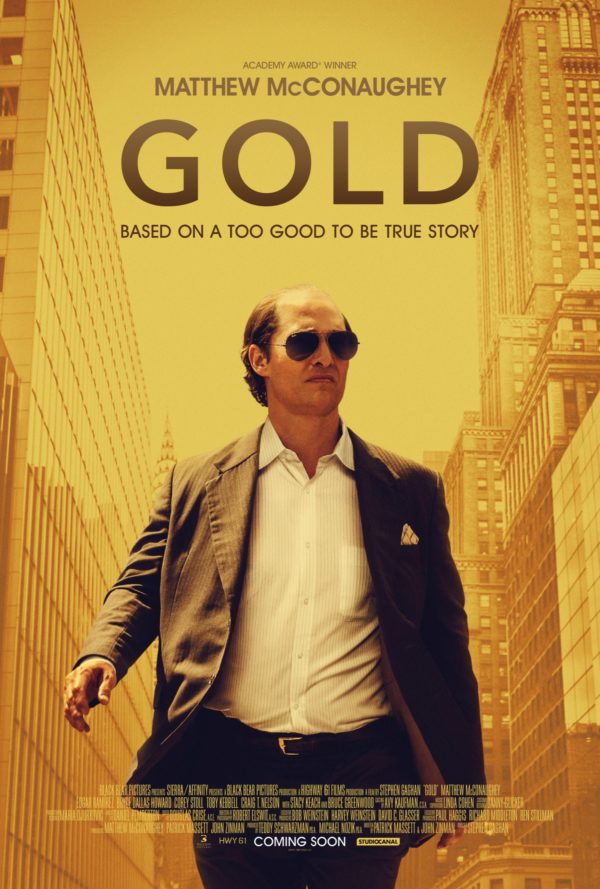
Gold

(USA 2016)

“The taste of it on your tongue, the feel of it on your fingers—it’s like a drug.”

—Mike Acosta

Not everything gold glitters; such is the case with Stephen Gaghan’s Gold, his first film since the acclaimed Syriana over a decade ago. Matthew McConaughey is Kenny Wells, a redneck businessman running his collapsing mining company from a smoke-filled tavern in Reno, Nevada, in 1988. Acting on little more than gut and some pawn shop cash from hocking gifts he gave his girlfriend (Bryce Dallas Howard) in better days shown as the movie opens, he abruptly heads to Indonesia to track down geologist Mike Acosta (Édgar Ramírez) to find a gold mine.

Their first meeting doesn’t go well at all. Looking like he stepped out of Banana Republic when it was a safari store in the ’80s, Acosta is shrewd, rugged, and quite experienced. Balding and sweaty Wells, with his jagged teeth and paunch, is sloppy and desperate. He reads as broke. Unimpressed, Acosta passes when Wells suggests they partner up—until the latter raises $200,000 for the proposed venture. After a series of miscalculations and mishaps (including a bout with malaria), they hit the jackpot in the middle of a jungle. Suddenly, the same banks and big investors that turned up their nose at Wells before want in on the action.

Gold isn’t a bad movie, but it’s not the impressive work it wants to be. The pace is fine, but the plot twists are unsurprising if not downright predictable. The problem is that I’ve seen this story before, and recently: mainstream films like The Big Short (https://moviebloke.wordpress.com/2016/01/03/the-big-short/), The Wolf of Wall Street, and American Hustle deal with the same themes in a similar manner. I’ve seen McConaughey be the same character, too. The curious statement “inspired by a true story” after the opening credits is the cue to something I found disappointing: Gold is a fictionalized account of a true story, changed enough that I guess it can’t claim to be “based on” reality. I’m not sure where that line is drawn, but it turns out much of the story is made up (http://www.financialpost.com/m/search/blog.html?b=business.financialpost.com/news/mining/gold-the-movie-about-the-bre-x-mining-scandal-that-isnt-about-bre-x&q=Bre). Plus, it’s never a good sign when the music in a film—here, artists ranging from Orange Juice to New Order and Joy Division to the Pixies and a new song by Iggy Pop and Danger Mouse—elicits the most enthusiastic response from me. Overall, meh.

Also starring Corey Stoll, Toby Kebbell, Craig T. Nelson, Stacy Keach, Rachael Taylor, Joshua Harto, and Timothy Simons

Produced by Boies/Schiller Films, Black Bear Pictures, and Highway 61 Films

Distributed by TWC-Dimension

121 minutes
Rated R

(AMC River East) C

http://gold-film.com


Eyes of Fire

(USA 1983)

I never heard of Eyes of Fire or anyone involved in it until it appeared on the roster for a local horror film festival. Featuring a team of inconsequentials—writer and director Avery Crounse completed two more projects I never heard of after this and most of the actors continued on to television roles—it’s a low budget fantasy/horror flick relegated to obscurity. It’s no wonder why.

Set in 1750 colonial America and told in flashback, Eyes of Fire follows vain and flighty missionary Will Smythe (Dennis Lipscomb), his small flock of devotees that includes his mistress, Eloise (Rebecca Stanley), and a ginger named Leah (Karlene Crockett) who everyone thinks is insane but is really a fairie, and Eloise’s estranged husband, Marion Dalton (Guy Boyd), as they stumble through the Eastern Woodlands looking for a safe haven. To escape attacking Shawnee natives, Dalton leads the group into a valley that Smythe takes to be “the promised land” and settles into the abandoned campsite there. Dalton is uneasy about staying. Leah also senses something amiss and starts seeing spirits—sometimes they’re clothed, sometimes they’re naked and covered in mud. They don’t look happy. An orphaned native girl (Rose Preston) appears on Smythe’s doorstep, and he takes her in to convert her to Christianity. Immediately, strange things start happening: Fanny (Sally Klein) disappears and is found in a coma, Meg (Erin Buchanan) is found hanging upside down from a tree, and a rotten skeleton pops up out of the dirt. !!! Leah figures out what’s going on: a devil-witch is trying to steal their souls and trap them all in the trees in the forest. Can she and Dalton stop the madness?

I’d be lying if I said Eyes of Fire isn’t silly. It takes itself so seriously, too. The story is easy to follow, but Crounse packs an awful lot into it: folklore, witchcraft, the supernatural, colonialism, ethnic superiority, religion, morality. Whatever points he makes are lost in cheesy special effects—lots of Tesla lightning, negative images, and distorted sounds. The trees have gruesome faces, and at one point they all puke bilge. The devil-witch looks like Captain Caveman made out of twigs. It all warrants a great big “whatever.” Even with its low-budget giveaways, though, I found this film weirdly fascinating—it plods along slowly but somehow kept me engaged. The simple stuff works best—the scene in the forest with white feathers covering the entrance to the valley (repeated later with pages torn out of Smythe’s books and spread all over the campsite) is beautifully ominous and visually arresting. Too bad there isn’t more of it.

86 minutes
Rated R

(Music Box) C-

Music Box of Horrors

https://youtu.be/BdSILmOWwDQ

A Nightmare on Elm Street

(USA 1984)

I’ve seen A Nightmare on Elm Street twice: once as a teenager and once as a middle-aged adult. I can say with authority: no matter how you slice it, this movie sucks.

The plot sounds like a good idea: a knife-fingered ruffian in a tacky striped sweater reminiscent of the original PBS children’s show Zoom haunts teenagers in their dreams and kills them in their sleep. The problem is, A Nightmare on Elm Street just isn’t scary. It’s silly. Dumb, even. One by one, a bunch of kids gets offed by Freddy Krueger (Robert Englund in the role of a lifetime). There’s a really cool scene of a blood geyser spurting from a bed. Heather Langenkamp’s overacting is amazingly bad. There’s that gorgeously diabolical line, “I’m your boyfriend now, Nancy” followed by a tongue coming out of the receiver (never mind that the phone’s unplugged). A young, dumb, and full of you-know-what Johnny Depp is here, all dolled up in an incredibly gay softcore porn outfit. Bizarre. Nancy’s weirdo vodka-lush mother (Ronee Blakley) adds some much needed comic relief—that final scene! Oh, and that catchy nursery rhyme. Other than that, though, this is tedious slasher stuff warmed over from the ’70s but with a slicker ’80s look. I mean, fuck, do we really need that clanking noise to cue us in that Freddy’s coming? Every time? We get it.

Watching it, one is dumbfounded knowing that A Nightmare on Elm Street spawned an entire franchise let alone a sequel. Sure, it’s got kitsch value, and everyone knows this movie so the late Wes Craven did something right. I’m just not sure what. To be fair, I was well aware of what I was getting into here, so I can’t complain about the experience; I already knew this is bad. I’m glad the theater has a bar and we went early as a group to load up on liquor (not vodka) before siting down—that made it fun for a midnight screening.

91 minutes
Rated R

(Music Box) D-

http://m.nightmareonelmstreet.com

http://nightmareonelmstreetfilms.com

Sixteen Candles

(USA 1984)

“I can’t believe this. They fucking forgot my birthday!”

—Samantha

It’s not a good day for Samantha (Molly Ringwald). Her entire family, including both sets of grandparents, totally forget her birthday—her “sweet sixteen,” no less. Everyone is focused on her older sister, Ginny (Blanche Baker), who is getting married to oily bohunk Rudy (John Kapelos) tomorrow. A sex questionnaire she fills out and thinks she passes to her friend Randy (Liane Curtis) during class is missing—and she admitted in it that she’d gladly lose her v-card to dreamboat senior Jake Ryan (Michael Schoeffling). Jake doesn’t know she exists—or so she believes. A freshman geek who calls himself “Farmer Ted” (Anthony Michael Hall) puts the moves on her while taking the bus home. Her grandfather Fred (Max Showalter) calls her boobs tiny while her grandmother Helen (Carole Cook) grabs them because “they’re so perky.” She’s coerced into taking a Chinese exchange student, Long Duk Dong (Gedde Watanabe), to a dance that evening—where she runs into Jake and Farmer Ted, the latter of whom ends up with her underpants. To top it off, she has to sleep on the couch because her grandparents are using her bedroom.

I’m a sucker for teen movies, maybe because deep inside I’m still a teen or wish I still was. Either way, I love John Hughes’s Sixteen Candles for all its goofiness, crude humor, and heart. Ringwald owns Samantha, a different and very Gen X kind of heroine: she’s angsty, gutsy, and fun. Plus, she has substance. Samantha liberally uses the F word, yet she wants all that stupid old shit like letters and sodas. She’s totally relatable—in fact, she reminds me of a dear friend (I’m talking to you, Michelle) in this film. I want the Bow Wow Wow and Culture Club posters on her bedroom walls. Likewise, Hall owns Farmer Ted, a different and very Gen X kind of dork: he’s got personality, and he dreams big. Things works out for him in the end, I guess.

One of the best scenes is an exchange between Samantha and Farmer Ted in a parked car inside a shop classroom. In typical Hughes fashion, the two talk and discover that they’re not so alien. I love what’s pretty much Jami Gertz’s only lines, indignantly and drunkenly slurred at a party to a guy off camera while she catches on a banister a string of pearls around her neck: “I’m sorry, I don’t do that!” When her drunk friend next to her mumbles that she does, Gertz snickers, “I know!” Seeing a baby John Cusack as a nerd (this was only his second appearance in a film) is special. The wedding is awesome, but the final scene in which Samantha finally gets Jake still sends chills up my spine—“If You Were Here” by Thompson Twins plays while car after car drives away, ultimately revealing him standing there across the street from the church. It’s downright magical.

Sixteen Candles has its dubious elements—Long Duk Dong smacks of racism, the word “faggot” is a bit too casually pervasive, and the appearance of Farmer Ted taking advantage of Caroline (Haviland Morris) when she’s passed out is creepy despite portraying it in a relatively innocent and humorous light. I can’t help but wonder whether these flaws detract from the film when viewing it through the lens of the present. I hope not—Sixteen Candles is a classic fairy tale that never gets old for me.

93 minutes
Rated PG

(Home via iTunes) B+

Weird Science

(USA 1985)

“So, what would you little maniacs like to do first?”

—Lisa

No one can accuse John Hughes of being highbrow with Weird Science, his farcical teenage male fantasy flick. The concept is ridiculously pedestrian: Gary (Anthony Michael Hall) and Wyatt (Ilan Mitchell-Smith), two high school “donkey dicks” who “couldn’t get laid in a morgue,” create an impossibly hot woman (Kelly LeBrock) using their computer and a Barbie doll—where exactly the latter came from isn’t clear. They name their creation Lisa and hope to put her to use for something—they’re not quite sure what. Turns out, Lisa has her own plans for them. Hilarity ensues.

It might sound awful: Weird Science is silly, indulgent, and crass. What sets it apart from other dumb films of the same ilk is that it actually has a heart. Plus, it’s funny. LeBrock is cheeky, charming, warm, and wry here; she knows exactly when to be flirty and when to be more motherly. She puts forth sincerity in her affection for Gary and Wyatt; the way her voice wavers at their parting scene is more touching than she has any business being in a film like this. Bill Paxton is hilarious as Chet, Wyatt’s militant abusive older brother—”he’s kind of an asshole.” His delivery is downright inspiring—that “greazy pork sandwich served in a dirty ashtray” line gets a snicker out of me every time, as does pretty much everything he says. The scene with Gary’s parents (Britt Leach and Barbara Lang) is classic boy humor. Even Robert Downey, Jr. and Robert Rusler are awesome in their smaller roles as tormentors. I love that Hughes incorporates elements from other movies, Mad Max: The Road Warrior and Return of the Jedi to name two. Even the (hopefully) tongue-in-cheek cheesy special effects fit. Bonus: Oingo Boingo. Somehow, Weird Science‘s utter juvenile goofiness is totally endearing. Be careful what you wish for—you just might get it.

94 minutes
Rated PG-13

(Home via iTunes) B-

Desperately Seeking Susan

(USA 1985)

“Yeah, well, fortunately for everyone, I’m here and I’m thinking.”

—Susan

Promoted as “the Madonna movie” when it came out just before the Virgin Tour kicked off in the spring of 1985, Desperately Seeking Susan is an ’80s time capsule: the story revolves around personal ads, the style is big hair bows and junk jewelry, the score is all synth, and of course there’s that catchy dance track “Into the Groove”—a deliciously raw demo, at that. It might seem unlikely, but this film has held up over time and has turned out to be an interesting little gem.

Desperately Seeking Susan is light and fun, but it’s not a fluff piece. Loaded with mistaken identities, missed connections, double reversals, and loopbacks, the plot is clever and tight even if it isn’t terribly complicated. Roberta Glass (Rosanna Arquette) is a lonely, unfulfilled housewife from Fort Lee, New Jersey. Neglected by her husband, Gary (Mark Blum), a hot tub salesman, she reads the personals for diversion and becomes obsessed with a recurring one between Susan (Madonna) and her boyfriend, Jim (Robert Joy). Roberta steps out to the City to spy on them when Jim summons Susan to Battery Park one afternoon. A series of finely timed events, including the exchange of a jacket with the Eye of Providence on the back of it and a nasty bump on the head, literally pulls Roberta into Susan’s wild life.

Director Susan Seidelman executes the whole thing nicely. The vibe is scrappy and energetic. The story is packed with great characters, and the actors all bring it to make them interesting and believable—even Madonna playing a far less ambitious version of herself. The standouts are Arquette; Laurie Metcalf, who plays Gary’s sister as a neurotic shrew; and Aidan Quinn, who plays projectionist and knight in shining armor Dez with the right amount of gruffness and sexiness. Notable small roles are John Turturro as Ray, the owner of the Magic Club; Steven Wright as Gary’s dentist; and Richard Hell as Bruce, the guy Susan leaves in a hotel room in Atlantic City. The best character, though, is New York City itself; all the exterior shots are fabulous if only for the fact that they capure a city that no longer exists. C’mon, I’m waiting!

104 minutes
Rated PG-13

(Home via iTunes) B

http://www.mgm.com/#/our-titles/524/Desperately-Seeking-Susan

Paris Is Burning

(USA 1991)

“Opulence. O, P, U, L, E, N, C, E, opulence. You own everything. Everything is yours!”

—Junior LaBeija

Before The Crying Game and Transamerica, RuPaul’s Drag Race, Bruce/Caitlyn Jenner, and Scissor Sisters’ “Let’s Have a Kiki,” there was Paris Is Burning. I first saw it at a screening on my college campus, I think, when it was fairly new—I remember a double feature with Madonna’s Truth or Dare, so it had to be summer or fall 1991. I’ve since seen it countless times. It’s one of the films I quote most. I love it, even as it turns 25 years old. It is, in two words, fucking fabulous!

Shot in 1987 with a short check in three years later, Paris Is Burning is ostensibly a documentary about the Harlem nightlife ball culture (pronounced “boo-wall” by most here). The film takes its name from one said ball, a rather clandestine affair held in a shabby party hall somewhere near Lexington/125. A world unto itself, ball culture was loaded with costumes, wild dancing, attitude, hierarchy, and tons of rules. There was blood, sweat, tears, and fighting—but there was also community and (for some) glory. As one subject, Willie Ninja, informs us, the balls may have been long and drawn out, but they were never boring. Amen! This is clear.

Much to her credit, director Jennie Livingston goes—excuse how this sounds—beyond the balls, getting into the daily challenges not only gay men and drag queens faced, but also actual bona fide transgender women. This was probably the first exposure I had to that. I mean, being gay in the Reagan Era was bad enough: if you weren’t destined to live a long and lonely life in the closet, you were going to get AIDS. Either way, the only thing straight about you was your road to hell. Transgender was…something else altogether. America was not ready for it when Paris is Burning came out, which makes it all the more remarkable.

Paris Is Burning is a big middle finger to all that thinking. While not everyone subscribed to that view, Paris Is Burning was the first film to show a lifestyle like this in a positive light. It was effective; it showed how fun and liberating it could be to walk a ball, fake tits or not. Hey babe, take a walk on the wild side. Damned fun! No wonder Madonna co-opted vogueing and snagged two Xtravaganzas for her tour.

Although there are undertones of sadness throughout, every person in this film is a hero. They were courageous simply living their lives how they did, when they did. The key was a mix of self confidence and major guts. Dorian Corey gave me a crash course on reading and shade. Pepper LaBeija showed me that living the good life takes more than money. Venus Xtravaganza showed me that life is a negotiation. Whatever category you choose, you better work it!

Sadly, the era and the players of Paris Is Burning are long gone, but their spirit doesn’t just live on—it thrives. Paris Is Burning and its subjects are legendary.

Side note: everything has its dark side. This is a perfect example: http://dangerousminds.net/comments/dorian_corey_the_drag_queen_had_a_mummy_in_her_closet

In 2016, the United States Library of Congress deemed Paris Is Burning “culturally, historically, or aesthetically significant” and selected it for preservation in the National Film Registry.

71 minutes
Rated R

(Home via iTunes) A

http://www.jennielivingston.com/paris-is-burning

The Infiltrator

(USA 2016)

Bryan Cranston has come a long way from his stint as Tim Whatley, Jerry Seinfeld’s dentist. He’s an excellent choice to play Robert “Bob” Mazur, a U.S. Customs agent who in 1985 went undercover as fictitious New Jersey money launderer Bob Musella to work his way into the trafficking network of Colombian drug czar Pablo Escobar. With the assistance of fellow agents Emir Abreu (John Leguizamo) and Kathy Ertz (Diane Kruger), Mazur—to use his words—“followed the money” instead of the drugs. It led to one of the biggest drug busts in American history.

Based on Mazur’s memoir The Infiltrator: My Secret Life Inside the Dirty Banks Behind Pablo Escobar’s Medellín Cartel, director Brad Furman—whose mother, Ellen Brown Furman, wrote the script—lets Cranston go absolutely apeshit with his character. It’s impossible not to draw parallels between Mazur and Breaking Bad’s Walter White; it’s glaringly obvious that both characters are essentially family guys who choose a dangerous double life that consumes them to the point of losing who they are—not to mention their lives. This plays out exquisitely in a scene where a cartel member (Simón Andreu) who knows Musella spots Mazur and his wife, Evelyn (Juliet Aubrey), having a quiet anniversary dinner at a restaurant.

The Infiltrator is a good movie. Despite occasionally feeling like an episode of Miami Vice, it nonetheless has an intensity that slowly comes to a boil, and when it finally does: BOOM! The moral dilemma of betraying the people not only who come to trust Musella but also welcome him into their lives adds a dramatic slant that movies like this tend to lack. I was riveted. Considering its subject matter, though, The Infiltrator doesn’t exactly move fast. It’s more of a low key character study fueled by what’s going on in Mazur’s head. Benjamin Bratt, Yul Vazquez, and even Olympia Dukakis turn in great performances. There are some dark, funny moments along with some really unsettling scenes—like a weird voodoo ritual, an out-of-nowhere drive-by, and murder on the dance floor. It remains to be seen how memorable The Infiltrator proves to be, though.

127 minutes
Rated R

(AMC River East) B

http://www.theinfiltrator.com

Home3