Ed Wood

(USA 1994)

“You’re wasting your lives making shit. Nobody cares. These movies are terrible!”

—Dolores Fuller


“How do you do it? How do you get all your friends to get baptized just so you can make a monster movie?”

—Bunny Breckinridge


“Can your heart stand the shocking facts of the true story of Edward D. Wood, Jr?”

—Criswell


“Confidentially, I even paratrooped wearing a brassier and panties. I wasn’t afraid of being killed, but I was terrified of being wounded and having the medics discover my secret.”

—Ed Wood

Edward D. Wood, Jr., or simply Ed Wood, is widely regarded as the worst director of all time. In fact, he received posthumous recognition—the Golden Turkey Award—designating him as such (http://www.legacy.com/news/celebrity-deaths/article/ed-wood-the-best-of-the-worst). His silly low-budget DIY pulp/science fiction/horror flicks from the 1950s—low on plot, technique, and talent—are beloved by many because they’re so bad. Monumentally bad. Okay, maybe ridiculous is a better word. You decide from this trailer:

Based on Rudolph Grey’s book Nightmare of Ecstasy and adapted for the screen by Scott Alexander and Larry Karaszewski, Tim Burton’s labor of love, Ed Wood, is a period-piece biopic about the eccentric angora-loving filmmaker responsible for such gems as Jail Bait, Glen or Glenda, Bride of the Monster, and of course Plan 9 from Outer Space—Wood’s Citizen Kane (as Burton likens it here). This film rocks; I never get sick of it. Not ever. And for a few reasons.

The characters and performances are fantastic. Leading man Ed Wood is one of Johnny Depp’s most endearing roles; he plays Wood with an affectionate and demonstrative earnestness he’s never quite duplicated. Burton has always held sympathetic misfits in high regard—Edward Scissorhands, also played by Depp, immediately comes to mind. Here, he has a field day, bringing in an entire cast of warm and colorful weirdos that flock to Wood. Consider: best bud Bunny Breckinridge (Bill Murray), a boozy grand queen with a penchant for drama and glitter. “The Amazing Criswell” (Jeffrey Jones), an androgynous self-proclaimed psychic/horse shit artist. Max (Max Casella), the president of Wood’s fan club—and his errand boy. Overzealous, chatty crew member Conrad (Brent Hinkley). Later, Vampira (Lisa Marie), a gothic midnight movie hostess with lots of bosom, and TV wrestler Tor Johnson (George “The Animal” Steele) become regulars in Wood’s films.

The most important relationship, though, is the one between Wood and has-been Dracula star Bela Lugosi (Martin Landau), whom he meets in a coffin store. Lugosi’s life is far from glamorous: he lives alone in obscurity in a tiny tract house in a nondescript suburban neighborhood. He’s also a junkie. Wood moves from starstruck fan to employer to custodian and confidant. Landau gives a flawless performance; he earned an Academy Award for Best Supporting Actor for it. Every scene is inspired, but one of my favorites is his dramatic reading of that hackneyed “home” speech; it is, to use Wood’s word, “perfect.” Their friendship gives Ed Wood much of its warmth and humanity.

Despite the laughably amateur quality of Wood’s films—and his unorthodox way of shooting them—he gets them made. And no matter how poorly received they are, he doesn’t give up. In this sense, Ed Wood is uplifting and inspiring. He embraces his flaws, sticks to his guns, and believes in himself. Orson Welles himself (Vincent D’Onofrio) backs him up in one great scene at a bar.

Some might find the pace a bit slow. I don’t—the whole film is fun and jammed with quotable material that keeps it moving. Line after line is memorable—I could string together a bunch of quotes I know by heart and leave it at that (I’ve seen this film quite a few times). From a technical standpoint, Ed Wood is exceedingly well done. Filmed in shimmering black and white, Stefan Czapsky’s camerawork is beautiful. The cleverly composed, shadowy shots of Lugosi “fixing” in the bathroom and later tied to a bed in rehab, and Wood and future wife Kathy (Patricia Arquette) inside the carnival ride are especially remarkable. Howard Shore’s score—a rich mix of jazz, Cuban orchestration that wouldn’t sound out of place on I Love Lucy, and monster madness—is awesome.

Burton easily could have made this a snarkfest. Instead, he shows his idol in a respectful and positive light. His spirited take makes Ed Wood exceptional.

With Sarah Jessica Parker, Mike Starr, Juliet Landau, Stanley Desantis, Ned Bellamy, Norman Alden, G.D. Spradlin

Produced by Touchstone Pictures

Distributed by Buena Vista Pictures Distribution

127 minutes
Rated R

(iTunes purchase) A

Florence Foster Jenkins

(UK 2016)

“People can say I can’t sing, but they can’t say I didn’t sing.”

—Florence Foster Jenkins

A lot of hype surrounded Florence Foster Jenkins before it arrived at a theater near us last fall. We wanted to catch it during its original run, but it came and went before we got around to seeing it. So, inspired by a post earlier in the day, I rented it on a Friday when we had no plans other than dinner at home. The night we watched it just happened to be Friday the 13th, which somehow seems appropriate.

Based on actual events and set during WWII, Florence (Meryl Streep) is a rich Manhattan society lady of a certain age who runs in an arty circle and knows a lot of people, some with money and others who follow it. She operates a private venue dedicated to opera, the Verdi Club, where she stars in a show and has a non-speaking role. Dying of either syphillis or the treatment for it—mercury and arsenic!—her one wish is to perform for an audience at Carnegie Hall. The problem is, she can’t sing; she’s downright awful. Her entrance here, lowered onstage from a rope and pulley while dressed as an angel with a harp, reminds me of Sarah Jessica Parker’s entrance (“I offer you mortals the bird of peace so that you may change your ways and end this destruction”) in Ed Wood, Tim Burton’s 1994 biopic about a similarly talentless film director who came along a decade or so later. The comparison is so apt that I wonder if it was intentional. Here, Florence’s husband, St. Clair Bayfield (Hugh Grant), doesn’t help matters by exaggerating her talent.

Determined to make her dream come true, Florence hires a vocal trainer, Carlo Edwards (David Haig), and a pianist, Cosmé McMoon (Simon Helberg), to put together a show. Established and well-known Carlo is content to take Florence’s money, build her ego, and let her dream on. Budding Cosmé, however, struggles with lying to her about her obvious ineptitude, not to mention her negative impact on his professional reputation. He soon sees that those around Florence stretch the truth about a lot of things when dealing with her.

Nicholas Martin’s script is kind to its characters, going for laughs in a way that doesn’t demean any of them. I never heard of her until this film, but the actual Florence Foster Jenkins was an interesting person. Her singing truly was awful:
https://www.youtube.com/watch?v=Hcs9yJjVecs. As always, Streep is spot on with her portrayal. She seems to have fun in this role, and it shows. Grant, who usually bores me but doesn’t here, is well suited for St. Clair: he’s stuffy and straight, but he nicely coveys an underlying deceitfulness that doesn’t come off as sinister. I like the way director Stephen Frears plays with deceit here, ultimately using it to depict a very touching side of St. Clair—who lives with his mistress (Rebecca Ferguson) in Brooklyn in apartment that Florence pays for. Much to my surprise, though, Big Bang Theory‘s Helberg steals practically every scene he’s in: keeping it subtle with Cosmé’s homosexuality (as Cosmé himself no doubt would have done during his day), he plays his character as a spineless, perennially uncomfortable, asexual bundle of nerves. He peppers his performance with grimaces and nervous giggles. Later, he delivers a line to explain his tardiness to Florence (of course, it involves sailors) with perfect and priceless dryness. He outshines everyone here.

Florence Foster Jenkins has some funny moments and some very touching ones. I found it enjoyable enough, but certainly not a knockout. It could have benefitted from a little more quirk and edge, especially considering its title character who showed no shortage of either.

Also starring Nina Arianda, Stanley Townsend, Allan Corduner, John Sessions, John Kavanagh, David Menkin, and Sid Phoenix

Produced by Qwerty Films, Pathé Pictures International, and BBC Films

Distributed by Paramount Pictures (USA)

111 minutes
Rated PG-13

(iTunes rental) C

http://www.florencefosterjenkinsmovie.com

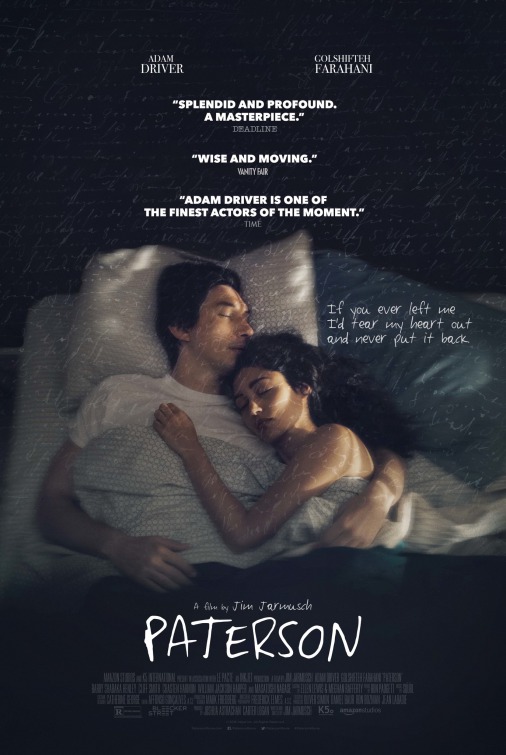
Paterson

(USA 2016)

Not a lot happens in Jim Jarmusch’s new film Paterson—it is, to borrow from Seinfeld, a show about nothing. Starting on a random Monday, the story follows Paterson (Adam Driver)—a Paterson, New Jersey, city bus driver and closet (or in this case, basement) poet—through his daily routine for a whole week. He finds inspiration in the simplest things: passengers, barflies, Ohio Blue Tip matches. He works it all into his “secret notebook” of poetry, scribbled in sidebars onscreen. Some of it is interesting, some not so much.

Jarmusch throws a lot out there: never mind the recurring parallels between Paterson and those he encounters—there’s imagery of twins, waterfalls, circles, and fireballs. Attempting to infer a weighty point in all of it, though, is probably an exercise in futility; this is fluid stream of consciousness. The story is more a string of vignettes: Paterson’s wife, Laura (Golshifteh Farahani), orders a guitar online and later serves Brussels sprout and cheddar pie for dinner; the bus Paterson drives breaks down; a situation arises in the bar where Paterson has a beer every night when he walks his wife’s dog, Marvin (Nellie, who, sadly, passed away before Paterson came out: http://www.indiewire.com/2016/05/the-2016-palm-dog-posthumously-awarded-to-nellie-the-dog-from-jim-jarmuschs-paterson-289094/).

The characters Paterson encounters are plentiful and colorful: defeatist coworker Donny (Rizwan Manji); a rapper (Method Man) in a laundromat; a young poet (Sterling Jerins) waiting for her mother in the bus yard; Marie (Chasten Harmon) and her sensitive beau, Everett (William Jackson Harper), whom she’s trying to dump; a nameless gangbanger (Luis Da Silva, Jr.) who warns Paterson about dog-jacking (not that it stops him from tying Marvin to a spigot outside the bar every night); anarchists, old ladies, and braggarts on the bus.

Perhaps the most accomplished thing about Paterson is its rhythm: the plot moves slowly but in a purposely metered fashion. Cinematographer Frederick Elmes creates a dreamy and downright poetic look. The relationship between Paterson and the world has its own set of rules. This film reminds me of Dead Man, which I haven’t seen in two decades: quietly contemplating routine and rut, Paterson ultimately celebrates the poetry in the mundane. The unnamed traveler and angel (Masatoshi Nagase) at the end literally gives us the “a-ha” moment. With nearly no outside sound, not even music, I thought of one thing: if James Joyce’s Ulysses were made into a movie, it would feel a lot like this. Unlike Leopold Bloom, though, Paterson’s wife isn’t cheating on him, and no one except Marvin seems to mind his presence.

Side note: for some reason, the screening I caught included Spanish subtitles, unintentionally adding another layer of what-the-fuck. Paterson is not a movie for everyone, but I definitely see a following here. I liked it.

Also starring Barry Shabaka Henley, Trevor Parham, Troy T. Parham, Kara Hayward, Jared Gilman, Johnnie Mae.

Produced by K5 International, Le Pacte, Animal Kingdom, and Inkjet Productions

Distributed by Bleeker Street Media and Amazon Studios

118 minutes
Rated R

(Landmark Century) B-

http://www.bleeckerstreetmedia.com/paterson

Hidden Figures

(USA 2016)

Houston, do you read me: NASA employed black people in its infancy during the early Sixties. What’s more, NASA’s first major project, Mercury, probably wouldn’t have gotten off the ground without three black female “computers,” or mathematicians, whose efforts literally put John Glenn and Friendship 7 into orbit. The result was a serious boost in American morale during the race against the Soviets into space and a boon to the Space Program under President Kennedy. So, with its historically significant and truly enlightening subject matter, what most caught me off guard about Hidden Figures is its tone, which is light, upbeat, cute, and often comical. While not in itself a bad thing, it’s not what I expected.

Unfortunately, that’s about all Hidden Figures offers that I didn’t expect. I’m not saying I didn’t enjoy this film; I did. It’s a great story about remarkable people who actually lived. According to one subject, their real stories are not far off from this film (http://www.latimes.com/science/sciencenow/la-sci-sn-hidden-figures-katherine-johnson-20170109-story.html). Taraji P. Henson plays Katherine Johnson, a recently widowed math whiz who works for NASA in Virginia, as a bookish nerd complete with glasses that keep sliding down her nose. She and her coworkers, smart and sassy Dorothy Vaughan (Octavia Spencer) and fiery and coquettish Mary Jackson (Janelle Monáe), quietly but forcefully demonstate their worth in an environment that doesn’t treat them as equals. While Katherine lugs binders and a calculator back and forth between her desk and the “colored” rest room clear across campus to figure out arcs and other shit I sure can’t, Dorothy teaches herself how to operate the new IBM that not even IBM technicians can set up correctly and Mary pushes her way into engineering classes at night in an all white, all male school. Director Theodore Melfi does a really nice job demonstrating institutionalized racism and sexism through characters who may not have anything against black people or women—as administrator Vivian Michael (Kristen Dunst) curtly tells Dorothy in one scene and unwilling research partner, Paul Stafford (Jim Parsons), makes clear to Katherine in another scene by redacting her name from a joint report they both wrote—but don’t recognize the issue.

Despite its merits, I found Hidden Figures to be slightly more sophisticated than a Lifetime movie. Melfi, who with Allison Schroeder adapted the screenplay from Margot Lee Shetterly’s book of the same name, takes a pretty basic approach to the material. It’s so easy—obvious, even—to gage where the story is headed. John Glenn (Glen Powell) sings Katherine’s praises while a love interest develops for her in handsome Col. Jim (Mahershala Ali). So cute. Hidden Figures gets into civil rights issues, but only on a superficial level. There are a few overdone Oscar grabs, like a scene between Katherine and her boss, Al Harrison (Kevin Costner), that ends with him smashing the sign outside the “colored” ladies’ rest room, but no true show stoppers. Frankly, though, most of the actors here have appeared in better movies. Too bad, because this could’ve been a great film instead of just an okay one. Hidden Figures doesn’t quite do its trailblazing subjects justice.

127 minutes
Rated PG

(AMC River East) C+

http://www.foxmovies.com/movies/hidden-figures

Manchester by the Sea

(USA 2016)

Home is where the heart is, but for Boston area janitor Lee Chandler (Casey Affleck) it’s where the heartbreak is. Withdrawn into a dreary and meager existence, he spends his days repairing tubs and toilets, listening to tenants bitch (and in one case talk on the phone about doing him), and shoveling snow at the apartment building where he lives in a dark basement with hardly any furniture and apparently one window. He spends his nights drinking himself stupid—so stupid he gets into the occasional brawl. He gets some positive attention here and there but never responds or engages. He’s dead inside for reasons that aren’t immediately clear.

Flashbacks show that Lee wasn’t always broken. He was married with three children. He had a home. He had friends and a social life. He spent a lot of time with his only sibling, older brother Joe (Kyle Chandler), and his nephew, Joe’s only kid Patrick (Ben O’Brien), on Joe’s boat. Joe’s wife, Elise (Gretchen Mol) is no longer in the picture. Neither is Lee’s, Randi (Michelle Williams).

One cold morning, a friend (C.J. Wilson) calls Lee to inform him that Joe had another heart attack. Joe dies before Lee gets to the hospital in his hometown, Manchester-by-the-Sea, about an hour up the coast from him. He has to tell Patrick (Lucas Hedges), who’s now in high school. Lee sticks around to help put together the funeral and look after his nephew. He gets pulled into a parental role, carting Patrick to hockey events and band —a rock band, not high school marching band—practice, and counseling him on matters of dating and sex. Both are surprised when Joe’s lawyer (Josh Hamilton) reveals his will: he made provisions for Lee to serve as Patrick’s guardian. Too bad Joe never said anything to Lee.

Manchester by the Sea has some truly depressing scenes. The backstory of what brought Lee to his current state is horrible—it’s no wonder he doesn’t want to be anyone’s guardian. One excruciating exchange between Randi and Lee turned on the waterworks—mine (and it takes some doing to get me to cry). Director and writer Kenneth Lonergan is focused on loss, forgiveness, and the complicated nature of taking care of one’s own in tough times. Jody Lee Lipes’s cinematography nicely translates that focus, giving the film its dreary, colorless look.

All that said, Manchester by the Sea really isn’t a depressing movie. Much of the dialogue between Lee and Patrick is amusing: snarky and smartass, they often end up arguing. They’re all macho but obviously have a bond they don’t ever bring up; instead, it shows subtly when they talk about Joe or the boat. Lonergan has a wonderfully dry sense of humor that makes this one more than melodrama. The frozen ground is too hard to dig, so Joe has to stay in a freezer until spring. Patrick tries hard to get into a bandmate’s (Anna Baryshnikov) pants, while her mother (Heather Burns) develops a thing for Lee. Patrick gets in touch with his mother, who to his disdain has become a born again Christian. Plus, her fiancé is played by Matthew Broderick. Nice touch!

Manchester by the Sea has a similar vibe as, say, a Smiths song. I like that. The rather abrupt ending doesn’t resolve much, which is something I’ve heard a few people complain about. It didn’t bother me.

137 minutes
Rated R

(Landmark Century) B+

http://manchesterbytheseathemovie.com

Amélie [Le Fabuleux Destin d’Amélie Poulain]

(France/Germany 2001)

“I like to look for things no one else catches.”

—Amélie Poulain

The Associate Board of Chicago International Film Festival presented a special screening of Jean-Pierre Jeunet’s Amélie, a sumptuous, romantic fantasy of a film that looks as good as it feels. I’ve seen it many times. It’s unrealistic, maybe even a bit silly; yet, it always leaves me smiling. I couldn’t pass up the chance to see it again.

Young Amélie Poulain (Flora Guiet) has a lonely childhood: her odd parents are overreactive, overprotective, and emotionally distant, preferring to rearrange the contents of their toolbox and purse than pay much attention to her. It’s so bad that her heart races when her father, Raphaël (Rufus), a physican, touches her during her annual checkup—a narrator (André Dussollier) explains that all she wants is a hug.

Her father misdiagnoses Amélie with a heart condition. As a result, she’s kept inside from the world and homeschooled by her mother, Amandine (Lorella Cravotta), a rather hysterical woman with a nervous tic in her eye. Amélie retreats into her imagination to deal with it all. Her home environment is so stifling, it makes her pet goldfish, Blubber, jump out of its bowl in multiple suicide attempts. A separate suicide at Notre-Dame, this one successful, changes Amélie’s life, leaving her father to raise her alone without any siblings, which her mother apparently wanted for her. C’est la vie.

Fast forward to 1997: grown up Amélie (Audrey Tautou) is a stylish but shy waitress at a café in the 18th Arrondissement of Paris—artsy Montmartre. While home alone (as usual) in her flat one evening—August 31, 1997—a TV news report of Princess Diana and Dodi Fayed’s fatal car accident jolts Amélie, causing a chain reaction that leads her directly to a rusty box of a boy’s trinkets from the 1950s hidden in her bathroom wall. She discerns the identity of the family who lived in her flat back then and devises an elaborate scheme to reunite the boy, now an older man (Maurice Bénichot), with his “treasures” while staying completely anonymous and out of view. It works, bringing happiness to him and in the process to Amélie.

Thrilled with her accomplishment, she decides that her life’s work will be making others happy—in her own amusingly roundabout, always off to the side way. Amélie, you see, prefers to be invisible. She describes what she sees to a blind man (Jean Darie), kidnaps her father’s garden gnome to inspire him to travel, mails a bunch of fake love letters to her landlord (Yolande Moreau) whose husband abandoned her decades ago, and fixes up a hypochondriac coworker (Isabelle Nanty) with a volatile café patron (Dominique Pinon) who just got dumped.

Amélie’s covert approach goes swimmingly for others, but not so much for her own happiness—something she discovers once she encounters Nino Quincampoix (Mathieu Kassovitz), a handsome and quirky stranger who works at a porn shop and collects discarded photos from a photo booth at Gare de l’Est. Amélie can’t bring herself to show herself to Nino, let alone speak to him through a door. Can her neighbor, “the Glass Man” (Serge Merlin), talk some sense into her?

Everything about Amélie dazzles. Just like earlier films Delicatessen and The City of Lost Children, Amélie is a treat, showcasing Jeunet’s distinct buoyantly surreal visual and narrative style. He’s more sophisticated here, though. He throws in offbeat narrative sidebars that tell about his characters. With wide shots, unexpected angles, a pallet of vividly dark colors, and a mix of elements from different decades, he concocts an idealized version of Paris that highlights all that makes it romantic and dreamy. It works well with Bruno Delbonnel’s cinematography, which has a cool sepiatone air to it. My favorite shot is the one of Amélie literally dissolving into a puddle of water.

Tatou is wonderfully mischievous, emulating both Audrey Hepburn in Breakfast at Tiffany’s and Tinkerbell. You can’t help but fall for her as she turns the mundane into magnifique. Kassovitz, who comes off as a weirdo at first, capably metamorphoses Nino into a go-getter who turns out to be a great match for Amélie. Plus, he’s easy on the eyes.

122 minutes
Rated R

(Public Chicago) A

Chicago International Film Festival

http://www.miramax.com/movie/amelie/

Closet Monster

(Canada 2016)

I wish I could play Bronski Beat’s “Smalltown Boy” for Closet Monster‘s protagonist, Oscar Madly (Connor Jessup), because the lyrics say something he needs to hear: the answers you seek and the love that you need will never be found at home. Sigh.

When young Oscar (Jack Fulton) is a wee lad of maybe seven or eight, his parents give him a hamster (played by four different actors: Chunk, Mama, Blood Thirsty, and Buffy #1). The gift, it turns out, is intended to take the sting out of their explosive announcement: his mother (Joanne Kelly) is leaving his father, Peter (Aaron Abrams). It doesn’t take long to see why, as Peter is an oppressive loose cannon. Oscar stays with his father and quietly retreats into his own world where his new furry friend, Buffy, becomes his companion and has a way of expressing what Oscar is feeling (Isabella Rossellini, of all people, provides Buffy’s voice).

One afternoon after school, Oscar follows a group of older teenage boys into a cemetery. Unbeknownst to them, he watches from behind a tree as they barbarously attack another boy—presumably a gay one—with a rusty iron rod. Immediately after, Oscar notices his father is a toxic alpha male asshole. Determined to prevent something horrible from happening to him, he jumps into survival mode and starts doing “guy” things.

Cut to a decade later: Oscar (Jessup) is into creating monsters with makeup and prosthetics, practicing in his treehouse on his friend Gemma (Sofia Banzhaf), an aspiring model who carries a torch for him. They both just finished high school. Oscar bides his time that summer working as a stockboy at a home improvement store while waiting for an acceptance letter from a school with a design program for cinematic special effects to which he’s applied. He’s completely beside himself when a new employee named Wilder (Aliocha Schneider) shows up and asks to borrow his work shirt. Wilder is cool, sexy, and has a way of transmitting ambiguous sexual signs—causing Oscar severe stomachaches and visions of that iron rod.

Writer and director Stephen Dunn’s first feature threw me for a loop, in a really good way. Closet Monster is packed with gay coming of age clichés, but it still stands on its own. Oscar’s homosexuality is more than incidental, but it’s no dark secret; Oscar knows he’s gay and he doesn’t seem to be ashamed of it, even if dealing with it is tricky. The cast here is excellent, particularly the exchanges between Jessup and Schneider (not to marginalize the other actors). Dunn exhibits a dinstinctive style both in how he tells his story and how he shows it. From a narrative standpoint, he concocts a compelling mix of comedy, teen drama, fantasy, horror, gore, and psychological intrigue. The tension between Oscar and Peter is palpable, simmering from a quiet friction to an all-out eruption.

Dunn’s visuals are even better: vivid, surreal imagery of iron rods popping out of Oscar and vomiting nuts and bolts into a sink, they indelibly illustrate what’s going on in his head. Peppered with retro electronica, I pick up a certain late ’80s/’90s vibe here; indeed, Dunn’s aesthetic reminds me of David Fincher, Spike Jonze, Michel Gondry, and to a lesser extent Anton Corbijn, all of whom started out doing music videos. Dunn’s sensibility is similar to another young director, Xander Robin (Are We Not Cats) (https://moviebloke.wordpress.com/2016/10/15/are-we-not-cats/), though Dunn is not as dark. Closet Monster has a few shortcomings, but overall it gels nicely into a totally satisfying film.

90 minutes
Not rated

(Facets) B

http://rhombusmedia.com/film/closet-monster/

http://www.strandreleasing.com/films/closet-monster/

A Man Called Ove [En man som heter Ove]

(Sweden 2015)

A few years ago, I picked up Fredrik Backman’s novel A Man Called Ove for my book club. Published in 2012, the story was familiar and the main character was one I’d seen many times before. What stood out was Backman’s writing—it was colorful. I must confess, I didn’t finish the book. I liked what I read, though.

Hannes Holm’s film adaptation is similarly colorful. Ove (Rolf Lassgård)—rigid, regimented, orderly, and blustery—is the archetypal curmudgeon. A victim of a recent reduction in force at the train yard that employed him for 40 years, his days now consist of essentially three activities: policing the neighborhood development where he lives to enforce antiquated rules no one pays attention to, correcting transgressors, and visiting the gave of his wife, Sonja (Ida Engvoll). He promises to join Sonja and even makes a few attempts at suicide, but he’s constantly interrupted.

The interesting thing about Ove’s suicide attempts is that they trigger his memories, which fills us in on his backstory: his unconventional childhood, getting his job, meeting the woman who would become his wife, and some other stuff that brought him to where he is. He’s had a life filled with heartbreak, and he loved his wife. It’s no wonder then that he bristles when he unwillingly meets his new neighbors, a Persian woman named Parvaneh (Bahar Pars) and her klutz of a husband (Tobias Almborg), after they plow into his mailbox.

Dealing with love and loss, A Man Called Ove easily could have turned into a sentimental mess. The Swedish spin on it—a tongue in cheek earnest practicality, as illustrated by a stray cat and a battle between Saab and Volkswagen, for example—and Lassgård’s winsome performance both succeed at preventing that. Göran Hallberg’s cinematography is crisp and vivid, with the present comprised of natural blues and greens while the flashbacks have a warm, glowing sort of sepia pallette.

116 minutes
Rated PG-13

(Landmark Century) B-

http://www.musicboxfilms.com/a-man-called-ove-movies-139.php

One Week and a Day [Shavua ve Yom]

(Israel 2016)

I suppose in Asaph Polonsky’s first full-length feature, One Week and a Day, nothing can be said to be certain except death and intoxication, the former of course bringing about the latter. With a dry and tentative sense of humor, he demonstrates how different people come to terms with grief as they struggle to move forward.

After sitting shiva for their son and sole offspring, Ronnie, a cancer victim, the Spivaks—Eyal (Shai Avivi) and Vicky (Evgenia Dodina)—gingerly go about getting back into their normal routine over the course of a day. As might be expected, it’s not easy: there’s a lot to do. Eyal, clad in shorts and sandals, isn’t up for the task—any task, it turns out. He decides to try a different approach when on a mission to retreive a blanket of many colors at the hospice where Ronnie died he instead finds his son’s medical marijuana—a humungous unopened foil bag of it.

There’s a lot of pot humor here: hiding the doobage in Eyal’s fly, toking up, hazy discussions, keeping the buzz on the D.L., playing ping pong and games that involve kittens, even an air guitar session with Zooler (Tomer Kapon), the next door neighbor’s son, a big stoner who works in food service and dutifully shows Eyal how to roll a joint (not with a gummy worm). Vicky, a sober school teacher with a lot on her plate, goes about her business jogging, going for a checkup with her dentist, and tutoring a young student in her home while Eyal and Zooler get baked. She gets an idea of her own. While all this is going on, Eyal has until 4:00 p.m. to confirm a reservation for two plots next to Ronnie at an already overcrowded cemetery, or he and Vicky forfeit them forever.

I enjoyed the offbeat humor of One Week and a Day, which has a few downright beautiful scenes—like Zooler’s pretend surgery to remove a hospice patient’s cancer for the benefit of her young daughter. However, the characters suffer from a certain flatness. When the smoke clears, though, this is a touching and often poignant story. The film neatly demonstrates that petty annoyances, drudgery, and boredom are all a part of life and persist even in the face of grief.

Screening followed by a live Q and A with director Asaph Polonsky.

98 minutes
Not rated

(AMC River East) B-

Chicago International Film Festival

http://bsheepfilms.com/portfolio/one-week-and-a-day/

Like Crazy [La pazza gioia]

(Italy 2016)

The festival program called Paolo Virzì’s Like Crazy a “hysterical, edgy comedy,” which is not entirely accurate (http://www.chicagofilmfestival.com/film/like-crazy/). For sure, the premise is fun: two female mental patients escape on a city bus and head for an adventure that includes shopping, stealing cars, gambling, clubbing, and getting a sort of revenge on some of those who did them wrong. Plus, the patient who instigates the caper, MILFy Beatrice (Valeria Bruni Tedeschi), is a hilarious character: an imperious namedropping motormouth who fabricates lie upon lie to get herself into (and out of) one shady shenanigan after another, she steamrolls everyone in her path for frivolity—more medication, booze, food, attention—and then condescends to them like they’re peons. Think of an Italian version of Patsy, Eddie, and Newhart‘s Stephanie rolled into one. Beatrice’s mere presence puts everyone on edge, not the least of whom are the nuns who run Villa Biondi, the mental hospital where she’s admitted indefinitely. The film is loaded with funny moments that poke fun at sex, religion, family, age, society, and status. There’s also a clever reference to Thelma and Louise.

For all its humor, though, Like Crazy has a sad underlying story: Donatella (Micaela Ramazzotti), a fragile wounded bird whom Beatrice drafts into her escapade, has a terribly dark past that includes trying to kill her infant son. The film takes a serious turn when Beatrice sets out to reunite him with Donatella. The two women become a support system, with the former serving as the latter’s rock until she discovers that she’s stronger than she thought even with her imperfections. Bruni Tedeschi and Ramazzotti are equally strong, and they operate with a nicely calibrated balance of outrageous and desperate. Aside from a rather random interlude with Beatrice’s ex-husband (Bob Messini), the story plays out damn near perfectly. Like Crazy is a joy but also very touching. My eyes were moist by the end—that caught me off guard, in a good way.

Side note: Vladan Radovic’s cinematography is gorgeously warm, bright, and summery throughout the film—a contrast that becomes more apparent as the mood here gets heavier. It’s a very nice touch.

116 minutes
Not rated

(AMC River East) B+

Chicago International Film Festival