The Adventures of Priscilla, Queen of the Desert

(Australia 1994)

The “road movie” is a subgenre that I think of as an American convention. They tend to involve younger people on a quest for something, perhaps a race (The Cannonball Run), a chase (Convoy), a new life (Alice Doesn’t Live Here Anymore), a vacation (National Lampoon’s Vacation), a mission (Pee-Wee’s Big Adventure), or or just getting laid (Losin’ It). They don’t usually involve gay men or drag performers or Australians for that matter, which makes The Adventures of Priscilla, Queen of the Desert rather compelling for its subversiveness if nothing else.

True, the world had seen a road movie with gay characters before (My Own Private Idaho, which predates this one by three years, comes to mind) and Australians (Roadgames, Backroads). However, The Adventures of Priscilla, Queen of the Desert is different. It’s every bit as fierce as Mad Max, but it’s fabulously fun—as though a team of drag queens tossed a bunch of glitter and disco (and CeCe Peniston) into the mix.

Anthony “Tick” Belrose a.k.a. Mitzi Del Bra (Hugo Weaving) is a drag performer in Sydney who accepts an offer to perform at a casino resort operated by his estranged wife, Marion (Sarah Chadwick), in remote Alice Springs—in the middle of the continent. He gets his buds Bernadette Bassinger (Terence Stamp), a recently widowed transgender woman, and Adam Whitely (Guy Pearce), an obnoxious younger queen whose drag name is Felicia Jollygoodfellow, to join him.

They hit the road in a huge silver tour bus that they christen “Priscilla, Queen of the Desert” and embark on a journey through the desert. A clan of Aboriginals is very welcoming, allowing the three to perform for them. Not everyone is nice, though, which they soon discover when some outbackass bumpkins spraypaint “AIDS Fuckers Go Home” across the side of the bus.

The three contend with the bus breaking down, a homophobic gang, what appears to be an inescapable bar brawl, and secrets—quite a few secrets. Some of the stuff that happens is predictable, but writer and director Stephan Elliott manages to keep the whole thing fresh because he infuses some great conflict and character development into the narrative. Bernadette’s subplot, a soul searching midlife “where do I go from here” kind of existential crisis, is probably the most interesting part of the movie. The acting—Weaving and Pearce (who looks like a cross between Brad Pitt and Mark Wahlberg) for sure, but especially Stamp—is moving for something that appears to be heading toward frivolous and campy territory. It doesn’t quite stop there. What the characters all end up with is something maybe none of us saw coming: acceptance.

What makes The Adventures of Priscilla, Queen of the Desert so great, still, is that it’s full of surprises.

With Rebel Russell, John Casey, June Marie Bennett, Murray Davies, Frank Cornelius, Bob Boyce, Leighton Picken, Maria Kmet, Joseph Kmet, Alan Dargin, Bill Hunter, Julia Cortez, Daniel Kellie, Hannah Corbett, Trevor Barrie, Ken Radley, Mark Holmes

Production: PolyGram Filmed Entertainment, Specific Films

Distribution: Gramercy Pictures, Roadshow Films

104 minutes
Rated R

(DVD purchase) B-

I, Daniel Blake

(UK/France/Belgium 2016)

I Daniel Blake.jpg

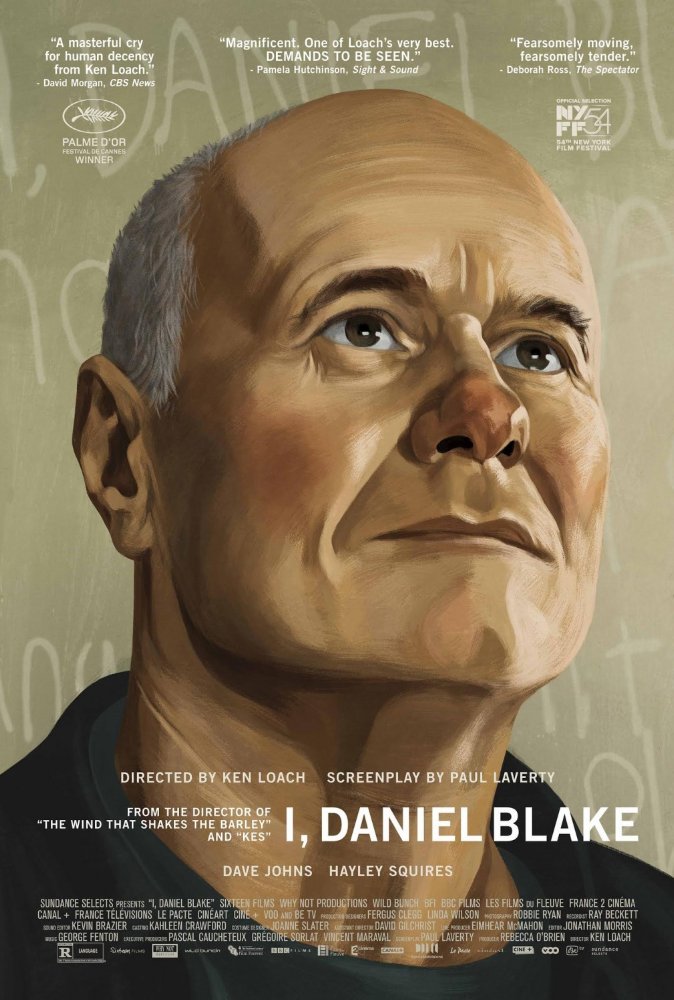
Ken Loach’s I, Daniel Blake has gotten a lot of attention and praise. Good: it wrestles with a topic that’s timely on both sides of the Atlantic—and elsewhere, for that matter. A political and poweful message, Loach has touched many a nerve. Case in point: I, Daniel Blake won the Palm d’Or at the Cannes Film Festival, where it finished with a 15-minute standing ovation (http://variety.com/2016/film/global/palme-dor-ken-loach-rebecca-obrien-1201785482/). 15 whole minutes?! Wow.

Daniel Blake (Dave Johns) is a kind of antihero. He’s gruff, he’s private, he’s not handsome or young. He probably goes to church. A heart attack seems like the thing that would change his life, but what really does is a new neighbor (Hayley Squires) and her two kids (Briana Shann and Dylan McKiernan).

I didn’t stand up, but I get it. Bureaucracy versus common sense is always fertile ground for storytelling. I applaud Loach for what he’s saying here, I really do. I, Daniel Blake is a good film: it’s engaging, brave, and relatable. The acting is good all around. So is the premise.

In my opinion, though, it just isn’t a great film. We’re talking shades of meaning here, so if you have five seconds to spare, I’ll tell you why. First, I’ve seen this device many times before—in the last year, even. A cranky old man meets a character that represents youth and hope, and it totally melts the icy facade and changes his life. Well, OK. This sense of hope is usually personified by the very person society looks down on. Next?

Second, I saw where the plot was going way before I got there. Again and again. Predictability is never groundbreaking.

Third, I can’t help but think that this film takes the easy way out. A heart attack in a movie ends only one way. And it’s only a sad ending. Yeah, I, Daniel Blake is emotionally manipulative.

So, my issues center on Paul Laverty’s writing. I wish I had a better way to tell this story. I don’t. For all its pluses and minuses, though, I’d rather watch something more intense. Overall, I, Daniel Blake is disappointingly soft.

With Kate Rutter, Sharon Percy, Kema Sikazwe, Steven Richens, Amanda Payne, Chris Mcglade, Shaun Prendergast, Gavin Webster, Sammy T. Dobson, Mickey Hutton, Colin Coombs, David Murray, Stephen Clegg, Andy Kidd , Dan Li, Jane Birch, Micky McGregor, Neil Stuart Morton

Production: Sixteen Films, Why Not Productions, Wild Bunch, British Film Institute (BFI), BBC Films, Les Films du Fleuve, Canal+, Ciné+

Distribution: Entertainment One Films (UK), Le Pacte (France), Cinéart (Belgium/Netherlands), Cinema (Italy), Feelgood Entertainment (Greece), Prokino Filmverleih (Germany), Scanbox Entertainment (Denmark), Sundance Selects (USA), Transmission Films (Australia), Vertigo Média Kft. (Hungary), Canibal Networks (Mexico), Cine Canibal (Mexico), Imovision (Brazil), Mont Blanc Cinema (Argentina), Longride (Japan)

100 minutes
Rated R

(Music Box) B

https://www.wildbunch.biz/movie/i-daniel-blake/

Some Freaks

(USA 2016)

A line from an old Billy Idol song (“Hole in the Wall”) appropriately sums up the plot of playwright Ian MacAllister-McDonald’s charming and touching debut feature film Some Freaks:

“We were such an ugly pair,
The chameleon twins they’d stop and stare.
Lovers know when love has gone.
A black hole there where love was once the end.”

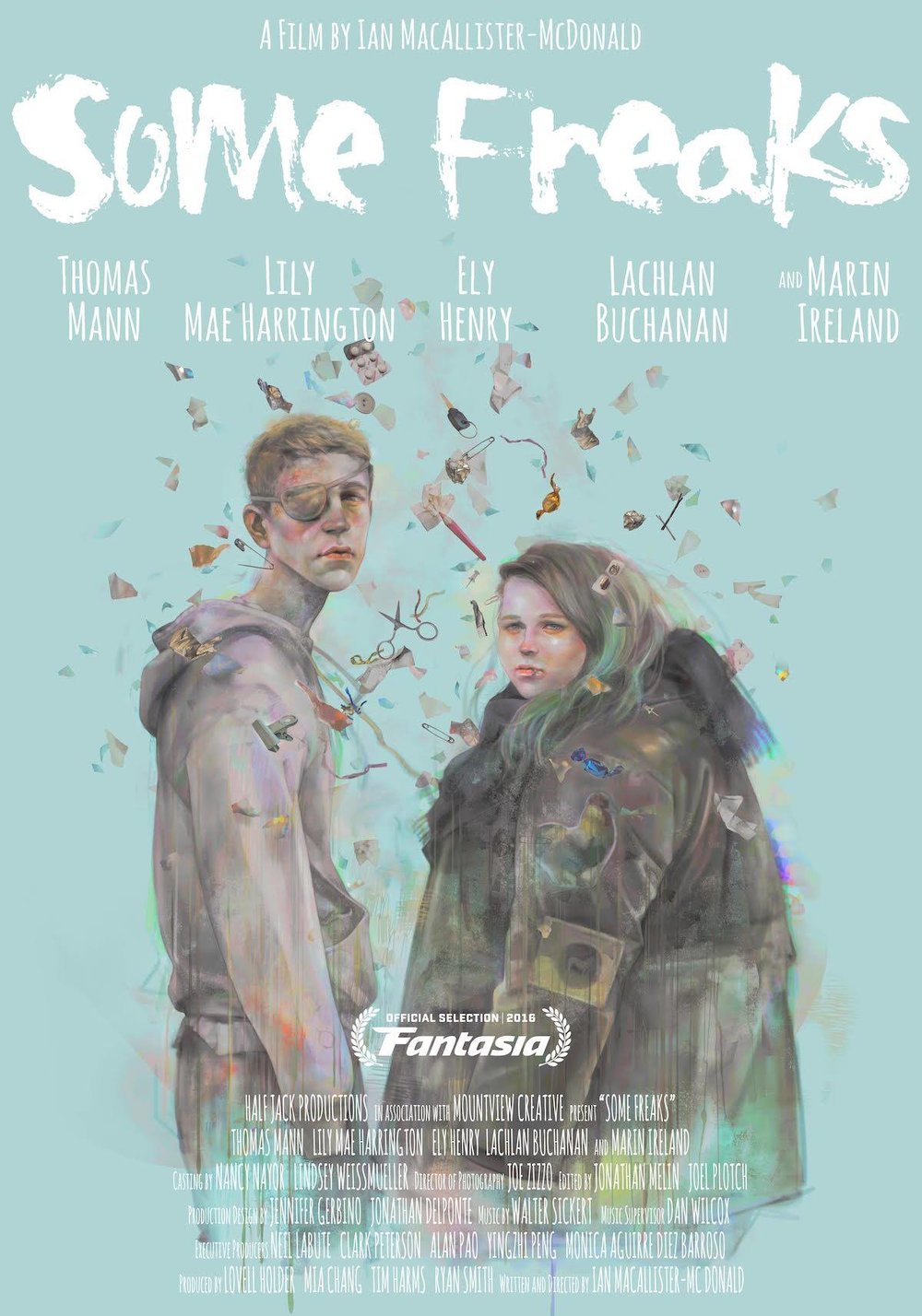
Rhode Island high school senior Matt Ledbetter (Thomas Mann), who has the unflattering nickname “Cyclops” because of the patch he wears over his fucked up eye, doesn’t fit in with his classmates. Awkward and unpopular and literally a freak, his only friend is schlubby neo-maxi-zoom-dweebie gay motormouth Elmo (Ely Henry), who seems eager to blow just about any guy—not that any guy is ever going to let him. Lucky Matt gets to hear all of Elmo’s fantasies in graphic detail as they play video games. Yipee.

A chubby new girl (Lily Mae Harrington) in thrift store clothes and green-streaked hair flirts with Matt in biology class. Matt doesn’t know what to make of her, but he’s obviously intrigued even though he’s all shy about it. She turns out to be Elmo’s cousin Jill, who’s staying with his family for the school year after some trouble at home in Oregon.

Jill and Matt get off to a rocky start when she overhears him crack a fat joke about her to Elmo. Despite her tough facade, cynical and insecure Jill is forgiving—she has no choice because she has a thing for Matt. The three of them start hanging out. To Elmo’s dismay, Matt and Jill fall for each other and start dating.

WARNING: Potential spoilers ahead!

The end of high school brings about a quandary neither starcrossed lover anticipated. Jill gets into college out West, leaving Matt behind on the East Coast. Thus begins their long distance relationship. They lead separate lives and make similar changes without telling each other: Matt gets a glass eye and starts working out while Jill gets a new wardrobe and goes on a diet. Suddenly normalized, Matt goes to a party and hits on chicks while Jill attracts the attention of frat boy hottie Patrick (Lachlan Buchanan), who went to high school with her. His mean girl pals were not very nice.

Matt and Jill’s metamorphoses clash when he visits her six months later and they discover that their natural connection is now strained and forced. What’s worse, they bring out something ugly in each other. Is this the death knell for their relationship?

Written and directed by MacAllister-McDonald, Some Freaks is impressive even with its flaws, especially for a first time full length feature. The story and the characters recall John Hughes and Todd Solondz, but this is by no means mere imitation or an update of either. I like MacAllister-McDonald’s straightforward and unsentimental view. Yes, much of what happens here is predictable; however, there are enough twists that I didn’t see coming to keep it interesting if not fresh. The actors put a lot of heart into their characters, and it shows—even Buchanan, whose Patrick is underdeveloped and not entirely believable.

I happened to see Some Freaks on April Fool’s Day with my teenage nephew. All things considered, I couldn’t have planned it better.

With Marin Ireland, John Thorsen, Sylvia Kates, Devon Caraway, Brian Semel, Nikki Massoud, Stephen Thorne, Shannon Hartman

Production: Half Jack Productions, Mountview Creative

Distribution: Good Deed Entertainment

Screening followed by a live Q and A with Ian MacAllister-McDonald, Lily Mae Harrington, and Ely Henry

97 minutes
Not rated

(Tower City Cinemas) B

Cleveland International Film Festival

http://www.somefreaksthemovie.com

Center of My World [Die Mitte der Welt]

(Germany 2016)

Center of My World, director/screenwriter Jakob M. Erwa’s adaptation of German author Andreas Steinhöfel’s 1998 novel for young adults, is not a home run. Fortunately, though, Erwa knows how to extract enough charm, particularly from its two main actors, to downplay its shortcomings and proffer a respectable and enjoyable film.

17-year-old Phil (Louis Hofmann) lives with his mercurial, flighty mother, Glass (Sabine Timoteo), and his twin sister, Dianne (Ada Philine Stappenbeck), in a gorgeous house on the outskirts of town. This family isn’t exactly The Brady Bunch: Phil is gay, Dianne supposedly communicates with animals, and Glass can’t commit to a partner for very long. She won’t even tell her kids who their father is.

Phil notices some friction between the women of the house after he returns from summer camp. When school starts, his best friend, Kat (Svenja Jung), encourages him to go after mysterious new guy Nicholas (Jannik Schümann), a dreamy transfer student who looks like a cuter blue-eyed version of Lance Bass with his chiseled cheeks, luscious lips, and perfect hair. Supposedly, he likes boys. Phil finds out for sure in the locker room one afternoon—and it leads to a passionate affair, insecurity, and a weird bout of jealous competition with Kat.

Center of My World is a cute and engaging story. Erwa does a nice job showing how any kid, gay or otherwise, has a lot to deal with when it comes to sexuality. The Chaun Ngo’s cinematography is well done, employing a bright color pallette verging on artificial that plays really well against the small town setting with all its gardens and summer greenery. The acting is generally good. Schümann is really easy to just…gaze upon, I guess, but in a harmless Teen Beat way.

All that said, Center of My World would have been a much gutsier film, say, 15 years ago. It probably would have made a bigger impact then, too. It contains hints and echoes of things I’ve seen before. The characters are a bit hollow; some of them come off as half-baked, rendering their importance to the story tenuous or questionable. These two boys have sex a lot, which is great. However, the sex scenes here need work even with the full frontal we get. More in-your-face than sexy, they come off as gratuitous. I don’t know if Erwa was trying to be shocking, but it didn’t work if he was. It’s like watching two puppies go at it. I hope that’s not the intended result.

With Inka Friedrich, Sascha Alexander Geršak, Thomas Goritzki, Nina Proll, Clemens Rehbein

Production: Neue Schönhauser Filmproduktion, Prisma Film, Universum Film, mojo:pictures, Westdeutscher Rundfunk, Bayerischer Rundfunk, ARTE, Österreichischer Rundfunk

Distribution: Constantin-Film, Universum Film

115 minutes
Not rated

(Tower City Cinemas) B-

Cleveland International Film Festival

http://mitte-der-welt-film.de

https://www.facebook.com/diemittederwelt.film

Lonesome [Solitude]

(USA 1928)

The promotional poster touts something “New! Different! Refreshing!” It sounds like soda, but it’s not: it’s Lonesome, a real charmer that still works as it nears its centennial.

Music Box Theatre screened a crisp restored 35mm print of Paul Fejos’s Lonesome for Reel Film Day, a countrywide event honoring films of the almost abandoned format (https://drafthouse.com/event/reel-film-day). The program was a double feature that included the Adam Sandler vehicle Punch Drunk. I didn’t stick around so I can’t comment on Punch Drunk, but Lonesome was an excellent choice.

Mary (Barbara Kent), a telephone operator for Ma Bell, and Jim (Glenn Tyron), a punch press operator in a factory, are two young working stiffs in the Big Apple. Both live alone in small rented room (not together—there’d be no movie then), and participate in an urban rat race that actually looks busier and grungier than what we have today.

Clearly, the film predates the standard five-day work week: the calendar in Mary’s room indicates that the day is Saturday, July 3. As Mary and Jim finish their respective jobs, which Fejos shows in a narrative that goes back and forth between the two, their work friends invite them to join in their weekend plans. Mary and Jim both see immediately that they’ll be the odd one out, as all of their friends are paired up. Both politely decline, going home dejectedly without any plans.

After they each see the same marching band advertising a cheap carriage ride to Coney Island, Mary and Jim end up going there solo on the same trip. They meet at the beach, and a modest flitration ensues. He tells her he’s a millionaire, and she tells him she’s a princess. They get along well, and commence an impromptu date, walking around, playing carnival games, and dancing. A fortune teller (Fred Esmelton) reveals that Mary has already met the man who will become her husband.

Mary and Jim get separated after a mishap on a rollercoaster. The problem is, they each have a tiny picture of the other from a photo booth and they only know each other’s first name. Finding each other in the throngs of people at the park that evening is like searching for a needle in a haystack. Have they lost each other before they even had a chance?

Edward T. Lowe, Jr. and Tom Reed adapt a cute story by Mann Page; it’s a simple yet clever plot. Despite its age, one point in Lonesome still rings loud and clear and true: connecting in the big city is harder than it looks. We all get wrapped up in the daily stuff of our lives, and we tend to overlook what’s right in front of us. Kent and Tyron are both adorable. Gilbert Warrenton’s kinetic camerawork captures a lot in the background, and it makes the shots at Coney Island especially fun to watch.

Lonesome features two or three abruptly placed “talking” scenes—the film was made when sound was a new thing—and the dialogue is laughably awful. There are also a few color tinted night shots: marquee lights, fireworks, stars. It’s really cheesy. That said, these are short, minor disruptions that don’t detract from enjoying this film for all its silent era charisma.

In 2010, the United States Library of Congress deemed Lonesome “culturally, historically, or aesthetically significant” and selected it for preservation in the National Film Registry (https://www.loc.gov/programs/national-film-preservation-board/film-registry/complete-national-film-registry-listing/).

With Fay Holderness, Gusztáv Pártos, Eddie Phillips, Andy Devine, Edgar Dearing

Production: Universal Pictures Corporation/Universal Pictures (USA)

Distribution: Universal Pictures Corporation/Universal Pictures (USA), European Motion Picture Company (UK), The Criterion Collection (DVD)

75 minutes
Not rated

(Music Box) A

Reel Film Day: A Celebration of 35mm Cinema

https://www.criterion.com/films/28212-lonesome

http://www.imdb.com/video/screenplay/vi389587993/

Toni Erdmann

(Germany/Austria 2016)

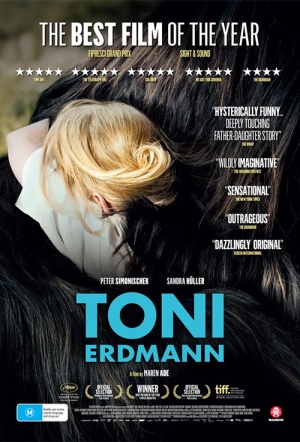
Toni Erdmann is not a real person; he’s the alterego of retired divorced schoolteacher Winfried Conradi (Peter Simonischek). When Winfried, a weird old hippy jokester, appears onscreen in a shaggy wig and bad fake teeth, he certainly gives the impression that those around him have to excuse his relatively harmless but tiresome—and often annoying—penchant for silliness. He is caretaker of his elderly mother, and death surrounds him. Perhaps that explains it.

Winfried’s daughter, Ines (Sandra Hüller), a young corporate sellout working on a project in Romania, drops by for a birthday. She’s on her phone most of the time, distracted by work. She’s so serious—and severe. Predictably, she doesn’t stick around long.

When his dog dies, Winfried flies to Bucharest and stalks Ines in the lobby of the office building where she works. She sees him and takes him to a reception, where she networks with Henneberg (Michael Wittenborn), an oil company executive she wants to make a deal with. The weekend is bizarre, filled with small talk, blank stares, and uncomfortable silence. Ines doesn’t bother to pretend she’s happy to see her father; in fact, it’s pretty clear she’s relieved to see him leave.

This is where Toni Erdmann gets interesting: Winfried doesn’t actually leave. Instead, he becomes “Toni Erdmann, life coach,” and sets out to reach Ines through her professional contacts. Funny thing: it actually works.

Writer/director Maren Ade has a solid grasp of strained relationships and embarrassing situations, and a sick sense of humor to boot. It’s a winning combination in Toni Erdmann, which has its share of quite a few awesomely cringeworthy moments. Your goofy dad upstaging you at a networking opportunity? Check. Naked birthday party—with coworkers? Check. An Easter party that includes an apoplectic performance of Whitney Houston’s “Greatest Love of All”? Check. A cum-soaked petit fours? Um, check.

For all its distance, Toni Erdmann turns out to be a surprisingly emotional film. It takes nearly three hours to get to it, but it ends on a whallop. It’s touching in a way I didn’t see coming. The final scene offers all anyone needs to see about this dysfunctional father/daughter relationship. And it’s beautiful.

With Ingrid Bisu, Lucy Russell, Thomas Loibl, Trystan Pütter, Hadewych Minis, Vlad Ivanov, Victoria Cocias

Production: Komplizen Film, coop99 filmproduktion, KNM, Missing Link Films, SWR/WDR/Arte

Distribution: NFP Marketing & Distribution (Germany), Soda Pictures (United Kingdom), Enfilade (Austria), Sony Pictures Classics (USA)

162 minutes
Rated R

(Music Box) B-

http://www.komplizen-film.de/e/toni-erdmann.html

http://www.sonyclassics.com/tonierdmann/

Captain Fantastic

(USA 2016)

Captain Fantastic came out last summer, and I wanted to see it then. I must confess, the cast interested me more than the plot.

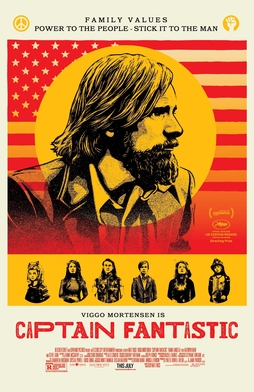
Viggo Mortensen is the aptly named Ben Cash, a long disenfranchised survivalist who is, like, so over American capitalism and politics. He and his wife, Leslie (Trin Miller), shown almost entirely in flashback, decide to raise their six kids—three boys and three girls—off the grid in the mountain wilderness of Washington State. Removed from society, Ben and Leslie teach their kids everything from logic and philosophy to hunting and gathering to Norman Mailer and Guns ‘n’ Roses. They do it all without iPhones or religion. Kudos to that!

Nothing is perfect: Leslie suddenly dies, forcing Ben to take his feral kids into the outside 21st Century world for the first time, ever—which calls everything they planned for their family into question.

Director and screenwriter Matt Ross poses some interesting questions about society, conformity, and the social contract in a provocative and often lighthearted way. However, Captain Fantastic is not terribly surprising, which is why it doesn’t work as well as it could. At heart, it’s a standard fish out of water dramedy. Frankly, I spotted every “twist” coming before it got to me: the cop (Rex Young) who pulls over their Partridge Family van, the mildly blasphemous excuse that saves the day, the family’s visit to the supermarket, their reaction to their extended family (and vice versa), that lame scene in which Ben’s sister-in-law (Kathryn Hahn) calls him out onto the carpet for his choices and his youngest daughter (Shree Crooks) recites the Constitution to prove her wrong, eldest son Bo (George MacKay) proposing to the first girl who gives him attention—a trailer park teen queen (Erin Moriarty)—and the colleges he manages to get into, the “situation” that requires modern medical attention. Meh.

For all its grandiose intentions to take on the establishment, Captain Fantastic actually relies on a rather orthodox and pedestrian approach to make its point. Maybe that is its point, that you can’t escape society. It doesn’t mater: this story is predictable and sentimental, two things that never bode well. I expected more than Spokane Swiss Family Brady Bunch, which is essentially what this is. The one thing that saves this film from total mediocrity is the acting, which is great all around.

With Frank Langella, Ann Dowd, Samantha Isler, Annalise Basso, Nicholas Hamilton, Charlie Shotwell, Steve Zahn, Elijah Stevenson, Teddy Van Ee

Production: Electric City Entertainment, ShivHans Pictures

Distribution: Bleecker Street, Universal Pictures

118 minutes
Rated R

(iTunes rental) C

http://www.bleeckerstreetmedia.com/captainfantastic

Elle

(France 2016)

Director Paul Verhoeven’s Elle doesn’t sound like a comedy: the central event of the film is a rape—a bloody, violent one at that. In fact, it’s the very first scene. Strangely, the opening credits warn us that what we are seeing is “a French comedy.” Really? I guess that explains it!

Michèle Leblanc (Isabelle Huppert) is raped in her dining room by a man in a ski mask while her green-eyed cat watches, detached and seemingly bored. China is smashed, furniture is toppled, blood is shed. After he leaves, Michèle cleans up the mess and resumes her life, ordering sushi delivery—a “holiday roll,” no less.

As the film proceeds, we learn a lot about Michèle. She’s the daughter of a famous mass murderer approaching parole. She’s a ballbusting owner of a video game company. Her staff, entirely young and male, either wants to sleep with her or murder her. Her son, Vincent (Jonas Bloquet), is totally whipped by a shrew (Alice Isaaz) who’s pregnant with a baby that clearly isn’t his. Her ex-husband (Charles Berling) is involved with a younger yoga instructor (Vimala Pons). Her mother (Judith Magre) is a high maintenance piece of work who carries on with men a third her age. Meanwhile, Michèle is having an affair with with Robert (Christian Berkel), the husband of her business partner (Anne Consigny).

Things get dicey when Michèle develops a thing for her neighbor, Patrick (Laurent Lafitte), a handsome banker married to a devout Catholic (Virginie Efira) who apparently won’t fuck him. Their flirtation messes with her head as she tries to figure out who raped her. She’s surrounded by men, and every one of them is suspect.

David Birke’s screen adaption of Philippe Djian’s novel Oh… is, in a word, warped. Elle plays with power, desire, sex, and of all things sympathy. Consistent with its character—a constant switcheroo you don’t know whether to trust or look away from—it’s not a sad affair. To the contrary, it’s daring, thrilling, irreverent, and totally fun. It shouldn’t work—I found myself questioning whether I should enjoy the film as much as I did—but it does. The execution of both the plot and the characters is clever—and Stéphane Fontaine’s cinematography, which nicely illustrates the psychological drama here, is flawless. If nothing else, Elle is a visually stunning film.

Iggy Pop’s “Lust for Life” plays at various points in Elle, suggesting a lot of contradictory things. I took it as ironic more than anything. Elle is not for everyone, but it’s a powerful statement for those who can handle it—the perfect film for Valentine’s Day.

With Lucas Prisor, Raphaël Lenglet, Arthur Mazet, Hugo Conzelmann

Production: SBS Productions, Pallas Film, France 2 Cinéma, Entre Chien et Loup, Canal+, France Télévisions, Orange Cinéma Séries, Casa Kafka Pictures, Proximus, Centre National de la Cinématographie, Filmförderungsanstalt

Distribution: SBS Distribution

130 minutes
Rated R

(Gene Siskel Film Center) B+

http://sonyclassics.com/elle/

Django Unchained

(USA 2012)

“The ‘D’ is silent, hillbilly!”

—Django

If anyone would take a stab at something that sounds as ridiculous and cringeworthy as tackling American slavery in a spaghetti Western, it’s Quentin Tarantino. “I want to do movies that deal with America’s horrible past with slavery and stuff, but do them like spaghetti Westerns, not like big issue movies,” he said, clearly referring to Django Unchained in a 2007 interview—five years before it came out. “I want to do them like they’re genre films, but they deal with everything that America has never dealt with because it’s ashamed of it.” (http://www.telegraph.co.uk/culture/film/starsandstories/3664742/Quentin-Tarantino-Im-proud-of-my-flop.html).

The title here references Sergio Corbucci’s 1966 film Django, an actual spaghetti Western in which the titular hero, a cowboy, is thrust into a row between Southern Klansmen and Mexican revolutionaries. In Django Unchained, the story starts in 1858—just a few years before the American Civil War. Django (Jamie Foxx) is a slave separated from his wife, the curiously named Broomhilda von Shaft (Kerry Washington), after they were caught trying to escape a plantation. He’s shackled to a group of slaves that the Speck brothers (James Remar and James Russo) are driving on foot to be sold.

Enter traveling dentist Dr. King Schultz (Christoph Waltz), a genteel German driving a wagon with a big wooden tooth on top of it. Schultz is actually a bounty hunter looking for the Brittle brothers—Big John (M.C. Gainey), Lil Raj (Cooper Huckabee), and Ellis (Doc Duhame)—who happen to be Django and Broomhilda’s former masters. He makes Django an offer he can’t refuse: help him find and kill the brothers, and Schultz will pay him, set him free, and help him find Broomhilda.

Django Unchained is structured in essentially three “episodes.” The first takes place in a one-horse town near El Paso, where Schultz provokes the ire of the townfolk, the sheriff (Don Stroud), and a U.S. Marshall (Tom Wopat). The second takes place on a plantation owned and operated by Spencer “Big Daddy” Bennett (Don Johnson—um, wow!). The last, longest, and most twisted takes place on another plantation in Mississippi, the bountiful Candie-Land, owned by charming but sadistic Calvin Candie (Leonardo DiCaprio) and operated by his shifty Uncle Tom house-slave, Stephen (Samuel L. Jackson).

Tarantino actually pulls off what he said he wanted to, and he does it quite well. Django Unchained could have been a really dark film like its immediate successor, The Hateful Eight. The two films have a lot in common. The tension—and there’s lots of it—built into the story is deliberately and profoundly slow in reaching a boil. Django Unchained certainly has Tarantino’s trademark violence, revenge theme, and liberal use of the ‘n’ word—116 times, a record for a film according to IMDB (http://www.imdb.com/title/tt1853728/trivia?ref_=tt_trv_trv). A few scenes are difficult to watch, the “Mandingo fight scene” being the worst for me. Unlike The Hateful Eight, though, the violence here is Tarantino’s typical flagrantly graphic cartoonish gore. He also shows a more conspicuous sense of humor—for example, Django and Broomhilda are ancestors of John Shaft of the Shaft franchise (https://www.google.com/amp/deadline.com/2012/07/django-unchained-a-shaft-prequel-so-says-quentin-tarantino-comic-con-301010/amp/).

Django Unchained is an unlikely and uncomfortable pairing of an ugly part of our collective past with absurdity, but it’s entertaining while still getting its point across: we’re still living with the aftermath. It’s the kind of film you mull over for a long time after you see it.

With Laura Cayouette, Jonah Hill, Walton Goggins, Dennis Christopher, Dana Gourrier, Nichole Galicia, Miriam F. Glover, Quentin Tarantino, Franco Nero, Russ Tamblyn, Bruce Dern, Misty Upham, Danièle Watts, Robert Carradine

Produced by The Weinstein Company, Columbia Pictures

Distributed by The Weinstein Company (North America), Sony Pictures Releasing (International)

165 minutes
Rated R

(iTunes rental) A-

http://www.unchainedmovie.com

https://youtu.be/eUdM9vrCbow

20th Century Women

(USA 2016)

“We are at a turning point in our history.”

—President Jimmy Carter

I was a little kid in the Seventies, but I have many indelibly vivid memories of the decade: huge cars, gas lines, expensive meat, hijacked planes, Sanka and Sweet’N Low, smoking everywhere, hard rock, punk rock, disco, macrame, spider plants, the Bicentennial, Sky Lab, Victoriana (we had Mucha posters in our mustard-colored kitchen), that strange Holly Hobby aesthetic. It seems like it all changed immediately when Reagan took office in 1981.

20th Century Women captures a slice of American life on that unique, unremembered and largely disowned cusp. Set as a flashback to 1979 with voiceovers that repeatedly remind us that we’re looking backward, the film is a rather remarkable time capsule. The story is simple: Dorothea (Annette Bening) is my grandparents’ age (born in 1924). She had her only son, Jamie (Lucas Jade Zumann), late in life—i.e., over age 40. She’s been divorecd for a few years, which was fine until Jamie hit puberty. Now, she needs help understanding him. She enlists his two closest allies—Julie (Elle Fanning), whose pants he wants to get into, and Abbie (Greta Gerwig), a postpunk fuckup—to help her figure him out.

Loosely based on actual events from director and writer Mike Mills’s childhood, 20th Century Women is fun to watch. Growing up in a house of females myself, I relate to a lot of his experiences. I loved all the Talking Heads, too. Oh!—and Siouxsie and the Banshees! That said, this film borders on overbearing with its nostalgia. It could’ve been so much better—the material and the talent are both there, but Mills goes for easy returns that don’t pay off. The story falls flat. Perhaps a quote from Bening in an earlier film, the superior and far more interesting Running with Scissors, succinctly sums up my problem here: “It’s shit, Fern. It’s sentimental. It’s emotionally dishonest. It implodes into nothingness.”

I wasn’t bored, and I didn’t hate 20th Century Women. But I’m never going to see this movie again. Too bad, because the acting is great. It’s a misfire due to its execution. It seemed like a good idea at the time.

Also starring Billy Crudup, Vitaly Andrew LeBeau, Curran Walters, Toni Christopher, Jimmy Carter (public domain footage)

Produced by Annapurna Pictures, Archer Gray, and Modern People

Distributed by A24

119 minutes
Rated R

(Landmark Century) C

http://20thcenturywomen-movie.com