I, Daniel Blake

(UK/France/Belgium 2016)

I Daniel Blake.jpg

Ken Loach’s I, Daniel Blake has gotten a lot of attention and praise. Good: it wrestles with a topic that’s timely on both sides of the Atlantic—and elsewhere, for that matter. A political and poweful message, Loach has touched many a nerve. Case in point: I, Daniel Blake won the Palm d’Or at the Cannes Film Festival, where it finished with a 15-minute standing ovation (http://variety.com/2016/film/global/palme-dor-ken-loach-rebecca-obrien-1201785482/). 15 whole minutes?! Wow.

Daniel Blake (Dave Johns) is a kind of antihero. He’s gruff, he’s private, he’s not handsome or young. He probably goes to church. A heart attack seems like the thing that would change his life, but what really does is a new neighbor (Hayley Squires) and her two kids (Briana Shann and Dylan McKiernan).

I didn’t stand up, but I get it. Bureaucracy versus common sense is always fertile ground for storytelling. I applaud Loach for what he’s saying here, I really do. I, Daniel Blake is a good film: it’s engaging, brave, and relatable. The acting is good all around. So is the premise.

In my opinion, though, it just isn’t a great film. We’re talking shades of meaning here, so if you have five seconds to spare, I’ll tell you why. First, I’ve seen this device many times before—in the last year, even. A cranky old man meets a character that represents youth and hope, and it totally melts the icy facade and changes his life. Well, OK. This sense of hope is usually personified by the very person society looks down on. Next?

Second, I saw where the plot was going way before I got there. Again and again. Predictability is never groundbreaking.

Third, I can’t help but think that this film takes the easy way out. A heart attack in a movie ends only one way. And it’s only a sad ending. Yeah, I, Daniel Blake is emotionally manipulative.

So, my issues center on Paul Laverty’s writing. I wish I had a better way to tell this story. I don’t. For all its pluses and minuses, though, I’d rather watch something more intense. Overall, I, Daniel Blake is disappointingly soft.

With Kate Rutter, Sharon Percy, Kema Sikazwe, Steven Richens, Amanda Payne, Chris Mcglade, Shaun Prendergast, Gavin Webster, Sammy T. Dobson, Mickey Hutton, Colin Coombs, David Murray, Stephen Clegg, Andy Kidd , Dan Li, Jane Birch, Micky McGregor, Neil Stuart Morton

Production: Sixteen Films, Why Not Productions, Wild Bunch, British Film Institute (BFI), BBC Films, Les Films du Fleuve, Canal+, Ciné+

Distribution: Entertainment One Films (UK), Le Pacte (France), Cinéart (Belgium/Netherlands), Cinema (Italy), Feelgood Entertainment (Greece), Prokino Filmverleih (Germany), Scanbox Entertainment (Denmark), Sundance Selects (USA), Transmission Films (Australia), Vertigo Média Kft. (Hungary), Canibal Networks (Mexico), Cine Canibal (Mexico), Imovision (Brazil), Mont Blanc Cinema (Argentina), Longride (Japan)

100 minutes
Rated R

(Music Box) B

https://www.wildbunch.biz/movie/i-daniel-blake/

Love & Anarchy [Film d’amore e d’anarchia, ovvero ‘stamattina alle 10 in via dei Fiori nella nota casa di tolleranza…’]

(Italy/France 1973)

The premise of Lina Wertmüller’s Love & Anarchy [Film d’amore e d’anarchia, ovvero ‘stamattina alle 10 in via dei Fiori nella nota casa di tolleranza…’] has the ring of something from Federico Fellini or maybe Pedro Almodóvar (though Fellini makes a lot more sense because she actually worked as his assistant for a spell).

Freckly yokel farmer Tunin (Giancarlo Giannini) learns that his friend was murdered. Why? Because he was an anarchist who was plotting to assassinate “ll Duce” Benito Mussolini. What’s more, Mussolini’s fascist police killed him. To avenge his friend’s death, Tunin takes up his cause.

Tunin ends up at a brothel in Rome. He spends a night with Salomè (Mariangela Melato), who reveals that she’s a co-conspirator for her own reasons. As the story progresses, it becomes clear that the coup is a harebrained idea.

Salomè takes Tunin to a rural spot just outside Rome with her and another prostitute, Tripolina (Lina Polito). Salomè distracts Spatoletti (Eros Pagni), the head of Mussolini’s police, while Tunin checks out the area; they then devise a plan to execute the mission.

Meanwhile, Tunin and Tripolina fall in love. Convinced that he isn’t going to make it past the assassination alive, he persuades Tripolina to spend the next two days with him.

The same radical spunk that Wertmüller exhibits in The Seduction of Mimi is just as prevalent in Love & Anarchy; this film is loaded with decadent, sexy hijinks. However, it also its share of some really tender moments—that surprised me. Love & Anarchy turns out devastatingly sad—I left the theater literally bummed out. For all its ridiculous sociopolitical and sexual shenanigans, it’s a far more powerful film.

With Pina Cei, Elena Fiore, Giuliana Calandra, Isa Bellini, Isa Danieli, Enrica Bonaccorti, Anna Bonaiuto, Anita Branzanti, Maria Sciacca, Anna Melato, Gea Linchi, Anna Stivala, Roberto Herlitzka

Production: Euro International Film, Labrador Films

Distribution: Peppercorn-Wormser, Kino Lorber

120 minutes
Not rated

(Gene Siskel Film Center) B

https://www.kinolorber.com/film/view/id/1306

Restless Blood [Levoton veri]

(Finland 1946)

The third Nitrate Picture Show ended on a high note with an unidentified film (the “blind date”) that turned out to be Finnish director Teuvo Tulio’s gloriously insane melodrama Restless Blood [Levoton veri]. I never heard of the director, the film, or anyone in it. I adore this silly spectacle, which straddles the line between soap opera and Saturday morning cartoon.

The story is a love triangle involving two sisters, elder Sylvi (Regina Linnanheimo) and younger Outi (Toini Vartiainen), and Valter Sora (Eino Katajavuori), a burly doctor in their small town. Outi is his patient—she broke her leg—but Sylvi snags him as a husband. Not that Outi has no chance—she does, which she proves when she returns after disappearing, heartbroken, for a few years. Oh yeah—Sylvi goes blind in the meantime: she drinks poison.

Written by Tulio, Linnanheimo, and Nisse Hirn, the script is prime time dynamite. And fresh even by today’s standards. Forget the Ewings and the Carringtons—loaded with sibling rivalry and drama, Restless Blood is the raw and bitter real deal.

Here’s Sylvi driving like a maniac, “blinded” by rage:

img_9487

Come on! That coat, those glasses, that pissed off vengeful smoke! It’s perfect. When we see that Sylvi gets what’s going on between her husband and her sister, wow. Just…wow. The story is thin, but the actors put a lot into it. Bonus: Pentti Lintonen’s cinematography is brilliant. Seeing it on a nitrate print was the icing on the cake—totally worth the cinematic fat and calories.

Restless Blood is not the best film screened at this year’s Nitrate Picture Show, but I dare say it’s the most interesting. I’m dying to see more by Tulio—too bad his work is not easily (or cheaply) accessible.

With H. Stenroos, Lauri Korpela, Laina Laine, Nora Mäkinen, Lida Salin, Emma Väänänen, Elli Ylimaa

Production: Teuvo Tulio

Distribution: Väinän Filmi

91 minutes
Not rated

(Dryden Theatre) B

Nitrate Picture Show

Spellbound

(USA 1945)

“The Fault…is Not in Our Stars,
But in Ourselves…”

—William Shakespeare

I’ve read enough online rankings of Alfred Hitchcock’s films to know that Spellbound often ends up in his top 20 or 30—sometimes higher than that—thank you. While certainly impressive considering the number of films he directed (https://en.wikipedia.org/wiki/Alfred_Hitchcock_filmography), I found Spellbound lackluster, comparatively speaking.

It’s not that I didn’t enjoy it. In the grand scheme of all things cinema, Spellbound is a solid work—it’s just not a great Hitchcock film. Ingrid Bergman is psychoanalyst Constance Petersen, the only female doctor at Green Manors, a mental hospital in Vermont. Her male colleagues see her as detached and cold, which doesn’t bode well for her career—particularly for a woman in the 1940s.

The hospital’s director, Dr. Murchison (Leo G. Carroll), is “retiring.” His replacement is young and handsome Dr. Anthony Edwardes (a young Gregory Peck), who catches Dr. Petersen off guard. Truth be told, she’s smitten—and who can blame her? Gregory Peck is gorgeous here. Anyway, Dr. Edwardes has a secret that becomes apparent: he’s not who he says he is. He’s actually John Ballantyne, a.k.a. John Brown, a dude with amnesia who says he killed the real Dr. Edwardes and assumed his identity. Dr. Petersen doesn’t believe him, and she sets out to find the real murderer—through psychoanalysis. It all leads to a fateful ski trip that comes full circle to Green Manors. Gasp!

Angus MacPhail and Ben Hecht based their screenplay on the 1928 novel The House of Dr. Edwardes by John Palmer and Hilary A. Saunders (as Francis Beeding). Clearly obsessed with Sigmund Freud, the story is clunky but cute and oddly entertaining even if it’s kind of stupid. Two things stick out in my mind about this film: one is Salvador Dalí’s cool dream sequence complete with random objects like big bleary eyes, scissors, a faceless figure, and wings; and that final scene where a gun is fired into the camera—I won’t ruin it, but it literally ends Spellbound with a bloody bang. Fucking awesome!

The nitrate print used for this screening was gorgeous, shimmering with rich blacks and luminescent whites. It impressed me. Miklòs Ròzsa’s grand, sweeping score is fierce—no wonder he won an Oscar for it (https://www.oscars.org/oscars/ceremonies/1946).

One extremely personal but annoying detail: the Siouxsie and the Banshees song “Spellbound” played in the back of my mind the entire time I watched this film. Yeah, I’m hearing voices, I guess…but it could be much worse (I’m talking to you, Paula Abdul).

With Michael Chekhov, Rhonda Fleming, John Emery, Steven Geray, Paul Harvey, Donald Curtis, Norman Lloyd, Bill Goodwin, Wallace Ford, Art Baker, Regis Toomey

Production: Selznick International Pictures, Vanguard Films

Distribution: United Artists

111 minutes
Not rated

(Dryden Theatre) B-

Nitrate Picture Show

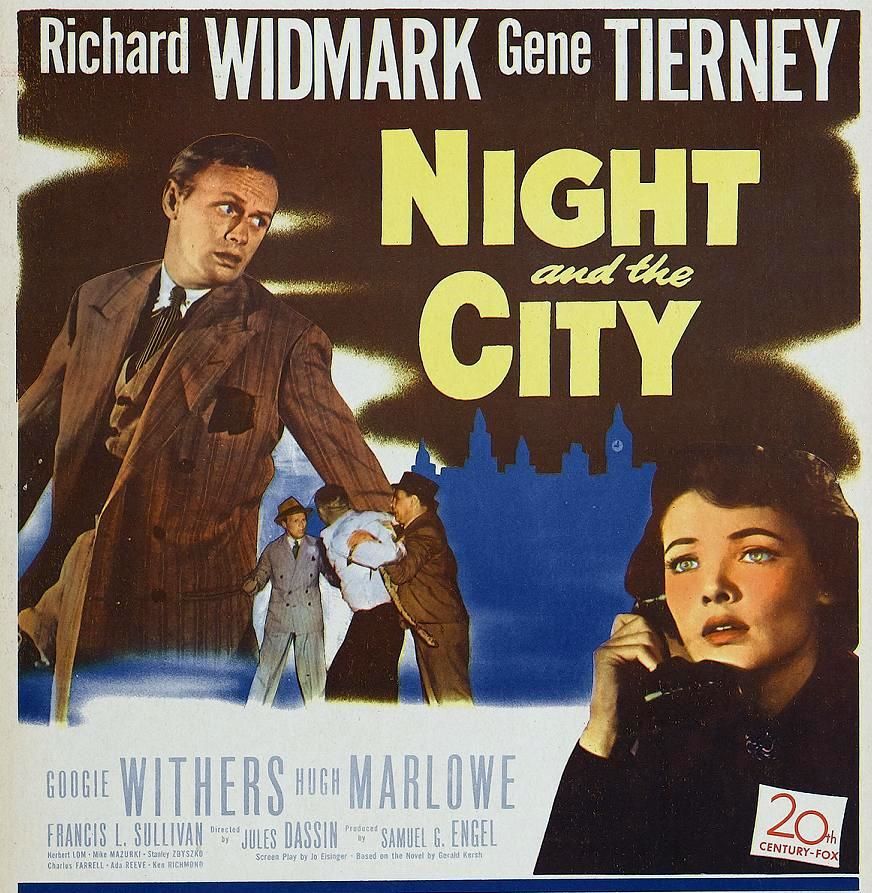
Night and the City

(UK/USA 1950)

“Harry is an artist without an art.”

—Adam Dunne

Jules Dassin’s Night and the City is a fine example of classic film noir. Filmed in smoky black and white mostly at nighttime on location in London, Dassin takes us slumming through the seedy underworld of nightlife, wrestling, and organized crime.

Harry Fabian (Richard Widmark) is a hard-bitten, ambitious, streetwise American con artist living in London. Always on the lookout for a quick buck, he can’t seem to catch a break. Ever. Literally running for his life in the opening scene, his latest career endeavor has failed, and his girl, Mary (Gene Tierney), is losing faith in him—stealing from her will do that.

Things brighten one night after a failed hustle at a wrestling match: Harry crosses paths with famous retired Greek wrestler Gregorius the Great (real life professional wrestler Stanislaus Zbyszko) and his prodigy, Nikolas of Athens (Ken Richmond), who both walk out of the arena in a huff. Gregorius is furious with his son, Kristo (Herbert Lom), who organized the fight, a low-end sort of WWE-like affair that he finds tacky.

Harry schmoozes Gregorius and learns that Kristo is a mobster who controls wrestling in all of London. He devises a plan to create a promotion startup, aligning himself with Gregorius to get around Kristo. He secures funding by double dealing with Phil Nosseross (Francis L. Sullivan), the owner of the Silver Fox Club where Mary works, and Phil’s wife, Helen (Googie Withers). She has plans of her own she doesn’t want Phil to know about.

The whole thing looks like it’s actually going to work despite Kristo’s threats, a plot to murder Harry, and Phil pulling his backing from the project. Harry gets so far as setting up a real fight between Nikolas and the Strangler (Mike Mazurki, also a real life professional wrestler). A miscalculation unravels everything—not just for him but everyone involved.

Jo Eisinger’s screenplay, based on Gerald Kersh’s novel Night and the City with contributions from Austin Dempster and William E. Watts, involves morally bankrupt lowlife characters who lack any redeeming qualities. All of them are scamming for one thing or another, and none of them—except maybe Mary—evokes any sympathy. This plays out nicely with the motifs of money, masculinity, and blind ambition that give this story its dark and bitter hue. It’s suspenseful. Ultimately, evil prevails in this dirty little story, which had to be revolutionary if jarring when this came out.

The backstory here is as interesting as the plot: during the production of Night and the City, Dassin was blacklisted for being a Communist. Pushed into exile, he infuses a strong sense of betrayal and fear into this film (https://en.wikipedia.org/wiki/Jules_Dassin).

Night and the City is desperate, chilly, and magnificently bleak—and it looks it thanks to Mutz Greenbaum’s shadowy and dramatic cinematography. Of the nitrate prints that screened this year, this was a standout. According to the festival program, this pre-release print is ten minutes longer than the UK version and 15 minutes longer than the US version.

With Hugh Marlowe, Ada Reeve, Charles Farrell, Edward Chapman, Betty Shale

Production: 20th Century Fox

Distribution: 20th Century Fox, Criterion

111 minutes (pre-release print)
Not rated

(Dryden Theatre) B

Nitrate Picture Show

https://www.criterion.com/films/933-night-and-the-city

Alexander Nevsky [Aleksandr Nevskij]

(Soviet Union/Russia 1938)

Sergei Eisenstein and Dmitriy Vasilev’s Alexander Nevsky [Алекса́ндр Не́вский] is an oddball film. An historical drama with major propagandist and nationalistic overtones, it depicts Prince Alexander a.k.a. Nevsky (Nikolay Cherkasov) in his battle against the Teutonics as they try to invade the medieval city of Novgorod. Spoiler alert: Nevsky defeats them.

Alexander Nevsky tried my patience; of all the films at this year’s Nitrate Picture Show, it’s the only one I can say bored me. The plot is dull and the execution of the narrative is boring. The acting is stiff and the dialogue, even translated with subtitles, is…severe? I got through it without hating it thanks to a tiny amount of lightheartedness spinkled throughout that makes the whole thing bearable.

One subplot in particular kept me engaged and amused: it involves Vasili Buslai (Nikolai Okhlopkov) and Gavrilo Oleksich (Andrei Abrikosov), two warriors competing for the affection of the same woman, Olga Danilovna, a Maid of Novgorod (Valentina Ivashova, and that’s her character’s name). The two men relentlessly try to outdo each other in courage and skill on the battlefield, as she’s the big prize waiting for the winner. It doesn’t turn out how I expected.

That said, Alexander Nevsky is definitely a worthwhile experience for its visuals. It has a cool neoclassical atomic age sensibility, mixing elements of mythology with a kind of futuristic sci-fi minimalism. The battlefield scenes are beautifully shot, evoking a sense of vast otherworldly shock and awe. Eduard Tisse’s cinematography shimmers, and he contrasts light and dark really nicely here. The nitrate print we saw was sharp. I see why this was included in the festival:

Nevsky Cliff.jpg

Nevsky warriors.jpg

nevsky battlefield.jpg

With Dmitriy Orlov, Vasili Novikov, Nikolai Arsky, Varvara Massalitinova , Amelfa Timoferevna, Valentina Ivashova, Aleksandra Danilova, Vladimir Yershov, Sergei Blinnikov, Ivan Lagutin, Lev Fenin, Naum Rogozhin

Production: Mosfilm

Distribution: Artkino Pictures, Progressive Film Institute (UK), Amkino Corporation (USA), Panthéon Distribution (France)

108 minutes
Not rated

(Dryden Theatre) D+

Nitrate Picture Show

Phantom of the Opera

(USA 1943)

I confess, I rolled my eyes when I found out that a print of Phantom of the Opera was chosen for a screening at the Nitrate Picture Show. I was totally unenthusiastic about seeing yet another version of something I’ve already seen more times than I care to admit. The trailer calls it “[a] story the world can never forget,” but that’s only because Gaston Leroux’s damned story won’t go away.

As it turns out, I quite enjoyed Arthur Lubin’s version. He switches gears with Eric Taylor and Samuel Hoffenstein’s screenplay, ditching horror in favor of romance and melodrama. In the process, he brings a really nice camp factor to the whole thing—I didn’t expect that. His version is a sillier, more fun soapy affair than what I’m used to.

Claude Rains is sympathetic as Erique Claudin, the downsized middle-aged composer who becomes the masked phantom after his publisher (Miles Mander) “steals” his new composition. One of my favorite moments of the entire film is the publisher’s exasperated secretary (Renee Carson) throwing acid from a baking pan in Claudin’s face. It’s so bizarre, it’s actually funny. Even with his acid face, Claudin has a crazy plan for making beautiful young soprano Christine Dubois (Susanna Foster) a star, even if she’ll never return his love. Her female rivalry with diva Biancarolli (Jane Farrar) stews while Anatole (Nelson Eddy), the baritone knight in shining armor, combs the Paris Opera House for the malformed monster (that would be Claudin) who murders anyone in his way. Things get dicier the closer Anatole gets to Claudin.

Phantom of the Opera is a treat for the senses, which makes it perfect for a nitrate print. A rich Technicolor dream, it won Oscars for cinematography (W. Howard Greene and Hal Mohr) and art direction (John B. Goodman, Alexander Golitzen, Russell A. Gausman, and Ira S. Webb) (https://www.oscars.org/oscars/ceremonies/1944). Edward Ward’s score is lovely.

With Edgar Barrier, Leo Carrillo, J. Edward Bromberg, Fritz Feld, Frank Puglia, Steven Geray, Barbara Everest, Hume Cronyn, Elvira Curci, Kate Lawson

Production: Universal Pictures

Distribution: Universal Pictures (USA), General Film Distributors (GFD) (UK), Motion Picture Export Association (MPEA) (Netherlands), Realart Pictures Inc. (USA), Universal Filmverleih (West Germany)

92 minutes
Not rated

(Dryden Theatre) B-

Nitrate Picture Show

The Strike [Siréna]

(Czechoslovakia 1947)

Based on the novel Sirená by Marie Majerová, a communist and feminist Czech author prolific before World War II (https://en.wikipedia.org/wiki/Marie_Majerová), Karel Steklý’s The Strike follows the Hudcový family during a mine workers’ strike outside Prague in the late 19th Century. Hudec (Ladislav Boháč) is a sort of foreman at a mine. His job makes him miserable, which is apparent from his drinking. He finds himself caught between the mine’s owner and the discontented, sorely underpaid workers that include his son Rudolf (Oleg Reif). Hudec tries to straddle the line between the two but ultimately joins the workers when pushed by his determined wife, Hudcová (Marie Vásová), who seems like she’s always hungry. The cost is devastating, especially for their preteen daughter Emča (Pavla Sucha).

Though not as elegant, The Strike recalls Metropolis (https://moviebloke.com/2015/09/12/metropolis/) both thematically and visually. Jaroslav Tuzar’s stark and grimy cinematography nicely highlights the plight of the workers, and it looks great in black and white. Nothing here is nuanced, though: the narrative is coarse and blunt, the acting is total amateur hour, and the moral is in-your-face. Still, The Strike is remarkable for its earnestness; the workers plotting a revolt, their riot, and the town police and corrupt mayor (Josef Benátský) standing behind the mine over the workers certainly all ring true and timely. It kept my interest all the way through.

I never heard of Steklý or The Strike or anyone involved with this picture until I saw it 70 years after its release. I’m not sure it ever enjoyed international distribution—I can’t find a trailer for it—and I can guess why: a dour postwar propaganda film, it likely would have turned off audiences with its Reefer Madness-like approach to capitalism and communism that seems to argue for the latter. Viewing it today, I saw it as an eerily accidental warning of what happens when the middle class disappears.

With Josef Bek, Josef Dekoj, Nadezda Gajerová, Vera Kalendová Bedrich Karen, Lída Matousková

Production: Ceskoslovenský Státní Film

Distribution:

77 minutes
Not rated

(Dryden Theatre) C

Nitrate Picture Show

Bakushū [Early Summer]

(Japan 1951)

After a presentation of shorts, the George Eastman Museum kicked off its third annual Nitrate Picture Show with a Japanese drama, Yasujirō Ozu’s quiet and gracefully understated Bakushū [麦秋]. In the context of midcentury Japan, Ozu explores the generational clash between tradition and progress, and both the possibilities and the casualties brought on by the latter. Opening with something that deals with changing values was an interesting choice on multiple levels.

Noriko (Setsuko Hara) lives in postwar Tokyo with her parents, Shūkichi (Ichirō Sugai) and Shige (Chieko Higashiyama); her older brother, physician Kōichi (Chishū Ryū); his wife, Fumiko (Kuniko Miyake); and their two unruly young sons, Minoru (Zen Murase) and Isamu (Isao Shirosawa). Noriko earns her own living as a secretary and contributes to the household, maintaining her own active social life. She seems happy, or at least content. Still, her more conventional family is concerned because she’s 28 years old and still isn’t married.

Noriko is a good sport about her family members’ not-so-subtle reminders, but the heat intensifies when an elderly uncle (Kokuten Kōdō) stays for a visit. Her chauvinistic boss (Shūji Sano) plays matchmaker, introducing her to Mr. Matanabe, a business associate in his 40s (all of his interactions occur off camera, so we never see him). He proposes. Naturally, Noriko’s family pushes her to accept his offer, which she considers even though the prospect doesn’t excite her.

Enter childhood friend, Kenkichi (Hiroshi Nihon’yanagi), who returns to the neighborhood with his daughter. He’s a widow in between job assignments. Noriko suddenly develops her own idea about which path she wants to take, much to the dismay of her family.

Bakushū is not a kinetic film—it’s slow, and the action centers on mundane routine activities like preparing meals, eating, conversing, working, and getting ready for bed. Some of the plot’s significant events aren’t even shown. Ozu favors low angles and wide, distant shots. He keeps the camera pretty still. He doesn’t use a lot of sets. On top of that, it takes some effort to keep track of the many characters.

Admittedly, I found myself zoning out at the beginning. Once I settled into Ozu’s rhythm, though, I got more interested in Bakushū. Some of the plot elements make the story seem slightly ahead of its time, but the core themes are universal. This is a family drama; the family unit ultimately falls apart, but it’s not necessarily a bad thing. The family portrait at the end closes things on a bittersweet note. I sensed more than a nod to the burgeoning westernization of Japanese society.

Bakushū fits nicely into the midcentury films I’ve developed a taste for. I never heard of it or Ozu, but I’ve already looked him up. I’m interested in seeing more of his work. As for this print, it was in all likelihood the very first feature film I’ve ever seen on nitrate (we’re not counting the shorts). The picture was crisp, but I must confess: its quality didn’t wow me like some others I saw after this.

With Chikage Awashima, Kuniko Igawa, Haruko Sugimura, Seiji Miyaguchi

Production: Takeshi Yamamoto

Distribution: Shochiku Company Limited, The Voyager Company (USA), Janus Films (USA)

124 minutes
Not rated

(Dryden Theatre) B-

Nitrate Picture Show

Lost Highway

(USA 1997)

I watched David Lynch’s Lost Highway on my iPad on an Amtrak train from Chicago to Rochester. The one thing I strongly recommend is that it be viewed on the big screen, or at the very least on a flatscreen television. Quite simply, the visuals here are far too beautiful to see in an abridged format. And frankly, the visuals—sets, colors, costumes, actors, props—are the best part of the film.

The second thing I recommend is that it be watched under the influence of something—booze, pot, or better yet, prescription drugs.

This begs a question I’ll just answer: Lost Highway is fucked up—thrillingly so. The whole things starts with a videotape of our unlucky hero, saxophonist Fred Madison (Bill Pullman), murdering his wife (Patricia Arquette), who in an alternate universe is having an affair with Madison’s younger alterego, Pete Dayton (Balthazar Getty). The married couple has no memory of this murder. Neither party seems aware of this wrinkle in time and space, either. The connection lies with two people: demanding gangster Mr. Eddy (Robert Loggia) and creepy-ass flour-faced Robert Blake in what must be his most frightening role as The Mystery Man, a pallid ghost straight from a silent movie or a video by The Cure.

Lost Highway isn’t my favorite David Lynch film. However, it’s intriguing and vague enough to keep me thinking about it. I’m not sure what to make of this one—but I’m also not sure I care enough to do the work to figure it out. Maybe someday, definitely not today. The star cameos are enough for now.

Interesting fact: Lost Highway features the final film performances of Blake, Jack Nance, and Richard Pryor. Who knew?

With Alice Wakefield, John Roselius, Lou Eppolito, Henry Rollins, Mink Stole, Gary Busey, Lucy Butler, Giovanni Ribisi, Marilyn Manson, David Lynch

Production: October Films, CiBy 2000, Asymmetrical Productions, Lost Highway Productions LLC

Distribution: October Films (USA), Polygram Filmed Entertainment (UK), Rialto Film AG (Switzerland), RCV Film Distribution, Cinemussy (Spain), Senator Film (Germany), Atalanta Filmes (Portugal), Edko Films (Hong Kong), NTV-PROFIT (Russia), Artistas Argentinos Asociados (AAA) (Argentina), AmaFilms (Greece), New Star (Greece), Sandrew Film (Sweden), United International Pictures (UIP) (Australia), Warner Brothers (Finland)

134 minutes
Rated R

(iTunes rental) C+

http://www.davidlynch.de