Good Time

(USA 2017)

Good Time is not a film to see for the plot. Written by Josh Safdie and Ronald Bronstein, the storyline is not all that novel, complicated, or interesting — in itself. I can sum it up in a single sentence: Queens bad boy Connie Nikas (Robert Pattinson) spends a night fleeing cops while trying to get his mentally handicapped younger brother, Nick (Benny Safdie), out of the mess he put him in after a bank robbery they commit goes sideways. It sounds like a comedy, but it most definitely is not.

Good Time is a movie to see for the mood it creates — and man, is it intense! More or less a character study, this could have been a disaster in someone else’s hands. As it is, the whole thing soars thanks to the directing by brothers Benny and Josh Safdie and the acting, which is all around great. Pattinson is particularly terrific — forget Twilight. I’ve heard comparisons to Al Pacino’s best work in the ’70s, and I’ve got to agree; Pattinson conveys a natural nervous energy just under the surface so well that you feel it watching him. I found myself more and more jittery and paranoid with every move and bad decision Connie makes and every character he encounters. I noticed hints of Dog Day Afternoon, Cruising, The Godfather, and even The Graduate in Pattinson’s performance.

Taking place almost entirely at night, the settings are familiar but eerie: a hospital, the crammed TV-lit apartment of a Jamaican immigrant (Gladys Mathon) and her weed smoking teenage granddaughter (Taliah Webster), an empty amusement park. Add a skittish techno score by Oneohtrix Point Never, a pallet of neon-colored light, and a nonstop chase, and you’ve got Good Time. Roller coaster ride or drug trip, take your pick — either way, this is a film that drags you along for the ride and zaps you, in a really satisfying way. I don’t know if Good Time is Oscar material, but it’s definitely memorable.

I almost missed Good Time, which opened for what appeared to be a very short limited run in Chicago. I made my own bad decision to see it Friday night after dinner with lots of cocktails. The film became a big blur that my drunk brain couldn’t handle. I went back for a Sunday matinee by myself. I left impressed, and actually pissed that I wasn’t present the first time I caught it.

With Jennifer Jason Leigh, Barkhad Abdi, Necro, Buddy Duress, Peter Verby, Saida Mansoor, Eric Paykert

Production: Elara Pictures, Rhea Films

Distribution: A24

99 minutes
Rated R

(AMC River East) B+

http://goodtime.movie

Kill, Baby…Kill! [Operation Fear] [Operazione paura]

(Italy 1966)

“Something in this town is supernatural. Tell me, why did they abandon the church? I’m scared. I almost think the devil’s here.”

— Monica

The second offering of a Mario Bava weekend double feature, Kill, Baby…Kill! is one of the director’s more commercially successful films. Many commentators have pointed out its influence on the horror genre and praised Bava’s gothic sensibilities, visuals, and use of irony. All good, I agree. Still, none of these things means Kill, Baby…Kill! is a great — or even a good — film.

In the early 20th Century, a coroner, Dr. Paul Eswai (Giacomo Rossi-Stuart), is en route to a remote village in Transylvania to perform an autopsy on a woman who died under mysterious circumstances. In a church — an abandoned one, no less, no doubt to provide a metaphor. The carriage driver, warning that this place is messed up, will only go to the edge of the village, not inside it.

Dr. Eswai finds the police inspector (Piero Lulli) at a local inn, where he is given instructions. When none of the superstitious and rather wan locals volunteer to help him with the autopsy, Monica Shuftan (Erika Blanc), a nurse of some sort who grew up there and just happens to be visiting the graves of her parents, steps up to assist.

During the autopsy, Dr. Eswai is puzzled to find a silver coin stuck in the woman’s heart. It’s a practice to thwart a local ghost that visits villagers in their sleep and puts a hex on them, making them commit suicide in ghastly ways — like jumping from heights and impaling themselves on iron posts.

Dr. Eswai runs into a creepy young thing in a white dress. He soon learns she’s the ghost of seven-year-old Melissa Graps (Valerio Valeri), who died 20 years before. She’s the little bugger who’s been freaking out everyone in the village for the last two decades. The doctor and Monica sense a spark, but first they must deal with this Melissa situation.

Romano Migliorini, Roberto Natale, and Bava all contributed to the screenplay. The story is unoriginal and silly, complete with cringeworthy dialogue and an actual sorceress (Fabienne Dalì). There’s an odd dub thing going on, too.

This being a Bava picture, though, Kill, Baby…Kill! works on primal instinct, here fear. Plus, it has its share of arresting visuals. The colors are vivid, though the palette is heavy on brown and green. The sets have a grimy, dilapidated medieval appearance to them, giving the look of a ghost story. There’s a cool scene where Dr. Eswai chases after Monica through a series of doors that keep taking him back to the same rooms — it’s delightfully dizzying.

Overall, Kill, Baby…Kill! is okay. It’s got Bava’s unique fingerprint all over it, and it’s fun to watch. It’s just not spectacular. Blood and Black Lace grabbed me; this did not, at least not for long. I hate the title — they should’ve kept Operation Fear.

With Luciano Catenacci (Max Lawrence), Micaela Esdra, Franca Dominici, Giuseppe Addobbati, Mirella Pamphili, Giana Vivaldi

Production: F.U.L. Films

Distribution: Internazionale Nembo, Distribuzione Importazione, Esportazione Film, Alpha (Germany), Europix Consolidated Corp. (USA), Astral Films (Canada), Metro-Goldwyn-Mayer

85 minutes
Rated PG

(Gene Siskel Film Center) C

Valley Girl

(USA 1983)

“Girls, we must fuck him.”

— Loryn


“Man, he’s like tripendicular, ya know?”

— Julie Richman


“Kings and queens, they don’t grow on trees.”

— Prom Teacher


“Well, fuck you, for sure, like totally!”

— Randy

“Bitchin’! Is this in 3D?” asks Tommy (Michael Bowen), whom no other Val dude can touch. It’s a fair question for a ticket taker wearing 3D glasses, I guess. “No,” responds Randy (Nicolas Cage) nonchalantly as he rips his ticket. “But your face is.” Burn!

I don’t know why Deborah Foreman isn’t on the poster, but I can’t help love Valley Girl. Directed by Martha Coolidge and written by Andrew Lane and Wayne Crawford, it’s a classic that always makes me smile. It’s not because it’s Nicolas Cage’s debut as Nicolas Cage (before Valley Girl, he was Nicolas Coppola). It’s not because it comes straight from the early ‘80s, or because it’s got a totally narly-ass soundtrack, or because of its awesome lines, or because it resonates, like, totally. It’s all of that. And more.

Well, like, it’s sushi, don’t you know? No one will mistake Valley Girl for anything but a product of its time. However, anyone can identify with the dilemma of Julie Richman (Foreman), who’s into Randy (Cage) because he’s not like all the other guys at school, but her friends don’t approve because, well, he’s not like all the other guys at school. He’s from the city — Hollywood, to be exact — and he’s new wave. Oh, the horror!

Randy sweeps Julie off her feet, taking her on a wild ride and introducing her to things you don’t get in the Valley. Her friends, shallow as they are, pressure her to drop Randy for Val dude Tommy (Bowen), who fits their idea of the right guy for Julie — never mind that they already dated and she broke it off because he made her feel “like an old chair or something.” Julie’s heart tells her not to do it. When her friends all but blacklist her, she capitulates. Spoiler alert: she’s not happy.

Randy’s heart is broken, but he won’t give up. He goes undercover, showing up literally everywhere Julie goes — drive-through diners, movie theaters, even camping out on her front lawn. Thanks to Randy’s bestie Fred (Cameron Dye), a plan to win Julie back comes together at her prom — which, incidentally, features Josie Cotton performing.

Part Rebel Without a CauseFast Times at Ridgemont HighGrease, and even The Graduate (Lee Purcell as Stacey’s mother is fantastic), Valley Girl is definitely romantic. It’s also fun and full of heart. The ending is predictable, but I wouldn’t have it any other way.

With Elizabeth Daily, Heidi Holicker, Michelle Meyrink, Tina Theberge, Richard Sanders, Colleen Camp, Frederic Forrest, David Ensor, Joanne Baron, Tony Markes, Camille Calvet, The Plimsouls

Production: Valley 9000

Distribution: Atlantic Releasing

99 minutes
Rated R

(Impact) B

Léon Morin, Priest [Léon Morin, prêtre]

(France / Italy 1961)

When young widow Barny (Emmanuelle Riva) bursts into a confessional and tells the priest, Léon Morin (Jean-Paul Belmondo), that “religion is the opiate of the masses,” it’s pretty clear that director Jean-Pierre Melville isn’t going easy on us. For awhile, it’s not clear where he’s going at all with Léon Morin, Priest [Léon Morin, prêtre], a moody work that percolates with repressed sexuality while it dives into religion, philosophy, and politics.

The story, based on Béatrix Beck’s novel and set in a tiny town somewhere in the French Alps during the Italian occupation right before the Nazis took over, centers on Barny as her relationship with Fr. Morin develops and intensifies. She reveals that she’s a communist militant, possibly a lesbian, and Jewish by injection (i.e., her dead husband was a Jew). She tries to provoke him with her jabs at the Catholic Church, but Fr. Morin’s responses are measured and considered. She’s seduced.

It looks like something sexual is going to happen between them: he’s young and handsome, and she’s been without a man for so long that she’s lusting after a female coworker (Nicole Mirel). Once the two are alone behind the closed door of Fr. Morin’s office in a church tower, it happens: they engage in…discourse, discussing the tenets of Catholicism.

Léon Morin, Priest is low on action and heavy on dialogue, and as a result it often feels lethargic. All of the “important” discussions — the ones that advance the plot, anyway — occur in one room, which does nothing to accelerate the pace. The discussions involve dry topics like theology and philosophy and religious dogma.

However, Melville keeps it interesting with what’s going on in the background: he’s brutally frank about the casual and pervasive anti-Semitism, the lackadaisical Italian soldiers, and the callous efficiency of the Nazis. Riva and Belmondo smoulder, though the former’s performance is far more compelling. Amid the hasty baptisms of children and the desperate hiding of neighbors is the curiously amusing subplot about Fr. Morin having all the women of the village spellbound. It’s a light touch in an otherwise heavy film.

With Irène Tunc, Gisèle Grimm, Marco Behar, Monique Bertho, Marc Heyraud, Nina Grégoire, Monique Hennessy, Edith Loria, Micheline Schererre, Renée Liques, Simone Vannier, Lucienne Marchand

Production: Georges de Beauregard, Concordia Compagnia Cinematografica, Carlo Ponti

Distribution: Lux Compagnie Cinématographique de France, Ciné Vog Films (Belgium), Cineriz (Italy), Eurooppalainen Filmi (Finland), Rialto Pictures (USA)

130 minutes (restored version)
Not rated

(Gene Siskel Film Center) B-

Dunkirk

(USA / UK / France / Netherlands 2017)

I have mixed feelings about Christopher Nolan’s spectacular Dunkirk, a World War II military drama that has very little to do with battle. Told from three perspectives — land (“the mole”), sea, and air — the story here centers on an evacuation, that of British and allied soldiers from the beaches of Dunkirk, a fishing village in northern France at the Belgian border, over a ten-day period in late Spring 1940 (https://en.wikipedia.org/wiki/Dunkirk_evacuation).

I have to admit ignorance here: I knew nothing about the Dunkirk evacuation going into this film. Nolan doesn’t spend any time on background or what led to this point; instead, he just picks up with British soldier Tommy (Fionn Whitehead) fleeing German fire outside the beach. I wish I had known ahead of time because I would have done some research. I thought a better job could have been done telling the story.

The structure, jumping between the three perspectives, takes a little work to follow. What exactly is going on is unclear and confusing, and it creates a nice sense of claustrophobia and panic in many scenes — especially that boat scene. This is good. However, keeping track of the characters is a tough task not made any easier by giving all the soldiers the exact same black hair dye. I found it hard to relate to or care much about any of them because I was kept at arm’s length. I couldn’t get invested. While definitely not the same story, Dunkirk is a kind of a big budget Son of Saul — just not as good.

As a spectacle, though, Dunkirk is magnificent. Cinematographer Hoyte van Hoytema shot it on 70 millimeter film, and he packs this picture with gorgeous wide shots of the beach, the sea, and throngs of desperate soldiers. He beautifully captures the hopelessness of the situation with a drab palette of only a few army colors: greens, greys, blues, and cold whites that convey a chill I could see and feel. The sound is over the top loud. If nothing else, Dunkirk is total sensory overload. It’s worth seeing for that alone.

Side note: I’m not sure which is the bigger surprise here — that 1D’s Harry Styles actually isn’t terrible, or that Tom Hardy is hidden under aviator goggles for the entire film. The latter is a bummer. He’s so hot!

With Mark Rylance, Tom Glynn-Carney, Jack Lowden, Aneurin Barnard, James D’Arcy, Barry Keoghan, Kenneth Branagh, Cillian Murphy, Michael Caine

Production: Syncopy, Warner Brothers, Dombey Street Productions, Kaap Holland Film, Canal+, Ciné+, RatPac-Dune Entertainment

Distribution: Warner Brothers, Karo Premiere (Russia), NOS Audiovisuais (Portugal), Roadshow Entertainment (New Zealand), Roadshow Films (Australia)

106 minutes
Rated PG-13

(Music Box) C+

http://www.dunkirkmovie.com

Saturday Church

(USA 2017)

Ulysses (Luka Kain) is a quiet, delicate teen who lives in Queens and is just starting to figure out his sexual identity — it involves wearing panty hose under his jeans. When his father dies, he becomes the “man of the house.” Unfortunately, his mother (Margot Bingham), who works all the time, is already on edge because she caught him wearing her clothes. Ulysses shares a bedroom with his younger brother, Abe (Jaylin Fletcher), who knows that he’s still rummaging through mom’s closet on the sly and gives him shit for it. School is no respite because Ulysses’s classmates are jerks.

Enter stern Aunt Rose (Regina Taylor) to help at home while mom is away at work. She takes charge, usurping Ulysses and his mother as the master of the domain. She’s not about to have a dress-wearing freak around, so she pushes Ulysses toward the one cure she knows: the Lord.

Ulysses escapes to the Christopher Street Pier, where he meets a gang of “drag queens”: Ebony (MJ Rodriguez), Dijon (Indya Moore), and Heaven (Alexia Garcia). They take him to “Saturday Church,” a space in Greenwich Village where one night a week trans mother hen Joan (Kate Bornstein) offers a meal, a shower, clothes, perhaps a spot to vogue, and companionship to homeless LGBTQ kids. This is where Ulysses finds his groove.

Too bad mean Aunt Rose is waiting for him to come home.

Damon Cardasis’s first feature length film is a winning mix of Moonlight (https://moviebloke.com/2016/11/19/moonlight/ ), La La Land (https://moviebloke.com/2016/10/13/la-la-land/ ), and Tangerine (https://moviebloke.com/2015/07/28/tangerine/ ) with just the right splash of Paris is Burning (https://moviebloke.com/2016/08/26/paris-is-burning/ ). Saturday Church has some shortcomings, but the film oozes so much charm and warmth that I found it easy to forgive its flaws. Some of the songs and dance numbers are better than others — the song in the locker room and the other with Ulysses singing to his new boyfriend (Marquis Rodriguez) as they walk to the train stand out, especially when flower petals start falling. It’s really cool.

The acting is really good all around, but Kain is particularly awesome. He gives palpable tenderness and vulnerability to his character. The so called “drag queens” are not just fierce but downright touching. The way they save Ulysses is sweet. They make you long for a friend who has your back like they do. The story here totally sold me. I look forward to what’s next from Cardasis.

With Stephen Conrad Moore, Peter Y. Kim, Evander Duck Jr.

Production: Spring Pictures, Round Films

Distribution: Samuel Goldwyn Films

Screening introduced and followed by a live Q and A with Damen Cardasis

82 minutes
Not rated

(Directors Guild of America) B-

Outfest Los Angeles LGBT Film Festival

http://www.samuelgoldwynfilms.com/saturday-church/

God’s Own Country

(UK 2017)

Francis Lee’s first feature God’s Own Country isn’t something I’d expect to open a film festival, but already it’s opened two: the 71st Edinburgh International Film Festival and the 35th Outfest Los Angeles LGBT Film Festival. I caught it at the latter.

God’s Own Country is a slow burner about a romance between a frustrated young farmer and a migrant Romanian worker. It doesn’t start out like a typical love story, it doesn’t develop like one, and it certainly doesn’t end like one. Kudos to Lee for that. In the end, it succeeds on multiple levels.

Set in rural Yorkshire, Johnny Saxby (Josh O’Connor) is the isolated 20-something son of a middle-aged sheep farmer (Ian Hart) whose days are numbered. While his father is dying, Johnny plugs away caring for calves and sheep, obviously resenting every minute of it. Something is amiss, something that has nothing to do with the farm.

Why are you so weird, boy? Johnny are you queer, boy? Turns out, yes: we learn this early on in the film at a cattle market, where Johnny picks up a trick (John McCrea) and fucks him in the back of a trailer. This small scene tells us all we need to know about where Johnny is with his sexuality through his terse response at the end of this tryst: his trick invites him for a pint, which Johnny coldly, emphatically, and violently declines.

Enter Gheorghe (Alec Secareanu), a hot Romanian farmhand who shows up just in time for “lambing,” or birthing lambs. He’s not a talker, but his eyes and his hands say everything. Johnny is intrigued. So are we in the audience.

Deliberately paced, God’s Own Country is a big statement composed of small, seemingly inconsequential moments. Each one is anything but. Like a horror movie, a few scenes literally make me call out to Johnny to ask him, “What are you doing?” Comparisons to Ang Lee’s Brokeback Mountain are inevitable, but this is not the same story. First of all, there’s no “I can’t quit you” moment. Second, I like to think the ending is much happier even if it leaves a lot to the imagination. I can’t wait to see what Lee does next.

With Gemma Jones, Harry Lister Smith, Melanie Kilburn, Liam Thomas , Patsy Ferran, Sarah White, Alexander Suvandjiev, Stefan Dermendjiev

Production: Inflammable Films, Magic Bear Productions, Shudder Films

Distribution: Picturehouse Entertainment (UK), Orion Pictures (USA), Samuel Goldwyn Films (USA)

Screening introduced and followed by a live Q and A with director Francis Lee and actor Alec Secareanu

104 minutes
Not rated

(Orpheum Theatre) B+

Outfest Los Angeles LGBT Film Festival 

http://www.godsowncountryfilm.com

An Autumn Afternoon [Sanma no aji] [The Taste of Mackerel Pike]

(Japan 1962)

“We are alone in life. Always alone.”

— Sakuma

If one film perfectly captures what solitude, melancholia, and acceptance of things for what they are feels like, it has to be Yasujirō Ozu’s gorgeous and quietly contemplative An Autumn Afternoon [秋刀魚の味]. Framing death and loneliness in such metaphors as war, alcohol, marriage, aging, and the global impact of postwar America, this one packs a punch that hits like a feather but still leaves a mark.

Shūhei Hirayama (Chishū Ryū) is a middle aged man who emits an air of defeat, as if life has disappointed him. A widower with three adult kids, only one of them, elder son Kōichi (Keiji Sada), is married — and he and his wife (Mariko Okada) have some messed up priorities, especially when it comes to money. No one seems interested in daughter Michiko (Shima Iwashita). Who knows what the deal is with younger son Kazuo (Shin’ichirō Mikami)? Hirayama bides his time between home, work, and dining with former classmates Kawai (Nobuo Nakamura), Horie (Ryūji Kita), Sugai (Tsūzai Sugawara), and Watanabe (Masao Oda) at Sugai’s restaurant. They mostly drink sake, reminisce, and make fun of each other. Horie’s new wife, who’s much younger than he, provides ample material for discussion.

A former professor, Sakuma (Eijirō Tōno), comes to dinner one night. He has way too much to drink. Hirayama and Kawai drive him home, where they meet his spinster daughter Tomoko (Haruko Sugimura). They learn he’s not doing well, operating a jank noodle joint in a low rent neighborhood to make ends meet. This gets Hirayama thinking about his own family and his obligations there.

An Autumn Afternoon is a film you see to experience its mood — not to be entertained. The narrative is engaging and plotted nicely, but it’s only half the story. Ozu uses composition to convey his points as much he uses words and characters. Long shots. Hallways, stairs, and windows. Army green and brown hues, a very ’60s sitcom look. Colors, solids, patterns, and textures. All of this is just as important as the narrative. More important, actually.

Roger Ebert offered the best description of Ozu I’ve seen to date: “He is a man with a profound understanding of human nature, about which he makes no dramatic statements. We are here, we hope to be happy, we want to do well, we are locked within our aloneness, life goes on.” (http://www.rogerebert.com/reviews/great-movie-an-autumn-afternoon-1962). Amen. This is the essence of An Autumn Afternoon, and it’s beautiful.

With Teruo Yoshida, Noriko Maki, Kuniko Miyake, Kyōko Kishida, Michiyo Kan, Daisuke Katō, Shinobu Asaji

Production: Shochiku

Distribution: Shochiku, Shochiku Films of America (USA), Criterion Collection (USA), Janus Films (USA)

113 minutes
Not rated

(iTunes rental) A-

https://www.criterion.com/films/784-an-autumn-afternoon

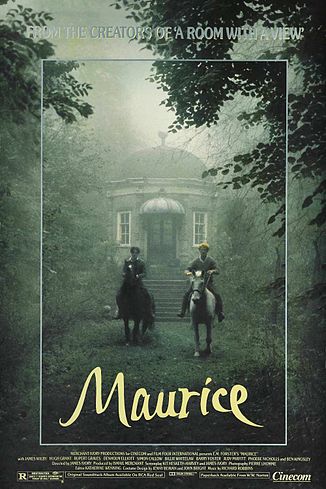
Maurice

(UK 1987)

“England has always been disinclined to accept human nature.”

— Lasker-Jones

I’m not usually a fan of period pieces, especially those set in Victorian or Edwardian England. Somehow, they tend to be stuffy, grandiloquent affairs that warrant a great big yawn — and they turn me off. James Ivory’s adaptation of E.M. Forster’s novel Maurice, however, is an exception.

I caught a 30th anniversary screening, and something crucial struck me: Ivory and cowriter Kit Hesketh-Harvey’s screenplay is downright daring even for the time when Maurice came out (no pun intended). A sort of forbidden romance that one character sees as the love of his life while the other tosses it aside as the folly of youth, I was moved by the frank depiction of gay love as a tender yet treacherous battlefield, no different than any other love — measured by intensity, law, or social construct. For this, Maurice stands way ahead of its time, even today.

Maurice Hall (James Wilby) is essentially Oscar Wilde at Cambridge circa 1910. He makes a move on social climbing classmate Clive Durham (Hugh Grant), who surprisingly welcomes his advances. They can only go so far, though: Clive doesn’t want to jeopradize his social standing, so the two maintain a platonic relationship. This is the key to Maurice, and the thing that makes it monumental: this is a film that attacks appearances.

Time goes by, shit happens, and Maurice ends up with Clive’s gutter cleaner, Alec Scudder (Rupert Graves, who looks like a plebeian Paul Young). This upsets Clive and sends Maurice to therapy. In the end, Maurice makes a choice that so many of us gays have: to be gay, or not to be.

Maurice operates on a strange platitude, one that isn’t clear at first. Maurice is vulnerable, almost stupid. Clive is chilly, reserved, and completely repressed. Both skirt around their issue. I found myself rooting for and actually admiring Maurice, who stays true to himself — class, law, and sexuality be damned. That last look on Clive’s face in the final scene is devastating…for him.

With Denholm Elliott, Simon Callow, Billie Whitelaw, Barry Foster, Judy Parfitt, Phoebe Nicholls, Ben Kingsley, Patrick Godfrey, Mark Tandy, Kitty Aldridge, Helena Michell, Catherine Rabett, Peter Eyre, Helena Bonham Carter

Production: Merchant Ivory Productions, Film Four International

Distribution: Cinecom Pictures (USA), Enterprise Pictures Limited (UK), Concorde Film (Netherlands), Cohen Media Group (USA)

140 minutes
Rated R

(Gene Siskel Film Center) B

http://www.merchantivory.com/film/maurice

Marie Antoinette

(USA/France 2006)

“This, Madame, is Versailles.”

—Comtesse de Noailles

If her take on Marie Antoinette is any clue, Sofia Coppola loves postpunk ’80s British bands like Siouxsie and the Banshees, the Cure, New Order, and New Romantic frontrunners Adam and the Ants and Bow Wow Wow. So do I. This in all likelihood is what drew me to Marie Antoinette: with three Bow Wow Wow songs (two remixed by My Bloody Valentine’s Kevin Shields), big hair, and a real MTV sensibility, its appeal to me is, well, a piece of cake.

All that is only part of the story. What really makes me love Marie Antionette is the sympathetic angle Coppola takes with this infamous character. Based on Antonia Fraser’s biography Marie Antoinette: The Journey, the first half of the movie is about the difficulties Marie (Kirsten Dunst) faces adapting to her new French surroundings and getting her new husband, Louis XVI (Jason Schwartzman, Coppola’s cousin), to consummate their marriage. She fails, and of course everyone blames her—even her mother (Marianne Faithfull). When she’s had enough, she says “fuck it” and becomes a full on rock star. This is where things get interesting.

Colorful and elaborate, Marie Antionette is not profound. So what? Lance Acord’s music video cinematography is perfect for what Coppola is going for; bordering on sensory overload, this film is busy, clever, and fun to watch. I know better than to take it as a history lesson.

With Judy Davis, Rip Torn, Rose Byrne, Asia Argento, Molly Shannon, Shirley Henderson, Danny Huston, Mary Nighy, Jamie Dornan, Steve Coogan, Tom Hardy

Production: Pricel, Tohokushinsha Film Corporation (TFC), American Zoetrope, Pathé, Commission du Film France, Commission du Film Île-de-France

Distribution: Columbia Pictures, Sony Pictures

123 minutes
Rated PG-13

(iTunes rental) B-

http://www.sonypictures.com/movies/marieantoinette2006feature/