A Married Woman [Une femme mariee]

(France 1964)

The original show about nothing, A Married Woman walks us through fragments of a day in the life of Charlotte (Macha Méril), a young wife torn between two lovers: her practical husband (Philippe Leroy) and her passionate, intellectual paramour (Bernard Noël). Apparently not in a hurry to choose one over the other, she’s thrown into a pickle when her doctor informs her she’s pregnant and she realizes that she doesn’t know which one is the father.

Heavy on closeups and dialogue, A Married Woman is thoroughly Modernist: more a treatise than a story, it delves into subjects like relationships, love, sex, morality, and the differences bewteen men and women through conversations that are practically interviews. Jean-Luc Godard stated that this film “attacks a certain mode of life; that of air conditioning, of the prefabricated, of advertising.” His sentiment is evident in all three yuppiesque main characters: they seem detached and adrift, oblivious to the impact their actions have on those around them. A Married Woman is sensual but not sexy, intimate but not warm, critical but not exactly moralistic, and clever but not always interesting.

It’s not all dour, though. Rita Maiden as the couple’s chatty housekeeper adds a priceless air of levity. A scene revealing Charlotte’s thoughts as she eavesdrops on two girls discussing sex at a cafe is hilarious if kinda mean. Gorgeous shots of midcentury Paris play like moving postcards. The little stuff here kept me engaged. I appreciate what Godard was getting at, but I found his execution ultimately underwhelming.

(Gene Siskel Film Center) C+

http://en.unifrance.org/movie/5416/a-married-woman

L’avventura

(Italy 1960)

I’ve really been digging Italian midcentury films lately. L’avventura was not one of them. Anna (Lea Massari) is a weirdo with a bug up her butt– about love, marriage, intimacy, whatever. While on a boating excursion with her fiancé, Sandro (Gabriele Ferzetti), and a group of friends, she has a meltdown and tells Sandro that she wants to be alone– then promptly disappears. Like, without a trace. This sets off a hunt for the psycho, and one of her friends, Claudia (Monica Vitti), gets involved with Sandro. Trouble starts.

L’avventura has hot women (particularly Vitti), cool cars, and a rad surf-music theme song. Other than that, it’s way too long, slow, boring, and not artfully done. It lacks the cinematic pizzazz of Italian films from this period: the settings are nothing special, and it has a cheap look to it. I didn’t care what happened to Anna by the end. Ciao bella.

(Gene Siskel Film Center) D

http://www.janusfilms.com/lavventura/

Gabriel

(USA 2014)

Poor Gabriel– or “Gabe,” as he wants to be called. On his way home presumably after being discharged from a mental hospital, he takes a detour off his bus to search for an old girlfriend, Alice. In the process, he irks those he encounters and upsets his family, waiting to pick him up from the bus station.

If that sounds like a comedy, it’s not. Gabriel takes us along with Gabe (Rory Caulkin) through a series of episodes that reveal the extent of his illness and how it affects those around him. Nothing about this film is immediate, obvious, or predictable. Details of Gabe’s diagnosis, what led to his current state, and what happened between him and Alice (Emily Meade) are smartly scarce; these ambiguities mirror his hazy, muddled frame of mind. The upstate New York setting during winter with its drab color palette and chilly look effectively underscores the bleakness of Gabe’s situation.

Longer on character than story, Gabriel probably wouldn’t work without Caulkin, whose believeable performance makes us empathize not only with Gabe, but also his mother (Dierdre O’Connell) and older brother, Matt (David Call). For all its merits, though, I found Gabriel the character as tiresome as those around him seemed to find him by the end of the film. The ending, by the way, is appropriate even if it is frustrating.

(Gene Siskel Film Center) B-

http://www.gabriel-movie.com

Sandra [Vaghe stelle dell’orsa]

(Italy 1965)

Sandra is Luchino Visconti’s scandalous, wonderfully melodramatic postwar reworking of the story of Elektra and her brother, Orestes. Here, Sandra (Claudia Cardinale) and her husband (Michael Craig), return to her girlhood family estate to dedicate property as a park in the name of her father, a victim of Auschwitz. To her surprise, her brother, Gianni (Jean Sorel), from whom she was “separated” years ago, shows up in the night, dragging skeletons out of the closet with him and his freshly penned novel.

Loaded with longing gazes, forlorn poses, dramatic sighs, and loud piano slams, Sandra plays out like an Italian soap opera. The big question involves incest: did Sandra and Gianni, or didn’t they? Cardinale and Sorel are both beautiful, contrasting nicely with the barren landscape and crumbling structures in Volterra, the Etruscan city where the story takes place. Visconti doesn’t answer the big question, but he offers evidence for us to draw our own conclusion. I sensed but didn’t quite grasp the significance of the siblings being half Jewish; I couldn’t tell whether this was intended to be antisemitic, but it added to the melodrama whatever it was about.

(Gene Siskel Film Center) B

La Dolce Vita

(Italy 1960)

What can I possibly say that hasn’t already been said about one of the most critically acclaimed films of all time? I loved it and I hated it at the same time.

I absolutely loved how beautifully it was filmed: the Italian landscape, the Roman street scenes, the elegant midcentury interiors, the cars and clothes and even hairdos. If nothing else, La Dolce Vita is a stunningly beautiful time capsule. Seeing Nico in action was also a treat—I have never seen her act anywhere else. I loved the character who was so obviously Marilyn Monroe. La Dolce Vita illustrates what a cool time the brink of the Sixties must have been.

What drove me crazy was the split up meandering “episodes” that did not seem cohesive or move quickly enough for my postmodern American sensibilities. And let’s be honest: three hours is a godawful length of time to sit through anything. However, the bad stuff is minor, and the good far outweighs it. I (think I) understand what Fellini was doing here, and I love it for that.

(Gene Siskel Film Center) A- (as if my little grade counts for anything)

Grandma

(USA 2015)

A day in the life of a cranky, emotionally blocked lesbian (Lily Tomlin) whose teenaged granddaughter (Julia Garner) appears on her doorstep to inform her that she’s pregnant and needs money for an abortion—scheduled for 5:30 p.m. that day. Part “road movie”—and I use that term loosely—the two embark on a mini Odyssey through Los Angeles that reveals who they are and where their limits lie.

Grandma has a lot to say about quite a bit: Sixties counterculture, feminism, sexuality, relationships, and yes women’s health issues. But it does so without getting overemotional or heavy-handed. I really wasn’t sure what I was walking into, and frankly my expectations were low. I left satisfied: Grandma is more complex than it lets on.

(AMC River East) B+

http://sonyclassics.com/grandma/

People Places Things

(USA 2015)

A gentle and engaging sorta-comedy about breaking up, starting over, and hanging onto what’s important. If that sounds sappy, it is—“sentimental,” “sensitive,” and “bittersweet” are words that describe this film.

People Places Things has a good share of nice, quiet moments and truths, although a few bitingly cynical and hilarious scenes succeed in balancing it out. Regina Hall and Jessica Williams steal the show in their secondary roles as a mother and daughter who get involved in the life of protagonist Will Henry (Jemaine Clement). While People Places Things no doubt tugs at the heartstrings, it manages to avoid falling headfirst into “schlock.” I doubt it’s something I’ll ever seek out to see a second time, though.

(Gene Siskel Film Center) B-

http://www.peopleplacesthingsfilm.com

Ten Thousand Saints

(USA 2014)

Married team Shari Springer Berman and Robert Pulcini’s banal coming-of-age story clearly aimed at Gen X. Going by the references, the story takes place in 1987 and 1988 when New York City still had post-punk cool credibility. Crunchy Jude (Asa Butterfield) and his best friend, Teddy (Avan Jogia), meet urbane Eliza (Hailee Steinfeld), the daughter of the girlfriend of Jude’s dad (Ethan Hawke) who is slumming from Manhattan, at a New Year’s Eve party in Vermont. Events from that night lead Jude to New York, where he moves in with his father and reunites with Eliza, who it turns out is in trouble deep and has been losing sleep: she’s pregnant, and she’s keeping her baby, mmm. An unconventional family unit starts to gel with Teddy’s “straight-edge” brother, Johnny (Emile Hirsch), the singer of a punk band.

Too nostalgic for my taste and not exactly deep, Ten Thousand Saints is neither awful nor anything to write home about. I’m not sure what Ethan Hawke saw in the script– not that he picks the most interesting vehicles, anyway. Adapted from Eleanor Henderson’s novel of the same name. Meh.

(Gene Siskel Film Center) C-

http://www.sundance.org/projects/ten-thousand-saints


Southpaw

(USA 2015)

I wanted to love this film. Sadly, I did not. Jake Gyllenhaal knows how to get to the core of a character, and Southpaw is no exception despite the annoying ghetto tough guy mumble he used for his character, Billy Hope, a fictitious boxer. The plot, however, is tedious and rife with clichés that aren’t even worth noting here—boxing and others. I also picked up a not-so-subtle racism that turned me off: the black or brown characters are one-dimensional and serve as either bad guys or helpers to Hope’s comeback. This struck me as particularly odd considering that the director (Antoine Fuqua) is black. A mildly interesting potential spark between Hope and his daughter’s social worker, Angela (Naomie Harris), was left undeveloped, dangling there through the movie like a wet snot. Yawn.

(AMC River East) D

http://southpawfilm.com

Tangerine

(USA 2015)

A day in the life of two transgender prostitutes, Sin-Dee (Kitana Kiki Rodriguez) and Alexandra (Mya Taylor) of West Hollywood. Sin-Dee just got out of jail and is trying to tack down her fiancé/pimp, Chester (James Ransone), who failed to pick her up. Fellow trans hooker Alexandra lets out of the bag that Chester has been shacking up with a real girl (Mickey O’Hagen) while Sin-Dee was in the slammer. Sin-Dee shifts her plan and sets out to kidnap her. Did I mention it’s Christmas Eve? Thrown into all this is Armenian cab driver Razmik (Karren Karagulian), who is married and has a thing for Alexandra. Where is all this going?

Tangerine gets off to a shaky start, but director Sean Baker lets his characters develop into full-fledged people as the film rolls on and ultimately proves to be a beautiful story. With a pervading sense of loneliness, it makes a point about survival and needing to rely on others to do it. No man (or woman) is an island.

(Music Box) B

http://www.magpictures.com/tangerine/

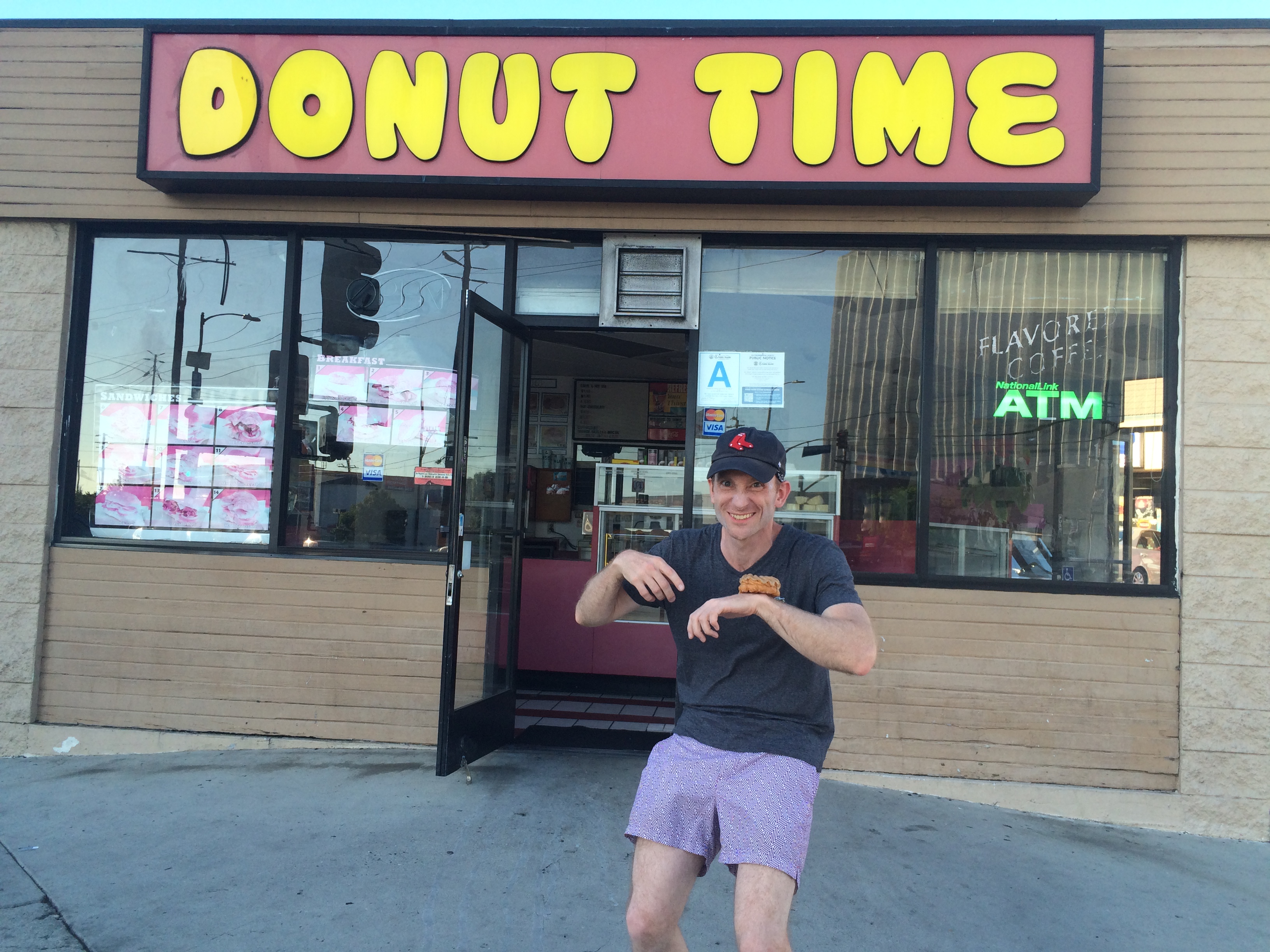
Footnote: I tracked down Donut Time, the donut shop where much of the action in Tangerine takes place. It’s located at 6785 Santa Monica Blvd. at the corner of Highland. I used the ATM and bought a cruller. It was awesome.

IMG_6293