I caught The Tell-Tale Heart as an extra at Music Box Theatre’s screening for Reel Film Day. Directed by Ted Parmelee and narrated by English actor James Mason, it’s a nifty modern take on Edgar Allan Poe’s famous 1843 short story about a murderer haunted by his victim’s heartbeat, which he hears from underneath the floorboards where he hid the body. Paul Julian’s design and Pat Matthews’s animation is shadowy and surreal, nicely depicting the horror and the madness of Poe’s classic. Boris Kremenliev’s score adds an eerie Twilight Zone feel.
“All the best people have bad chests and bone diseases. It’s all frightfully romantic!”
—Juliet Hulme
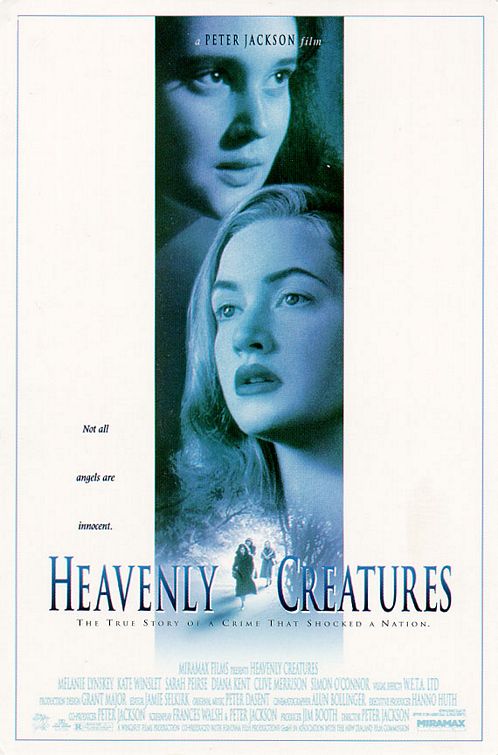
Forget Lord of the Rings—Heavenly Creatures is Peter Jackson’s coolest film. Before big budget Hollywood blockbuster fantasy franchises, the New Zealand filmmaker wrote, produced, and directed offbeat small-scale gore and porn comedies like Bad Taste (1987), Meet the Feebles (1989), and Dead Alive (1993). I’d already seen that last one by the time Heavenly Creatures came out for a limited run (in the States, anyway) in the fall of 1994. I assumed it would be another messy splatterfest—described to me as a “lesbian murder flick,” what would you think? Turns out, that’s not quite what it is.
Far more than a “lesbian murder flick” or even a brilliant stepping stone to bigger and better things, Heavenly Creatures represents a turning point in Jackson’s career. It’s a rare example of flawless execution across the board. He brings together every element—narrative, character development, casting, visuals, special effects, dialogue, period costumes and sets—to create a real humdinger.
Christchurch, New Zealand, 1952: 14-year-old Yvonne Reiper (Melanie Lynskey), who goes by “Pauline,” is a messy-haired, brooding loner at an all-girl high school. In her first scene, she’s wearing a big scowl on her face at an assembly, not singing along with the rest of her classmates—not until the school’s headmaster (Darien Takle) catches her gaze and snaps her into line with a widening of her eyes. Pauline’s father (Simon O’Connor) manages a grocery market and her mother (Sarah Pierse) runs a room and board for college students out of their home.
WARNING: Potential spoilers ahead!
A new student is introduced during French class: Juliet Hulme (Kate Winslet), the privileged daughter of a reknown college professor (Clive Merrison) and a psychologist (Diana Kent). Juliet, who proclaims she’s “actually from England” and chooses the French name “Antoinette,” captures Pauline’s attention when she insults the teacher, Miss Waller (Elizabeth Moody), unleashing a hilarious hissy fit. The scene is, in a word, awesome to watch play out. Right after that, their art teacher, Mrs. Collins (Liz Mullane), pairs the girls for an assignment that Julia disregards; instead, she draws dragon-slaying St. George, depicting him in the likeness of Mario Lanza, “the world’s greatest tenor!” She doesn’t get around to drawing Pauline, her model. Mrs. Collins isn’t impressed, but Pauline is.
Thus begins the girls’ friendship. They bond over their similar pasts involving childhood disease and extended hospital stays, a penchant for drama, and a mutual distaste for their peers (and perhaps social issues that leave a void). Juliet is mischievous and romantic, which softens Pauline and gets her to open up. Sitting out gym, they giggle over sexy WWII pulp novels. They bike through the woods and strip to their underwear, dancing and singing. They hug a bum (played by Jackson himself) on the street. They hold weird rituals for celebrities they like. They make Plasticine models, write stories, and devise an elaborate royal family tree, building around themselves a fantasy medievalesque kingdom called Borovnia where all its inhabitants worship them. Their imaginary world blurs the bounds of reality as their friendship intensifies.
A string of troubles arises that threatens to separate Pauline and Juliet: tuberculosis, an extramarital affair, a divorce, South Africa, and a medical diagnosis of incurable homosexuality. The girls decide to run away to America, but they can’t secure a passport for Pauline. They devise another scheme to stay together, but it’s a risky one: kill Pauline’s mother.
Heavenly Creatures starts out sweet—it’s something of a typical teen movie at first—but it does a complete turnaround. Based on actual events, Jackson wrote the screenplay with Frances Walsh; the real story is sad but compelling, and the script is tight. The casting—married couple John and Ros Hubbard and the aforementioned Mullane—is genius: every single actor is terrific in his or her part, even the minor ones, and it makes Heavenly Creatures all the richer. Many of them turn up in Jackson’s later projects.
Lynskey and Winslet own their characters; I can’t imagine anyone else in their roles. They’re charming, silly, histrionic, desperate, deranged, and ultimately “stark raving mad”—and they portray all of it exceptionally well. They manage to keep the homosexual subtext from getting out of hand. You can tell from Winslet’s first scene—she walks in with that crazy look on her face—that she’s destined for more. She became a star after Heavenly Creatures in a way that Lynskey didn’t, but both are mesmerizing.
The scenes in Borovnia and the Fourth World are nothing short of spectacular. Actually, many of the visuals here are burned into my memory. Alun Bollinger’s camerawork and bleached palette lends a lovely dreamlike quality. Once things start to unravel for these “nice” girls, the whole thing shifts to a darker, more sinister tone. It’s an emotional downward spiral to the end—those splatter films serve Jackson well.
Heavenly Creatures hasn’t lost its luster after nearly 25 years. I lost track of how many times I’ve seen it, yet it continues to suck me in every single time. It’s one of my favorites.
With Gilbert Goldie, Jed Brophy, Peter Elliott, Kirsti Ferry, Ben Skjellerup, Jean Guérin, Stephen Reilly, Jessica Bradley, Alex Shirtcliffe-Scott
Production: WingNut Films, New Zealand Film Commission
Toni Erdmann is not a real person; he’s the alterego of retired divorced schoolteacher Winfried Conradi (Peter Simonischek). When Winfried, a weird old hippy jokester, appears onscreen in a shaggy wig and bad fake teeth, he certainly gives the impression that those around him have to excuse his relatively harmless but tiresome—and often annoying—penchant for silliness. He is caretaker of his elderly mother, and death surrounds him. Perhaps that explains it.
Winfried’s daughter, Ines (Sandra Hüller), a young corporate sellout working on a project in Romania, drops by for a birthday. She’s on her phone most of the time, distracted by work. She’s so serious—and severe. Predictably, she doesn’t stick around long.
When his dog dies, Winfried flies to Bucharest and stalks Ines in the lobby of the office building where she works. She sees him and takes him to a reception, where she networks with Henneberg (Michael Wittenborn), an oil company executive she wants to make a deal with. The weekend is bizarre, filled with small talk, blank stares, and uncomfortable silence. Ines doesn’t bother to pretend she’s happy to see her father; in fact, it’s pretty clear she’s relieved to see him leave.
This is where Toni Erdmann gets interesting: Winfried doesn’t actually leave. Instead, he becomes “Toni Erdmann, life coach,” and sets out to reach Ines through her professional contacts. Funny thing: it actually works.
Writer/director Maren Ade has a solid grasp of strained relationships and embarrassing situations, and a sick sense of humor to boot. It’s a winning combination in Toni Erdmann, which has its share of quite a few awesomely cringeworthy moments. Your goofy dad upstaging you at a networking opportunity? Check. Naked birthday party—with coworkers? Check. An Easter party that includes an apoplectic performance of Whitney Houston’s “Greatest Love of All”? Check. A cum-soaked petit fours? Um, check.
For all its distance, Toni Erdmann turns out to be a surprisingly emotional film. It takes nearly three hours to get to it, but it ends on a whallop. It’s touching in a way I didn’t see coming. The final scene offers all anyone needs to see about this dysfunctional father/daughter relationship. And it’s beautiful.
With Ingrid Bisu, Lucy Russell, Thomas Loibl, Trystan Pütter, Hadewych Minis, Vlad Ivanov, Victoria Cocias
Production: Komplizen Film, coop99 filmproduktion, KNM, Missing Link Films, SWR/WDR/Arte
Distribution: NFP Marketing & Distribution (Germany), Soda Pictures (United Kingdom), Enfilade (Austria), Sony Pictures Classics (USA)
“My life isn’t over. Deep down, I was prepared. I’m lucky to be fulfilled intellectually.”
—Nathalie
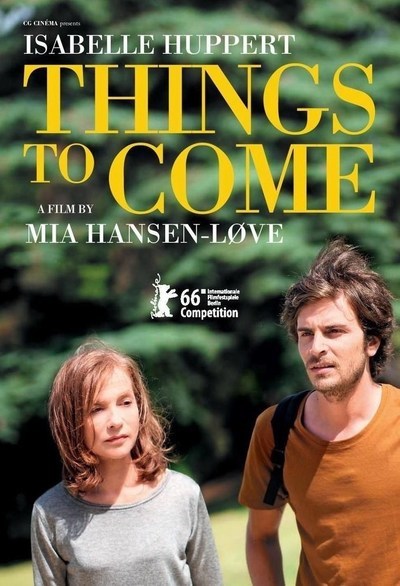
A line from Talking Heads’ song “Once in a Lifetime” is apt to describe the root of the dramatic tension in Mia Hansen-Løve’s latest film: “Well, how did I get here?” Things to Come is a character study of Nathalie Chazeaux (Isabelle Huppert), a philosophy professor at an unnamed Paris university, as she navigates and reinvents her place in the world after her bourgeois examined life suddenly transforms into something else and leaves her floundering in the process.
Nathalie’s passion for her work is clear beyond her career: her husband of 25 years, Heinz (André Marcon), is also a philosophy professor; the textbook she wrote is something of a standard; and her apartment is crammed with books. Even her everyday conversation is peppered with references to philosophers, some I know and other I have never heard of. Her two adult children can follow her when she goes on about, oh, say, Plato, as she sets the table. She seems like someone who has always relied on intellect and reason.
The protesters blocking access to campus early in the film hint to something amiss; Nathalie participated in her share of protests back in the day, but this is different. Selfish, perhaps? One day, Heinz announces that he’s leaving her for another woman. “I thought you would love me forever,” Nathalie responds in a way that reads more like examining a problem than expressing surprise or hurt. Soon, her needy mother (Edith Scob) takes a turn for the worst, leaving Nathalie to figure out what to do with the cat. Meanwhile, her publisher informs her that her textbook’s future is uncertain. Then there’s the matter of her reunion with a former student, Fabien (Roman Kolinka), a cute and promising writer living in an anarchists’ commune.
Things to Come is very much about change, both in circumstances and relationships. Hansen-Løve takes a decidedly distant approach, letting us watch things unfold from afar. She’s not detached; she just seems more interested in showing the small events that shape Nathalie’s journey and letting us figure out the big picture. It works really well. Choosing “Unchained Melody” for the background in the final scene is especially clever; it’s clear about where Nathalie is on an emotional level, yet it’s open to interpretation about whether the future holds good things for her. It’s a happy, hopeful ending if you want it to be.
With Sarah Le Picard, Solal Forte, Guy-Patrick Sainderichin, Rachel Arditi, Yves Heck
Production: Arte France Cinéma, CG Cinéma, Detail Film, Rhône-Alpes Cinéma
Captain Fantastic came out last summer, and I wanted to see it then. I must confess, the cast interested me more than the plot.
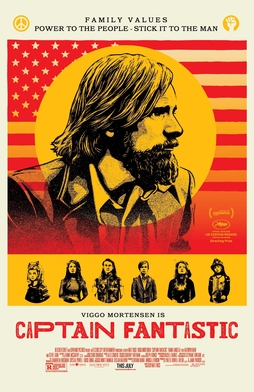
Viggo Mortensen is the aptly named Ben Cash, a long disenfranchised survivalist who is, like, so over American capitalism and politics. He and his wife, Leslie (Trin Miller), shown almost entirely in flashback, decide to raise their six kids—three boys and three girls—off the grid in the mountain wilderness of Washington State. Removed from society, Ben and Leslie teach their kids everything from logic and philosophy to hunting and gathering to Norman Mailer and Guns ‘n’ Roses. They do it all without iPhones or religion. Kudos to that!
Nothing is perfect: Leslie suddenly dies, forcing Ben to take his feral kids into the outside 21st Century world for the first time, ever—which calls everything they planned for their family into question.
Director and screenwriter Matt Ross poses some interesting questions about society, conformity, and the social contract in a provocative and often lighthearted way. However, Captain Fantastic is not terribly surprising, which is why it doesn’t work as well as it could. At heart, it’s a standard fish out of water dramedy. Frankly, I spotted every “twist” coming before it got to me: the cop (Rex Young) who pulls over their Partridge Family van, the mildly blasphemous excuse that saves the day, the family’s visit to the supermarket, their reaction to their extended family (and vice versa), that lame scene in which Ben’s sister-in-law (Kathryn Hahn) calls him out onto the carpet for his choices and his youngest daughter (Shree Crooks) recites the Constitution to prove her wrong, eldest son Bo (George MacKay) proposing to the first girl who gives him attention—a trailer park teen queen (Erin Moriarty)—and the colleges he manages to get into, the “situation” that requires modern medical attention. Meh.
For all its grandiose intentions to take on the establishment, Captain Fantastic actually relies on a rather orthodox and pedestrian approach to make its point. Maybe that is its point, that you can’t escape society. It doesn’t mater: this story is predictable and sentimental, two things that never bode well. I expected more than Spokane Swiss Family Brady Bunch, which is essentially what this is. The one thing that saves this film from total mediocrity is the acting, which is great all around.
With Frank Langella, Ann Dowd, Samantha Isler, Annalise Basso, Nicholas Hamilton, Charlie Shotwell, Steve Zahn, Elijah Stevenson, Teddy Van Ee
Production: Electric City Entertainment, ShivHans Pictures
Director Paul Verhoeven’s Elle doesn’t sound like a comedy: the central event of the film is a rape—a bloody, violent one at that. In fact, it’s the very first scene. Strangely, the opening credits warn us that what we are seeing is “a French comedy.” Really? I guess that explains it!
Michèle Leblanc (Isabelle Huppert) is raped in her dining room by a man in a ski mask while her green-eyed cat watches, detached and seemingly bored. China is smashed, furniture is toppled, blood is shed. After he leaves, Michèle cleans up the mess and resumes her life, ordering sushi delivery—a “holiday roll,” no less.
As the film proceeds, we learn a lot about Michèle. She’s the daughter of a famous mass murderer approaching parole. She’s a ballbusting owner of a video game company. Her staff, entirely young and male, either wants to sleep with her or murder her. Her son, Vincent (Jonas Bloquet), is totally whipped by a shrew (Alice Isaaz) who’s pregnant with a baby that clearly isn’t his. Her ex-husband (Charles Berling) is involved with a younger yoga instructor (Vimala Pons). Her mother (Judith Magre) is a high maintenance piece of work who carries on with men a third her age. Meanwhile, Michèle is having an affair with with Robert (Christian Berkel), the husband of her business partner (Anne Consigny).
Things get dicey when Michèle develops a thing for her neighbor, Patrick (Laurent Lafitte), a handsome banker married to a devout Catholic (Virginie Efira) who apparently won’t fuck him. Their flirtation messes with her head as she tries to figure out who raped her. She’s surrounded by men, and every one of them is suspect.
David Birke’s screen adaption of Philippe Djian’s novel Oh… is, in a word, warped. Elle plays with power, desire, sex, and of all things sympathy. Consistent with its character—a constant switcheroo you don’t know whether to trust or look away from—it’s not a sad affair. To the contrary, it’s daring, thrilling, irreverent, and totally fun. It shouldn’t work—I found myself questioning whether I should enjoy the film as much as I did—but it does. The execution of both the plot and the characters is clever—and Stéphane Fontaine’s cinematography, which nicely illustrates the psychological drama here, is flawless. If nothing else, Elle is a visually stunning film.
Iggy Pop’s “Lust for Life” plays at various points in Elle, suggesting a lot of contradictory things. I took it as ironic more than anything. Elle is not for everyone, but it’s a powerful statement for those who can handle it—the perfect film for Valentine’s Day.
With Lucas Prisor, Raphaël Lenglet, Arthur Mazet, Hugo Conzelmann
Production: SBS Productions, Pallas Film, France 2 Cinéma, Entre Chien et Loup, Canal+, France Télévisions, Orange Cinéma Séries, Casa Kafka Pictures, Proximus, Centre National de la Cinématographie, Filmförderungsanstalt
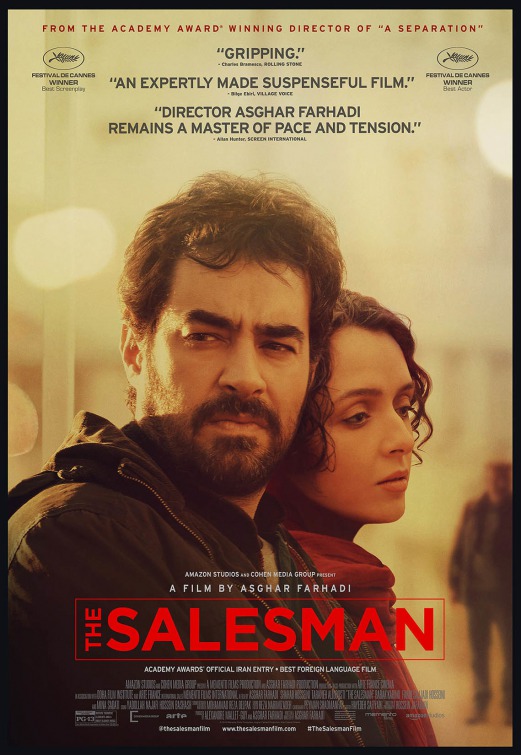
Asghar Farhadi’s The Salesman [Forušande] [فروشنده] is a marvelously dark and brooding study of a married couple that shifts smoothly from a domestic crisis drama to a revenge flick. His approach is a lot more subtle than one an American director might take, but this is precisely what makes The Salesman so satisfying.
While working out the finishing touches of a production of Arthur Miller’s Death of a Salesman in which they play the Lomans, community actors Emad (Shahab Hosseini) and Rana (Taraneh Alidoosti) are forced out of their apartment just days before the play opens when a construction mishap next door weakens the building’s foundation. The cracks in the walls become a metaphor for what’s about to happen to their relatively peaceful marriage.
A fellow cast member, Babak (Babak Karimi), sets them up in temporary digs, a recently and hastily vacated apartment that still contains the previous tenant’s belongings: furniture, bedding, dresses, tons of high heel shoes, a kid’s bike. One night when she’s home alone, a stranger attacks Rana in the shower. She can’t identify him, and she doesn’t want to go to the police. She won’t even say exactly what happened.
Rana starts to go off the deep end; the more unsafe she feels, the less secure Emad is in his own ego. He stews as he pieces together what might have transpired. A set of keys and a delivery truck parked on the street seems like a promising lead to tracking down the stranger, which becomes something of an obsession for Emad.
Farhadi has a straightforward, minimal style. Although he draws a few parallels to Death of a Salesman, he doesn’t beat us over the head with them. He does a nice job dropping us into the story and letting us figure out what he’s getting at. He has a lot to say about male aggression, turning the tables from Rana as the victim to Emad—his masculinity takes a beating as the film progresses.
With Farid Sajadhosseini, Mina Sadati, Mojtaba Pirzadeh
Production: Memento Films Production, Asghar Farhadi Production, Arte France Cinéma
Distribution: Amazon Studios (USA), Cohen Media Group (USA), Filmiran (Iran), Memento Films Distribution (France)
Pedro Almodóvar has his own voice and his own vision, and he’s stayed true to both from the beginnning of his career. He’s an incredible story teller with no shortage of stories to tell; in fact, he once said that he “can make a thousand different movies about the same subject” (https://www.brainyquote.com/quotes/quotes/p/pedroalmod587571.html). His frank treatment of sexuality is as bold as his visual style, and his characters are all memorable. His plots are intricate, loaded with twists and turns and weird things that throw in a wrench that takes the whole thing somewhere you never saw coming. He’s a master of exaggeration—it works just as well in his comedy as it does in his melodrama.
Julieta, Almodóvar’s current film—his twentieth feature—is no exception. Like most of his movies, particularly his post-millennial work, this one centers on women. Inspired by three short stories (“Chance”, “Soon,” and “Silence”) from from Alice Munro’s 2004 book Runaway, Julieta is, in simplest terms, the story of one woman’s search for her estranged daughter. There’s a lot more to it, of course, and Almodóvar slowly reveals it all, layer by layer.
Julieta (Emma Suárez) is a middle-aged woman who lives in Madrid with her boyfriend, Lorenzo (Darío Grandinetti). They’re packing to move to Portugal. Julieta has a secret: she has a daughter, Antiá, who checked out of her life more than a decade ago. She happens to run into Beatriz (Michelle Jenner), an old friend of Antiá, on the street. Beatriz gives Julieta some small information about Antiá, prompting Julieta to drop all plans in the hope of her daughter returning. She begins writing a journal, which turns into a flashback that tells us what happened.
Some 30 years before, young Julieta (Adriana Ugarte) meets scruffy fisherman Xoan (Daniel Grao) on a train. He’s married, but his wife is in a coma. He knocks up Julieta, who receives a letter from him and visits him at his home in a small Spanish fishing town. They decide to raise Antiá together there. When Antiá (Priscilla Delgado) is a teen and away at camp, Julieta and Xoan have a fight that leads to disaster. Julieta doesn’t tell Antiá everything, and it comes back to bite her.
Nothing by Almodóvar ever sucks, but I’ve found his work to be up and down after All About My Mother. It’s to be expected from an artist with a long career, Madonna being a good example. His last project, 2013’s I’m So Excited, was fun but certainly not his most compelling. Julieta, however, is solid—I say it’s his finest hour and a half since Volver. It’s not a light film—it’s an elegant, emotional slow burner that deals with regret, omission, and forgiveness. Ugarte and Grao are both hot, and they have a palpable chemistry. Casting Rossy De Palma as Xoan’s longtime passive-aggressive housekeeper is a nice touch.
With Inma Cuesta, Blanca Parés, Pilar Castro, Tomás del Estal
Production: El Deseo
Distribution: Warner Brothers (Spain), Pathé, 20th Century Fox
“I don’t know how I’m gonna live with myself if I don’t stay true to what I believe.”
—Desmond Doss
Like him or not, Mel Gibson has what it takes to direct a massive Hollywood picture. Hacksaw Ridge, his first directorial job in a decade, demonstrates that much—just in case earlier films like Braveheart, The Passion of the Christ, and Apocalypto didn’t.
Hacksaw Ridge depicts the remarkable and true story of Desmond Doss (Andrew Garfield), the Lynchburg, Virginia, Seventh-day Adventist who served as a medic in the U.S. Army during World War II. His story is unique: he enlisted, but as a conscientous objector for religious reasons. Refusing to kill or carry a gun, he rescued 75 or so wounded soldiers from the field during the Battle of Okinawa (http://www.collegedale-americanlegion.org/Pages/DesmondTDoss.aspx). President Harry S. Truman awarded Doss the Congressional Medal of Honor in 1945, the first time such a high accolade was bestowed upon someone who never even discharged a weapon (https://en.wikipedia.org/wiki/Desmond_Doss).
From a technical standpoint, Hacksaw Ridge is pretty awesome. The story is a good one. The battle scenes are clearly the centerpiece: they’re loud and extremely graphic. The prosthetics are spot on realistic. Cinematographer Simon Duggan starts out with warm, almost sepia tones in the early civilian scenes, but as the setting moves onto the battlefield he ditches color in favor of a washed out black, green, and white palette. Shaky closeups, slow motion shots, blurry pans, and quick cuts create a sense of confusion as gunfire and explosions and human carnage take over the screen. Hacksaw Ridge is no Son of Saul (https://moviebloke.com/2016/02/11/son-of-saul-saul-fia/), but it still overwhelms the senses albeit in a distanced, staged blockbuster way.
Otherwise, Hacksaw Ridge didn’t impress me all that much. At its core, it’s a standard-issue war movie complete with a sugary subplot about the girl, Dorothy Schutte (Teresa Palmer), waiting for Doss to hurry up and get back home so they can get married, and lots of humorous if mawkish male bonding through nicknames, insults, physical attacks, and simply having each other’s back. There’s a military court scene, trite “war is hell, boys” lines, soldiers who freak out once they get on the battlefield, likable characters who perish, and of course the superhuman heroic deeds of Doss.
Most character background is given hurried and superficial treatment: Doss’s alcoholic veteran father (Hugo Weaving) and his bad experience in World War I, Doss and Dorothy’s quick courtship, even the failed attempts of Sgt. Howell (Vince Vaughn) and Cpt. Glover (Sam Worthington) to persuade Doss to leave the Army. Too bad, because a little more insight could have made the film stronger. A particularly glaring example is brother Hal (Nathaniel Buzolic), who simply vanishes once he shows up at the dinner table in uniform. What happens to him? Did I miss it?
I’m conflcited on the message here, but I guess that’s okay because frankly Hacksaw Ridge is a conflicted film. Gibson maintains that it’s an anti-war statement (http://www.christianpost.com/news/mel-gibson-hacksaw-ridge-is-an-anti-war-movie-170318/). Fine, but that’s hard to believe considering the disproportionate amount of time and resources given to overblown battle scenes. I’m not sure the film honors Doss or his pacifist convictions. Moreover, what sure seems like a blatant parallel to the so-called religious liberty movement is, in my view, misguided and hollow, especially when Doss’s faith is treated more or less as incidental. Hacksaw Ridge sustained my interest, but I would have appreciated a little more depth.
With Luke Bracey, Darcy Bryce, Rachel Griffiths, Firass Dirani, Michael Sheasby, Luke Pegler, Nico Cortez, Goran D. Kleut, Harry Greenwood, Damien Thomlinson, Ben O’Toole
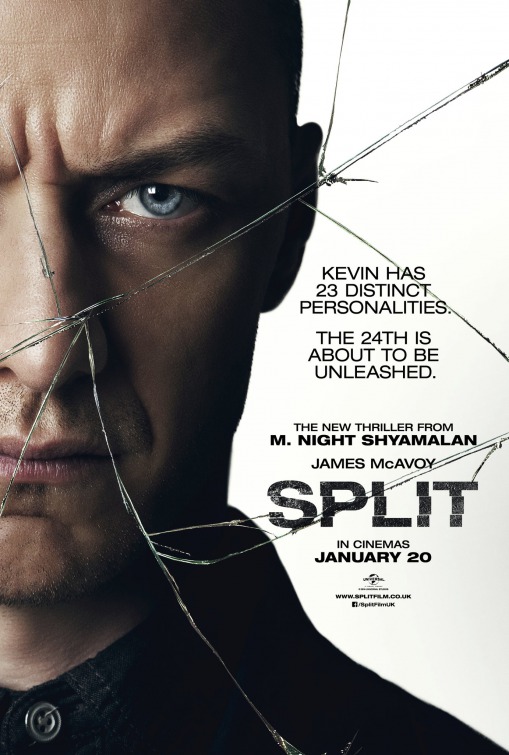
Poor Kevin Wendell Crumb (James McAvoy). His mother (Rosemary Howard) abused him when he was a child, and he developed split personalities to deal with it. Now, he’s got a thing for watching underage girls dance naked. Dennis, the sternest of Kevin’s personalities, has asserted control and drives him to kidnap three teenage girls (Anya Taylor-Joy, Jessica Sula, and Haley Lu Richardson) leaving a birthday party at a lame Chuck E. Cheese place. He locks them up in a dungeon in his underground industrial hideout. Kevin is undergoing psychiatric care, but his doctor (Betty Buckley from Eight is Enough) senses something horribly amiss when she receives email from each of his 23 personalities seeking an urgent appointment. Kevin’s personalities prepare the girls for the arrival of “the Beast,” the last and most powerful personality. Only one of them is poised to survive.
WARNING: Potential spoilers ahead!
M. Night Shyamalan’s Split is, in a word, stupid. The story has potential, but it suffers a major breakdown pretty quickly. It’s more silly than scary. I found myself tracking horror movie clichés like a checklist and asking how many more can fit into the plot. I saw the so-called twists coming before they turned the corner. The reference to another movie at the end is mildly amusing, I guess, but not what I’d call clever. The parallel to one kidnapped girl’s childhood, shown in flashbacks, warrants a great big ‘whatever.’ The only thing Split has going for it is McAvoy, who emulates Jude Law doing an impression of Eminem impersonating Justin Timberlake. His characters are fun, particularly severe schoolmarm type Patricia (for whom McAvoy wears heels) and little boy Hedwig. However, even they get tiresome, coming off as a mishmosh of standup routines after awhile, like sticking all of the characters from Little Britain into one body.
I could make a lame comment about replacing “pl” with “h” in the title and getting a far more accurate name for this film, but I’ll just say I wasn’t impressed and leave it at that.
With Izzie Coffey, Sebastian Arcelus, Brad William Henke, Neal Huff, Bruce Willis
Production: Blinding Edge Pictures and Blumhouse Productions











 moviebloke