1 Mile to You

(USA 2017)

High school senior track star Kevin (Graham Rogers) is livin’ the dream in his Mississippi small town: he’s handsome, athletic, and setting records in the state. He and his girlfriend, sweet Ellie (Stefanie Scott), are working on a way to end up in the same city for college next year so they can be together.

Kevin’s happiness implodes after a track meet one Saturday in the fall: his coach (Tim Roth) loses control of the bus carrying his entire team, which leads to an accident that kills everyone on board—including Ellie, who happens to be his coach’s daughter. The only reason Kevin isn’t on the bus is because he has to go somewhere with his parents after the meet.

Kevin deals with his grief and his guilt by running—a lot. And hard. He quickly discovers that he can “communicate” with Ellie during the runner’s high he gets toward the end of a sustained, hard run. The chance to be with her again makes him run faster and faster, more and more.

For some reason—maybe his whole class was on the track team, I don’t know—Kevin switches schools. His new principal (Peter Coyote) coerces him into joining the track team, and he participates grudgingly. Kevin doesn’t like his new school, his new coach (Billy Crudup), or Henny (Liana Liberato), the girl who follows him everywhere. On top of that, a running rival (Thomas Cocquerel) is giving him shit. It’s all getting in the way of his time with Ellie.

Based on Jeremy Jackson’s Life at These Speeds: A Novel, 1 Mile to You is not what I expected. It’s an underwhelming melodrama disguised as a sports tragedy. The plot is somewhat promising and the film has a few good scenes, but the story lacks intensity. I’m not sure whether the problem is Marc Novak’s screenplay or Leif Tilden’s directing, but the characters don’t fully develop and Kevin’s catharsis is given shallow treatment. The whole thing is dull. Plus, the special effects that tell us Kevin is in his trance are, in a word, cheesy.

Tilden has a lot of talent to work with, but he underutilizes everyone except Rogers and maybe Crudup. While I won’t be surprised to see Rogers in bigger and better things in the future, 1 Mile to You did not impress me.

With Melanie Lynskey, Ty Parker, Peter Holden, Elizabeth Canavan, Jaren Mitchell, Casey Groves

Production: Cinema Revival, Culmination Productions, Ingenious Media, LATS Productions, WeatherVane Productions

Distribution: Paseo Miramar Pictures, Gravitas Ventures

104 minutes
Not rated

(Facets) C-

https://m.facebook.com/1MILETOYOU/

North by Northwest

(USA 1959)

“I’m an advertising man, not a red herring. I’ve got a job, a secretary, a mother, two ex-wives, and several bartenders that depend upon me, and I don’t intend to disappoint them all by getting myself ‘slightly’ killed.”

—Roger Thornhill


“That’s funny. That plane’s dusting crops where there ain’t no crops.”

—Man at the Prairie Crossing

I expected Alfred Hitchcock’s North by Northwest to be suspenseful, cinematic, and even a bit perverse, peppered with the director’s inimitable wit and dark sense of humor. It certainly is all that. However, I didn’t expect it to be altogether facetious, or as fun as it is. Scene after scene, North by Northwest delivers; not many films give as much bang for your buck as this one.

Cary Grant is Manhattan ad executive Roger O. Thornhill—”The ‘O’ stands for nothing,” he quips at one point. A mild-mannered, stylish middle-aged man in a grey flannel Brooks Brothers suit—think Mad Men—he leads a perfectly predictable straight life serving clients, drinking martinis, and keeping his WASPy mother (Jessie Royce Landis) entertained.

While having cocktails at the Plaza Hotel one afternoon, Thornhill is yanked into a treacherous game of cat-and-mouse when the goons of a smooth and well-spoken spy, baritone Phillip Vandamm (James Mason), mistake him for a government agent named George Kaplan. It’s nothing but trouble from here.

Relentlessly hunted after being framed for an incident at the United Nations, Thornhill flees Manhattan on a passenger train that looks a lot like Amtrak’s Lake Shore Limited. He meets cool, mysterious, and sultry stranger Eve Kendall (Eva Marie Saint), who’s headed to Chicago. Her innuendo is sexy, but she’s not exactly trustworthy—Thornhill senses it, and so do we.

North by Northwest is ultimate Hitchcock, fueled by mistaken identity and packed with psychological drama manifest mostly in the form of dizzying pursuit: a drunken car chase on a windy road, a moving train, an out-of-nowhere crop duster in an Indiana cornfield, a race down Mount Rushmore. Nothing about the plot is believable; it’s more preposterous than a James Bond film. Although it shares the same Cold War sensibility, North by Northwest is much more intriguing and memorable. It’s also more entertaining.

Ernest Lehman’s script is brilliantly put together, but the story isn’t what makes this soar; it’s Hitchcock’s directing and the acting, particularly that of Grant, Saint, and Mason. Grant is a hoot to watch here; he plays Thornhill like a high-style Thurston Howell without his Lovie. He walks a fine line between convincing and cartoonish, always coming off as the former. It’s quite an astounding feat of balance, actually. Saint is the perfect counterpart to Grant. I could listen to Mason talk endlessly. Martin Landau plays a secondary character, but he’s awesome as über creepy (and probably closeted) Leonard, Vandamm’s right hand man.

Ahead of its time in many ways, North by Northwest is consciously silly yet pushes a few boundaries. Exceedingly mischievous, it just might be Hitchcock’s most charming film. It’s definitely more fun than any other film of his that I’ve seen—not that I’ve come close to seeing all of them. It’s truly a dazzler.

Personal geek-out side note: in a film full of thrilling moments, the most thrilling for me was the scene outside The Ambassador Hotel in Chicago. I live two doors down from the hotel, now known as Public. I’ve stood in the exact spot Grant did as he exited the alley to cross Goethe to get to the hotel—I walk my dog there all the time. It’s amusingly weird to see a place you know so well onscreen, let alone in something from almost 60 years ago. It’s different, but not much. Here’s what it looked like when North by Northwest was filmed:

IMG_9083.PNG

And here’s what it looks like today:

Ambassador.jpg

In 1995, the United States Library of Congress deemed North by Northwest “culturally, historically, or aesthetically significant” and selected it for preservation in the National Film Registry (https://www.loc.gov/programs/national-film-preservation-board/film-registry/complete-national-film-registry-listing/).

With Leo G. Carroll, Philip Ober, Josephine Hutchinson, Adam Williams, Robert Ellenstein, Edward Platt, Philip Coolidge, Edward Binns

Production: Metro-Goldwyn-Mayer/MGM

Distribution: Metro-Goldwyn-Mayer/MGM

136 minutes
Not rated

(AMC River East) A

Fathom Events

Some Freaks

(USA 2016)

A line from an old Billy Idol song (“Hole in the Wall”) appropriately sums up the plot of playwright Ian MacAllister-McDonald’s charming and touching debut feature film Some Freaks:

“We were such an ugly pair,
The chameleon twins they’d stop and stare.
Lovers know when love has gone.
A black hole there where love was once the end.”

Rhode Island high school senior Matt Ledbetter (Thomas Mann), who has the unflattering nickname “Cyclops” because of the patch he wears over his fucked up eye, doesn’t fit in with his classmates. Awkward and unpopular and literally a freak, his only friend is schlubby neo-maxi-zoom-dweebie gay motormouth Elmo (Ely Henry), who seems eager to blow just about any guy—not that any guy is ever going to let him. Lucky Matt gets to hear all of Elmo’s fantasies in graphic detail as they play video games. Yipee.

A chubby new girl (Lily Mae Harrington) in thrift store clothes and green-streaked hair flirts with Matt in biology class. Matt doesn’t know what to make of her, but he’s obviously intrigued even though he’s all shy about it. She turns out to be Elmo’s cousin Jill, who’s staying with his family for the school year after some trouble at home in Oregon.

Jill and Matt get off to a rocky start when she overhears him crack a fat joke about her to Elmo. Despite her tough facade, cynical and insecure Jill is forgiving—she has no choice because she has a thing for Matt. The three of them start hanging out. To Elmo’s dismay, Matt and Jill fall for each other and start dating.

WARNING: Potential spoilers ahead!

The end of high school brings about a quandary neither starcrossed lover anticipated. Jill gets into college out West, leaving Matt behind on the East Coast. Thus begins their long distance relationship. They lead separate lives and make similar changes without telling each other: Matt gets a glass eye and starts working out while Jill gets a new wardrobe and goes on a diet. Suddenly normalized, Matt goes to a party and hits on chicks while Jill attracts the attention of frat boy hottie Patrick (Lachlan Buchanan), who went to high school with her. His mean girl pals were not very nice.

Matt and Jill’s metamorphoses clash when he visits her six months later and they discover that their natural connection is now strained and forced. What’s worse, they bring out something ugly in each other. Is this the death knell for their relationship?

Written and directed by MacAllister-McDonald, Some Freaks is impressive even with its flaws, especially for a first time full length feature. The story and the characters recall John Hughes and Todd Solondz, but this is by no means mere imitation or an update of either. I like MacAllister-McDonald’s straightforward and unsentimental view. Yes, much of what happens here is predictable; however, there are enough twists that I didn’t see coming to keep it interesting if not fresh. The actors put a lot of heart into their characters, and it shows—even Buchanan, whose Patrick is underdeveloped and not entirely believable.

I happened to see Some Freaks on April Fool’s Day with my teenage nephew. All things considered, I couldn’t have planned it better.

With Marin Ireland, John Thorsen, Sylvia Kates, Devon Caraway, Brian Semel, Nikki Massoud, Stephen Thorne, Shannon Hartman

Production: Half Jack Productions, Mountview Creative

Distribution: Good Deed Entertainment

Screening followed by a live Q and A with Ian MacAllister-McDonald, Lily Mae Harrington, and Ely Henry

97 minutes
Not rated

(Tower City Cinemas) B

Cleveland International Film Festival

http://www.somefreaksthemovie.com

Center of My World [Die Mitte der Welt]

(Germany 2016)

Center of My World, director/screenwriter Jakob M. Erwa’s adaptation of German author Andreas Steinhöfel’s 1998 novel for young adults, is not a home run. Fortunately, though, Erwa knows how to extract enough charm, particularly from its two main actors, to downplay its shortcomings and proffer a respectable and enjoyable film.

17-year-old Phil (Louis Hofmann) lives with his mercurial, flighty mother, Glass (Sabine Timoteo), and his twin sister, Dianne (Ada Philine Stappenbeck), in a gorgeous house on the outskirts of town. This family isn’t exactly The Brady Bunch: Phil is gay, Dianne supposedly communicates with animals, and Glass can’t commit to a partner for very long. She won’t even tell her kids who their father is.

Phil notices some friction between the women of the house after he returns from summer camp. When school starts, his best friend, Kat (Svenja Jung), encourages him to go after mysterious new guy Nicholas (Jannik Schümann), a dreamy transfer student who looks like a cuter blue-eyed version of Lance Bass with his chiseled cheeks, luscious lips, and perfect hair. Supposedly, he likes boys. Phil finds out for sure in the locker room one afternoon—and it leads to a passionate affair, insecurity, and a weird bout of jealous competition with Kat.

Center of My World is a cute and engaging story. Erwa does a nice job showing how any kid, gay or otherwise, has a lot to deal with when it comes to sexuality. The Chaun Ngo’s cinematography is well done, employing a bright color pallette verging on artificial that plays really well against the small town setting with all its gardens and summer greenery. The acting is generally good. Schümann is really easy to just…gaze upon, I guess, but in a harmless Teen Beat way.

All that said, Center of My World would have been a much gutsier film, say, 15 years ago. It probably would have made a bigger impact then, too. It contains hints and echoes of things I’ve seen before. The characters are a bit hollow; some of them come off as half-baked, rendering their importance to the story tenuous or questionable. These two boys have sex a lot, which is great. However, the sex scenes here need work even with the full frontal we get. More in-your-face than sexy, they come off as gratuitous. I don’t know if Erwa was trying to be shocking, but it didn’t work if he was. It’s like watching two puppies go at it. I hope that’s not the intended result.

With Inka Friedrich, Sascha Alexander Geršak, Thomas Goritzki, Nina Proll, Clemens Rehbein

Production: Neue Schönhauser Filmproduktion, Prisma Film, Universum Film, mojo:pictures, Westdeutscher Rundfunk, Bayerischer Rundfunk, ARTE, Österreichischer Rundfunk

Distribution: Constantin-Film, Universum Film

115 minutes
Not rated

(Tower City Cinemas) B-

Cleveland International Film Festival

http://mitte-der-welt-film.de

https://www.facebook.com/diemittederwelt.film

Donnie Darko

(USA 2001)

“Has he ever told you about his friend Frank, the giant bunny rabbit?”

—Dr. Lilian Thurman


“Every living creature on earth dies alone.”

—Grandma Death

Donnie Darko, a period piece set during a time I remember quite well—October 1988, the second full month of my college freshman year and the height of the Bush-Dukakis presidential election—has a great moody soundtrack that includes the likes of Tears for Fears, Joy Division, the Church, Duran Duran, and of course Echo and the Bunnymen. Even if it would have stuck out like a sore thumb, a song more fitting with the theme would have been Cher’s “If I Could Turn Back Time.”

October 2, 1988: troubled and highly medicated loner Donnie Darko (Jake Gyllenhaal), a middle class teen in suburban Middlesex, Virginia, sleepwalks outside of his house and meets Frank (James Duval), a new “friend.” Frank is a guy in a creepy rabbit suit—he looks like he was plucked from the cover of a heavy metal album. Frank tells Donnie that the world is coming to an end—in exactly 28 days, 6 hours, 42 minutes, and 12 seconds.

Thus begins the apocalyptic timewarping adventure of Donnie Darko. After being rudely awakened on a golf course the next morning, Donnie lumbers home in a daze to discover that a jet engine fell from the sky and crashed into his bedroom. His family, obviously already having assumed the worst, is shocked but relieved to see him approaching from the street—except maybe his mother (Mary McDonnell). Federal investigators can’t trace where the engine came from.

At school, a new student, Gretchen (Jena Malone), interrupts Donnie’s English class—taught by the young and snarky Ms. Pomeroy (Drew Barrymore). They’re discussing their reading assignment, Graham Greene’s short story “The Destructors.” Gretchen asks where she should sit, and Ms. Pomeroy directs her “next to the boy you think is the cutest.” Gretchen sits next to Donnie. Duh!

Donnie and Gretchen dig each other, which is a ray of light to his psychiatrist, Dr. Thurman (Katharine Ross). The doctor has been concerned about Donnie’s “hallucinations” of Frank, as well as some of his erratic behavior. Donnie is growing more and more obsessed with a senile elderly neighbor he and his friends nicknamed “Grandma Death” (Patience Cleveland) and a book about time travel. Everything comes to a head at a party Donnie and his sister Elizabeth (Maggie Gyllenhaal) throw while their parents are out of town on Halloween—which is 28 days from where this all started.

Simultaneously funny, foreboding, weird, and utterly thought-provoking, I can see why Donnie Darko has the following it does. Director and screenwriter Richard Kelly comes up with something unlike anything else I’ve ever seen. It’s a winning mix of teen comedy, science fiction, and fantasy. I caught an anniversary screening with my nephew, and this film is as fresh as when I first saw it in 2002. Loaded with indelible imagery, symbolism, ’80s pop cultural references, and clever narrative loopbacks, I find Donnie Darko‘s greatest asset to be its open-ended mystery; what exactly happens is left for the viewer to figure out. A quick Google search pulls up ample musings of the meaning of this film. I’ve seen this a few times, and I’m not sure.

Aside from the plot, the characters and the casting are terrific. Both Gyllenhaals are great, and you can actually see they’re both destined for more. Patrick Swayze is awesome as motivational speaker Jim Cunningham, but Beth Grant takes the cake here as passive-aggressive bitch Kitty Farmer. Oh yeah, this is also Seth Rogen’s first onscreen role—see if you can spot him.

Side note: Frank’s rabbit suit was designed by April Ferry, who went on to work for Game of Thrones (http://ew.com/movies/2017/03/31/donnie-darko-bunny-suit-frank-untold-stories/). I was hoping to catch the director’s cut, but this wasn’t it.

With Holmes Osborne, Daveigh Chase, Noah Wyle, Stuart Stone, Gary Lundy, Alex Greenwald, Jolene Purdy, Ashley Tisdale

Production: Flower Films

Distribution: Pandora Cinema, Newmarket Films

113 minutes
Rated R

(Capitol Theatre) B+

http://archive.hi-res.net/donniedarko/

Blade Runner: The Final Cut

(USA 1982, 2007)

Ridley Scott is hit or miss with me, Harrison Ford bores me, and I tend to eschew science fiction. So, neo-noir sci-fi drama Blade Runner doesn’t seem like something that would appeal to me. It does, though—in fact, I love it.

Like Alien, another gem by Scott, Blade Runner succeeds on so many levels. Executed near flawlessly, its themes and narrative, its structure and pace, its sets and technical aspects are all polished, eloquent, and downright cerebral. It cuts right to the heart of humanity—what’s beautiful about it and what isn’t, and what it is to be human.

Los Angeles, November 2019: six rogue artificial humans known as replicants that were banished to an “off-world” work camp in space return to Earth in a desperate attempt to extend their life. Created by tech behemoth Tyrell Corporation, this particular model, the Nexus-6, is the smartest and strongest replicant. However, it has a lifespan of only four years—and the meter is ticking. Fortunately for them, replicants are indistinguishable from real humans, except for their emotional responses. It takes a lengthy question-and-answer test to positively identify them.

Burned out former cop Rick Deckard (Ford), whose job as a blade runner was to track down replicants and “retire,” or kill them, is persuaded—okay, extorted—out of a self-imposed furlough to find and get rid of these troublemakers. Stat. The job isn’t an easy one, particularly where charmingly weird and conniving Pris (Daryl Hannah) and invincible badass Roy (Rutger Hauer) are involved.

As Deckard searches for his targets, he meets and gets to know the rather severely formal Rachael (Sean Young), assistant to replicant inventor Dr. Eldon Tyrell (Joe Turkel). Rachael doesn’t know she’s a replicant. Tyrell asks Deckard to retire her as well, but there’s a problem: Deckard realizes he’s falling for her.

Adapted from Philip K. Dick’s novel Do Androids Dream of Electric Sheep?—with the title taken from Alan E. Nourse’s novel The Blade Runner, which had nothing to do with Dick (https://www.neondystopia.com/cyberpunk-movies-anime/the-story-behind-blade-runners-title/)—Blade Runner is dark in every sense of the word. Jordan Cronenweth’s cinematography is stunningly bleak. The setting might be Los Angeles, but Scott slyly references Metropolis—only he refits it to Hong Kong or Tokyo. Many of the ideas explored here are eerily relevant today, especially the way morality plays out with corporations, genetic engineering, a police state, the environment, and hierarchy of life and life forms.

Blade Runner is a weighty movie, but seriousness aside—I found myself entertained with a number of things that simply aren’t present today: PanAm, Atari, and TDK. Smoking indoors. Pay phones. Photographs. Even urban decay. I was also floored that one of the replicants was “born” 20 days after this screening. Plus, Roy is a bionic Ken doll and Pris looks like a club kid from Party Monster. Still, Blade Runner is timeless; I’ll see it again in three or 33 years and still swoon over it. Yes, it’s that good. The Final Cut is Scott’s own finetuned version of the original theatrical release. It kills me that after all this time, a sequel that I probably won’t see is coming out later this year.

In 1993, the United States Library of Congress deemed Blade Runner “culturally, historically, or aesthetically significant” and selected it for preservation in the National Film Registry (https://www.loc.gov/programs/national-film-preservation-board/film-registry/complete-national-film-registry-listing/).

With Edward James Olmos, M. Emmet Walsh, William Sanderson, Brion James, Joanna Cassidy, Kevin Thompson, John Edward Allen, Robert Okazaki

Production: Ladd Company, The Shaw Brothers/Sir Run Run Shaw, Warner Brothers

Distribution: Warner Brothers

117 minutes
Rated R

(Music Box) A

https://www.warnerbros.com/blade-runner

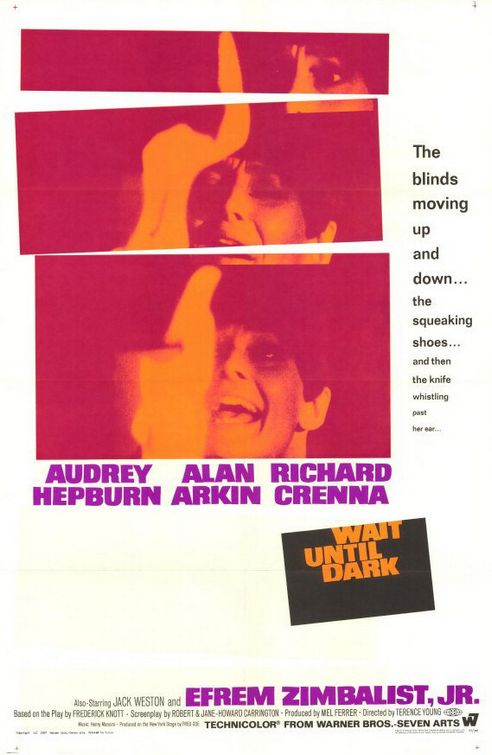
Wait Until Dark

(USA 1967)

A heroin smuggling ring. A creepy doll. A corpse. A blind woman alone in her basement apartment in the West Village. These are the elements of Wait Until Dark, a quaint and dingy little crime thriller adapted from Frederick Knott’s 1966 play by screenwriters Robert Carrington and Jane-Howard Carrington.

Suzy Hendrix (Audrey Hepburn) is the hapless gudgeon who, being blind, already has the proverbial wool over her eyes. Her husband, Sam (Efrem Zimbalist Jr.), comes home from a business trip with a doll that unbeknownst to him contains a hidden stash of heroin sewn into it. This does not bode well for Lisa (Samantha Jones), the glamorous and sexy stranger who asks him to hold it for her at JFK International Airport.

A case of mistaken identity leads a pair of small time crooks (Richard Crenna and Jack Weston) to Sam and Suzy’s apartment, where psychotic hooligan Harry Roat (Alan Arkin) coerces them into helping him find the doll—as soon as they dispose of a dead body. Nice. They devise an elaborately devious scam to recover the doll when they realize Suzy, who walks in on them, is blind.

Terence Young’s directing is certainly competent. I last saw this movie on some late night UHF station when I was a kid, and two things have stayed with me: a sense of severe claustrophobia as the story unfolds, and that fucking groovy apartment. The plot has flaws that strain credibility. For one thing, Suzy is far too unguarded for a New Yorker. Why doesn’t she lock her door? Roger Ebert pointed out this detail (http://www.rogerebert.com/reviews/wait-until-dark-1968). I didn’t obsess over it like he did, but I noticed it and thought the same thing. When Roat tells her he knows she has the doll, why doesn’t Suzy hand it over? Why does she tell Gloria (Julie Herrod) to meet Sam at the train station instead of going to the police? Why do the guys bother to put on disguises if Suzy can’t see them?

Despite these glaring issues, Young ultimately succeeds in bringing Wait Until Dark to a boil. It lives up to its hype: I saw people jump in their seats at the end. The acting here overcomes any shortcomings in plot. Hepburn is little more than a blind Holly Golightly, but at certain points she reminds me of Barbara Stanwyck screaming that she can’t wake up from a nightmare in, I think, The Night Walker. Weston is a little too bumbling, but Crenna and Arkin are chillingly menacing and foreboding even if they are silly by today’s standards (yeah, sunglasses at night went a long way making Corey Hart look tough). Henry Mancini’s eerie score is the clincher in setting the right mood.

A trivial point of interest: Suzy’s apartment is in the same block of rowhouses as the one used for the Huxtable residence on The Cosby Show (http://www.movie-locations.com/movies/w/Wait_Until_Dark.html#.WRU0W1LMyWY). The small street, St. Luke’s Place, has a bit of literary history, too (http://www.nytimes.com/1996/10/27/realestate/in-a-village-enclave-15-remarkable-rowhouses.html).

With Jean Del Val, Frank O’Brien

Production: Warner Brothers

Distribution: Warner Brothers/Seven Arts

108 minutes
Not rated

(Music Box) B-

Quiz Show

(USA 1994)

“Cheating on a quiz show? That’s sort of like plagiarizing a comic strip.”

—Mark Van Doren


The quiz show scandal of the late 1950s doesn’t sound like a riveting topic for a film, but that’s exactly what it is in Quiz Show, Robert Redford’s fourth directing gig. Every aspect of this film is spectacularly elegant, starting with Bobby Darin crooning “Mack the Knife” as the opening credits roll over shots of armored security guards transferring sealed questions and answers from a bank vault to a studio. Quiz Show is a modern morality play with lots of style.

It’s 1958, and NBC’s Twenty-One is the biggest game show in America. Homely goofball Herbert Stempel (John Turturro) of Queens is a surprise celebrity after an unprecedented winning streak, but the show’s ratings have “plateaued.” The show’s sponsor, Geritol, is ready for a change. So are producers Dan Enright (David Paymer) and Albert Freedman (Hank Azaria), who decide that a charismatic, television-ready new contestant is what the show needs.

WASPy college professor Charles Van Doren (Ralph Fiennes) happens to audition for another NBC game show, the less popular Tic Tac Dough. Handsome, polished, and hailing from an eminent intellectual family, “Charlie” fits the bill for Enright and Freedman’s vision.

Enright takes Stempel out for a steak dinner and asks him to “take a dive,” or purposely lose to Van Doren, on an upcoming show. Predictably, this isn’t something Stempel wants to do—at least, not without something in return. Enright fails to deliver on purposely vague promises, and Stempel publicly calls Twenty-One a fraud, saying it’s rigged. A judge seals the findings of a grand jury investigation, which gets some very minor press: a blurb in the paper. It catches the attention of ladder climbing Richard “Dick” Goodwin (Rob Morrow), a lawyer with the House Legislative Oversight Subcommittee in Washington, D.C., who plans to “put TV on trial.”

Quiz Show didn’t set the box office on fire during its original run, which is really odd (http://www.boxofficemojo.com/yearly/chart/?yr=1994). No matter, because it’s a fine drama. Based on the book Remembering America: A Voice From the Sixties by the real Richard Goodwin, Paul Attanasio’s screenplay is meticulously calibrated and cerebral, rich with strong characters, intertwined dilemmas, a fascinating plot, and a plethora of Fifties pop cultural references without nostalgia. Redford’s pacing is excellent: he sets up the story slowly then knocks down each character one after another. He draws superb performances out of the actors, too. The literary repartee between Van Doren and his genteel father, Mark (Paul Scofield), is one of the best things about this film. A wry and subtle sense of humor keeps the story exuberant: Martin Scorsese is great as fast talking Geritol CEO Martin Rittenhome, and Christopher McDonald makes an awesome Jack Barry.

Sure, Quiz Show isn’t an “exact word” historical documentary; Redford and Attanasio took some license. However, the result is an excellent depiction of good versus evil, not just in the television industry but in corporate America altogether. There’s not a lull or a dull moment here. The only criticism I have is Morrow’s unconvincing Boston accent; that can go. Everything else, though, is brilliant. Enright’s son, Don, wrote a piece about Quiz Show for the L.A. Times (http://articles.latimes.com/1994-09-19/entertainment/ca-40429_1_quiz-show); it’s another view worth considering.

With Mira Sorvino, Johann Carlo, Elizabeth Wilson, Allan Rich, Griffin Dunne

Production: Hollywood Pictures

Distribution: Buena Vista Pictures

133 minutes
Rated PG-13

(DVD/iTunes purchase) A

TwentyOne Pic

Who’s Afraid of Virginia Woolf?

(USA 1966)

Elizabeth Taylor. Richard Burton. Edward Albee. Even George Segal, who was kind of a fixture on NBC during the ’80s and ’90s. Need I say more? Probably not, but I will.

Director Mike Nichols and screenwriter Ernest Lehman stick pretty close to Albee’s 1962 play with their film adaptation of Who’s Afraid of Virginia Woolf?, and it’s hard to watch. Really hard. To be fair, though, it’s supposed to be, and that’s what makes it so good.

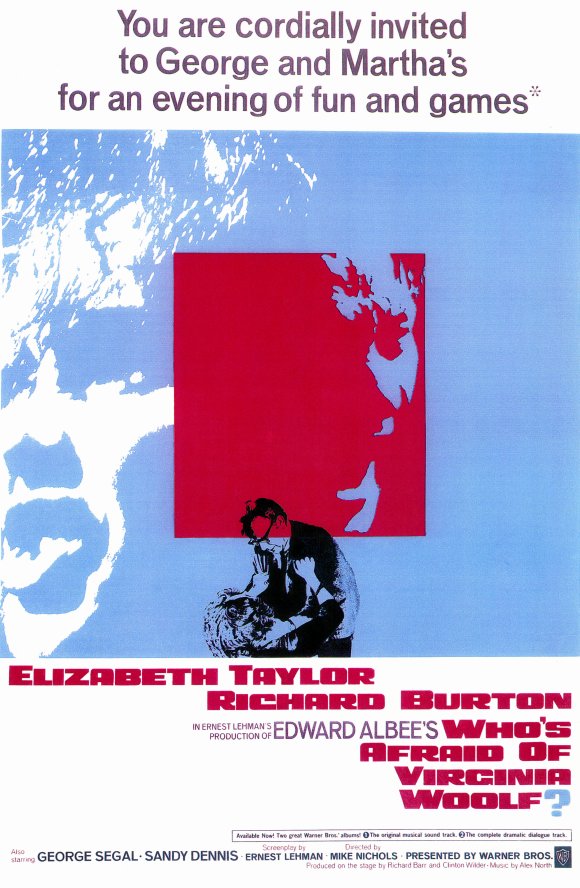
The promotional poster promises an evening of fun and games, but very little joy is to be found here, at least on the surface: all that marital baiting, sniping, and yelling is miserable. Fuck! It took me five or six false starts over a few years before I finally got into the film—and only with the help of a bottle of bourbon. Once I was in, though, I was hooked: watching this disastrous night unfold and all four characters unravel engrossed me desite the buzz I had going.

The oddly but appropriately named George (Burton), a history professor at a small East Coast university, and Martha (Taylor), the daughter of the school’s president, stumble home drunk from a faculty party, neither one listening to the other as they babble about nothing. Martha quotes Bette Davis, which ultimately reveals more about her viewpoint than any other comment she makes—and the woman can talk.

They babble and respond to each other half-heartedly. Martha tells George that she invited a young couple, a professor from another department and his wife, over for a drink. George is miffed, but there’s no time to react.

Enter Nick (Segal) and Honey (Sandy Dennis), a polite, young, good-looking couple that, as we learn, has their own set of problems. Martha and George pour drinks and pick at each other while Nick and Honey watch, uncomfortable at first, thinking maybe they shouldn’t be there. As the drinking continues, though, they’re pulled into the…drama? Turns out, they have more in common with each other than they think.

Here’s the thing about George and Martha: their marriage is dysfunctional, but they seem to operate well inside the confines of their explosive relationship—Martha brays and George stays, responding in a passive aggressive manner as he fixes them both another drink. Over and over and over again. Do they have any limits? It’s hard to say, partly because it’s never clear that we should take anything at face value: what we see is not necessarily what it is. That’s the genius of Who’s Afraid of Virginia Woolf. 

In 2013, the United States Library of Congress deemed Who’s Afraid of Virginia Woolf? “culturally, historically, or aesthetically significant” and selected it for preservation in the National Film Registry (https://www.loc.gov/programs/national-film-preservation-board/film-registry/complete-national-film-registry-listing/).

With Frank Flanagan, Agnes Flanagan

Production: Warner Brothers

Distribution: Warner Brothers

131 minutes
Not rated

(DVD purchase) A

Lonesome [Solitude]

(USA 1928)

The promotional poster touts something “New! Different! Refreshing!” It sounds like soda, but it’s not: it’s Lonesome, a real charmer that still works as it nears its centennial.

Music Box Theatre screened a crisp restored 35mm print of Paul Fejos’s Lonesome for Reel Film Day, a countrywide event honoring films of the almost abandoned format (https://drafthouse.com/event/reel-film-day). The program was a double feature that included the Adam Sandler vehicle Punch Drunk. I didn’t stick around so I can’t comment on Punch Drunk, but Lonesome was an excellent choice.

Mary (Barbara Kent), a telephone operator for Ma Bell, and Jim (Glenn Tyron), a punch press operator in a factory, are two young working stiffs in the Big Apple. Both live alone in small rented room (not together—there’d be no movie then), and participate in an urban rat race that actually looks busier and grungier than what we have today.

Clearly, the film predates the standard five-day work week: the calendar in Mary’s room indicates that the day is Saturday, July 3. As Mary and Jim finish their respective jobs, which Fejos shows in a narrative that goes back and forth between the two, their work friends invite them to join in their weekend plans. Mary and Jim both see immediately that they’ll be the odd one out, as all of their friends are paired up. Both politely decline, going home dejectedly without any plans.

After they each see the same marching band advertising a cheap carriage ride to Coney Island, Mary and Jim end up going there solo on the same trip. They meet at the beach, and a modest flitration ensues. He tells her he’s a millionaire, and she tells him she’s a princess. They get along well, and commence an impromptu date, walking around, playing carnival games, and dancing. A fortune teller (Fred Esmelton) reveals that Mary has already met the man who will become her husband.

Mary and Jim get separated after a mishap on a rollercoaster. The problem is, they each have a tiny picture of the other from a photo booth and they only know each other’s first name. Finding each other in the throngs of people at the park that evening is like searching for a needle in a haystack. Have they lost each other before they even had a chance?

Edward T. Lowe, Jr. and Tom Reed adapt a cute story by Mann Page; it’s a simple yet clever plot. Despite its age, one point in Lonesome still rings loud and clear and true: connecting in the big city is harder than it looks. We all get wrapped up in the daily stuff of our lives, and we tend to overlook what’s right in front of us. Kent and Tyron are both adorable. Gilbert Warrenton’s kinetic camerawork captures a lot in the background, and it makes the shots at Coney Island especially fun to watch.

Lonesome features two or three abruptly placed “talking” scenes—the film was made when sound was a new thing—and the dialogue is laughably awful. There are also a few color tinted night shots: marquee lights, fireworks, stars. It’s really cheesy. That said, these are short, minor disruptions that don’t detract from enjoying this film for all its silent era charisma.

In 2010, the United States Library of Congress deemed Lonesome “culturally, historically, or aesthetically significant” and selected it for preservation in the National Film Registry (https://www.loc.gov/programs/national-film-preservation-board/film-registry/complete-national-film-registry-listing/).

With Fay Holderness, Gusztáv Pártos, Eddie Phillips, Andy Devine, Edgar Dearing

Production: Universal Pictures Corporation/Universal Pictures (USA)

Distribution: Universal Pictures Corporation/Universal Pictures (USA), European Motion Picture Company (UK), The Criterion Collection (DVD)

75 minutes
Not rated

(Music Box) A

Reel Film Day: A Celebration of 35mm Cinema

https://www.criterion.com/films/28212-lonesome

http://www.imdb.com/video/screenplay/vi389587993/