North by Northwest

(USA 1959)

“I’m an advertising man, not a red herring. I’ve got a job, a secretary, a mother, two ex-wives, and several bartenders that depend upon me, and I don’t intend to disappoint them all by getting myself ‘slightly’ killed.”

—Roger Thornhill


“That’s funny. That plane’s dusting crops where there ain’t no crops.”

—Man at the Prairie Crossing

I expected Alfred Hitchcock’s North by Northwest to be suspenseful, cinematic, and even a bit perverse, peppered with the director’s inimitable wit and dark sense of humor. It certainly is all that. However, I didn’t expect it to be altogether facetious, or as fun as it is. Scene after scene, North by Northwest delivers; not many films give as much bang for your buck as this one.

Cary Grant is Manhattan ad executive Roger O. Thornhill—”The ‘O’ stands for nothing,” he quips at one point. A mild-mannered, stylish middle-aged man in a grey flannel Brooks Brothers suit—think Mad Men—he leads a perfectly predictable straight life serving clients, drinking martinis, and keeping his WASPy mother (Jessie Royce Landis) entertained.

While having cocktails at the Plaza Hotel one afternoon, Thornhill is yanked into a treacherous game of cat-and-mouse when the goons of a smooth and well-spoken spy, baritone Phillip Vandamm (James Mason), mistake him for a government agent named George Kaplan. It’s nothing but trouble from here.

Relentlessly hunted after being framed for an incident at the United Nations, Thornhill flees Manhattan on a passenger train that looks a lot like Amtrak’s Lake Shore Limited. He meets cool, mysterious, and sultry stranger Eve Kendall (Eva Marie Saint), who’s headed to Chicago. Her innuendo is sexy, but she’s not exactly trustworthy—Thornhill senses it, and so do we.

North by Northwest is ultimate Hitchcock, fueled by mistaken identity and packed with psychological drama manifest mostly in the form of dizzying pursuit: a drunken car chase on a windy road, a moving train, an out-of-nowhere crop duster in an Indiana cornfield, a race down Mount Rushmore. Nothing about the plot is believable; it’s more preposterous than a James Bond film. Although it shares the same Cold War sensibility, North by Northwest is much more intriguing and memorable. It’s also more entertaining.

Ernest Lehman’s script is brilliantly put together, but the story isn’t what makes this soar; it’s Hitchcock’s directing and the acting, particularly that of Grant, Saint, and Mason. Grant is a hoot to watch here; he plays Thornhill like a high-style Thurston Howell without his Lovie. He walks a fine line between convincing and cartoonish, always coming off as the former. It’s quite an astounding feat of balance, actually. Saint is the perfect counterpart to Grant. I could listen to Mason talk endlessly. Martin Landau plays a secondary character, but he’s awesome as über creepy (and probably closeted) Leonard, Vandamm’s right hand man.

Ahead of its time in many ways, North by Northwest is consciously silly yet pushes a few boundaries. Exceedingly mischievous, it just might be Hitchcock’s most charming film. It’s definitely more fun than any other film of his that I’ve seen—not that I’ve come close to seeing all of them. It’s truly a dazzler.

Personal geek-out side note: in a film full of thrilling moments, the most thrilling for me was the scene outside The Ambassador Hotel in Chicago. I live two doors down from the hotel, now known as Public. I’ve stood in the exact spot Grant did as he exited the alley to cross Goethe to get to the hotel—I walk my dog there all the time. It’s amusingly weird to see a place you know so well onscreen, let alone in something from almost 60 years ago. It’s different, but not much. Here’s what it looked like when North by Northwest was filmed:

IMG_9083.PNG

And here’s what it looks like today:

Ambassador.jpg

In 1995, the United States Library of Congress deemed North by Northwest “culturally, historically, or aesthetically significant” and selected it for preservation in the National Film Registry (https://www.loc.gov/programs/national-film-preservation-board/film-registry/complete-national-film-registry-listing/).

With Leo G. Carroll, Philip Ober, Josephine Hutchinson, Adam Williams, Robert Ellenstein, Edward Platt, Philip Coolidge, Edward Binns

Production: Metro-Goldwyn-Mayer/MGM

Distribution: Metro-Goldwyn-Mayer/MGM

136 minutes
Not rated

(AMC River East) A

Fathom Events

Donnie Darko

(USA 2001)

“Has he ever told you about his friend Frank, the giant bunny rabbit?”

—Dr. Lilian Thurman


“Every living creature on earth dies alone.”

—Grandma Death

Donnie Darko, a period piece set during a time I remember quite well—October 1988, the second full month of my college freshman year and the height of the Bush-Dukakis presidential election—has a great moody soundtrack that includes the likes of Tears for Fears, Joy Division, the Church, Duran Duran, and of course Echo and the Bunnymen. Even if it would have stuck out like a sore thumb, a song more fitting with the theme would have been Cher’s “If I Could Turn Back Time.”

October 2, 1988: troubled and highly medicated loner Donnie Darko (Jake Gyllenhaal), a middle class teen in suburban Middlesex, Virginia, sleepwalks outside of his house and meets Frank (James Duval), a new “friend.” Frank is a guy in a creepy rabbit suit—he looks like he was plucked from the cover of a heavy metal album. Frank tells Donnie that the world is coming to an end—in exactly 28 days, 6 hours, 42 minutes, and 12 seconds.

Thus begins the apocalyptic timewarping adventure of Donnie Darko. After being rudely awakened on a golf course the next morning, Donnie lumbers home in a daze to discover that a jet engine fell from the sky and crashed into his bedroom. His family, obviously already having assumed the worst, is shocked but relieved to see him approaching from the street—except maybe his mother (Mary McDonnell). Federal investigators can’t trace where the engine came from.

At school, a new student, Gretchen (Jena Malone), interrupts Donnie’s English class—taught by the young and snarky Ms. Pomeroy (Drew Barrymore). They’re discussing their reading assignment, Graham Greene’s short story “The Destructors.” Gretchen asks where she should sit, and Ms. Pomeroy directs her “next to the boy you think is the cutest.” Gretchen sits next to Donnie. Duh!

Donnie and Gretchen dig each other, which is a ray of light to his psychiatrist, Dr. Thurman (Katharine Ross). The doctor has been concerned about Donnie’s “hallucinations” of Frank, as well as some of his erratic behavior. Donnie is growing more and more obsessed with a senile elderly neighbor he and his friends nicknamed “Grandma Death” (Patience Cleveland) and a book about time travel. Everything comes to a head at a party Donnie and his sister Elizabeth (Maggie Gyllenhaal) throw while their parents are out of town on Halloween—which is 28 days from where this all started.

Simultaneously funny, foreboding, weird, and utterly thought-provoking, I can see why Donnie Darko has the following it does. Director and screenwriter Richard Kelly comes up with something unlike anything else I’ve ever seen. It’s a winning mix of teen comedy, science fiction, and fantasy. I caught an anniversary screening with my nephew, and this film is as fresh as when I first saw it in 2002. Loaded with indelible imagery, symbolism, ’80s pop cultural references, and clever narrative loopbacks, I find Donnie Darko‘s greatest asset to be its open-ended mystery; what exactly happens is left for the viewer to figure out. A quick Google search pulls up ample musings of the meaning of this film. I’ve seen this a few times, and I’m not sure.

Aside from the plot, the characters and the casting are terrific. Both Gyllenhaals are great, and you can actually see they’re both destined for more. Patrick Swayze is awesome as motivational speaker Jim Cunningham, but Beth Grant takes the cake here as passive-aggressive bitch Kitty Farmer. Oh yeah, this is also Seth Rogen’s first onscreen role—see if you can spot him.

Side note: Frank’s rabbit suit was designed by April Ferry, who went on to work for Game of Thrones (http://ew.com/movies/2017/03/31/donnie-darko-bunny-suit-frank-untold-stories/). I was hoping to catch the director’s cut, but this wasn’t it.

With Holmes Osborne, Daveigh Chase, Noah Wyle, Stuart Stone, Gary Lundy, Alex Greenwald, Jolene Purdy, Ashley Tisdale

Production: Flower Films

Distribution: Pandora Cinema, Newmarket Films

113 minutes
Rated R

(Capitol Theatre) B+

http://archive.hi-res.net/donniedarko/

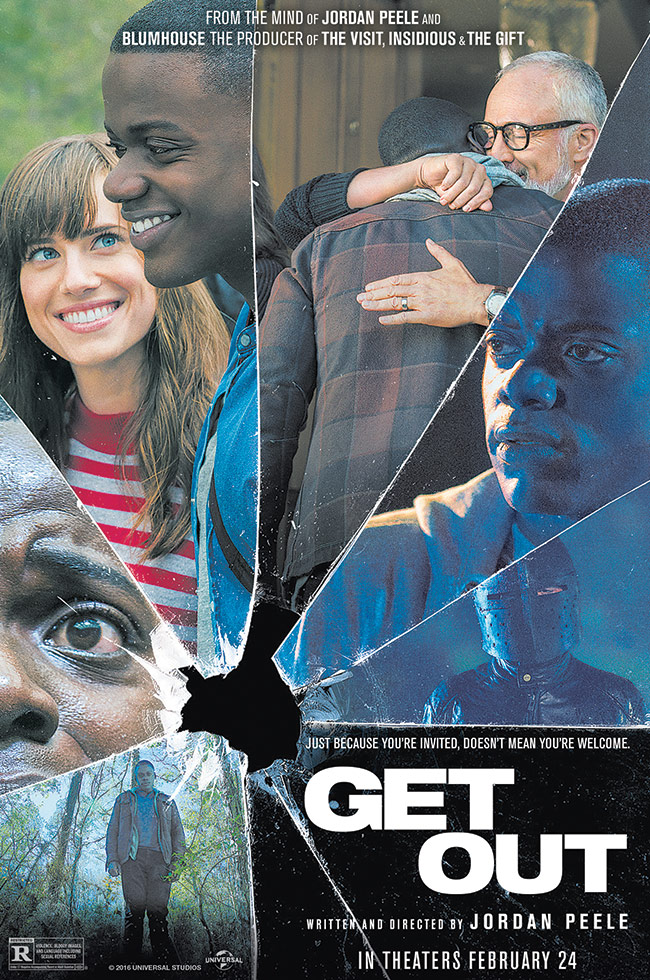
Get Out

(USA 2017)

I caught the hype surrounding Jordan Peele’s first feature length film, Get Out, a comedy horror flick that takes on race—specifically, the dynamics of white power and black subordination. He wrote the script and directed the film. I went into Get Out with some doubt and maybe trepidation about how it might come off. The concept is one that seems too easy to go horribly sideways.

I guess if anyone can pull it off, it’s Peele—and I’m relieved to report that he succeeds. With an oddly compelling mix of Guess Who’s Coming To Dinner, Meet the Parents, Nightmare on Elm Street, and The Stepford Wives, he takes on the cultural idiosyncrasies of Caucasian cultural dominance within the constructs of a horror flick. He’s got a lot of points to make, and he gets them across in a sharp but entertaining way. Like the best horror movies, Get Out makes you squirm—but it does so on multiple levels.

New York City photographer Chris (Daniel Kaluuya) is black. His girlfriend, Rose Arlington (Allison Williams), is white. She invites him on a weekend getaway to her parents’ home in upstate New York because, well, it’s time for him to meet the fam. Chris agrees, going into it nervously and not without personal baggage. His hyperactive best bud, Rod (Lil Rel Howery), a TSA agent who always expects the worst, is not helping.

Rose’s parents are, like the quiet town where they live, nice. Or at least welcoming. Dean (Bradley Whitford) drops silly slang, affects a bizarre accent, and praises President Obama. Missy (Catherine Keener) is more direct, asking pointed questions in a weird attempt to get to know Chris. It’s awkward and doesn’t quite break the ice, but it’s harmless. Right?

The family’s two longterm servants, maid Georgina (Betty Gabriel) and gardener Walter (Marcus Henderson), carry themselves like they’ve had lobotomies. Rose’s younger brother, Jeremy (Caleb Landry Jones), is, um, aggressively complimentary to Chris. On top of it, the Armitages’ neighbors are not quite right, obsessed with Chris and his virility.

During the first part of Get Out, Peele keeps things light but lets a sense of creepy unease simmer. The laughs are there, but like all of the characters coming and going from the house, something is off. He makes a major shift in tone once Missy insists on hypnotizing Chris, ostensibly to help him quit smoking. What was innocuous up to now becomes nefarious.

Ultimately, the evil here is not a monster hiding under the bed, but rather something more obvious that exists in broad daylight. I could have done without the bloody finale, but it works in the context of the film; Peele plays with genre, so I see why it’s here. Either way, Get Out is a bold move that pays off.

With Stephen Root, LaKeith Stanfield, Ashley LeConte Campbell, John Wilmot, Caren Larkey, Julie Ann Doan, Rutherford Cravens, Geraldine Singer, Yasuhiko Oyama, Richard Herd, Erika Alexander, Jeronimo Spinx, Ian Casselberry, Trey Burvant, Zailand Adams

Production: Blumhouse Productions, Monkeypaw Productions, QC Entertainment

Distribution: Universal Pictures

104 minutes
Rated R

(ArcLight) B

https://www.uphe.com/movies/get-out

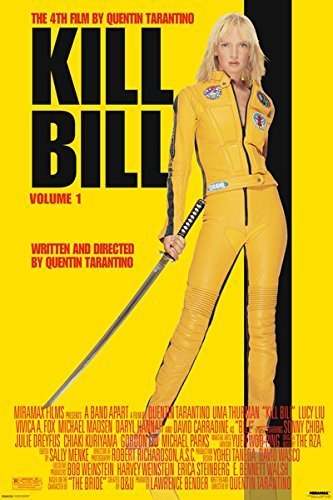
Kill Bill: Volume 1

(USA 2003)

“Revenge is never a straight line. It’s a forest. And like a forest, it’s easy to lose your way. To get lost. To forget where you came in.”

—Hattori Hanzō

“It’s mercy, compassion, and forgiveness I lack,” The Bride (Uma Thurman) plainly informs one of her assailants before she exacts revenge. “Not rationality.” Uh, really? Right off the bat, Quentin Tarantino’s Kill Bill, Volume 1 (not to be conflated with Kill Bill: Volume 2, which is longer but not quite as good) is an action film packed with snark and coolness. Uma Thurman is The Bride (codeman Black Mamba), who in the sepiatone opening scene is lying on the floor of a chapel in El Paso, Texas. She’s in a wedding dress, bleeding and pleading for her life. “It’s your baby,” she tells Bill (David Carradine, who has a bigger part in the second installment). He shoots her in the head.

Four years later, The Bride wakes up—midfuck, mind you—from a coma in the hospital. There’s no baby. She takes out a would-be rapist, Jasper (Jonathan Loughran), and an orderly named Buck (Michael Bowen), who pimped her out. Incidentally, Buck has a catchphrase that rhymes with his name—you figure it out. The Bride runs off with Buck’s truck, the “Pussy Wagon.” Once she gets her feet and legs moving, she sets out to settle a score—or six. First, though, she has to persuade retired master swordsmith Hattori Hanzō (Sonny Chiba), who runs a sushi bar in Okinawa, to make her a sword.

Kill Bill: Volume 1 is totally far fetched, but that’s not important. Like most Tarantino films, the emphasis here is on the characters and the action, not the plot; otherwise, two hours of not much more than a badass blonde babe methodically killing teammates who double-crossed her when she was a member of something called the Viper Assassination Squad wouldn’t work. Originally intended as one long film (http://killbill.wikia.com/wiki/Kill_Bill:_Vol._1), Kill Bill: Volume 1 depicts two of the paybacks: Vernita Green (Vivica A. Fox), who’s now a housewife and mother in suburban Los Angeles, and O’Ren Ishii (Lucy Liu), the head of the Tokyo Yakuza.

Beautifully staged and shot, the violence is over the top yet perfectly choreographed. The scene at the House of Blue Leaves is eloquent right down to the blood in the snow. Tarantino plays around with the sequence of events and mixes genres including anime. He employs his penchant for sharp dialogue, snazzy settings with memorable names, and sick humor. Plus, he throws in cool music and clothes; Daryl Hannah dressed as a nurse, for example, is fucking fabulous! As a result, Kill Bill: Volume 1 is a dazzling bloodfest. It takes a certain type to love a film like this—and it’s one of my favorites.

With Julie Dreyfus, Chiaki Kuriyama, Gordon Liu, Michael Parks, James Parks, Sakichi Sato, Ambrosia Kelley

Production: A Band Apart

Distribution: Miramax Films

111 minutes
Rated R

(Logan Theatre) A

https://www.miramax.com/movie/kill-bill-volume-1/

Storytelling

(USA 2001)


“I just thought Marcus would be different. I mean, he’s got C.P.”

—Vi

I get why Todd Solondz doesn’t appeal to everyone: his outlook isn’t warm and fuzzy, his characters aren’t heroic or even admirable, and his blunt, unflattering and brutal honesty is easy to misinterpret as cruel or tasteless. To all that, I shrug; his films don’t put the viewer at ease, and that’s exactly what draws me to him. A master of the uncomfortable, he shines a light on subjects that are hard to discuss in mixed company if not off limits altogether. And he’s not moralistic about it—he leaves it to the viewer to arrive at his or her own conclusions. His moral ambiguity is perhaps the strongest characteristic of his work, and I suspect it more than anything makes people cringe because, well, it’s confusing. They don’t know what to think.

So be it. Barring one scene in Happiness that scarred me forever, Solondz’s fourth film, Storytelling, is probably his most uncomfortable—it opens with Vi (Selma Blair) riding Marcus (Leo Fitzpatrick, who played Telly in Kids), a classmate crippled from cerebral palsy. Comprised of two unconnected storylines, “Fiction” and “Non Fiction,” Solondz pulls out a broad range of societal taboos—American ones, anyway. I won’t go through them here like a grocery list, but they all involve sex and/or abuse of power.

Side note: Censorship is an unintended subject—a big red block obscures one scene in the U.S. release. It wasn’t planned that way, but rather came about by contract (http://www.indiewire.com/2002/01/interview-the-sad-comedy-solondz-discusses-storytelling-80562/ ) (https://www.brainyquote.com/quotes/quotes/t/toddsolond355306.html). My DVD doesn’t have the red block—the scene is graphic, but not pornographic. Concealing it wasn’t worth the effort or the P.R.

The first and shorter story, “Fiction,” is about the aforementioned Vi, a wannabe writer who probably doesn’t belong in the writing class she’s taking. The class is taught by Pulitzer Prize winning Gary Scott (Robert Wisdom), an imposing egomaniac author who’s also a black man. His critiques of his students’ work is harsh—except when it comes to Catherine (Aleksa Palladino), a bookish pseudointellectual who looks like she’s into S&M. Guess what happens when Vi finds herself in a bar with Scott, and an opportunity to go home with him presents itself? You’ll have to read the book—or in this case the writing assignment, as Vi does what any writer would: she writes about the experience.

The second—and longer—story, “Non Fiction,” is about unsuccessful schlub Toby Oxman (Paul Giamati), a floundering self-proclaimed documentary filmmaker, as he sets out to make an exposé on the everyday American teenager. The problem is, he can’t find a subject. Enter slackerish pothead Scooby Livingston (Steven Weber) and his dysfunctional family led by father Marty (John Goodman). A series of unplanned mishaps threatens to derail the whole project, until one morbid event turns the whole thing around. Belle and Sebastian proves a nice choice for the music.

Storytelling is not quite as intriguing as Welcome to the Dollhouse or Happiness, but it’s still quintessential Solondz. The lines here are quotable gold—particularly the exchanges between Scooby’s youngest brother, Mikey (Jonathan Osser), and the Livingstons’ housekeeper, Consuela (Lupe Ontiveros), which are nothing short of awesome. I love that Solondz calls out his critics—it’s the film equivalent of Madonna’s “Human Nature.” “Fiction” is definitely the more impactful of the two segments, but that’s because “Non Fiction” is just too long and meandering for its own good; it peters out around two-thirds of the way through. Storytelling doesn’t immediately come to mind when Solondz’s name comes up, but parts of it will definitely haunt you. Unlike his other films, I’m not sure what to make of this one.

A third scene, “Autobiography,” was shot but left out of the final product (https://en.wikipedia.org/wiki/Storytelling_(film) ) (http://www.imdb.com/title/tt0250081/trivia?ref_=tt_trv_trv ). It starred James Van Der Beek as a closeted high school football player and featured a gay sex scene with Steve Rosen. I don’t know about the sex scene, but I think a third story would have added impact.

With Maria Thayer, Steve Rosen, Julie Hagerty, Noah Fleiss, Conan O’Brien

Production: Good Machine, Killer Films, New Line Cinema

Distribution: Fine Line Features

87 minutes
Rated R

(DVD purchase) B

http://www.toddsolondz.com

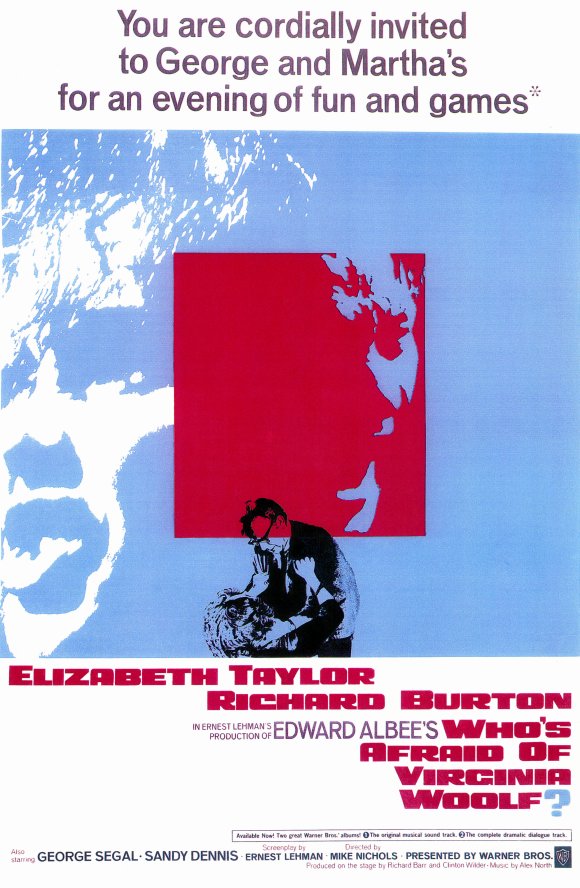
Who’s Afraid of Virginia Woolf?

(USA 1966)

Elizabeth Taylor. Richard Burton. Edward Albee. Even George Segal, who was kind of a fixture on NBC during the ’80s and ’90s. Need I say more? Probably not, but I will.

Director Mike Nichols and screenwriter Ernest Lehman stick pretty close to Albee’s 1962 play with their film adaptation of Who’s Afraid of Virginia Woolf?, and it’s hard to watch. Really hard. To be fair, though, it’s supposed to be, and that’s what makes it so good.

The promotional poster promises an evening of fun and games, but very little joy is to be found here, at least on the surface: all that marital baiting, sniping, and yelling is miserable. Fuck! It took me five or six false starts over a few years before I finally got into the film—and only with the help of a bottle of bourbon. Once I was in, though, I was hooked: watching this disastrous night unfold and all four characters unravel engrossed me desite the buzz I had going.

The oddly but appropriately named George (Burton), a history professor at a small East Coast university, and Martha (Taylor), the daughter of the school’s president, stumble home drunk from a faculty party, neither one listening to the other as they babble about nothing. Martha quotes Bette Davis, which ultimately reveals more about her viewpoint than any other comment she makes—and the woman can talk.

They babble and respond to each other half-heartedly. Martha tells George that she invited a young couple, a professor from another department and his wife, over for a drink. George is miffed, but there’s no time to react.

Enter Nick (Segal) and Honey (Sandy Dennis), a polite, young, good-looking couple that, as we learn, has their own set of problems. Martha and George pour drinks and pick at each other while Nick and Honey watch, uncomfortable at first, thinking maybe they shouldn’t be there. As the drinking continues, though, they’re pulled into the…drama? Turns out, they have more in common with each other than they think.

Here’s the thing about George and Martha: their marriage is dysfunctional, but they seem to operate well inside the confines of their explosive relationship—Martha brays and George stays, responding in a passive aggressive manner as he fixes them both another drink. Over and over and over again. Do they have any limits? It’s hard to say, partly because it’s never clear that we should take anything at face value: what we see is not necessarily what it is. That’s the genius of Who’s Afraid of Virginia Woolf. 

In 2013, the United States Library of Congress deemed Who’s Afraid of Virginia Woolf? “culturally, historically, or aesthetically significant” and selected it for preservation in the National Film Registry (https://www.loc.gov/programs/national-film-preservation-board/film-registry/complete-national-film-registry-listing/).

With Frank Flanagan, Agnes Flanagan

Production: Warner Brothers

Distribution: Warner Brothers

131 minutes
Not rated

(DVD purchase) A

T2 Trainspotting

(UK 2017)

“You’re a tourist in your own youth.”

—Sick Boy

“Face your past. Choose your future.” That’s what the poster for T2 Trainspotting says. Perhaps it should say, “Paybacks are a bitch,” something Mark Renton (Ewan McGregor) finds out pretty quickly when he returns home to Edinburgh after 20 years in Amsterdam following his little fuckover at the end of Trainspotting. Ostensibly back to make amends and settle his debt, Renton knows that forgiving and forgetting isn’t so easy—or smooth. Truth be told, he probably didn’t expect it to be.

Renton finds Spud (Ewen Bremner) unemployed, still struggling with heroin, and literally killing himself—like, alone with a plastic bag over his head in his dingy apartment. Sick Boy (Jonny Lee Miller) is a full-fledged douche, complete with a failing bar—the Port Sunshine—that he inherited from his aunt, a blackmail sex scam he runs on the side with a Bulgarian partner—Veronika (Anjela Nedyalkova), whom he fancies as his girlfriend—and a seriously unflattering coke habit. Oh yeah, he’s still bleaching what he’s got left of his hair. Neither is stoked about Renton showing up, but Sick Boy is clearly more bitter than Spud. He has a plan to get even.

Soon, however, Renton and Sick Boy are up to their old tricks, nightclubbing, tripping, and yes, thieving. In one of T2‘s best scenes, they head somewhere outside Edinburgh and hit a pub that looks more like an American VFW hall. It’s some weird open mic night for a crowd of Protestant Unionists who are rabidly anti-Catholic because of history. Explaining it all to Veronika in the car before the heist—the plan is to pickpocket as many ATM cards as they can get their hands on—Renton calls them “relics.” After a successful mission, the bouncer won’t let them leave until they perform a number. What they come up with is brilliant.

The fun and games come to a grinding halt when Begbie (Robert Carlyle), who’s serving a 25-year prison sentence and is denied parole because of his anger management problem, breaks out of jail and runs into Renton. He loses his shit in yet another great scene. Renton gets away for the moment but Begbie is on his trail, which leads him to a sketchy business partnership. Will history repeat itself?

I was skeptical when I heard director Danny Boyle was making a sequel; I guess I thought Trainspotting didn’t need a follow up. T2, which is loosely based on Irvine Welsh’s 2002 novel Porno, lacks the youthful vigor of the original and frankly isn’t as cool. How could it be? It wouldn’t exist without Trainspotting; it’s got flashbacks and obligatory references, some more clever than others, throughout. Kelly Macdonald has a fun cameo, Renton’s “Choose Life” monologue is updated, that toilet makes a brief appearance, and there’s a nice remix of Iggy Pop’s “Lust for Life” at the end (and yes, we know it’s coming).

Still, T2 stands on its own. It’s fueled by nostalgia and revenge, which in this case turns out to be a rather interesting combination. T2 has more of a conventional plot, and it’s oddly fascinating. The dialogue is every bit as wickedly sharp as before. These boys have grown up—they’ve turned into sad men because they’ve chosen unfulfilled promise and disappointment (to use Renton’s words). Now they have to deal with it, which isn’t what I imagined them doing in 20 years—if they even lived, which they most definitely have. Surprise! We all know someone like this, right? I would see T2 again.

At a post screening discussion, Boyle said he really made an effort to connect to the original. He succeeded, in a good way. As for the title, he said it’s an homage of sorts to Terminator director James Cameron, whom the characters would simultaneously want to honor and piss off.

With Shirley Henderson, Scot Greenan, Pauline Lynch, James Cosmo, Eileen Nicholas, Irvine Welsh

Production: Film4, Creative Scotland, Cloud Eight Films, DNA Films, Decibel Films

Distribution: TriStar Pictures

Screening followed by a live Q and A with Danny Boyle and Irvine Welsh moderated by Richard Roeper

117 minutes
Rated R

(AMC River East) B

Chicago International Film Festival

http://www.t2trainspottingmovie.com

https://www.facebook.com/T2TrainspottingMovie/?brand_redir=490630094455946

You’re Killing Me Susana [Me estás matando Susana]

(Mexico 2016)

When I was a kid, Cedar Point would start hyping its newest ride, usually but not always a roller coaster, just as winter gave over to spring. In June, we’d finally get to the park and wait in line for two hours to experience it. Some years, the ride didn’t live up to its promise; I felt I had been duped. I recently felt that same disappointment again leaving the theater after a sold out screening of Roberto Sneider’s edgy new romantic comedy You’re Killing Me Susana.

Self-absorbed lout Eligio (Gael García Bernal) is a minor soap opera actor who believes in monogamy—for his wife, Susana (Verónica Echegui), not him. He stays out drinking, cheats on her, and sometimes drags his thespian friends over to their apartment to party into the wee hours—after Susana’s gone to bed. The look on her face and the way she pushes him off of her when he stumbles into bed and nuzzles her to cuddle is sublimely bitchy—and funny.

Eligio is the only one who’s confused when Susana leaves him. He schleps from Mexico City to Iowa to track her down, enduring American customs agents and evading campus police. He finds her enrolled in a writing program for foreign students at an unnamed university (University of Iowa, perhaps?). She’s also running around with a silent, brooding, and well-endowed Polish poet (Bjorn Hlynur Haraldsson). Without a plan or a place to stay, Eligio moves into Susana’s dorm—ostensibly to work out their issues.

Adapted by Sneider and Luis Cámara from José Agustín’s novel, You’re Killing Me Susana depicts a dysfunctional relationship that both participants take a lax approach to maintaining. I don’t mind dislikable characters, but I had some difficulty connecting with these ones. They seem to recognize a problem, but it doesn’t come off as dire. Some of what happens between them is confusing, and as a result the message gets lost. Somewhere in here, I suspect, are statements about machismo, maturity, fidelity, how men and women view sex, and what they want out of life.

The previews suggested something riotously fun and sexy, and I really like Bernal. You’re Killing Me Susana exudes that distinct cuteness with a dark undertone you see a lot in Mexican films. Overall, though, this is just okay. It has some funny moments—most of them in the trailer—but the execution is shallow, simplistic, and forgettable. Too bad, because this could have been a really powerful and interesting film.

With Ashley Grace, Andrés Almeida, Jadyn Wong, Adam Hurtig, Barbara Garrick, Ilse Salas

Production: Cuévano Films, La Banda Films

Distribution: Hola Mexico Distribution

100 minutes
Not rated

(Gene Siskel Film Center) C-

http://holamexicoff.com/susana/

https://www.facebook.com/killingmesusana/

Toni Erdmann

(Germany/Austria 2016)

Toni Erdmann is not a real person; he’s the alterego of retired divorced schoolteacher Winfried Conradi (Peter Simonischek). When Winfried, a weird old hippy jokester, appears onscreen in a shaggy wig and bad fake teeth, he certainly gives the impression that those around him have to excuse his relatively harmless but tiresome—and often annoying—penchant for silliness. He is caretaker of his elderly mother, and death surrounds him. Perhaps that explains it.

Winfried’s daughter, Ines (Sandra Hüller), a young corporate sellout working on a project in Romania, drops by for a birthday. She’s on her phone most of the time, distracted by work. She’s so serious—and severe. Predictably, she doesn’t stick around long.

When his dog dies, Winfried flies to Bucharest and stalks Ines in the lobby of the office building where she works. She sees him and takes him to a reception, where she networks with Henneberg (Michael Wittenborn), an oil company executive she wants to make a deal with. The weekend is bizarre, filled with small talk, blank stares, and uncomfortable silence. Ines doesn’t bother to pretend she’s happy to see her father; in fact, it’s pretty clear she’s relieved to see him leave.

This is where Toni Erdmann gets interesting: Winfried doesn’t actually leave. Instead, he becomes “Toni Erdmann, life coach,” and sets out to reach Ines through her professional contacts. Funny thing: it actually works.

Writer/director Maren Ade has a solid grasp of strained relationships and embarrassing situations, and a sick sense of humor to boot. It’s a winning combination in Toni Erdmann, which has its share of quite a few awesomely cringeworthy moments. Your goofy dad upstaging you at a networking opportunity? Check. Naked birthday party—with coworkers? Check. An Easter party that includes an apoplectic performance of Whitney Houston’s “Greatest Love of All”? Check. A cum-soaked petit fours? Um, check.

For all its distance, Toni Erdmann turns out to be a surprisingly emotional film. It takes nearly three hours to get to it, but it ends on a whallop. It’s touching in a way I didn’t see coming. The final scene offers all anyone needs to see about this dysfunctional father/daughter relationship. And it’s beautiful.

With Ingrid Bisu, Lucy Russell, Thomas Loibl, Trystan Pütter, Hadewych Minis, Vlad Ivanov, Victoria Cocias

Production: Komplizen Film, coop99 filmproduktion, KNM, Missing Link Films, SWR/WDR/Arte

Distribution: NFP Marketing & Distribution (Germany), Soda Pictures (United Kingdom), Enfilade (Austria), Sony Pictures Classics (USA)

162 minutes
Rated R

(Music Box) B-

http://www.komplizen-film.de/e/toni-erdmann.html

http://www.sonyclassics.com/tonierdmann/

Elle

(France 2016)

Director Paul Verhoeven’s Elle doesn’t sound like a comedy: the central event of the film is a rape—a bloody, violent one at that. In fact, it’s the very first scene. Strangely, the opening credits warn us that what we are seeing is “a French comedy.” Really? I guess that explains it!

Michèle Leblanc (Isabelle Huppert) is raped in her dining room by a man in a ski mask while her green-eyed cat watches, detached and seemingly bored. China is smashed, furniture is toppled, blood is shed. After he leaves, Michèle cleans up the mess and resumes her life, ordering sushi delivery—a “holiday roll,” no less.

As the film proceeds, we learn a lot about Michèle. She’s the daughter of a famous mass murderer approaching parole. She’s a ballbusting owner of a video game company. Her staff, entirely young and male, either wants to sleep with her or murder her. Her son, Vincent (Jonas Bloquet), is totally whipped by a shrew (Alice Isaaz) who’s pregnant with a baby that clearly isn’t his. Her ex-husband (Charles Berling) is involved with a younger yoga instructor (Vimala Pons). Her mother (Judith Magre) is a high maintenance piece of work who carries on with men a third her age. Meanwhile, Michèle is having an affair with with Robert (Christian Berkel), the husband of her business partner (Anne Consigny).

Things get dicey when Michèle develops a thing for her neighbor, Patrick (Laurent Lafitte), a handsome banker married to a devout Catholic (Virginie Efira) who apparently won’t fuck him. Their flirtation messes with her head as she tries to figure out who raped her. She’s surrounded by men, and every one of them is suspect.

David Birke’s screen adaption of Philippe Djian’s novel Oh… is, in a word, warped. Elle plays with power, desire, sex, and of all things sympathy. Consistent with its character—a constant switcheroo you don’t know whether to trust or look away from—it’s not a sad affair. To the contrary, it’s daring, thrilling, irreverent, and totally fun. It shouldn’t work—I found myself questioning whether I should enjoy the film as much as I did—but it does. The execution of both the plot and the characters is clever—and Stéphane Fontaine’s cinematography, which nicely illustrates the psychological drama here, is flawless. If nothing else, Elle is a visually stunning film.

Iggy Pop’s “Lust for Life” plays at various points in Elle, suggesting a lot of contradictory things. I took it as ironic more than anything. Elle is not for everyone, but it’s a powerful statement for those who can handle it—the perfect film for Valentine’s Day.

With Lucas Prisor, Raphaël Lenglet, Arthur Mazet, Hugo Conzelmann

Production: SBS Productions, Pallas Film, France 2 Cinéma, Entre Chien et Loup, Canal+, France Télévisions, Orange Cinéma Séries, Casa Kafka Pictures, Proximus, Centre National de la Cinématographie, Filmförderungsanstalt

Distribution: SBS Distribution

130 minutes
Rated R

(Gene Siskel Film Center) B+

http://sonyclassics.com/elle/