Mon Mon Mon Monsters [Bào Gào Lǎo Shī! Guài Guài Guài Guài Wù!]

(Taiwan 2017)

In his latest film, peer pressure horror comedy Mon Mon Mon Monsters [報告老師! 怪怪怪怪物!] [Bào Gào Lǎo Shī! Guài Guài Guài Guài Wù!], writer/director Giddens Ko takes us on a wild ride that leaves us pondering who the real mosters are. He subtly gives us his answer in the title.

High school student Lin Shu-wei (Deng Yu-kai) is a neo maxi zoom dweebie with a masochistic edge. Why else would he tolerate the constant flying bits of paper, chairs pulled out from under him, and general teenage tomfoolery directed at him?

Lin becomes the target of Bully Ren-hao (Kent Tsai), a closet psychopath who relentlessly dreams up new ways to torment him. Ren-hao has two flunkies, Liao Kuo-feng (James Lai) and Yeh Wei-chu (Tao Meng) who do his bidding. Ren-hao’s girlfriend, Wu Si-hua (Bonnie Liang), contributes to the hell — never removing her star-studded headset as she snaps photos with her iPhone.

A pacificst teacher (Carolyn Chen) has an idea to get the boys on common ground: she assigns the four of them to community service feeding senile elderlies at a decrepit old age home that looks like something straight out of Blade Runner. Lin has a bad feeling about it, and he’s right: in the process of robbing an old man, the boys corner and capture a flesh-eating female beast (Lin Pei-hsin) they find roaming around.

They take her to an abandoned recreation center, where they chain her up and torture her with light, fire, and starvation. Lin reluctantly goes along with it, but he reaches a point where he either has to put up or shut up. Meanwhile, the beast’s protective and pissed off older sister (Eugenie Liu) is looking for her. This is where Lin is put to the test: does he have any character, and can he stay true to it?

Despite inconsistent pacing, Mon Mon Mon Monsters is overall engaging. Ko has something to say about the moral fabric of today’s youth, but he says it in a mostly lighthearted way. The acting is solid all around, which is pretty amazing for a slasher flick. The “monsters” are sweet in their own way. It’s smart to show them right off the bat rather than let us wonder what they look like; they come off as more human than the teenagers in this movie.

The special effects are pretty good, and the way Ko plays with light and color is downright spectacular. Quite a few scenes here are magnificent even if they’re cheesy and gory (that scene on the bus is fabulous, as are the scene where the teacher ignites in the gym and pretty much any of the scenes in the recreation center). Underneath all the blood and hate is a truth about the social ladder.

With Kai Ko, Vivian Sung, Emerson Tsai, Phil Hou, Bruce Hung 

Production: Star Ritz International Entertainment

Distribution: Vie Vision Pictures

113 Minutes
Not rated

(AMC River East) B-

Chicago International Film Festival

La Chinoise

(France 1967)

“Okay, it’s fiction. But it brings me closer to reality.”

— Véronique

Set in the context of the New Left movement in late 1960s France, Jean-Luc Godard’s La Chinoise is not really about the political ideas it raises — many of which seem relevant today. No, at its core is Godard satirizing the idealism of youth.

Structured as a mockumentary in what undoubtedly is an intentionally scrappy art school style, La Chinoise is a series of “interviews” of five middle class college students about their Maoist terrorist organization. Headquartered in a loft apartment in a suburb of Paris, they named their organization “Aden Arabie” after a novel by French communist Paul Nizan.

The apartment, all done up in primary colors like a Piet Mondrian painting, is owned by one of the members’ parents.

Véronique (Anne Wiazemsky, who sadly died exactly a week before the screening I attended) (https://www.nytimes.com/2017/10/05/obituaries/anne-wiazemsky-french-film-star-and-novelist-dies-at-70.html) is the bossy leader, a philosophy student from a family of bankers. She’s involved with Guillaume (Jean-Pierre Léaud), a “theatrical actor.” Yvonne (Juliet Berto) grew up on a farm and works as a housekeeper and occasional hooker. She’s involved with Henri (Michel Semeniako), a writer who protests and publishes essays. Serge Kirilov (Lex de Bruijin) is a Russian nihilist who is single and suicidal.

La Chinoise is dense with ramblings about social and economic philosophy, politics, and literature. However, Godard uses all of it to make his point: these are kids who are still naïve and don’t fully grasp what they say they stand for. He shows them running around with toy weapons, playing school, and acting out scenes from books in the apartment, often cutting to pictures of comic book and cartoon characters. The joke is pretty funny when you consider the bourgeois backgrounds of the kids.

A conversation between Véronique and French philosopher Francis Jeanson on a train best illustrates Godard’s point: he asks a series of questions challenging her proposal to blow up the university in an effort to expose the flaws in her plan — and maybe get her to question her motives and the depth of her conviction. It goes over her head. So much for carrying pictures of Chairman Mao.

Side note: Claude Channes’s song “Mao-Mao” features prominently here. It’s a nifty little earworm.

With Omar Blondin Diop

Production: Anouchka Films, Les Productions de la Guéville, Athos Films, Parc Film, Simar Films

Distribution: Athos Films (France), Pennebaker Films (United States), Kino Lorber

96 minutes
Not rated

(Gene Siskel Film Center) C+

https://www.kinolorber.com/film/view/id/1111

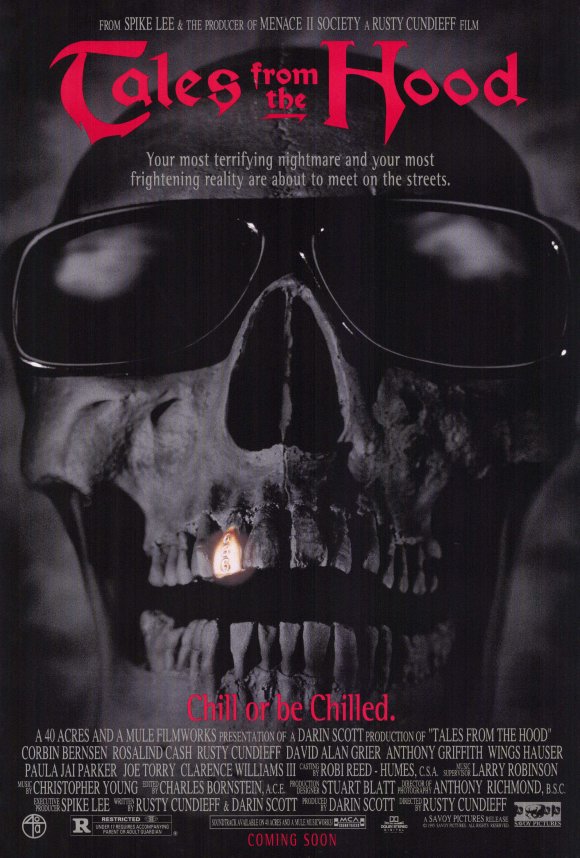
Tales from the Hood

(USA 1995)

The road to hell is paved with good intentions. Rusty Cundieff’s anthology Tales from the Hood is a good idea: four vignettes of black life presented as horror stories — so, a horror flick with a message, more commentary than a “scary movie.” I see why Spike Lee attached his name to it (as executive producer).

Cundieff and cowriter Darin Scott pick material topics that still resonate more than 20 years later: racism, police brutality, domestic abuse, drugs, and black-on-black violence. The messages are strong, but unfortunately the writing always isn’t.

The best segment is “Hard Core Convert,” which is also the closer. Jerome a.k.a. Crazy K (Lamont Bentley) is a drug dealer shot in a gang hit. He wakes up in a Kafkaesue prison, where a stern nurse (Lira Angel) subjects him to rehabilitation methods straight from A Clockwork Orange. This particular piece and the way it’s executed are both powerful and memorable.

The second segment, “Boys Do Get Bruised,” takes on domestic abuse. It’s not bad, but it’s not great. The other two segments, “Rogue Cop Revelation” and “KKK Comeuppance,” fall flat.

Tales from the Hood targets the right notes, but it misses many of them. For one thing, the approach here is really heavy-handed. Plus, the impact is diluted by the silly bit that frames the stories: a funeral home in South Central Los Angeles run by weirdo Mr. Simms (Clarence Williams III). He tells the four stories to three “gangstas,” Ball (De’aundre Bonds), Bulldog (Samuel Monroe Jr.), and Stack (Joe Torry), who stumble into the home looking for drugs. I could have done without this device — it served as a distraction more than anything.

With Wings Hauser, Tom Wright, Anthony Griffith, Michael Massee, Duane Whitaker, David Alan Grier, Brandon Hammond, Rusty Cundieff, Paula Jai Parker, Corbin Bernsen, Roger Guenveur Smith, Art Evans, Rosalind Cash, Chris Edwards , Troy Cartwright, Brenden Jefferson, Tim Hutchinson, John A. Cundieff, Bobby McGee, Christina Cundieff, Ricky Harris, Darin Scott, Mark Christopher Lawrence, Scotty Brulee, Ryan Williams, Kamau Holloway, Tasha Johnson

Production: 40 Acres and a Mule Filmworks

Distribution: Savoy Pictures Entertainment

98 minutes
Rated R

(Music Box) C-

Music Box of Horrors

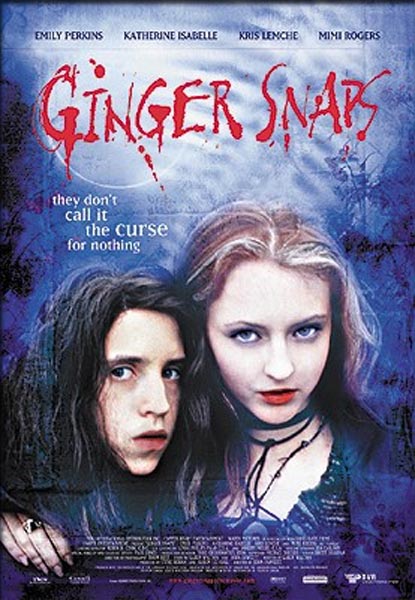
Ginger Snaps

(Canada 2000)

“Shit, wrists are for girls. I’m slitting my throat.”

— Ginger Fitzgerald

Puberty is tough enough without your older sister turning into a werewolf. Just ask 15-year-old Brigitte Fitzgerald (Emily Perkins), who with her sib, Ginger (Katharine Isabelle), stages gory death scenes and takes pictures of them, like a pair of morose Cindy Shermans. When they were kids, they made a pact to die together. Their classmates think they’re weird.

A run-in with mean girl Trina Sinclair (Danielle Hampton) sparks a war. Walking through the woods on their way to exact revenge one October night with a full moon, Ginger gets her first period. She also gets attacked by a mysterious and savage beast — the same one responsible for eviscerating all the dogs in the neighborhood.

Ginger turns increasingly feral over the next few days, growing more aggressive and sexual. Her wounds, which heal almost immediately, are sprouting hair. Oh yeah, she’s also developing what appears to be…a tail?

Brigitte, or “B,” connects with cute, brooding dope dealer Sam (Kris Lemche), who struck and killed the beast while he was driving his van down the road where it ran after it attacked Gretchen. He’s got a recipe for what might be the cure. The clock is ticking as Gretchen gets farther out of control, and Halloween — with another full moon — approaches.

On paper — all I had going into it because I’d never heard of it — John Fawcett’s Ginger Snaps sounds dubious at best. The premise seems trite. The part about the period sounds stupid, and the analogy to “becoming a lady” is obvious.

Turns out, Ginger Snaps is surprisingly good. Incorporating familiar elements of teen movies and splatter flicks, Fawcett, who wrote the screenplay with Karen Walton, pushes the “suspension of disbelief” envelope. He knows just when to stop, though. There’s quite a bit of gore here. The special effects are dated but effective nonetheless.

What really sells this film, though, is the acting: Perkins and Isabelle evoke a warmth to their relationship despite their offputting personalities and a fierceness to their bond. They’re totally believable as sisters. The final scene, which involves only them, is downright sad. Crushing, even.

With Mimi Rogers, Jesse Moss, John Bourgeois, Peter Keleghan, Christopher Redman, Lindsay Leese, Wendii Fulford, Pak-Kong Ho, Lucy Lawless

Production: Motion International, Copperheart Entertainment, Water Pictures, Lions Gate Films, Oddbod Productions, TVA International

Distribution: Motion International (Canada), Unapix Entertainment Productions (USA), Lions Gate Films

108 minutes
Not rated

(Music Box) B-

Music Box of Horrors

http://www.gingersnapsthemovie.com

Hellraiser

(UK 1987)

“Oh, no tears, please. It’s a waste of good suffering!”

— “Pinhead” (the Lead Cenobite)

Roger Ebert famously derided Clive Barker’s directorial debut, the sadomasochistic horror classic Hellraiser, calling it “without wit, style, or reason” for its “bankruptcy of imagination” (http://www.rogerebert.com/reviews/hellraiser-1987). Well, talk about tearing your soul apart!

Hellraiser isn’t particularly scary, but it is creepy and fucking weird. I certainly don’t find it lacking wit, style, or imagination; quite the opposite. It’s a ridiculous, kinky, and bloody telenovela. Based on Barker’s short novel The Hellbound Heart, Hellraiser takes the idea of something in the attic to a place no one else has.

Larry (Andrew Robinson) and Julia Cotton (Clare Higgins) have a strained marriage. After leaving Manhattan to go live in his abandoned boyhood home somewhere on the Atlantic coast, Julia finds Larry’s brother — who’s her ex lover — Frank (Sean Chapman in the flashbacks and Oliver Smith in the present) reanimated without skin in the attic. The movie doesn’t explain it, but the novel does: Larry cuts his hand and drips blood onto the attic floor, right where Frank’s comeshot dried up in the floorboards. Nice.

An unrelenting hedonist, Frank lost his body and soul to demons in his quest for sexual gratification. It started with an antique puzzle box that opened a portal to hell and summoned the Cenobites, led by “Pinhead” (Doug Bradley), the apparent spokesman for the motley foursome. Now, Frank needs blood, which is where Julia comes in. Too bad Frank’s daughter, Kirsty (Ashley Laurence), keeps getting in the way.

The special effects look cheap and the plot is choppy. It isn’t clear at first whether the cuts to Frank and Julia getting it on are flashbacks or fantasy, so this detail could have been done better. Nonetheless, Hellraiser is totally engrossing (and at points, just gross). Barker makes a silly story bizarre enough to keep you interested in what happens next. Higgins effectively channels a tortured melodramatic ’50s B-movie damsel in distress. And her big ’80s hair and sunglasses are fabulous!

Perhaps the best thing Hellraiser has going for it, though, is its twisted sense of humor: all of this happens — and will happen again — because Frank thinks with his dick. Now that’s funny.

With Nicholas Vince, Simon Bamford, Grace Kirby, Robert Hines, Anthony Allen, Leon Davis, Michael Cassidy, Frank Baker, Kenneth Nelson, Gay Baynes, Dave Atkins, Oliver Parker

Production: Cinemarque Entertainment BV, Film Futures, Rivdel Films

Distribution: New World Pictures (USA), Entertainment Film Distributors (UK), Highlight Film (West Germany), Paraiso Films S.A. (Spain), Prooptiki (Greece), Roadshow Film Distributors (Australia), Toei Classic (Japan), Vestron Benelux (Netherlands)

94 minutes
Rated R

(Music Box) B-

Music Box of Horrors

http://www.clivebarker.info/hellraiser.html

Il Boom

(Italy 1964, 2017)

For some reason — I can’t find an answer — Il Boom was not released in the States until this year. Madonne! Better late than never, and I’m glad it made it because it reaffirms my love of midcentury Italian cinema.

Giovanni Alberti (Alberto Sordi) lives large. His fabulously modern apartment in Rome features a gorgeous patio for entertaining. He employs a housekeeper and sometimes a wait staff. His beautiful and frivolous wife, Silvia (Gianna Maria Canale), has expensive taste. Every night, they go out on the town for lavish dinners and fancy cocktails, dancing and partying in the most chic and trendy clubs.

A game of footsie under the table suggests that his bourgeois crowd is into some naughty stuff on the side, but Giovanni loves Sylvia way too much for that.

Life is grand, but that’s the problem: Giovanni lives above his means. Unbeknownst to Sylvia, who continues to spend gleefully, he’s over his head in debt and about to be publicly humiliated on “the registry.” He can’t get another loan because his credit is shot. Desperate, he suggests a simpler lifestyle, which Sylvia simply ignores. He can’t bring himself to tell her why.

Giovanni fails miserably to convince a number of friends and associates to invest in his land development plan, which may or may not be a scam. His last hope is one-eyed real estate mogul Mr. Bausetti (Ettore Geri), who like everyone else turns him down. Mrs. Bausetti (Elena Nicolai), however, makes a proposal behind her husband’s back: she offers to buy Giovanni’s left eye. He can name his price.

Il Boom is a lot of fun. The title refers to the postwar economic boom in Italy and elsewhere. Director Vittorio De Sica and writer Cesare Zavattini are critical of consumerism, and there’s definitely a moral. However, they avoid getting on a soapbox and simply make fun of it. The story moves along breezily, and quite a few scenes — the dinner party, the hospital — are memorably offbeat and funny. Sordi is perfect as the hapless Giovanni, displaying a mercurial energy and general uneasiness that keeps you watching. His reaction to Mrs. Bausetti’s offer is priceless. I left with a smile.

Armando Nannuzzi’s cinematography is beautiful in luminous black and white; I can’t imagine Il Boom in color. Billy Vaughn’s super cool “Wheels” plays throughout the film; man, does it stick in your head. I’m humming it now.

With Alceo Barnabei, Federico Giordano, Antonio Mambretti, Silvio Battistini, Sandro Merli, John Karlsen, Ugo Silvestri, Gloria Cervi, Gino Pasquarelli, Maria Grazia Buccella, Mariolina Bovo, Felicita Tranchina, Franco Abbiana, Rosetta Biondi

Production: Dino de Laurentiis Cinematografica

Distribution: Rialto Pictures, StudioCanal

88 minutes
Not rated

(Gene Siskel Film Center) B+

http://www.rialtopictures.com/catalogue/il-boom

Swept Away…by an Unusual Destiny in the Blue Sea of August [Travolti da un insolito destino nell’azzurro mare d’agosto]

(Italy 1974)

“Oh, Madonna! This nightmare is finally over. God, do I want some coffee. Fresh, of course.”

— Raffaella Pavone Lanzetti

More than 40 years after the fact, Lina Wertmüller is still an audacious filmmaker. Not only does she incorporate sociopolitical commentary, satire, and crazy sex into her work, but her ’70s films are inherently interesting because they push buttons. She’s the first female nominated for an Oscar for Best Director, and there’s a reason for that: she’s a radical with more balls than just about anyone else working, even today.

Case in point: Swept Away…by an Unusual Destiny in the Blue Sea of August [Travolti da un insolito destino nell’azzurro mare d’agosto] — or simply Swept Away for short — is not a standard comedy. The plot is simple: an insufferable rich bitch, Raffaella (Mariangela Melato), is vacationing in the Mediterranean with her millionare husband (Riccardo Salvino) and their friends on a yacht. Raffaella is thoughtless and demanding, and she relentlessly berates rugged deckhand Gennarino Carunchio (Giancarlo Giannini) because the coffee isn’t fresh, the fish doesn’t taste right, and the pasta isn’t al dente enough.

She insists that Gennarino take her swimming. The two end up stranded in the water, far from the yacht. They eventually spot land, which turns out to be a small uninhabited island. Gennarino, a fisher, has no trouble finding food or shelter. Raffaella isn’t used to doing things herself, and soon finds that she is dependent on Gennarino. He isn’t exactly gracious about his new upper hand. It isn’t long before their relationship takes a sexual turn.

Wertmüller, who wrote the screenplay as well as directed, plays on traditional notions of sex roles. By today’s standards, Swept Away is probably too violent to come off as funny. The many scenes where Gennarino slaps and physically pummels Raffaella are bad enough, but when he rapes her on the beach? It’s disturbing. How is that funny? That’s the point — at first, anyway.

Swept Away isn’t really about sex: it’s about power. Here, the power dynamic shifts once Raffaella and Gennarino are out of the “civilized” world and lost in the wild, where economics and social status no longer define one’s place. Like all of her early films, Wertmüller has a lot to say about class structure; here, she also has a lot to say about male/female relationships. She’s controversial, but her approach works really well. It helps that Melato and Giannini, who starred in earlier films together, have a believable chemistry — and they spend a bit of time here wearing very little.

Swept Away is not a typical film. I call it a comedy, but it doesn’t fit neatly into any category. It’s sharp, subversive, and still pretty potent.

With Isa Danieli, Aldo Puglisi, Anna Melita, Giuseppe Durini, Lucrezia De Domizio, Luis Suárez, Vittorio Fanfoni, Lorenzo Piani, Eros Pagni

Production: Medusa Distribuzione

Distribution: Medusa Distribuzione (Italy), Cinema 5 Distributing (USA)

116 minutes
Rated R

(iTunes rental) B+

http://www.linawertmuller.com/framegeo.htm

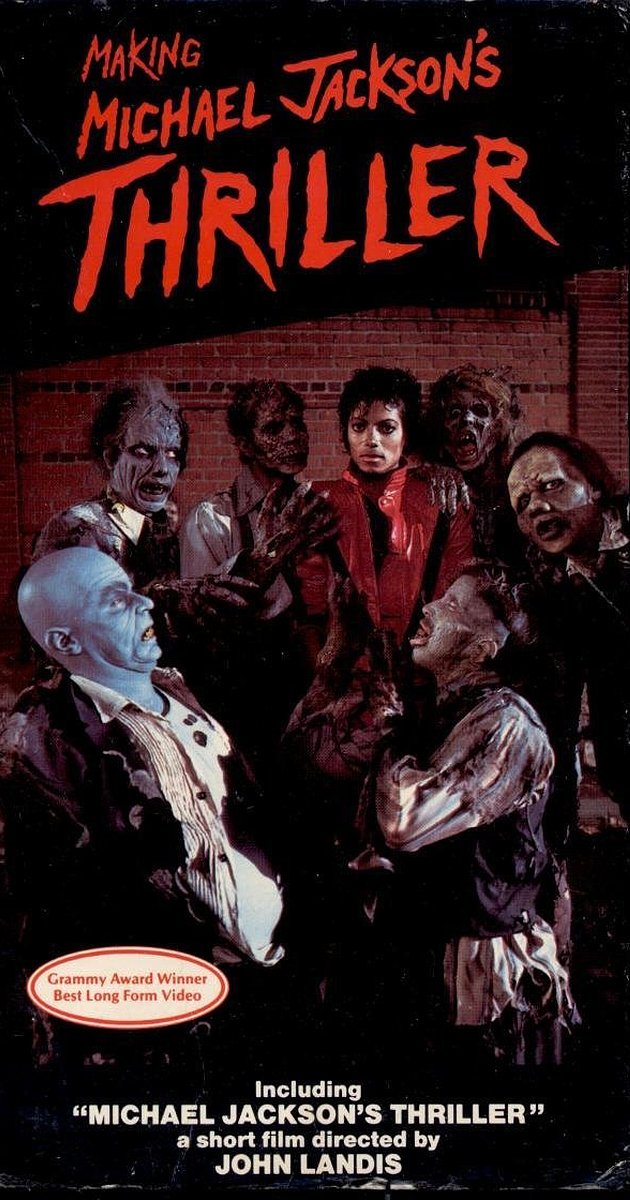
Michael Jackson’s Thriller

(USA 1983)

“Now, I have something to tell you…I’m not like other guys.”

— Michael Jackson

A very young Michael Jackson on a date with…his girlfriend (Ola Ray)? Jackson playing a werewolf, a zombie, and a lizard-eyed creature? Vincent Price reading an outro? Bad ’80s hair? You know it’s thriller, thriller night!

It’s not his best song, but Michael Jackson’s Thriller is a fucking cool video. It features all the showmanship he’s known for — the dancing, the weirdness, the bigness of the whole thing, that red jacket and those white socks, oh and a setting in the midst of seedy urban decay, this time a cemetery apparently somewhere downtown. Directed by John Landis, Thriller is clever: what starts as a cheesy horror movie turns out to be…a cheesy horror movie. Loaded with references to Night of the Living Dead and An American Werewolf in London, Thriller demonstrates that Jackson actually had a sense of humor.

I don’t put a music video on my blog every day. In fact, Michael Jackson’s Thriller is (so far) the only one. Why? In my quest to see as much as possible on the Library of Congress National Film Registry, I am obligated to include the final single and title track from the legendary pop star’s massive blockbuster album Thriller (https://en.m.wikipedia.org/wiki/Thriller_(Michael_Jackson_album) ). The song was not written by Jackson — Rod Temperton came up with it.

This video truly was a “seismic shift” — longer, more dramatic, and reaching beyond the song, it proved that music videos could be more than promotional clips; they literally could be little movies — or as here, bona fide events — that attract a huge audience, and thus worthy of a big budget. I can cite a number of artists who followed the template that Jackson set with Thriller.

In 2009, the United States Library of Congress deemed Michael Jackson’s Thriller “culturally, historically, or aesthetically significant” and selected it for preservation in the National Film Registry (https://www.loc.gov/programs/national-film-preservation-board/film-registry/complete-national-film-registry-listing/).

With Marcea Lane, Kim Blank, Lorraine Fields, Tony Fields, Michele Simmons, Vincent Peters, Michael Peters, Vincent Paterson, Michael De Lorenzo, Ben Lokey, John Command, Richard Gaines, Mark Sellers, Suzan Stadner, Diane Geroni, Suga Pop

Production: MJJ Productions, Optimum Productions

Distribution: Epic Records, Vestron Video

14 minutes
Not rated

(iTunes) A

https://michaeljackson.com

Snow-White

(USA 1933)

Max Fleischer’s Snow-White is nothing like Walt Disney’s — and that’s good. Fleischer offers a dark, edgy, and weirdly trippy death-focused version of the story most know from Disney. He “staffs” this short with characters from his Betty Boop cartoons.

Betty Boop (Mae Questel) — as Snow White — is off to a bad start when a magic mirror with Cab Calloway in it tells the Evil Queen (Questel), who looks and acts a lot like Olive Oyl, that Betty is “the fairest in the land.” The Queen orders her flunkies, Bimbo and Ko-Ko the Clown, to kill Betty — off with her head!

Bimbo and Ko-Ko don’t really want to hurt Betty. They take her to the forest, where she escapes by jumping into a river that freezes her into a box that looks like a coffin and carries her down a hill to the seven dwarves. Meanwhile, Bimbo and Ko-Ko fall into a hole and land in a cave where the Queen is. She turns them into monsters as they sing a blues number.

The Queen asks the mirror again who the fairest in the land is, and this time the mirror explodes into a puff of smoke that puts her face to face with Betty. Things don’t end well for the Queen.

Roland C. Crandall’s animation is rough and jagged and kind of jumpy, giving the whole thing a nervous energy and a sketchy vibe. He loads this cartoon with ghosts, skeletons, armored executioners, and other creepy goblins. Ko-Ko dancing to “St. James Infirmary Blues” is rotoscoped from footage of Calloway performing the song. This Snow-White has a Cajun flavor to it. It’s an interesting approach.

In 1994, the United States Library of Congress deemed Snow-White “culturally, historically, or aesthetically significant” and selected it for preservation in the National Film Registry (https://www.loc.gov/programs/national-film-preservation-board/film-registry/complete-national-film-registry-listing/).

With Billy Murray

Production: Fleischer Studios

Distribution: Paramount Pictures

7 minutes
Not rated

(YouTube) C+

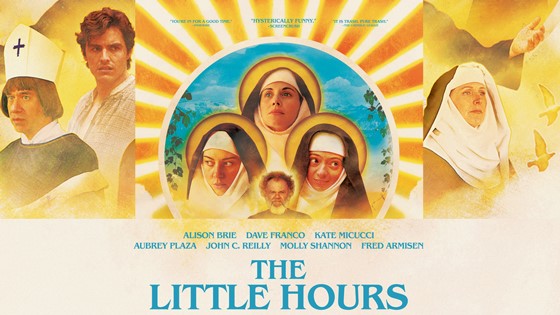
The Little Hours

(USA / Canada 2017)

“Eating blood? Do you think I’ve ever written down ‘eating blood’ before? Where am I?”

— Bishop Bartolomeo

From what I remember in my English lit classes, Geoffrey Chaucer called it as he saw it. He took a dim view of piousness and devotion because he knew that neither makes someone a good person. Hold that thought.

Some people take religion very seriously. Others reach such a high level of intellectual refinement or maturity that it puts them beyond crass, juvenile humor. Good for them — I’m not one of those people. I adore a snarky, irreverent story; it’s even better when it involves absurdism or sacrilege and still has something to say. The Little Hours is exactly that: a farce with a point.

Set during the Middle Ages, hapless Fr. Tommasso (John C. Reilly) has the unenviable job of overseeing a convent. Yipee. He finds himself without a gardner when Lurco (Paul Weitz) quits after three hateful young nuns — vain Sr. Alessandra (Alison Brie), nerdy gossipry Sr. Ginerva (Kate Micucci), and belligerent Sr. Fernanda (Aubrey Plaza) — physically attack him one too many times.

While on a mission selling embroidery to raise funds for the convent, Fr. Tommasso, lost and drunk, crosses paths with Massetto (Dave Franco), a servant running from his master, obnoxious douchebag Lord Bruno (Nick Offerman). Bruno is out for blood (not to mention balls) after he discovers Massetto has been carrying on with his wife (Lauren Weedman) for some time.

Fr. Tommasso learns of Massetto’s dilemma and makes a proposal: Massetto can work in the garden at the convent, but he must pose as a deaf-mute to avoid stirring the ire of the nuns. Massetto accepts, but things don’t pan out quite as intended. The young nuns are, well, horny. Not long after he arrives at the convent, Massetto is getting it on with both Alessandra and Fernanda. All hell breaks loose when they find out.

Written and directed by Jeff Baena, The Little Hours is loosely based on — or a spoof of — a novella from Giovanni Boccaccio’s The Decameron, a 14th Century epic. If this sounds highbrow, don’t fret — it’s the only sophisticated thing about this film, which is fine because it is above all else a comedy.

Loaded with f-bombs, sex, and general malice, The Little Hours is an amusing mix of Mean Girls and Monty Python. The cast works well as an ensemble, bringing out and playing off of each other’s goofiness in an endearing way. I see hints of improvisation, which brings even more energy to the whole thing. Although the story peters out toward the end, Baena keeps the momentum going strong for most of it. What could have been a thin joke stretched out too long and too far stays fresh and fun with this vibrant and funny cast.

For all its silliness and flippancy — pretty much all seven deadly sins make an appearance here — Baena raises an interesting point. The Little Hours is very much a comedy about desire, and it get its laughs from the conflict between desire and appearance. Without getting preachy, The Little Hours shows that piousness and devotion don’t douse the flames of desire; sometimes, they fan them. After all, we’re all merely human. I can’t help thinking that Chaucer would approve.

With Molly Shannon, Fred Armisen, Jon Gabrus, Jemima Kirke, Adam Pally, Paul Reiser

Production: StarStream Media, Bow and Arrow Entertainment, Destro Films, Dublab Media, Productivity Media, Concourse Media, Exhibit Entertainment, Foton Pictures

Distribution: Gunpowder & Sky (USA), Mongrel Media (Canada), GEM Entertainment (International)

90 minutes
Rated R

(Gene Siskel Film Center) B

http://www.thelittlehoursmovie.com