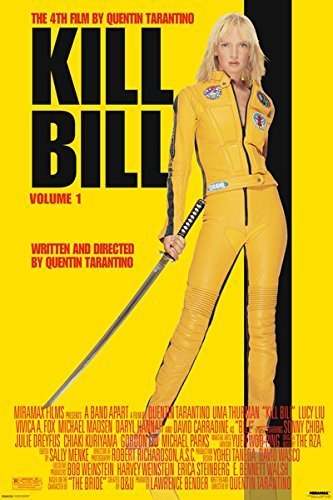
Kill Bill: Volume 1

(USA 2003)

“Revenge is never a straight line. It’s a forest. And like a forest, it’s easy to lose your way. To get lost. To forget where you came in.”

—Hattori Hanzō

“It’s mercy, compassion, and forgiveness I lack,” The Bride (Uma Thurman) plainly informs one of her assailants before she exacts revenge. “Not rationality.” Uh, really? Right off the bat, Quentin Tarantino’s Kill Bill, Volume 1 (not to be conflated with Kill Bill: Volume 2, which is longer but not quite as good) is an action film packed with snark and coolness. Uma Thurman is The Bride (codeman Black Mamba), who in the sepiatone opening scene is lying on the floor of a chapel in El Paso, Texas. She’s in a wedding dress, bleeding and pleading for her life. “It’s your baby,” she tells Bill (David Carradine, who has a bigger part in the second installment). He shoots her in the head.

Four years later, The Bride wakes up—midfuck, mind you—from a coma in the hospital. There’s no baby. She takes out a would-be rapist, Jasper (Jonathan Loughran), and an orderly named Buck (Michael Bowen), who pimped her out. Incidentally, Buck has a catchphrase that rhymes with his name—you figure it out. The Bride runs off with Buck’s truck, the “Pussy Wagon.” Once she gets her feet and legs moving, she sets out to settle a score—or six. First, though, she has to persuade retired master swordsmith Hattori Hanzō (Sonny Chiba), who runs a sushi bar in Okinawa, to make her a sword.

Kill Bill: Volume 1 is totally far fetched, but that’s not important. Like most Tarantino films, the emphasis here is on the characters and the action, not the plot; otherwise, two hours of not much more than a badass blonde babe methodically killing teammates who double-crossed her when she was a member of something called the Viper Assassination Squad wouldn’t work. Originally intended as one long film (http://killbill.wikia.com/wiki/Kill_Bill:_Vol._1), Kill Bill: Volume 1 depicts two of the paybacks: Vernita Green (Vivica A. Fox), who’s now a housewife and mother in suburban Los Angeles, and O’Ren Ishii (Lucy Liu), the head of the Tokyo Yakuza.

Beautifully staged and shot, the violence is over the top yet perfectly choreographed. The scene at the House of Blue Leaves is eloquent right down to the blood in the snow. Tarantino plays around with the sequence of events and mixes genres including anime. He employs his penchant for sharp dialogue, snazzy settings with memorable names, and sick humor. Plus, he throws in cool music and clothes; Daryl Hannah dressed as a nurse, for example, is fucking fabulous! As a result, Kill Bill: Volume 1 is a dazzling bloodfest. It takes a certain type to love a film like this—and it’s one of my favorites.

With Julie Dreyfus, Chiaki Kuriyama, Gordon Liu, Michael Parks, James Parks, Sakichi Sato, Ambrosia Kelley

Production: A Band Apart

Distribution: Miramax Films

111 minutes
Rated R

(Logan Theatre) A

https://www.miramax.com/movie/kill-bill-volume-1/

The Tell-Tale Heart

(USA 1953)

I caught The Tell-Tale Heart as an extra at Music Box Theatre’s screening for Reel Film Day. Directed by Ted Parmelee and narrated by English actor James Mason, it’s a nifty modern take on Edgar Allan Poe’s famous 1843 short story about a murderer haunted by his victim’s heartbeat, which he hears from underneath the floorboards where he hid the body. Paul Julian’s design and Pat Matthews’s animation is shadowy and surreal, nicely depicting the horror and the madness of Poe’s classic. Boris Kremenliev’s score adds an eerie Twilight Zone feel.

This short has the distinction of being the first cartoon to earn an ‘X’ rating. However, it appears the rating, assigned by the British Board of Film Censors in the UK, had more to do with religion than obscenity (http://dangerousminds.net/comments/this_moody_1953_animation_of_edgar_allan_poes_the_tell-tale_heart_was_the_f). It had to be the dark occult nature of the story,  as there is nothing remotely sexual here.

In 2001, the United States Library of Congress deemed The Tell-Tale Heart “culturally, historically, or aesthetically significant” and selected it for preservation in the National Film Registry (https://www.loc.gov/programs/national-film-preservation-board/film-registry/complete-national-film-registry-listing/).

Production: United Productions of America

Distribution: Columbia Pictures

7 minutes
Not rated (USA)

(Music Box) A

Reel Film Day: A Celebration of 35mm Cinema

Sad Vacation: the Last Days of Sid and Nancy

(USA 2016)

It doesn’t get more P.R. (“punk rock”) than the final days of Sid Vicious and Nancy Spungen, the notorious and dysfunctional so-called “Romeo and Juliet of punk”—frankly, I’ve always viewed them as not too far off from John and Yoko, but I digress. Two messy heroin junkies, they bounced around for most of 1978 after the Sex Pistols disbanded. In September, they landed in Manhattan, where they rented a room at the Chelsea Hotel and Nancy appointed herself Sid’s manager. A month later, she ended up slumped next to the toilet in their room, dead from a stab wound to the abdomen (though she had multiple shallow stabs all over). Sid was arrested and allegedly confessed to her murder. While out of prison on bail, he died of a heroin overdose—some claim accidentally administered by his mother, others claim suicide—just four months later.

Danny Garcia’s Sad Vacation, a straight-to-video release coming out almost exactly 30 years after Alex Cox’s biopic Sid and Nancy, revisits these legendary rock and roll deaths. Interviewing many a soul who was there—Steve “Roadent” Conolly, Kenny “Stinker” Gordon, Hellin Killer, Walter Lure, Howie Pyro, Cynthia Ross, Gaye Black, Phyllis Stein, and Sylvain Sylvain to name a few—Garcia presents the facts, which are conflicting and not at all clear. Although Sad Vacation covers a little history of the punk movement, Malcolm McLaren, and the Sex Pistols, the focus is assiduously on what happened at the Chelsea. Narrated by Fun Lovin’ Criminals front man Huey Morgan, Sad Vacation takes on the tone of a crime documentary, laying out evidence and showing the holes in it. Not surprisingly, Garcia reveals some of the “eight thousand or so” conspiracy theories surrounding the murder, with those who knew the couple speculating on who really killed Nancy. Many point to Rockets Redglare, a drug dealer and bodyguard who worked for them. Redglare, who went on to appear in a number of films you’ve actually seen, died in 2001 (https://en.m.wikipedia.org/wiki/Rockets_Redglare).

Sad Vacation is not essential viewing; it doesn’t uncover anything new, raise any points that haven’t been raised before, or even pick a theory to endorse. It concludes that no one will ever know what happened. Big wow. That said, Garcia succeeds in showing that Sid and Nancy were kids—flawed ones, but still. After hearing words like “mess,” “dysfunctional,” and “destructive” to describe their relationship, it’s sweet to learn that his ashes were spread on her grave because they couldn’t be buried together. Now that’s P.R.

94 minutes
Not rated

(Home via iTunes) C

https://m.facebook.com/sadvacationdocumentary/

http://www.chipbakerfilms.com

King Cobra

(USA 2016)

Well now, Justin Kelly’s King Cobra looks like a film with some serious bang: it depicts the salacious, sensational, and supposedly true story of tres popular real-life gay porn actor Sean Lockhart b/k/a Brent Corrigan’s messy entry into the porn industry. Packing loads of scandal and suspense, it comes with a denouncement of sorts from Lockhart himself (https://www.google.com/amp/www.gaystarnews.com/article/brent-corrigan-condemns-gay-drama-king-cobra-bastardising-story-life/amp/?client=safari). Oh, and the money shot: a wad of bona fide Hollywood stars all in on the action. Hot yet? Not so fast, Jack: if there’s one thing I’ve learned from many an opportunity to view gay porn, it’s that looks are deceiving and the movies rarely live up to their promise. Assessing King Cobra therefore demands some deeper probing to get to the bottom of it.

Taken from Andrew E. Stoner and Peter A. Conway’s true crime exposé Cobra Killer: Gay Porn, Murder, and the Manhunt to Bring the Killers to Justice, Kelly’s screenplay gets into the real 2007 murder of Bryan Kocis, the owner and operator of Cobra Video, a real gay porn production company. As such, it makes sense that Kelly doesn’t focus on Corrigan as much as he does on Stephen (Christian Slater), a thinly fictionalized version of Kocis. A forty-something professional photographer turned producer of twink skin flicks, Stephen “discovers” Lockhart (Garrett Clayton) and signs him to make videos in a room of his suburban home in Dallas Township, Pennsylvania. Lockhart becomes Brent Corrigan, a name he plucks from the phone book, and proves to be an internet superstar as a bareback bottom. Things are strained—Stephen is clearly smitten with Lockhart, who moves in with him and does menial chores like yard work and scrubbing toilets around the house shirtless when he’s not shooting porn. Plus, Stephen is doughy and creepy. Lockhart realizes he’s being exploited and sees his potential to make a lot more money on his own. The shit hits the fan when he walks away from his contract with Cobra only to find that he can’t use his porn name because Stephen trademarked it.

Enter psychotic couple Harlow (Keegan Allen), a porn actor and rent boy, and his intense, overbearing boyfriend, Joe Kerekes (James Franco), owner of Viper Boyz, a smaller porn production company. Kerekes is a half million dollars in debt thanks to their ridiculously expensive lifestyle, which is starting to disintegrate. He’s got an idea for a sure moneymaker: Harlow and Corrigan together in a porn. They meet Lockhart, who wants to work with them but can’t use his lucrative name. Desperate to make it happen, they come up with a way to solve Lockhart’s dilemma: get rid of Stephen.

Although I didn’t love it, King Cobra is not terrible. In fact, it’s a noticeable improvement over Kelly’s first film, last year’s I Am Michael (https://moviebloke.wordpress.com/2015/10/24/i-am-michael/). That said, it still suffers from the same deficiencies. If anything, it feels underdeveloped. The two subplots—the storyline with Stephen and Lockhart, and the one with Joe and Harlow—take too long to intersect; when they do, King Cobra devolves into a gay slasher flick. Ho hum. Molly Ringwald and Alicia Silverstone are okay in their roles as Stephen’s sister and Lockhart’s mother, respectively. However, their characters are superfluous and don’t fit into the story—it’s as though they’re dropped in just to give the actors a part in the film so their names can be included on the poster. Oh yeah: another film with Franco playing a gay guy, only this time he gets his butt plowed. Big wow. For a film about the gay porn industry, King Cobra is shy about nudity; it comes off as sanitized cable soft core lite. It’s not even the whole true story; Rolling Stone ran a story about the murder of Kocis in a September 2007 issue: http://www.rollingstone.com/culture/features/death-of-a-porn-king-20070920. Kelly takes some generous artistic license, leaving out parts of what happened (and thus arousing the real Lockhart’s ire).

Kelly’s script is so overboard on gay clichés that it rings hollow. Just as he did in I Am Michael, he again gives superficial treatment to his characters here and doesn’t quite get into their heads, leaving them flat—though he does a better job with Stephen and to a somewhat lesser degree Lockhart. Kelly seems drawn to the dark side of the gays, and I won’t fault him for that. However, his way of portraying this dark side is amateurish and uninformed, recalling films like Cruising and Basic Instinct. Having seen the only two films he’s made, I have to wonder whether he knows any gay people.

I’ll end this on a positive note: Clayton is the real star of this picture. He plays Lockhart as a diva hustler, one with an agenda that no one is getting in the way of. He’s pouty, arrogant, bitchy, so stuck on himself, and unapologetic about it all. He’s brilliant! The scene where a makeup artist touches up his butt says it all.

92 minutes
Not rated

(Home via iTunes) C-

http://www.ifcfilms.com/films/king-cobra

http://gowatchit.com/microsite/4274?gwi_origin=tracking_link&gwi_origin_context=microsite#upcoming_theaters-11402

London Road

(UK 2015)

“Everyone is very, very nervous. Um. And very unsure of everything, basically.”

—The Cast

“British,” “murder,” “mystery,” “thriller,” “comedy,” and “musical” are words that might sound dubious when used together to describe the same work. These elements, though, gel nicely in the amusingly quirky London Road, Rufus Norris’s adaptation of Adam Cork and Alecky Blythe’s musical theatre revolving around Steve Wright, the notorious Suffolk Strangler a.k.a. Ipswich Ripper.

The subject matter of London Road certainly isn’t anything to sing about: Wright moved to a modest working class neighborhood in Ipswich for ten weeks and killed five prostitutes during Autumn 2006. The bodies started showing up, casting paranoia over the small town. Wright was arrested just before Christmas, stressing out his neighbors on London Road, where the murders occurred in his house.

London Road could accurately be called an anatomy of a community directly affected by a macabre event, as the story is not really about Wright but rather his spooked neighbors. Based on actual interviews, the story traces their reactions to the murders and the fact that they occurred so close to home. Particularly hitting is the impact of the small street’s invasion by the police and the media on the various residents’ daily lives. Flowers bring them to their ultimate redemption.

London Road features Olivia Colman, Anita Dobson, Kate Fleetwood, Nick Holder, Paul Thornley, Michael Shaeffer, and Tom Hardy, whom I didn’t even recognize in his small role as a cab driver. Norris respects the characters’ dignity, letting them each have their own voice without putting them in a negative, unsophisticated light. The mood is a bit schizo, going from tense to darkly comic before erupting into song and choreographed numbers. The songs, by the way, are droll and clever, incorporating verbal ticks into the rhythm. They’re catchy, too—I’m still singing one of them two days later. I loved one scene in which a newscaster (Shaeffer) struggles in song to explain how forensics identified Wright through DNA in his semen, a word he can’t use during daytime TV—who knew the Brits have prudish broadcasting rules just like we Americans do?

Overall, London Road is an interesting experience unlike any other film I’ve seen lately. I laughed, I was intrigued, and the music pulled me in.

91 minutes
Not rated

(Facets) B-

http://ntlive.nationaltheatre.org.uk/productions/ntlout11-london-road-film

Hell or High Water

(USA 2016)

“I’ve been working here since 19 and 87. Ain’t nobody ever ordered nothing but a T-bone steak and baked potato. Except one time, this asshole from New York ordered a trout. We ain’t got no goddamned trout.”

—T-Bone Diner waitress

I must admit: I got good and liquored up before I saw Hell or High Water. Fortunately, my buzz did not ruin the movie—or vice versa.

Hell or High Water is a richly layered, rather cerebral Western heist film. Two brothers, cool and brooding Toby (Chris Pine) and impulsive ex-con Tanner (Ben Foster), systematically hold up various branches of Texas Midland, a bank in rural west Texas. Initially, the series of robberies comes off as a mindless crime spree for two punk cowboys in ski masks and a shitty car. It turns out to be much more complicated: Toby has a week to come up with thousands of dollars to pay off the mortgage on the family ranch, or shady Texas Midland will foreclose on it. The brothers attract the attention of sheriff Marcus Hamilton (Jeff Bridges) and his partner, Alberto (Gil Birmingham), who follow their trail patiently and methodically with good old-fashioned horse sense.

Taylor Sheridan’s screenplay is thoughtfully tight and complex, loaded with plot turns and moral questions. He raises provocative points about capitalism and the American finance system. All of his characters are flawed but sympathetic, making Hell or High Water more than a simple good-versus-evil story. There is no real hero here. Director David Mackenzie maintains a really nice balance of tension, drama, and humor without relying on gunfire and chases (though both of those are in the film). The acting is superb—I can’t think of a single performance that isn’t stellar. The multitude of minor characters—waitresses (Margaret Bowman and Debrianna Mansini), townsfolk, bank employees (Dale Dickey and Joe Berryman)—give the film its color. Hell or High Water has a major Coen Brothers vibe to it—think Blood Simple or No Country for Old Men. The pace is painfully slow at points, but it works. Giles Nuttgens’s sunbleached cinematography is nothing short of stunning, and it beautifully captures the ominously vast and barren landscape that seems to suffocate everyone in it.

102 minutes
Rated R

(ArcLight) B+

http://www.hellorhighwaterofficial.com

Any Number Can Win [Melodie en Sous-Sol]

(France 1963)

I approach “heist” movies with hesitation—they tend to be silly, formulaic affairs. As a fan of midcentury Italian and French film, though, Any Number Can Win caught my eye. The promotional blurb I read persuaded me to give it a shot. I’m glad I did.

Charles (Jean Cabin) is a gruff career criminal who just got out of the joint. His wife (Viviane Romance) wants to retire and play it straight, but he insists on one last job: knocking off a casino in Cannes. He recruits Francis (Alain Delon), a petty thief he met in prison, and Francis’s brother-in-law, Louis (Maurice Biraud), a simple mechanic who really has no business participating in a scheme like this. The plan calls for Francis, posing as a high-rolling playboy, to stay at the casino for a week; his job is to scope out an entrance to the elevator shaft backstage that leads to the vault where the money is kept.

Once Francis arrives, he’s immediately smitten with Cannes: hanging out at the pool, driving a cool car, chatting up beautiful girls over cocktails, hitting night clubs, ordering room service. He hooks up with a dancer, Brigitte (Carla Marlier), as a means to an end—but he gets caught up in the melodrama of their fling and the glamorous life he’s gotten himself into. His dalliance threatens to derail the entire operation.

Any Number Can Win gets off to a shaky start—it’s so slow that I began to doze off. Director Henri Vernuil picks up the pace once Francis gets to Cannes and steadily builds momentum and suspense as the story progresses. I got more and more anxious watching the plan come to fruition, excited to see what happens next. A great jazz score orchestrated by Jean Gitton punctuates the action nicely. The early Sixties French Riviera setting—palm trees, lights, and nouveau-meets-modern architecture—is dazzling in black and white. Delon fits perfectly with his smoldering, polished looks. The ending is one of the most memorable I’ve ever seen: floating cash, that’s all I’ll say.

118 minutes
Not rated

(Gene Siskel Film Center) B

https://youtu.be/lWsGuQwyKbA

The Infiltrator

(USA 2016)

Bryan Cranston has come a long way from his stint as Tim Whatley, Jerry Seinfeld’s dentist. He’s an excellent choice to play Robert “Bob” Mazur, a U.S. Customs agent who in 1985 went undercover as fictitious New Jersey money launderer Bob Musella to work his way into the trafficking network of Colombian drug czar Pablo Escobar. With the assistance of fellow agents Emir Abreu (John Leguizamo) and Kathy Ertz (Diane Kruger), Mazur—to use his words—“followed the money” instead of the drugs. It led to one of the biggest drug busts in American history.

Based on Mazur’s memoir The Infiltrator: My Secret Life Inside the Dirty Banks Behind Pablo Escobar’s Medellín Cartel, director Brad Furman—whose mother, Ellen Brown Furman, wrote the script—lets Cranston go absolutely apeshit with his character. It’s impossible not to draw parallels between Mazur and Breaking Bad’s Walter White; it’s glaringly obvious that both characters are essentially family guys who choose a dangerous double life that consumes them to the point of losing who they are—not to mention their lives. This plays out exquisitely in a scene where a cartel member (Simón Andreu) who knows Musella spots Mazur and his wife, Evelyn (Juliet Aubrey), having a quiet anniversary dinner at a restaurant.

The Infiltrator is a good movie. Despite occasionally feeling like an episode of Miami Vice, it nonetheless has an intensity that slowly comes to a boil, and when it finally does: BOOM! The moral dilemma of betraying the people not only who come to trust Musella but also welcome him into their lives adds a dramatic slant that movies like this tend to lack. I was riveted. Considering its subject matter, though, The Infiltrator doesn’t exactly move fast. It’s more of a low key character study fueled by what’s going on in Mazur’s head. Benjamin Bratt, Yul Vazquez, and even Olympia Dukakis turn in great performances. There are some dark, funny moments along with some really unsettling scenes—like a weird voodoo ritual, an out-of-nowhere drive-by, and murder on the dance floor. It remains to be seen how memorable The Infiltrator proves to be, though.

127 minutes
Rated R

(AMC River East) B

http://www.theinfiltrator.com

Home3

The Nice Guys

(USA 2016)

Last year’s Inherent Vice disappointed me; I dug its ’70s Venice Beach vibe, but I found the story choppy and its execution ultimately lackluster—unforgivable for a film with arguably the best all-star cast in years. Little did I know walking into the theater that Shane Black’s The Nice Guys is exactly what I hoped for with Inherent Vice: an unapologetically dippy and fun action retro-comedy with stylish sets, cool clothes, and a rad soundtrack. Shallow? Maybe. But I enjoyed The Nice Guys a lot more; like old MTV, it’s a fluffy guilty pleasure.

Los Angeles, 1977: Holland March (Ryan Gosling) is a detective—the world’s worst, by his own admission—down on his luck. Amid jobs like the senile widow looking for her missing husband—his ashes are in an urn on the mantle—March is hired by the aunt (Lois Smith) of a dead porn actress, Misty Mountains (Murielle Telio); she claims her niece just visited her, and she wants him to find her. After a run-in with thug-for-hire Jackson Healy (Russell Crowe) and a trail that leads to a girl named Amelia (Margaret Qualley) and an “experimental” skin flick called How Do You Like My Car, Big Boy, March joins forces with Healy to solve a mystery that brings them right to the heart of the porn and auto industries.

The Nice Guys is a treat all around. No one thing carries this film; it’s a successful combination of multiple elements. The story and tone—a mix of the aforementioned Inherent Vice, Lethal Weapon (also by Black), and Boogie Nights with a whiff of Scooby Doo—is surprisingly cohesive, absorbing, and entertaining. Where Lethal Weapon‘s Martin and Roger are buddies, March and Healy are “frienemies:” the former is as drunkenly and sweetly inept as the latter is soberly and brutally efficient. It works; Gosling and Crowe, who looks like John Goodman these days, have a solid chemistry. It’s fun to see them both in something light, and they seem to have a good time here. I never thought of Gosling as a comedic actor, but his timing is great—my favorite scene is Healy busting into the men’s room stall on him. March gets by thanks in large part to his teenaged daughter, Holly (Angourie Rice), who serves as a voice of reason even as he corrects her grammar. Matt Bomer makes a brief, creepy, and violent cameo as John Boy, a hitman with a big mole on his face—anyone familiar with The Waltons no doubt will get the reference right away. Kim Basinger is a welcome surprise as a hard, all-business federal agent. The whole thing ends in a crazy choreograped sequence involving a film canister.

Philippe Rousselot’s cinematography is snappy, with vivid colors that shine though even during the night scenes. The Nice Guys depicts a sleazy era of Los Angeles in a cheeky, over-the-top way—a time I would have loved to have seen it. This is not a film that takes itself seriously—it seems to revel in its frivolity. Seeing it over Memorial Day weekend was a great way to kick off the summer movie season. Indulge, I say.

116 minutes
Rated R

(ArcLight) B-

http://www.theniceguysmovie.com

Dead End

(USA 1937)

I never heard of the Dead End Kids until I saw this film. Long before West Side Story and The Outsiders, the Dead End Kids served as a Depression Era vehicle for social commentary on American urban life. Living in tenements along the East River as the moneyed started to convert Manhattan’s slums into upscale properties, the Dead End Kids demonstrated some of the pains of change and the kinds of decisions necessary to avoid going down a road to ruin (i.e., a life of crime). The ensemble held on in different incarnations well past its shelf life until the late 1950s, when the actors were in their mid-30s and had become more of a comedy act.

Adapted from Sidney Kingsley’s successful 1935 play, Dead End is the one that started it all. It goes through a day in the life of a street “gang” led by Tommy Gordon (Billy Halop). The kids are rough around the edges and have names like Dippy (Huntz Hall), Spit (Leo Gorcey), and T.B. (Gabriel Dell). They openly mock their rich neighbors across the street in the co-op that abuts the slum (the windowless door to the co-op clearly states “service entrance”), steal, fight, play cards, shine shoes, and spend a lot of time swiming in the river at the end of the block. A slick neighborhood expat gangster, “Baby Face” Martin (a young Humphrey Bogart), who apparently made it as a hit man elsewhere, returns with his thug, Hunk (Allen Jenkins). No one, not even his low-talking mother (Minor Watson), wants him around. Meanwhile, Tommy’s sister, Drina (Sylvia Sidney), a mother figure who’s off work striking for better wages, is trying her best to keep Tommy on the right path. She mentions a few times that the extra $3.50 a week (!) she’s fighting for would get them to a better place. She’s all into Dave (Joel McCrea), an unemployed architect with his eye on a rich girl (Wendy Barrie) who lives in the co-op.

Loaded with subplots, the story is okay even with its old school melodrama. Some of the performances—specifically Bogart, Sidney, McCrea, and Watson—are decent. The surreptitious way syphilis is slipped into the story is interesting. Otherwise, Dead End has issues. It may have been edgy in the ’30s, but in comtemporary eyes it reads as silly, even campy. The set is too tidy and ordered to be a real street. The kids’ exaggerated fake Archie Bunker accents get annoying after awhile—I expected to hear the word “murdalize” at many points (I didn’t). The story is moralistic in an unsophisticated way that even the ABC Afterschool Special never was. Still, Dead End depicts a world without a middle class and criticizes gentrification, points that ring familiar today. I didn’t hate Dead End, but it’s completely forgettable.

(Gene Siskel Film Center) C-

http://youtu.be/10MCEnHKxR4