The Asphalt Jungle

(USA 1950)

I expected crime noir classic The Asphalt Jungle to be something of a cheesefest: stiffly acted, overly melodramatic, and maybe a bit hamfisted in its morality, like The Hardy Boys for adults of the Greatest Generation. Thankfully, John Huston’s film adaptation of W.R. Burnett’s 1949 novel is none of that.

No sooner is Doc Riedenschneider (Sam Jaffe) out of the big house when he hatches a plan to do what he does best: steal. Like, a million bucks or more in jewels from a jewelry store (not Jared’s). Yes, a jewel heist. He pitches his plan to Cobby (Marc Lawrence), a two-bit gambling bookie, who puts him in touch with Alonzo Emmerich (Louis Calhern), a rich but shady attorney. Emmerich buys in, not just providing financial backing but also agreeing to handle disposing the booty for cash.

Doc assembles a crew of petty thieves consisting of a “box man,” or a safecracker (Anthony Caruso), a driver (James Whitmore), and an all-important “hooligan” (Sterling Hayden) to execute the plan. The heist goes off without a hitch, mission accomplished. It’s smooth; uneventful, even. That is, until a stray bullet accidentally hits one of the crew members.

This is where the plot gets really interesting, as human nature and a slew of bad decisions rear their ugly heads. It doesn’t help that at the same time, sundry troubles that have been brewing alongside all the planning are coming to a boil. Soon, it’s every man for himself in a sticky web of deception, doublecrossing, and death.

The Asphalt Jungle is an exquisitely layered and calibrated drama that’s tough to turn away from — and tough not to appreciate. Written by Huston with Ben Maddow, the screenplay is tight. The characters — a collection of urban lowlife thieves, thugs, private detectives, crooked cops, and good looking dames — all have dimension. Interestingly, what would probably be the most intense scene in most movies — the break-in — isn’t; the intensity and the drama come from what happens after that. A manhunt that ends in Cleveland and an attempted swindle serve as the ticking clock here. This is the perfect thriller for a hot summer night in the city. Bonus: The Asphalt Jungle features a young but unmistakable Marilyn Monroe in one of her earliest roles.

In 2008, the United States Library of Congress deemed The Asphalt Jungle “culturally, historically, or aesthetically significant” and selected it for preservation in the National Film Registry (https://www.loc.gov/programs/national-film-preservation-board/film-registry/complete-national-film-registry-listing/).

With Jean Hagen, John McIntire, Barry Kelley, Teresa Celli, William “Wee Willie” Davis, Dorothy Tree, Brad Dexter, Helene Stanley, John Maxwell, Strother Martin, Jack Warden, Tim Ryan

Production: Metro-Goldwyn-Mayer

Distribution: Metro-Goldwyn-Mayer

112 minutes
Not rated

(Music Box) A-

Noir City

https://www.warnerbros.com/asphalt-jungle

Good Time

(USA 2017)

Good Time is not a film to see for the plot. Written by Josh Safdie and Ronald Bronstein, the storyline is not all that novel, complicated, or interesting — in itself. I can sum it up in a single sentence: Queens bad boy Connie Nikas (Robert Pattinson) spends a night fleeing cops while trying to get his mentally handicapped younger brother, Nick (Benny Safdie), out of the mess he put him in after a bank robbery they commit goes sideways. It sounds like a comedy, but it most definitely is not.

Good Time is a movie to see for the mood it creates — and man, is it intense! More or less a character study, this could have been a disaster in someone else’s hands. As it is, the whole thing soars thanks to the directing by brothers Benny and Josh Safdie and the acting, which is all around great. Pattinson is particularly terrific — forget Twilight. I’ve heard comparisons to Al Pacino’s best work in the ’70s, and I’ve got to agree; Pattinson conveys a natural nervous energy just under the surface so well that you feel it watching him. I found myself more and more jittery and paranoid with every move and bad decision Connie makes and every character he encounters. I noticed hints of Dog Day Afternoon, Cruising, The Godfather, and even The Graduate in Pattinson’s performance.

Taking place almost entirely at night, the settings are familiar but eerie: a hospital, the crammed TV-lit apartment of a Jamaican immigrant (Gladys Mathon) and her weed smoking teenage granddaughter (Taliah Webster), an empty amusement park. Add a skittish techno score by Oneohtrix Point Never, a pallet of neon-colored light, and a nonstop chase, and you’ve got Good Time. Roller coaster ride or drug trip, take your pick — either way, this is a film that drags you along for the ride and zaps you, in a really satisfying way. I don’t know if Good Time is Oscar material, but it’s definitely memorable.

I almost missed Good Time, which opened for what appeared to be a very short limited run in Chicago. I made my own bad decision to see it Friday night after dinner with lots of cocktails. The film became a big blur that my drunk brain couldn’t handle. I went back for a Sunday matinee by myself. I left impressed, and actually pissed that I wasn’t present the first time I caught it.

With Jennifer Jason Leigh, Barkhad Abdi, Necro, Buddy Duress, Peter Verby, Saida Mansoor, Eric Paykert

Production: Elara Pictures, Rhea Films

Distribution: A24

99 minutes
Rated R

(AMC River East) B+

http://goodtime.movie

Two Men in Manhattan [Deux hommes dans Manhattan]

(France 1959)

In his cool noir mystery Two Men in Manhattan [Deux hommes dans Manhattan], director Jean-Pierre Melville in his only starring role is Moreau, a cheerless and jaded reporter with Agence France-Presse. As he’s leaving work one night, his boss (Jean Lara) asks him to investigate the whereabouts of one Mssr. Fèvre-Berthier, the French United Nations delegate, who curiously has gone M.I.A.

Moreau heads straight to the flat of a frequent collaborator, hardened alcoholic photographer Pierre Delmas (Pierre Grasset), and yanks him out of bed—never mind the girl there with him. Delmas is the archetype paparazzo: cold-blooded and motivated by money. He knows his way around Manhattan.

The two men trail Fèvre-Berthier through a number of female associates: his secretary (Colette Fleury), a two-bit actress (Ginger Hall), a jazz singer (Glenda Leigh), a burlesque stripper (Michèle Bailly), and a high dollar whore in a high class brothel (Monique Hennessy). They find out what happened to him, but the story is scandalous.

Moreau doesn’t want to print it, but Delmas insists otherwise. A strange car following them around may persuade them to do the right thing—whatever that is.

With enough trench coats and fedora hats to clothe a newsroom, Two Men in Manhattan reflects Melville’s characteristic minimalist neo gangster movie style. The personal ethics here are all grey, which fits nicely with the night scenes, especially the exteriors shot on Times Square by cinematographer Nicolas Hayer. Aside from the exteriors, Manhattan never looked more fabulously fake: most of the interiors—the subway, a bar, a club, a theater, a hospital, a diner—were shot in a studio.

Part detective flick and part morality play, the tone shifts quite a bit between drama and waggishness, leading me to conclude that Melville didn’t take Two Men in Manhattan very seriously. It’s a minor work that comes off tongue in cheek, which makes it fun to watch—it compensates for Melville’s rather thin script. Plus, the whole thing sure is pretty.

With Christiane Eudes, Paula Dehelly, Nancy Delorme, Carole Sands, Gloria Kayser, Barbara Hall, Monica Ford, Billy Beck, Deya Kent, Carl Studer, Billy Kearns , Hyman Yanovitz, Ro. Tetelman, Art Simmons, Jerry Mengo

Production: Belfort Films, Alter Films

Distribution: Columbia Films (France), Mercurfin Italiana (Italy), Cable Hogue Co. (Japan), Cohen Media Group (USA)

85 minutes
Not rated

(Gene Siskel Film Center) B-

Disco Godfather [The Avenging Disco Godfather]

(USA 1979)

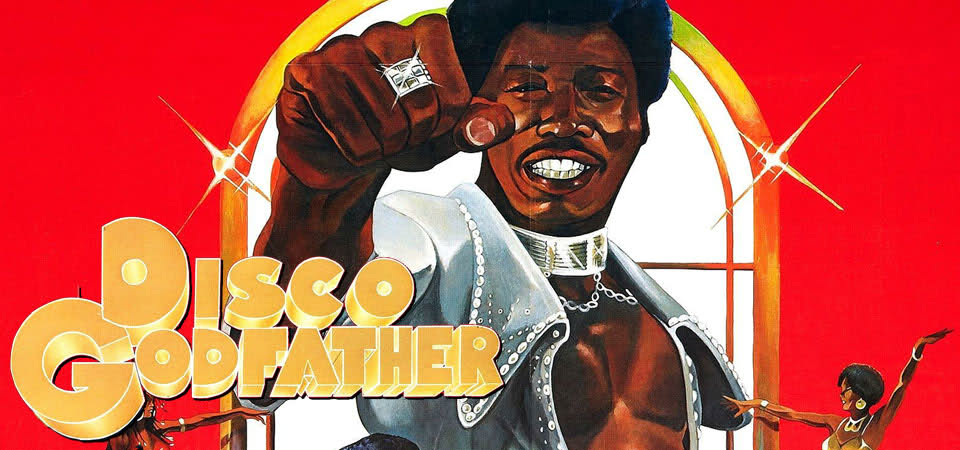
Dear God the Father! Some movies are so terrible, you love them for everything wrong with them—what’s bad is exactly what endears them. Other movies…well, they’re just terrible. It’s a thin line. Sadly, Disco Godfather falls into the latter category.

J. Robert Wagoner and Cliff Roquemore’s screenplay stars Rudy Ray Moore as Tucker Williams, an L.A. cop-turned-DJ at the trashy-ass Blueberry Hill Disco, which looks like a repurposed Denny’s. The plot involves Williams’s nephew, Bucky (Julius J. Carry III), who’s gotten hooked on “angel dust.”

One word: YAWN! What were they thinking? Disco Godfather is so boring, I’d rather watch reruns of 2 Broke Girls. The only thing that saves it from total failure is the wardrobe—Felice Hurtes, Jimmy Lynch, and Kimberly Sizemore deserve major kudos for finding the cool Goodwill stores. Fuck this bullshit: watch Dolemite and call it a day. They could have tried a little harder here.

With Carol Speed, Jimmy Lynch, Jerry Jones, Lady Reed, Hawthorne James, Frank Finn, Julius J. Carry III, Bishop Pat Patterson, Pucci Jhones, Howard Jackson, Yetta Collier, Pat Washington, Doc Watson, Leroy Daniels, Melvin Smith, Ronny Harris, Dolorise Parr, John Casino, Keith David

Production: Generation International

Distribution: Transvue Pictures (USA), Xenon Pictures

93 minutes
Rated R

(DVD purchase) D-

Breathless [Á bout de souffle]

(France 1960)

“After all, I’m an asshole.”

—Michel Poiccard

The third time is a charm: after seeing Jean Luc-Godard’s first full length feature film, Breathless, I now understand the love-meh relationship I have with his work.

On one hand, he’s got a remarkable grasp of human behavior and what motivates it. He’s got a snarky sense of humor. He’s stylish. His technique is gutsy for a lot of reasons. His characters are flawed. His subject matter is cool. He knows how to make a film look pretty, and most of them might as well be deemed official historical documents of the places where they were shot. Seeing a Godard film is like traveling back in time, an incidental bonus he probably never considered. I love all of this.

For all his strengths, on the other hand, a Godard film can be so damned…boring. Merde!

Fortunately, that’s not the case with Breathless, which I enjoyed. Godard and François Truffaut developed the story—I won’t call it a script or a screenplay because they made up much of it as they went along. Plot is always a loose construct with Godard, but there’s enough of one here to follow along fairly easily. Ugly cute guy (or is he a cute ugly guy?) Michel Poiccard (Jean-Paul Belmondo), a drifter car thief who fancies himself a French Humphrey Bogart, steals a car and drives it through the countryside. He shoots a policeman who pursues him and kills him.

With nowhere else to go, he heads straight to his American girl, Patricia (Jean Seberg), an expat student who sells a newspaper, the now defunct New York Herald Tribune, on the Champs-Élysées—that’s kind of weird—and writes articles here and there. She brings Michel to her apartment, where he hides out. He doesn’t mention anything to her about what happened. They get it on, or at least it’s implied that they do. She’s tells him she’s pregnant. One extended scene involves them lying around, talking.

Michel becomes a marked man, which he discovers as soon as he leaves the apartment with Patricia and sees a newspaper with a headline about him. I won’t ruin the ending, but it doesn’t bode well for him—especially after Godard himself sees Michel.

Breathless is a psuedo noir thriller that’s low on action but loaded with morally vacant characters who lack any redeeming qualities. There’s a nihilistic sexiness to it. The narrative moves along in a jazzy free-form way, and the imagery here is every bit a part of the story as the characters. The ending is not a happy one. If nothing else, Breathless is a visual stunner—black and white cinematic candy. The restored digital version I saw literally glowed.

I can handle more films like this one.

With Daniel Boulanger, Henri-Jacques Huet, Roger Hanin, Van Doude, Liliane David, Michel Fabre, Jean-Pierre Melville, Claude Mansard, Jean-Luc Godard, Richard Balducci, Jacques Rivette

Production: Les Films Impéria, Les Productions Georges de Beauregard, Société Nouvelle de Cinématographie (SNC)

Distribution: Films Georges de Beauregard, Les Films Impéria, Société Nouvelle de Cinématographie (SNC), Euro International Film (EIA) (Italy), Pallas Filmverleih (West Germany), British Lion Film Corporation (UK), Cinematográfica Azteca (Mexico), Ciné Vog Films (Belgium), Wivefilm (Sweden), Films Around the World (USA), Rialto Pictures (USA), Criterion Collection (USA)

90 minutes
Not rated

(iTunes rental) B

http://www.jean-lucgodard.com/films.html

https://www.criterion.com/films/268-breathless

The Godfather

(USA 1972)

“Why did you go to the police? Why didn’t you come to me first? What have I ever done to make you treat me so disrespectfully?”

—Don Vito Corleone


“My father is no different than any powerful man, any man with power. Like a president or a senator.”

—Michael Corleone


“And may their first child be a masculine child.”

—Luca Brasi


“Hey Mikey, why don’cha tell that nice girl you love her? ‘I love you with all a-my heart. If I don’t a-see you again a-soon, I’m a-gonna die!'”

“Leave the gun. Take the cannoli.”

—Peter Clemenza

Pretty much perfect, The Godfather was almost a different movie. Based on Mario Puzo’s insanely popular best selling 1969 novel, studio executives conceived a pulp gangster drama for its film adaptation. Good thing they wanted a “real” Italian-American to direct so it would be so authentic that moviegoers would “smell the spaghetti” (https://www.vanityfair.com/news/2009/03/godfather200903). Several unsuccessful attempts were made to attract a director, including Warren Beatty. Paramount “settled for” unknown Francis Ford Coppola, who took it somewhere else.

The Godfather is universally held in high esteem as one of the greatest films of all time—as it should be. It’s a a movie showered in superlatives—like the bullets that shower, well, most of the characters. It’s impeccable. We caught an anniversary screening.

Coppola’s morality play is a masterpiece, more complex than it seems at first and full of contrast and contradiction. A solemn and ominous mob drama that centers on Don Vito Corleone (Marlon Brando) and his family business, The Godfather boasts one riveting career-defining performance after another—Brando, Al Pacino, James Caan, Richard Castellano, Robert Duvall, and Abe Vigoda, to name a few. The characters are great, and the dialogue—perfect! Not a single second is wasted here, not even that long ass wedding scene.

The observations about human nature are astute, and the spin on assimilation and the American Dream is clever. The dramatic arc involving the descent of younger son Michael (Pacino) into a moral apocalypse is something you can’t shift your eyes away from. Black as its promotional poster, The Godfather leaves so much to chew on. This is what cinema is all about.

In 1990, the United States Library of Congress deemed The Godfather “culturally, historically, or aesthetically significant” and selected it for preservation in the National Film Registry (https://www.loc.gov/programs/national-film-preservation-board/film-registry/complete-national-film-registry-listing/).

With Sterling Hayden, John Marley, Richard Conte, Al Lettieri, Diane Keaton, Talia Shire, Gianni Russo, John Cazale, Rudy Bond, Al Martino , Morgana King, Lenny Montana, John Martino, Salvatore Corsitto, Richard Bright, Alex Rocco, Tony Giorgio, Vito Scotti, Tere Livrano, Victor Rendina, Jeannie Linero, Julie Gregg, Ardell Sheridan, Simonetta Stefanelli, Angelo Infanti, Corrado Gaipa, Franco Citti, Saro Urzì, Sofia Coppola

Production: Paramount Pictures, Alfran Productions

Distribution: Paramount Pictures (USA), Cinema International Corporation (CIC) (International)

175 minutes
Rated R

(AMC River East) A+

Fathom Events

Love & Anarchy [Film d’amore e d’anarchia, ovvero ‘stamattina alle 10 in via dei Fiori nella nota casa di tolleranza…’]

(Italy/France 1973)

The premise of Lina Wertmüller’s Love & Anarchy [Film d’amore e d’anarchia, ovvero ‘stamattina alle 10 in via dei Fiori nella nota casa di tolleranza…’] has the ring of something from Federico Fellini or maybe Pedro Almodóvar (though Fellini makes a lot more sense because she actually worked as his assistant for a spell).

Freckly yokel farmer Tunin (Giancarlo Giannini) learns that his friend was murdered. Why? Because he was an anarchist who was plotting to assassinate “ll Duce” Benito Mussolini. What’s more, Mussolini’s fascist police killed him. To avenge his friend’s death, Tunin takes up his cause.

Tunin ends up at a brothel in Rome. He spends a night with Salomè (Mariangela Melato), who reveals that she’s a co-conspirator for her own reasons. As the story progresses, it becomes clear that the coup is a harebrained idea.

Salomè takes Tunin to a rural spot just outside Rome with her and another prostitute, Tripolina (Lina Polito). Salomè distracts Spatoletti (Eros Pagni), the head of Mussolini’s police, while Tunin checks out the area; they then devise a plan to execute the mission.

Meanwhile, Tunin and Tripolina fall in love. Convinced that he isn’t going to make it past the assassination alive, he persuades Tripolina to spend the next two days with him.

The same radical spunk that Wertmüller exhibits in The Seduction of Mimi is just as prevalent in Love & Anarchy; this film is loaded with decadent, sexy hijinks. However, it also its share of some really tender moments—that surprised me. Love & Anarchy turns out devastatingly sad—I left the theater literally bummed out. For all its ridiculous sociopolitical and sexual shenanigans, it’s a far more powerful film.

With Pina Cei, Elena Fiore, Giuliana Calandra, Isa Bellini, Isa Danieli, Enrica Bonaccorti, Anna Bonaiuto, Anita Branzanti, Maria Sciacca, Anna Melato, Gea Linchi, Anna Stivala, Roberto Herlitzka

Production: Euro International Film, Labrador Films

Distribution: Peppercorn-Wormser, Kino Lorber

120 minutes
Not rated

(Gene Siskel Film Center) B

https://www.kinolorber.com/film/view/id/1306

Night and the City

(UK/USA 1950)

“Harry is an artist without an art.”

—Adam Dunne

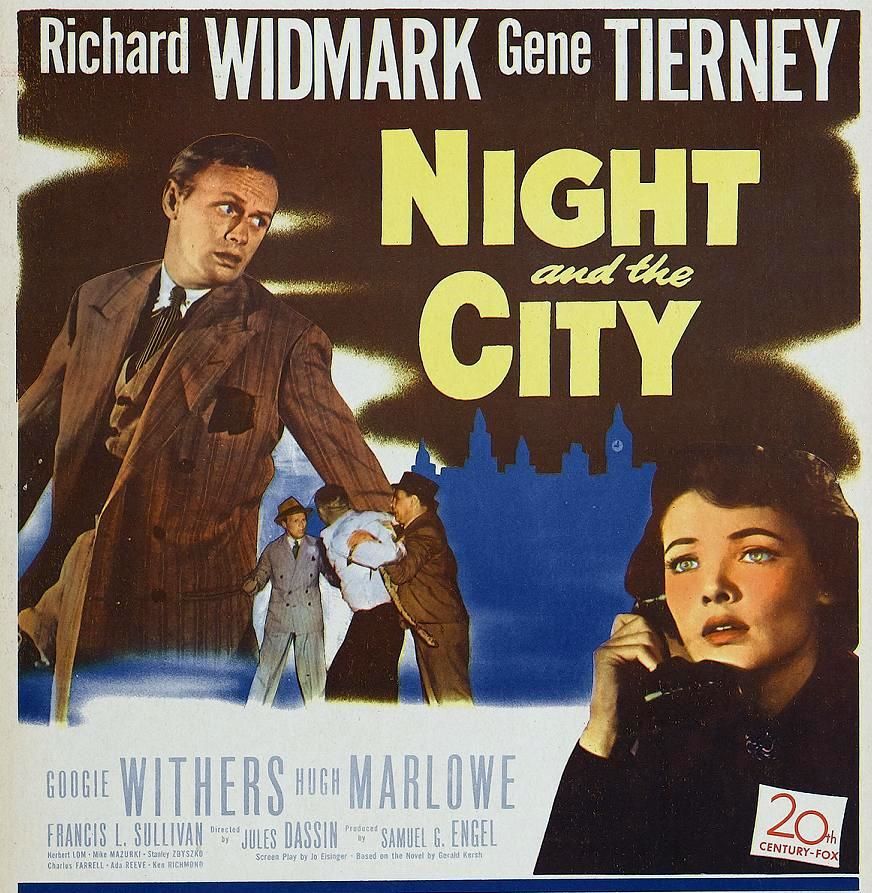
Jules Dassin’s Night and the City is a fine example of classic film noir. Filmed in smoky black and white mostly at nighttime on location in London, Dassin takes us slumming through the seedy underworld of nightlife, wrestling, and organized crime.

Harry Fabian (Richard Widmark) is a hard-bitten, ambitious, streetwise American con artist living in London. Always on the lookout for a quick buck, he can’t seem to catch a break. Ever. Literally running for his life in the opening scene, his latest career endeavor has failed, and his girl, Mary (Gene Tierney), is losing faith in him—stealing from her will do that.

Things brighten one night after a failed hustle at a wrestling match: Harry crosses paths with famous retired Greek wrestler Gregorius the Great (real life professional wrestler Stanislaus Zbyszko) and his prodigy, Nikolas of Athens (Ken Richmond), who both walk out of the arena in a huff. Gregorius is furious with his son, Kristo (Herbert Lom), who organized the fight, a low-end sort of WWE-like affair that he finds tacky.

Harry schmoozes Gregorius and learns that Kristo is a mobster who controls wrestling in all of London. He devises a plan to create a promotion startup, aligning himself with Gregorius to get around Kristo. He secures funding by double dealing with Phil Nosseross (Francis L. Sullivan), the owner of the Silver Fox Club where Mary works, and Phil’s wife, Helen (Googie Withers). She has plans of her own she doesn’t want Phil to know about.

The whole thing looks like it’s actually going to work despite Kristo’s threats, a plot to murder Harry, and Phil pulling his backing from the project. Harry gets so far as setting up a real fight between Nikolas and the Strangler (Mike Mazurki, also a real life professional wrestler). A miscalculation unravels everything—not just for him but everyone involved.

Jo Eisinger’s screenplay, based on Gerald Kersh’s novel Night and the City with contributions from Austin Dempster and William E. Watts, involves morally bankrupt lowlife characters who lack any redeeming qualities. All of them are scamming for one thing or another, and none of them—except maybe Mary—evokes any sympathy. This plays out nicely with the motifs of money, masculinity, and blind ambition that give this story its dark and bitter hue. It’s suspenseful. Ultimately, evil prevails in this dirty little story, which had to be revolutionary if jarring when this came out.

The backstory here is as interesting as the plot: during the production of Night and the City, Dassin was blacklisted for being a Communist. Pushed into exile, he infuses a strong sense of betrayal and fear into this film (https://en.wikipedia.org/wiki/Jules_Dassin).

Night and the City is desperate, chilly, and magnificently bleak—and it looks it thanks to Mutz Greenbaum’s shadowy and dramatic cinematography. Of the nitrate prints that screened this year, this was a standout. According to the festival program, this pre-release print is ten minutes longer than the UK version and 15 minutes longer than the US version.

With Hugh Marlowe, Ada Reeve, Charles Farrell, Edward Chapman, Betty Shale

Production: 20th Century Fox

Distribution: 20th Century Fox, Criterion

111 minutes (pre-release print)
Not rated

(Dryden Theatre) B

Nitrate Picture Show

https://www.criterion.com/films/933-night-and-the-city

Body of Evidence

(USA 1993)

“That’s what I do. I fuck. And it made me eight million dollars.”

—Rebecca Carlson

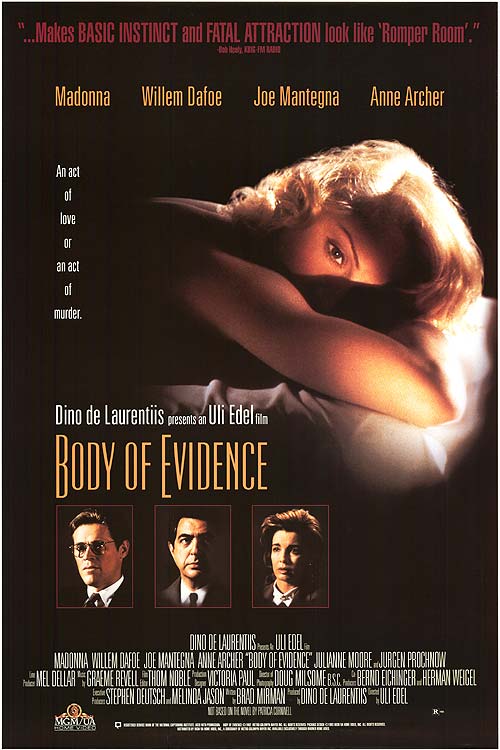
As true blue a Madonna fan as I am, I haven’t bothered to see a considerable number of her movies. Uli Edel’s Body of Evidence is one of them (she has top billing here, so yes, it’s a Madonna movie). On a ridiculously cold and rainy Saturday night, I decided to change that when I saw it showing on cable. Now that I’ve seen it, what surprised me most about Body of Evidence is that it’s actually not that bad. To be clear, it’s not good—it’s fluffy erotic fromage designed to be “provocative,” a sort of lame Basic Instinct (as if that’s a good movie)—but it’s not quite the disaster I expected.

Madonna is Rebecca Carlson, a femme fatale accused of slipping cocaine into her older lover’s nasal spray and “fucking him to death”—i.e., arousing him to the point of inducing a fatal heart attack. Willem Dafoe is her defense attorney. Of course, he gets involved with her despite his happy marriage to Julianne Moore.

Brad Mirman’s writing is pretty basic; his script feels a lot like a Law & Order episode, skipping through real life things like discovery and motions in limine to get right to the court stuff. I half-expected to hear that clang sound between scenes. His dialogue is often silly and, as demonstrated above, at times cringeworthy.

The promotional poster for Body of Evidence promises to make Fatal Attraction and the aforementioned Basic Instinct “look like Romper Room;” it doesn’t. The candle wax scene is kinda hot, but that’s it. The cast is impressive, but sadly no one gives a remarkable performance. Moore’s role, one of her first in a major studio release, is so small it’s background. Madonna pretty much plays Dita, her alterego from her Erotica album and Sex book, both of which came out just a few months before Body of Evidence. Her acting isn’t good, but somehow she comes off slightly less wooden than any character from her earlier movies, even A League of Their Own. Her look is exactly the same as in the video for “Bad Girl.” I’m not sure what Dafoe or Joe Mantegna, both good actors, saw in this project.

Body of Evidence is ultimately a forgettable snooze of a film. If it’s offensive at all, it’s because it’s boring.

With Anne Archer, Lillian Lehman, Stan Shaw, Charles Hallahan, Mark Rolston, Jürgen Prochnow, Frank Langella

Production: Dino De Laurentiis Communications, Neue Constantin Films

Distribution: Metro-Goldwyn-Mayer (USA), Guild Film Distribution (UK)

99 minutes
Rated R

(Impact) D+

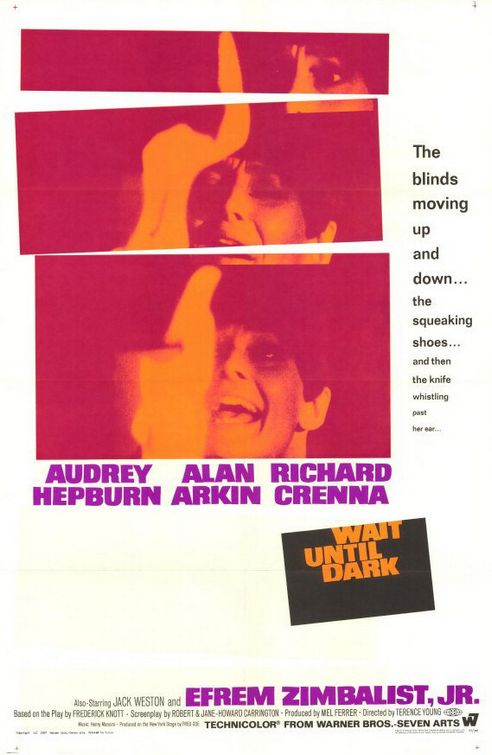
Wait Until Dark

(USA 1967)

A heroin smuggling ring. A creepy doll. A corpse. A blind woman alone in her basement apartment in the West Village. These are the elements of Wait Until Dark, a quaint and dingy little crime thriller adapted from Frederick Knott’s 1966 play by screenwriters Robert Carrington and Jane-Howard Carrington.

Suzy Hendrix (Audrey Hepburn) is the hapless gudgeon who, being blind, already has the proverbial wool over her eyes. Her husband, Sam (Efrem Zimbalist Jr.), comes home from a business trip with a doll that unbeknownst to him contains a hidden stash of heroin sewn into it. This does not bode well for Lisa (Samantha Jones), the glamorous and sexy stranger who asks him to hold it for her at JFK International Airport.

A case of mistaken identity leads a pair of small time crooks (Richard Crenna and Jack Weston) to Sam and Suzy’s apartment, where psychotic hooligan Harry Roat (Alan Arkin) coerces them into helping him find the doll—as soon as they dispose of a dead body. Nice. They devise an elaborately devious scam to recover the doll when they realize Suzy, who walks in on them, is blind.

Terence Young’s directing is certainly competent. I last saw this movie on some late night UHF station when I was a kid, and two things have stayed with me: a sense of severe claustrophobia as the story unfolds, and that fucking groovy apartment. The plot has flaws that strain credibility. For one thing, Suzy is far too unguarded for a New Yorker. Why doesn’t she lock her door? Roger Ebert pointed out this detail (http://www.rogerebert.com/reviews/wait-until-dark-1968). I didn’t obsess over it like he did, but I noticed it and thought the same thing. When Roat tells her he knows she has the doll, why doesn’t Suzy hand it over? Why does she tell Gloria (Julie Herrod) to meet Sam at the train station instead of going to the police? Why do the guys bother to put on disguises if Suzy can’t see them?

Despite these glaring issues, Young ultimately succeeds in bringing Wait Until Dark to a boil. It lives up to its hype: I saw people jump in their seats at the end. The acting here overcomes any shortcomings in plot. Hepburn is little more than a blind Holly Golightly, but at certain points she reminds me of Barbara Stanwyck screaming that she can’t wake up from a nightmare in, I think, The Night Walker. Weston is a little too bumbling, but Crenna and Arkin are chillingly menacing and foreboding even if they are silly by today’s standards (yeah, sunglasses at night went a long way making Corey Hart look tough). Henry Mancini’s eerie score is the clincher in setting the right mood.

A trivial point of interest: Suzy’s apartment is in the same block of rowhouses as the one used for the Huxtable residence on The Cosby Show (http://www.movie-locations.com/movies/w/Wait_Until_Dark.html#.WRU0W1LMyWY). The small street, St. Luke’s Place, has a bit of literary history, too (http://www.nytimes.com/1996/10/27/realestate/in-a-village-enclave-15-remarkable-rowhouses.html).

With Jean Del Val, Frank O’Brien

Production: Warner Brothers

Distribution: Warner Brothers/Seven Arts

108 minutes
Not rated

(Music Box) B-