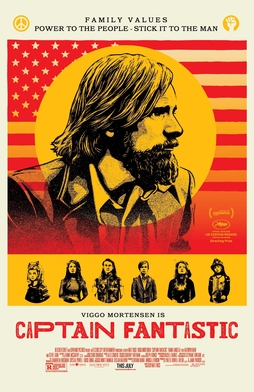
Captain Fantastic

(USA 2016)

Captain Fantastic came out last summer, and I wanted to see it then. I must confess, the cast interested me more than the plot.

Viggo Mortensen is the aptly named Ben Cash, a long disenfranchised survivalist who is, like, so over American capitalism and politics. He and his wife, Leslie (Trin Miller), shown almost entirely in flashback, decide to raise their six kids—three boys and three girls—off the grid in the mountain wilderness of Washington State. Removed from society, Ben and Leslie teach their kids everything from logic and philosophy to hunting and gathering to Norman Mailer and Guns ‘n’ Roses. They do it all without iPhones or religion. Kudos to that!

Nothing is perfect: Leslie suddenly dies, forcing Ben to take his feral kids into the outside 21st Century world for the first time, ever—which calls everything they planned for their family into question.

Director and screenwriter Matt Ross poses some interesting questions about society, conformity, and the social contract in a provocative and often lighthearted way. However, Captain Fantastic is not terribly surprising, which is why it doesn’t work as well as it could. At heart, it’s a standard fish out of water dramedy. Frankly, I spotted every “twist” coming before it got to me: the cop (Rex Young) who pulls over their Partridge Family van, the mildly blasphemous excuse that saves the day, the family’s visit to the supermarket, their reaction to their extended family (and vice versa), that lame scene in which Ben’s sister-in-law (Kathryn Hahn) calls him out onto the carpet for his choices and his youngest daughter (Shree Crooks) recites the Constitution to prove her wrong, eldest son Bo (George MacKay) proposing to the first girl who gives him attention—a trailer park teen queen (Erin Moriarty)—and the colleges he manages to get into, the “situation” that requires modern medical attention. Meh.

For all its grandiose intentions to take on the establishment, Captain Fantastic actually relies on a rather orthodox and pedestrian approach to make its point. Maybe that is its point, that you can’t escape society. It doesn’t mater: this story is predictable and sentimental, two things that never bode well. I expected more than Spokane Swiss Family Brady Bunch, which is essentially what this is. The one thing that saves this film from total mediocrity is the acting, which is great all around.

With Frank Langella, Ann Dowd, Samantha Isler, Annalise Basso, Nicholas Hamilton, Charlie Shotwell, Steve Zahn, Elijah Stevenson, Teddy Van Ee

Production: Electric City Entertainment, ShivHans Pictures

Distribution: Bleecker Street, Universal Pictures

118 minutes
Rated R

(iTunes rental) C

http://www.bleeckerstreetmedia.com/captainfantastic

20th Century Women

(USA 2016)

“We are at a turning point in our history.”

—President Jimmy Carter

I was a little kid in the Seventies, but I have many indelibly vivid memories of the decade: huge cars, gas lines, expensive meat, hijacked planes, Sanka and Sweet’N Low, smoking everywhere, hard rock, punk rock, disco, macrame, spider plants, the Bicentennial, Sky Lab, Victoriana (we had Mucha posters in our mustard-colored kitchen), that strange Holly Hobby aesthetic. It seems like it all changed immediately when Reagan took office in 1981.

20th Century Women captures a slice of American life on that unique, unremembered and largely disowned cusp. Set as a flashback to 1979 with voiceovers that repeatedly remind us that we’re looking backward, the film is a rather remarkable time capsule. The story is simple: Dorothea (Annette Bening) is my grandparents’ age (born in 1924). She had her only son, Jamie (Lucas Jade Zumann), late in life—i.e., over age 40. She’s been divorecd for a few years, which was fine until Jamie hit puberty. Now, she needs help understanding him. She enlists his two closest allies—Julie (Elle Fanning), whose pants he wants to get into, and Abbie (Greta Gerwig), a postpunk fuckup—to help her figure him out.

Loosely based on actual events from director and writer Mike Mills’s childhood, 20th Century Women is fun to watch. Growing up in a house of females myself, I relate to a lot of his experiences. I loved all the Talking Heads, too. Oh!—and Siouxsie and the Banshees! That said, this film borders on overbearing with its nostalgia. It could’ve been so much better—the material and the talent are both there, but Mills goes for easy returns that don’t pay off. The story falls flat. Perhaps a quote from Bening in an earlier film, the superior and far more interesting Running with Scissors, succinctly sums up my problem here: “It’s shit, Fern. It’s sentimental. It’s emotionally dishonest. It implodes into nothingness.”

I wasn’t bored, and I didn’t hate 20th Century Women. But I’m never going to see this movie again. Too bad, because the acting is great. It’s a misfire due to its execution. It seemed like a good idea at the time.

Also starring Billy Crudup, Vitaly Andrew LeBeau, Curran Walters, Toni Christopher, Jimmy Carter (public domain footage)

Produced by Annapurna Pictures, Archer Gray, and Modern People

Distributed by A24

119 minutes
Rated R

(Landmark Century) C

http://20thcenturywomen-movie.com

Being 17 [Quand on a 17 ans]

(France 2016)

“I don’t know if I’m into guys or just you.”

—Damien

In a pivotal scene in André Téchiné’s astute and poetic sexual awakening drama Being 17, French high school boys Damien (Kacey Mottet Klein) and Thomas (Corentin Fila) throw literary quotes at each other while studying together. As their discussion intensifies, their disparate views toward their strange attraction become clear from the material they cite: Damien is willing—eager, even—to go with his unfamiliar feelings, while Thomas fights his. The scene eloquently brings into focus the essence of the tension between them.

Being 17 takes place over the course of a school year. As the story begins, a serious animosity suddenly develops between classmates Damien, a privileged brainy blonde French teen who wears a big flashy (and probably fake) diamond earring, and Thomas, the quiet, rugged brown adopted son of animal farmers. The whole thing starts when Thomas trips Damien as he walks back to his seat in one of their classes. Their interactions grow increasingly hostile and physical: shoving, slapping, and punching. It isn’t clear why, but the two can’t keep their hands—or eyes—off each other. The plot thickens when Damien’s mother (Sandrine Kiberlain), a physician in the remote mountain town where they live, arranges for Thomas to move in with her and Damien while his mother (Mama Prassinos) works through a difficult pregnancy. In a more intimate setting, the boys play a prickly game of cat and mouse as they gingerly let down their guard—only to an extent.

At times, Being 17 pushes suspension of disbelief to its edge. Still, it’s an achingly moving story that is extremely well executed. Even when the interactions between Damien and Thomas get, um, sultry—and they do—this isn’t so much a “gay” film as it is commentary on the power of desire. Téchiné wrote the script with Céline Sciamma, and they explore how hostility and desire play on each other. It’s a complicated dynamic: suspenseful, exciting, and confusing. Alexis Rault’s haunting score lends a pensive, masculine, almost Old Western touch that fits in perfectly. Julien Hirsch’s hazy cinematography gives the film a dreamy, sensual quality that highlights the natural beauty of the settings: the mountains, the lake, the snow, even the fields in the spring. It works really well showing both characters making it through the wilderness, figuratively and literally.

116 minutes
Not rated

(Gene Siskel Film Center) B

http://www.elledriver.fr/being-17/

Coming Through the Rye

(USA 2015)

Occasionally, I’m a real starstruck starfucker; I’ve met two of my own idols, and each time was a story in itself. I’m a fan of both The Catcher in the Rye and Nine Stories, too (though not so much Franny and Zooey).

So not surprisingly, I found the premise of Coming Through the Rye appealing and totally relatable: set in 1969, Jamie Schwartz (Alex Wolff), an angsty, unpopular, nerdy high school student at an all-boy boarding school in Pennsylvania, sets out to track down the reclusive J.D. Salinger (Chris Cooper). Like many a midcentury American boy, Jamie says Salinger’s Catcher changed his life; although he’s not as harsh, he identifies with Holden Caulfield because he sees himself isolated and surrounded by phonies. He seeks the author’s blessing on his senior project, a stage adaptation of Catcher (in which Jamie plays Caulfield, of course) to be performed at his school.

Anyone remotely familiar with Salinger knows that Jamie isn’t getting his wish, something at least two teachers let him know. The kid will not take no for an answer. After failing to reach Salinger both by letter and by dropping in on his agent in New York City, a series of unfortunate events at school prompts Jamie to take off and look for Salinger himself. Deedee (Stefania Owen), a local girl who likes him and fortunately for him has a car (a cool Rambler), picks him up and offers to drive. The two embark on a short odyssey through New England.

Equal parts road movie, romance, and coming of age story, there’s quite a bit to like here. Based on actual events from his own high school years, writer and director James Steven Sadwith crafts a straightforward, easygoing story that flows naturally. The many parallels between Jamie and Caulfield—right down to a red hunter’s cap and a disquieting older brother (Zephyr Benson)—are cute; the fact that Jamie is the only Jewish kid at a WASPy boarding school is a nice touch that underscores his status as an outsider. Sadwith does a fine job showing the loss of Jamie’s innocence through a number of small events. Wolff and Owen have a wonderfully guileless chemistry that works really well; a scene with milkweed blowing in the wind is downright beautiful. Jamie’s ultimate discoveries, however, aren’t so cute—this is what keeps Coming Through the Rye from turning into nostalgic drivel.

97 minutes
PG-13

(Gene Siskel Film Center) B

http://www.comingthroughtheryemovie.com

Closet Monster

(Canada 2016)

I wish I could play Bronski Beat’s “Smalltown Boy” for Closet Monster‘s protagonist, Oscar Madly (Connor Jessup), because the lyrics say something he needs to hear: the answers you seek and the love that you need will never be found at home. Sigh.

When young Oscar (Jack Fulton) is a wee lad of maybe seven or eight, his parents give him a hamster (played by four different actors: Chunk, Mama, Blood Thirsty, and Buffy #1). The gift, it turns out, is intended to take the sting out of their explosive announcement: his mother (Joanne Kelly) is leaving his father, Peter (Aaron Abrams). It doesn’t take long to see why, as Peter is an oppressive loose cannon. Oscar stays with his father and quietly retreats into his own world where his new furry friend, Buffy, becomes his companion and has a way of expressing what Oscar is feeling (Isabella Rossellini, of all people, provides Buffy’s voice).

One afternoon after school, Oscar follows a group of older teenage boys into a cemetery. Unbeknownst to them, he watches from behind a tree as they barbarously attack another boy—presumably a gay one—with a rusty iron rod. Immediately after, Oscar notices his father is a toxic alpha male asshole. Determined to prevent something horrible from happening to him, he jumps into survival mode and starts doing “guy” things.

Cut to a decade later: Oscar (Jessup) is into creating monsters with makeup and prosthetics, practicing in his treehouse on his friend Gemma (Sofia Banzhaf), an aspiring model who carries a torch for him. They both just finished high school. Oscar bides his time that summer working as a stockboy at a home improvement store while waiting for an acceptance letter from a school with a design program for cinematic special effects to which he’s applied. He’s completely beside himself when a new employee named Wilder (Aliocha Schneider) shows up and asks to borrow his work shirt. Wilder is cool, sexy, and has a way of transmitting ambiguous sexual signs—causing Oscar severe stomachaches and visions of that iron rod.

Writer and director Stephen Dunn’s first feature threw me for a loop, in a really good way. Closet Monster is packed with gay coming of age clichés, but it still stands on its own. Oscar’s homosexuality is more than incidental, but it’s no dark secret; Oscar knows he’s gay and he doesn’t seem to be ashamed of it, even if dealing with it is tricky. The cast here is excellent, particularly the exchanges between Jessup and Schneider (not to marginalize the other actors). Dunn exhibits a dinstinctive style both in how he tells his story and how he shows it. From a narrative standpoint, he concocts a compelling mix of comedy, teen drama, fantasy, horror, gore, and psychological intrigue. The tension between Oscar and Peter is palpable, simmering from a quiet friction to an all-out eruption.

Dunn’s visuals are even better: vivid, surreal imagery of iron rods popping out of Oscar and vomiting nuts and bolts into a sink, they indelibly illustrate what’s going on in his head. Peppered with retro electronica, I pick up a certain late ’80s/’90s vibe here; indeed, Dunn’s aesthetic reminds me of David Fincher, Spike Jonze, Michel Gondry, and to a lesser extent Anton Corbijn, all of whom started out doing music videos. Dunn’s sensibility is similar to another young director, Xander Robin (Are We Not Cats) (https://moviebloke.wordpress.com/2016/10/15/are-we-not-cats/), though Dunn is not as dark. Closet Monster has a few shortcomings, but overall it gels nicely into a totally satisfying film.

90 minutes
Not rated

(Facets) B

http://rhombusmedia.com/film/closet-monster/

http://www.strandreleasing.com/films/closet-monster/

https://youtu.be/RTgM1e8w05g

American Honey

(UK/USA 2016)

Andrea Arnold’s American Honey is not a typical teenage girl movie. It isn’t a comedy. Its protagonist, 18 year old Star (Sasha Lane), isn’t funny, cutsie, bitchy, or crazy. To the contrary, she’s smart, strong, serious, and quite desperate. Star is pursuing a boy, but her agenda extends beyond that, even if she doesn’t realize it. She also seems acutely aware that for better or for worse, she’s in control of her own fate.

American Honey opens with Star and two young kids chained to her side digging out discarded chickens from a dumpster for dinner. They walk aimlessly to K-Mart—a place I had no idea still exists—where they cross paths with a feral band of cracky-looking misfits led by Jake (Shia LaBeouf), a ringleader of sorts for the trailer park set. Star and Jake flirt, but security ejects Jake and his posse from the store when they get rowdy. Star ends up with Jake’s phone, giving her the perfect opportunity to continue their encounter in the parking lot. Smitten, she ditches the kids (it turns out they’re not hers) and takes him up on his offer to join him and his “mag crew” on the road.

A “mag crew” is a nomadic lot of door-to-door sales reps, usually kids, hawking magazine subscriptions (http://mobile.nytimes.com/2007/02/21/us/21magcrew.html). The environment is cutthroat and the crew is often abused and exploited. Jake’s crew sells magazines in small mainly rural towns throughout middle America—places like Oklahoma, Kansas, South Dakota, and Missouri. It doesn’t sound fun or profitable, but it works for Star—for a little while, anyway. Despite unrelenting shade from the crew’s manager, suspicious and bossy queen bee Krystal (Riley Keough), Star finds her stride in this ragtag mess, competing for sales, partying with the group, and getting involved with Jake, the top salesman who takes her under his wing and trains her. As rapper E-40 says in “Choices,” one of the songs used for the soundtrack, “I choose to get money, I’m stuck to this bread.”

American Honey doesn’t feel very structured; it plays out more as improvisation than something planned from a script. At times, the pace is rambling and almost painfully slow, which usually sounds the death knell for a lengthy film such as this. Surprisingly, it works for these characters and this story. Arnold is clearly interested in the geographical, cultural, and economic continental divide of America, and she’s adept at exhibiting this through her artistic choices. The settings—mostly barren highways, shitty little meth towns, cheap roadside motels and truck stops, even an oil field—nicely frame the characters’ collective circumstances. The locations provide precisely the backdrop one would expect in a road movie, but somehow they’re more beautiful here. The music is a hodgepodge of genres from techno to country to rap to folk, and it all fits perfectly. I must confess, I downloaded the soundtrack (Bruce Springsteen is not on it). American Honey paints a lusty, vivid picture of life on the fringe.

Newcomer Lane is intriguing and charismatic; it’s hard to believe this is her first film. The part of Jake seems tailor made for LaBeouf, who brings a volatile, forboding edge to his character. The supporting cast is adequate but for the most part forgettable. A few stand out. One is QT (Veronica Ezell), a friendly and chubby pot smoking hippy. Another is Pagan (Arielle Holmes), a sweet goth chick obsessed with Star Wars. The true scene stealer, though, is Corey (McCaul Lombardi), the tanned, blue-eyed, tattooed, fake blonde horndog party boy with a penchant for whipping out his dick whenever because, well, he can. I hope and expect to see more of him and his chiseled cheekbones in the future.

I doubt American Honey has mainstream appeal; it’s too fluid, subtle, and open-ended. It’s got its flaws, but I loved it. On the surface, it’s a road movie about a girl pursuing a boy. The real narrative, though, is much deeper. Like the character in the Lady Antebellum song that gives this film its title, Star literally grows up on the side of the road, and does so before our eyes. She starts out a kid. In the final scene, she immerses herself in a pond, an event spurred by a turtle Jake gives her and likely by a few hungry, neglected children she encounters on her own while selling magazines earlier that day. Her “baptism” is symbolic: with it, Star resigns herself to the fact that she has a role in the grand sceme of things even if she’s never going to get all she wants. In other words, she’s grown up. It’s a gorgeously demonstrated point, if you can make it all the way to the end.

163 minutes
Rated R

(Facets) B-

http://americanhoney-movie.com

Moonlight

(USA 2016)

“At some point, you got to decide for yourself who you’re going to be. Can’t let nobody make that decision for you.”

—Juan

A few films impressed me this year, but so far none have moved me like Moonlight, screenwriter and director Barry Jenkins’s first project in eight years. Inspired by Tarell Alvin McCraney’s piece In Moonlight Black Boys Look Blue, Moonlight peers into three brief but pivotal intervals in the life of Chiron, a poor black kid in a Miami hood, as he grows up, struggling to connect to the world and find his place in it. This doesn’t sound revolutionary—I could say the same thing to summarize a handful of other movies—but Moonlight is different; it’s not merely Boyz N the Hood or Precious with a gay protagonist. Executed beautifully and flawlessly in three “acts,” it covers a lot of ground—blackness for sure, but also family relationships, sexuality, masculinity, and identity. I relate to so much about it even though my world is nothing like the one it depicts. Jenkins hits something universal, and I can’t imagine many people walking away from this film not feeling it.

WARNING: Potential spoilers ahead!

Act one: It’s clear from the outset that something is different about Chiron, who everyone calls “Little” (Alex Hibbert). He’s quiet and contemplative. A group of boys chases him into a dope hole, an abandoned apartment building or motel where junkies do drugs. Juan (Mahershala Ali), a dealer, finds him hiding out there. Chiron won’t talk even after Juan takes him to eat. He warms up a little when he meets Juan’s girlfriend, Teresa (Janelle Monáe), but he’s still guarded. Chiron’s mother (Naomie Harris), who has a difficult relationship with her son, knows he’s not like other boys.

When Chiron is kicked off the field during a game of something—soccer or football, I don’t remember—a classmate, Kevin (Jaden Piner), runs after him. He tells Chiron he’s “funny” before he picks a fake fight with him to get Chiron to show the other boys that he’s not “soft.” Apparently, they don’t buy it: “What’s a faggot? Am I a faggot? How do I know?” are some of the questions Chiron peppers Juan with not long afterward.

Act two: Chiron (Ashton Sanders), trying to shed “Little,” is a scrawny teenager. He’s still dodging bullies, particularly Terrel (Patrick Decile). He’s also still friendly with Kevin (Jharrel Jerome), who brags about his sexual exploits and smokes a lot of pot. Chiron has a thing for him. They share a surprise moment on the beach one night—it’s deep for Chiron. Too bad things go violently sideways when they’re back at school the next day.

Act three: Chiron, now “Black” (Trevante Rhodes)—incidentally, the name Kevin gives him in high school—is his 20s and living in Atlanta. He emulates Juan, and not just by following in his footsteps selling drugs. Kevin (André Holland) calls out of the blue. He’s a cook in Miami. He says that a guy played a song on the jukebox where he works that reminded him of Chiron, and he offers to make him dinner sometime. It’s a weird call that gets to Chiron, who still carries a torch for Kevin.

After visiting his mother at a treatment center, he heads down to Miami and finds Kevin at the restaurant where he works. They skirt around a bit, and Kevin plays the song: “Hello Stranger” by Barbara Lewis, a smooth ‘60s R&B track with lyrics like “I’m so glad you stopped by to say hello to me” and “If you’re not gonna stay please don’t treat me like you did before because I still love you so.” Kevin vaguely seems to come on to Chiron, who doesn’t understand why Kevin called him—though he seems glad he did.

The sum of Moonlight is greater than its parts, but its parts are still great. The plot is fluid, driven more by dialogue and little moments—like Juan teaching Chiron how to swim, Teresa making the bed for Chiron, and Kevin cooking him dinner—than building up to any single climax. Moonlight is voyeuristic, crammed with moments that are so personal it feels like we shouldn’t be watching. The third act is strange and even a bit slow, but it’s brilliant nonetheless. Chiron and Kevin’s meeting is suspenseful and confusing, percolating with an urgent and erotic undertone. Something about how they convey what they’re feeling with just their eyes makes you actually want to see them kiss. Kevin sums up what the film is all about in one question when he asks Chiron point blank, “Who is you?” The end is unresolved, but it’s perfect.

Moonlight is as close to poetry as a movie gets. James Laxton’s cinematography uses colors that are so lush that you can actually feel the humidity in the air. The night scenes, especially on the beach, are an odd mix of serene and ghostly.

Side note: Chiron’s mother is an interesting character. She seems overprotective at first, wearing scrubs and a name tag when we first see her rushing up to Chiron as Juan brings him home the next day. Upset with Chiron for not coming home, she revokes his TV privileges and tells him to find something to read. Sensible parenting, perhaps; but a lot here is not how it appears. It doesn’t take long to see that she’s a mess. Likewise, it doesn’t take long to see that Juan is not the thug he appears to be. Nothing about Moonlight is what its seems on the surface.

111 minutes
Rated R

(AMC River East) A+

http://moonlight.movie

Boyz N the Hood

(USA 1991)

I’ve seen Boyz N the Hood a few times, but the last time had to be at least 15 years ago. I was curious to see it again when I noticed it playing on cable recently. It definitely shows its age, but it’s retained its impact and remains required viewing.

The boyz are three teens, Trey “Tre” Styles (Cuba Gooding, Jr.) and twin brothers Ricky (Morris Chestnut) and Darrin “Doughboy” Baker (Ice Cube). The hood is the Crenshaw neighborhood of South Central L.A. The boyz met when they were 10 and Tre moved in with his father, Furious (Laurence Fishburne), after his mother (Angela Bassett) decided it was time for a man to raise him. Now, Tre is getting ready to go to college, football recruiters are courting Ricky, and Doughboy is in a gang and making a half-assed attempt not to end up in jail again. It’s apparent that their choices have put them on different paths that already are removing them from each other. Furious is okay with that—especially when a senseless shooting rocks Tre’s world.

In his debut, writer/director John Singleton takes a powerful and realistic look at the problems that still plague American cities: racism (internalized racism, too), segregation, economics, education, parenting, violence, addiction. To his credit, he doesn’t glorify any of it. His characters are multidimensional, into the same things that all teenage boys are: sharp clothes (and, yes, they’re awful), chasing girls, playing games, driving cool cars. Even the not-so-good kids have dignity. When shit happens, Singleton pulls us into it along with his characters. For example, we feel the sting when the Baker boys’ mother (Tyra Ferrell) unleashes her attitude on Doughboy. We also experience a shot of adrenaline when an ominous car chases Tre and Ricky up and down back alleys. It helps that the cast is fantastic.

Nominated for an Academy Award for both Best Director and Best Original Screenplay in 1992 (https://www.oscars.org/oscars/ceremonies/1992), Boyz N the Hood still resonates despite its tendency to lapse into short spells of preachiness. Perhaps it’s because things haven’t changed as much in 25 years as we’d like to believe.

In 2002, the United States Library of Congress deemed Boyz N the Hood “culturally, historically, or aesthetically significant” and selected it for preservation in the National Film Registry (https://www.loc.gov/programs/national-film-preservation-board/film-registry/complete-national-film-registry-listing/).

112 minutes
Rated R

(MoviePlex) A-

http://www.sonypictures.com/movies/boyznthehood/