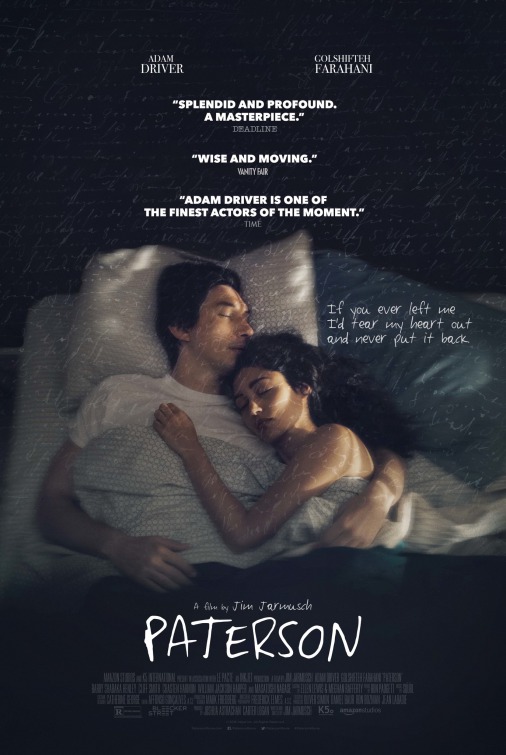
Paterson

(USA 2016)

Not a lot happens in Jim Jarmusch’s new film Paterson—it is, to borrow from Seinfeld, a show about nothing. Starting on a random Monday, the story follows Paterson (Adam Driver)—a Paterson, New Jersey, city bus driver and closet (or in this case, basement) poet—through his daily routine for a whole week. He finds inspiration in the simplest things: passengers, barflies, Ohio Blue Tip matches. He works it all into his “secret notebook” of poetry, scribbled in sidebars onscreen. Some of it is interesting, some not so much.

Jarmusch throws a lot out there: never mind the recurring parallels between Paterson and those he encounters—there’s imagery of twins, waterfalls, circles, and fireballs. Attempting to infer a weighty point in all of it, though, is probably an exercise in futility; this is fluid stream of consciousness. The story is more a string of vignettes: Paterson’s wife, Laura (Golshifteh Farahani), orders a guitar online and later serves Brussels sprout and cheddar pie for dinner; the bus Paterson drives breaks down; a situation arises in the bar where Paterson has a beer every night when he walks his wife’s dog, Marvin (Nellie, who, sadly, passed away before Paterson came out: http://www.indiewire.com/2016/05/the-2016-palm-dog-posthumously-awarded-to-nellie-the-dog-from-jim-jarmuschs-paterson-289094/).

The characters Paterson encounters are plentiful and colorful: defeatist coworker Donny (Rizwan Manji); a rapper (Method Man) in a laundromat; a young poet (Sterling Jerins) waiting for her mother in the bus yard; Marie (Chasten Harmon) and her sensitive beau, Everett (William Jackson Harper), whom she’s trying to dump; a nameless gangbanger (Luis Da Silva, Jr.) who warns Paterson about dog-jacking (not that it stops him from tying Marvin to a spigot outside the bar every night); anarchists, old ladies, and braggarts on the bus.

Perhaps the most accomplished thing about Paterson is its rhythm: the plot moves slowly but in a purposely metered fashion. Cinematographer Frederick Elmes creates a dreamy and downright poetic look. The relationship between Paterson and the world has its own set of rules. This film reminds me of Dead Man, which I haven’t seen in two decades: quietly contemplating routine and rut, Paterson ultimately celebrates the poetry in the mundane. The unnamed traveler and angel (Masatoshi Nagase) at the end literally gives us the “a-ha” moment. With nearly no outside sound, not even music, I thought of one thing: if James Joyce’s Ulysses were made into a movie, it would feel a lot like this. Unlike Leopold Bloom, though, Paterson’s wife isn’t cheating on him, and no one except Marvin seems to mind his presence.

Side note: for some reason, the screening I caught included Spanish subtitles, unintentionally adding another layer of what-the-fuck. Paterson is not a movie for everyone, but I definitely see a following here. I liked it.

Also starring Barry Shabaka Henley, Trevor Parham, Troy T. Parham, Kara Hayward, Jared Gilman, Johnnie Mae.

Produced by K5 International, Le Pacte, Animal Kingdom, and Inkjet Productions

Distributed by Bleeker Street Media and Amazon Studios

118 minutes
Rated R

(Landmark Century) B-

http://www.bleeckerstreetmedia.com/paterson

Hidden Figures

(USA 2016)

Houston, do you read me: NASA employed black people in its infancy during the early Sixties. What’s more, NASA’s first major project, Mercury, probably wouldn’t have gotten off the ground without three black female “computers,” or mathematicians, whose efforts literally put John Glenn and Friendship 7 into orbit. The result was a serious boost in American morale during the race against the Soviets into space and a boon to the Space Program under President Kennedy. So, with its historically significant and truly enlightening subject matter, what most caught me off guard about Hidden Figures is its tone, which is light, upbeat, cute, and often comical. While not in itself a bad thing, it’s not what I expected.

Unfortunately, that’s about all Hidden Figures offers that I didn’t expect. I’m not saying I didn’t enjoy this film; I did. It’s a great story about remarkable people who actually lived. According to one subject, their real stories are not far off from this film (http://www.latimes.com/science/sciencenow/la-sci-sn-hidden-figures-katherine-johnson-20170109-story.html). Taraji P. Henson plays Katherine Johnson, a recently widowed math whiz who works for NASA in Virginia, as a bookish nerd complete with glasses that keep sliding down her nose. She and her coworkers, smart and sassy Dorothy Vaughan (Octavia Spencer) and fiery and coquettish Mary Jackson (Janelle Monáe), quietly but forcefully demonstate their worth in an environment that doesn’t treat them as equals. While Katherine lugs binders and a calculator back and forth between her desk and the “colored” rest room clear across campus to figure out arcs and other shit I sure can’t, Dorothy teaches herself how to operate the new IBM that not even IBM technicians can set up correctly and Mary pushes her way into engineering classes at night in an all white, all male school. Director Theodore Melfi does a really nice job demonstrating institutionalized racism and sexism through characters who may not have anything against black people or women—as administrator Vivian Michael (Kristen Dunst) curtly tells Dorothy in one scene and unwilling research partner, Paul Stafford (Jim Parsons), makes clear to Katherine in another scene by redacting her name from a joint report they both wrote—but don’t recognize the issue.

Despite its merits, I found Hidden Figures to be slightly more sophisticated than a Lifetime movie. Melfi, who with Allison Schroeder adapted the screenplay from Margot Lee Shetterly’s book of the same name, takes a pretty basic approach to the material. It’s so easy—obvious, even—to gage where the story is headed. John Glenn (Glen Powell) sings Katherine’s praises while a love interest develops for her in handsome Col. Jim (Mahershala Ali). So cute. Hidden Figures gets into civil rights issues, but only on a superficial level. There are a few overdone Oscar grabs, like a scene between Katherine and her boss, Al Harrison (Kevin Costner), that ends with him smashing the sign outside the “colored” ladies’ rest room, but no true show stoppers. Frankly, though, most of the actors here have appeared in better movies. Too bad, because this could’ve been a great film instead of just an okay one. Hidden Figures doesn’t quite do its trailblazing subjects justice.

127 minutes
Rated PG

(AMC River East) C+

http://www.foxmovies.com/movies/hidden-figures

The Devil Wears Prada

(USA 2006)

Some movies you watch just because they start and you’re too damned lazy to see what else is on. Such is the case with The Devil Wears Prada, which served as the end of my Christmas night movie binge.

Andy Sachs (Anne Hathaway) just finished school and moved to New York City to become a journalist. While seeking employment with more weighty publications like The New Yorker, she snags a one-off interview for Runway magazine. Surprise: she gets the job—working as personal assistant to ball busting editor-in-chief, Miranda Priestly (Meryl Streep). Andy’s job duties and a chance meeting with handsome magazine writer Simon Baker (Christian Thompson) cause friction in her personal relationships, especially her chef boyfriend, Nate (Adrian Grenier). Is a job worth this much hassle?

Director David Frankel does a competent job with Aline Brosh McKenna’s screen adaptation of Lauren Weisberger’s novel even if the end result is nothing special. The acting is fine, particularly Stanley Tucci as caddy and nelly designer Nigel. It’s nice to hear Madonna’s “Vogue” in one scene outside Andy’s car. The problem I have is the script, which is formulaic and predictable girl movie stuff: awkward girl in the big city reinvents herself and not just survives but excels in the face of adversity. Of course, there’s a happy ending. The Devil Wears Prada is not my cup of tea: it’s cute, but that’s about it.

109 minutes
Rated PG-13

(Bravo) D+

http://www.foxmovies.com/movies/the-devil-wears-prada

The Brand New Testament [Le tout nouveau testament]

(Belgium/France/Luxembourg 2015)

Joan Osborne once posed the question, “What if God was one of us, just a slob like one of us?” In Jaco Van Dormael’s The Brand New Testament, God (Benoît Poelvoorde) is a sloppy, angry middle-aged white guy with a very plain wife (Yolande Moreau). They live in a dark apartment in Brussels, where He works from home (she’s a homemaker with a thing for collecting baseball cards). His job is pretty easy: to heap misery onto the human race, which He watches over on a computer in a room with a card catalog that stretches to the sky. God’s preteen daughter, Ea (Pili Groyne), is not impressed with Him or His arrogant, authoritarian, and sadistic ways. Inspired by her brother “JC” (David Murgia), who tells her how to get out of the apartment through the washing machine, Ea hatches a plan to revise the way things work and hopefully make the world a better place: while Our Father is asleep on the couch, she sends a text message to everyone on Earth that reveals the date and exact time of their death, locks God’s computer, and runs away from home in search of six apostles to tell their stories—the Brand New Testament.

This film could have made a weighty statement, but it doesn’t. Instead, The Brand New Testament, executed with a hefty dose of fantasy and fabulism, is a fluffy affair. While all six apostles lack something—love, passion, an arm—they’re comical despite their sadness. Some of their subplots are better than others, particularly Aurélie (Laura Verlinden), a beautiful woman with a secret, and Willy (Romain Gelin), a young boy with cancer who wants to be a girl. Catherine Deneuve plays a neglected and bored housewife, and it’s truly surreal to see her in a role where she gets fucked by a street gigolo (Bilal Aya) and ends up leaving her husband (Johan Leysen) for a gorilla (Kiko Mirales). That’s right, a gorilla. Clever Biblical references, especially to the numbers 12 and 18, are generously sprinkled throughout the script. There’s even a point in here about gender politics. For all its charms, though, The Brand New Testament is a much better concept than a finished product.

112 minutes
Not rated

(Music Box) C

http://www.musicboxfilms.com/the-brand-new-testament-movies-143.php

Amélie [Le Fabuleux Destin d’Amélie Poulain]

(France/Germany 2001)

“I like to look for things no one else catches.”

—Amélie Poulain

The Associate Board of Chicago International Film Festival presented a special screening of Jean-Pierre Jeunet’s Amélie, a sumptuous, romantic fantasy of a film that looks as good as it feels. I’ve seen it many times. It’s unrealistic, maybe even a bit silly; yet, it always leaves me smiling. I couldn’t pass up the chance to see it again.

Young Amélie Poulain (Flora Guiet) has a lonely childhood: her odd parents are overreactive, overprotective, and emotionally distant, preferring to rearrange the contents of their toolbox and purse than pay much attention to her. It’s so bad that her heart races when her father, Raphaël (Rufus), a physican, touches her during her annual checkup—a narrator (André Dussollier) explains that all she wants is a hug.

Her father misdiagnoses Amélie with a heart condition. As a result, she’s kept inside from the world and homeschooled by her mother, Amandine (Lorella Cravotta), a rather hysterical woman with a nervous tic in her eye. Amélie retreats into her imagination to deal with it all. Her home environment is so stifling, it makes her pet goldfish, Blubber, jump out of its bowl in multiple suicide attempts. A separate suicide at Notre-Dame, this one successful, changes Amélie’s life, leaving her father to raise her alone without any siblings, which her mother apparently wanted for her. C’est la vie.

Fast forward to 1997: grown up Amélie (Audrey Tautou) is a stylish but shy waitress at a café in the 18th Arrondissement of Paris—artsy Montmartre. While home alone (as usual) in her flat one evening—August 31, 1997—a TV news report of Princess Diana and Dodi Fayed’s fatal car accident jolts Amélie, causing a chain reaction that leads her directly to a rusty box of a boy’s trinkets from the 1950s hidden in her bathroom wall. She discerns the identity of the family who lived in her flat back then and devises an elaborate scheme to reunite the boy, now an older man (Maurice Bénichot), with his “treasures” while staying completely anonymous and out of view. It works, bringing happiness to him and in the process to Amélie.

Thrilled with her accomplishment, she decides that her life’s work will be making others happy—in her own amusingly roundabout, always off to the side way. Amélie, you see, prefers to be invisible. She describes what she sees to a blind man (Jean Darie), kidnaps her father’s garden gnome to inspire him to travel, mails a bunch of fake love letters to her landlord (Yolande Moreau) whose husband abandoned her decades ago, and fixes up a hypochondriac coworker (Isabelle Nanty) with a volatile café patron (Dominique Pinon) who just got dumped.

Amélie’s covert approach goes swimmingly for others, but not so much for her own happiness—something she discovers once she encounters Nino Quincampoix (Mathieu Kassovitz), a handsome and quirky stranger who works at a porn shop and collects discarded photos from a photo booth at Gare de l’Est. Amélie can’t bring herself to show herself to Nino, let alone speak to him through a door. Can her neighbor, “the Glass Man” (Serge Merlin), talk some sense into her?

Everything about Amélie dazzles. Just like earlier films Delicatessen and The City of Lost Children, Amélie is a treat, showcasing Jeunet’s distinct buoyantly surreal visual and narrative style. He’s more sophisticated here, though. He throws in offbeat narrative sidebars that tell about his characters. With wide shots, unexpected angles, a pallet of vividly dark colors, and a mix of elements from different decades, he concocts an idealized version of Paris that highlights all that makes it romantic and dreamy. It works well with Bruno Delbonnel’s cinematography, which has a cool sepiatone air to it. My favorite shot is the one of Amélie literally dissolving into a puddle of water.

Tatou is wonderfully mischievous, emulating both Audrey Hepburn in Breakfast at Tiffany’s and Tinkerbell. You can’t help but fall for her as she turns the mundane into magnifique. Kassovitz, who comes off as a weirdo at first, capably metamorphoses Nino into a go-getter who turns out to be a great match for Amélie. Plus, he’s easy on the eyes.

122 minutes
Rated R

(Public Chicago) A

Chicago International Film Festival

http://www.miramax.com/movie/amelie/

Bullets Over Broadway

(USA 1994)

“The world will open to you like an oyster. No, not like an oyster. The world will open to you like a magnificent vagina.”

—Helen Sinclair

Apparently, I’m not the only one who holds 1994 in very high regard as a landmark year for film: http://wtop.com/movies/2016/01/best-years-ever-movies/;
http://www.killcure.com/2009/12/05/the-5-best-years-for-movies/;
http://ew.com/article/2009/08/05/which-was-the-best-year-for-movies-1977-1994-or-1999/; http://www.maxim.com/entertainment/10-movies-prove-1994-was-best-year-film-history; http://twoguysonemovie.com/editorial-1994-the-best-year-for-movies-ever/; https://www.quora.com/Was-1994-the-best-year-in-the-history-of-film-making-in-Hollywood; http://luminarydaily.com/no-huffington-post-1993-wasnt-the-best-year-for-movies-1994-was/. Seriously, here’s what I saw that year: Pulp Fiction, Quiz Show, Heavenly Creatures, Ed Wood, Shawshank Redemption, Four Weddings and a Funeral, Killing Zöe, and of couse Bullets Over Broadway. I think I saw Schindler’s List that year, too—at least, by the time it opened where I lived. Fuck yeah, what a year! If this were a report card, I’d have straight A’s.

Now for Bullets Over Broadway: I suspect that once we as a culture got to the ’80s, complete artistic control became a pipe dream. This is because by that point, entertainment already was a bona fide industry with backers, lawyers, trademarks, and a human resources department—a mix of commerce that sometimes can but most of the time just doesn’t mix with art. Let’s be honest: how could it?

This is what makes Bullets Over Broadway so much fun! Set in 1920s Manhattan, Woody Allen—himself an artist by this point in his career—is making fun of, well, artists. And commerce. And you know what? The whole thing is fucking brilliant! I mean, if anyone knows how that works…

John Cusack is David Shayne, the Broadway playwright du jour. His agent (Jack Warden) gets his play produced—but it requires a series of concessions, some of which literally are do or die. You see, a mafia kingpin (Joe Viterelli) agrees to finance the play as long as his girlfriend, Olive Neal (Jennifer Tilly), is cast as the lead. OK, but…Olive has no talent. And remember: this is Prohibition. Who’s going to say anything—especially when Olive arrives to rehearsals with a bodyguard (Chazz Palminteri)? Bueller?

You’d be surprised—like an asshole, everyone has an opinion. Some, particularly those with artistic credibility (but not necessarily looking out for the best interests of the play), get David’s attention more than others—lead actress Helen Sinclair (Dianne Wiest), for one. Never mind that she pretends she wants to sleep with David—she’s got his ear. Too bad David writes off the ones with the best ideas—and the best intentions. Who’s the artist now?

With excellent appearances by Jim Broadbent, Rob Reiner, Mary-Louise Parker, Harvey Fierstein, and Tracey Ullman, Bullets Over Broadway is one of Allen’s best films. For some strange reason, it’s damned near impossible to find on home video—DVD maybe, if you get lucky; but definitely not a download. I don’t understand why.

98 minutes
Rated R

(Home via DVD) A-

http://www.woodyallen.com/filmography/directed-by/

The Brady Bunch Movie

(USA 1995)

“Marcia did it again! Marcia, Marcia, Marcia!”

—Jan Brady

After the announcement of Florence Henderson’s death on Thanksgiving, it seemed appropriate to honor her memory by spending some time with the character for whom she’ll always be remembered: Carol Brady. I chose not to watch episodes of the sitcom but something else she was in, and The Brady Bunch Movie fit the bill. Although she doesn’t play her iconic character here, Henderson still makes a cameo as Carol’s mother.

The Brady Bunch Movie has about as much depth as the show—less, actually. It doesn’t matter, though, because it’s a divinely groovy tribute to the series, tongue firmly in cheek. Set in the mid ’90s when it came out, the world has changed—but the Bradys, fixed in the ’70s, haven’t. The plot revolves around previously unseen shady next door neighbor Larry Dittmeyer (Michael McKean) and his underhanded plot to get the Bradys out of their home, which they don’t want to sell. Much of the humor comes from the anachronistic nature of the family, especially interesting to watch now that we’re as far in time from the movie as the movie is from the series. Again, the world has changed.

The Brady Bunch Movie captures everything lovably goofy about the series, and does so better than any other movie based on a television show. Deborah Aquila’s casting is genius; every single actor here nails his or her character’s idiosyncrasies. Shelley Long’s Carol is uncanny. Christine Taylor is a dead ringer for Maureen McCormick—it’s actually creepy. Jennifer Elise Cox is amazing as Jan, playing up Eve Plumb’s weird mannerisms and way of speaking as psychotic. Henriette Mantel acts exactly like Ann B. Davis as Alice, right down to her comic beat and the face she makes when she says her punchline. Indeed, casting other sitcom stars like McKean (Laverne & Shirley) and Jean Smart (Designing Women) as the Dittmeyers is a subtle yet wickedly snarky touch. RuPaul makes a bizarre appearance as a guidance counselor. Practically obligatory cameos by Barry Williams, Christopher Knight, and Davis are wacky and good-natured without coming off as desperate.

Director Betty Thomas keeps the pace quick and the lines flying, one right after another. The script is packed with references to quintessential episodes: Jan’s wig and glasses, Marcia’s nose, Greg’s “Johnny Bravo” song (“clowns never laughed before, beanstalks never grew”), Peter’s changing voice, Cindy’s tattling, even Davy Jones singing “Girl” with the Monkees. Fucking brilliant! The script crams an impressive number of lines from the series into an hour and a half.

The Brady Bunch Movie is a fun tribute to a show everyone knows—everyone born between the late 1950s and maybe early to mid 1980s, anyway. I laughed my ass off when I saw it during its original run, and I laughed my ass off again this time. Perhaps one day I’ll bring myself to see A Very Brady Sequel. Rest in peace, Ms. Henderson—I’ll always remember you fondly.

90 minutes
Rated PG-13

(Home via iTunes) B

Closet Monster

(Canada 2016)

I wish I could play Bronski Beat’s “Smalltown Boy” for Closet Monster‘s protagonist, Oscar Madly (Connor Jessup), because the lyrics say something he needs to hear: the answers you seek and the love that you need will never be found at home. Sigh.

When young Oscar (Jack Fulton) is a wee lad of maybe seven or eight, his parents give him a hamster (played by four different actors: Chunk, Mama, Blood Thirsty, and Buffy #1). The gift, it turns out, is intended to take the sting out of their explosive announcement: his mother (Joanne Kelly) is leaving his father, Peter (Aaron Abrams). It doesn’t take long to see why, as Peter is an oppressive loose cannon. Oscar stays with his father and quietly retreats into his own world where his new furry friend, Buffy, becomes his companion and has a way of expressing what Oscar is feeling (Isabella Rossellini, of all people, provides Buffy’s voice).

One afternoon after school, Oscar follows a group of older teenage boys into a cemetery. Unbeknownst to them, he watches from behind a tree as they barbarously attack another boy—presumably a gay one—with a rusty iron rod. Immediately after, Oscar notices his father is a toxic alpha male asshole. Determined to prevent something horrible from happening to him, he jumps into survival mode and starts doing “guy” things.

Cut to a decade later: Oscar (Jessup) is into creating monsters with makeup and prosthetics, practicing in his treehouse on his friend Gemma (Sofia Banzhaf), an aspiring model who carries a torch for him. They both just finished high school. Oscar bides his time that summer working as a stockboy at a home improvement store while waiting for an acceptance letter from a school with a design program for cinematic special effects to which he’s applied. He’s completely beside himself when a new employee named Wilder (Aliocha Schneider) shows up and asks to borrow his work shirt. Wilder is cool, sexy, and has a way of transmitting ambiguous sexual signs—causing Oscar severe stomachaches and visions of that iron rod.

Writer and director Stephen Dunn’s first feature threw me for a loop, in a really good way. Closet Monster is packed with gay coming of age clichés, but it still stands on its own. Oscar’s homosexuality is more than incidental, but it’s no dark secret; Oscar knows he’s gay and he doesn’t seem to be ashamed of it, even if dealing with it is tricky. The cast here is excellent, particularly the exchanges between Jessup and Schneider (not to marginalize the other actors). Dunn exhibits a dinstinctive style both in how he tells his story and how he shows it. From a narrative standpoint, he concocts a compelling mix of comedy, teen drama, fantasy, horror, gore, and psychological intrigue. The tension between Oscar and Peter is palpable, simmering from a quiet friction to an all-out eruption.

Dunn’s visuals are even better: vivid, surreal imagery of iron rods popping out of Oscar and vomiting nuts and bolts into a sink, they indelibly illustrate what’s going on in his head. Peppered with retro electronica, I pick up a certain late ’80s/’90s vibe here; indeed, Dunn’s aesthetic reminds me of David Fincher, Spike Jonze, Michel Gondry, and to a lesser extent Anton Corbijn, all of whom started out doing music videos. Dunn’s sensibility is similar to another young director, Xander Robin (Are We Not Cats) (https://moviebloke.wordpress.com/2016/10/15/are-we-not-cats/), though Dunn is not as dark. Closet Monster has a few shortcomings, but overall it gels nicely into a totally satisfying film.

90 minutes
Not rated

(Facets) B

http://rhombusmedia.com/film/closet-monster/

http://www.strandreleasing.com/films/closet-monster/

A Man Called Ove [En man som heter Ove]

(Sweden 2015)

A few years ago, I picked up Fredrik Backman’s novel A Man Called Ove for my book club. Published in 2012, the story was familiar and the main character was one I’d seen many times before. What stood out was Backman’s writing—it was colorful. I must confess, I didn’t finish the book. I liked what I read, though.

Hannes Holm’s film adaptation is similarly colorful. Ove (Rolf Lassgård)—rigid, regimented, orderly, and blustery—is the archetypal curmudgeon. A victim of a recent reduction in force at the train yard that employed him for 40 years, his days now consist of essentially three activities: policing the neighborhood development where he lives to enforce antiquated rules no one pays attention to, correcting transgressors, and visiting the gave of his wife, Sonja (Ida Engvoll). He promises to join Sonja and even makes a few attempts at suicide, but he’s constantly interrupted.

The interesting thing about Ove’s suicide attempts is that they trigger his memories, which fills us in on his backstory: his unconventional childhood, getting his job, meeting the woman who would become his wife, and some other stuff that brought him to where he is. He’s had a life filled with heartbreak, and he loved his wife. It’s no wonder then that he bristles when he unwillingly meets his new neighbors, a Persian woman named Parvaneh (Bahar Pars) and her klutz of a husband (Tobias Almborg), after they plow into his mailbox.

Dealing with love and loss, A Man Called Ove easily could have turned into a sentimental mess. The Swedish spin on it—a tongue in cheek earnest practicality, as illustrated by a stray cat and a battle between Saab and Volkswagen, for example—and Lassgård’s winsome performance both succeed at preventing that. Göran Hallberg’s cinematography is crisp and vivid, with the present comprised of natural blues and greens while the flashbacks have a warm, glowing sort of sepia pallette.

116 minutes
Rated PG-13

(Landmark Century) B-

http://www.musicboxfilms.com/a-man-called-ove-movies-139.php

Hairspray

(USA 1988)

“Mama, welcome to the Sixties.”

—Tracy Turnblad

Tracy Turnblad (Ricki Lake) is fucking fabulous, and all of Baltimore knows it! The humble hair-hopping heroine of the kitschy-sixties John Waters classic Hairspray is lower middle class and fat—or as she puts it, “pleasantly plump.” Her parents are clueless and preoccupied with their own drab lot in life: mother Edna (Divine) irons constantly and father Wilbur (Jerry Stiller) owns a joke shop below their dingy little apartment. Tracy’s best friend, Penny Pingleton (Leslie Ann Powers), is positively nerdy—not to mention permanently punished.

None of it stands in Tracy’s way of getting what she wants, whether it’s a slot as a regular on a teen dance program on local television, the hottest guy on the show (Michael St. Gerard), or racial integration. She’s a modern kind of girl—she’ll swim in an integrated pool and support the right of “colored” kids to have more screen time than just on designated “Negro Day” on the last Thursday of every month. Tracy is the height of teen fashion: all ratted up like a teenage Jezebel, no one rocks a sleeveless frock, a plaid skirt, or a pastel pink cockroach gown quite like she does. It should be no surprise that she’s got a modeling gig. And on top of it, the girl can move! Who wouldn’t want to be her?

Tracy’s self-assurance provokes the ire of teachers and mean girls alike, especially rival regular and stuck up little spastic Amber Von Tussle (Colleen Fitzpatrick) and her pageant winning mother, “Miss Soft Crab 1945” Velma (Debbie Harry). Tracy commands attention; when Amber gossips about her and sneers, “Tracy Turnblad is a whore,” she reveals the extent of her own intimidation. You know her, come on, rip her to shreds.

Hairspray has John Waters’s trademark demented sense of humor all over it, and stars regulars like Divine and Mink Stole. However, it marked a shift for Waters into mainstream territory (he started with Polyester, but that one is still a bit weird and definitely not as accessible). It’s no shock that it’s his biggest hit. Like his other leading ladies, Tracy is strong; what’s different, though, is that nothing about her despicable—a first for him. In fact, she’s probably the only lead in a Waters film who’s downright admirable. Her confidence is solid, and her heart is always in the right place. Hairspray makes being an outcast look glamorous and accomplished in a way none of his other films do.

I saw Hairspray the first time in a dorm room during my freshman year of college: we rented a copy on VHS tape, which honestly sounds more quaint now than The Corny Collins Show looked to me back then. I’ve seen Hairspray more times than I can count, and I never get tired of it. I’m apparently not the only one, as the multiple remakes and reboots demonstrate. None of them can touch the original. How could anything top Sonny Bono as a dad, or Pia Zadora as a beatnik chick going on about Odetta while Ric Ocasek paints behind her and utters his one-word line: “reefer!”

92 minutes
Rated PG

(Home via iTunes) B+

http://www.dreamlandnews.com/films/hairspray.shtml