You’re Killing Me Susana [Me estás matando Susana]

(Mexico 2016)

When I was a kid, Cedar Point would start hyping its newest ride, usually but not always a roller coaster, just as winter gave over to spring. In June, we’d finally get to the park and wait in line for two hours to experience it. Some years, the ride didn’t live up to its promise; I felt I had been duped. I recently felt that same disappointment again leaving the theater after a sold out screening of Roberto Sneider’s edgy new romantic comedy You’re Killing Me Susana.

Self-absorbed lout Eligio (Gael García Bernal) is a minor soap opera actor who believes in monogamy—for his wife, Susana (Verónica Echegui), not him. He stays out drinking, cheats on her, and sometimes drags his thespian friends over to their apartment to party into the wee hours—after Susana’s gone to bed. The look on her face and the way she pushes him off of her when he stumbles into bed and nuzzles her to cuddle is sublimely bitchy—and funny.

Eligio is the only one who’s confused when Susana leaves him. He schleps from Mexico City to Iowa to track her down, enduring American customs agents and evading campus police. He finds her enrolled in a writing program for foreign students at an unnamed university (University of Iowa, perhaps?). She’s also running around with a silent, brooding, and well-endowed Polish poet (Bjorn Hlynur Haraldsson). Without a plan or a place to stay, Eligio moves into Susana’s dorm—ostensibly to work out their issues.

Adapted by Sneider and Luis Cámara from José Agustín’s novel, You’re Killing Me Susana depicts a dysfunctional relationship that both participants take a lax approach to maintaining. I don’t mind dislikable characters, but I had some difficulty connecting with these ones. They seem to recognize a problem, but it doesn’t come off as dire. Some of what happens between them is confusing, and as a result the message gets lost. Somewhere in here, I suspect, are statements about machismo, maturity, fidelity, how men and women view sex, and what they want out of life.

The previews suggested something riotously fun and sexy, and I really like Bernal. You’re Killing Me Susana exudes that distinct cuteness with a dark undertone you see a lot in Mexican films. Overall, though, this is just okay. It has some funny moments—most of them in the trailer—but the execution is shallow, simplistic, and forgettable. Too bad, because this could have been a really powerful and interesting film.

With Ashley Grace, Andrés Almeida, Jadyn Wong, Adam Hurtig, Barbara Garrick, Ilse Salas

Production: Cuévano Films, La Banda Films

Distribution: Hola Mexico Distribution

100 minutes
Not rated

(Gene Siskel Film Center) C-

http://holamexicoff.com/susana/

https://www.facebook.com/killingmesusana/

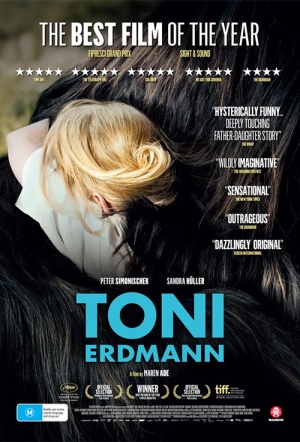
Toni Erdmann

(Germany/Austria 2016)

Toni Erdmann is not a real person; he’s the alterego of retired divorced schoolteacher Winfried Conradi (Peter Simonischek). When Winfried, a weird old hippy jokester, appears onscreen in a shaggy wig and bad fake teeth, he certainly gives the impression that those around him have to excuse his relatively harmless but tiresome—and often annoying—penchant for silliness. He is caretaker of his elderly mother, and death surrounds him. Perhaps that explains it.

Winfried’s daughter, Ines (Sandra Hüller), a young corporate sellout working on a project in Romania, drops by for a birthday. She’s on her phone most of the time, distracted by work. She’s so serious—and severe. Predictably, she doesn’t stick around long.

When his dog dies, Winfried flies to Bucharest and stalks Ines in the lobby of the office building where she works. She sees him and takes him to a reception, where she networks with Henneberg (Michael Wittenborn), an oil company executive she wants to make a deal with. The weekend is bizarre, filled with small talk, blank stares, and uncomfortable silence. Ines doesn’t bother to pretend she’s happy to see her father; in fact, it’s pretty clear she’s relieved to see him leave.

This is where Toni Erdmann gets interesting: Winfried doesn’t actually leave. Instead, he becomes “Toni Erdmann, life coach,” and sets out to reach Ines through her professional contacts. Funny thing: it actually works.

Writer/director Maren Ade has a solid grasp of strained relationships and embarrassing situations, and a sick sense of humor to boot. It’s a winning combination in Toni Erdmann, which has its share of quite a few awesomely cringeworthy moments. Your goofy dad upstaging you at a networking opportunity? Check. Naked birthday party—with coworkers? Check. An Easter party that includes an apoplectic performance of Whitney Houston’s “Greatest Love of All”? Check. A cum-soaked petit fours? Um, check.

For all its distance, Toni Erdmann turns out to be a surprisingly emotional film. It takes nearly three hours to get to it, but it ends on a whallop. It’s touching in a way I didn’t see coming. The final scene offers all anyone needs to see about this dysfunctional father/daughter relationship. And it’s beautiful.

With Ingrid Bisu, Lucy Russell, Thomas Loibl, Trystan Pütter, Hadewych Minis, Vlad Ivanov, Victoria Cocias

Production: Komplizen Film, coop99 filmproduktion, KNM, Missing Link Films, SWR/WDR/Arte

Distribution: NFP Marketing & Distribution (Germany), Soda Pictures (United Kingdom), Enfilade (Austria), Sony Pictures Classics (USA)

162 minutes
Rated R

(Music Box) B-

http://www.komplizen-film.de/e/toni-erdmann.html

http://www.sonyclassics.com/tonierdmann/

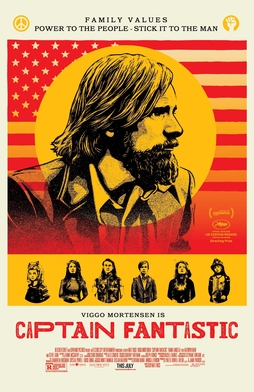
Captain Fantastic

(USA 2016)

Captain Fantastic came out last summer, and I wanted to see it then. I must confess, the cast interested me more than the plot.

Viggo Mortensen is the aptly named Ben Cash, a long disenfranchised survivalist who is, like, so over American capitalism and politics. He and his wife, Leslie (Trin Miller), shown almost entirely in flashback, decide to raise their six kids—three boys and three girls—off the grid in the mountain wilderness of Washington State. Removed from society, Ben and Leslie teach their kids everything from logic and philosophy to hunting and gathering to Norman Mailer and Guns ‘n’ Roses. They do it all without iPhones or religion. Kudos to that!

Nothing is perfect: Leslie suddenly dies, forcing Ben to take his feral kids into the outside 21st Century world for the first time, ever—which calls everything they planned for their family into question.

Director and screenwriter Matt Ross poses some interesting questions about society, conformity, and the social contract in a provocative and often lighthearted way. However, Captain Fantastic is not terribly surprising, which is why it doesn’t work as well as it could. At heart, it’s a standard fish out of water dramedy. Frankly, I spotted every “twist” coming before it got to me: the cop (Rex Young) who pulls over their Partridge Family van, the mildly blasphemous excuse that saves the day, the family’s visit to the supermarket, their reaction to their extended family (and vice versa), that lame scene in which Ben’s sister-in-law (Kathryn Hahn) calls him out onto the carpet for his choices and his youngest daughter (Shree Crooks) recites the Constitution to prove her wrong, eldest son Bo (George MacKay) proposing to the first girl who gives him attention—a trailer park teen queen (Erin Moriarty)—and the colleges he manages to get into, the “situation” that requires modern medical attention. Meh.

For all its grandiose intentions to take on the establishment, Captain Fantastic actually relies on a rather orthodox and pedestrian approach to make its point. Maybe that is its point, that you can’t escape society. It doesn’t mater: this story is predictable and sentimental, two things that never bode well. I expected more than Spokane Swiss Family Brady Bunch, which is essentially what this is. The one thing that saves this film from total mediocrity is the acting, which is great all around.

With Frank Langella, Ann Dowd, Samantha Isler, Annalise Basso, Nicholas Hamilton, Charlie Shotwell, Steve Zahn, Elijah Stevenson, Teddy Van Ee

Production: Electric City Entertainment, ShivHans Pictures

Distribution: Bleecker Street, Universal Pictures

118 minutes
Rated R

(iTunes rental) C

http://www.bleeckerstreetmedia.com/captainfantastic

Can’t Hardly Wait

(USA 1998)

As teen comedies go, the ’90s were a teenage wasteland. Sure, there were a few classics: Dazed and Confused, Clueless, Election, and American Pie immediately come to mind. That’s really about it. Can’t Hardly Wait, the second film of Chicago International Film Festival’s Totally ’90s series, is a typical specimen from the decade: it has some moments, but overall it’s either bland or reductive. Frankly, I don’t even remember it in theaters, which probably says all I need to know.

The setting is a huge kegger in a Los Angeles suburb the night of graduation. Leading man Preston Meyers (Ethan Embry), a sensitive dork, has longed for class babe Amanda Beckett (Jennifer Love Hewitt) ever since he first laid eyes on her during freshman year: he knew they were destined to be together when he noticed the same strawberry Pop Tarts in her bag that he had in his. She went for Mike Dexter (Peter Facinelli), a jock, instead; they dated all through high school. Word on the street is, Mike dumped Amanda. Intrigued, Preston persuades his snarky and derisive bestie Denise Fleming (Lauren Ambrose), certainly no woo-woo girl, to accompany him.

Meanwhile, class geek William Lichter (Charles R. Korsmo), who looks like a deranged Harry Potter, shows up to exact revenge against Mike, his lifelong nemesis. Mike, who dumped Amanda so he could be free to sleep around all summer, isn’t having fun—he’s preoccupied reconsidering his decision. While Preston chases after Amanda to give her a letter in which he spills his guts, Denise gets locked into a secluded bathroom with wannabe gangsta/raver Kenny Fisher (Seth Green), who wears big sneakers and goggles and thinks he’s a stud but isn’t.

Co-directors and screenwriters Harry Elfont and Deborah Kaplan clearly watched a ton of ’70s and ’80s teen flicks. They have good ideas, but I’ve seen them done before and done better. The only storyline that really interested me was the one with Denise and Kenny in the bathroom. And I love Seth Green. Other than that, the situations and the dialogue here lack any snap or punch. It’s all pretty flat.

This is not to say I hated Can’t Hardly Wait; I didn’t. I just didn’t love it. It was merely okay. I consider myself a teen movie aficionado, and this did not move me. The soundtrack is way better.

With Michelle Brookhurst, Alexander Martin, Erik Palladino, Channon Roe, Sean Patrick Thomas, Freddy Rodríguez, Joel Michaely, Jay Paulson, Jason Segel (in his first appearance onscreen), Selma Blair, Jerry O’Connell

Production: Columbia Pictures Corporation, A Tall Trees Production

Distribution: Columbia Pictures

101 minutes
Rated PG-13

(Public Chicago) C

Chicago International Film Festival

Clueless

(USA 1995)

“Searching for a boy in high school is as useless as searching for meaning in a Pauly Shore movie.”

—Cher Horowitz

The first screening of Chicago International Film Festival’s Totally ’90s series is Clueless, a sort of link between ’80s classics like Valley Girl and Heathers and later films like Election, 10 Things I Hate About You, Mean Girls, and even Fox’s current television series Scream Queens. Adapted from Jane Austen’s Emma, which I haven’t read and probably never will, Clueless transmits the novel’s heroine across time and space from outside London in the early Nineteenth Century to Beverly Hills in the late Twentieth. It’s a cute idea that works—I didn’t know until this screening that the story is 200 years old. As if!

“Hymenally challenged” (i.e., virgin) 16 year old California girl Cher Horowitz (Alicia Silverstone) is vain, popular, and rich. Perhaps not surprisingly, she’s incredibly superficial, even if she means well. Her mother died in “a freak accident during a routine liposuction,” leaving her father, brass-balled Type A litigator Mel (Dan Hedaya), to raise her. When Cher gets a bad report card, she enlists her bestie Dionne (Stacey Dash), a hip black version of herself, to help fix up two nerdy tough-grading teachers, Mr. Hall (Wallace Shawn) and Miss Geist (Twink Caplan). Her plan is simple: she wants to get them laid so they’ll chill out and be receptive to negotiating her grades. Meanwhile, Cher adopts a new student, “tragically unhip” druggie tomboy Tai (Brittany Murphy) as a pet project: Cher plans to make Tai more like Cher. Duh. Semi-crunchy, socially conscious stepbrother Josh (Paul Rudd) does not approve of Cher’s antics.

Written and directed by Fast Times at Ridgemont High‘s Amy Heckerling, Clueless feels like an ’80s throwback, but it’s still a lot of fun. Loaded with great zingers and one-liners, I laughed a lot. It also has a ton of references to ’90s pop culture that clearly date the film (Luke Perry? Snapple? A Cranberries CD?! Egads!). Clueless lacks a ceratin bite that makes “mean girl” flicks so, well, biting. I guess a large part is because Cher and Dionne aren’t really mean girls; they’re actually pretty naive. After all, it takes Cher awhile to figure out that Christian (Justin Walker), the guy she lusts after, is a friend of Dorothy. Hello?

With Julie Brown, Jeremy Sisto, Breckin Meyer, Donald Faison, Elisa Donovan

Production: Paramount Pictures

Distribution: Paramount Pictures (USA)

97 minutes
Rated PG-13

(Public Chicago) B-

Chicago International Film Festival

https://www.facebook.com/CluelessMovie

Django Unchained

(USA 2012)

“The ‘D’ is silent, hillbilly!”

—Django

If anyone would take a stab at something that sounds as ridiculous and cringeworthy as tackling American slavery in a spaghetti Western, it’s Quentin Tarantino. “I want to do movies that deal with America’s horrible past with slavery and stuff, but do them like spaghetti Westerns, not like big issue movies,” he said, clearly referring to Django Unchained in a 2007 interview—five years before it came out. “I want to do them like they’re genre films, but they deal with everything that America has never dealt with because it’s ashamed of it.” (http://www.telegraph.co.uk/culture/film/starsandstories/3664742/Quentin-Tarantino-Im-proud-of-my-flop.html).

The title here references Sergio Corbucci’s 1966 film Django, an actual spaghetti Western in which the titular hero, a cowboy, is thrust into a row between Southern Klansmen and Mexican revolutionaries. In Django Unchained, the story starts in 1858—just a few years before the American Civil War. Django (Jamie Foxx) is a slave separated from his wife, the curiously named Broomhilda von Shaft (Kerry Washington), after they were caught trying to escape a plantation. He’s shackled to a group of slaves that the Speck brothers (James Remar and James Russo) are driving on foot to be sold.

Enter traveling dentist Dr. King Schultz (Christoph Waltz), a genteel German driving a wagon with a big wooden tooth on top of it. Schultz is actually a bounty hunter looking for the Brittle brothers—Big John (M.C. Gainey), Lil Raj (Cooper Huckabee), and Ellis (Doc Duhame)—who happen to be Django and Broomhilda’s former masters. He makes Django an offer he can’t refuse: help him find and kill the brothers, and Schultz will pay him, set him free, and help him find Broomhilda.

Django Unchained is structured in essentially three “episodes.” The first takes place in a one-horse town near El Paso, where Schultz provokes the ire of the townfolk, the sheriff (Don Stroud), and a U.S. Marshall (Tom Wopat). The second takes place on a plantation owned and operated by Spencer “Big Daddy” Bennett (Don Johnson—um, wow!). The last, longest, and most twisted takes place on another plantation in Mississippi, the bountiful Candie-Land, owned by charming but sadistic Calvin Candie (Leonardo DiCaprio) and operated by his shifty Uncle Tom house-slave, Stephen (Samuel L. Jackson).

Tarantino actually pulls off what he said he wanted to, and he does it quite well. Django Unchained could have been a really dark film like its immediate successor, The Hateful Eight. The two films have a lot in common. The tension—and there’s lots of it—built into the story is deliberately and profoundly slow in reaching a boil. Django Unchained certainly has Tarantino’s trademark violence, revenge theme, and liberal use of the ‘n’ word—116 times, a record for a film according to IMDB (http://www.imdb.com/title/tt1853728/trivia?ref_=tt_trv_trv). A few scenes are difficult to watch, the “Mandingo fight scene” being the worst for me. Unlike The Hateful Eight, though, the violence here is Tarantino’s typical flagrantly graphic cartoonish gore. He also shows a more conspicuous sense of humor—for example, Django and Broomhilda are ancestors of John Shaft of the Shaft franchise (https://www.google.com/amp/deadline.com/2012/07/django-unchained-a-shaft-prequel-so-says-quentin-tarantino-comic-con-301010/amp/).

Django Unchained is an unlikely and uncomfortable pairing of an ugly part of our collective past with absurdity, but it’s entertaining while still getting its point across: we’re still living with the aftermath. It’s the kind of film you mull over for a long time after you see it.

With Laura Cayouette, Jonah Hill, Walton Goggins, Dennis Christopher, Dana Gourrier, Nichole Galicia, Miriam F. Glover, Quentin Tarantino, Franco Nero, Russ Tamblyn, Bruce Dern, Misty Upham, Danièle Watts, Robert Carradine

Produced by The Weinstein Company, Columbia Pictures

Distributed by The Weinstein Company (North America), Sony Pictures Releasing (International)

165 minutes
Rated R

(iTunes rental) A-

http://www.unchainedmovie.com

20th Century Women

(USA 2016)

“We are at a turning point in our history.”

—President Jimmy Carter

I was a little kid in the Seventies, but I have many indelibly vivid memories of the decade: huge cars, gas lines, expensive meat, hijacked planes, Sanka and Sweet’N Low, smoking everywhere, hard rock, punk rock, disco, macrame, spider plants, the Bicentennial, Sky Lab, Victoriana (we had Mucha posters in our mustard-colored kitchen), that strange Holly Hobby aesthetic. It seems like it all changed immediately when Reagan took office in 1981.

20th Century Women captures a slice of American life on that unique, unremembered and largely disowned cusp. Set as a flashback to 1979 with voiceovers that repeatedly remind us that we’re looking backward, the film is a rather remarkable time capsule. The story is simple: Dorothea (Annette Bening) is my grandparents’ age (born in 1924). She had her only son, Jamie (Lucas Jade Zumann), late in life—i.e., over age 40. She’s been divorecd for a few years, which was fine until Jamie hit puberty. Now, she needs help understanding him. She enlists his two closest allies—Julie (Elle Fanning), whose pants he wants to get into, and Abbie (Greta Gerwig), a postpunk fuckup—to help her figure him out.

Loosely based on actual events from director and writer Mike Mills’s childhood, 20th Century Women is fun to watch. Growing up in a house of females myself, I relate to a lot of his experiences. I loved all the Talking Heads, too. Oh!—and Siouxsie and the Banshees! That said, this film borders on overbearing with its nostalgia. It could’ve been so much better—the material and the talent are both there, but Mills goes for easy returns that don’t pay off. The story falls flat. Perhaps a quote from Bening in an earlier film, the superior and far more interesting Running with Scissors, succinctly sums up my problem here: “It’s shit, Fern. It’s sentimental. It’s emotionally dishonest. It implodes into nothingness.”

I wasn’t bored, and I didn’t hate 20th Century Women. But I’m never going to see this movie again. Too bad, because the acting is great. It’s a misfire due to its execution. It seemed like a good idea at the time.

Also starring Billy Crudup, Vitaly Andrew LeBeau, Curran Walters, Toni Christopher, Jimmy Carter (public domain footage)

Produced by Annapurna Pictures, Archer Gray, and Modern People

Distributed by A24

119 minutes
Rated R

(Landmark Century) C

http://20thcenturywomen-movie.com

Ed Wood

(USA 1994)

“You’re wasting your lives making shit. Nobody cares. These movies are terrible!”

—Dolores Fuller


“How do you do it? How do you get all your friends to get baptized just so you can make a monster movie?”

—Bunny Breckinridge


“Can your heart stand the shocking facts of the true story of Edward D. Wood, Jr?”

—Criswell


“Confidentially, I even paratrooped wearing a brassier and panties. I wasn’t afraid of being killed, but I was terrified of being wounded and having the medics discover my secret.”

—Ed Wood

Edward D. Wood, Jr., or simply Ed Wood, is widely regarded as the worst director of all time. In fact, he received posthumous recognition—the Golden Turkey Award—designating him as such (http://www.legacy.com/news/celebrity-deaths/article/ed-wood-the-best-of-the-worst). His silly low-budget DIY pulp/science fiction/horror flicks from the 1950s—low on plot, technique, and talent—are beloved by many because they’re so bad. Monumentally bad. Okay, maybe ridiculous is a better word. You decide from this trailer:

Based on Rudolph Grey’s book Nightmare of Ecstasy and adapted for the screen by Scott Alexander and Larry Karaszewski, Tim Burton’s labor of love, Ed Wood, is a period-piece biopic about the eccentric angora-loving filmmaker responsible for such gems as Jail Bait, Glen or Glenda, Bride of the Monster, and of course Plan 9 from Outer Space—Wood’s Citizen Kane (as Burton likens it here). This film rocks; I never get sick of it. Not ever. And for a few reasons.

The characters and performances are fantastic. Leading man Ed Wood is one of Johnny Depp’s most endearing roles; he plays Wood with an affectionate and demonstrative earnestness he’s never quite duplicated. Burton has always held sympathetic misfits in high regard—Edward Scissorhands, also played by Depp, immediately comes to mind. Here, he has a field day, bringing in an entire cast of warm and colorful weirdos that flock to Wood. Consider: best bud Bunny Breckinridge (Bill Murray), a boozy grand queen with a penchant for drama and glitter. “The Amazing Criswell” (Jeffrey Jones), an androgynous self-proclaimed psychic/horse shit artist. Max (Max Casella), the president of Wood’s fan club—and his errand boy. Overzealous, chatty crew member Conrad (Brent Hinkley). Later, Vampira (Lisa Marie), a gothic midnight movie hostess with lots of bosom, and TV wrestler Tor Johnson (George “The Animal” Steele) become regulars in Wood’s films.

The most important relationship, though, is the one between Wood and has-been Dracula star Bela Lugosi (Martin Landau), whom he meets in a coffin store. Lugosi’s life is far from glamorous: he lives alone in obscurity in a tiny tract house in a nondescript suburban neighborhood. He’s also a junkie. Wood moves from starstruck fan to employer to custodian and confidant. Landau gives a flawless performance; he earned an Academy Award for Best Supporting Actor for it. Every scene is inspired, but one of my favorites is his dramatic reading of that hackneyed “home” speech; it is, to use Wood’s word, “perfect.” Their friendship gives Ed Wood much of its warmth and humanity.

Despite the laughably amateur quality of Wood’s films—and his unorthodox way of shooting them—he gets them made. And no matter how poorly received they are, he doesn’t give up. In this sense, Ed Wood is uplifting and inspiring. He embraces his flaws, sticks to his guns, and believes in himself. Orson Welles himself (Vincent D’Onofrio) backs him up in one great scene at a bar.

Some might find the pace a bit slow. I don’t—the whole film is fun and jammed with quotable material that keeps it moving. Line after line is memorable—I could string together a bunch of quotes I know by heart and leave it at that (I’ve seen this film quite a few times). From a technical standpoint, Ed Wood is exceedingly well done. Filmed in shimmering black and white, Stefan Czapsky’s camerawork is beautiful. The cleverly composed, shadowy shots of Lugosi “fixing” in the bathroom and later tied to a bed in rehab, and Wood and future wife Kathy (Patricia Arquette) inside the carnival ride are especially remarkable. Howard Shore’s score—a rich mix of jazz, Cuban orchestration that wouldn’t sound out of place on I Love Lucy, and monster madness—is awesome.

Burton easily could have made this a snarkfest. Instead, he shows his idol in a respectful and positive light. His spirited take makes Ed Wood exceptional.

With Sarah Jessica Parker, Mike Starr, Juliet Landau, Stanley Desantis, Ned Bellamy, Norman Alden, G.D. Spradlin

Produced by Touchstone Pictures

Distributed by Buena Vista Pictures Distribution

127 minutes
Rated R

(iTunes purchase) A

Popstar: Never Stop Never Stopping

(USA 2016)

One of the best things to come from Saturday Night Live has to be its Digital Shorts segment. With titles like “Laser Cats!,” “Please Don’t Cut My Testicles,” “Jizz in My Pants,” and of course “Dick in a Box” and its follow up, “Motherlover,” the angle was decidedly crass and juvenile—high school boy stuff loaded with potty, sex, and to a lesser degree drug humor with the occasional reference to geek fodder, usually some work of the science fiction or fantasy genre. Written and produced by The Lonely Island—comedy trio Jorma Taccone, Akiva Schaffer, and Andy Samberg—the genius lied in the creators’ astute balance of pop cultural literacy, musical aptitude, and complete absurdism. Generally performed as music videos for rap and pop songs so spot on they sounded real, Digital Shorts attracted the likes of Steve Martin, Natalie Portman, Lady Gaga, Betty White, and of course Justin Timberlake.

In Popstar: Never Stop Never Stopping, The Lonely Island expands its formula into a feature length film, playing former members of Style Boyz, a boy band whose biggest hit was “The Donkey Roll” (https://youtu.be/-mRVK8-XfEU). After a rift over credit, the Boyz break up and go their separate ways. Lawrence (Schaffer) and Owen (Taccone) fail to duplicate their success, but narcissistic and dubiously talented frontman Conner Friel (Samberg) has a huge blockbuster with his solo album Thriller, Also. The film, done as a mockumentary very much in the style of This Is Spinal Tap!, picks up just as Conner’s followup, Connquest, is about to “drop” (i.e, be released). A huge media blitz including a tour is in the works. When Connquest fails to live up to its predecessor, all signs point to a Style Boyz reunion—but can that happen?

Popstar makes it abundantly clear why The Lonely Island’s brand of humor works as shorts: it simply can’t sustain a movie. With Popstar, they nail the excess, the ego, and the emptiness of the entertainment biz. Tim Meadows as Conner’s manager and Sarah Silverman as his publicist are awesome, simultaneously informing, persuading, and babysitting Conner while constantly stroking his ego. The songs sound real. Conner’s show, complete with backup dancers and a deejay, looks authentic. Some of the scenes are pretty damned funny, including one where Conner is forced to autograph a fan’s, um, junk (props for getting it through the window of the limo). It’s amusing to see real popstars like Questlove, Usher, 50 Cent, and Ringo Starr (not to mention bitch on wheels Simon Cowell) gush in fake interviews over something so obviously lame as Style Boyz and Conner. It’s fun to see P!nk, Adam Levine, and Michael Bolton perform with Conner—and “Equal Rights” (with P!nk) is a hilarious, cheerful spoof of Macklemore & Ryan Lewis’s “Same Love.” Seal and Mariah Carey make gracious cameos that show they can take a joke. This is all good. The problem is, Popstar is essentially a string of dumb gags. Unlike This Is Spinal Tap!, it gets tiresome, fast. I lost interest after a little while; the characters and the jokes are too thin to carry Popstar all the way. Even Timberlake, whose appearances with The Lonely Island have always been funny, is an uncharacteristic yawn as Conner’s chef. Meh.

Curiously, the best song for this film was deleted: https://youtu.be/t3jKtjgRZQY. Seeing it as a short probably is best, anyway.

Also starring Maya Rudolph, Joan Cusack, Imogen Poots, Chris Redd, Edgar Blackmon, James Buckley, Ashley Moore, Bill Hader, Will Forte, Will Arnett, Carrie Underwood, Nas, Akon, Big Boy, D.J. Khaled, Danger Mouse, Pharrell Williams, Jimmy Fallon, Martin Sheen, Snoop Dog, Weird Al Yankovic

Produced by Perfect World Pictures, Apatow Company, and The Lonely Island

Distributed by Universal Pictures

87 minutes
Rated R

(iTunes rental) D+

https://www.uphe.com/movies/popstar-never-stop-never-stopping

Florence Foster Jenkins

(UK 2016)

“People can say I can’t sing, but they can’t say I didn’t sing.”

—Florence Foster Jenkins

A lot of hype surrounded Florence Foster Jenkins before it arrived at a theater near us last fall. We wanted to catch it during its original run, but it came and went before we got around to seeing it. So, inspired by a post earlier in the day, I rented it on a Friday when we had no plans other than dinner at home. The night we watched it just happened to be Friday the 13th, which somehow seems appropriate.

Based on actual events and set during WWII, Florence (Meryl Streep) is a rich Manhattan society lady of a certain age who runs in an arty circle and knows a lot of people, some with money and others who follow it. She operates a private venue dedicated to opera, the Verdi Club, where she stars in a show and has a non-speaking role. Dying of either syphillis or the treatment for it—mercury and arsenic!—her one wish is to perform for an audience at Carnegie Hall. The problem is, she can’t sing; she’s downright awful. Her entrance here, lowered onstage from a rope and pulley while dressed as an angel with a harp, reminds me of Sarah Jessica Parker’s entrance (“I offer you mortals the bird of peace so that you may change your ways and end this destruction”) in Ed Wood, Tim Burton’s 1994 biopic about a similarly talentless film director who came along a decade or so later. The comparison is so apt that I wonder if it was intentional. Here, Florence’s husband, St. Clair Bayfield (Hugh Grant), doesn’t help matters by exaggerating her talent.

Determined to make her dream come true, Florence hires a vocal trainer, Carlo Edwards (David Haig), and a pianist, Cosmé McMoon (Simon Helberg), to put together a show. Established and well-known Carlo is content to take Florence’s money, build her ego, and let her dream on. Budding Cosmé, however, struggles with lying to her about her obvious ineptitude, not to mention her negative impact on his professional reputation. He soon sees that those around Florence stretch the truth about a lot of things when dealing with her.

Nicholas Martin’s script is kind to its characters, going for laughs in a way that doesn’t demean any of them. I never heard of her until this film, but the actual Florence Foster Jenkins was an interesting person. Her singing truly was awful:
https://www.youtube.com/watch?v=Hcs9yJjVecs. As always, Streep is spot on with her portrayal. She seems to have fun in this role, and it shows. Grant, who usually bores me but doesn’t here, is well suited for St. Clair: he’s stuffy and straight, but he nicely coveys an underlying deceitfulness that doesn’t come off as sinister. I like the way director Stephen Frears plays with deceit here, ultimately using it to depict a very touching side of St. Clair—who lives with his mistress (Rebecca Ferguson) in Brooklyn in apartment that Florence pays for. Much to my surprise, though, Big Bang Theory‘s Helberg steals practically every scene he’s in: keeping it subtle with Cosmé’s homosexuality (as Cosmé himself no doubt would have done during his day), he plays his character as a spineless, perennially uncomfortable, asexual bundle of nerves. He peppers his performance with grimaces and nervous giggles. Later, he delivers a line to explain his tardiness to Florence (of course, it involves sailors) with perfect and priceless dryness. He outshines everyone here.

Florence Foster Jenkins has some funny moments and some very touching ones. I found it enjoyable enough, but certainly not a knockout. It could have benefitted from a little more quirk and edge, especially considering its title character who showed no shortage of either.

Also starring Nina Arianda, Stanley Townsend, Allan Corduner, John Sessions, John Kavanagh, David Menkin, and Sid Phoenix

Produced by Qwerty Films, Pathé Pictures International, and BBC Films

Distributed by Paramount Pictures (USA)

111 minutes
Rated PG-13

(iTunes rental) C

http://www.florencefosterjenkinsmovie.com