Tokyo Vampire Hotel

(Japan 2017)

This theatrical cut of director Sion Sono’s Amazon Prime miniseries Tokyo Vampire Hotel [東京ヴァンパイアホテル] (http://www.indiewire.com/2017/04/tokyo-vampire-hotel-sion-sono-amazon-1201808369/) is a fast-paced stylish and colorful bloodbath, something that wouldn’t be out of place in Quentin Tarantino’s oeuvre.

Manami (Tomite Ami) is a nice girl who shares a tiny apartment with her boyfriend (Saito Takumi) in Tokyo. Just after she arrives for dinner with her friends on the evening of her 22nd birthday, a crazy gun-toting assassin (Shoko Nakagawa) in a fuzzy pink mink shows up and takes out everyone in the restaurant — except Manami, whom she came to kidnap.

Manami flees, only to be picked up by another kidnapper, the mysterious K (Kaho). K in not so may words explains that Manami is a pawn in a war between two vampire clans, the Draculas and the Corvins, who have been enemies for centuries. Unbeknownst to Manami, she’s the target of a worldwide vampire hunt. K takes her to the glamorous Tokyo Vampire Hotel, which is run by a creepy geisha empress (Adachi Yumi) who needs blood.

The end of civilization is coming, but the empress has a plan: use the hotel to trap a healthy supply of humans to serve as food. Things don’t pan out as planned when the humans figure out what’s happening and the Draculas show up to crash the party.

This photo sums up what you’re getting into here:

Tokyo still.jpg

Tokyo Vampire Hotel is quirky, sexy, lavish, and fun. Sono serves up an imaginative feast of dazzling eye candy and nonstop action. His use of Christian symbols adds a nice touch. The sets are fantastic, and the action moves from the streets of Tokyo at night to inside the hotel to Bran Castle in Transylvania, and back. The editing works to make nine episodes flow seamlessly into a feature length film. However, the story wears thin after a little while, and it can’t sustain the interest I started out with. The gore gets old, too. The length, nearly two and a half hours, is a problem. It demonstrates why Tokyo Vampire Hotel is probably better in smaller doses.

With Mitsushima Shinnosuke, Yokoyama Ayumu, Kagurazaka Megumi, Shibukawa Kiyohiko, Takatsuki Sara, Tsutsui Mariko, Sakurai Yuki

Production: Amazon, Django Film, Nikkatsu Pictures

Distribution: Nikkatsu International Sales

142 minutes
Not rated

(AMC River East) C+

Chicago International Film Festival

https://youtu.be/2cJRq73BAhE

La Chinoise

(France 1967)

“Okay, it’s fiction. But it brings me closer to reality.”

— Véronique

Set in the context of the New Left movement in late 1960s France, Jean-Luc Godard’s La Chinoise is not really about the political ideas it raises — many of which seem relevant today. No, at its core is Godard satirizing the idealism of youth.

Structured as a mockumentary in what undoubtedly is an intentionally scrappy art school style, La Chinoise is a series of “interviews” of five middle class college students about their Maoist terrorist organization. Headquartered in a loft apartment in a suburb of Paris, they named their organization “Aden Arabie” after a novel by French communist Paul Nizan.

The apartment, all done up in primary colors like a Piet Mondrian painting, is owned by one of the members’ parents.

Véronique (Anne Wiazemsky, who sadly died exactly a week before the screening I attended) (https://www.nytimes.com/2017/10/05/obituaries/anne-wiazemsky-french-film-star-and-novelist-dies-at-70.html) is the bossy leader, a philosophy student from a family of bankers. She’s involved with Guillaume (Jean-Pierre Léaud), a “theatrical actor.” Yvonne (Juliet Berto) grew up on a farm and works as a housekeeper and occasional hooker. She’s involved with Henri (Michel Semeniako), a writer who protests and publishes essays. Serge Kirilov (Lex de Bruijin) is a Russian nihilist who is single and suicidal.

La Chinoise is dense with ramblings about social and economic philosophy, politics, and literature. However, Godard uses all of it to make his point: these are kids who are still naïve and don’t fully grasp what they say they stand for. He shows them running around with toy weapons, playing school, and acting out scenes from books in the apartment, often cutting to pictures of comic book and cartoon characters. The joke is pretty funny when you consider the bourgeois backgrounds of the kids.

A conversation between Véronique and French philosopher Francis Jeanson on a train best illustrates Godard’s point: he asks a series of questions challenging her proposal to blow up the university in an effort to expose the flaws in her plan — and maybe get her to question her motives and the depth of her conviction. It goes over her head. So much for carrying pictures of Chairman Mao.

Side note: Claude Channes’s song “Mao-Mao” features prominently here. It’s a nifty little earworm.

With Omar Blondin Diop

Production: Anouchka Films, Les Productions de la Guéville, Athos Films, Parc Film, Simar Films

Distribution: Athos Films (France), Pennebaker Films (United States), Kino Lorber

96 minutes
Not rated

(Gene Siskel Film Center) C+

https://www.kinolorber.com/film/view/id/1111

Foxy Brown

(USA 1974)

“That’s my sister, baby. And she’s a whole lot of woman.”

— Link


“Death is too easy for you, bitch. I want you to suffer.”

— Foxy

To use a term straight from Willie Hutch’s theme song, director/screenwriter Jack Hill’s Foxy Brown is superbad. It’s definitely not something to see for technical or artistic excellence, but it’s cool nonetheless. A sort of reworking of Coffey, it’s a sexy vigilante revenge tale that doesn’t take itself too seriously.

Pam Grier is Foxy Brown, a bodacious woman on a mission to track down the goons who shot and killed her boyfriend (Terry Carter), a government agent who just had plastic surgery to change his identity, right outside her door. Obviously, this is the work of a Los Angeles drug ring.

Foxy quickly figures out who the rat is: her own brother, Link (Antonio Fargas). He identifies her boyfriend’s killers as affiliates of a “modeling agency.” The agency is run by fixers Miss Kathryn Wall (Kathryn Loder) and Steve Elias (Peter Brown). Their clients are crooked high profile men of the law like judges and politicians who trade favors for girls.

Posing as a prostitute, Foxy gets inside the operation and does some major damage. It gets her in serious hot water when she’s exposed, bringing her into the center of a lesbian bar brawl and then onto a coke ranch as a junky sex slave. Fortunately, she’s tough and resourceful. No one gets the best of Foxy.

Built on sex parties, chase scenes, shoot outs, and boobs, the plot is structured like a sitcom, and it’s about as complicated and predictable. Naturally, Foxy gets what she wants in the end. Except for the very cool opening titles, there are no effects to speak of. The acting is average at best. However, the action is surprisingly steady, leaving very few dull spots. Plus, there’s real sas here, mostly from Grier, that keeps the whole thing interesting.

I wouldn’t go so far as to call Foxy Brown a feminist work, but Foxy is a badass heroine with her heart — and her head — in the right place. It’s a thrill watching her take control, especially in heels and those fabulous frocks. I wouldn’t want to piss her off.

With Harry Holcombe, Sid Haig, Juanita Brown, Sally Ann Stroud, Bob Minor, Tony Giorgio, Fred Lerner, Judy Cassmore, H.B. Haggerty, Boyd ‘Red’ Morgan, Jack Bernardi, Brenda Venus, Kimberly Hyde, Jon Cedar, Ed Knight, Esther Sutherland, Mary Foran, Jeannie Epper, Stephanie Epper, Peaches Jones, Helen Boll, Conrad Bachmann, Russ Grieve, Rodney Grier, Roydon E. Clark, Don Gazzaniga, Jay Fletcher, Gary Wright, Fred Murphy, Edward Cross, Larry Kinley Jr.

Production: American International Pictures (AIP)

Distribution: American International Pictures (AIP) (USA), Sociedade Importadora de Filmes (SIF) (Portugal), Film AB Corona (Sweden), Cinema Mondo (Finland)

92 minutes
Rated R

(Impact) C+

https://youtu.be/eVDvu28O3WU

Snow-White

(USA 1933)

Max Fleischer’s Snow-White is nothing like Walt Disney’s — and that’s good. Fleischer offers a dark, edgy, and weirdly trippy death-focused version of the story most know from Disney. He “staffs” this short with characters from his Betty Boop cartoons.

Betty Boop (Mae Questel) — as Snow White — is off to a bad start when a magic mirror with Cab Calloway in it tells the Evil Queen (Questel), who looks and acts a lot like Olive Oyl, that Betty is “the fairest in the land.” The Queen orders her flunkies, Bimbo and Ko-Ko the Clown, to kill Betty — off with her head!

Bimbo and Ko-Ko don’t really want to hurt Betty. They take her to the forest, where she escapes by jumping into a river that freezes her into a box that looks like a coffin and carries her down a hill to the seven dwarves. Meanwhile, Bimbo and Ko-Ko fall into a hole and land in a cave where the Queen is. She turns them into monsters as they sing a blues number.

The Queen asks the mirror again who the fairest in the land is, and this time the mirror explodes into a puff of smoke that puts her face to face with Betty. Things don’t end well for the Queen.

Roland C. Crandall’s animation is rough and jagged and kind of jumpy, giving the whole thing a nervous energy and a sketchy vibe. He loads this cartoon with ghosts, skeletons, armored executioners, and other creepy goblins. Ko-Ko dancing to “St. James Infirmary Blues” is rotoscoped from footage of Calloway performing the song. This Snow-White has a Cajun flavor to it. It’s an interesting approach.

In 1994, the United States Library of Congress deemed Snow-White “culturally, historically, or aesthetically significant” and selected it for preservation in the National Film Registry (https://www.loc.gov/programs/national-film-preservation-board/film-registry/complete-national-film-registry-listing/).

With Billy Murray

Production: Fleischer Studios

Distribution: Paramount Pictures

7 minutes
Not rated

(YouTube) C+

Fatty’s Tintype Tangle

(USA 1915)

Roscoe “Fatty” Arbuckle was a huge (no pun intended) but beleaguered star in the early 20th Century. He had a tough life and he died young (https://en.wikipedia.org/wiki/Roscoe_Arbuckle). After a start in vaudeville, he became one of Hollywood’s first movie stars, quickly negotiating a deal worth a million dollars a year plus a quarter of the profits from his films (https://www.thehairpin.com/2012/02/scandals-of-classic-hollywood-the-destruction-of-fatty-arbuckle/). On top of it, he got total artistic control.

It all came to a screeching halt when a young alcoholic actress died after a hotel party he threw, and he was accused of rape. It was Hollywood’s first big scandal, and it ended his career (http://www.smithsonianmag.com/history/the-skinny-on-the-fatty-arbuckle-trial-131228859/).

Incidentally, that hotel party occurred in San Francisco exactly 96 years ago on the day after this post.

Today, I saw my first Fatty Arbuckle film — and it only took me 108 years (https://en.wikipedia.org/wiki/Roscoe_Arbuckle_filmography). I had a loose idea of what to expect but I wasn’t quite sure. Fatty’s Tintype Tangle is familiar and not too crazy, the cinematic equivalent of something that tastes like chicken.

WARNING: Potential spoilers ahead!

A slapstick farce, Fatty’s Tintype Tangle tells of a husband (Arbuckle) whose mother-in-law (Mai Wells) nags the shit out of him. He and his wife (Norma Nichols) laugh at her behind her back. After getting liquored up in the kitchen while cooking breakfast, Fatty tells off his mother-in-law and either throws her ass out of his house or upsets her to the point that she gets up and goes — it’s hard to say.

Fatty goes to the park, where he sits on a bench next to a woman (Louise Fazenda) whose husband (Edgar Kennedy) momentarily leaves her to go do something — the scene card tells us they’re Alaskan “homeseekers,” whatever that is. They seem down and out, staying at an obviously low rent room and board. A photographer (Glen Cavender) snaps their picture — hence the “tintype” in the title — which isn’t cool because, well, they’re both married. The husband returns, mistakes Fatty for a creep, and threatens to kill him if he doesn’t leave town.

Fatty runs home and packs his bags — including his booze. He tells his wife he’s going on a business trip. Despondent, she answers an ad in the paper from someone seeking an apartment. She rents out the house and apparently moves in with her mother. Turns out, her tenants are the Alaskan couple. Doh!

Fatty misses his train and goes home. Unbeknownst to him, the Alaskan woman is in his bathroom. Hilarity ensues.

Fatty’s Tintype Tangle has all the elements of early comedy, a lot of it cliché now: misunderstandings, the hapless henpecked male, a slip and fall on a banana peel, gunshots to the ass, even Keystone cops. The only thing missing is a pie in the face. A rather cool extended scene features Arbuckle climbing up a pole and running across power lines. I was impressed to see him doing his own stunts; he was surprisingly limber for such a big guy.

Slapstick isn’t my favorite form of entertainment, but this is solid physical comedy even if it’s hard to follow at points. The version I saw had no sound at all, which was a bummer — hearing myself breathe adds nothing to the experience.

In 1995, the United States Library of Congress deemed Fatty’s Tintype Tangle “culturally, historically, or aesthetically significant” and selected it for preservation in the National Film Registry (https://www.loc.gov/programs/national-film-preservation-board/film-registry/complete-national-film-registry-listing/).

With Frank Hayes, Joe Bordeaux, Bobby Dunn, Ted Edwards, Charles Lakin

Production: Keystone Film Company

Distribution: Mutual Film Corporation

27 minutes
Not rated

(YouTube) C+

https://youtu.be/a1VROYs1D6Y

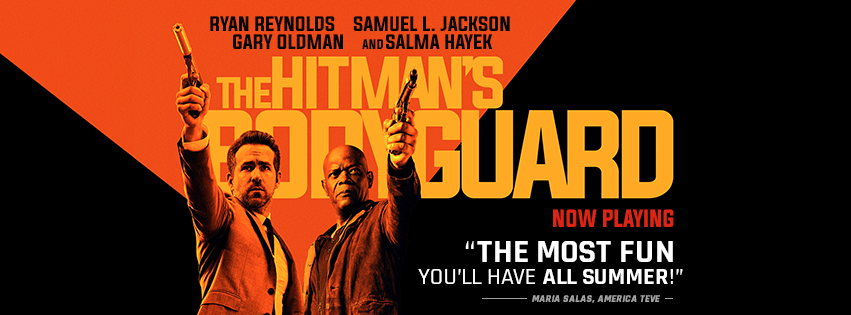
The Hitman’s Bodyguard

(USA 2017)

“Get Triggered,” commands one of the movie posters for Patrick Hughes’s The Hitman’s Bodyguard. I don’t know what that means here, but this film is a bit fluffy to trigger much more than some chuckles — after all the eyerolling, of course. That’s how it went for me.

Ryan Reynolds is Michael Bryce, a humiliated professional bodyguard whose career took a hit — get it? — after a client (Tsuwayuki Saotome) was shot and killed right in front of him. Now, he barely ekes out a living guarding low profile corporate executives addicted to speed. He operates out of his run down car, which is where he also lives (as evident from his “bathroom,” an empty water bottle). To make matters worse, Michael is still reeling from a breakup with Amelia (Élodie Yung), an Interpol agent he blames for his sad state.

Amelia is charged with a simple but very consequential mission: to deliver notorious hitman Darius Kincaid (Samuel L. Jackson) to the International Court of Justice at the Hague. Darius has agreed to testify against Vladislav Dukhovich (Gary Oldman), the depraved dictator of Belarus on trial for crimes against humanity. Unfortunately for the prosecution, Dukhovich has a stalwart and invincible army of goons that hunts and kills any witness who has any dirt on him. Darius is the prosecution’s last hope, and the clock is ticking.

When Amelia’s armored car is attacked by Dukhovich’s men, she and Darius go into hiding. She contacts Michael for a favor: to complete the mission and get the star witness to the Hague. She doesn’t tell him who the witness is, and it turns out that Michael and Darius have a history. It ain’t pretty.

Not surprisingly, The Hitman’s Bodyguard is light fare, a stock comedy/action quasi buddy flick. It’s a perfect summer movie; frankly, I’m not sure why it wasn’t released earlier. Tom O’Connor’s screenplay is repetitive, predictable, and loaded with F-bombs, but it’s fun and isn’t at all serious. Reynolds and Jackson have an amusing love/hate relationship filled with banter about everything from murder to love to pop music that wouldn’t be out of place in Pulp Fiction. In between their banter is nonstop action — car chases, explosions, shoot outs in helicopters and boats, cat and mouse games.

Jackson does what he does best: causes grief and cusses with force. Reynolds plays a good square with earnestness. If these two had better chemistry, The Hitman’s Bodyguard would be a more memorable film. Salma Hayek is the best thing about this movie: she’s dramatic and severe and hilarious as Sonia Kincaid, the streetwise but still crazy wife of Darius. Rotting away in an Amsterdam prison, she’s relentless about protesting the grave injustice done to her. She effortlessly steals every scene she’s in.

With Michael Gor, Tine Joustra, Yuri Kolokolnikov, Rod Hallett, Joaquim de Almeida, Kirsty Mitchell, Richard E. Grant

Production: Millennium Films, Cristal Pictures

Distribution: Lionsgate Films

118 minutes
Rated R

(ArcLight) C+

http://www.thehitmansbodyguard.movie/mobile/

Dunkirk

(USA / UK / France / Netherlands 2017)

I have mixed feelings about Christopher Nolan’s spectacular Dunkirk, a World War II military drama that has very little to do with battle. Told from three perspectives — land (“the mole”), sea, and air — the story here centers on an evacuation, that of British and allied soldiers from the beaches of Dunkirk, a fishing village in northern France at the Belgian border, over a ten-day period in late Spring 1940 (https://en.wikipedia.org/wiki/Dunkirk_evacuation).

I have to admit ignorance here: I knew nothing about the Dunkirk evacuation going into this film. Nolan doesn’t spend any time on background or what led to this point; instead, he just picks up with British soldier Tommy (Fionn Whitehead) fleeing German fire outside the beach. I wish I had known ahead of time because I would have done some research. I thought a better job could have been done telling the story.

The structure, jumping between the three perspectives, takes a little work to follow. What exactly is going on is unclear and confusing, and it creates a nice sense of claustrophobia and panic in many scenes — especially that boat scene. This is good. However, keeping track of the characters is a tough task not made any easier by giving all the soldiers the exact same black hair dye. I found it hard to relate to or care much about any of them because I was kept at arm’s length. I couldn’t get invested. While definitely not the same story, Dunkirk is a kind of a big budget Son of Saul — just not as good.

As a spectacle, though, Dunkirk is magnificent. Cinematographer Hoyte van Hoytema shot it on 70 millimeter film, and he packs this picture with gorgeous wide shots of the beach, the sea, and throngs of desperate soldiers. He beautifully captures the hopelessness of the situation with a drab palette of only a few army colors: greens, greys, blues, and cold whites that convey a chill I could see and feel. The sound is over the top loud. If nothing else, Dunkirk is total sensory overload. It’s worth seeing for that alone.

Side note: I’m not sure which is the bigger surprise here — that 1D’s Harry Styles actually isn’t terrible, or that Tom Hardy is hidden under aviator goggles for the entire film. The latter is a bummer. He’s so hot!

With Mark Rylance, Tom Glynn-Carney, Jack Lowden, Aneurin Barnard, James D’Arcy, Barry Keoghan, Kenneth Branagh, Cillian Murphy, Michael Caine

Production: Syncopy, Warner Brothers, Dombey Street Productions, Kaap Holland Film, Canal+, Ciné+, RatPac-Dune Entertainment

Distribution: Warner Brothers, Karo Premiere (Russia), NOS Audiovisuais (Portugal), Roadshow Entertainment (New Zealand), Roadshow Films (Australia)

106 minutes
Rated PG-13

(Music Box) C+

http://www.dunkirkmovie.com

The Bachelor and the Bobby-Soxer

(USA 1947)

Richard “Dick” Nugent (Cary Grant) is a dashing, self-absorbed playboy charged with inciting a brawl at a nightclub. A self-employed artist, he shows up late for his hearing before priggish Judge Margaret Turner (Myrna Loy), who’s put off by his casual indifference. Nevertheless, she dismisses the case when she sees that the whole thing started with two floozies (Veda Ann Borg and Carol Hughes) fighting over him. With a slam of her gavel and an eyeroll, she sends Dick on his way, warning him to watch himself.

A free man, Dick heads straight to his next appointment: he’s the guest lecturn at a high school where Margaret’s dramatic 17-year-old sister, Susan (Shirley Temple), is a student. She attends the lecture, and is immediately smitten. Susan approaches Dick afterward and offers to, err, model for him. He’s noncommittal, clearly unaware that he’s dealing with a determined gal.

That evening, Susan gets all dolled up and sneaks out to Dick’s apartment, a spacious two-story downtown suite I’d kill to have. He’s not home, but she persuades the young doorman (Ian Bernard?) to let her up so she can wait for him. Naturally, she falls asleep on the davenport.

A big misunderstanding leads to Dick punching Margaret’s date, district attorney Tommy Chamberlain (Rudy Vallee), when they show up at his apartment to rescue Susan soon after he gets home and discovers her there. Dick is sent to the slammer, where court psychiatrist Dr. Matt Beemish (Ray Collins)—Margaret and Susan’s uncle—figures out what’s up. The good doctor proposes a “simple” solution: Dick agrees to date Susan, Margaret agrees to allow Susan to date Dick until her infatuation runs its course, and Tommy agrees to drop the assault charge. All three grudgingly agree to the plan. Hilarity ensues, especially as Dick and Margaret start digging each other—and Susan proves to be a real pain in the ass.

Penned by future TV creator/writer Sidney Sheldon (The Patty Duke Show, I Dream of Jeannie, and Hart to Hart), The Bachelor and the Bobby-Soxer is a solid textbook screwball comedy. It actually feels like a sitcom. Sheldon won an Oscar for Best Original Screenplay for this (https://www.oscars.org/oscars/ceremonies/1948), and I can see why: his script is light and fun, capitalizing on the generation gap between youth culture and, I guess, middle age. I doubt the story would fly today; the whole premise reads as creepy by 21st Century standards. For a more innocent time, though, it totally works. And it’s amusing.

Director Irving Reis straddles the line between silly and ridiculous without going overboard. Grant, Loy, and Temple all have better work under their belt, but each still gives a memorable performance here even if their characters and this fluffy film are forgettable. I heard some grumbling from others in the audience, but I enjoyed this for what it is—and it ain’t Citizen Kane.

One final word about the nitrate print I saw: it was stunning, exceeding my expectations. I had my doubts that black and white film would make me sing the praises of nitrate, but The Bachelor and the Bobby-Soxer made me a believer; the whites were luminescent and the blacks and greys were deep and complex. Lovely!

With Lillian Randolph, Harry Davenport, Johnny Sands, Don Beddoe, Dan Tobin, Ransom Sherman, William Bakewell, Irving Bacon, Dore Schary

Production: RKO Radio Pictures, Vanguard Films

Distribution: RKO Radio Pictures

95 minutes
Not rated

(Dryden Theatre) C+

Nitrate Picture Show

Lost Highway

(USA 1997)

I watched David Lynch’s Lost Highway on my iPad on an Amtrak train from Chicago to Rochester. The one thing I strongly recommend is that it be viewed on the big screen, or at the very least on a flatscreen television. Quite simply, the visuals here are far too beautiful to see in an abridged format. And frankly, the visuals—sets, colors, costumes, actors, props—are the best part of the film.

The second thing I recommend is that it be watched under the influence of something—booze, pot, or better yet, prescription drugs.

This begs a question I’ll just answer: Lost Highway is fucked up—thrillingly so. The whole things starts with a videotape of our unlucky hero, saxophonist Fred Madison (Bill Pullman), murdering his wife (Patricia Arquette), who in an alternate universe is having an affair with Madison’s younger alterego, Pete Dayton (Balthazar Getty). The married couple has no memory of this murder. Neither party seems aware of this wrinkle in time and space, either. The connection lies with two people: demanding gangster Mr. Eddy (Robert Loggia) and creepy-ass flour-faced Robert Blake in what must be his most frightening role as The Mystery Man, a pallid ghost straight from a silent movie or a video by The Cure.

Lost Highway isn’t my favorite David Lynch film. However, it’s intriguing and vague enough to keep me thinking about it. I’m not sure what to make of this one—but I’m also not sure I care enough to do the work to figure it out. Maybe someday, definitely not today. The star cameos are enough for now.

Interesting fact: Lost Highway features the final film performances of Blake, Jack Nance, and Richard Pryor. Who knew?

With Alice Wakefield, John Roselius, Lou Eppolito, Henry Rollins, Mink Stole, Gary Busey, Lucy Butler, Giovanni Ribisi, Marilyn Manson, David Lynch

Production: October Films, CiBy 2000, Asymmetrical Productions, Lost Highway Productions LLC

Distribution: October Films (USA), Polygram Filmed Entertainment (UK), Rialto Film AG (Switzerland), RCV Film Distribution, Cinemussy (Spain), Senator Film (Germany), Atalanta Filmes (Portugal), Edko Films (Hong Kong), NTV-PROFIT (Russia), Artistas Argentinos Asociados (AAA) (Argentina), AmaFilms (Greece), New Star (Greece), Sandrew Film (Sweden), United International Pictures (UIP) (Australia), Warner Brothers (Finland)

134 minutes
Rated R

(iTunes rental) C+

http://www.davidlynch.de

https://youtu.be/1nKjO9QCSic

El Revenge [La Vingança]

(Argentina/Brazil 2016)

Sweet but not exactly savvy Brazilian stuntman Caco (Felipe Rocha) finds out the hard way that nice guys finish last. He surprises his girlfriend, Julia (Leandra Leal), at the restaurant where she works: all set to propose, he stumbles upon her and her boss in flagrante delicto in the pantry. Her boss, arrogant macho celebrity chef Facundo (Adrián Navarro), isn’t just hot, rich, and famous—he’s also Argentinian, which adds insult to injury.

Caco’s stunted party boy buddy Vadão (Daniel Furlan) does what any brah would under the circumstances: he takes Caco out to get wasted. While they’re out, Vadão surmises that what Caco needs to forget Julia is a roadtrip to Argentina to bag as many Argentinian babes as possible. It’s a weird way to get back at her and Facundo. Caco emphatically declines—that is, until he sees Julia’s Facebook post saying she’s moving to Buenos Aires with Facundo. He changes his mind but doesn’t tell Vadão why. They take off in a yellow Chevy Opala from the ’70s.

Honestly, I’ve seen this road movie many times before. Even so, I enjoyed El Revenge; director and cowriter Fernando Fraiha has a lot of fun with broken hearts, national pride, and fútbol (a.k.a. soccer) rivalries. The script isn’t the most original but the adventures are still entertaining: a customs agent who looks like Bruce Willis confiscates Vadão’s supply of Viagra, a beautiful woman (Aylin Prandi) walks in on Caco while his pants are in the washer in a motel laundry room, the car breaks down after the guys pick up a hitchhiking bride (Ana Pauls), and they share a competitive ride to the airport with a van full of condescending soccer fans. Raindrops can’t keep falling on Caco’s head forever, can they?

With Sebastián Presti, Gastón Ricaud

Production: Querosene Filmes, Globo Filmes, Bionica Films, Zarlek Producciones, Telecine Productions, Downtown Filmes

Distribution: Paris Filmes

90 minutes
Not rated

(AMC River East) C+

Chicago Latin International Film Festival

http://decimequesesientelavenganza.com

http://www.querosenefilmes.com.br/en/movies/la_vinganca