Center of My World [Die Mitte der Welt]

(Germany 2016)

Center of My World, director/screenwriter Jakob M. Erwa’s adaptation of German author Andreas Steinhöfel’s 1998 novel for young adults, is not a home run. Fortunately, though, Erwa knows how to extract enough charm, particularly from its two main actors, to downplay its shortcomings and proffer a respectable and enjoyable film.

17-year-old Phil (Louis Hofmann) lives with his mercurial, flighty mother, Glass (Sabine Timoteo), and his twin sister, Dianne (Ada Philine Stappenbeck), in a gorgeous house on the outskirts of town. This family isn’t exactly The Brady Bunch: Phil is gay, Dianne supposedly communicates with animals, and Glass can’t commit to a partner for very long. She won’t even tell her kids who their father is.

Phil notices some friction between the women of the house after he returns from summer camp. When school starts, his best friend, Kat (Svenja Jung), encourages him to go after mysterious new guy Nicholas (Jannik Schümann), a dreamy transfer student who looks like a cuter blue-eyed version of Lance Bass with his chiseled cheeks, luscious lips, and perfect hair. Supposedly, he likes boys. Phil finds out for sure in the locker room one afternoon—and it leads to a passionate affair, insecurity, and a weird bout of jealous competition with Kat.

Center of My World is a cute and engaging story. Erwa does a nice job showing how any kid, gay or otherwise, has a lot to deal with when it comes to sexuality. The Chaun Ngo’s cinematography is well done, employing a bright color pallette verging on artificial that plays really well against the small town setting with all its gardens and summer greenery. The acting is generally good. Schümann is really easy to just…gaze upon, I guess, but in a harmless Teen Beat way.

All that said, Center of My World would have been a much gutsier film, say, 15 years ago. It probably would have made a bigger impact then, too. It contains hints and echoes of things I’ve seen before. The characters are a bit hollow; some of them come off as half-baked, rendering their importance to the story tenuous or questionable. These two boys have sex a lot, which is great. However, the sex scenes here need work even with the full frontal we get. More in-your-face than sexy, they come off as gratuitous. I don’t know if Erwa was trying to be shocking, but it didn’t work if he was. It’s like watching two puppies go at it. I hope that’s not the intended result.

With Inka Friedrich, Sascha Alexander Geršak, Thomas Goritzki, Nina Proll, Clemens Rehbein

Production: Neue Schönhauser Filmproduktion, Prisma Film, Universum Film, mojo:pictures, Westdeutscher Rundfunk, Bayerischer Rundfunk, ARTE, Österreichischer Rundfunk

Distribution: Constantin-Film, Universum Film

115 minutes
Not rated

(Tower City Cinemas) B-

Cleveland International Film Festival

http://mitte-der-welt-film.de

https://www.facebook.com/diemittederwelt.film

Wait Until Dark

(USA 1967)

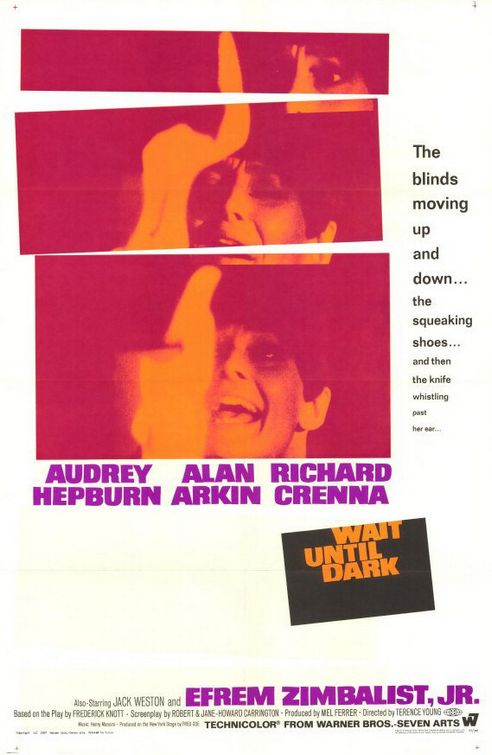
A heroin smuggling ring. A creepy doll. A corpse. A blind woman alone in her basement apartment in the West Village. These are the elements of Wait Until Dark, a quaint and dingy little crime thriller adapted from Frederick Knott’s 1966 play by screenwriters Robert Carrington and Jane-Howard Carrington.

Suzy Hendrix (Audrey Hepburn) is the hapless gudgeon who, being blind, already has the proverbial wool over her eyes. Her husband, Sam (Efrem Zimbalist Jr.), comes home from a business trip with a doll that unbeknownst to him contains a hidden stash of heroin sewn into it. This does not bode well for Lisa (Samantha Jones), the glamorous and sexy stranger who asks him to hold it for her at JFK International Airport.

A case of mistaken identity leads a pair of small time crooks (Richard Crenna and Jack Weston) to Sam and Suzy’s apartment, where psychotic hooligan Harry Roat (Alan Arkin) coerces them into helping him find the doll—as soon as they dispose of a dead body. Nice. They devise an elaborately devious scam to recover the doll when they realize Suzy, who walks in on them, is blind.

Terence Young’s directing is certainly competent. I last saw this movie on some late night UHF station when I was a kid, and two things have stayed with me: a sense of severe claustrophobia as the story unfolds, and that fucking groovy apartment. The plot has flaws that strain credibility. For one thing, Suzy is far too unguarded for a New Yorker. Why doesn’t she lock her door? Roger Ebert pointed out this detail (http://www.rogerebert.com/reviews/wait-until-dark-1968). I didn’t obsess over it like he did, but I noticed it and thought the same thing. When Roat tells her he knows she has the doll, why doesn’t Suzy hand it over? Why does she tell Gloria (Julie Herrod) to meet Sam at the train station instead of going to the police? Why do the guys bother to put on disguises if Suzy can’t see them?

Despite these glaring issues, Young ultimately succeeds in bringing Wait Until Dark to a boil. It lives up to its hype: I saw people jump in their seats at the end. The acting here overcomes any shortcomings in plot. Hepburn is little more than a blind Holly Golightly, but at certain points she reminds me of Barbara Stanwyck screaming that she can’t wake up from a nightmare in, I think, The Night Walker. Weston is a little too bumbling, but Crenna and Arkin are chillingly menacing and foreboding even if they are silly by today’s standards (yeah, sunglasses at night went a long way making Corey Hart look tough). Henry Mancini’s eerie score is the clincher in setting the right mood.

A trivial point of interest: Suzy’s apartment is in the same block of rowhouses as the one used for the Huxtable residence on The Cosby Show (http://www.movie-locations.com/movies/w/Wait_Until_Dark.html#.WRU0W1LMyWY). The small street, St. Luke’s Place, has a bit of literary history, too (http://www.nytimes.com/1996/10/27/realestate/in-a-village-enclave-15-remarkable-rowhouses.html).

With Jean Del Val, Frank O’Brien

Production: Warner Brothers

Distribution: Warner Brothers/Seven Arts

108 minutes
Not rated

(Music Box) B-

Toni Erdmann

(Germany/Austria 2016)

Toni Erdmann is not a real person; he’s the alterego of retired divorced schoolteacher Winfried Conradi (Peter Simonischek). When Winfried, a weird old hippy jokester, appears onscreen in a shaggy wig and bad fake teeth, he certainly gives the impression that those around him have to excuse his relatively harmless but tiresome—and often annoying—penchant for silliness. He is caretaker of his elderly mother, and death surrounds him. Perhaps that explains it.

Winfried’s daughter, Ines (Sandra Hüller), a young corporate sellout working on a project in Romania, drops by for a birthday. She’s on her phone most of the time, distracted by work. She’s so serious—and severe. Predictably, she doesn’t stick around long.

When his dog dies, Winfried flies to Bucharest and stalks Ines in the lobby of the office building where she works. She sees him and takes him to a reception, where she networks with Henneberg (Michael Wittenborn), an oil company executive she wants to make a deal with. The weekend is bizarre, filled with small talk, blank stares, and uncomfortable silence. Ines doesn’t bother to pretend she’s happy to see her father; in fact, it’s pretty clear she’s relieved to see him leave.

This is where Toni Erdmann gets interesting: Winfried doesn’t actually leave. Instead, he becomes “Toni Erdmann, life coach,” and sets out to reach Ines through her professional contacts. Funny thing: it actually works.

Writer/director Maren Ade has a solid grasp of strained relationships and embarrassing situations, and a sick sense of humor to boot. It’s a winning combination in Toni Erdmann, which has its share of quite a few awesomely cringeworthy moments. Your goofy dad upstaging you at a networking opportunity? Check. Naked birthday party—with coworkers? Check. An Easter party that includes an apoplectic performance of Whitney Houston’s “Greatest Love of All”? Check. A cum-soaked petit fours? Um, check.

For all its distance, Toni Erdmann turns out to be a surprisingly emotional film. It takes nearly three hours to get to it, but it ends on a whallop. It’s touching in a way I didn’t see coming. The final scene offers all anyone needs to see about this dysfunctional father/daughter relationship. And it’s beautiful.

With Ingrid Bisu, Lucy Russell, Thomas Loibl, Trystan Pütter, Hadewych Minis, Vlad Ivanov, Victoria Cocias

Production: Komplizen Film, coop99 filmproduktion, KNM, Missing Link Films, SWR/WDR/Arte

Distribution: NFP Marketing & Distribution (Germany), Soda Pictures (United Kingdom), Enfilade (Austria), Sony Pictures Classics (USA)

162 minutes
Rated R

(Music Box) B-

http://www.komplizen-film.de/e/toni-erdmann.html

http://www.sonyclassics.com/tonierdmann/

Clueless

(USA 1995)

“Searching for a boy in high school is as useless as searching for meaning in a Pauly Shore movie.”

—Cher Horowitz

The first screening of Chicago International Film Festival’s Totally ’90s series is Clueless, a sort of link between ’80s classics like Valley Girl and Heathers and later films like Election, 10 Things I Hate About You, Mean Girls, and even Fox’s current television series Scream Queens. Adapted from Jane Austen’s Emma, which I haven’t read and probably never will, Clueless transmits the novel’s heroine across time and space from outside London in the early Nineteenth Century to Beverly Hills in the late Twentieth. It’s a cute idea that works—I didn’t know until this screening that the story is 200 years old. As if!

“Hymenally challenged” (i.e., virgin) 16 year old California girl Cher Horowitz (Alicia Silverstone) is vain, popular, and rich. Perhaps not surprisingly, she’s incredibly superficial, even if she means well. Her mother died in “a freak accident during a routine liposuction,” leaving her father, brass-balled Type A litigator Mel (Dan Hedaya), to raise her. When Cher gets a bad report card, she enlists her bestie Dionne (Stacey Dash), a hip black version of herself, to help fix up two nerdy tough-grading teachers, Mr. Hall (Wallace Shawn) and Miss Geist (Twink Caplan). Her plan is simple: she wants to get them laid so they’ll chill out and be receptive to negotiating her grades. Meanwhile, Cher adopts a new student, “tragically unhip” druggie tomboy Tai (Brittany Murphy) as a pet project: Cher plans to make Tai more like Cher. Duh. Semi-crunchy, socially conscious stepbrother Josh (Paul Rudd) does not approve of Cher’s antics.

Written and directed by Fast Times at Ridgemont High‘s Amy Heckerling, Clueless feels like an ’80s throwback, but it’s still a lot of fun. Loaded with great zingers and one-liners, I laughed a lot. It also has a ton of references to ’90s pop culture that clearly date the film (Luke Perry? Snapple? A Cranberries CD?! Egads!). Clueless lacks a ceratin bite that makes “mean girl” flicks so, well, biting. I guess a large part is because Cher and Dionne aren’t really mean girls; they’re actually pretty naive. After all, it takes Cher awhile to figure out that Christian (Justin Walker), the guy she lusts after, is a friend of Dorothy. Hello?

With Julie Brown, Jeremy Sisto, Breckin Meyer, Donald Faison, Elisa Donovan

Production: Paramount Pictures

Distribution: Paramount Pictures (USA)

97 minutes
Rated PG-13

(Public Chicago) B-

Chicago International Film Festival

https://www.facebook.com/CluelessMovie

Paterson

(USA 2016)

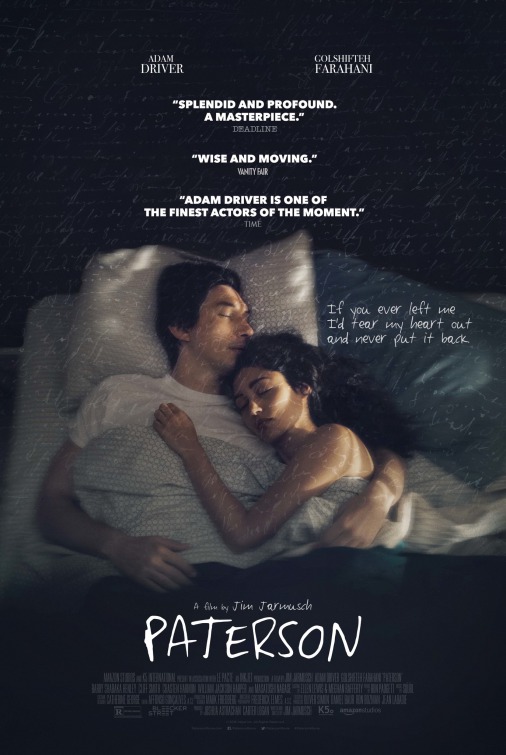
Not a lot happens in Jim Jarmusch’s new film Paterson—it is, to borrow from Seinfeld, a show about nothing. Starting on a random Monday, the story follows Paterson (Adam Driver)—a Paterson, New Jersey, city bus driver and closet (or in this case, basement) poet—through his daily routine for a whole week. He finds inspiration in the simplest things: passengers, barflies, Ohio Blue Tip matches. He works it all into his “secret notebook” of poetry, scribbled in sidebars onscreen. Some of it is interesting, some not so much.

Jarmusch throws a lot out there: never mind the recurring parallels between Paterson and those he encounters—there’s imagery of twins, waterfalls, circles, and fireballs. Attempting to infer a weighty point in all of it, though, is probably an exercise in futility; this is fluid stream of consciousness. The story is more a string of vignettes: Paterson’s wife, Laura (Golshifteh Farahani), orders a guitar online and later serves Brussels sprout and cheddar pie for dinner; the bus Paterson drives breaks down; a situation arises in the bar where Paterson has a beer every night when he walks his wife’s dog, Marvin (Nellie, who, sadly, passed away before Paterson came out: http://www.indiewire.com/2016/05/the-2016-palm-dog-posthumously-awarded-to-nellie-the-dog-from-jim-jarmuschs-paterson-289094/).

The characters Paterson encounters are plentiful and colorful: defeatist coworker Donny (Rizwan Manji); a rapper (Method Man) in a laundromat; a young poet (Sterling Jerins) waiting for her mother in the bus yard; Marie (Chasten Harmon) and her sensitive beau, Everett (William Jackson Harper), whom she’s trying to dump; a nameless gangbanger (Luis Da Silva, Jr.) who warns Paterson about dog-jacking (not that it stops him from tying Marvin to a spigot outside the bar every night); anarchists, old ladies, and braggarts on the bus.

Perhaps the most accomplished thing about Paterson is its rhythm: the plot moves slowly but in a purposely metered fashion. Cinematographer Frederick Elmes creates a dreamy and downright poetic look. The relationship between Paterson and the world has its own set of rules. This film reminds me of Dead Man, which I haven’t seen in two decades: quietly contemplating routine and rut, Paterson ultimately celebrates the poetry in the mundane. The unnamed traveler and angel (Masatoshi Nagase) at the end literally gives us the “a-ha” moment. With nearly no outside sound, not even music, I thought of one thing: if James Joyce’s Ulysses were made into a movie, it would feel a lot like this. Unlike Leopold Bloom, though, Paterson’s wife isn’t cheating on him, and no one except Marvin seems to mind his presence.

Side note: for some reason, the screening I caught included Spanish subtitles, unintentionally adding another layer of what-the-fuck. Paterson is not a movie for everyone, but I definitely see a following here. I liked it.

Also starring Barry Shabaka Henley, Trevor Parham, Troy T. Parham, Kara Hayward, Jared Gilman, Johnnie Mae.

Produced by K5 International, Le Pacte, Animal Kingdom, and Inkjet Productions

Distributed by Bleeker Street Media and Amazon Studios

118 minutes
Rated R

(Landmark Century) B-

http://www.bleeckerstreetmedia.com/paterson

Lion

(Australia/UK 2016)

Like any kid, five-year-old Saroo (Sunny Pawar) is enamored of his older brother, Guddu (Abhishek Bharate). Saroo shadows Guddu everywhere, helping him do things like steal coal from trains to trade for milk for their penurious mother (Priyanka Bose) and little sister (Khushi Solanki) in their tiny village in India. After begging his brother to take him to “work” with him in a nearby city one night, both boys quickly learn that Saroo is too young to hack the late shift. Guddu leaves Saroo on a bench at a train station, promising to be right back. Saroo dozes off, waking up on an empty platform in the middle of the night. Scared and maybe cold, he gets on a vacant train and drifts back to sleep in one of the compartments. He’s jolted up while the train is speeding through terrain he’s never seen before.

The train takes Saroo to Kolkata (formerly Calcutta), where he must fend for himself. He doesn’t know the city, the language, or even his mother’s name. Kolkata is dangerous for a kid: Saroo is nearly abducted at the train station. He meets Noor (Tannishtha Chatterjee), a seemingly nice lady who takes him in. Saroo senses that her creepy friend Rawa (Nawazuddin Siddiqui) has nefarious plans for him, so he bails. A man (Riddhi Sen) eating in a café takes Saroo to the police, who turn him over to an orphanage. They try to find Saroo’s mother, but he’s unable to provide any useful information. Mrs. Sood (Deepti Naval) teaches him English and manners. An Australian couple, John (David Wenham) and Sue Brierley (Nicole Kidman), adopt him.

To use a line from the Beastie Boys, you think this story’s over but it’s ready to begin. Cut to 2008: Saroo (Dev Patel) is grown up, Westernized, and starting school for hospitality management. During introductions, he tells his classmates that he’s from Calcutta but that’s about all he knows. While attending a friend’s party, he goes to the kitchen to get a beer and sees a plate of jalebi, an orange deep-fried Indian pastry. It triggers his memory, and he becomes obsessed with finding his “real” family.

Adapted from Saroo Brierley’s memoir A Long Way Home, Lion plays out as two movies: one about young Saroo, and the other about adult Saroo. On an emotional level, Lion is a beautiful and powerful accomplishment—I defy anyone not to feel something from this film, which deals with identity, family, and home. Even so, it’s flawed. First-time feature director Garth Davis is really heavy-handed with the tears, so much that Lion comes off as trying too hard—manipulative, even. Davis connects the two stories, but he treats them vastly differently. The pace of young Saroo’s story is far superior: it flows naturally, unlike adult Saroo’s, which is choppy and abrupt. Young Saroo’s story is insightful and lyrical, while adult Saroo’s is too often inelegant. I found the unevenness distracting. Plus, the apparitions of Guddu and Saroo’s mother in Australia got silly after awhile. It shouldn’t be difficult to tell from the first three paragraphs of this entry which story I found more engaging.

Even with its flaws, Lion is still a good movie—well worth the two hours it eats of your life. The acting all around is superb, though Lucy (Rooney Mara) is a bit superfluous. Patel is great, but Pawar is the star here; it’s hard to believe this is his first film. Sia’s “Never Give Up,” which plays over the closing credits, will get stuck in your head for days.

118 minutes
Rated PG-13

(AMC River East) B-

http://lionmovie.com

American Honey

(UK/USA 2016)

Andrea Arnold’s American Honey is not a typical teenage girl movie. It isn’t a comedy. Its protagonist, 18 year old Star (Sasha Lane), isn’t funny, cutsie, bitchy, or crazy. To the contrary, she’s smart, strong, serious, and quite desperate. Star is pursuing a boy, but her agenda extends beyond that, even if she doesn’t realize it. She also seems acutely aware that for better or for worse, she’s in control of her own fate.

American Honey opens with Star and two young kids chained to her side digging out discarded chickens from a dumpster for dinner. They walk aimlessly to K-Mart—a place I had no idea still exists—where they cross paths with a feral band of cracky-looking misfits led by Jake (Shia LaBeouf), a ringleader of sorts for the trailer park set. Star and Jake flirt, but security ejects Jake and his posse from the store when they get rowdy. Star ends up with Jake’s phone, giving her the perfect opportunity to continue their encounter in the parking lot. Smitten, she ditches the kids (it turns out they’re not hers) and takes him up on his offer to join him and his “mag crew” on the road.

A “mag crew” is a nomadic lot of door-to-door sales reps, usually kids, hawking magazine subscriptions (http://mobile.nytimes.com/2007/02/21/us/21magcrew.html). The environment is cutthroat and the crew is often abused and exploited. Jake’s crew sells magazines in small mainly rural towns throughout middle America—places like Oklahoma, Kansas, South Dakota, and Missouri. It doesn’t sound fun or profitable, but it works for Star—for a little while, anyway. Despite unrelenting shade from the crew’s manager, suspicious and bossy queen bee Krystal (Riley Keough), Star finds her stride in this ragtag mess, competing for sales, partying with the group, and getting involved with Jake, the top salesman who takes her under his wing and trains her. As rapper E-40 says in “Choices,” one of the songs used for the soundtrack, “I choose to get money, I’m stuck to this bread.”

American Honey doesn’t feel very structured; it plays out more as improvisation than something planned from a script. At times, the pace is rambling and almost painfully slow, which usually sounds the death knell for a lengthy film such as this. Surprisingly, it works for these characters and this story. Arnold is clearly interested in the geographical, cultural, and economic continental divide of America, and she’s adept at exhibiting this through her artistic choices. The settings—mostly barren highways, shitty little meth towns, cheap roadside motels and truck stops, even an oil field—nicely frame the characters’ collective circumstances. The locations provide precisely the backdrop one would expect in a road movie, but somehow they’re more beautiful here. The music is a hodgepodge of genres from techno to country to rap to folk, and it all fits perfectly. I must confess, I downloaded the soundtrack (Bruce Springsteen is not on it). American Honey paints a lusty, vivid picture of life on the fringe.

Newcomer Lane is intriguing and charismatic; it’s hard to believe this is her first film. The part of Jake seems tailor made for LaBeouf, who brings a volatile, forboding edge to his character. The supporting cast is adequate but for the most part forgettable. A few stand out. One is QT (Veronica Ezell), a friendly and chubby pot smoking hippy. Another is Pagan (Arielle Holmes), a sweet goth chick obsessed with Star Wars. The true scene stealer, though, is Corey (McCaul Lombardi), the tanned, blue-eyed, tattooed, fake blonde horndog party boy with a penchant for whipping out his dick whenever because, well, he can. I hope and expect to see more of him and his chiseled cheekbones in the future.

I doubt American Honey has mainstream appeal; it’s too fluid, subtle, and open-ended. It’s got its flaws, but I loved it. On the surface, it’s a road movie about a girl pursuing a boy. The real narrative, though, is much deeper. Like the character in the Lady Antebellum song that gives this film its title, Star literally grows up on the side of the road, and does so before our eyes. She starts out a kid. In the final scene, she immerses herself in a pond, an event spurred by a turtle Jake gives her and likely by a few hungry, neglected children she encounters on her own while selling magazines earlier that day. Her “baptism” is symbolic: with it, Star resigns herself to the fact that she has a role in the grand sceme of things even if she’s never going to get all she wants. In other words, she’s grown up. It’s a gorgeously demonstrated point, if you can make it all the way to the end.

163 minutes
Rated R

(Facets) B-

http://americanhoney-movie.com

Tower

(USA 2016)

On August 1, 1966, Charles Whitman, an engineering student at the University of Texas, Austin, killed his mother and his wife before taking over the observation deck of the 30-story Main Building on campus (“The Tower”). Known as the infamous “Texas Tower Sniper,” he then shot random passers-by on the mall below, terrorizing the campus for over an hour and a half. When it was over, 17 victims including him were dead and dozens were wounded (https://en.wikipedia.org/wiki/Charles_Whitman). Quite possibly the first mass shooting on a school campus in the United States—and definitely the first of this magnitude—the event resonates nearly 50 years later.

Keith Maitland’s Tower is a sort of oral history of this tragic day, and it’s compelling from the outset. I may seem to be stating the obvious here—how could the story of such an event be anything but compelling? I haven’t mentioned that the whole thing is animated—as in, a cartoon. I must admit that I was skeptical. Turning a combination of archival footage and reenactments into rotoscopes that have an offbeat King of the Hill quality sounds dubiously unfitting for many reasons. Nonetheless, Tower works unsparingly well.

With barely a mention of Whitman—his name comes up toward the end, and only incidentally—Maitland chooses to focus on those caught in the confusion. He doesn’t say who is shooting or why, putting viewers into the thick of it. He let’s survivors, heroes, and witnesses narrate their ordeals: what they were doing, who was with them, and what happened to them. Claire Wilson (Violett Beane), a pregnant teenager who was the first one shot on campus, tells about seeing her boyfriend, Thomas Eckman, die right next to her and losing her baby while she lied in a pool of her blood on the hot concrete. She also talks about the woman, Rita Starpattern (Josephine McAdam), who played dead to stay with her and keep her conscious until help could get to her. Aleck Hernandez (Aldo Ordoñez) tells about being shot in the shoulder while delivering newspapers with his cousin riding on his bicyle with him. Allen Crum (Chris Doubek), a middleaged bookstore employee, tells about dodging bullets to help a victim on the ground and winding up on the observation deck while Whitman was still shooting. Austin police officers Houston McCoy (Blair Jackson) and Ramiro Martinez (Louie Arnette) talk separately about their roles in bringing down Whitman.

Each account is unflinchingly brutal with lots of personal detail. The animation is an odd but effective way to bring us close to the action in a way that otherwise wouldn’t happen. Considering how it’s presented, Tower is surprisingly emotional and personal. I haven’t seen a documentary like this before.

96 minutes
Not rated

(Music Box) B-

http://towerdocumentary.com

A Man Called Ove [En man som heter Ove]

(Sweden 2015)

A few years ago, I picked up Fredrik Backman’s novel A Man Called Ove for my book club. Published in 2012, the story was familiar and the main character was one I’d seen many times before. What stood out was Backman’s writing—it was colorful. I must confess, I didn’t finish the book. I liked what I read, though.

Hannes Holm’s film adaptation is similarly colorful. Ove (Rolf Lassgård)—rigid, regimented, orderly, and blustery—is the archetypal curmudgeon. A victim of a recent reduction in force at the train yard that employed him for 40 years, his days now consist of essentially three activities: policing the neighborhood development where he lives to enforce antiquated rules no one pays attention to, correcting transgressors, and visiting the gave of his wife, Sonja (Ida Engvoll). He promises to join Sonja and even makes a few attempts at suicide, but he’s constantly interrupted.

The interesting thing about Ove’s suicide attempts is that they trigger his memories, which fills us in on his backstory: his unconventional childhood, getting his job, meeting the woman who would become his wife, and some other stuff that brought him to where he is. He’s had a life filled with heartbreak, and he loved his wife. It’s no wonder then that he bristles when he unwillingly meets his new neighbors, a Persian woman named Parvaneh (Bahar Pars) and her klutz of a husband (Tobias Almborg), after they plow into his mailbox.

Dealing with love and loss, A Man Called Ove easily could have turned into a sentimental mess. The Swedish spin on it—a tongue in cheek earnest practicality, as illustrated by a stray cat and a battle between Saab and Volkswagen, for example—and Lassgård’s winsome performance both succeed at preventing that. Göran Hallberg’s cinematography is crisp and vivid, with the present comprised of natural blues and greens while the flashbacks have a warm, glowing sort of sepia pallette.

116 minutes
Rated PG-13

(Landmark Century) B-

http://www.musicboxfilms.com/a-man-called-ove-movies-139.php

Strike a Pose

(Belgium/Netherlands 2016)

It’s no secret that Madonna’s Truth or Dare occupies a special place in my heart (https://moviebloke.wordpress.com/2016/08/26/truth-or-dare-in-bed-with-madonna/ ). As ladies with an attitude or fellas that were in the mood, the dancers are a big reason why; all seven young guys proved to be more than incidental eye candy, each adding considerable spirit not just to the film but to the tour—and arguably Madonna’s persona. Strike a Pose shows where they are now, which isn’t necessarily pretty but certainly isn’t all that bad.

Directors Ester Gould and Reijer Zwaan get into the past and even dig up a little dirt, like the lawsuits some of the dancers filed after Truth or Dare came out. Thankfully, they don’t spend a lot of time on either. Instead, they focus on what exactly working with Madonna during such a pivotal time in her career brought to each of their lives, for better or for worse. What each dancer ultimately ended up doing isn’t as interesting as the subtext, which suggests that it was all an illusion.

As one might expect, some of the dancers at least on the surface have done better than others. Salim “Slam” Gauwloos, Luis Camacho, and Kevin Stea are working choreographers (Stea also got into deejaying and recently even recorded an album). Carlton Wilborn, the only one who toured with Madonna again after Blond Ambition, published a biography and is now a life coach. Jose Gutierez Xtravaganza lives with his mother in her apartment in New York. Oliver Crumes is married and possibly disabled—it’s not entirely clear, but that’s what I deduced. Sadly, Gabriel Trupin died in 1995 (which I already knew). His mother, Sue, has a lot to say about his role in Truth or Dare.

As a huge Madonna fan, Strike a Pose did not reveal much that I didn’t already know. That said, one thing that blew me away was that three of the dancers knew they were HIV-positive during the tour, yet none of them said anything about it. I’m not judging—anyone who made it through the “crisis years” of AIDS understands why. Still, it’s sad that not even someone as big and unfazed as Madonna, who gave a poignant speech about Keith Haring and featured a gay kiss in her tour documentary, was capable of creating a safe space then. Things have changed.

It’s easy to write off Strike a Pose as a lame attempt by minor players to milk their 15 minutes of fame, but I didn’t find them to come off that way. Not at all. Each seems sincerely okay with where he is, which is great. None of them plug any current projects. If anything, the focus is on what one does after the lights dim. Each of them has faced demons—drugs, disease, career obstacles. In fact, Camacho suggests that they are all responsible in one way or another for forcing Madonna to back away from them.

None of the dancers are as fierce as they were 25 years ago; this didn’t bother me because frankly I’m not, either. Watching Strike a Pose feels like meeting up with some friends you haven’t seen in a long time. If there’s one thing I learned from this documentary, it’s that Truth or Dare touched a lot more people than I thought. The one thing that would’ve been nice: Madonna showing up.

Screening followed by a live Q and A with Carlton Wilborn.

83 minutes
Not rated

(AMC River East) B-

Chicago International Film Festival

http://www.strikeaposefilm.com