Charleston

(Romania / France 2017)

With the title of his new film Charleston, writer and director Andrei Cretulescu seems to play on late actor Charleton Heston, who comes up during a dinner conversation between recently widowed Alexandru (Serban Pavlu) and his gay brother, Ludovic (Gavril Patru), while the latter’s silent and vacant German boy toy (Vlad Galer) plays a video game. It’s fitting for a movie that explores grief and masculinity.

It’s Alexandru’s birthday. His wife, Ioana (Ana Ularu), was just killed, run down as she crossed the street. A cut to him lounging nonchalantly at her grave, wearing earphones and big sunglasses and smoking a cigarette, raises doubt about how bad he’s taking it.

After his dinner with Ludovic, a surprise knock on the door brings Alexandru face to face with Sebastian (Radu Iacoban), a stuttering hipster metrosexual wimp who introduces himself as Ioana’s lover. A punch in the face starts a strange partnership in which the two men pair up to commiserate separately.

Cretulescu’s premise is promising, and it gets some solid mileage for most of the film. Alexandru’s cynicism and derision contrasts sharply with Sebastian’s unsophisticated neediness and angst. Drinking, stealing, playing records, and constantly bickering, the two lonely men get into some marvelously absurd situations. A certain dance during the “intermission” is out of nowhere. They also learn a few things about the woman who left them behind.

Unfortunately, the story peters out about two thirds of the way through, starting with a plainly weird road trip to a town on the sea that both associate with Ioana. The climax isn’t exactly satisfying. I wish Charleston ended up somewhere as interesting as it seemed to be headed.

With Victor Rebengiuc, Ana Ciontea, Gabriela Popescu, Dorian Boguta, Andreea Vasile, Adrian Titieni, Sergiu Costache, Claudiu Dumitru, Alina Berzunteanu, Letitia Vladescu

Production: ICON, Les Films du Tambour, Kinosseur, Digital Cube, Mille et une Films, WAG Prod, Wearebasca

Distribution: Kinosseur (Romania), Versatile (International)

U.S. Premiere

Screening introduced and followed by a live Q and A with director Andrei Cretulescu

119 minutes
Not rated

(AMC River East) B-

Chicago International Film Festival

https://www.facebook.com/Charleston2017

Mon Mon Mon Monsters [Bào Gào Lǎo Shī! Guài Guài Guài Guài Wù!]

(Taiwan 2017)

In his latest film, peer pressure horror comedy Mon Mon Mon Monsters [報告老師! 怪怪怪怪物!] [Bào Gào Lǎo Shī! Guài Guài Guài Guài Wù!], writer/director Giddens Ko takes us on a wild ride that leaves us pondering who the real mosters are. He subtly gives us his answer in the title.

High school student Lin Shu-wei (Deng Yu-kai) is a neo maxi zoom dweebie with a masochistic edge. Why else would he tolerate the constant flying bits of paper, chairs pulled out from under him, and general teenage tomfoolery directed at him?

Lin becomes the target of Bully Ren-hao (Kent Tsai), a closet psychopath who relentlessly dreams up new ways to torment him. Ren-hao has two flunkies, Liao Kuo-feng (James Lai) and Yeh Wei-chu (Tao Meng) who do his bidding. Ren-hao’s girlfriend, Wu Si-hua (Bonnie Liang), contributes to the hell — never removing her star-studded headset as she snaps photos with her iPhone.

A pacificst teacher (Carolyn Chen) has an idea to get the boys on common ground: she assigns the four of them to community service feeding senile elderlies at a decrepit old age home that looks like something straight out of Blade Runner. Lin has a bad feeling about it, and he’s right: in the process of robbing an old man, the boys corner and capture a flesh-eating female beast (Lin Pei-hsin) they find roaming around.

They take her to an abandoned recreation center, where they chain her up and torture her with light, fire, and starvation. Lin reluctantly goes along with it, but he reaches a point where he either has to put up or shut up. Meanwhile, the beast’s protective and pissed off older sister (Eugenie Liu) is looking for her. This is where Lin is put to the test: does he have any character, and can he stay true to it?

Despite inconsistent pacing, Mon Mon Mon Monsters is overall engaging. Ko has something to say about the moral fabric of today’s youth, but he says it in a mostly lighthearted way. The acting is solid all around, which is pretty amazing for a slasher flick. The “monsters” are sweet in their own way. It’s smart to show them right off the bat rather than let us wonder what they look like; they come off as more human than the teenagers in this movie.

The special effects are pretty good, and the way Ko plays with light and color is downright spectacular. Quite a few scenes here are magnificent even if they’re cheesy and gory (that scene on the bus is fabulous, as are the scene where the teacher ignites in the gym and pretty much any of the scenes in the recreation center). Underneath all the blood and hate is a truth about the social ladder.

With Kai Ko, Vivian Sung, Emerson Tsai, Phil Hou, Bruce Hung 

Production: Star Ritz International Entertainment

Distribution: Vie Vision Pictures

113 Minutes
Not rated

(AMC River East) B-

Chicago International Film Festival

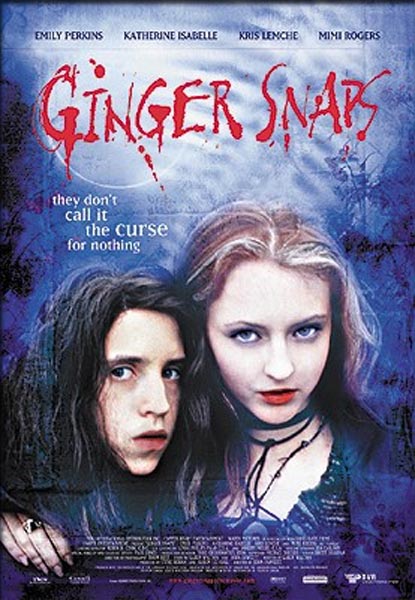
Ginger Snaps

(Canada 2000)

“Shit, wrists are for girls. I’m slitting my throat.”

— Ginger Fitzgerald

Puberty is tough enough without your older sister turning into a werewolf. Just ask 15-year-old Brigitte Fitzgerald (Emily Perkins), who with her sib, Ginger (Katharine Isabelle), stages gory death scenes and takes pictures of them, like a pair of morose Cindy Shermans. When they were kids, they made a pact to die together. Their classmates think they’re weird.

A run-in with mean girl Trina Sinclair (Danielle Hampton) sparks a war. Walking through the woods on their way to exact revenge one October night with a full moon, Ginger gets her first period. She also gets attacked by a mysterious and savage beast — the same one responsible for eviscerating all the dogs in the neighborhood.

Ginger turns increasingly feral over the next few days, growing more aggressive and sexual. Her wounds, which heal almost immediately, are sprouting hair. Oh yeah, she’s also developing what appears to be…a tail?

Brigitte, or “B,” connects with cute, brooding dope dealer Sam (Kris Lemche), who struck and killed the beast while he was driving his van down the road where it ran after it attacked Gretchen. He’s got a recipe for what might be the cure. The clock is ticking as Gretchen gets farther out of control, and Halloween — with another full moon — approaches.

On paper — all I had going into it because I’d never heard of it — John Fawcett’s Ginger Snaps sounds dubious at best. The premise seems trite. The part about the period sounds stupid, and the analogy to “becoming a lady” is obvious.

Turns out, Ginger Snaps is surprisingly good. Incorporating familiar elements of teen movies and splatter flicks, Fawcett, who wrote the screenplay with Karen Walton, pushes the “suspension of disbelief” envelope. He knows just when to stop, though. There’s quite a bit of gore here. The special effects are dated but effective nonetheless.

What really sells this film, though, is the acting: Perkins and Isabelle evoke a warmth to their relationship despite their offputting personalities and a fierceness to their bond. They’re totally believable as sisters. The final scene, which involves only them, is downright sad. Crushing, even.

With Mimi Rogers, Jesse Moss, John Bourgeois, Peter Keleghan, Christopher Redman, Lindsay Leese, Wendii Fulford, Pak-Kong Ho, Lucy Lawless

Production: Motion International, Copperheart Entertainment, Water Pictures, Lions Gate Films, Oddbod Productions, TVA International

Distribution: Motion International (Canada), Unapix Entertainment Productions (USA), Lions Gate Films

108 minutes
Not rated

(Music Box) B-

Music Box of Horrors

http://www.gingersnapsthemovie.com

Hellraiser

(UK 1987)

“Oh, no tears, please. It’s a waste of good suffering!”

— “Pinhead” (the Lead Cenobite)

Roger Ebert famously derided Clive Barker’s directorial debut, the sadomasochistic horror classic Hellraiser, calling it “without wit, style, or reason” for its “bankruptcy of imagination” (http://www.rogerebert.com/reviews/hellraiser-1987). Well, talk about tearing your soul apart!

Hellraiser isn’t particularly scary, but it is creepy and fucking weird. I certainly don’t find it lacking wit, style, or imagination; quite the opposite. It’s a ridiculous, kinky, and bloody telenovela. Based on Barker’s short novel The Hellbound Heart, Hellraiser takes the idea of something in the attic to a place no one else has.

Larry (Andrew Robinson) and Julia Cotton (Clare Higgins) have a strained marriage. After leaving Manhattan to go live in his abandoned boyhood home somewhere on the Atlantic coast, Julia finds Larry’s brother — who’s her ex lover — Frank (Sean Chapman in the flashbacks and Oliver Smith in the present) reanimated without skin in the attic. The movie doesn’t explain it, but the novel does: Larry cuts his hand and drips blood onto the attic floor, right where Frank’s comeshot dried up in the floorboards. Nice.

An unrelenting hedonist, Frank lost his body and soul to demons in his quest for sexual gratification. It started with an antique puzzle box that opened a portal to hell and summoned the Cenobites, led by “Pinhead” (Doug Bradley), the apparent spokesman for the motley foursome. Now, Frank needs blood, which is where Julia comes in. Too bad Frank’s daughter, Kirsty (Ashley Laurence), keeps getting in the way.

The special effects look cheap and the plot is choppy. It isn’t clear at first whether the cuts to Frank and Julia getting it on are flashbacks or fantasy, so this detail could have been done better. Nonetheless, Hellraiser is totally engrossing (and at points, just gross). Barker makes a silly story bizarre enough to keep you interested in what happens next. Higgins effectively channels a tortured melodramatic ’50s B-movie damsel in distress. And her big ’80s hair and sunglasses are fabulous!

Perhaps the best thing Hellraiser has going for it, though, is its twisted sense of humor: all of this happens — and will happen again — because Frank thinks with his dick. Now that’s funny.

With Nicholas Vince, Simon Bamford, Grace Kirby, Robert Hines, Anthony Allen, Leon Davis, Michael Cassidy, Frank Baker, Kenneth Nelson, Gay Baynes, Dave Atkins, Oliver Parker

Production: Cinemarque Entertainment BV, Film Futures, Rivdel Films

Distribution: New World Pictures (USA), Entertainment Film Distributors (UK), Highlight Film (West Germany), Paraiso Films S.A. (Spain), Prooptiki (Greece), Roadshow Film Distributors (Australia), Toei Classic (Japan), Vestron Benelux (Netherlands)

94 minutes
Rated R

(Music Box) B-

Music Box of Horrors

http://www.clivebarker.info/hellraiser.html

Pass the Gravy

(USA 1928)

Every now and then, I come across a literary or artistic work from the past that makes me reevaluate its day as maybe a little cooler than I gave it credit for. The silent gem Pass the Gravy is one such work. It’s longer than it needs to be, but it exhibits a twisted sense of humor that I love.

Schultz (Bert Sprotte) and Davidson (Max Davidson) are next door neighbors who don’t get along. Schultz, a well-dressed pompous ass, raises chickens that constantly eat the seeds Davidson, a far less dapper man, plants in his backyard. Schultz’s prize-winning pet rooster, Brigham, makes him, shall we say, cockproud.

When Schultz’s son (Gene Morgan) and Davidson’s daughter (Martha Sleeper) announce their engagement, the two older gentlemen reluctantly agree to set aside their differences and celebrate the occasion with a fine feast. Davidson gives his conniving son, Ignatz (Spec O’Donnell), two bucks to go buy a chicken. Instead, Ignatz pockets the money and steals a bird from Schultz’s yard — it’s Brigham.

The two families sit down at the table. Ignatz realizes what he’s done when he notices a tag that says “1st Prize” hanging off one of the roasted bird’s drumsticks. Hilarity ensues as one by one, each guest at the table realizes what Ignatz did and tries to hide it from Schultz.

Produced by Hal Roach (Our Gang, Laurel and Hardy) and directed by Fred Guiol with Leo McCarey, Pass the Gravy sounds like something Family Guy made up. It’s not: it’s real, and it’s actually pretty funny — if only for Davidson’s well played reaction that has to be seen to be appreciated and Schultz’s morbidly ironic quips (“They act like it’s a funeral” and “It’s my chicken and I’m going to eat it!”).

A football pantomime toward the end is shaky, and the joke here wears thin before the whole thing is over. Still, even with its antiquated slapstick silliness, Pass the Gravy is solid humor.

In 1998, the United States Library of Congress deemed Pass the Gravy “culturally, historically, or aesthetically significant” and selected it for preservation in the National Film Registry (https://www.loc.gov/programs/national-film-preservation-board/film-registry/complete-national-film-registry-listing/).

Production: Metro-Goldwyn-Mayer

Distribution: Metro-Goldwyn-Mayer

27 minutes
Not rated

(YouTube) B-

Léon Morin, Priest [Léon Morin, prêtre]

(France / Italy 1961)

When young widow Barny (Emmanuelle Riva) bursts into a confessional and tells the priest, Léon Morin (Jean-Paul Belmondo), that “religion is the opiate of the masses,” it’s pretty clear that director Jean-Pierre Melville isn’t going easy on us. For awhile, it’s not clear where he’s going at all with Léon Morin, Priest [Léon Morin, prêtre], a moody work that percolates with repressed sexuality while it dives into religion, philosophy, and politics.

The story, based on Béatrix Beck’s novel and set in a tiny town somewhere in the French Alps during the Italian occupation right before the Nazis took over, centers on Barny as her relationship with Fr. Morin develops and intensifies. She reveals that she’s a communist militant, possibly a lesbian, and Jewish by injection (i.e., her dead husband was a Jew). She tries to provoke him with her jabs at the Catholic Church, but Fr. Morin’s responses are measured and considered. She’s seduced.

It looks like something sexual is going to happen between them: he’s young and handsome, and she’s been without a man for so long that she’s lusting after a female coworker (Nicole Mirel). Once the two are alone behind the closed door of Fr. Morin’s office in a church tower, it happens: they engage in…discourse, discussing the tenets of Catholicism.

Léon Morin, Priest is low on action and heavy on dialogue, and as a result it often feels lethargic. All of the “important” discussions — the ones that advance the plot, anyway — occur in one room, which does nothing to accelerate the pace. The discussions involve dry topics like theology and philosophy and religious dogma.

However, Melville keeps it interesting with what’s going on in the background: he’s brutally frank about the casual and pervasive anti-Semitism, the lackadaisical Italian soldiers, and the callous efficiency of the Nazis. Riva and Belmondo smoulder, though the former’s performance is far more compelling. Amid the hasty baptisms of children and the desperate hiding of neighbors is the curiously amusing subplot about Fr. Morin having all the women of the village spellbound. It’s a light touch in an otherwise heavy film.

With Irène Tunc, Gisèle Grimm, Marco Behar, Monique Bertho, Marc Heyraud, Nina Grégoire, Monique Hennessy, Edith Loria, Micheline Schererre, Renée Liques, Simone Vannier, Lucienne Marchand

Production: Georges de Beauregard, Concordia Compagnia Cinematografica, Carlo Ponti

Distribution: Lux Compagnie Cinématographique de France, Ciné Vog Films (Belgium), Cineriz (Italy), Eurooppalainen Filmi (Finland), Rialto Pictures (USA)

130 minutes (restored version)
Not rated

(Gene Siskel Film Center) B-

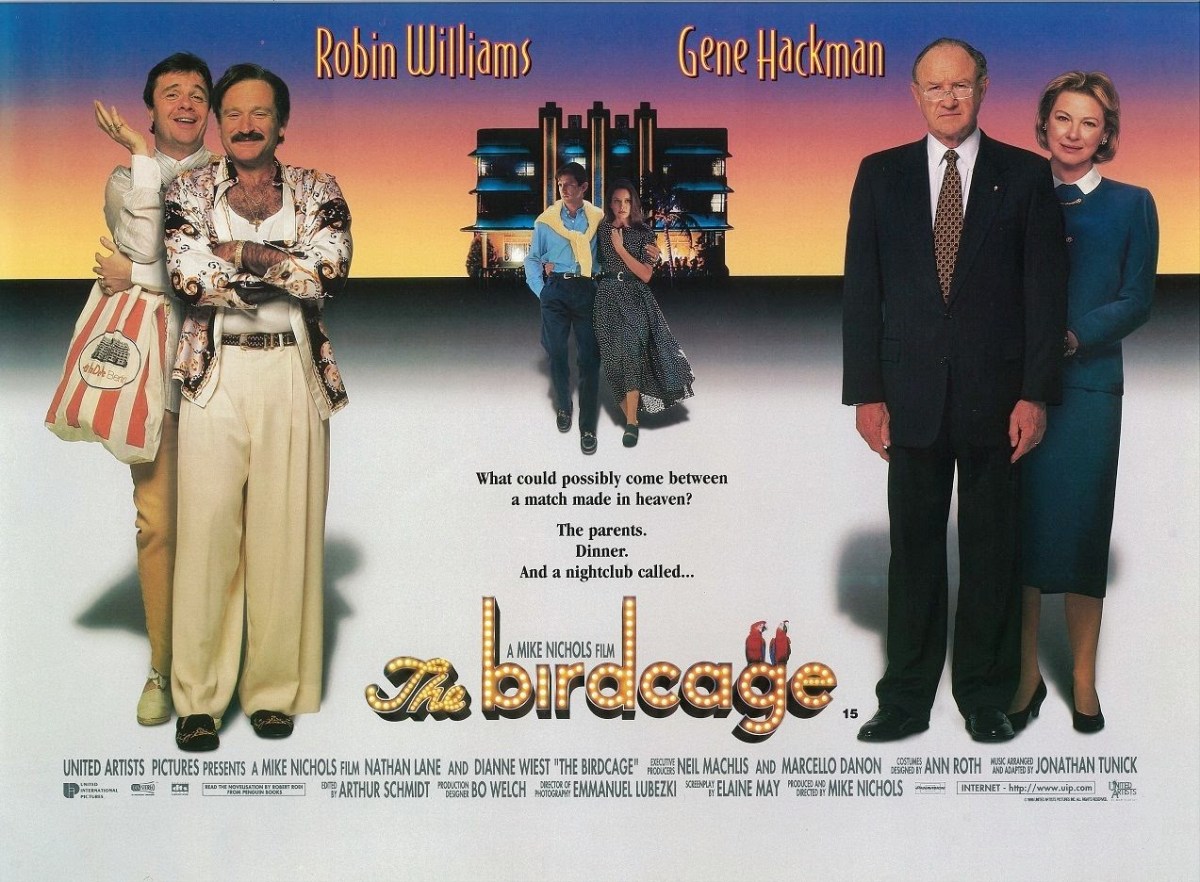
The Birdcage

(USA 1996)

“It’s aspirin with the ‘A’ and the ‘S’ scraped off.”

— Agador

Mark Caro’s latest presentation in his “Is It Still Funny?” series, The Birdcage, is director Mike Nichols’s 1996 Americanized remake of Jean Poiret’s classic 1979 French farce La Cage aux Folles. I’m not sure it was intentional, but this presentation coincides with National Drag Day, something I didn’t know existed.

I left the theater with three impressions: one, things have changed quite a bit in two decades; two, The Birdcage is still funny even if it is silly and dated; and three, Robin Williams could do anything well.

Armand Goldman (Williams) owns and operates a drag nightclub, the Birdcage, in South Beach. His flamboyant husband, Albert (Nathan Lane), is the club’s star attraction. Armand’s son, Val (Dan Futterman), announces his engagement to Barbara Keeley (Calista Flockhart), the daughter of right wing Republican senator Kevin Keeley (Gene Hackman). The kids want to — and should — introduce their parents to each other, but the problem is Barbara’s father, who no doubt will not approve.

Val has a solution: Armand can fake being straight — and married to his biological mother, Katherine Archer (Christine Baranski), who didn’t have much to do with him growing up but maybe will do him this one solid. And the Keeleys will be no worse not knowing the truth.

Albert, who’s a gay giveaway, can’t be part of it. He can’t even be around. This puts Armand — and the entire household — in a tricky situation. Albert is delicate at the moment, and this will hurt him. Little does anyone know how important he’ll prove to be in pulling off the ruse.

It’s easy to dismiss The Birdcage as fluff. The whole thing — plot, setting, characters, that dinner — is really, really silly. The humor relies heavily on stereotypes — histrionic Albert, house “boy” Agador (Hank Azaria), and conservative Kevin are the most obvious examples. Madonna dancers Luis Camacho and Kevin Stea have bit parts as…dancers, big shock. There’s a lot of camp and physical humor here, which doesn’t make for sophisticated comedy.

Nonetheless, the actors bring it, particularly Lane, who imbues his role with unexpected tenderness. Elaine May updates and punches up the screenplay with political jabs and cultural witticisms. At the center of the insanity is Williams, who despite a few glimmers of his wacky old self (“You do Fosse, Fosse, Fosse! You do Martha Graham, Martha Graham, Martha Graham! Or Twyla, Twyla, Twyla! Or Michael Kidd, Michael Kidd, Michael Kidd, Michael Kidd! Or Madonna, Madonna, Madonna!”), plays the Straight Man — that might sound contradictory considering his character here, but I’m not referring to his orientation. And he does it well. The result is a guilty pleasure.

With Dianne Wiest, Tom McGowan, Grant Heslov, James Lally, Luca Tommassini, André Fuentes, Tony Gonzalez, Dante Lamar Henderson, Scott Kaske, Tim Kelleher, Ann Cusack, Stanley DeSantis, J. Roy Helland, Anthony Giaimo, Lee Delano, David Sage, Michael Kinsley, Tony Snow, Dorothy Constantine

Production: United Artists Pictures

Distribution: United Artists (USA), United International Pictures (UIP), Filmes Lusomundo (Portugal)

117 minutes
Rated R

(Music Box) B-

http://www.mgm.com/#/our-titles/187/The-Birdcage/

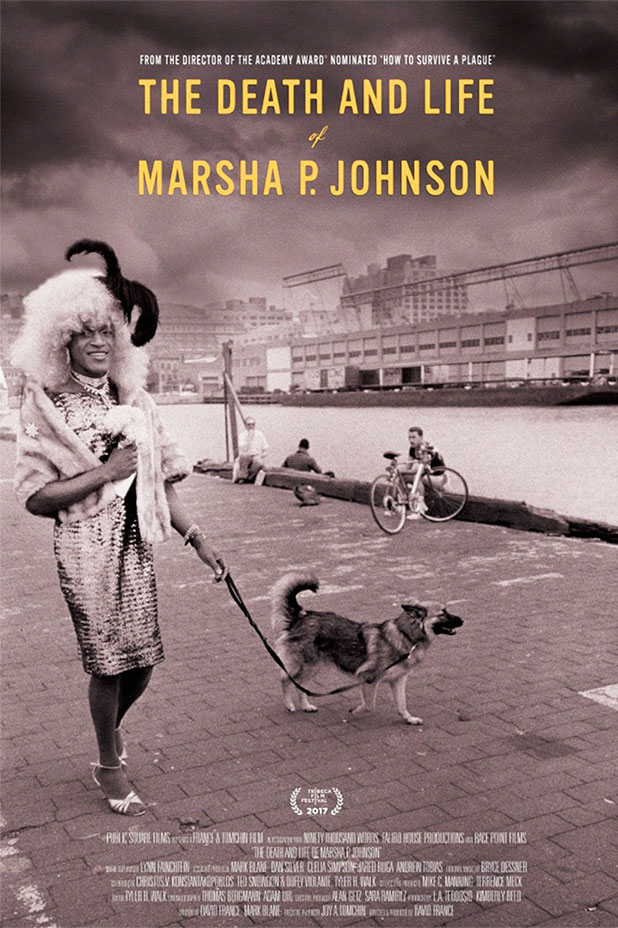
The Death and Life of Marsha P. Johnson

(USA 2017)

Marsha, Marsha, MARSHA! I’ll say this: David France’s new documentary has a lot going on in it. The center of the film, obviously, is legendary Greenwich Village “street queen” Marsha P. Johnson, a trans LGBT activist who hit the streets and stood at the front line when the fight was just about the “gay rights” movement. In the ’60s. Marsha, a figure at the Stonewall riots, founded Street Transvestites Action Revolutionaries, or S.T.A.R., with Sylvia Rivera in the early ’70s — 1970 to be exact. Her fight continued onto AIDS and transgender issues. She clearly was ahead of her time.

Sadly, Marsha ended up in the Hudson River in 1992, an apparent murder victim. It was almost 25 years to the date that I saw this film. The New York City Police Department called it a “suicide” — then called it a day. It remains an unsolved case.

The Death and Life of Marsha P. Johnson wants to honor Marsha, and it kind of does. At the very least, it sings her praises and puts her in a positive light. Ultimately, though, it fails. Told through the eyes of friend and surrogate Victoria Cruz, it unfortunately lets other things — mainly other people’s egos — get in the way. Part history and part true crime, Marsha’s story is watered down because French crams in more than what’s necessary to tell it, and he loses her in the process.

The Death and Life of Marsha P. Johnson succeeds in showing Marsha’s determination and influence. Perhaps unintentionally, it also shows a wonderfully colorful version of New York City in its cultural — or countercultural — prime, a place that simply doesn’t exist anymore. The hardest part of watching this film, though, is the attitude against trans people — even from gay men. It’s something you might not expect, but there it is.

From a historical or social standpoint, this is a winner. As far as Marsha is concerned, it could have been better. Still, it’s worth the time it takes to see it.

With Michael Baden, Frances Baugh, Pat Bumgardner, Jimmy Camicia, Eddie DeGrand, Matt Foreman, Jacques Garon, Chelsea Goodwin, Xena Grandichelli, Jennifer Louise Lopez, Agosto Machado, Marcus Maier, Ted Mcguire, Jean Michaels, Robert Michaels, Rusty Mae Moore, Candida Scott Piel, Coco Rodriguez, Kitty Rotolo, Vito Russo, Mark Segal, Beverly Tillery, Randy Wicker, Brian R. Wills, Sue Yacka

Production: Public Square Films, Faliro House Productions, Ninety Thousand Words, Race Point Films, Terasem Media & Films

Distribution: The Film Collaborative, Netflix

Screening introduced by David France and followed by a live Q and A with France, Mark Blane, and someone whose name I didn’t catch moderated by Alonso Duralde

105 minutes
Not rated

(Directors Guild of America) B-

Outfest Los Angeles LGBT Film Festival

https://www.netflix.com/title/80189623

Saturday Church

(USA 2017)

Ulysses (Luka Kain) is a quiet, delicate teen who lives in Queens and is just starting to figure out his sexual identity — it involves wearing panty hose under his jeans. When his father dies, he becomes the “man of the house.” Unfortunately, his mother (Margot Bingham), who works all the time, is already on edge because she caught him wearing her clothes. Ulysses shares a bedroom with his younger brother, Abe (Jaylin Fletcher), who knows that he’s still rummaging through mom’s closet on the sly and gives him shit for it. School is no respite because Ulysses’s classmates are jerks.

Enter stern Aunt Rose (Regina Taylor) to help at home while mom is away at work. She takes charge, usurping Ulysses and his mother as the master of the domain. She’s not about to have a dress-wearing freak around, so she pushes Ulysses toward the one cure she knows: the Lord.

Ulysses escapes to the Christopher Street Pier, where he meets a gang of “drag queens”: Ebony (MJ Rodriguez), Dijon (Indya Moore), and Heaven (Alexia Garcia). They take him to “Saturday Church,” a space in Greenwich Village where one night a week trans mother hen Joan (Kate Bornstein) offers a meal, a shower, clothes, perhaps a spot to vogue, and companionship to homeless LGBTQ kids. This is where Ulysses finds his groove.

Too bad mean Aunt Rose is waiting for him to come home.

Damon Cardasis’s first feature length film is a winning mix of Moonlight (https://moviebloke.com/2016/11/19/moonlight/ ), La La Land (https://moviebloke.com/2016/10/13/la-la-land/ ), and Tangerine (https://moviebloke.com/2015/07/28/tangerine/ ) with just the right splash of Paris is Burning (https://moviebloke.com/2016/08/26/paris-is-burning/ ). Saturday Church has some shortcomings, but the film oozes so much charm and warmth that I found it easy to forgive its flaws. Some of the songs and dance numbers are better than others — the song in the locker room and the other with Ulysses singing to his new boyfriend (Marquis Rodriguez) as they walk to the train stand out, especially when flower petals start falling. It’s really cool.

The acting is really good all around, but Kain is particularly awesome. He gives palpable tenderness and vulnerability to his character. The so called “drag queens” are not just fierce but downright touching. The way they save Ulysses is sweet. They make you long for a friend who has your back like they do. The story here totally sold me. I look forward to what’s next from Cardasis.

With Stephen Conrad Moore, Peter Y. Kim, Evander Duck Jr.

Production: Spring Pictures, Round Films

Distribution: Samuel Goldwyn Films

Screening introduced and followed by a live Q and A with Damen Cardasis

82 minutes
Not rated

(Directors Guild of America) B-

Outfest Los Angeles LGBT Film Festival

http://www.samuelgoldwynfilms.com/saturday-church/

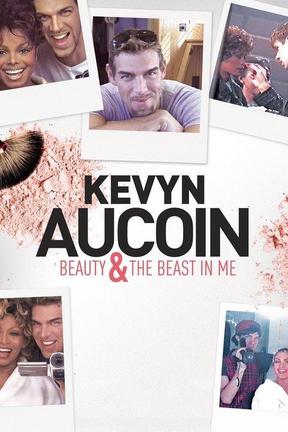
Kevyn Aucoin Beauty & the Beast in Me

(USA 2017)

“He was way ahead of his time. Just the way we do now with selfies and Snapchat and Facebook — he would have put the little Instagram kids to shame!”

— Amber Valletta


“Kevyn’s biggest motivation to succeed was his abandonment issues. He had this thought that, if I work with you and you become my friend, and I make you pretty, then you won’t abandon me. I absolutely think he was looking for a mother figure in the people that he worked with.”

— Eric Sakas

Superstar makeup artist Kevyn Aucoin lived an enviable life. He was successful doing what he loved — his work was on runways, in music videos, on award shows, and on magazine covers, at one point nine consecutive issues of Vogue. He wrote books and started a line of cosmetics.

On top of that, he hung out with models, legends, and his own idols: Kate Moss, Cindy Crawford, Naomi Campbell, Linda Evangelista, Christy Turlington, Paulina Porizkova, Susan Sarandon, Gwyneth Paltrow, Winona Ryder, Liza Minnelli, Tina Turner, Whitney Houston, Janet Jackson, Madonna, Cher, and Jennifer Lopez to name a few. Some of them were actual friends (I can only imagine Liza leaving voicemail for me).

Judging from the fact that they all let Aucoin record him with them backstage — on videotape, and not always made up — they must have felt something for him. An affinity? Safety? A debt? Whatever it was, it endeared him. Even in his home videos, he made them look good.

So it’s odd and downright tragic that someone who brought so much beauty to the world, never felt beautiful himself. Perhaps it had to do with his birth mother, Nelda Mae Williams, giving him up for adoption, or all the bullying he got as a teenager. He didn’t like his physical features, which were exaggerated by a condition that went undiagnosed for most of his life: acromegaly, a tumour on the pituitary gland that keeps the brain secreting growth hormones. It’s a painful condition that causes headaches and joint pain, and it got Aucoin addicted to prescription drugs.

A trove of home videos found after his death in 2002 forms the basis for Lori Kaye’s documentary, Kevyn Aucoin Beauty & the Beast in Me. He recorded everything — the aforementioned videos with celebrities, with family members and boyfriends, and even when he was alone. Kaye interviews different people from Aucoin’s life to tell his story, and the interviews range from funny (Andie MacDowell) to sad (ex boyfriend Eric Sakas discusses Aucoin’s downward spiral) to eyeroll-inducing (Williams claims Aucoin would not have been gay had she raised him).

His adoptive parents, Isidore and Thelma Aucoin, accepted him and even dropped out of their church because of its stance on homosexuality. He moved to New York City, and the rest is history.

The celebrity interviews are fun, and some are gushy. Some of the interviewees even cry. They all provide insight into the kind of guy Aucoin was. What Kaye has that makes her documentary special, though, is Aucoin’s tapes, and she incorporates footage from them into the project in a way that lets him tell his own story. It’s an often amusing one with a sad undertone. It also serves, as Cindy Crawford points out, as a time capsule — a really good one. I confess, a few scenes gave me chills.

With Andie MacDowell, Cindy Crawford, Naomi Campbell, Paulina Porizkova, Gwyneth Paltrow, Amber Valletta, Isidore Aucoin, Nelda Mae Williams, Jed Root, Eric Sakas, Tina Turner, Cher, Liza Minnelli, Whitney Houston, Jennifer Lopez, Janet Jackson

Production: Putti Media

Distribution: Logo Documentary Films (USA), Dogwoof (International)

World Premiere

Screening introduced by director Lori Kaye

90 minutes
Not rated

(Directors Guild of America) B-

Outfest Los Angeles LGBT Film Festival

https://www.kevynaucoindocumentary.com