Some Freaks

(USA 2016)

A line from an old Billy Idol song (“Hole in the Wall”) appropriately sums up the plot of playwright Ian MacAllister-McDonald’s charming and touching debut feature film Some Freaks:

“We were such an ugly pair,
The chameleon twins they’d stop and stare.
Lovers know when love has gone.
A black hole there where love was once the end.”

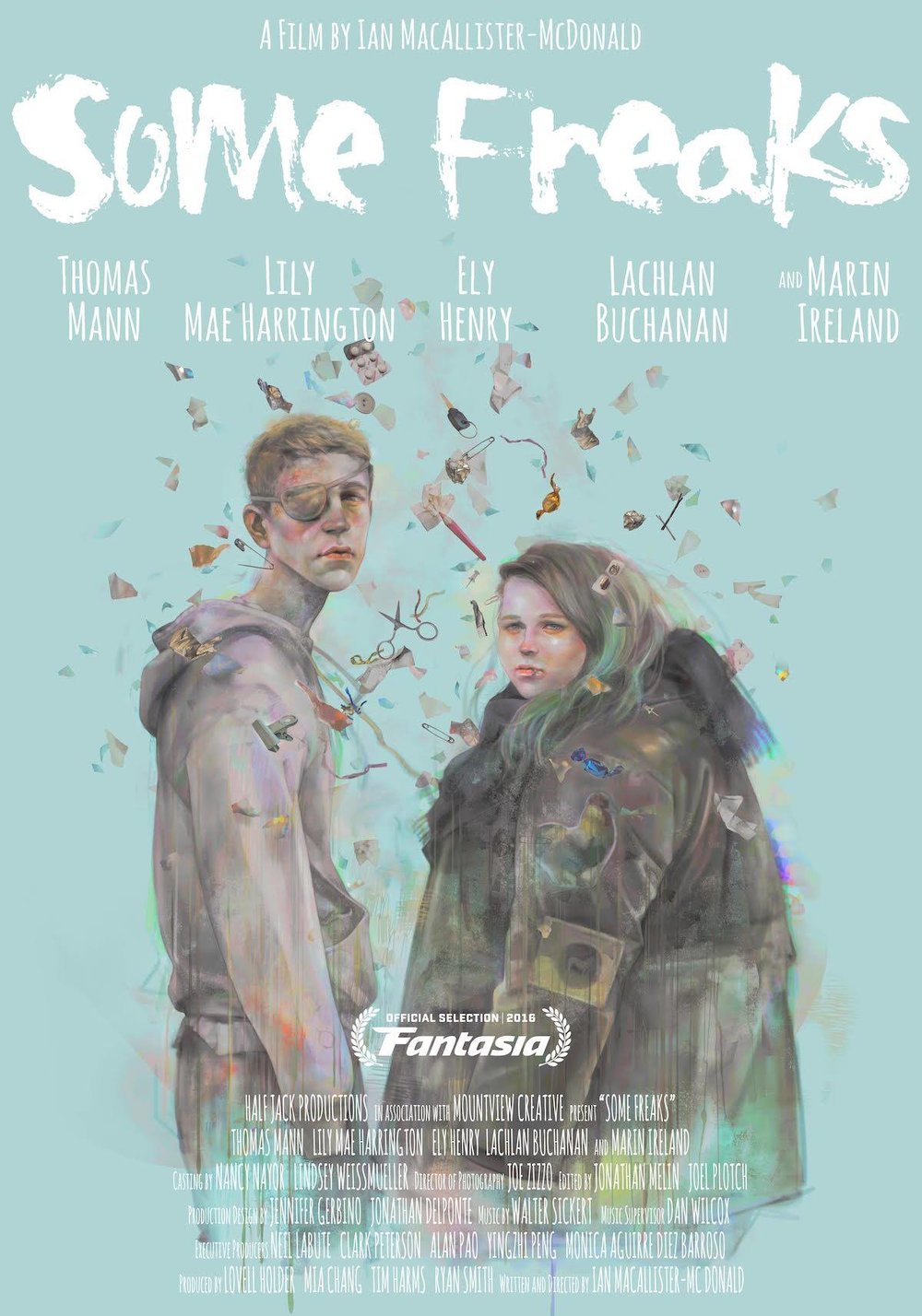
Rhode Island high school senior Matt Ledbetter (Thomas Mann), who has the unflattering nickname “Cyclops” because of the patch he wears over his fucked up eye, doesn’t fit in with his classmates. Awkward and unpopular and literally a freak, his only friend is schlubby neo-maxi-zoom-dweebie gay motormouth Elmo (Ely Henry), who seems eager to blow just about any guy—not that any guy is ever going to let him. Lucky Matt gets to hear all of Elmo’s fantasies in graphic detail as they play video games. Yipee.

A chubby new girl (Lily Mae Harrington) in thrift store clothes and green-streaked hair flirts with Matt in biology class. Matt doesn’t know what to make of her, but he’s obviously intrigued even though he’s all shy about it. She turns out to be Elmo’s cousin Jill, who’s staying with his family for the school year after some trouble at home in Oregon.

Jill and Matt get off to a rocky start when she overhears him crack a fat joke about her to Elmo. Despite her tough facade, cynical and insecure Jill is forgiving—she has no choice because she has a thing for Matt. The three of them start hanging out. To Elmo’s dismay, Matt and Jill fall for each other and start dating.

WARNING: Potential spoilers ahead!

The end of high school brings about a quandary neither starcrossed lover anticipated. Jill gets into college out West, leaving Matt behind on the East Coast. Thus begins their long distance relationship. They lead separate lives and make similar changes without telling each other: Matt gets a glass eye and starts working out while Jill gets a new wardrobe and goes on a diet. Suddenly normalized, Matt goes to a party and hits on chicks while Jill attracts the attention of frat boy hottie Patrick (Lachlan Buchanan), who went to high school with her. His mean girl pals were not very nice.

Matt and Jill’s metamorphoses clash when he visits her six months later and they discover that their natural connection is now strained and forced. What’s worse, they bring out something ugly in each other. Is this the death knell for their relationship?

Written and directed by MacAllister-McDonald, Some Freaks is impressive even with its flaws, especially for a first time full length feature. The story and the characters recall John Hughes and Todd Solondz, but this is by no means mere imitation or an update of either. I like MacAllister-McDonald’s straightforward and unsentimental view. Yes, much of what happens here is predictable; however, there are enough twists that I didn’t see coming to keep it interesting if not fresh. The actors put a lot of heart into their characters, and it shows—even Buchanan, whose Patrick is underdeveloped and not entirely believable.

I happened to see Some Freaks on April Fool’s Day with my teenage nephew. All things considered, I couldn’t have planned it better.

With Marin Ireland, John Thorsen, Sylvia Kates, Devon Caraway, Brian Semel, Nikki Massoud, Stephen Thorne, Shannon Hartman

Production: Half Jack Productions, Mountview Creative

Distribution: Good Deed Entertainment

Screening followed by a live Q and A with Ian MacAllister-McDonald, Lily Mae Harrington, and Ely Henry

97 minutes
Not rated

(Tower City Cinemas) B

Cleveland International Film Festival

http://www.somefreaksthemovie.com

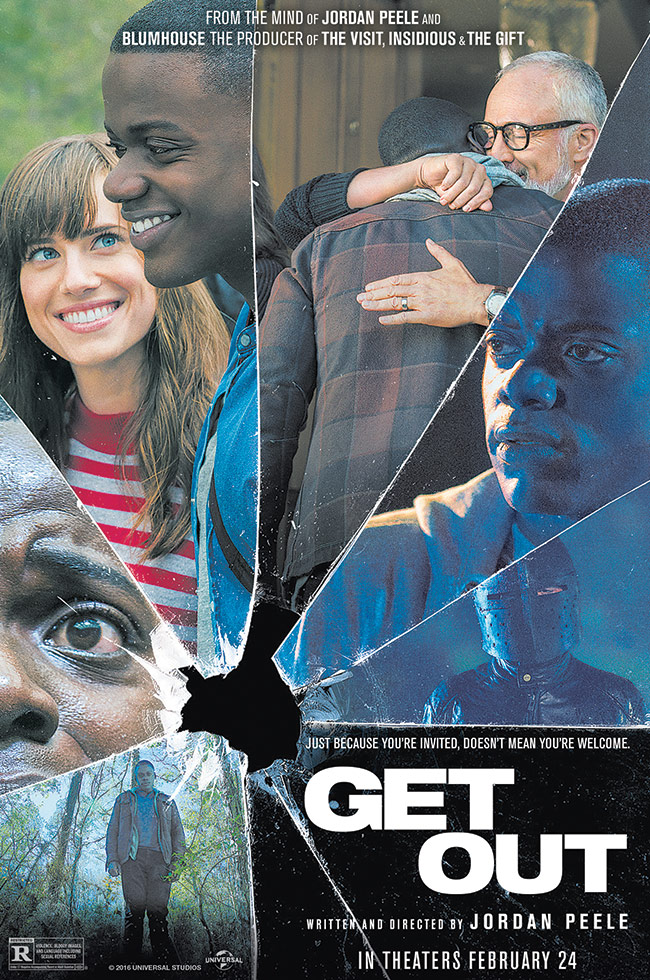
Get Out

(USA 2017)

I caught the hype surrounding Jordan Peele’s first feature length film, Get Out, a comedy horror flick that takes on race—specifically, the dynamics of white power and black subordination. He wrote the script and directed the film. I went into Get Out with some doubt and maybe trepidation about how it might come off. The concept is one that seems too easy to go horribly sideways.

I guess if anyone can pull it off, it’s Peele—and I’m relieved to report that he succeeds. With an oddly compelling mix of Guess Who’s Coming To Dinner, Meet the Parents, Nightmare on Elm Street, and The Stepford Wives, he takes on the cultural idiosyncrasies of Caucasian cultural dominance within the constructs of a horror flick. He’s got a lot of points to make, and he gets them across in a sharp but entertaining way. Like the best horror movies, Get Out makes you squirm—but it does so on multiple levels.

New York City photographer Chris (Daniel Kaluuya) is black. His girlfriend, Rose Arlington (Allison Williams), is white. She invites him on a weekend getaway to her parents’ home in upstate New York because, well, it’s time for him to meet the fam. Chris agrees, going into it nervously and not without personal baggage. His hyperactive best bud, Rod (Lil Rel Howery), a TSA agent who always expects the worst, is not helping.

Rose’s parents are, like the quiet town where they live, nice. Or at least welcoming. Dean (Bradley Whitford) drops silly slang, affects a bizarre accent, and praises President Obama. Missy (Catherine Keener) is more direct, asking pointed questions in a weird attempt to get to know Chris. It’s awkward and doesn’t quite break the ice, but it’s harmless. Right?

The family’s two longterm servants, maid Georgina (Betty Gabriel) and gardener Walter (Marcus Henderson), carry themselves like they’ve had lobotomies. Rose’s younger brother, Jeremy (Caleb Landry Jones), is, um, aggressively complimentary to Chris. On top of it, the Armitages’ neighbors are not quite right, obsessed with Chris and his virility.

During the first part of Get Out, Peele keeps things light but lets a sense of creepy unease simmer. The laughs are there, but like all of the characters coming and going from the house, something is off. He makes a major shift in tone once Missy insists on hypnotizing Chris, ostensibly to help him quit smoking. What was innocuous up to now becomes nefarious.

Ultimately, the evil here is not a monster hiding under the bed, but rather something more obvious that exists in broad daylight. I could have done without the bloody finale, but it works in the context of the film; Peele plays with genre, so I see why it’s here. Either way, Get Out is a bold move that pays off.

With Stephen Root, LaKeith Stanfield, Ashley LeConte Campbell, John Wilmot, Caren Larkey, Julie Ann Doan, Rutherford Cravens, Geraldine Singer, Yasuhiko Oyama, Richard Herd, Erika Alexander, Jeronimo Spinx, Ian Casselberry, Trey Burvant, Zailand Adams

Production: Blumhouse Productions, Monkeypaw Productions, QC Entertainment

Distribution: Universal Pictures

104 minutes
Rated R

(ArcLight) B

https://www.uphe.com/movies/get-out

https://youtu.be/A2JbO9lnVLE

Storytelling

(USA 2001)


“I just thought Marcus would be different. I mean, he’s got C.P.”

—Vi

I get why Todd Solondz doesn’t appeal to everyone: his outlook isn’t warm and fuzzy, his characters aren’t heroic or even admirable, and his blunt, unflattering and brutal honesty is easy to misinterpret as cruel or tasteless. To all that, I shrug; his films don’t put the viewer at ease, and that’s exactly what draws me to him. A master of the uncomfortable, he shines a light on subjects that are hard to discuss in mixed company if not off limits altogether. And he’s not moralistic about it—he leaves it to the viewer to arrive at his or her own conclusions. His moral ambiguity is perhaps the strongest characteristic of his work, and I suspect it more than anything makes people cringe because, well, it’s confusing. They don’t know what to think.

So be it. Barring one scene in Happiness that scarred me forever, Solondz’s fourth film, Storytelling, is probably his most uncomfortable—it opens with Vi (Selma Blair) riding Marcus (Leo Fitzpatrick, who played Telly in Kids), a classmate crippled from cerebral palsy. Comprised of two unconnected storylines, “Fiction” and “Non Fiction,” Solondz pulls out a broad range of societal taboos—American ones, anyway. I won’t go through them here like a grocery list, but they all involve sex and/or abuse of power.

Side note: Censorship is an unintended subject—a big red block obscures one scene in the U.S. release. It wasn’t planned that way, but rather came about by contract (http://www.indiewire.com/2002/01/interview-the-sad-comedy-solondz-discusses-storytelling-80562/ ) (https://www.brainyquote.com/quotes/quotes/t/toddsolond355306.html). My DVD doesn’t have the red block—the scene is graphic, but not pornographic. Concealing it wasn’t worth the effort or the P.R.

The first and shorter story, “Fiction,” is about the aforementioned Vi, a wannabe writer who probably doesn’t belong in the writing class she’s taking. The class is taught by Pulitzer Prize winning Gary Scott (Robert Wisdom), an imposing egomaniac author who’s also a black man. His critiques of his students’ work is harsh—except when it comes to Catherine (Aleksa Palladino), a bookish pseudointellectual who looks like she’s into S&M. Guess what happens when Vi finds herself in a bar with Scott, and an opportunity to go home with him presents itself? You’ll have to read the book—or in this case the writing assignment, as Vi does what any writer would: she writes about the experience.

The second—and longer—story, “Non Fiction,” is about unsuccessful schlub Toby Oxman (Paul Giamati), a floundering self-proclaimed documentary filmmaker, as he sets out to make an exposé on the everyday American teenager. The problem is, he can’t find a subject. Enter slackerish pothead Scooby Livingston (Steven Weber) and his dysfunctional family led by father Marty (John Goodman). A series of unplanned mishaps threatens to derail the whole project, until one morbid event turns the whole thing around. Belle and Sebastian proves a nice choice for the music.

Storytelling is not quite as intriguing as Welcome to the Dollhouse or Happiness, but it’s still quintessential Solondz. The lines here are quotable gold—particularly the exchanges between Scooby’s youngest brother, Mikey (Jonathan Osser), and the Livingstons’ housekeeper, Consuela (Lupe Ontiveros), which are nothing short of awesome. I love that Solondz calls out his critics—it’s the film equivalent of Madonna’s “Human Nature.” “Fiction” is definitely the more impactful of the two segments, but that’s because “Non Fiction” is just too long and meandering for its own good; it peters out around two-thirds of the way through. Storytelling doesn’t immediately come to mind when Solondz’s name comes up, but parts of it will definitely haunt you. Unlike his other films, I’m not sure what to make of this one.

A third scene, “Autobiography,” was shot but left out of the final product (https://en.wikipedia.org/wiki/Storytelling_(film) ) (http://www.imdb.com/title/tt0250081/trivia?ref_=tt_trv_trv ). It starred James Van Der Beek as a closeted high school football player and featured a gay sex scene with Steve Rosen. I don’t know about the sex scene, but I think a third story would have added impact.

With Maria Thayer, Steve Rosen, Julie Hagerty, Noah Fleiss, Conan O’Brien

Production: Good Machine, Killer Films, New Line Cinema

Distribution: Fine Line Features

87 minutes
Rated R

(DVD purchase) B

http://www.toddsolondz.com

T2 Trainspotting

(UK 2017)

“You’re a tourist in your own youth.”

—Sick Boy

“Face your past. Choose your future.” That’s what the poster for T2 Trainspotting says. Perhaps it should say, “Paybacks are a bitch,” something Mark Renton (Ewan McGregor) finds out pretty quickly when he returns home to Edinburgh after 20 years in Amsterdam following his little fuckover at the end of Trainspotting. Ostensibly back to make amends and settle his debt, Renton knows that forgiving and forgetting isn’t so easy—or smooth. Truth be told, he probably didn’t expect it to be.

Renton finds Spud (Ewen Bremner) unemployed, still struggling with heroin, and literally killing himself—like, alone with a plastic bag over his head in his dingy apartment. Sick Boy (Jonny Lee Miller) is a full-fledged douche, complete with a failing bar—the Port Sunshine—that he inherited from his aunt, a blackmail sex scam he runs on the side with a Bulgarian partner—Veronika (Anjela Nedyalkova), whom he fancies as his girlfriend—and a seriously unflattering coke habit. Oh yeah, he’s still bleaching what he’s got left of his hair. Neither is stoked about Renton showing up, but Sick Boy is clearly more bitter than Spud. He has a plan to get even.

Soon, however, Renton and Sick Boy are up to their old tricks, nightclubbing, tripping, and yes, thieving. In one of T2‘s best scenes, they head somewhere outside Edinburgh and hit a pub that looks more like an American VFW hall. It’s some weird open mic night for a crowd of Protestant Unionists who are rabidly anti-Catholic because of history. Explaining it all to Veronika in the car before the heist—the plan is to pickpocket as many ATM cards as they can get their hands on—Renton calls them “relics.” After a successful mission, the bouncer won’t let them leave until they perform a number. What they come up with is brilliant.

The fun and games come to a grinding halt when Begbie (Robert Carlyle), who’s serving a 25-year prison sentence and is denied parole because of his anger management problem, breaks out of jail and runs into Renton. He loses his shit in yet another great scene. Renton gets away for the moment but Begbie is on his trail, which leads him to a sketchy business partnership. Will history repeat itself?

I was skeptical when I heard director Danny Boyle was making a sequel; I guess I thought Trainspotting didn’t need a follow up. T2, which is loosely based on Irvine Welsh’s 2002 novel Porno, lacks the youthful vigor of the original and frankly isn’t as cool. How could it be? It wouldn’t exist without Trainspotting; it’s got flashbacks and obligatory references, some more clever than others, throughout. Kelly Macdonald has a fun cameo, Renton’s “Choose Life” monologue is updated, that toilet makes a brief appearance, and there’s a nice remix of Iggy Pop’s “Lust for Life” at the end (and yes, we know it’s coming).

Still, T2 stands on its own. It’s fueled by nostalgia and revenge, which in this case turns out to be a rather interesting combination. T2 has more of a conventional plot, and it’s oddly fascinating. The dialogue is every bit as wickedly sharp as before. These boys have grown up—they’ve turned into sad men because they’ve chosen unfulfilled promise and disappointment (to use Renton’s words). Now they have to deal with it, which isn’t what I imagined them doing in 20 years—if they even lived, which they most definitely have. Surprise! We all know someone like this, right? I would see T2 again.

At a post screening discussion, Boyle said he really made an effort to connect to the original. He succeeded, in a good way. As for the title, he said it’s an homage of sorts to Terminator director James Cameron, whom the characters would simultaneously want to honor and piss off.

With Shirley Henderson, Scot Greenan, Pauline Lynch, James Cosmo, Eileen Nicholas, Irvine Welsh

Production: Film4, Creative Scotland, Cloud Eight Films, DNA Films, Decibel Films

Distribution: TriStar Pictures

Screening followed by a live Q and A with Danny Boyle and Irvine Welsh moderated by Richard Roeper

117 minutes
Rated R

(AMC River East) B

Chicago International Film Festival

http://www.t2trainspottingmovie.com

https://www.facebook.com/T2TrainspottingMovie/?brand_redir=490630094455946

Things to Come [L’avenir]

(France/Germany 2016)

“My life isn’t over. Deep down, I was prepared. I’m lucky to be fulfilled intellectually.”

—Nathalie

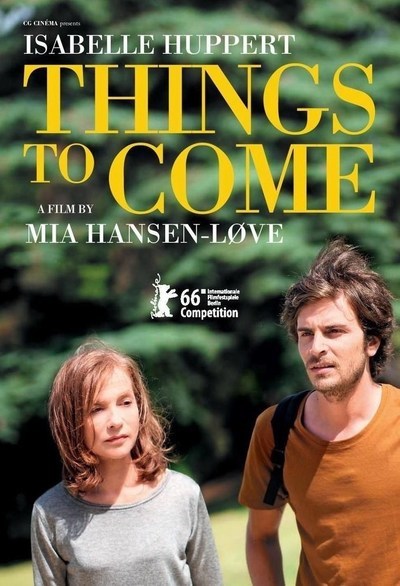
A line from Talking Heads’ song “Once in a Lifetime” is apt to describe the root of the dramatic tension in Mia Hansen-Løve’s latest film: “Well, how did I get here?” Things to Come is a character study of Nathalie Chazeaux (Isabelle Huppert), a philosophy professor at an unnamed Paris university, as she navigates and reinvents her place in the world after her bourgeois examined life suddenly transforms into something else and leaves her floundering in the process.

Nathalie’s passion for her work is clear beyond her career: her husband of 25 years, Heinz (André Marcon), is also a philosophy professor; the textbook she wrote is something of a standard; and her apartment is crammed with books. Even her everyday conversation is peppered with references to philosophers, some I know and other I have never heard of. Her two adult children can follow her when she goes on about, oh, say, Plato, as she sets the table. She seems like someone who has always relied on intellect and reason.

The protesters blocking access to campus early in the film hint to something amiss; Nathalie participated in her share of protests back in the day, but this is different. Selfish, perhaps? One day, Heinz announces that he’s leaving her for another woman. “I thought you would love me forever,” Nathalie responds in a way that reads more like examining a problem than expressing surprise or hurt. Soon, her needy mother (Edith Scob) takes a turn for the worst, leaving Nathalie to figure out what to do with the cat. Meanwhile, her publisher informs her that her textbook’s future is uncertain. Then there’s the matter of her reunion with a former student, Fabien (Roman Kolinka), a cute and promising writer living in an anarchists’ commune.

Things to Come is very much about change, both in circumstances and relationships. Hansen-Løve takes a decidedly distant approach, letting us watch things unfold from afar. She’s not detached; she just seems more interested in showing the small events that shape Nathalie’s journey and letting us figure out the big picture. It works really well. Choosing “Unchained Melody” for the background in the final scene is especially clever; it’s clear about where Nathalie is on an emotional level, yet it’s open to interpretation about whether the future holds good things for her. It’s a happy, hopeful ending if you want it to be.

With Sarah Le Picard, Solal Forte, Guy-Patrick Sainderichin, Rachel Arditi, Yves Heck

Production: Arte France Cinéma, CG Cinéma, Detail Film, Rhône-Alpes Cinéma

Distribution: Les Films du Losange, Palace Films

102 minutes
Rated PG-13

(Gene Siskel Film Center) B

http://www.thingstocomefilm.com

Being 17 [Quand on a 17 ans]

(France 2016)

“I don’t know if I’m into guys or just you.”

—Damien

In a pivotal scene in André Téchiné’s astute and poetic sexual awakening drama Being 17, French high school boys Damien (Kacey Mottet Klein) and Thomas (Corentin Fila) throw literary quotes at each other while studying together. As their discussion intensifies, their disparate views toward their strange attraction become clear from the material they cite: Damien is willing—eager, even—to go with his unfamiliar feelings, while Thomas fights his. The scene eloquently brings into focus the essence of the tension between them.

Being 17 takes place over the course of a school year. As the story begins, a serious animosity suddenly develops between classmates Damien, a privileged brainy blonde French teen who wears a big flashy (and probably fake) diamond earring, and Thomas, the quiet, rugged brown adopted son of animal farmers. The whole thing starts when Thomas trips Damien as he walks back to his seat in one of their classes. Their interactions grow increasingly hostile and physical: shoving, slapping, and punching. It isn’t clear why, but the two can’t keep their hands—or eyes—off each other. The plot thickens when Damien’s mother (Sandrine Kiberlain), a physician in the remote mountain town where they live, arranges for Thomas to move in with her and Damien while his mother (Mama Prassinos) works through a difficult pregnancy. In a more intimate setting, the boys play a prickly game of cat and mouse as they gingerly let down their guard—only to an extent.

At times, Being 17 pushes suspension of disbelief to its edge. Still, it’s an achingly moving story that is extremely well executed. Even when the interactions between Damien and Thomas get, um, sultry—and they do—this isn’t so much a “gay” film as it is commentary on the power of desire. Téchiné wrote the script with Céline Sciamma, and they explore how hostility and desire play on each other. It’s a complicated dynamic: suspenseful, exciting, and confusing. Alexis Rault’s haunting score lends a pensive, masculine, almost Old Western touch that fits in perfectly. Julien Hirsch’s hazy cinematography gives the film a dreamy, sensual quality that highlights the natural beauty of the settings: the mountains, the lake, the snow, even the fields in the spring. It works really well showing both characters making it through the wilderness, figuratively and literally.

116 minutes
Not rated

(Gene Siskel Film Center) B

http://www.elledriver.fr/being-17/

Coming Through the Rye

(USA 2015)

Occasionally, I’m a real starstruck starfucker; I’ve met two of my own idols, and each time was a story in itself. I’m a fan of both The Catcher in the Rye and Nine Stories, too (though not so much Franny and Zooey).

So not surprisingly, I found the premise of Coming Through the Rye appealing and totally relatable: set in 1969, Jamie Schwartz (Alex Wolff), an angsty, unpopular, nerdy high school student at an all-boy boarding school in Pennsylvania, sets out to track down the reclusive J.D. Salinger (Chris Cooper). Like many a midcentury American boy, Jamie says Salinger’s Catcher changed his life; although he’s not as harsh, he identifies with Holden Caulfield because he sees himself isolated and surrounded by phonies. He seeks the author’s blessing on his senior project, a stage adaptation of Catcher (in which Jamie plays Caulfield, of course) to be performed at his school.

Anyone remotely familiar with Salinger knows that Jamie isn’t getting his wish, something at least two teachers let him know. The kid will not take no for an answer. After failing to reach Salinger both by letter and by dropping in on his agent in New York City, a series of unfortunate events at school prompts Jamie to take off and look for Salinger himself. Deedee (Stefania Owen), a local girl who likes him and fortunately for him has a car (a cool Rambler), picks him up and offers to drive. The two embark on a short odyssey through New England.

Equal parts road movie, romance, and coming of age story, there’s quite a bit to like here. Based on actual events from his own high school years, writer and director James Steven Sadwith crafts a straightforward, easygoing story that flows naturally. The many parallels between Jamie and Caulfield—right down to a red hunter’s cap and a disquieting older brother (Zephyr Benson)—are cute; the fact that Jamie is the only Jewish kid at a WASPy boarding school is a nice touch that underscores his status as an outsider. Sadwith does a fine job showing the loss of Jamie’s innocence through a number of small events. Wolff and Owen have a wonderfully guileless chemistry that works really well; a scene with milkweed blowing in the wind is downright beautiful. Jamie’s ultimate discoveries, however, aren’t so cute—this is what keeps Coming Through the Rye from turning into nostalgic drivel.

97 minutes
PG-13

(Gene Siskel Film Center) B

http://www.comingthroughtheryemovie.com

The Brady Bunch Movie

(USA 1995)

“Marcia did it again! Marcia, Marcia, Marcia!”

—Jan Brady

After the announcement of Florence Henderson’s death on Thanksgiving, it seemed appropriate to honor her memory by spending some time with the character for whom she’ll always be remembered: Carol Brady. I chose not to watch episodes of the sitcom but something else she was in, and The Brady Bunch Movie fit the bill. Although she doesn’t play her iconic character here, Henderson still makes a cameo as Carol’s mother.

The Brady Bunch Movie has about as much depth as the show—less, actually. It doesn’t matter, though, because it’s a divinely groovy tribute to the series, tongue firmly in cheek. Set in the mid ’90s when it came out, the world has changed—but the Bradys, fixed in the ’70s, haven’t. The plot revolves around previously unseen shady next door neighbor Larry Dittmeyer (Michael McKean) and his underhanded plot to get the Bradys out of their home, which they don’t want to sell. Much of the humor comes from the anachronistic nature of the family, especially interesting to watch now that we’re as far in time from the movie as the movie is from the series. Again, the world has changed.

The Brady Bunch Movie captures everything lovably goofy about the series, and does so better than any other movie based on a television show. Deborah Aquila’s casting is genius; every single actor here nails his or her character’s idiosyncrasies. Shelley Long’s Carol is uncanny. Christine Taylor is a dead ringer for Maureen McCormick—it’s actually creepy. Jennifer Elise Cox is amazing as Jan, playing up Eve Plumb’s weird mannerisms and way of speaking as psychotic. Henriette Mantel acts exactly like Ann B. Davis as Alice, right down to her comic beat and the face she makes when she says her punchline. Indeed, casting other sitcom stars like McKean (Laverne & Shirley) and Jean Smart (Designing Women) as the Dittmeyers is a subtle yet wickedly snarky touch. RuPaul makes a bizarre appearance as a guidance counselor. Practically obligatory cameos by Barry Williams, Christopher Knight, and Davis are wacky and good-natured without coming off as desperate.

Director Betty Thomas keeps the pace quick and the lines flying, one right after another. The script is packed with references to quintessential episodes: Jan’s wig and glasses, Marcia’s nose, Greg’s “Johnny Bravo” song (“clowns never laughed before, beanstalks never grew”), Peter’s changing voice, Cindy’s tattling, even Davy Jones singing “Girl” with the Monkees. Fucking brilliant! The script crams an impressive number of lines from the series into an hour and a half.

The Brady Bunch Movie is a fun tribute to a show everyone knows—everyone born between the late 1950s and maybe early to mid 1980s, anyway. I laughed my ass off when I saw it during its original run, and I laughed my ass off again this time. Perhaps one day I’ll bring myself to see A Very Brady Sequel. Rest in peace, Ms. Henderson—I’ll always remember you fondly.

90 minutes
Rated PG-13

(Home via iTunes) B

Closet Monster

(Canada 2016)

I wish I could play Bronski Beat’s “Smalltown Boy” for Closet Monster‘s protagonist, Oscar Madly (Connor Jessup), because the lyrics say something he needs to hear: the answers you seek and the love that you need will never be found at home. Sigh.

When young Oscar (Jack Fulton) is a wee lad of maybe seven or eight, his parents give him a hamster (played by four different actors: Chunk, Mama, Blood Thirsty, and Buffy #1). The gift, it turns out, is intended to take the sting out of their explosive announcement: his mother (Joanne Kelly) is leaving his father, Peter (Aaron Abrams). It doesn’t take long to see why, as Peter is an oppressive loose cannon. Oscar stays with his father and quietly retreats into his own world where his new furry friend, Buffy, becomes his companion and has a way of expressing what Oscar is feeling (Isabella Rossellini, of all people, provides Buffy’s voice).

One afternoon after school, Oscar follows a group of older teenage boys into a cemetery. Unbeknownst to them, he watches from behind a tree as they barbarously attack another boy—presumably a gay one—with a rusty iron rod. Immediately after, Oscar notices his father is a toxic alpha male asshole. Determined to prevent something horrible from happening to him, he jumps into survival mode and starts doing “guy” things.

Cut to a decade later: Oscar (Jessup) is into creating monsters with makeup and prosthetics, practicing in his treehouse on his friend Gemma (Sofia Banzhaf), an aspiring model who carries a torch for him. They both just finished high school. Oscar bides his time that summer working as a stockboy at a home improvement store while waiting for an acceptance letter from a school with a design program for cinematic special effects to which he’s applied. He’s completely beside himself when a new employee named Wilder (Aliocha Schneider) shows up and asks to borrow his work shirt. Wilder is cool, sexy, and has a way of transmitting ambiguous sexual signs—causing Oscar severe stomachaches and visions of that iron rod.

Writer and director Stephen Dunn’s first feature threw me for a loop, in a really good way. Closet Monster is packed with gay coming of age clichés, but it still stands on its own. Oscar’s homosexuality is more than incidental, but it’s no dark secret; Oscar knows he’s gay and he doesn’t seem to be ashamed of it, even if dealing with it is tricky. The cast here is excellent, particularly the exchanges between Jessup and Schneider (not to marginalize the other actors). Dunn exhibits a dinstinctive style both in how he tells his story and how he shows it. From a narrative standpoint, he concocts a compelling mix of comedy, teen drama, fantasy, horror, gore, and psychological intrigue. The tension between Oscar and Peter is palpable, simmering from a quiet friction to an all-out eruption.

Dunn’s visuals are even better: vivid, surreal imagery of iron rods popping out of Oscar and vomiting nuts and bolts into a sink, they indelibly illustrate what’s going on in his head. Peppered with retro electronica, I pick up a certain late ’80s/’90s vibe here; indeed, Dunn’s aesthetic reminds me of David Fincher, Spike Jonze, Michel Gondry, and to a lesser extent Anton Corbijn, all of whom started out doing music videos. Dunn’s sensibility is similar to another young director, Xander Robin (Are We Not Cats) (https://moviebloke.wordpress.com/2016/10/15/are-we-not-cats/), though Dunn is not as dark. Closet Monster has a few shortcomings, but overall it gels nicely into a totally satisfying film.

90 minutes
Not rated

(Facets) B

http://rhombusmedia.com/film/closet-monster/

http://www.strandreleasing.com/films/closet-monster/

https://youtu.be/RTgM1e8w05g

Christine

(USA 2016)

“In keeping with Channel 40’s policy of bringing you the latest in ‘blood and guts’ and in living color, you are going to see another first—attempted suicide.”

—Christine Chubbuck

During the summer of 1974, local television reporter Christine Chubbuck shot herself in the head on the air while presenting a live news segment at a small station in Sarasota, Florida. I’m not spoiling anything by saying Christine leads up to this jarring moment, but screenwriter Craig Shilowich and director Antonio Campos apparently aim to demonstrate why it happened. A dispositive answer never comes—it could have been a number of reasons, as the film suggests—but that’s because no one but Chubbuck knows for sure. Christine isn’t really about this singular moment, anyway—it’s an intense, sometimes humorous but thoroughly wrenching character study of the solitary woman behind it.

The first time we see Chubbuck (Rebecca Hall) is, appropriately, on a TV monitor: she’s alone in a room interviewing an imaginary Richard Nixon, aggressively grilling him on Watergate. She watches herself, taking notes on how she looks and sounds. She asks a passing colleague about her performance, probing as to whether she comes off as warm and human. This scene succinctly sets up Chubbuck’s dilemma: she wants to be a real journalist going after important newsworthy stories, not the fluff pieces about chickens she usually covers. The problem is, she doesn’t come off quite right: she’s awkward, brusque, combative, and not particularly “feminine,” characteristics that she’s all too aware thwart her chances of improving her lot with a spot as an anchor in a larger market.

Chubbuck lives with her mother (J. Smith-Cameron) and pines for a colleague, anchorman George (Michael C. Hall). She’s an idealist who fights her toxic boss (Tracy Letts) as he pushes to sensationalize the news for the sake of higher ratings. She’s obsessed with her work, which is increasingly unfulfilling. She’s also privately coming undone, something crystal clear from her depressed tendencies, wild mood swings, and bitter resentments toward others she thinks have it better in one way or another than she does.

The cast is spectacular, but it’s no surprise that Hall (Rebecca, not Michael C.) carries Christine—she has to. Hall owns the role: her performance is flawlessly mesmerizing. Resembling a severe Olive Oyl crossed with Wednesday Addams, she deftly uses body language and posture to convey Chubbuck’s uneasy and awkward intensity. Hall slowly and deliberately brings Chubbuck’s frustrations—with her boss, her career, and herself—to a rolling boil. The tone here is clinically journalistic, with the facts of Chubbuck’s situation laid out one by one and offered into evidence for the viewer to make what he or she will of them.

As I watched, I expected Christine to make some profound statement—something about the integrity of “news” in America, gender equality, idealism versus reality, mental health, all of the above. It plants the seeds, but it doesn’t quite get there—it’s either noncommittal or too subtle, I can’t tell which. About halfway through, I realized I wasn’t catching a clear message or a moral. Maybe there isn’t one. A reference to The Mary Tyler Moore Show can be interpreted as irony or cynicism, and it exemplifies Christine‘s ambiguous motive. The film has the feint whiff of exploitation, yet it still tells a lot about Christine Chubbuck and what pushed her over the edge. Christine is respectful to who she was, depicting her as far more than her final moment: she was smart, her peers respected her, she volunteered as a performer at a children’s hospital, and she struggled with many demons. If the actual event played out the way it does in this film, it was a chillingly snarky, mean way to make a point. If nothing else, Christine shows what depression can do to a person.

115 minutes
Rated R

(AMC River East) B

Chicago International Film Festival