Every now and then, I come across a literary or artistic work from the past that makes me reevaluate its day as maybe a little cooler than I gave it credit for. The silent gem Pass the Gravy is one such work. It’s longer than it needs to be, but it exhibits a twisted sense of humor that I love.
Schultz (Bert Sprotte) and Davidson (Max Davidson) are next door neighbors who don’t get along. Schultz, a well-dressed pompous ass, raises chickens that constantly eat the seeds Davidson, a far less dapper man, plants in his backyard. Schultz’s prize-winning pet rooster, Brigham, makes him, shall we say, cockproud.
When Schultz’s son (Gene Morgan) and Davidson’s daughter (Martha Sleeper) announce their engagement, the two older gentlemen reluctantly agree to set aside their differences and celebrate the occasion with a fine feast. Davidson gives his conniving son, Ignatz (Spec O’Donnell), two bucks to go buy a chicken. Instead, Ignatz pockets the money and steals a bird from Schultz’s yard — it’s Brigham.
The two families sit down at the table. Ignatz realizes what he’s done when he notices a tag that says “1st Prize” hanging off one of the roasted bird’s drumsticks. Hilarity ensues as one by one, each guest at the table realizes what Ignatz did and tries to hide it from Schultz.
Produced by Hal Roach (Our Gang, Laurel and Hardy) and directed by Fred Guiol with Leo McCarey, Pass the Gravy sounds like something Family Guy made up. It’s not: it’s real, and it’s actually pretty funny — if only for Davidson’s well played reaction that has to be seen to be appreciated and Schultz’s morbidly ironic quips (“They act like it’s a funeral” and “It’s my chicken and I’m going to eat it!”).
A football pantomime toward the end is shaky, and the joke here wears thin before the whole thing is over. Still, even with its antiquated slapstick silliness, Pass the Gravy is solid humor.
Max Fleischer’s Snow-White is nothing like Walt Disney’s — and that’s good. Fleischer offers a dark, edgy, and weirdly trippy death-focused version of the story most know from Disney. He “staffs” this short with characters from his Betty Boop cartoons.
Betty Boop (Mae Questel) — as Snow White — is off to a bad start when a magic mirror with Cab Calloway in it tells the Evil Queen (Questel), who looks and acts a lot like Olive Oyl, that Betty is “the fairest in the land.” The Queen orders her flunkies, Bimbo and Ko-Ko the Clown, to kill Betty — off with her head!
Bimbo and Ko-Ko don’t really want to hurt Betty. They take her to the forest, where she escapes by jumping into a river that freezes her into a box that looks like a coffin and carries her down a hill to the seven dwarves. Meanwhile, Bimbo and Ko-Ko fall into a hole and land in a cave where the Queen is. She turns them into monsters as they sing a blues number.
The Queen asks the mirror again who the fairest in the land is, and this time the mirror explodes into a puff of smoke that puts her face to face with Betty. Things don’t end well for the Queen.
Roland C. Crandall’s animation is rough and jagged and kind of jumpy, giving the whole thing a nervous energy and a sketchy vibe. He loads this cartoon with ghosts, skeletons, armored executioners, and other creepy goblins. Ko-Ko dancing to “St. James Infirmary Blues” is rotoscoped from footage of Calloway performing the song. This Snow-White has a Cajun flavor to it. It’s an interesting approach.
“Eating blood? Do you think I’ve ever written down ‘eating blood’ before? Where am I?”
— Bishop Bartolomeo
From what I remember in my English lit classes, Geoffrey Chaucer called it as he saw it. He took a dim view of piousness and devotion because he knew that neither makes someone a good person. Hold that thought.
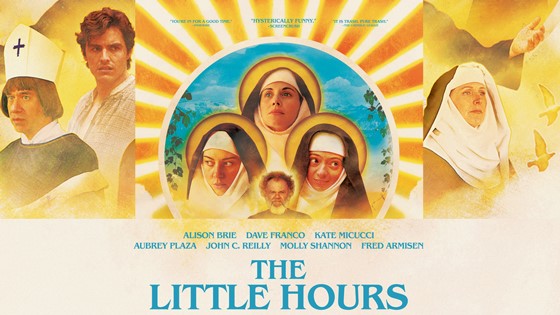
Some people take religion very seriously. Others reach such a high level of intellectual refinement or maturity that it puts them beyond crass, juvenile humor. Good for them — I’m not one of those people. I adore a snarky, irreverent story; it’s even better when it involves absurdism or sacrilege and still has something to say. The Little Hours is exactly that: a farce with a point.
Set during the Middle Ages, hapless Fr. Tommasso (John C. Reilly) has the unenviable job of overseeing a convent. Yipee. He finds himself without a gardner when Lurco (Paul Weitz) quits after three hateful young nuns — vain Sr. Alessandra (Alison Brie), nerdy gossipry Sr. Ginerva (Kate Micucci), and belligerent Sr. Fernanda (Aubrey Plaza) — physically attack him one too many times.
While on a mission selling embroidery to raise funds for the convent, Fr. Tommasso, lost and drunk, crosses paths with Massetto (Dave Franco), a servant running from his master, obnoxious douchebag Lord Bruno (Nick Offerman). Bruno is out for blood (not to mention balls) after he discovers Massetto has been carrying on with his wife (Lauren Weedman) for some time.
Fr. Tommasso learns of Massetto’s dilemma and makes a proposal: Massetto can work in the garden at the convent, but he must pose as a deaf-mute to avoid stirring the ire of the nuns. Massetto accepts, but things don’t pan out quite as intended. The young nuns are, well, horny. Not long after he arrives at the convent, Massetto is getting it on with both Alessandra and Fernanda. All hell breaks loose when they find out.
Written and directed by Jeff Baena, The Little Hours is loosely based on — or a spoof of — a novella from Giovanni Boccaccio’s The Decameron, a 14th Century epic. If this sounds highbrow, don’t fret — it’s the only sophisticated thing about this film, which is fine because it is above all else a comedy.
Loaded with f-bombs, sex, and general malice, The Little Hours is an amusing mix of Mean Girls and Monty Python. The cast works well as an ensemble, bringing out and playing off of each other’s goofiness in an endearing way. I see hints of improvisation, which brings even more energy to the whole thing. Although the story peters out toward the end, Baena keeps the momentum going strong for most of it. What could have been a thin joke stretched out too long and too far stays fresh and fun with this vibrant and funny cast.
For all its silliness and flippancy — pretty much all seven deadly sins make an appearance here — Baena raises an interesting point. The Little Hours is very much a comedy about desire, and it get its laughs from the conflict between desire and appearance. Without getting preachy, The Little Hours shows that piousness and devotion don’t douse the flames of desire; sometimes, they fan them. After all, we’re all merely human. I can’t help thinking that Chaucer would approve.
With Molly Shannon, Fred Armisen, Jon Gabrus, Jemima Kirke, Adam Pally, Paul Reiser
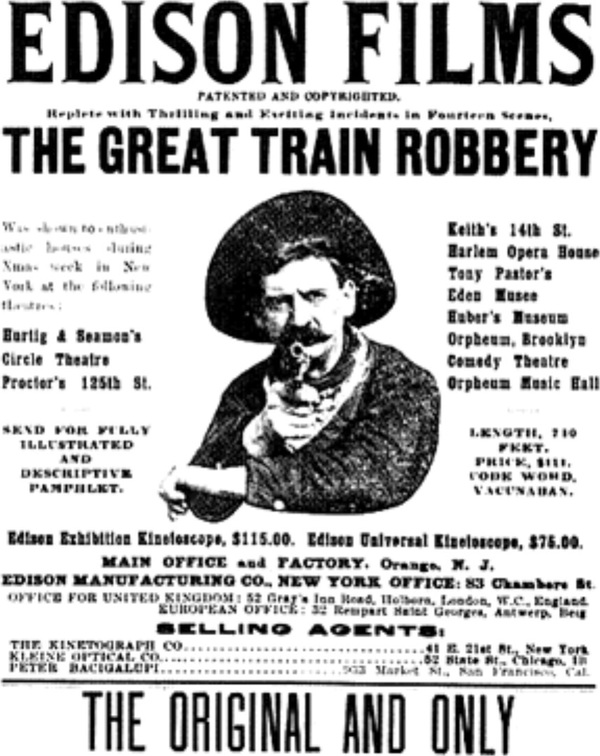
The Great Train Robbery is another early narrative film produced by Thomas Edison and directed by Edwin S. Porter. Unlike Life of an American Fireman earlier the same year, this one looks like a movie: it has a title card, a cast that acts (even if it’s humorously overdramatic), and a more complicated plot — though it’s still pretty simple.
The focus is clearly on telling a story, and on that level it works: a bunch of bandits (Gilbert M. ‘Broncho Billy’ Anderson, Justus D. Barnes, John Manus Dougherty Sr., Frank Hanaway, Adam Charles Hayman) rob a passenger train and are pursued over it. The action is parsed out more thoughtfully, no doubt for dramatic effect. The settings change, and a lot more characters are involved. Plus, the very last scene is clever — it’s a bit Hitchcockian.
With A.C. Abadie, George Barnes, Walter Cameron, Donald Gallaher, Shadrack E. Graham, Morgan Jones, Tom London, Robert Milasch, Marie Murray, Mary Snow
Production: Edison Manufacturing Company
Distribution: Edison Manufacturing Company, Kleine Optical Company
The Immigrant is quintessential Charlie Chaplin: funny, cute, and touching, it entertains while criticizing the social conditions of the day — here, the treatment of immigrants in “the Land of Liberty.” You decide whether all that much has changed in a hundred years.
Written and directed by Chaplin, The Immigrant follows his Tramp character on a boat bound for the States. He meets a fellow passenger, a beautiful young woman (Edna Purviance) traveling with her mother (Kitty Bradbury), and he has the perfect “in” when money is stolen from her purse. Sparks fly, but unfortunately the two potential love birds are separated by U.S. Customs agents as soon as they reach New York Harbor.
Once in the New World, the Immigrant has some trouble making ends meet. He finds a quarter on the ground one dreary afternoon and heads to a restaurant where a hostile head waiter (Eric Campbell) gives him a hard time. By chance, he sees the young woman from the boat and invites her to his table for beans and coffee (yuck!). Soon realizing that the quarter slipped through a hole in his pocket, he tries to impress her while stalling on the check to avoid ejectment.
The Immigrant starts off rocky — literally: the boat rocks back and forth, lending itself to some nice physical comedy with passengers sliding across the floor, juggling moves, and dishes sliding across a table. Thankfully, the rocking stops just before it becomes annoying. The scene in the restaurant is fascinating both for the character development and the physical choreography. This is a sweet story, an early romcom with a happy ending — and it’s downright charming a century later.
With Albert Austin, Henry Bergman, Loyal Underwood, William Gillespie, James T. Kelly, John Rand, Frank J. Coleman, Tom Harrington, Janet Miller Sully, Tom Wilson, Tiny Sandford
Incidentally, that hotel party occurred in San Francisco exactly 96 years ago on the day after this post.
Today, I saw my first Fatty Arbuckle film — and it only took me 108 years (https://en.wikipedia.org/wiki/Roscoe_Arbuckle_filmography). I had a loose idea of what to expect but I wasn’t quite sure. Fatty’s Tintype Tangle is familiar and not too crazy, the cinematic equivalent of something that tastes like chicken.
WARNING: Potential spoilers ahead!
A slapstick farce, Fatty’s Tintype Tangle tells of a husband (Arbuckle) whose mother-in-law (Mai Wells) nags the shit out of him. He and his wife (Norma Nichols) laugh at her behind her back. After getting liquored up in the kitchen while cooking breakfast, Fatty tells off his mother-in-law and either throws her ass out of his house or upsets her to the point that she gets up and goes — it’s hard to say.
Fatty goes to the park, where he sits on a bench next to a woman (Louise Fazenda) whose husband (Edgar Kennedy) momentarily leaves her to go do something — the scene card tells us they’re Alaskan “homeseekers,” whatever that is. They seem down and out, staying at an obviously low rent room and board. A photographer (Glen Cavender) snaps their picture — hence the “tintype” in the title — which isn’t cool because, well, they’re both married. The husband returns, mistakes Fatty for a creep, and threatens to kill him if he doesn’t leave town.
Fatty runs home and packs his bags — including his booze. He tells his wife he’s going on a business trip. Despondent, she answers an ad in the paper from someone seeking an apartment. She rents out the house and apparently moves in with her mother. Turns out, her tenants are the Alaskan couple. Doh!
Fatty misses his train and goes home. Unbeknownst to him, the Alaskan woman is in his bathroom. Hilarity ensues.
Fatty’s Tintype Tangle has all the elements of early comedy, a lot of it cliché now: misunderstandings, the hapless henpecked male, a slip and fall on a banana peel, gunshots to the ass, even Keystone cops. The only thing missing is a pie in the face. A rather cool extended scene features Arbuckle climbing up a pole and running across power lines. I was impressed to see him doing his own stunts; he was surprisingly limber for such a big guy.
Slapstick isn’t my favorite form of entertainment, but this is solid physical comedy even if it’s hard to follow at points. The version I saw had no sound at all, which was a bummer — hearing myself breathe adds nothing to the experience.
I expected crime noir classic The Asphalt Jungle to be something of a cheesefest: stiffly acted, overly melodramatic, and maybe a bit hamfisted in its morality, like The Hardy Boys for adults of the Greatest Generation. Thankfully, John Huston’s film adaptation of W.R. Burnett’s 1949 novel is none of that.
No sooner is Doc Riedenschneider (Sam Jaffe) out of the big house when he hatches a plan to do what he does best: steal. Like, a million bucks or more in jewels from a jewelry store (not Jared’s). Yes, a jewel heist. He pitches his plan to Cobby (Marc Lawrence), a two-bit gambling bookie, who puts him in touch with Alonzo Emmerich (Louis Calhern), a rich but shady attorney. Emmerich buys in, not just providing financial backing but also agreeing to handle disposing the booty for cash.
Doc assembles a crew of petty thieves consisting of a “box man,” or a safecracker (Anthony Caruso), a driver (James Whitmore), and an all-important “hooligan” (Sterling Hayden) to execute the plan. The heist goes off without a hitch, mission accomplished. It’s smooth; uneventful, even. That is, until a stray bullet accidentally hits one of the crew members.
This is where the plot gets really interesting, as human nature and a slew of bad decisions rear their ugly heads. It doesn’t help that at the same time, sundry troubles that have been brewing alongside all the planning are coming to a boil. Soon, it’s every man for himself in a sticky web of deception, doublecrossing, and death.
The Asphalt Jungle is an exquisitely layered and calibrated drama that’s tough to turn away from — and tough not to appreciate. Written by Huston with Ben Maddow, the screenplay is tight. The characters — a collection of urban lowlife thieves, thugs, private detectives, crooked cops, and good looking dames — all have dimension. Interestingly, what would probably be the most intense scene in most movies — the break-in — isn’t; the intensity and the drama come from what happens after that. A manhunt that ends in Cleveland and an attempted swindle serve as the ticking clock here. This is the perfect thriller for a hot summer night in the city. Bonus: The Asphalt Jungle features a young but unmistakable Marilyn Monroe in one of her earliest roles.
With Jean Hagen, John McIntire, Barry Kelley, Teresa Celli, William “Wee Willie” Davis, Dorothy Tree, Brad Dexter, Helene Stanley, John Maxwell, Strother Martin, Jack Warden, Tim Ryan
“If I ever see a hat on a bed in this house, man, like you’ll never see me again. I’m gone.”
“Show time!”
“Well, to begin with, nobody, and I mean nobody, can talk a junkie out of using. You can talk to ’em for years but sooner or later they’re gonna get ahold of something. Maybe it’s not dope. Maybe it’s booze, maybe it’s glue, maybe it’s gasoline. Maybe it’s a gunshot to the head. But something. Something to relieve the pressures of their everyday life, like having to tie their shoes.”
— Bob Hughes
“Narcotics have been systematically scapegoated and demonized. The idea that anyone can use drugs and escape a horrible fate is anathema to these idiots. I predict in the near future right-wingers will use drug hysteria as a pretext to set up an international police apparatus.”
— Fr. Murphy
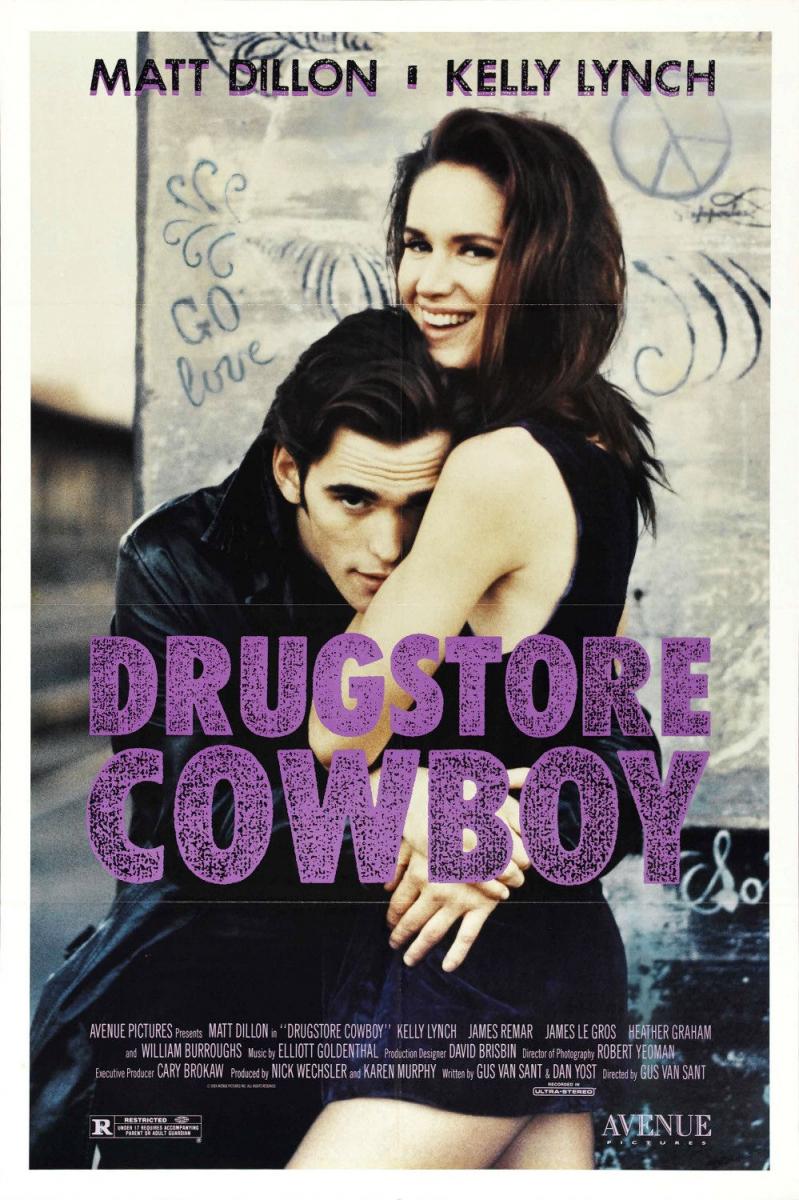
I love everything about Drugstore Cowboy, the first film I ever saw by director Gus Van Sant. It’s the one that I view as his gold standard even after nearly 30 years. Funny, touching, and insightful in ways that have to be seen, it speaks to me. It probably always will. It’s a rare film that has it all: flawlessly executed from start to finish, it’s totally absorbing and entertaining yet still makes its points in a way that hits hard even after seeing it dozens of times.
Bad Bobby Hughes (Matt Dillon) — or just “Bob” — is the first one to tell you he’s a junkie. He and his wife, Dianne (Kelly Lynch), lead a small nomadic “crew” that consists of Rick (James LeGros) and his young girlfriend, Nadine (Heather Graham). The four of them spend their days getting high and devising elaborate — and amusing — schemes to rob drugs from pharmacies and hospitals. Then they go out and execute their mission.
Once they’ve made a score, they do the drugs they like, sell the ones they don’t, hang out doing little more than watching TV, and move onto another neighborhood somewhere else in Portland, Oregon, when they’ve either run out or overstayed their welcome, whichever comes first.
They’ve repeated the cycle so many times that cocky Detective Gentry (James Remar) and his men are on their trail. Bob manages to stay a step ahead, but it’s getting tougher. He sees that his luck is running out — and it’s not just because of the hex that Nadine inadvertently put on them by mentioning a dog (one thing about Bob: he’s a bit superstitious).
To outrun one such hex — and more realistically, because Bob runs out of ideas and doesn’t know what to do next — they hit the road, stuffing their drug stash in suitcases, shipping them on Greyhound buses, and following them by car. A string of bad luck and bad outcomes presents Bob with an epiphany — and a choice.
With both humor and compassion, Van Sant — and for his part, Dillon — tells a moving and curiously relatable story about people who aren’t necessarily bad, but they’ve allowed their lives to drift away from them. Here, it’s for drugs. They don’t always do the right thing, and often the members of this little family of outcasts are each other’s worst enemies. But they’re realistic. Dillon makes Bob so likable that I find myself rooting for him even when he’s making bad choices; despite his flaws, I like him enough that I can see myself having fun with him.
Drugstore Cowboy easily could’ve been a very different movie. It works because it’s not preachy or judgmental or hyperbolic. Based on a novel by real-life criminal and addict James Fogle (https://en.m.wikipedia.org/wiki/James_Fogle), Van Sant and Daniel Yost’s screenplay eschews melodrama for a decidedly objective and almost clinical approach, showing the joys of drugs in some visually well constructed sequences as well as the cost of addiction. The film does an excellent job showing how much work it is to maintain a habit. Throughout the movie, Dillon’s narration keeps the story grounded. Van Sant never sells out his characters’ humanity.
It doesn’t hurt that this film is loaded with spectacular performances all around, including those of Grace Zabriskie as Bob’s battleworn mother and William S. Burroughs as disgraced priest and fellow addict Fr. Tom Murphy. Robert Yeoman’s cinematography gives Drugstore Cowboy a drab, threadbare look that works well with Elliot Goldenthal’s moody score. Every element comes together to make this a truly remarkable film, definitely one of my favorites.
With Max Perlich, George Catalano, Janet Baumhover, Stephen Rutledge, Beah Richards, Robert Lee Pitchlynn, Ray Monge, Woody
Production: Avenue Pictures
Distribution: Avenue Pictures Productions (USA), Astral Films (Canada), Forum Distribution (France), Sandrew Film & Teater (Sweden), GAGA Communications (Japan)
“I’ve come here to chew bubblegum and kick ass…and I’m all out of bubblegum.”
“I’m giving you the choice: either put on these glasses or eat that trashcan.”
“Brother, life’s a bitch. And she’s back in heat.”
— Nada
Director John Carpenter has done a few good pictures that probably will have an audience long after he’s gone; They Live isn’t one of them. At least, not in a good way. B-movie cult fodder all the way, They Live is a somewhat delayed and really heavy-handed reaction to ’80s conspicuous consumption. Based on Ray Nelson’s 1963 short story “Eight O’Clock in the Morning” and subsequent comic strip, Carpenter’s screenplay, written under the pseudonym Frank Armitage, is founded on a decent premise; it just doesn’t go where it could have.
Nada (Roddy Piper), a migrant construction worker who’s seen better days, picks up a job in downtown Los Angeles. He notices some weirdness going on with a television station that seems to be connected to a church across the lot where he and other homeless people have set up camp. His coworker Frank (Keith David) doesn’t want to hear about it. No one does.
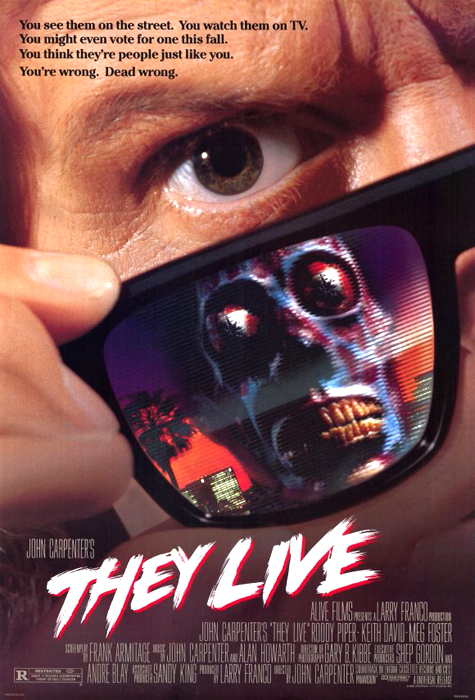
One morning, Nada comes into possession of a pair of sunglasses. When he puts them on, he sees subliminal messages everywhere. A billboard with the tagline “We’re creating the transparent computing environment” says “Obey” with the glasses on. A travel ad beckoning, “Come to the Caribbean” says “Marry and reproduce.” “Men’s apparel” says “No independent thought.” Signs all around him order one to consume, conform, buy, watch TV, submit, sleep, do not question authority:
Even the dollar bill has a different message: “This is your god.”
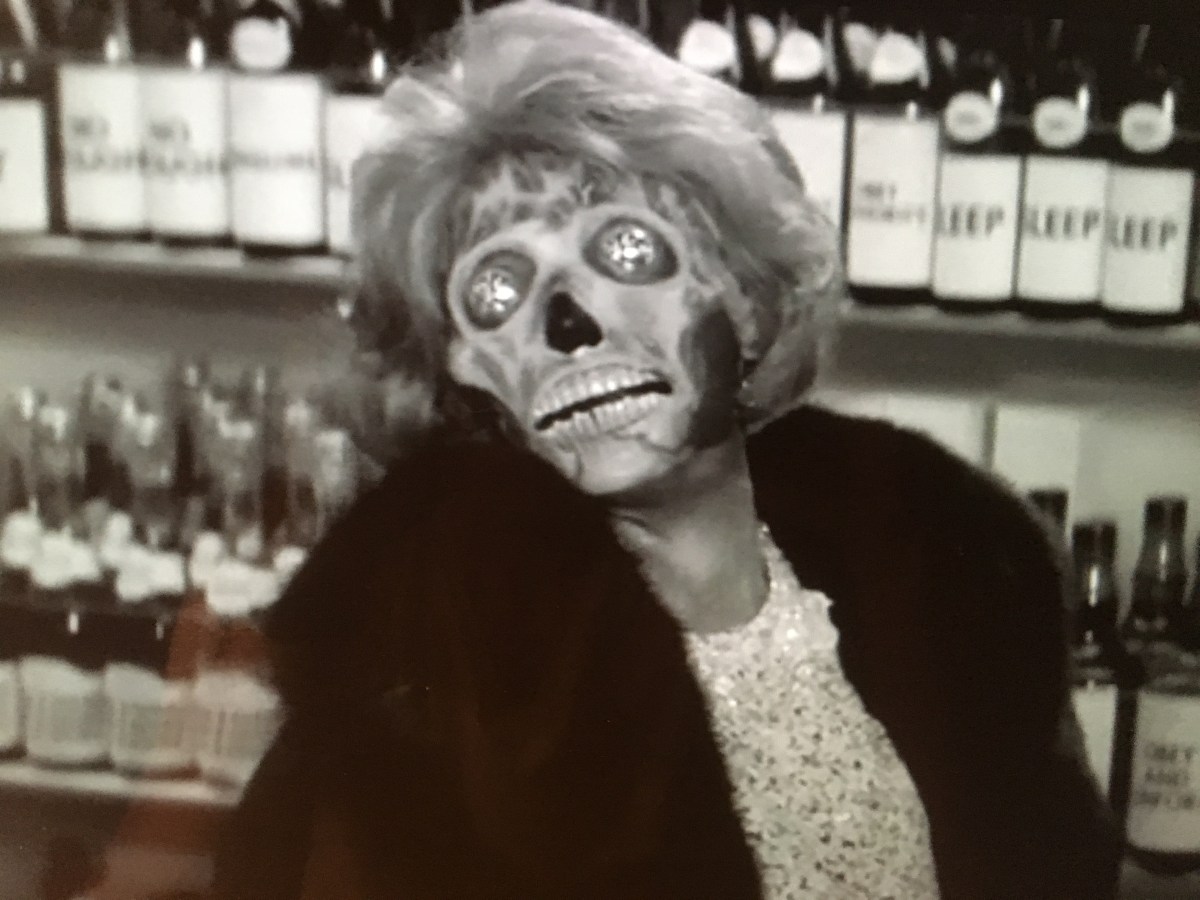
What’s worse, some people are not what they appear to be. At all. They aren’t even human — they’re skeletal reptiles, a kind of mutant species of Sleestaks or something:
What the hell is going on? Who are these things? What do they want? As Nada tells Frank, they ain’t from Cleveland.
I remember seeing They Live at the theater when it was new. It was okay. Three decades later, it’s still okay. It’s a lot sillier this time around, though. The whole thing gets off to a good enough start, but the momentum peters out just before midpoint. Carpenter — or anyone, for that matter — can get only so much mileage out of this story. They Live feels like 40 minutes of material stretched into more than twice that amount of time.
The denouement is not just predictable but anticlimactic, and the perspective here is adolescent at best. The lines are cringeworthy, falling painfully short of the Arnold Schwarzenegger zingers they aim to be. The acting is pretty bad, especially David and Meg Foster, both of whom are as stiff and lifeless as a dead gerbil. Surprisingly, Piper and his mullet are the best thing about They Live; Piper isn’t enough to carry it, though. And that wrestling scene in the alley is inane — misplaced, unnecessary, and too long, it adds nothing except maybe ten minutes to the running time.
The worst thing about They Live is that it seems Carpenter was serious — nothing here reads as tongue in cheek to me.
With George “Buck” Flower, Peter Jason, Raymond St. Jacques, Jason Robards III, Lucille Meredith, Norman Alden, Norm Wilson, Thelma Lee, Rezza Shan
Good Time is not a film to see for the plot. Written by Josh Safdie and Ronald Bronstein, the storyline is not all that novel, complicated, or interesting — in itself. I can sum it up in a single sentence: Queens bad boy Connie Nikas (Robert Pattinson) spends a night fleeing cops while trying to get his mentally handicapped younger brother, Nick (Benny Safdie), out of the mess he put him in after a bank robbery they commit goes sideways. It sounds like a comedy, but it most definitely is not.
Good Time is a movie to see for the mood it creates — and man, is it intense! More or less a character study, this could have been a disaster in someone else’s hands. As it is, the whole thing soars thanks to the directing by brothers Benny and Josh Safdie and the acting, which is all around great. Pattinson is particularly terrific — forget Twilight. I’ve heard comparisons to Al Pacino’s best work in the ’70s, and I’ve got to agree; Pattinson conveys a natural nervous energy just under the surface so well that you feel it watching him. I found myself more and more jittery and paranoid with every move and bad decision Connie makes and every character he encounters. I noticed hints of Dog Day Afternoon, Cruising, The Godfather, and even The Graduate in Pattinson’s performance.
Taking place almost entirely at night, the settings are familiar but eerie: a hospital, the crammed TV-lit apartment of a Jamaican immigrant (Gladys Mathon) and her weed smoking teenage granddaughter (Taliah Webster), an empty amusement park. Add a skittish techno score by Oneohtrix Point Never, a pallet of neon-colored light, and a nonstop chase, and you’ve got Good Time. Roller coaster ride or drug trip, take your pick — either way, this is a film that drags you along for the ride and zaps you, in a really satisfying way. I don’t know if Good Time is Oscar material, but it’s definitely memorable.
I almost missed Good Time, which opened for what appeared to be a very short limited run in Chicago. I made my own bad decision to see it Friday night after dinner with lots of cocktails. The film became a big blur that my drunk brain couldn’t handle. I went back for a Sunday matinee by myself. I left impressed, and actually pissed that I wasn’t present the first time I caught it.
With Jennifer Jason Leigh, Barkhad Abdi, Necro, Buddy Duress, Peter Verby, Saida Mansoor, Eric Paykert









 moviebloke