You’re Killing Me Susana [Me estás matando Susana]

(Mexico 2016)

When I was a kid, Cedar Point would start hyping its newest ride, usually but not always a roller coaster, just as winter gave over to spring. In June, we’d finally get to the park and wait in line for two hours to experience it. Some years, the ride didn’t live up to its promise; I felt I had been duped. I recently felt that same disappointment again leaving the theater after a sold out screening of Roberto Sneider’s edgy new romantic comedy You’re Killing Me Susana.

Self-absorbed lout Eligio (Gael García Bernal) is a minor soap opera actor who believes in monogamy—for his wife, Susana (Verónica Echegui), not him. He stays out drinking, cheats on her, and sometimes drags his thespian friends over to their apartment to party into the wee hours—after Susana’s gone to bed. The look on her face and the way she pushes him off of her when he stumbles into bed and nuzzles her to cuddle is sublimely bitchy—and funny.

Eligio is the only one who’s confused when Susana leaves him. He schleps from Mexico City to Iowa to track her down, enduring American customs agents and evading campus police. He finds her enrolled in a writing program for foreign students at an unnamed university (University of Iowa, perhaps?). She’s also running around with a silent, brooding, and well-endowed Polish poet (Bjorn Hlynur Haraldsson). Without a plan or a place to stay, Eligio moves into Susana’s dorm—ostensibly to work out their issues.

Adapted by Sneider and Luis Cámara from José Agustín’s novel, You’re Killing Me Susana depicts a dysfunctional relationship that both participants take a lax approach to maintaining. I don’t mind dislikable characters, but I had some difficulty connecting with these ones. They seem to recognize a problem, but it doesn’t come off as dire. Some of what happens between them is confusing, and as a result the message gets lost. Somewhere in here, I suspect, are statements about machismo, maturity, fidelity, how men and women view sex, and what they want out of life.

The previews suggested something riotously fun and sexy, and I really like Bernal. You’re Killing Me Susana exudes that distinct cuteness with a dark undertone you see a lot in Mexican films. Overall, though, this is just okay. It has some funny moments—most of them in the trailer—but the execution is shallow, simplistic, and forgettable. Too bad, because this could have been a really powerful and interesting film.

With Ashley Grace, Andrés Almeida, Jadyn Wong, Adam Hurtig, Barbara Garrick, Ilse Salas

Production: Cuévano Films, La Banda Films

Distribution: Hola Mexico Distribution

100 minutes
Not rated

(Gene Siskel Film Center) C-

http://holamexicoff.com/susana/

https://www.facebook.com/killingmesusana/

Captain Fantastic

(USA 2016)

Captain Fantastic came out last summer, and I wanted to see it then. I must confess, the cast interested me more than the plot.

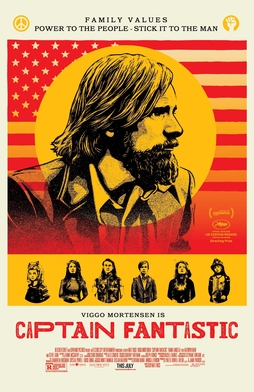
Viggo Mortensen is the aptly named Ben Cash, a long disenfranchised survivalist who is, like, so over American capitalism and politics. He and his wife, Leslie (Trin Miller), shown almost entirely in flashback, decide to raise their six kids—three boys and three girls—off the grid in the mountain wilderness of Washington State. Removed from society, Ben and Leslie teach their kids everything from logic and philosophy to hunting and gathering to Norman Mailer and Guns ‘n’ Roses. They do it all without iPhones or religion. Kudos to that!

Nothing is perfect: Leslie suddenly dies, forcing Ben to take his feral kids into the outside 21st Century world for the first time, ever—which calls everything they planned for their family into question.

Director and screenwriter Matt Ross poses some interesting questions about society, conformity, and the social contract in a provocative and often lighthearted way. However, Captain Fantastic is not terribly surprising, which is why it doesn’t work as well as it could. At heart, it’s a standard fish out of water dramedy. Frankly, I spotted every “twist” coming before it got to me: the cop (Rex Young) who pulls over their Partridge Family van, the mildly blasphemous excuse that saves the day, the family’s visit to the supermarket, their reaction to their extended family (and vice versa), that lame scene in which Ben’s sister-in-law (Kathryn Hahn) calls him out onto the carpet for his choices and his youngest daughter (Shree Crooks) recites the Constitution to prove her wrong, eldest son Bo (George MacKay) proposing to the first girl who gives him attention—a trailer park teen queen (Erin Moriarty)—and the colleges he manages to get into, the “situation” that requires modern medical attention. Meh.

For all its grandiose intentions to take on the establishment, Captain Fantastic actually relies on a rather orthodox and pedestrian approach to make its point. Maybe that is its point, that you can’t escape society. It doesn’t mater: this story is predictable and sentimental, two things that never bode well. I expected more than Spokane Swiss Family Brady Bunch, which is essentially what this is. The one thing that saves this film from total mediocrity is the acting, which is great all around.

With Frank Langella, Ann Dowd, Samantha Isler, Annalise Basso, Nicholas Hamilton, Charlie Shotwell, Steve Zahn, Elijah Stevenson, Teddy Van Ee

Production: Electric City Entertainment, ShivHans Pictures

Distribution: Bleecker Street, Universal Pictures

118 minutes
Rated R

(iTunes rental) C

http://www.bleeckerstreetmedia.com/captainfantastic

Gold

(USA 2016)

“The taste of it on your tongue, the feel of it on your fingers—it’s like a drug.”

—Mike Acosta

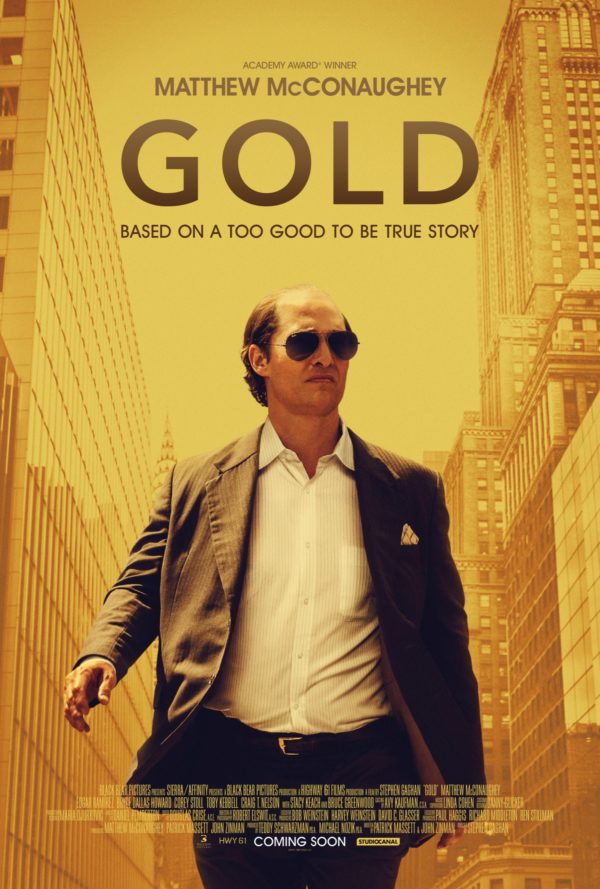
Not everything gold glitters; such is the case with Stephen Gaghan’s Gold, his first film since the acclaimed Syriana over a decade ago. Matthew McConaughey is Kenny Wells, a redneck businessman running his collapsing mining company from a smoke-filled tavern in Reno, Nevada, in 1988. Acting on little more than gut and some pawn shop cash from hocking gifts he gave his girlfriend (Bryce Dallas Howard) in better days shown as the movie opens, he abruptly heads to Indonesia to track down geologist Mike Acosta (Édgar Ramírez) to find a gold mine.

Their first meeting doesn’t go well at all. Looking like he stepped out of Banana Republic when it was a safari store in the ’80s, Acosta is shrewd, rugged, and quite experienced. Balding and sweaty Wells, with his jagged teeth and paunch, is sloppy and desperate. He reads as broke. Unimpressed, Acosta passes when Wells suggests they partner up—until the latter raises $200,000 for the proposed venture. After a series of miscalculations and mishaps (including a bout with malaria), they hit the jackpot in the middle of a jungle. Suddenly, the same banks and big investors that turned up their nose at Wells before want in on the action.

Gold isn’t a bad movie, but it’s not the impressive work it wants to be. The pace is fine, but the plot twists are unsurprising if not downright predictable. The problem is that I’ve seen this story before, and recently: mainstream films like The Big Short (https://moviebloke.wordpress.com/2016/01/03/the-big-short/), The Wolf of Wall Street, and American Hustle deal with the same themes in a similar manner. I’ve seen McConaughey be the same character, too. The curious statement “inspired by a true story” after the opening credits is the cue to something I found disappointing: Gold is a fictionalized account of a true story, changed enough that I guess it can’t claim to be “based on” reality. I’m not sure where that line is drawn, but it turns out much of the story is made up (http://www.financialpost.com/m/search/blog.html?b=business.financialpost.com/news/mining/gold-the-movie-about-the-bre-x-mining-scandal-that-isnt-about-bre-x&q=Bre). Plus, it’s never a good sign when the music in a film—here, artists ranging from Orange Juice to New Order and Joy Division to the Pixies and a new song by Iggy Pop and Danger Mouse—elicits the most enthusiastic response from me. Overall, meh.

Also starring Corey Stoll, Toby Kebbell, Craig T. Nelson, Stacy Keach, Rachael Taylor, Joshua Harto, and Timothy Simons

Produced by Boies/Schiller Films, Black Bear Pictures, and Highway 61 Films

Distributed by TWC-Dimension

121 minutes
Rated R

(AMC River East) C

http://gold-film.com


Django Unchained

(USA 2012)

“The ‘D’ is silent, hillbilly!”

—Django

If anyone would take a stab at something that sounds as ridiculous and cringeworthy as tackling American slavery in a spaghetti Western, it’s Quentin Tarantino. “I want to do movies that deal with America’s horrible past with slavery and stuff, but do them like spaghetti Westerns, not like big issue movies,” he said, clearly referring to Django Unchained in a 2007 interview—five years before it came out. “I want to do them like they’re genre films, but they deal with everything that America has never dealt with because it’s ashamed of it.” (http://www.telegraph.co.uk/culture/film/starsandstories/3664742/Quentin-Tarantino-Im-proud-of-my-flop.html).

The title here references Sergio Corbucci’s 1966 film Django, an actual spaghetti Western in which the titular hero, a cowboy, is thrust into a row between Southern Klansmen and Mexican revolutionaries. In Django Unchained, the story starts in 1858—just a few years before the American Civil War. Django (Jamie Foxx) is a slave separated from his wife, the curiously named Broomhilda von Shaft (Kerry Washington), after they were caught trying to escape a plantation. He’s shackled to a group of slaves that the Speck brothers (James Remar and James Russo) are driving on foot to be sold.

Enter traveling dentist Dr. King Schultz (Christoph Waltz), a genteel German driving a wagon with a big wooden tooth on top of it. Schultz is actually a bounty hunter looking for the Brittle brothers—Big John (M.C. Gainey), Lil Raj (Cooper Huckabee), and Ellis (Doc Duhame)—who happen to be Django and Broomhilda’s former masters. He makes Django an offer he can’t refuse: help him find and kill the brothers, and Schultz will pay him, set him free, and help him find Broomhilda.

Django Unchained is structured in essentially three “episodes.” The first takes place in a one-horse town near El Paso, where Schultz provokes the ire of the townfolk, the sheriff (Don Stroud), and a U.S. Marshall (Tom Wopat). The second takes place on a plantation owned and operated by Spencer “Big Daddy” Bennett (Don Johnson—um, wow!). The last, longest, and most twisted takes place on another plantation in Mississippi, the bountiful Candie-Land, owned by charming but sadistic Calvin Candie (Leonardo DiCaprio) and operated by his shifty Uncle Tom house-slave, Stephen (Samuel L. Jackson).

Tarantino actually pulls off what he said he wanted to, and he does it quite well. Django Unchained could have been a really dark film like its immediate successor, The Hateful Eight. The two films have a lot in common. The tension—and there’s lots of it—built into the story is deliberately and profoundly slow in reaching a boil. Django Unchained certainly has Tarantino’s trademark violence, revenge theme, and liberal use of the ‘n’ word—116 times, a record for a film according to IMDB (http://www.imdb.com/title/tt1853728/trivia?ref_=tt_trv_trv). A few scenes are difficult to watch, the “Mandingo fight scene” being the worst for me. Unlike The Hateful Eight, though, the violence here is Tarantino’s typical flagrantly graphic cartoonish gore. He also shows a more conspicuous sense of humor—for example, Django and Broomhilda are ancestors of John Shaft of the Shaft franchise (https://www.google.com/amp/deadline.com/2012/07/django-unchained-a-shaft-prequel-so-says-quentin-tarantino-comic-con-301010/amp/).

Django Unchained is an unlikely and uncomfortable pairing of an ugly part of our collective past with absurdity, but it’s entertaining while still getting its point across: we’re still living with the aftermath. It’s the kind of film you mull over for a long time after you see it.

With Laura Cayouette, Jonah Hill, Walton Goggins, Dennis Christopher, Dana Gourrier, Nichole Galicia, Miriam F. Glover, Quentin Tarantino, Franco Nero, Russ Tamblyn, Bruce Dern, Misty Upham, Danièle Watts, Robert Carradine

Produced by The Weinstein Company, Columbia Pictures

Distributed by The Weinstein Company (North America), Sony Pictures Releasing (International)

165 minutes
Rated R

(iTunes rental) A-

http://www.unchainedmovie.com

Silence

(USA 2016)

“I pray but I am lost. Am I just praying to silence?”

—Fr. Rodrigues

Just as main character Fr. Rodrigues (Andrew Garfield) is conflicted about his faith, I’m conflicted about Martin Scorsese’s current project, Silence. This film is clearly a labor of love and something extremely personal, both of which I greatly respect. Its genesis dates back nearly 30 years to the controversial The Last Temptation of Christ—can there be a more fitting starting point?—when Scorsese read Shusaku Endo’s novel (the title is the same as the movie) about Jesuit missionaries and Catholicism in Japan in the 17th Century (http://mobile.nytimes.com/2016/11/27/magazine/the-passion-of-martin-scorsese.html?_r=0&referer=https://www.theatlantic.com/entertainment/archive/2016/12/martin-scorsese-silence-theology-art-jesuits/510827/ ). Having a Jesuit education myself, the nuance of what drives the characters (i.e., the service-oriented “men for others” philosophy of the Society of Jesus and the desire to make the right decisions and find answers) is not lost on me.

Momentary diversion: I was simultaneously amused and wowed by the number of nuns and priests in attendance at the pre-opening screening that I attended. I say “amused” because the audience looked like a Catholic J. Crew catalog; and I say “wowed” because the turnout served as a testament to the weight of this film. I felt it, and it was heavy. Credible. Plus, what does it say that a lapsed Catholic like me shows up for the pre-opening screening of a religious film as if it were a release party for a new Madonna album? More conflict.

But I digress. Silence follows two Portuguese Jesuit priests—the aforementioned Fr. Rodrigues and Fr. Garrpe (Adam Driver)—on their search to find their spiritual teacher and mentor, Fr. Ferreira (Liam Neeson), who has gone missing in Japan. The Japanese state has banned Christianity: those who practice it are hunted down by a committee, tortured, and killed. There’s an easy way out, weird as it is, that involves stepping on Catholic icons. Unsettling rumors have come to light concerning Fr. Ferreira, the most troubling of which is that he renounced Catholicism.

Silence is a gorgeous film—Rodrigo Prieto’s cinematography is breathtaking. I can feel every fly and bead of sweat I see on the screen. The idea of pushing “What Would Jesus Do?” to its mindfucking extreme is absolutely brilliant. The acting is generally flawless, but Issei Ogata easily shines lightyears beyond everyone else as the surprisingly unarresting, pragmatic, and understanding Inquisitor. Scorcese does a beautiful job demonstrating two timely ideas: tolerance is crucial for any civilized society, and doubt is totally normal. Can I get an amen? All that said, however, Silence is gratuitous in length, tedious, and exhausting. Painfully boring at points, even. The narration drove me crazy after awhile, as did the subpar Portugese accents. The ending is emotionally brutal; it’s ultimately satisfying, but you have to look closely and you have to be thinking. Normally, this wouldn’t be something worth mentioning; but at the end of such an energy zapper as Silence, it’s just not what I was prepared to do. I love what Scorcese gets at here; he does it artfully for sure, but I wish he had gone about it in a more direct and interesting way.

Also starring Ciarán Hinds, Shin’ya Tsukamoto, and Yôsuke Kubozuka.

Produced by Sharpsword Films, AI Film, CatchPlay, IM Global, Verdi Productions, YLK Sikella, and Fábrica de Cine

Distributed by Paramount Pictures

161 minutes
Rated R

(AMC River East) C+

http://www.silencemovie.com

Lion

(Australia/UK 2016)

Like any kid, five-year-old Saroo (Sunny Pawar) is enamored of his older brother, Guddu (Abhishek Bharate). Saroo shadows Guddu everywhere, helping him do things like steal coal from trains to trade for milk for their penurious mother (Priyanka Bose) and little sister (Khushi Solanki) in their tiny village in India. After begging his brother to take him to “work” with him in a nearby city one night, both boys quickly learn that Saroo is too young to hack the late shift. Guddu leaves Saroo on a bench at a train station, promising to be right back. Saroo dozes off, waking up on an empty platform in the middle of the night. Scared and maybe cold, he gets on a vacant train and drifts back to sleep in one of the compartments. He’s jolted up while the train is speeding through terrain he’s never seen before.

The train takes Saroo to Kolkata (formerly Calcutta), where he must fend for himself. He doesn’t know the city, the language, or even his mother’s name. Kolkata is dangerous for a kid: Saroo is nearly abducted at the train station. He meets Noor (Tannishtha Chatterjee), a seemingly nice lady who takes him in. Saroo senses that her creepy friend Rawa (Nawazuddin Siddiqui) has nefarious plans for him, so he bails. A man (Riddhi Sen) eating in a café takes Saroo to the police, who turn him over to an orphanage. They try to find Saroo’s mother, but he’s unable to provide any useful information. Mrs. Sood (Deepti Naval) teaches him English and manners. An Australian couple, John (David Wenham) and Sue Brierley (Nicole Kidman), adopt him.

To use a line from the Beastie Boys, you think this story’s over but it’s ready to begin. Cut to 2008: Saroo (Dev Patel) is grown up, Westernized, and starting school for hospitality management. During introductions, he tells his classmates that he’s from Calcutta but that’s about all he knows. While attending a friend’s party, he goes to the kitchen to get a beer and sees a plate of jalebi, an orange deep-fried Indian pastry. It triggers his memory, and he becomes obsessed with finding his “real” family.

Adapted from Saroo Brierley’s memoir A Long Way Home, Lion plays out as two movies: one about young Saroo, and the other about adult Saroo. On an emotional level, Lion is a beautiful and powerful accomplishment—I defy anyone not to feel something from this film, which deals with identity, family, and home. Even so, it’s flawed. First-time feature director Garth Davis is really heavy-handed with the tears, so much that Lion comes off as trying too hard—manipulative, even. Davis connects the two stories, but he treats them vastly differently. The pace of young Saroo’s story is far superior: it flows naturally, unlike adult Saroo’s, which is choppy and abrupt. Young Saroo’s story is insightful and lyrical, while adult Saroo’s is too often inelegant. I found the unevenness distracting. Plus, the apparitions of Guddu and Saroo’s mother in Australia got silly after awhile. It shouldn’t be difficult to tell from the first three paragraphs of this entry which story I found more engaging.

Even with its flaws, Lion is still a good movie—well worth the two hours it eats of your life. The acting all around is superb, though Lucy (Rooney Mara) is a bit superfluous. Patel is great, but Pawar is the star here; it’s hard to believe this is his first film. Sia’s “Never Give Up,” which plays over the closing credits, will get stuck in your head for days.

118 minutes
Rated PG-13

(AMC River East) B-

http://lionmovie.com

Amélie [Le Fabuleux Destin d’Amélie Poulain]

(France/Germany 2001)

“I like to look for things no one else catches.”

—Amélie Poulain

The Associate Board of Chicago International Film Festival presented a special screening of Jean-Pierre Jeunet’s Amélie, a sumptuous, romantic fantasy of a film that looks as good as it feels. I’ve seen it many times. It’s unrealistic, maybe even a bit silly; yet, it always leaves me smiling. I couldn’t pass up the chance to see it again.

Young Amélie Poulain (Flora Guiet) has a lonely childhood: her odd parents are overreactive, overprotective, and emotionally distant, preferring to rearrange the contents of their toolbox and purse than pay much attention to her. It’s so bad that her heart races when her father, Raphaël (Rufus), a physican, touches her during her annual checkup—a narrator (André Dussollier) explains that all she wants is a hug.

Her father misdiagnoses Amélie with a heart condition. As a result, she’s kept inside from the world and homeschooled by her mother, Amandine (Lorella Cravotta), a rather hysterical woman with a nervous tic in her eye. Amélie retreats into her imagination to deal with it all. Her home environment is so stifling, it makes her pet goldfish, Blubber, jump out of its bowl in multiple suicide attempts. A separate suicide at Notre-Dame, this one successful, changes Amélie’s life, leaving her father to raise her alone without any siblings, which her mother apparently wanted for her. C’est la vie.

Fast forward to 1997: grown up Amélie (Audrey Tautou) is a stylish but shy waitress at a café in the 18th Arrondissement of Paris—artsy Montmartre. While home alone (as usual) in her flat one evening—August 31, 1997—a TV news report of Princess Diana and Dodi Fayed’s fatal car accident jolts Amélie, causing a chain reaction that leads her directly to a rusty box of a boy’s trinkets from the 1950s hidden in her bathroom wall. She discerns the identity of the family who lived in her flat back then and devises an elaborate scheme to reunite the boy, now an older man (Maurice Bénichot), with his “treasures” while staying completely anonymous and out of view. It works, bringing happiness to him and in the process to Amélie.

Thrilled with her accomplishment, she decides that her life’s work will be making others happy—in her own amusingly roundabout, always off to the side way. Amélie, you see, prefers to be invisible. She describes what she sees to a blind man (Jean Darie), kidnaps her father’s garden gnome to inspire him to travel, mails a bunch of fake love letters to her landlord (Yolande Moreau) whose husband abandoned her decades ago, and fixes up a hypochondriac coworker (Isabelle Nanty) with a volatile café patron (Dominique Pinon) who just got dumped.

Amélie’s covert approach goes swimmingly for others, but not so much for her own happiness—something she discovers once she encounters Nino Quincampoix (Mathieu Kassovitz), a handsome and quirky stranger who works at a porn shop and collects discarded photos from a photo booth at Gare de l’Est. Amélie can’t bring herself to show herself to Nino, let alone speak to him through a door. Can her neighbor, “the Glass Man” (Serge Merlin), talk some sense into her?

Everything about Amélie dazzles. Just like earlier films Delicatessen and The City of Lost Children, Amélie is a treat, showcasing Jeunet’s distinct buoyantly surreal visual and narrative style. He’s more sophisticated here, though. He throws in offbeat narrative sidebars that tell about his characters. With wide shots, unexpected angles, a pallet of vividly dark colors, and a mix of elements from different decades, he concocts an idealized version of Paris that highlights all that makes it romantic and dreamy. It works well with Bruno Delbonnel’s cinematography, which has a cool sepiatone air to it. My favorite shot is the one of Amélie literally dissolving into a puddle of water.

Tatou is wonderfully mischievous, emulating both Audrey Hepburn in Breakfast at Tiffany’s and Tinkerbell. You can’t help but fall for her as she turns the mundane into magnifique. Kassovitz, who comes off as a weirdo at first, capably metamorphoses Nino into a go-getter who turns out to be a great match for Amélie. Plus, he’s easy on the eyes.

122 minutes
Rated R

(Public Chicago) A

Chicago International Film Festival

http://www.miramax.com/movie/amelie/

Coming Through the Rye

(USA 2015)

Occasionally, I’m a real starstruck starfucker; I’ve met two of my own idols, and each time was a story in itself. I’m a fan of both The Catcher in the Rye and Nine Stories, too (though not so much Franny and Zooey).

So not surprisingly, I found the premise of Coming Through the Rye appealing and totally relatable: set in 1969, Jamie Schwartz (Alex Wolff), an angsty, unpopular, nerdy high school student at an all-boy boarding school in Pennsylvania, sets out to track down the reclusive J.D. Salinger (Chris Cooper). Like many a midcentury American boy, Jamie says Salinger’s Catcher changed his life; although he’s not as harsh, he identifies with Holden Caulfield because he sees himself isolated and surrounded by phonies. He seeks the author’s blessing on his senior project, a stage adaptation of Catcher (in which Jamie plays Caulfield, of course) to be performed at his school.

Anyone remotely familiar with Salinger knows that Jamie isn’t getting his wish, something at least two teachers let him know. The kid will not take no for an answer. After failing to reach Salinger both by letter and by dropping in on his agent in New York City, a series of unfortunate events at school prompts Jamie to take off and look for Salinger himself. Deedee (Stefania Owen), a local girl who likes him and fortunately for him has a car (a cool Rambler), picks him up and offers to drive. The two embark on a short odyssey through New England.

Equal parts road movie, romance, and coming of age story, there’s quite a bit to like here. Based on actual events from his own high school years, writer and director James Steven Sadwith crafts a straightforward, easygoing story that flows naturally. The many parallels between Jamie and Caulfield—right down to a red hunter’s cap and a disquieting older brother (Zephyr Benson)—are cute; the fact that Jamie is the only Jewish kid at a WASPy boarding school is a nice touch that underscores his status as an outsider. Sadwith does a fine job showing the loss of Jamie’s innocence through a number of small events. Wolff and Owen have a wonderfully guileless chemistry that works really well; a scene with milkweed blowing in the wind is downright beautiful. Jamie’s ultimate discoveries, however, aren’t so cute—this is what keeps Coming Through the Rye from turning into nostalgic drivel.

97 minutes
PG-13

(Gene Siskel Film Center) B

http://www.comingthroughtheryemovie.com

American Honey

(UK/USA 2016)

Andrea Arnold’s American Honey is not a typical teenage girl movie. It isn’t a comedy. Its protagonist, 18 year old Star (Sasha Lane), isn’t funny, cutsie, bitchy, or crazy. To the contrary, she’s smart, strong, serious, and quite desperate. Star is pursuing a boy, but her agenda extends beyond that, even if she doesn’t realize it. She also seems acutely aware that for better or for worse, she’s in control of her own fate.

American Honey opens with Star and two young kids chained to her side digging out discarded chickens from a dumpster for dinner. They walk aimlessly to K-Mart—a place I had no idea still exists—where they cross paths with a feral band of cracky-looking misfits led by Jake (Shia LaBeouf), a ringleader of sorts for the trailer park set. Star and Jake flirt, but security ejects Jake and his posse from the store when they get rowdy. Star ends up with Jake’s phone, giving her the perfect opportunity to continue their encounter in the parking lot. Smitten, she ditches the kids (it turns out they’re not hers) and takes him up on his offer to join him and his “mag crew” on the road.

A “mag crew” is a nomadic lot of door-to-door sales reps, usually kids, hawking magazine subscriptions (http://mobile.nytimes.com/2007/02/21/us/21magcrew.html). The environment is cutthroat and the crew is often abused and exploited. Jake’s crew sells magazines in small mainly rural towns throughout middle America—places like Oklahoma, Kansas, South Dakota, and Missouri. It doesn’t sound fun or profitable, but it works for Star—for a little while, anyway. Despite unrelenting shade from the crew’s manager, suspicious and bossy queen bee Krystal (Riley Keough), Star finds her stride in this ragtag mess, competing for sales, partying with the group, and getting involved with Jake, the top salesman who takes her under his wing and trains her. As rapper E-40 says in “Choices,” one of the songs used for the soundtrack, “I choose to get money, I’m stuck to this bread.”

American Honey doesn’t feel very structured; it plays out more as improvisation than something planned from a script. At times, the pace is rambling and almost painfully slow, which usually sounds the death knell for a lengthy film such as this. Surprisingly, it works for these characters and this story. Arnold is clearly interested in the geographical, cultural, and economic continental divide of America, and she’s adept at exhibiting this through her artistic choices. The settings—mostly barren highways, shitty little meth towns, cheap roadside motels and truck stops, even an oil field—nicely frame the characters’ collective circumstances. The locations provide precisely the backdrop one would expect in a road movie, but somehow they’re more beautiful here. The music is a hodgepodge of genres from techno to country to rap to folk, and it all fits perfectly. I must confess, I downloaded the soundtrack (Bruce Springsteen is not on it). American Honey paints a lusty, vivid picture of life on the fringe.

Newcomer Lane is intriguing and charismatic; it’s hard to believe this is her first film. The part of Jake seems tailor made for LaBeouf, who brings a volatile, forboding edge to his character. The supporting cast is adequate but for the most part forgettable. A few stand out. One is QT (Veronica Ezell), a friendly and chubby pot smoking hippy. Another is Pagan (Arielle Holmes), a sweet goth chick obsessed with Star Wars. The true scene stealer, though, is Corey (McCaul Lombardi), the tanned, blue-eyed, tattooed, fake blonde horndog party boy with a penchant for whipping out his dick whenever because, well, he can. I hope and expect to see more of him and his chiseled cheekbones in the future.

I doubt American Honey has mainstream appeal; it’s too fluid, subtle, and open-ended. It’s got its flaws, but I loved it. On the surface, it’s a road movie about a girl pursuing a boy. The real narrative, though, is much deeper. Like the character in the Lady Antebellum song that gives this film its title, Star literally grows up on the side of the road, and does so before our eyes. She starts out a kid. In the final scene, she immerses herself in a pond, an event spurred by a turtle Jake gives her and likely by a few hungry, neglected children she encounters on her own while selling magazines earlier that day. Her “baptism” is symbolic: with it, Star resigns herself to the fact that she has a role in the grand sceme of things even if she’s never going to get all she wants. In other words, she’s grown up. It’s a gorgeously demonstrated point, if you can make it all the way to the end.

163 minutes
Rated R

(Facets) B-

http://americanhoney-movie.com

Staying Vertical [Rester vertical]

(France 2016)

Writer-director Alain Guiraudie’s Staying Vertical is a strange trip indeed. Traveling through the mountains while writing a script, screenwriter Léo (Damien Bonnard) comes upon Marie (India Hair), a single mother of two and a shepherd who works on her father’s farm. Within the first 20 minutes or so of the film, he knocks her up and sticks around after the baby is born. Without explanation, Marie takes off with her two boys, leaving Léo behind to care for the baby. Marie’s father, Jean-Louis (Raphaël Thiéry), allows him to stay on the farm in exchange for taking care of the sheep.

Meanwhile, Léo develops an obsession with a pretty young buck named Yoan (Basile Meilleurat), who lives down the road with a cantankerous old man, Marcel (Christian Bouillette). Their relationship is ambigous: Yoan seems to do nothing but occasionally clean Marcel’s house—and not very well—while Marcel sits in his chair, blasting Pink Floyd and condemning Yoan with anti-gay rants. While this is going on, Léo seeks assistance for his writer’s block from a spiritual healer (Laure Calamy) while dodging his publisher (Sébastien Novac).

Staying Vertical has some great characters, particularly Marcel and Yoan. It also has a few gorgeous and memorable images, such as a brood of vagrants descending upon Léo and the baby under a bridge and a truly odd final scene involving wolves coming out of the dark onto the farm. Other than that, though, it’s really nothing more than a number of episodes and subplots that don’t exactly connect. A pervading homoeroticism that starts out mildly interesting goes somewhere completely unbelivable. I’m not sure what the point of it is, but I can say that about a lot in this film.

98 minutes
Not rated

(AMC River East) C

Chicago International Film Festival

http://www.wildbunch.biz/movie/staying-vertical/