T2 Trainspotting

(UK 2017)

“You’re a tourist in your own youth.”

—Sick Boy

“Face your past. Choose your future.” That’s what the poster for T2 Trainspotting says. Perhaps it should say, “Paybacks are a bitch,” something Mark Renton (Ewan McGregor) finds out pretty quickly when he returns home to Edinburgh after 20 years in Amsterdam following his little fuckover at the end of Trainspotting. Ostensibly back to make amends and settle his debt, Renton knows that forgiving and forgetting isn’t so easy—or smooth. Truth be told, he probably didn’t expect it to be.

Renton finds Spud (Ewen Bremner) unemployed, still struggling with heroin, and literally killing himself—like, alone with a plastic bag over his head in his dingy apartment. Sick Boy (Jonny Lee Miller) is a full-fledged douche, complete with a failing bar—the Port Sunshine—that he inherited from his aunt, a blackmail sex scam he runs on the side with a Bulgarian partner—Veronika (Anjela Nedyalkova), whom he fancies as his girlfriend—and a seriously unflattering coke habit. Oh yeah, he’s still bleaching what he’s got left of his hair. Neither is stoked about Renton showing up, but Sick Boy is clearly more bitter than Spud. He has a plan to get even.

Soon, however, Renton and Sick Boy are up to their old tricks, nightclubbing, tripping, and yes, thieving. In one of T2‘s best scenes, they head somewhere outside Edinburgh and hit a pub that looks more like an American VFW hall. It’s some weird open mic night for a crowd of Protestant Unionists who are rabidly anti-Catholic because of history. Explaining it all to Veronika in the car before the heist—the plan is to pickpocket as many ATM cards as they can get their hands on—Renton calls them “relics.” After a successful mission, the bouncer won’t let them leave until they perform a number. What they come up with is brilliant.

The fun and games come to a grinding halt when Begbie (Robert Carlyle), who’s serving a 25-year prison sentence and is denied parole because of his anger management problem, breaks out of jail and runs into Renton. He loses his shit in yet another great scene. Renton gets away for the moment but Begbie is on his trail, which leads him to a sketchy business partnership. Will history repeat itself?

I was skeptical when I heard director Danny Boyle was making a sequel; I guess I thought Trainspotting didn’t need a follow up. T2, which is loosely based on Irvine Welsh’s 2002 novel Porno, lacks the youthful vigor of the original and frankly isn’t as cool. How could it be? It wouldn’t exist without Trainspotting; it’s got flashbacks and obligatory references, some more clever than others, throughout. Kelly Macdonald has a fun cameo, Renton’s “Choose Life” monologue is updated, that toilet makes a brief appearance, and there’s a nice remix of Iggy Pop’s “Lust for Life” at the end (and yes, we know it’s coming).

Still, T2 stands on its own. It’s fueled by nostalgia and revenge, which in this case turns out to be a rather interesting combination. T2 has more of a conventional plot, and it’s oddly fascinating. The dialogue is every bit as wickedly sharp as before. These boys have grown up—they’ve turned into sad men because they’ve chosen unfulfilled promise and disappointment (to use Renton’s words). Now they have to deal with it, which isn’t what I imagined them doing in 20 years—if they even lived, which they most definitely have. Surprise! We all know someone like this, right? I would see T2 again.

At a post screening discussion, Boyle said he really made an effort to connect to the original. He succeeded, in a good way. As for the title, he said it’s an homage of sorts to Terminator director James Cameron, whom the characters would simultaneously want to honor and piss off.

With Shirley Henderson, Scot Greenan, Pauline Lynch, James Cosmo, Eileen Nicholas, Irvine Welsh

Production: Film4, Creative Scotland, Cloud Eight Films, DNA Films, Decibel Films

Distribution: TriStar Pictures

Screening followed by a live Q and A with Danny Boyle and Irvine Welsh moderated by Richard Roeper

117 minutes
Rated R

(AMC River East) B

Chicago International Film Festival

http://www.t2trainspottingmovie.com

https://www.facebook.com/T2TrainspottingMovie/?brand_redir=490630094455946

Who’s That Girl

(USA 1987)

“You gotta see me spend money to really appreciate me.”

—Nikki Finn

“¿Quién es esa niña?” asks the buoyant but trite title song, which topped the Billboard Hot 100 charts for a week during the summer of 1987. We all know the answer: it’s Madonna, of course. Perhaps a better question is, what happened with this movie?

Madonna is Nikki Finn, a playful gumcracking ex-con who just got out of jail serving time for a crime she didn’t commit. She’s rough around the edges but dead serious about her mission: she’s determined to find out who framed her for the murder of her boyfriend, Johnny.

Enter uptight humorless yuppie tax attorney Loudon Trott (Griffin Dunne), who works for Manhattan mogul Simon Worthington (John McMartin) and is about to marry his daughter, Wendy (Haviland Morris). Louden is charged with the task of picking up Nikki from the pen and making sure she gets on a bus to Philadelphia. Surprise: it’s not that easy with someone like darling Nikki, which becomes abundantly clear to Louden over the next 24 hours. Talk about causing a commotion.

Originally titled Slammer, Who’s That Girl is an homage of sorts to the screwball comedies of the 1930s and 1940s. It’s a total “summer movie.” Written by Andrew Smith and Ken Finkleman, and directed by James Foley, it shows glimpses of some okay ideas. It’s supposed to be fun, and to a degree it is. Madonna and Dunne concoct a believable chemistry, I’ll give them that. Dunne is a great straight guy, on par with his performance in After Hours. The problem is, Who’s That Girl just isn’t very funny. The jokes are lame, the laughs are far and few between, and the plot is predictable. The whole thing loses steam about halfway through. Murray the cougar (Murray) is a pointless gimmick that, sadly, doesn’t add anything.

The animated opening sequence is cool (and parts of it ended up in the music video for “Who’s That Girl”). The soundtrack is better than the film. Overall, though, Who’s That Girl is a pretty uninspired work. I love Madonna and I ran to the theater when this came out. I was underwhelmed then; after waiting almost 30 years to see it again, I’m underwhelmed now. Fun fact, though: Stanley Tucci and Mike Starr both have minor roles as dockworkers.

With Coati Mundi, Dennis Burkley, James Dietz, Bibi Besch, John Mills, Robert Swan, Drew Pillsbury, Liz Sheridan

Production: Guber-Peters Company

Distribution: Warner Brothers

92 minutes
Rated PG

(iTunes purchase) D+


Hacksaw Ridge

(USA/Australia 2016)

“Thou shalt not kill.”

—The Ten Commandments


“I don’t know how I’m gonna live with myself if I don’t stay true to what I believe.”

—Desmond Doss

Like him or not, Mel Gibson has what it takes to direct a massive Hollywood picture. Hacksaw Ridge, his first directorial job in a decade, demonstrates that much—just in case earlier films like Braveheart, The Passion of the Christ, and Apocalypto didn’t.

Hacksaw Ridge depicts the remarkable and true story of Desmond Doss (Andrew Garfield), the Lynchburg, Virginia, Seventh-day Adventist who served as a medic in the U.S. Army during World War II. His story is unique: he enlisted, but as a conscientous objector for religious reasons. Refusing to kill or carry a gun, he rescued 75 or so wounded soldiers from the field during the Battle of Okinawa (http://www.collegedale-americanlegion.org/Pages/DesmondTDoss.aspx). President Harry S. Truman awarded Doss the Congressional Medal of Honor in 1945, the first time such a high accolade was bestowed upon someone who never even discharged a weapon (https://en.wikipedia.org/wiki/Desmond_Doss).

From a technical standpoint, Hacksaw Ridge is pretty awesome. The story is a good one. The battle scenes are clearly the centerpiece: they’re loud and extremely graphic. The prosthetics are spot on realistic. Cinematographer Simon Duggan starts out with warm, almost sepia tones in the early civilian scenes, but as the setting moves onto the battlefield he ditches color in favor of a washed out black, green, and white palette. Shaky closeups, slow motion shots, blurry pans, and quick cuts create a sense of confusion as gunfire and explosions and human carnage take over the screen. Hacksaw Ridge is no Son of Saul (https://moviebloke.com/2016/02/11/son-of-saul-saul-fia/), but it still overwhelms the senses albeit in a distanced, staged blockbuster way.

Otherwise, Hacksaw Ridge didn’t impress me all that much. At its core, it’s a standard-issue war movie complete with a sugary subplot about the girl, Dorothy Schutte (Teresa Palmer), waiting for Doss to hurry up and get back home so they can get married, and lots of humorous if mawkish male bonding through nicknames, insults, physical attacks, and simply having each other’s back. There’s a military court scene, trite “war is hell, boys” lines, soldiers who freak out once they get on the battlefield, likable characters who perish, and of course the superhuman heroic deeds of Doss.

Most character background is given hurried and superficial treatment: Doss’s alcoholic veteran father (Hugo Weaving) and his bad experience in World War I, Doss and Dorothy’s quick courtship, even the failed attempts of Sgt. Howell (Vince Vaughn) and Cpt. Glover (Sam Worthington) to persuade Doss to leave the Army. Too bad, because a little more insight could have made the film stronger. A particularly glaring example is brother Hal (Nathaniel Buzolic), who simply vanishes once he shows up at the dinner table in uniform. What happens to him? Did I miss it?

I’m conflcited on the message here, but I guess that’s okay because frankly Hacksaw Ridge is a conflicted film. Gibson maintains that it’s an anti-war statement (http://www.christianpost.com/news/mel-gibson-hacksaw-ridge-is-an-anti-war-movie-170318/). Fine, but that’s hard to believe considering the disproportionate amount of time and resources given to overblown battle scenes. I’m not sure the film honors Doss or his pacifist convictions. Moreover, what sure seems like a blatant parallel to the so-called religious liberty movement is, in my view, misguided and hollow, especially when Doss’s faith is treated more or less as incidental. Hacksaw Ridge sustained my interest, but I would have appreciated a little more depth.

With Luke Bracey, Darcy Bryce, Rachel Griffiths, Firass Dirani, Michael Sheasby, Luke Pegler, Nico Cortez, Goran D. Kleut, Harry Greenwood, Damien Thomlinson, Ben O’Toole

Production: Pandemonium Films, Permut Productions, Vendian Entertainment, Kylin Pictures

Distribution: Summit Entertainment (USA)

139 minutes
Rated R

(ArcLight) C+

http://www.hacksawridge.movie

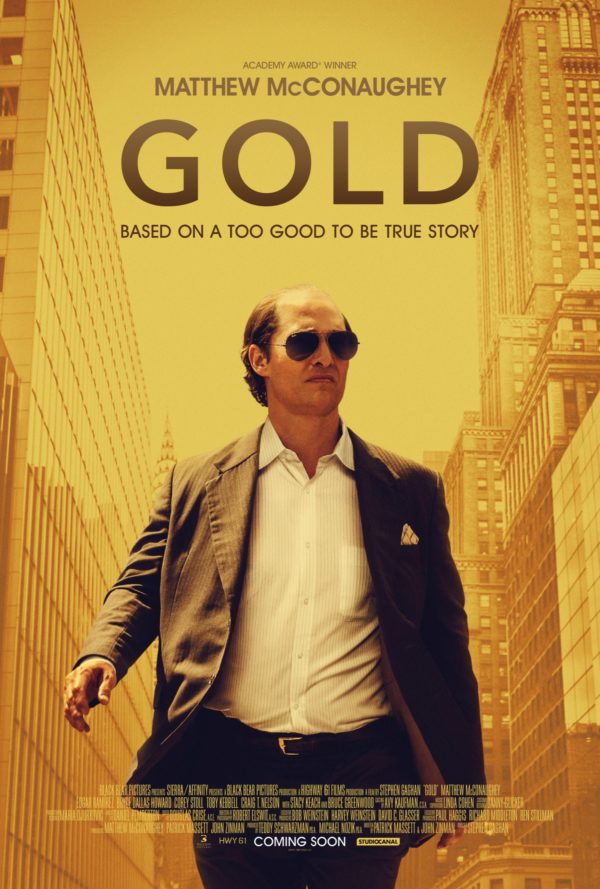
Gold

(USA 2016)

“The taste of it on your tongue, the feel of it on your fingers—it’s like a drug.”

—Mike Acosta

Not everything gold glitters; such is the case with Stephen Gaghan’s Gold, his first film since the acclaimed Syriana over a decade ago. Matthew McConaughey is Kenny Wells, a redneck businessman running his collapsing mining company from a smoke-filled tavern in Reno, Nevada, in 1988. Acting on little more than gut and some pawn shop cash from hocking gifts he gave his girlfriend (Bryce Dallas Howard) in better days shown as the movie opens, he abruptly heads to Indonesia to track down geologist Mike Acosta (Édgar Ramírez) to find a gold mine.

Their first meeting doesn’t go well at all. Looking like he stepped out of Banana Republic when it was a safari store in the ’80s, Acosta is shrewd, rugged, and quite experienced. Balding and sweaty Wells, with his jagged teeth and paunch, is sloppy and desperate. He reads as broke. Unimpressed, Acosta passes when Wells suggests they partner up—until the latter raises $200,000 for the proposed venture. After a series of miscalculations and mishaps (including a bout with malaria), they hit the jackpot in the middle of a jungle. Suddenly, the same banks and big investors that turned up their nose at Wells before want in on the action.

Gold isn’t a bad movie, but it’s not the impressive work it wants to be. The pace is fine, but the plot twists are unsurprising if not downright predictable. The problem is that I’ve seen this story before, and recently: mainstream films like The Big Short (https://moviebloke.wordpress.com/2016/01/03/the-big-short/), The Wolf of Wall Street, and American Hustle deal with the same themes in a similar manner. I’ve seen McConaughey be the same character, too. The curious statement “inspired by a true story” after the opening credits is the cue to something I found disappointing: Gold is a fictionalized account of a true story, changed enough that I guess it can’t claim to be “based on” reality. I’m not sure where that line is drawn, but it turns out much of the story is made up (http://www.financialpost.com/m/search/blog.html?b=business.financialpost.com/news/mining/gold-the-movie-about-the-bre-x-mining-scandal-that-isnt-about-bre-x&q=Bre). Plus, it’s never a good sign when the music in a film—here, artists ranging from Orange Juice to New Order and Joy Division to the Pixies and a new song by Iggy Pop and Danger Mouse—elicits the most enthusiastic response from me. Overall, meh.

Also starring Corey Stoll, Toby Kebbell, Craig T. Nelson, Stacy Keach, Rachael Taylor, Joshua Harto, and Timothy Simons

Produced by Boies/Schiller Films, Black Bear Pictures, and Highway 61 Films

Distributed by TWC-Dimension

121 minutes
Rated R

(AMC River East) C

http://gold-film.com


Django Unchained

(USA 2012)

“The ‘D’ is silent, hillbilly!”

—Django

If anyone would take a stab at something that sounds as ridiculous and cringeworthy as tackling American slavery in a spaghetti Western, it’s Quentin Tarantino. “I want to do movies that deal with America’s horrible past with slavery and stuff, but do them like spaghetti Westerns, not like big issue movies,” he said, clearly referring to Django Unchained in a 2007 interview—five years before it came out. “I want to do them like they’re genre films, but they deal with everything that America has never dealt with because it’s ashamed of it.” (http://www.telegraph.co.uk/culture/film/starsandstories/3664742/Quentin-Tarantino-Im-proud-of-my-flop.html).

The title here references Sergio Corbucci’s 1966 film Django, an actual spaghetti Western in which the titular hero, a cowboy, is thrust into a row between Southern Klansmen and Mexican revolutionaries. In Django Unchained, the story starts in 1858—just a few years before the American Civil War. Django (Jamie Foxx) is a slave separated from his wife, the curiously named Broomhilda von Shaft (Kerry Washington), after they were caught trying to escape a plantation. He’s shackled to a group of slaves that the Speck brothers (James Remar and James Russo) are driving on foot to be sold.

Enter traveling dentist Dr. King Schultz (Christoph Waltz), a genteel German driving a wagon with a big wooden tooth on top of it. Schultz is actually a bounty hunter looking for the Brittle brothers—Big John (M.C. Gainey), Lil Raj (Cooper Huckabee), and Ellis (Doc Duhame)—who happen to be Django and Broomhilda’s former masters. He makes Django an offer he can’t refuse: help him find and kill the brothers, and Schultz will pay him, set him free, and help him find Broomhilda.

Django Unchained is structured in essentially three “episodes.” The first takes place in a one-horse town near El Paso, where Schultz provokes the ire of the townfolk, the sheriff (Don Stroud), and a U.S. Marshall (Tom Wopat). The second takes place on a plantation owned and operated by Spencer “Big Daddy” Bennett (Don Johnson—um, wow!). The last, longest, and most twisted takes place on another plantation in Mississippi, the bountiful Candie-Land, owned by charming but sadistic Calvin Candie (Leonardo DiCaprio) and operated by his shifty Uncle Tom house-slave, Stephen (Samuel L. Jackson).

Tarantino actually pulls off what he said he wanted to, and he does it quite well. Django Unchained could have been a really dark film like its immediate successor, The Hateful Eight. The two films have a lot in common. The tension—and there’s lots of it—built into the story is deliberately and profoundly slow in reaching a boil. Django Unchained certainly has Tarantino’s trademark violence, revenge theme, and liberal use of the ‘n’ word—116 times, a record for a film according to IMDB (http://www.imdb.com/title/tt1853728/trivia?ref_=tt_trv_trv). A few scenes are difficult to watch, the “Mandingo fight scene” being the worst for me. Unlike The Hateful Eight, though, the violence here is Tarantino’s typical flagrantly graphic cartoonish gore. He also shows a more conspicuous sense of humor—for example, Django and Broomhilda are ancestors of John Shaft of the Shaft franchise (https://www.google.com/amp/deadline.com/2012/07/django-unchained-a-shaft-prequel-so-says-quentin-tarantino-comic-con-301010/amp/).

Django Unchained is an unlikely and uncomfortable pairing of an ugly part of our collective past with absurdity, but it’s entertaining while still getting its point across: we’re still living with the aftermath. It’s the kind of film you mull over for a long time after you see it.

With Laura Cayouette, Jonah Hill, Walton Goggins, Dennis Christopher, Dana Gourrier, Nichole Galicia, Miriam F. Glover, Quentin Tarantino, Franco Nero, Russ Tamblyn, Bruce Dern, Misty Upham, Danièle Watts, Robert Carradine

Produced by The Weinstein Company, Columbia Pictures

Distributed by The Weinstein Company (North America), Sony Pictures Releasing (International)

165 minutes
Rated R

(iTunes rental) A-

http://www.unchainedmovie.com

Silence

(USA 2016)

“I pray but I am lost. Am I just praying to silence?”

—Fr. Rodrigues

Just as main character Fr. Rodrigues (Andrew Garfield) is conflicted about his faith, I’m conflicted about Martin Scorsese’s current project, Silence. This film is clearly a labor of love and something extremely personal, both of which I greatly respect. Its genesis dates back nearly 30 years to the controversial The Last Temptation of Christ—can there be a more fitting starting point?—when Scorsese read Shusaku Endo’s novel (the title is the same as the movie) about Jesuit missionaries and Catholicism in Japan in the 17th Century (http://mobile.nytimes.com/2016/11/27/magazine/the-passion-of-martin-scorsese.html?_r=0&referer=https://www.theatlantic.com/entertainment/archive/2016/12/martin-scorsese-silence-theology-art-jesuits/510827/ ). Having a Jesuit education myself, the nuance of what drives the characters (i.e., the service-oriented “men for others” philosophy of the Society of Jesus and the desire to make the right decisions and find answers) is not lost on me.

Momentary diversion: I was simultaneously amused and wowed by the number of nuns and priests in attendance at the pre-opening screening that I attended. I say “amused” because the audience looked like a Catholic J. Crew catalog; and I say “wowed” because the turnout served as a testament to the weight of this film. I felt it, and it was heavy. Credible. Plus, what does it say that a lapsed Catholic like me shows up for the pre-opening screening of a religious film as if it were a release party for a new Madonna album? More conflict.

But I digress. Silence follows two Portuguese Jesuit priests—the aforementioned Fr. Rodrigues and Fr. Garrpe (Adam Driver)—on their search to find their spiritual teacher and mentor, Fr. Ferreira (Liam Neeson), who has gone missing in Japan. The Japanese state has banned Christianity: those who practice it are hunted down by a committee, tortured, and killed. There’s an easy way out, weird as it is, that involves stepping on Catholic icons. Unsettling rumors have come to light concerning Fr. Ferreira, the most troubling of which is that he renounced Catholicism.

Silence is a gorgeous film—Rodrigo Prieto’s cinematography is breathtaking. I can feel every fly and bead of sweat I see on the screen. The idea of pushing “What Would Jesus Do?” to its mindfucking extreme is absolutely brilliant. The acting is generally flawless, but Issei Ogata easily shines lightyears beyond everyone else as the surprisingly unarresting, pragmatic, and understanding Inquisitor. Scorcese does a beautiful job demonstrating two timely ideas: tolerance is crucial for any civilized society, and doubt is totally normal. Can I get an amen? All that said, however, Silence is gratuitous in length, tedious, and exhausting. Painfully boring at points, even. The narration drove me crazy after awhile, as did the subpar Portugese accents. The ending is emotionally brutal; it’s ultimately satisfying, but you have to look closely and you have to be thinking. Normally, this wouldn’t be something worth mentioning; but at the end of such an energy zapper as Silence, it’s just not what I was prepared to do. I love what Scorcese gets at here; he does it artfully for sure, but I wish he had gone about it in a more direct and interesting way.

Also starring Ciarán Hinds, Shin’ya Tsukamoto, and Yôsuke Kubozuka.

Produced by Sharpsword Films, AI Film, CatchPlay, IM Global, Verdi Productions, YLK Sikella, and Fábrica de Cine

Distributed by Paramount Pictures

161 minutes
Rated R

(AMC River East) C+

http://www.silencemovie.com

William Shakespeare’s Romeo + Juliet

(USA 1996)

“My only love sprung from my only hate.”

—Juliet Capulet

I don’t usually read reviews when I write my entries here, but sometimes I can’t resist checking what critics had to say about older movies when they first hit theaters back in the day. Roger Ebert did not like this one, which he called “a mess” and “a very bad idea” (http://www.rogerebert.com/reviews/romeo-and-juliet-1996). I respectfully disagree; Baz Luhrmann’s overblown and over the top take on Shakespeare’s (probably) best known play is, in a word, awesome—even with 20 years’ wear.

William Shakespeare’s Romeo + Juliet definitely is not your lit teacher’s Shakespeare: set in hyper-paced, decaying fictitious Verona Beach on the verge of the Millennium, Luhrmann reimagines the feuding Montagues and Capulets as two family corporate empires embrolied in a turf war. They act like cartels: Romeo’s cousin Benvolio (Dash Mihok) and Juliet’s cousin Tybalt (John Leguizamo) brawl at a gas station, wrecking havok in the city. Instead of knives, their weapons are guns with brand names “Dagger” and “Sword” embossed on them. Chief of Police Captain Prince (Vondie Curtis-Hall) warns family heads Ted Montague (Brian Dennehy) and Fulgencio Capulet (Paul Sorvino) to get their boys under control, or there will be hell to pay.

That evening, Romeo (Leonardo DiCaprio), Benvolio, and Mercutio (Harold Perrineau) take ecstasy and crash a costume party at the Capulet mansion, where prima donna Mrs. Capulet (Diane Venora) has arranged an introduction between Juliet (Claire Danes, who you oughta know emulates Alanis Morissette) and governor’s son Dave Paris (Paul Rudd dressed as an astronaut). Drawn to a blacklit aquarium in the bathroom, rolling Romeo, literally a knight in shining armor, sees Juliet in angel wings on the other side. Thus begins the fateful downfall of the star-crossed lovers, aided by Fr. Laurence (Pete Postlewaite).

William Shakespeare’s Romeo + Juliet injects new life into a classic. Laying the groundwork for 2000’s Moulin Rouge!, everything about it is bold and flamboyant—especially the choice to stick mostly with the play’s original prose. Luhrmann mixes a headspinning cocktail of English literature, Alexander McQueen, Quentin Tarantino, and MTV to create an apocalyptic assault on the senses. He combines outrageous sets (including a crumbling movie theater on the beach that provides the perfect stage for some of the action), religious imagery, sexy thugs, car chases, a drag performance, newscasts, and hip tunage into a whirl of color, noise, and poetry. Donald M. McAlpine’s cinematography is downright decadent. The soundtrack is strong: it boasts, among other acts, Radiohead, Everclear, Garbage, Butthole Surfers, and of course the Cardigans with their only U.S. chart hit, “Lovefool.”

I can see why purists and old fogies will pass on this adaptation. I, however, love it. William Shakespeare’s Romeo + Juliet isn’t perfect, but it’s wickedly clever, fun, and never dull.

120 minutes
Rated PG-13

(Gene Siskel Film Center) B+

Hell or High Water

(USA 2016)

“I’ve been working here since 19 and 87. Ain’t nobody ever ordered nothing but a T-bone steak and baked potato. Except one time, this asshole from New York ordered a trout. We ain’t got no goddamned trout.”

—T-Bone Diner waitress

I must admit: I got good and liquored up before I saw Hell or High Water. Fortunately, my buzz did not ruin the movie—or vice versa.

Hell or High Water is a richly layered, rather cerebral Western heist film. Two brothers, cool and brooding Toby (Chris Pine) and impulsive ex-con Tanner (Ben Foster), systematically hold up various branches of Texas Midland, a bank in rural west Texas. Initially, the series of robberies comes off as a mindless crime spree for two punk cowboys in ski masks and a shitty car. It turns out to be much more complicated: Toby has a week to come up with thousands of dollars to pay off the mortgage on the family ranch, or shady Texas Midland will foreclose on it. The brothers attract the attention of sheriff Marcus Hamilton (Jeff Bridges) and his partner, Alberto (Gil Birmingham), who follow their trail patiently and methodically with good old-fashioned horse sense.

Taylor Sheridan’s screenplay is thoughtfully tight and complex, loaded with plot turns and moral questions. He raises provocative points about capitalism and the American finance system. All of his characters are flawed but sympathetic, making Hell or High Water more than a simple good-versus-evil story. There is no real hero here. Director David Mackenzie maintains a really nice balance of tension, drama, and humor without relying on gunfire and chases (though both of those are in the film). The acting is superb—I can’t think of a single performance that isn’t stellar. The multitude of minor characters—waitresses (Margaret Bowman and Debrianna Mansini), townsfolk, bank employees (Dale Dickey and Joe Berryman)—give the film its color. Hell or High Water has a major Coen Brothers vibe to it—think Blood Simple or No Country for Old Men. The pace is painfully slow at points, but it works. Giles Nuttgens’s sunbleached cinematography is nothing short of stunning, and it beautifully captures the ominously vast and barren landscape that seems to suffocate everyone in it.

102 minutes
Rated R

(ArcLight) B+

http://www.hellorhighwaterofficial.com

The Nice Guys

(USA 2016)

Last year’s Inherent Vice disappointed me; I dug its ’70s Venice Beach vibe, but I found the story choppy and its execution ultimately lackluster—unforgivable for a film with arguably the best all-star cast in years. Little did I know walking into the theater that Shane Black’s The Nice Guys is exactly what I hoped for with Inherent Vice: an unapologetically dippy and fun action retro-comedy with stylish sets, cool clothes, and a rad soundtrack. Shallow? Maybe. But I enjoyed The Nice Guys a lot more; like old MTV, it’s a fluffy guilty pleasure.

Los Angeles, 1977: Holland March (Ryan Gosling) is a detective—the world’s worst, by his own admission—down on his luck. Amid jobs like the senile widow looking for her missing husband—his ashes are in an urn on the mantle—March is hired by the aunt (Lois Smith) of a dead porn actress, Misty Mountains (Murielle Telio); she claims her niece just visited her, and she wants him to find her. After a run-in with thug-for-hire Jackson Healy (Russell Crowe) and a trail that leads to a girl named Amelia (Margaret Qualley) and an “experimental” skin flick called How Do You Like My Car, Big Boy, March joins forces with Healy to solve a mystery that brings them right to the heart of the porn and auto industries.

The Nice Guys is a treat all around. No one thing carries this film; it’s a successful combination of multiple elements. The story and tone—a mix of the aforementioned Inherent Vice, Lethal Weapon (also by Black), and Boogie Nights with a whiff of Scooby Doo—is surprisingly cohesive, absorbing, and entertaining. Where Lethal Weapon‘s Martin and Roger are buddies, March and Healy are “frienemies:” the former is as drunkenly and sweetly inept as the latter is soberly and brutally efficient. It works; Gosling and Crowe, who looks like John Goodman these days, have a solid chemistry. It’s fun to see them both in something light, and they seem to have a good time here. I never thought of Gosling as a comedic actor, but his timing is great—my favorite scene is Healy busting into the men’s room stall on him. March gets by thanks in large part to his teenaged daughter, Holly (Angourie Rice), who serves as a voice of reason even as he corrects her grammar. Matt Bomer makes a brief, creepy, and violent cameo as John Boy, a hitman with a big mole on his face—anyone familiar with The Waltons no doubt will get the reference right away. Kim Basinger is a welcome surprise as a hard, all-business federal agent. The whole thing ends in a crazy choreograped sequence involving a film canister.

Philippe Rousselot’s cinematography is snappy, with vivid colors that shine though even during the night scenes. The Nice Guys depicts a sleazy era of Los Angeles in a cheeky, over-the-top way—a time I would have loved to have seen it. This is not a film that takes itself seriously—it seems to revel in its frivolity. Seeing it over Memorial Day weekend was a great way to kick off the summer movie season. Indulge, I say.

116 minutes
Rated R

(ArcLight) B-

http://www.theniceguysmovie.com

Mad Max: Fury Road

(Australia/USA 2015)

Mad Max: Fury Road is not a movie I would have bothered to see but for the fact that it was nominated for Best Picture. It’s a huge Hollywood blockbuster retooling of an earlier Hollywood blockbuster—totally not my thing.

Tom Hardy is Mad Max, and he’s taken captive by Immortan Joe (Hugh Keays-Byrne) and his gang of warboys who look like an army of “Zero” era Billy Corgans. Max gets away and finds himself working with Furiosa (Charlize Theron), a rig driver liberating a gaggle of Joe’s “breeders”—young women he keeps for reproductive purposes. Loaded with fast cars, a badass woman, fox females, a rock band, and weapons, the first hour is nonstop noise and destruction. There’s some decent acting in the middle, but it doesn’t last. A final plan to take out Joe brings on another barrage of destruction.

Mad Max: Fury Road is exactly what it’s supposed to be: an action picture. The costumes and cars are imaginative even if derivative. John Seale’s cimenatography is snappy: he makes the desert look hot, colorful, and stunning with not all that much to work with. It’s easily the film’s most impressive element. Hardy is nice to look at, all rugged and filthy and with all his teeth (unlike many other characters). This is about all I can say that’s positive. Director George Miller’s cho-mo (my term for choppy motion) technique gives the film a cheesy, horror movie look. There are no big surprises here—we know how it ends.

Mad Max: Fury Road is an indulgent, guilty pleasure for those who dig this stuff. I’m just not one of them. Best Picture, my ass.

(ArcLight) D+

http://www.madmaxmovie.com