Who’s Afraid of Virginia Woolf?

(USA 1966)

Elizabeth Taylor. Richard Burton. Edward Albee. Even George Segal, who was kind of a fixture on NBC during the ’80s and ’90s. Need I say more? Probably not, but I will.

Director Mike Nichols and screenwriter Ernest Lehman stick pretty close to Albee’s 1962 play with their film adaptation of Who’s Afraid of Virginia Woolf?, and it’s hard to watch. Really hard. To be fair, though, it’s supposed to be, and that’s what makes it so good.

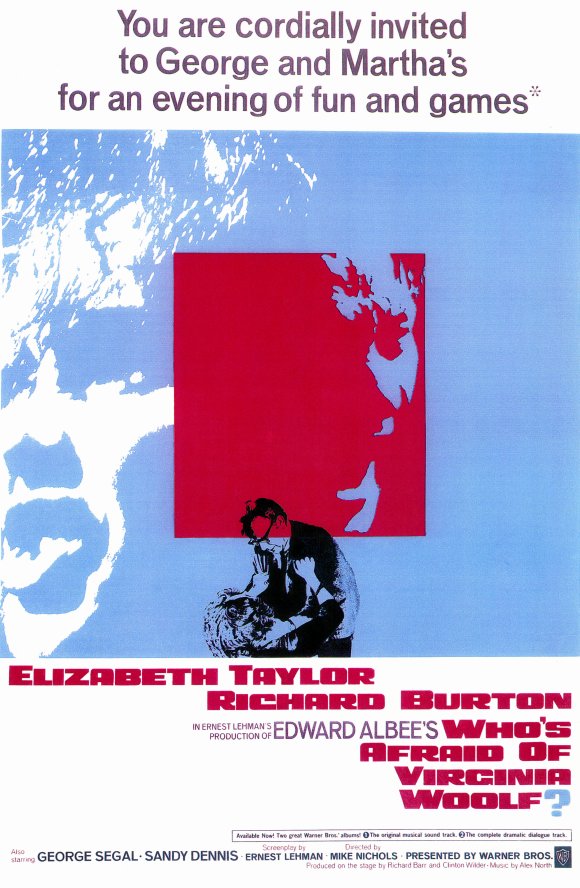
The promotional poster promises an evening of fun and games, but very little joy is to be found here, at least on the surface: all that marital baiting, sniping, and yelling is miserable. Fuck! It took me five or six false starts over a few years before I finally got into the film—and only with the help of a bottle of bourbon. Once I was in, though, I was hooked: watching this disastrous night unfold and all four characters unravel engrossed me desite the buzz I had going.

The oddly but appropriately named George (Burton), a history professor at a small East Coast university, and Martha (Taylor), the daughter of the school’s president, stumble home drunk from a faculty party, neither one listening to the other as they babble about nothing. Martha quotes Bette Davis, which ultimately reveals more about her viewpoint than any other comment she makes—and the woman can talk.

They babble and respond to each other half-heartedly. Martha tells George that she invited a young couple, a professor from another department and his wife, over for a drink. George is miffed, but there’s no time to react.

Enter Nick (Segal) and Honey (Sandy Dennis), a polite, young, good-looking couple that, as we learn, has their own set of problems. Martha and George pour drinks and pick at each other while Nick and Honey watch, uncomfortable at first, thinking maybe they shouldn’t be there. As the drinking continues, though, they’re pulled into the…drama? Turns out, they have more in common with each other than they think.

Here’s the thing about George and Martha: their marriage is dysfunctional, but they seem to operate well inside the confines of their explosive relationship—Martha brays and George stays, responding in a passive aggressive manner as he fixes them both another drink. Over and over and over again. Do they have any limits? It’s hard to say, partly because it’s never clear that we should take anything at face value: what we see is not necessarily what it is. That’s the genius of Who’s Afraid of Virginia Woolf. 

In 2013, the United States Library of Congress deemed Who’s Afraid of Virginia Woolf? “culturally, historically, or aesthetically significant” and selected it for preservation in the National Film Registry (https://www.loc.gov/programs/national-film-preservation-board/film-registry/complete-national-film-registry-listing/).

With Frank Flanagan, Agnes Flanagan

Production: Warner Brothers

Distribution: Warner Brothers

131 minutes
Not rated

(DVD purchase) A

All About Eve

(USA 1950)

“Fasten your seatbelts, it’s going to be a bumpy night.”

—Margo Channing

That iconic line succinctly captures the essence of Joseph L. Mankiewicz’s All About Eve, a sharp commentary on the treacherous relationship between female ambition and the American obsession with youth that still rings—and stings—true nearly 70 years later.

Based on Mary Orr’s short story The Wisdom of Eve, Bette Davis is Broadway legend Margo Channing, who’s turning 40 and sees doors closing in her professional and personal life. One rainy night, Karen Richards (Celeste Holm), Margo’s bestie, happens upon a young starstruck fan waiting backstage to meet Margo after a performance of her latest play, the aptly titled Aged in Wood. The fan, of course, is wide-eyed Eve Harrington (Anne Baxter), a mousy but well-spoken girl in an oversized trenchcoat who says she followed Margo from San Francisco to New York City and has seen every performance of the play—from the back of the house.

Karen, whose husband is none other than playwright Lloyd Richards (Hugh Marlowe), Margo’s frequent collaborator and author of Aged in Wood, brings Eve into Margo’s dressing room to meet her. Lloyd is there, along with Margo’s fiancé, director Bill Simpson (Gary Merrill), and her crusty sharp-tongued maid, Birdie (Thelma Ritter). Eve wins over everyone in the room with her poignant backstory about a poor midwestern upbringing on a farm, a husband killed in the War, and a humble stiff upper lip. Everyone, that is, except Birdie—she smells a rat.

Margo takes Eve under her wing as her personal assistant. Eve quickly proves to be an ace at organizing Margo’s affairs—and sneaking herself squarely into the middle of them. She aligns with caustic theater critic Addison DeWitt (George Sanders), who like Birdie doesn’t buy what Eve puts out there but unlike Birdie sees a mutual opportunity. Things sour all around when Margo learns that her producer, Max Fabian (Gregory Ratoff), designates Eve as her understudy without consulting her first.

Often compared to Sunset Boulevard for a variety of reasons, All About Eve is not as dark or campy but is way bitchier. From a technical standpoint, the script is tighter, the production more sophisticated, and the story a lot wittier. All things considered, it’s way more fun and has held up quite well—sure, the voiceovers are overdramatic, but these are theater people so it fits. I found it particularly interesting to see this film again right around the beginning of the FX series Feud, which not only is half about Davis but elaborates on the same issues that All About Eve raises. It underscores much of what Davis said about the industry in interviews late in her life.

None of the men here have any reason to worry about their age; for all of them, their success has nothing to do with how old they are or even how they look (their thing is power, but that’s another discussion). The women, on the other hand, constantly struggle to secure and then maintain their positions—and they’re ruthless about it. Eve earns the acting award she gets at the end (which is really the beginning): she fools everyone to manipulate them into giving her what she wants. It’s clear that sooner than later, she’ll be right where Margo is, for better but more likely for worse.

In one of her earlier roles, Marilyn Monroe makes an amusingly memorable appearance as dippy starlet Miss Casswell, who’s trying to catch a break. She’s got the best line of all: “I don’t want to make trouble. All I want is a drink.” Amen!

In 1990, the United States Library of Congress deemed All About Eve “culturally, historically, or aesthetically significant” and selected it for preservation in the National Film Registry (https://www.loc.gov/programs/national-film-preservation-board/film-registry/complete-national-film-registry-listing/).

With Barbara Bates, Craig Hill, Helen Mowery, Steven Geray

Production: 20th Century Fox

Distribution: 20th Century Fox

138 minutes
Not rated

(AMC River East) A

Fathom Events

Lonesome [Solitude]

(USA 1928)

The promotional poster touts something “New! Different! Refreshing!” It sounds like soda, but it’s not: it’s Lonesome, a real charmer that still works as it nears its centennial.

Music Box Theatre screened a crisp restored 35mm print of Paul Fejos’s Lonesome for Reel Film Day, a countrywide event honoring films of the almost abandoned format (https://drafthouse.com/event/reel-film-day). The program was a double feature that included the Adam Sandler vehicle Punch Drunk. I didn’t stick around so I can’t comment on Punch Drunk, but Lonesome was an excellent choice.

Mary (Barbara Kent), a telephone operator for Ma Bell, and Jim (Glenn Tyron), a punch press operator in a factory, are two young working stiffs in the Big Apple. Both live alone in small rented room (not together—there’d be no movie then), and participate in an urban rat race that actually looks busier and grungier than what we have today.

Clearly, the film predates the standard five-day work week: the calendar in Mary’s room indicates that the day is Saturday, July 3. As Mary and Jim finish their respective jobs, which Fejos shows in a narrative that goes back and forth between the two, their work friends invite them to join in their weekend plans. Mary and Jim both see immediately that they’ll be the odd one out, as all of their friends are paired up. Both politely decline, going home dejectedly without any plans.

After they each see the same marching band advertising a cheap carriage ride to Coney Island, Mary and Jim end up going there solo on the same trip. They meet at the beach, and a modest flitration ensues. He tells her he’s a millionaire, and she tells him she’s a princess. They get along well, and commence an impromptu date, walking around, playing carnival games, and dancing. A fortune teller (Fred Esmelton) reveals that Mary has already met the man who will become her husband.

Mary and Jim get separated after a mishap on a rollercoaster. The problem is, they each have a tiny picture of the other from a photo booth and they only know each other’s first name. Finding each other in the throngs of people at the park that evening is like searching for a needle in a haystack. Have they lost each other before they even had a chance?

Edward T. Lowe, Jr. and Tom Reed adapt a cute story by Mann Page; it’s a simple yet clever plot. Despite its age, one point in Lonesome still rings loud and clear and true: connecting in the big city is harder than it looks. We all get wrapped up in the daily stuff of our lives, and we tend to overlook what’s right in front of us. Kent and Tyron are both adorable. Gilbert Warrenton’s kinetic camerawork captures a lot in the background, and it makes the shots at Coney Island especially fun to watch.

Lonesome features two or three abruptly placed “talking” scenes—the film was made when sound was a new thing—and the dialogue is laughably awful. There are also a few color tinted night shots: marquee lights, fireworks, stars. It’s really cheesy. That said, these are short, minor disruptions that don’t detract from enjoying this film for all its silent era charisma.

In 2010, the United States Library of Congress deemed Lonesome “culturally, historically, or aesthetically significant” and selected it for preservation in the National Film Registry (https://www.loc.gov/programs/national-film-preservation-board/film-registry/complete-national-film-registry-listing/).

With Fay Holderness, Gusztáv Pártos, Eddie Phillips, Andy Devine, Edgar Dearing

Production: Universal Pictures Corporation/Universal Pictures (USA)

Distribution: Universal Pictures Corporation/Universal Pictures (USA), European Motion Picture Company (UK), The Criterion Collection (DVD)

75 minutes
Not rated

(Music Box) A

Reel Film Day: A Celebration of 35mm Cinema

https://www.criterion.com/films/28212-lonesome

http://www.imdb.com/video/screenplay/vi389587993/

The Tell-Tale Heart

(USA 1953)

I caught The Tell-Tale Heart as an extra at Music Box Theatre’s screening for Reel Film Day. Directed by Ted Parmelee and narrated by English actor James Mason, it’s a nifty modern take on Edgar Allan Poe’s famous 1843 short story about a murderer haunted by his victim’s heartbeat, which he hears from underneath the floorboards where he hid the body. Paul Julian’s design and Pat Matthews’s animation is shadowy and surreal, nicely depicting the horror and the madness of Poe’s classic. Boris Kremenliev’s score adds an eerie Twilight Zone feel.

This short has the distinction of being the first cartoon to earn an ‘X’ rating. However, it appears the rating, assigned by the British Board of Film Censors in the UK, had more to do with religion than obscenity (http://dangerousminds.net/comments/this_moody_1953_animation_of_edgar_allan_poes_the_tell-tale_heart_was_the_f). It had to be the dark occult nature of the story,  as there is nothing remotely sexual here.

In 2001, the United States Library of Congress deemed The Tell-Tale Heart “culturally, historically, or aesthetically significant” and selected it for preservation in the National Film Registry (https://www.loc.gov/programs/national-film-preservation-board/film-registry/complete-national-film-registry-listing/).

Production: United Productions of America

Distribution: Columbia Pictures

7 minutes
Not rated (USA)

(Music Box) A

Reel Film Day: A Celebration of 35mm Cinema

Heavenly Creatures

(New Zealand 1994)

“All the best people have bad chests and bone diseases. It’s all frightfully romantic!”

—Juliet Hulme

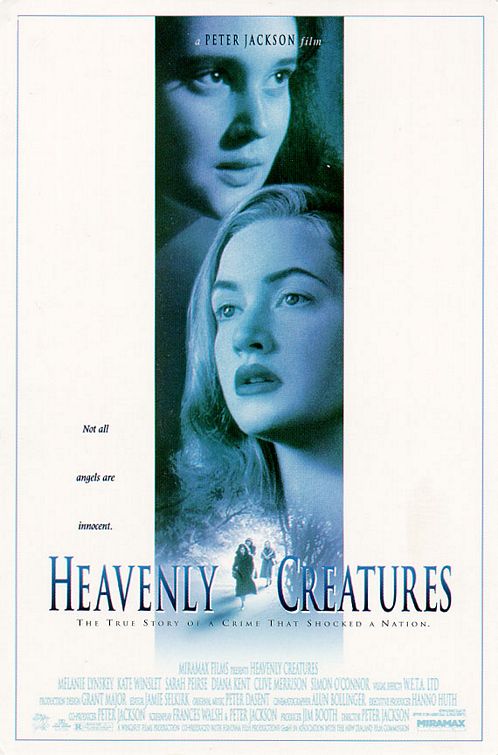
Forget Lord of the RingsHeavenly Creatures is Peter Jackson’s coolest film. Before big budget Hollywood blockbuster fantasy franchises, the New Zealand filmmaker wrote, produced, and directed offbeat small-scale gore and porn comedies like Bad Taste (1987), Meet the Feebles (1989), and Dead Alive (1993). I’d already seen that last one by the time Heavenly Creatures came out for a limited run (in the States, anyway) in the fall of 1994. I assumed it would be another messy splatterfest—described to me as a “lesbian murder flick,” what would you think? Turns out, that’s not quite what it is.

Far more than a “lesbian murder flick” or even a brilliant stepping stone to bigger and better things, Heavenly Creatures represents a turning point in Jackson’s career. It’s a rare example of flawless execution across the board. He brings together every element—narrative, character development, casting, visuals, special effects, dialogue, period costumes and sets—to create a real humdinger.

Christchurch, New Zealand, 1952: 14-year-old Yvonne Reiper (Melanie Lynskey), who goes by “Pauline,” is a messy-haired, brooding loner at an all-girl high school. In her first scene, she’s wearing a big scowl on her face at an assembly, not singing along with the rest of her classmates—not until the school’s headmaster (Darien Takle) catches her gaze and snaps her into line with a widening of her eyes. Pauline’s father (Simon O’Connor) manages a grocery market and her mother (Sarah Pierse) runs a room and board for college students out of their home.

WARNING: Potential spoilers ahead!

A new student is introduced during French class: Juliet Hulme (Kate Winslet), the privileged daughter of a reknown college professor (Clive Merrison) and a psychologist (Diana Kent). Juliet, who proclaims she’s “actually from England” and chooses the French name “Antoinette,” captures Pauline’s attention when she insults the teacher, Miss Waller (Elizabeth Moody), unleashing a hilarious hissy fit. The scene is, in a word, awesome to watch play out. Right after that, their art teacher, Mrs. Collins (Liz Mullane), pairs the girls for an assignment that Julia disregards; instead, she draws dragon-slaying St. George, depicting him in the likeness of Mario Lanza, “the world’s greatest tenor!” She doesn’t get around to drawing Pauline, her model. Mrs. Collins isn’t impressed, but Pauline is.

Thus begins the girls’ friendship. They bond over their similar pasts involving childhood disease and extended hospital stays, a penchant for drama, and a mutual distaste for their peers (and perhaps social issues that leave a void). Juliet is mischievous and romantic, which softens Pauline and gets her to open up. Sitting out gym, they giggle over sexy WWII pulp novels. They bike through the woods and strip to their underwear, dancing and singing. They hug a bum (played by Jackson himself) on the street. They hold weird rituals for celebrities they like. They make Plasticine models, write stories, and devise an elaborate royal family tree, building around themselves a fantasy medievalesque kingdom called Borovnia where all its inhabitants worship them. Their imaginary world blurs the bounds of reality as their friendship intensifies.

A string of troubles arises that threatens to separate Pauline and Juliet: tuberculosis, an extramarital affair, a divorce, South Africa, and a medical diagnosis of incurable homosexuality. The girls decide to run away to America, but they can’t secure a passport for Pauline. They devise another scheme to stay together, but it’s a risky one: kill Pauline’s mother.

Heavenly Creatures starts out sweet—it’s something of a typical teen movie at first—but it does a complete turnaround. Based on actual events, Jackson wrote the screenplay with Frances Walsh; the real story is sad but compelling, and the script is tight. The casting—married couple John and Ros Hubbard and the aforementioned Mullane—is genius: every single actor is terrific in his or her part, even the minor ones, and it makes Heavenly Creatures all the richer. Many of them turn up in Jackson’s later projects.

Lynskey and Winslet own their characters; I can’t imagine anyone else in their roles. They’re charming, silly, histrionic, desperate, deranged, and ultimately “stark raving mad”—and they portray all of it exceptionally well. They manage to keep the homosexual subtext from getting out of hand. You can tell from Winslet’s first scene—she walks in with that crazy look on her face—that she’s destined for more. She became a star after Heavenly Creatures in a way that Lynskey didn’t, but both are mesmerizing.

The scenes in Borovnia and the Fourth World are nothing short of spectacular. Actually, many of the visuals here are burned into my memory. Alun Bollinger’s camerawork and bleached palette lends a lovely dreamlike quality. Once things start to unravel for these “nice” girls, the whole thing shifts to a darker, more sinister tone. It’s an emotional downward spiral to the end—those splatter films serve Jackson well.

Heavenly Creatures hasn’t lost its luster after nearly 25 years. I lost track of how many times I’ve seen it, yet it continues to suck me in every single time. It’s one of my favorites.

With Gilbert Goldie, Jed Brophy, Peter Elliott, Kirsti Ferry, Ben Skjellerup, Jean Guérin, Stephen Reilly, Jessica Bradley, Alex Shirtcliffe-Scott

Production: WingNut Films, New Zealand Film Commission

Distribution: Miramax Films (USA)

109 minutes (director’s cut)
Rated R

(iTunes purchase) A

https://www.miramax.com/movie/heavenly-creatures/

https://www.facebook.com/heavenlycreaturesmovie

Ed Wood

(USA 1994)

“You’re wasting your lives making shit. Nobody cares. These movies are terrible!”

—Dolores Fuller


“How do you do it? How do you get all your friends to get baptized just so you can make a monster movie?”

—Bunny Breckinridge


“Can your heart stand the shocking facts of the true story of Edward D. Wood, Jr?”

—Criswell


“Confidentially, I even paratrooped wearing a brassier and panties. I wasn’t afraid of being killed, but I was terrified of being wounded and having the medics discover my secret.”

—Ed Wood

Edward D. Wood, Jr., or simply Ed Wood, is widely regarded as the worst director of all time. In fact, he received posthumous recognition—the Golden Turkey Award—designating him as such (http://www.legacy.com/news/celebrity-deaths/article/ed-wood-the-best-of-the-worst). His silly low-budget DIY pulp/science fiction/horror flicks from the 1950s—low on plot, technique, and talent—are beloved by many because they’re so bad. Monumentally bad. Okay, maybe ridiculous is a better word. You decide from this trailer:

https://youtu.be/2i1xhEm5ER8

Based on Rudolph Grey’s book Nightmare of Ecstasy and adapted for the screen by Scott Alexander and Larry Karaszewski, Tim Burton’s labor of love, Ed Wood, is a period-piece biopic about the eccentric angora-loving filmmaker responsible for such gems as Jail Bait, Glen or Glenda, Bride of the Monster, and of course Plan 9 from Outer Space—Wood’s Citizen Kane (as Burton likens it here). This film rocks; I never get sick of it. Not ever. And for a few reasons.

The characters and performances are fantastic. Leading man Ed Wood is one of Johnny Depp’s most endearing roles; he plays Wood with an affectionate and demonstrative earnestness he’s never quite duplicated. Burton has always held sympathetic misfits in high regard—Edward Scissorhands, also played by Depp, immediately comes to mind. Here, he has a field day, bringing in an entire cast of warm and colorful weirdos that flock to Wood. Consider: best bud Bunny Breckinridge (Bill Murray), a boozy grand queen with a penchant for drama and glitter. “The Amazing Criswell” (Jeffrey Jones), an androgynous self-proclaimed psychic/horse shit artist. Max (Max Casella), the president of Wood’s fan club—and his errand boy. Overzealous, chatty crew member Conrad (Brent Hinkley). Later, Vampira (Lisa Marie), a gothic midnight movie hostess with lots of bosom, and TV wrestler Tor Johnson (George “The Animal” Steele) become regulars in Wood’s films.

The most important relationship, though, is the one between Wood and has-been Dracula star Bela Lugosi (Martin Landau), whom he meets in a coffin store. Lugosi’s life is far from glamorous: he lives alone in obscurity in a tiny tract house in a nondescript suburban neighborhood. He’s also a junkie. Wood moves from starstruck fan to employer to custodian and confidant. Landau gives a flawless performance; he earned an Academy Award for Best Supporting Actor for it. Every scene is inspired, but one of my favorites is his dramatic reading of that hackneyed “home” speech; it is, to use Wood’s word, “perfect.” Their friendship gives Ed Wood much of its warmth and humanity.

Despite the laughably amateur quality of Wood’s films—and his unorthodox way of shooting them—he gets them made. And no matter how poorly received they are, he doesn’t give up. In this sense, Ed Wood is uplifting and inspiring. He embraces his flaws, sticks to his guns, and believes in himself. Orson Welles himself (Vincent D’Onofrio) backs him up in one great scene at a bar.

Some might find the pace a bit slow. I don’t—the whole film is fun and jammed with quotable material that keeps it moving. Line after line is memorable—I could string together a bunch of quotes I know by heart and leave it at that (I’ve seen this film quite a few times). From a technical standpoint, Ed Wood is exceedingly well done. Filmed in shimmering black and white, Stefan Czapsky’s camerawork is beautiful. The cleverly composed, shadowy shots of Lugosi “fixing” in the bathroom and later tied to a bed in rehab, and Wood and future wife Kathy (Patricia Arquette) inside the carnival ride are especially remarkable. Howard Shore’s score—a rich mix of jazz, Cuban orchestration that wouldn’t sound out of place on I Love Lucy, and monster madness—is awesome.

Burton easily could have made this a snarkfest. Instead, he shows his idol in a respectful and positive light. His spirited take makes Ed Wood exceptional.

With Sarah Jessica Parker, Mike Starr, Juliet Landau, Stanley Desantis, Ned Bellamy, Norman Alden, G.D. Spradlin

Produced by Touchstone Pictures

Distributed by Buena Vista Pictures Distribution

127 minutes
Rated R

(iTunes purchase) A

Amélie [Le Fabuleux Destin d’Amélie Poulain]

(France/Germany 2001)

“I like to look for things no one else catches.”

—Amélie Poulain

The Associate Board of Chicago International Film Festival presented a special screening of Jean-Pierre Jeunet’s Amélie, a sumptuous, romantic fantasy of a film that looks as good as it feels. I’ve seen it many times. It’s unrealistic, maybe even a bit silly; yet, it always leaves me smiling. I couldn’t pass up the chance to see it again.

Young Amélie Poulain (Flora Guiet) has a lonely childhood: her odd parents are overreactive, overprotective, and emotionally distant, preferring to rearrange the contents of their toolbox and purse than pay much attention to her. It’s so bad that her heart races when her father, Raphaël (Rufus), a physican, touches her during her annual checkup—a narrator (André Dussollier) explains that all she wants is a hug.

Her father misdiagnoses Amélie with a heart condition. As a result, she’s kept inside from the world and homeschooled by her mother, Amandine (Lorella Cravotta), a rather hysterical woman with a nervous tic in her eye. Amélie retreats into her imagination to deal with it all. Her home environment is so stifling, it makes her pet goldfish, Blubber, jump out of its bowl in multiple suicide attempts. A separate suicide at Notre-Dame, this one successful, changes Amélie’s life, leaving her father to raise her alone without any siblings, which her mother apparently wanted for her. C’est la vie.

Fast forward to 1997: grown up Amélie (Audrey Tautou) is a stylish but shy waitress at a café in the 18th Arrondissement of Paris—artsy Montmartre. While home alone (as usual) in her flat one evening—August 31, 1997—a TV news report of Princess Diana and Dodi Fayed’s fatal car accident jolts Amélie, causing a chain reaction that leads her directly to a rusty box of a boy’s trinkets from the 1950s hidden in her bathroom wall. She discerns the identity of the family who lived in her flat back then and devises an elaborate scheme to reunite the boy, now an older man (Maurice Bénichot), with his “treasures” while staying completely anonymous and out of view. It works, bringing happiness to him and in the process to Amélie.

Thrilled with her accomplishment, she decides that her life’s work will be making others happy—in her own amusingly roundabout, always off to the side way. Amélie, you see, prefers to be invisible. She describes what she sees to a blind man (Jean Darie), kidnaps her father’s garden gnome to inspire him to travel, mails a bunch of fake love letters to her landlord (Yolande Moreau) whose husband abandoned her decades ago, and fixes up a hypochondriac coworker (Isabelle Nanty) with a volatile café patron (Dominique Pinon) who just got dumped.

Amélie’s covert approach goes swimmingly for others, but not so much for her own happiness—something she discovers once she encounters Nino Quincampoix (Mathieu Kassovitz), a handsome and quirky stranger who works at a porn shop and collects discarded photos from a photo booth at Gare de l’Est. Amélie can’t bring herself to show herself to Nino, let alone speak to him through a door. Can her neighbor, “the Glass Man” (Serge Merlin), talk some sense into her?

Everything about Amélie dazzles. Just like earlier films Delicatessen and The City of Lost Children, Amélie is a treat, showcasing Jeunet’s distinct buoyantly surreal visual and narrative style. He’s more sophisticated here, though. He throws in offbeat narrative sidebars that tell about his characters. With wide shots, unexpected angles, a pallet of vividly dark colors, and a mix of elements from different decades, he concocts an idealized version of Paris that highlights all that makes it romantic and dreamy. It works well with Bruno Delbonnel’s cinematography, which has a cool sepiatone air to it. My favorite shot is the one of Amélie literally dissolving into a puddle of water.

Tatou is wonderfully mischievous, emulating both Audrey Hepburn in Breakfast at Tiffany’s and Tinkerbell. You can’t help but fall for her as she turns the mundane into magnifique. Kassovitz, who comes off as a weirdo at first, capably metamorphoses Nino into a go-getter who turns out to be a great match for Amélie. Plus, he’s easy on the eyes.

122 minutes
Rated R

(Public Chicago) A

Chicago International Film Festival

http://www.miramax.com/movie/amelie/

Breakfast at Tiffany’s

(USA 1961)

“You musn’t give your heart to a wild thing. The more you do, the stronger they get, until they’re strong enough to run into the woods or fly into a tree. And then to a higher tree, and then to the sky.”

—Holly Golightly

So, “Audrey Hepburn is having breakfast at Tiffany’s”?! Why, yes, I would love to join her!

When Fathom Events, Turner Classic Movies, and Paramount Pictures invited me to “fall in love again” for a special 55th anniversary screening of Breakfast at Tiffany’s in a select theater near me, well, I couldn’t say no. Until now, I’ve only seen it on my television or computer screen.

I admit, I’m a sucker for this film—even though it’s not the kind of thing I usually go for, and Mickey Rooney as Mr. Yunioshi was a terrible idea even if many films of the era did the same thing to get a big name involved. Whatever. I’ve never met anyone who didn’t like this film. Directed by Blake Edwards and adapted for the screen by George Axelrod, Breakfast at Tiffany’s is a fine midcentury fairy tale. Set in Manhattan, Holly Golightly (Hepburn) leads a life full of the very trappings I imagined myself having as an adult: a cool apartment in a big city, great clothes, wicked accessories, lots of fashionable friends and acquaintances, wild parties, drinks all the time, travel plans, and generally risqué fun and fabulousness. I have some of them.

What’s brilliant about this story, though—and probably why it appeals to me—is its dark side. Nothing here is what it seems: what we see is a ruse—to use the words of O.J. Berman (Martin Balsam), Holly is a phony. Her life is phony. She puts on an act. It’s more than simply running away from her past, represented by ex-husband Doc (Buddy Ebsen) and his references to her former self, Lulamae. She’s not the naïve eccentric she would have everyone believe she is. She’s also not the high society sophisticate she presents, either: the apostrophe ‘s’ she adds to the name of her ideal escape (the store is called “Tiffany & Co.”) gives her away. Frankly, she’s not even true call girl material, however downplayed that part of her personality is (we’re only told that she gets fifty bucks for the powder room).

Like her dark sunglasses and the Halloween mask she steals from the five and dime with fellow phony Paul Varjak (George Peppard), Holly’s working a facade she hides behind. Holly is a product of Lulamae’s imagination; she left behind her life in Tulip, Texas, for a bigger, more exciting one. The problem is, she doesn’t seem to know exactly what she wants, bouncing carefreely from one half-baked plan to another. She’s afraid to commit to anything because doing so puts her in a vulnerable position. Why else would one call her cat, “Cat” (Orangie)? Oh, the poor slob without a name!

At the end of the story, Cat represents something different. Holly throws him out of the cab into the rain in a “bad” neighborhood. She realizes that she wants to belong somewhere, to someone. Ummm…Paul? I know Truman Capote wrote a different ending, and I tend to disdain a neat, happy Hollywood ending; but here, it’s perfect. I can’t see a better way to end this story. Sorry, Mr. Capote.

Three more things: Patricia Neal is fantastic as stylish girl “2E.” Henry Mancini’s score is the cherry on the top of this sundae—mmmmm! If I ever have two dogs, I’m naming them Sally Tomato (Alan Reed, who went on to be the voice of Fred Flintstone) and Mr. O’Shaunessy (Joseph J. Greene).

In 2012, the United States Library of Congress deemed Breakfast at Tiffany’s “culturally, historically, or aesthetically significant” and selected it for preservation in the National Film Registry (https://www.loc.gov/programs/national-film-preservation-board/film-registry/complete-national-film-registry-listing/).

114 minutes
Not rated

(Evanston Century) A

Fathom Events

Annie Hall

(USA 1977)

“A relationship, I think, is like a shark. It has to constantly move forward or it dies. And I think what we got on our hands is a dead shark.”

“You know, this guy goes to his psychiatrist and says, ‘Doc, my brother’s crazy. He thinks he’s a chicken.’ And the doctor says, ‘Well why don’t you turn him in?’ The guy says, ‘I would, but I need the eggs.’ Well, I guess that’s pretty much now how I feel about relationships: you know, they’re totally irrational and crazy and absurd, but I guess we keep going through it because most of us need the eggs.”

—Alvy Singer

Classic Woody Allen is an acquired taste, kind of like gefilte fish: too weird and off putting to appreciate right off the bat, you find that you actually look forward to his annual appearance once you get what he’s about. There’s no way around it: Woody Allen is for the urban set.

Annie Hall is hands down my favorite Woody Allen film, at least out of the ones I’ve seen—and I haven’t seen them all. It’s everything that makes a Woody Allen film great: lots of nervous banter, self-deprication, uncomfortable situations (usually but not always related to sex), an obsession with manners and etiquette, and hilariously pointed observations on the absurdities of modern life. It sounds like Seinfeld, but Allen was first.

The plot is simple enough: Alvy Singer (Allen) examines his relationship with Annie Hall (Diane Keaton), an aspiring Manhattan singer and photographer. They play a cat-and-mouse game because neither wants to make the first move. Alvy and Annie are awkward and bizarre, but I still found myself rooting for both of them. The relationship doesn’t work out, but it’s really something while it lasts. Along the way are small, sublime parts for Carol Kane, Shelley Duvall, Jeff Goldblum, and Christopher Walken.

Annie Hall stands out even as a Woody Allen film, and for an obvious reason. Underneath its entertaining and brilliant storytelling, underneath its many bells and whistles—subtitled subtext, a cartoon segment, and cameos by Marshall McLuhan, Paul Simon, and the Evil Queen from Snow White? Fuck yeah!—is a poignant reality: people change. For all its warmth and wit, Annie Hall spends more time showing its protagonists fall out of love than in it. Rich and layered, it’s funny yet wrenchingly accurate. While we laugh out loud, it plays on our worst fears—none of us wants to end up where Alvy and Annie do.

In 1992, the United States Library of Congress deemed Annie Hall “culturally, historically, or aesthetically significant” and selected it for preservation in the National Film Registry (https://www.loc.gov/programs/national-film-preservation-board/film-registry/complete-national-film-registry-listing/).

96 minutes
Rated PG

(Music Box) A

http://www.woodyallen.com

The Kid

(USA 1921)

I must confess that I never saw a Charlie Chaplin film until The Kid, his first full-length feature—he wrote, produced, directed, and starred in it. He also composed the score, something I didn’t know silent movies had; I guess I assumed organ players picked their own music to accompany films in those days. It’s a small miracle that The Kid made it out in one piece, as its production faced some financing difficulties (http://about.bankofamerica.com/en-us/our-story/making-of-charlie-chaplins-the-kid.html#fbid=eIQZsBMJxKN) and its release was entangled in Chaplin’s divorce proceedings and studio double-dealing. It was a huge success, becoming the second-highest grossing film of 1921 (http://www.filmsite.org/1921.html) (http://www.wikiwand.com/en/The_Kid_(1921_film) ). It’s easy to see why.

I enjoyed The Kid more than I expected. I was taken aback at how well this film, nearly a century old, works even by today’s standards. It’s a beautifully executed story with elements that seem way ahead of its time. A penniless unmarried woman (Edna Purviance) abandons her illegitimate newborn in the back seat of an expensive Model-T type limo parked in front of a mansion. Two gangsters who steal the limo pull over and dump the baby among some trash in an alley when they discover him crying. The tramp (Chaplin) happens upon him. After a few failed attempts to pawn off the baby on someone else, he finds a note inside his blanket, begging whoever finds him “to love and care for this orphan child.” The tramp takes him in, names him “John,” and raises him as his own in the tenement where he lives.

Five years pass. The tramp has taught John (Jackie Coogan, who later in life would play Uncle Fester on The Addams Family) how to help him eke a living off a window repair scam. By now, the woman is a rich performer who does charity work to help the poor. She crosses paths with John, but of course doesn’t realize who he is. The tramp calls a physician (Jules Hanft) when John gets sick and unwittingly sets in motion a chain of events that threatens to separate them when child welfare authorities take custody of John to place him in an orphanage.

The Kid may very well be the first “dramedy” ever; the opening card (this is a silent picture) gets that out up front, revealing it to be “[a] picture with a smile—and perhaps, a tear.” Chaplin’s trademark slapstick is a prominent ingredient, but he infuses serious drama into the story. The opening sequence that tells us about John’s parents is tragic, but it doesn’t compare to the scene in which the child welfare authority agents take John away from the tramp: the kid is in tears, desperately reaching out of the truck for the tramp to rescue him. Soon, the tramp is running after the truck in an intense rooftop chase and ultimately gets to it, pulling John out of the back. You feel every rush of emotion the characters do—amazing considering it’s accomplished without sound or words. Chaplin and Coogan adeptly convey feelings with simple body movements, facial expressions, and their eyes. Even the mundane parts of their day—like making breakfast and getting dressed—ooze a tenderness that emphasizes their bond.

I picked up on a few themes, but two struck me in particular. The first is religion, though I’m not entirely sure how to interpret it. Much of it comes from the hospital at the beginning and the notorious weird dream sequence the tramp has toward the end of the film—I found this scene curious because I’m not sure how it fits into the whole picture. The point could have something to do with a number of things: mercy, the golden rule, resurrection (this film has a few examples of rebirth and reinvention), salvation, hypocrisy, or something else altogether. The second theme is urban poverty; Chaplin is obviously making a statement about it in the way he shows authority figures—cops, child welfare agents, the doctor who turned him in—barging in on his low-status life and throwing it into turmoil.

The Kid is interesting not only for the autobiographical elements Chaplin incorporates, but also for the time period it depicts. The restored print I saw was luminous and crisp, vividly showing details from the sets (bricks on the buildings, dust in the streets, the tramp’s shabby furniture), the textures of the characters’ clothing, and even the skin tone and hair quality of some of the actors. It’s simultaneously cool and mildly creepy. The exteriors, shot mainly in Hollywood and downtown Los Angeles, remarkably capture the look and feel of a grimy Victorian city. An extra bonus was a live organ player at the screening I caught.

Speaking of Los Angeles, many of the filming locations still exist. Here’s a great blog that shows them today: https://silentlocations.wordpress.com/2016/01/09/how-charlie-chaplin-filmed-the-kid-2/.

The Kid is more complex that it looks. It’s thoroughly satisfying on multiple levels: narrative, visual, social, and historical. I’m thrilled I had an opportunity to see it on the big screen.

In 2011, the United States Library of Congress deemed The Kid “culturally, historically, or aesthetically significant” and selected it for preservation in the National Film Registry (https://www.loc.gov/programs/national-film-preservation-board/film-registry/complete-national-film-registry-listing/).

68 minutes
Not rated

(Music Box) A

Full movie (with sound):

https://www.youtube.com/watch?v=ZNyttSbCUCU