Blade Runner: The Final Cut

(USA 1982, 2007)

Ridley Scott is hit or miss with me, Harrison Ford bores me, and I tend to eschew science fiction. So, neo-noir sci-fi drama Blade Runner doesn’t seem like something that would appeal to me. It does, though—in fact, I love it.

Like Alien, another gem by Scott, Blade Runner succeeds on so many levels. Executed near flawlessly, its themes and narrative, its structure and pace, its sets and technical aspects are all polished, eloquent, and downright cerebral. It cuts right to the heart of humanity—what’s beautiful about it and what isn’t, and what it is to be human.

Los Angeles, November 2019: six rogue artificial humans known as replicants that were banished to an “off-world” work camp in space return to Earth in a desperate attempt to extend their life. Created by tech behemoth Tyrell Corporation, this particular model, the Nexus-6, is the smartest and strongest replicant. However, it has a lifespan of only four years—and the meter is ticking. Fortunately for them, replicants are indistinguishable from real humans, except for their emotional responses. It takes a lengthy question-and-answer test to positively identify them.

Burned out former cop Rick Deckard (Ford), whose job as a blade runner was to track down replicants and “retire,” or kill them, is persuaded—okay, extorted—out of a self-imposed furlough to find and get rid of these troublemakers. Stat. The job isn’t an easy one, particularly where charmingly weird and conniving Pris (Daryl Hannah) and invincible badass Roy (Rutger Hauer) are involved.

As Deckard searches for his targets, he meets and gets to know the rather severely formal Rachael (Sean Young), assistant to replicant inventor Dr. Eldon Tyrell (Joe Turkel). Rachael doesn’t know she’s a replicant. Tyrell asks Deckard to retire her as well, but there’s a problem: Deckard realizes he’s falling for her.

Adapted from Philip K. Dick’s novel Do Androids Dream of Electric Sheep?—with the title taken from Alan E. Nourse’s novel The Blade Runner, which had nothing to do with Dick (https://www.neondystopia.com/cyberpunk-movies-anime/the-story-behind-blade-runners-title/)—Blade Runner is dark in every sense of the word. Jordan Cronenweth’s cinematography is stunningly bleak. The setting might be Los Angeles, but Scott slyly references Metropolis—only he refits it to Hong Kong or Tokyo. Many of the ideas explored here are eerily relevant today, especially the way morality plays out with corporations, genetic engineering, a police state, the environment, and hierarchy of life and life forms.

Blade Runner is a weighty movie, but seriousness aside—I found myself entertained with a number of things that simply aren’t present today: PanAm, Atari, and TDK. Smoking indoors. Pay phones. Photographs. Even urban decay. I was also floored that one of the replicants was “born” 20 days after this screening. Plus, Roy is a bionic Ken doll and Pris looks like a club kid from Party Monster. Still, Blade Runner is timeless; I’ll see it again in three or 33 years and still swoon over it. Yes, it’s that good. The Final Cut is Scott’s own finetuned version of the original theatrical release. It kills me that after all this time, a sequel that I probably won’t see is coming out later this year.

In 1993, the United States Library of Congress deemed Blade Runner “culturally, historically, or aesthetically significant” and selected it for preservation in the National Film Registry (https://www.loc.gov/programs/national-film-preservation-board/film-registry/complete-national-film-registry-listing/).

With Edward James Olmos, M. Emmet Walsh, William Sanderson, Brion James, Joanna Cassidy, Kevin Thompson, John Edward Allen, Robert Okazaki

Production: Ladd Company, The Shaw Brothers/Sir Run Run Shaw, Warner Brothers

Distribution: Warner Brothers

117 minutes
Rated R

(Music Box) A

https://www.warnerbros.com/blade-runner

Wait Until Dark

(USA 1967)

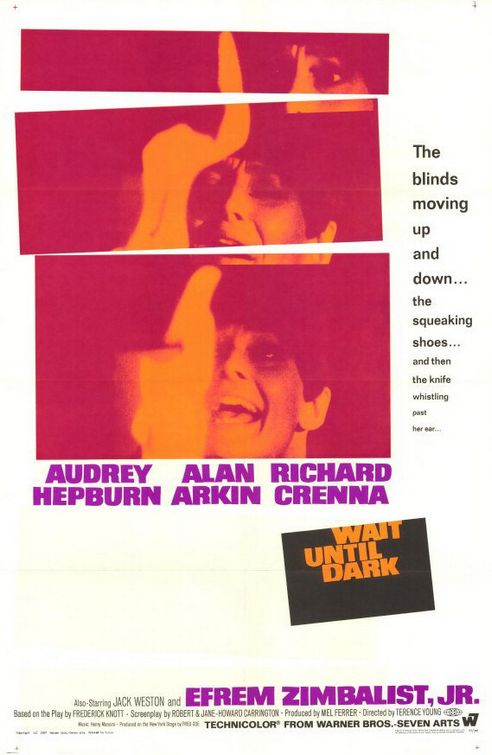
A heroin smuggling ring. A creepy doll. A corpse. A blind woman alone in her basement apartment in the West Village. These are the elements of Wait Until Dark, a quaint and dingy little crime thriller adapted from Frederick Knott’s 1966 play by screenwriters Robert Carrington and Jane-Howard Carrington.

Suzy Hendrix (Audrey Hepburn) is the hapless gudgeon who, being blind, already has the proverbial wool over her eyes. Her husband, Sam (Efrem Zimbalist Jr.), comes home from a business trip with a doll that unbeknownst to him contains a hidden stash of heroin sewn into it. This does not bode well for Lisa (Samantha Jones), the glamorous and sexy stranger who asks him to hold it for her at JFK International Airport.

A case of mistaken identity leads a pair of small time crooks (Richard Crenna and Jack Weston) to Sam and Suzy’s apartment, where psychotic hooligan Harry Roat (Alan Arkin) coerces them into helping him find the doll—as soon as they dispose of a dead body. Nice. They devise an elaborately devious scam to recover the doll when they realize Suzy, who walks in on them, is blind.

Terence Young’s directing is certainly competent. I last saw this movie on some late night UHF station when I was a kid, and two things have stayed with me: a sense of severe claustrophobia as the story unfolds, and that fucking groovy apartment. The plot has flaws that strain credibility. For one thing, Suzy is far too unguarded for a New Yorker. Why doesn’t she lock her door? Roger Ebert pointed out this detail (http://www.rogerebert.com/reviews/wait-until-dark-1968). I didn’t obsess over it like he did, but I noticed it and thought the same thing. When Roat tells her he knows she has the doll, why doesn’t Suzy hand it over? Why does she tell Gloria (Julie Herrod) to meet Sam at the train station instead of going to the police? Why do the guys bother to put on disguises if Suzy can’t see them?

Despite these glaring issues, Young ultimately succeeds in bringing Wait Until Dark to a boil. It lives up to its hype: I saw people jump in their seats at the end. The acting here overcomes any shortcomings in plot. Hepburn is little more than a blind Holly Golightly, but at certain points she reminds me of Barbara Stanwyck screaming that she can’t wake up from a nightmare in, I think, The Night Walker. Weston is a little too bumbling, but Crenna and Arkin are chillingly menacing and foreboding even if they are silly by today’s standards (yeah, sunglasses at night went a long way making Corey Hart look tough). Henry Mancini’s eerie score is the clincher in setting the right mood.

A trivial point of interest: Suzy’s apartment is in the same block of rowhouses as the one used for the Huxtable residence on The Cosby Show (http://www.movie-locations.com/movies/w/Wait_Until_Dark.html#.WRU0W1LMyWY). The small street, St. Luke’s Place, has a bit of literary history, too (http://www.nytimes.com/1996/10/27/realestate/in-a-village-enclave-15-remarkable-rowhouses.html).

With Jean Del Val, Frank O’Brien

Production: Warner Brothers

Distribution: Warner Brothers/Seven Arts

108 minutes
Not rated

(Music Box) B-

Who’s Afraid of Virginia Woolf?

(USA 1966)

Elizabeth Taylor. Richard Burton. Edward Albee. Even George Segal, who was kind of a fixture on NBC during the ’80s and ’90s. Need I say more? Probably not, but I will.

Director Mike Nichols and screenwriter Ernest Lehman stick pretty close to Albee’s 1962 play with their film adaptation of Who’s Afraid of Virginia Woolf?, and it’s hard to watch. Really hard. To be fair, though, it’s supposed to be, and that’s what makes it so good.

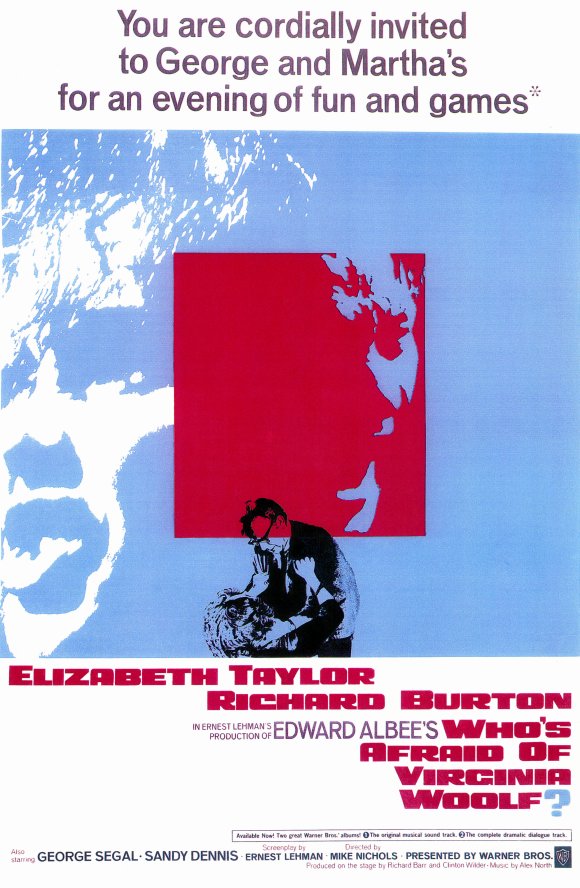
The promotional poster promises an evening of fun and games, but very little joy is to be found here, at least on the surface: all that marital baiting, sniping, and yelling is miserable. Fuck! It took me five or six false starts over a few years before I finally got into the film—and only with the help of a bottle of bourbon. Once I was in, though, I was hooked: watching this disastrous night unfold and all four characters unravel engrossed me desite the buzz I had going.

The oddly but appropriately named George (Burton), a history professor at a small East Coast university, and Martha (Taylor), the daughter of the school’s president, stumble home drunk from a faculty party, neither one listening to the other as they babble about nothing. Martha quotes Bette Davis, which ultimately reveals more about her viewpoint than any other comment she makes—and the woman can talk.

They babble and respond to each other half-heartedly. Martha tells George that she invited a young couple, a professor from another department and his wife, over for a drink. George is miffed, but there’s no time to react.

Enter Nick (Segal) and Honey (Sandy Dennis), a polite, young, good-looking couple that, as we learn, has their own set of problems. Martha and George pour drinks and pick at each other while Nick and Honey watch, uncomfortable at first, thinking maybe they shouldn’t be there. As the drinking continues, though, they’re pulled into the…drama? Turns out, they have more in common with each other than they think.

Here’s the thing about George and Martha: their marriage is dysfunctional, but they seem to operate well inside the confines of their explosive relationship—Martha brays and George stays, responding in a passive aggressive manner as he fixes them both another drink. Over and over and over again. Do they have any limits? It’s hard to say, partly because it’s never clear that we should take anything at face value: what we see is not necessarily what it is. That’s the genius of Who’s Afraid of Virginia Woolf. 

In 2013, the United States Library of Congress deemed Who’s Afraid of Virginia Woolf? “culturally, historically, or aesthetically significant” and selected it for preservation in the National Film Registry (https://www.loc.gov/programs/national-film-preservation-board/film-registry/complete-national-film-registry-listing/).

With Frank Flanagan, Agnes Flanagan

Production: Warner Brothers

Distribution: Warner Brothers

131 minutes
Not rated

(DVD purchase) A

All About Eve

(USA 1950)

“Fasten your seatbelts, it’s going to be a bumpy night.”

—Margo Channing

That iconic line succinctly captures the essence of Joseph L. Mankiewicz’s All About Eve, a sharp commentary on the treacherous relationship between female ambition and the American obsession with youth that still rings—and stings—true nearly 70 years later.

Based on Mary Orr’s short story The Wisdom of Eve, Bette Davis is Broadway legend Margo Channing, who’s turning 40 and sees doors closing in her professional and personal life. One rainy night, Karen Richards (Celeste Holm), Margo’s bestie, happens upon a young starstruck fan waiting backstage to meet Margo after a performance of her latest play, the aptly titled Aged in Wood. The fan, of course, is wide-eyed Eve Harrington (Anne Baxter), a mousy but well-spoken girl in an oversized trenchcoat who says she followed Margo from San Francisco to New York City and has seen every performance of the play—from the back of the house.

Karen, whose husband is none other than playwright Lloyd Richards (Hugh Marlowe), Margo’s frequent collaborator and author of Aged in Wood, brings Eve into Margo’s dressing room to meet her. Lloyd is there, along with Margo’s fiancé, director Bill Simpson (Gary Merrill), and her crusty sharp-tongued maid, Birdie (Thelma Ritter). Eve wins over everyone in the room with her poignant backstory about a poor midwestern upbringing on a farm, a husband killed in the War, and a humble stiff upper lip. Everyone, that is, except Birdie—she smells a rat.

Margo takes Eve under her wing as her personal assistant. Eve quickly proves to be an ace at organizing Margo’s affairs—and sneaking herself squarely into the middle of them. She aligns with caustic theater critic Addison DeWitt (George Sanders), who like Birdie doesn’t buy what Eve puts out there but unlike Birdie sees a mutual opportunity. Things sour all around when Margo learns that her producer, Max Fabian (Gregory Ratoff), designates Eve as her understudy without consulting her first.

Often compared to Sunset Boulevard for a variety of reasons, All About Eve is not as dark or campy but is way bitchier. From a technical standpoint, the script is tighter, the production more sophisticated, and the story a lot wittier. All things considered, it’s way more fun and has held up quite well—sure, the voiceovers are overdramatic, but these are theater people so it fits. I found it particularly interesting to see this film again right around the beginning of the FX series Feud, which not only is half about Davis but elaborates on the same issues that All About Eve raises. It underscores much of what Davis said about the industry in interviews late in her life.

None of the men here have any reason to worry about their age; for all of them, their success has nothing to do with how old they are or even how they look (their thing is power, but that’s another discussion). The women, on the other hand, constantly struggle to secure and then maintain their positions—and they’re ruthless about it. Eve earns the acting award she gets at the end (which is really the beginning): she fools everyone to manipulate them into giving her what she wants. It’s clear that sooner than later, she’ll be right where Margo is, for better but more likely for worse.

In one of her earlier roles, Marilyn Monroe makes an amusingly memorable appearance as dippy starlet Miss Casswell, who’s trying to catch a break. She’s got the best line of all: “I don’t want to make trouble. All I want is a drink.” Amen!

In 1990, the United States Library of Congress deemed All About Eve “culturally, historically, or aesthetically significant” and selected it for preservation in the National Film Registry (https://www.loc.gov/programs/national-film-preservation-board/film-registry/complete-national-film-registry-listing/).

With Barbara Bates, Craig Hill, Helen Mowery, Steven Geray

Production: 20th Century Fox

Distribution: 20th Century Fox

138 minutes
Not rated

(AMC River East) A

Fathom Events

Lonesome [Solitude]

(USA 1928)

The promotional poster touts something “New! Different! Refreshing!” It sounds like soda, but it’s not: it’s Lonesome, a real charmer that still works as it nears its centennial.

Music Box Theatre screened a crisp restored 35mm print of Paul Fejos’s Lonesome for Reel Film Day, a countrywide event honoring films of the almost abandoned format (https://drafthouse.com/event/reel-film-day). The program was a double feature that included the Adam Sandler vehicle Punch Drunk. I didn’t stick around so I can’t comment on Punch Drunk, but Lonesome was an excellent choice.

Mary (Barbara Kent), a telephone operator for Ma Bell, and Jim (Glenn Tyron), a punch press operator in a factory, are two young working stiffs in the Big Apple. Both live alone in small rented room (not together—there’d be no movie then), and participate in an urban rat race that actually looks busier and grungier than what we have today.

Clearly, the film predates the standard five-day work week: the calendar in Mary’s room indicates that the day is Saturday, July 3. As Mary and Jim finish their respective jobs, which Fejos shows in a narrative that goes back and forth between the two, their work friends invite them to join in their weekend plans. Mary and Jim both see immediately that they’ll be the odd one out, as all of their friends are paired up. Both politely decline, going home dejectedly without any plans.

After they each see the same marching band advertising a cheap carriage ride to Coney Island, Mary and Jim end up going there solo on the same trip. They meet at the beach, and a modest flitration ensues. He tells her he’s a millionaire, and she tells him she’s a princess. They get along well, and commence an impromptu date, walking around, playing carnival games, and dancing. A fortune teller (Fred Esmelton) reveals that Mary has already met the man who will become her husband.

Mary and Jim get separated after a mishap on a rollercoaster. The problem is, they each have a tiny picture of the other from a photo booth and they only know each other’s first name. Finding each other in the throngs of people at the park that evening is like searching for a needle in a haystack. Have they lost each other before they even had a chance?

Edward T. Lowe, Jr. and Tom Reed adapt a cute story by Mann Page; it’s a simple yet clever plot. Despite its age, one point in Lonesome still rings loud and clear and true: connecting in the big city is harder than it looks. We all get wrapped up in the daily stuff of our lives, and we tend to overlook what’s right in front of us. Kent and Tyron are both adorable. Gilbert Warrenton’s kinetic camerawork captures a lot in the background, and it makes the shots at Coney Island especially fun to watch.

Lonesome features two or three abruptly placed “talking” scenes—the film was made when sound was a new thing—and the dialogue is laughably awful. There are also a few color tinted night shots: marquee lights, fireworks, stars. It’s really cheesy. That said, these are short, minor disruptions that don’t detract from enjoying this film for all its silent era charisma.

In 2010, the United States Library of Congress deemed Lonesome “culturally, historically, or aesthetically significant” and selected it for preservation in the National Film Registry (https://www.loc.gov/programs/national-film-preservation-board/film-registry/complete-national-film-registry-listing/).

With Fay Holderness, Gusztáv Pártos, Eddie Phillips, Andy Devine, Edgar Dearing

Production: Universal Pictures Corporation/Universal Pictures (USA)

Distribution: Universal Pictures Corporation/Universal Pictures (USA), European Motion Picture Company (UK), The Criterion Collection (DVD)

75 minutes
Not rated

(Music Box) A

Reel Film Day: A Celebration of 35mm Cinema

https://www.criterion.com/films/28212-lonesome

http://www.imdb.com/video/screenplay/vi389587993/

The Tell-Tale Heart

(USA 1953)

I caught The Tell-Tale Heart as an extra at Music Box Theatre’s screening for Reel Film Day. Directed by Ted Parmelee and narrated by English actor James Mason, it’s a nifty modern take on Edgar Allan Poe’s famous 1843 short story about a murderer haunted by his victim’s heartbeat, which he hears from underneath the floorboards where he hid the body. Paul Julian’s design and Pat Matthews’s animation is shadowy and surreal, nicely depicting the horror and the madness of Poe’s classic. Boris Kremenliev’s score adds an eerie Twilight Zone feel.

This short has the distinction of being the first cartoon to earn an ‘X’ rating. However, it appears the rating, assigned by the British Board of Film Censors in the UK, had more to do with religion than obscenity (http://dangerousminds.net/comments/this_moody_1953_animation_of_edgar_allan_poes_the_tell-tale_heart_was_the_f). It had to be the dark occult nature of the story,  as there is nothing remotely sexual here.

In 2001, the United States Library of Congress deemed The Tell-Tale Heart “culturally, historically, or aesthetically significant” and selected it for preservation in the National Film Registry (https://www.loc.gov/programs/national-film-preservation-board/film-registry/complete-national-film-registry-listing/).

Production: United Productions of America

Distribution: Columbia Pictures

7 minutes
Not rated (USA)

(Music Box) A

Reel Film Day: A Celebration of 35mm Cinema

Clueless

(USA 1995)

“Searching for a boy in high school is as useless as searching for meaning in a Pauly Shore movie.”

—Cher Horowitz

The first screening of Chicago International Film Festival’s Totally ’90s series is Clueless, a sort of link between ’80s classics like Valley Girl and Heathers and later films like Election, 10 Things I Hate About You, Mean Girls, and even Fox’s current television series Scream Queens. Adapted from Jane Austen’s Emma, which I haven’t read and probably never will, Clueless transmits the novel’s heroine across time and space from outside London in the early Nineteenth Century to Beverly Hills in the late Twentieth. It’s a cute idea that works—I didn’t know until this screening that the story is 200 years old. As if!

“Hymenally challenged” (i.e., virgin) 16 year old California girl Cher Horowitz (Alicia Silverstone) is vain, popular, and rich. Perhaps not surprisingly, she’s incredibly superficial, even if she means well. Her mother died in “a freak accident during a routine liposuction,” leaving her father, brass-balled Type A litigator Mel (Dan Hedaya), to raise her. When Cher gets a bad report card, she enlists her bestie Dionne (Stacey Dash), a hip black version of herself, to help fix up two nerdy tough-grading teachers, Mr. Hall (Wallace Shawn) and Miss Geist (Twink Caplan). Her plan is simple: she wants to get them laid so they’ll chill out and be receptive to negotiating her grades. Meanwhile, Cher adopts a new student, “tragically unhip” druggie tomboy Tai (Brittany Murphy) as a pet project: Cher plans to make Tai more like Cher. Duh. Semi-crunchy, socially conscious stepbrother Josh (Paul Rudd) does not approve of Cher’s antics.

Written and directed by Fast Times at Ridgemont High‘s Amy Heckerling, Clueless feels like an ’80s throwback, but it’s still a lot of fun. Loaded with great zingers and one-liners, I laughed a lot. It also has a ton of references to ’90s pop culture that clearly date the film (Luke Perry? Snapple? A Cranberries CD?! Egads!). Clueless lacks a ceratin bite that makes “mean girl” flicks so, well, biting. I guess a large part is because Cher and Dionne aren’t really mean girls; they’re actually pretty naive. After all, it takes Cher awhile to figure out that Christian (Justin Walker), the guy she lusts after, is a friend of Dorothy. Hello?

With Julie Brown, Jeremy Sisto, Breckin Meyer, Donald Faison, Elisa Donovan

Production: Paramount Pictures

Distribution: Paramount Pictures (USA)

97 minutes
Rated PG-13

(Public Chicago) B-

Chicago International Film Festival

https://www.facebook.com/CluelessMovie

20th Century Women

(USA 2016)

“We are at a turning point in our history.”

—President Jimmy Carter

I was a little kid in the Seventies, but I have many indelibly vivid memories of the decade: huge cars, gas lines, expensive meat, hijacked planes, Sanka and Sweet’N Low, smoking everywhere, hard rock, punk rock, disco, macrame, spider plants, the Bicentennial, Sky Lab, Victoriana (we had Mucha posters in our mustard-colored kitchen), that strange Holly Hobby aesthetic. It seems like it all changed immediately when Reagan took office in 1981.

20th Century Women captures a slice of American life on that unique, unremembered and largely disowned cusp. Set as a flashback to 1979 with voiceovers that repeatedly remind us that we’re looking backward, the film is a rather remarkable time capsule. The story is simple: Dorothea (Annette Bening) is my grandparents’ age (born in 1924). She had her only son, Jamie (Lucas Jade Zumann), late in life—i.e., over age 40. She’s been divorecd for a few years, which was fine until Jamie hit puberty. Now, she needs help understanding him. She enlists his two closest allies—Julie (Elle Fanning), whose pants he wants to get into, and Abbie (Greta Gerwig), a postpunk fuckup—to help her figure him out.

Loosely based on actual events from director and writer Mike Mills’s childhood, 20th Century Women is fun to watch. Growing up in a house of females myself, I relate to a lot of his experiences. I loved all the Talking Heads, too. Oh!—and Siouxsie and the Banshees! That said, this film borders on overbearing with its nostalgia. It could’ve been so much better—the material and the talent are both there, but Mills goes for easy returns that don’t pay off. The story falls flat. Perhaps a quote from Bening in an earlier film, the superior and far more interesting Running with Scissors, succinctly sums up my problem here: “It’s shit, Fern. It’s sentimental. It’s emotionally dishonest. It implodes into nothingness.”

I wasn’t bored, and I didn’t hate 20th Century Women. But I’m never going to see this movie again. Too bad, because the acting is great. It’s a misfire due to its execution. It seemed like a good idea at the time.

Also starring Billy Crudup, Vitaly Andrew LeBeau, Curran Walters, Toni Christopher, Jimmy Carter (public domain footage)

Produced by Annapurna Pictures, Archer Gray, and Modern People

Distributed by A24

119 minutes
Rated R

(Landmark Century) C

http://20thcenturywomen-movie.com

Ed Wood

(USA 1994)

“You’re wasting your lives making shit. Nobody cares. These movies are terrible!”

—Dolores Fuller


“How do you do it? How do you get all your friends to get baptized just so you can make a monster movie?”

—Bunny Breckinridge


“Can your heart stand the shocking facts of the true story of Edward D. Wood, Jr?”

—Criswell


“Confidentially, I even paratrooped wearing a brassier and panties. I wasn’t afraid of being killed, but I was terrified of being wounded and having the medics discover my secret.”

—Ed Wood

Edward D. Wood, Jr., or simply Ed Wood, is widely regarded as the worst director of all time. In fact, he received posthumous recognition—the Golden Turkey Award—designating him as such (http://www.legacy.com/news/celebrity-deaths/article/ed-wood-the-best-of-the-worst). His silly low-budget DIY pulp/science fiction/horror flicks from the 1950s—low on plot, technique, and talent—are beloved by many because they’re so bad. Monumentally bad. Okay, maybe ridiculous is a better word. You decide from this trailer:

Based on Rudolph Grey’s book Nightmare of Ecstasy and adapted for the screen by Scott Alexander and Larry Karaszewski, Tim Burton’s labor of love, Ed Wood, is a period-piece biopic about the eccentric angora-loving filmmaker responsible for such gems as Jail Bait, Glen or Glenda, Bride of the Monster, and of course Plan 9 from Outer Space—Wood’s Citizen Kane (as Burton likens it here). This film rocks; I never get sick of it. Not ever. And for a few reasons.

The characters and performances are fantastic. Leading man Ed Wood is one of Johnny Depp’s most endearing roles; he plays Wood with an affectionate and demonstrative earnestness he’s never quite duplicated. Burton has always held sympathetic misfits in high regard—Edward Scissorhands, also played by Depp, immediately comes to mind. Here, he has a field day, bringing in an entire cast of warm and colorful weirdos that flock to Wood. Consider: best bud Bunny Breckinridge (Bill Murray), a boozy grand queen with a penchant for drama and glitter. “The Amazing Criswell” (Jeffrey Jones), an androgynous self-proclaimed psychic/horse shit artist. Max (Max Casella), the president of Wood’s fan club—and his errand boy. Overzealous, chatty crew member Conrad (Brent Hinkley). Later, Vampira (Lisa Marie), a gothic midnight movie hostess with lots of bosom, and TV wrestler Tor Johnson (George “The Animal” Steele) become regulars in Wood’s films.

The most important relationship, though, is the one between Wood and has-been Dracula star Bela Lugosi (Martin Landau), whom he meets in a coffin store. Lugosi’s life is far from glamorous: he lives alone in obscurity in a tiny tract house in a nondescript suburban neighborhood. He’s also a junkie. Wood moves from starstruck fan to employer to custodian and confidant. Landau gives a flawless performance; he earned an Academy Award for Best Supporting Actor for it. Every scene is inspired, but one of my favorites is his dramatic reading of that hackneyed “home” speech; it is, to use Wood’s word, “perfect.” Their friendship gives Ed Wood much of its warmth and humanity.

Despite the laughably amateur quality of Wood’s films—and his unorthodox way of shooting them—he gets them made. And no matter how poorly received they are, he doesn’t give up. In this sense, Ed Wood is uplifting and inspiring. He embraces his flaws, sticks to his guns, and believes in himself. Orson Welles himself (Vincent D’Onofrio) backs him up in one great scene at a bar.

Some might find the pace a bit slow. I don’t—the whole film is fun and jammed with quotable material that keeps it moving. Line after line is memorable—I could string together a bunch of quotes I know by heart and leave it at that (I’ve seen this film quite a few times). From a technical standpoint, Ed Wood is exceedingly well done. Filmed in shimmering black and white, Stefan Czapsky’s camerawork is beautiful. The cleverly composed, shadowy shots of Lugosi “fixing” in the bathroom and later tied to a bed in rehab, and Wood and future wife Kathy (Patricia Arquette) inside the carnival ride are especially remarkable. Howard Shore’s score—a rich mix of jazz, Cuban orchestration that wouldn’t sound out of place on I Love Lucy, and monster madness—is awesome.

Burton easily could have made this a snarkfest. Instead, he shows his idol in a respectful and positive light. His spirited take makes Ed Wood exceptional.

With Sarah Jessica Parker, Mike Starr, Juliet Landau, Stanley Desantis, Ned Bellamy, Norman Alden, G.D. Spradlin

Produced by Touchstone Pictures

Distributed by Buena Vista Pictures Distribution

127 minutes
Rated R

(iTunes purchase) A

Hidden Figures

(USA 2016)

Houston, do you read me: NASA employed black people in its infancy during the early Sixties. What’s more, NASA’s first major project, Mercury, probably wouldn’t have gotten off the ground without three black female “computers,” or mathematicians, whose efforts literally put John Glenn and Friendship 7 into orbit. The result was a serious boost in American morale during the race against the Soviets into space and a boon to the Space Program under President Kennedy. So, with its historically significant and truly enlightening subject matter, what most caught me off guard about Hidden Figures is its tone, which is light, upbeat, cute, and often comical. While not in itself a bad thing, it’s not what I expected.

Unfortunately, that’s about all Hidden Figures offers that I didn’t expect. I’m not saying I didn’t enjoy this film; I did. It’s a great story about remarkable people who actually lived. According to one subject, their real stories are not far off from this film (http://www.latimes.com/science/sciencenow/la-sci-sn-hidden-figures-katherine-johnson-20170109-story.html). Taraji P. Henson plays Katherine Johnson, a recently widowed math whiz who works for NASA in Virginia, as a bookish nerd complete with glasses that keep sliding down her nose. She and her coworkers, smart and sassy Dorothy Vaughan (Octavia Spencer) and fiery and coquettish Mary Jackson (Janelle Monáe), quietly but forcefully demonstate their worth in an environment that doesn’t treat them as equals. While Katherine lugs binders and a calculator back and forth between her desk and the “colored” rest room clear across campus to figure out arcs and other shit I sure can’t, Dorothy teaches herself how to operate the new IBM that not even IBM technicians can set up correctly and Mary pushes her way into engineering classes at night in an all white, all male school. Director Theodore Melfi does a really nice job demonstrating institutionalized racism and sexism through characters who may not have anything against black people or women—as administrator Vivian Michael (Kristen Dunst) curtly tells Dorothy in one scene and unwilling research partner, Paul Stafford (Jim Parsons), makes clear to Katherine in another scene by redacting her name from a joint report they both wrote—but don’t recognize the issue.

Despite its merits, I found Hidden Figures to be slightly more sophisticated than a Lifetime movie. Melfi, who with Allison Schroeder adapted the screenplay from Margot Lee Shetterly’s book of the same name, takes a pretty basic approach to the material. It’s so easy—obvious, even—to gage where the story is headed. John Glenn (Glen Powell) sings Katherine’s praises while a love interest develops for her in handsome Col. Jim (Mahershala Ali). So cute. Hidden Figures gets into civil rights issues, but only on a superficial level. There are a few overdone Oscar grabs, like a scene between Katherine and her boss, Al Harrison (Kevin Costner), that ends with him smashing the sign outside the “colored” ladies’ rest room, but no true show stoppers. Frankly, though, most of the actors here have appeared in better movies. Too bad, because this could’ve been a great film instead of just an okay one. Hidden Figures doesn’t quite do its trailblazing subjects justice.

127 minutes
Rated PG

(AMC River East) C+

http://www.foxmovies.com/movies/hidden-figures