La Chinoise

(France 1967)

“Okay, it’s fiction. But it brings me closer to reality.”

— Véronique

Set in the context of the New Left movement in late 1960s France, Jean-Luc Godard’s La Chinoise is not really about the political ideas it raises — many of which seem relevant today. No, at its core is Godard satirizing the idealism of youth.

Structured as a mockumentary in what undoubtedly is an intentionally scrappy art school style, La Chinoise is a series of “interviews” of five middle class college students about their Maoist terrorist organization. Headquartered in a loft apartment in a suburb of Paris, they named their organization “Aden Arabie” after a novel by French communist Paul Nizan.

The apartment, all done up in primary colors like a Piet Mondrian painting, is owned by one of the members’ parents.

Véronique (Anne Wiazemsky, who sadly died exactly a week before the screening I attended) (https://www.nytimes.com/2017/10/05/obituaries/anne-wiazemsky-french-film-star-and-novelist-dies-at-70.html) is the bossy leader, a philosophy student from a family of bankers. She’s involved with Guillaume (Jean-Pierre Léaud), a “theatrical actor.” Yvonne (Juliet Berto) grew up on a farm and works as a housekeeper and occasional hooker. She’s involved with Henri (Michel Semeniako), a writer who protests and publishes essays. Serge Kirilov (Lex de Bruijin) is a Russian nihilist who is single and suicidal.

La Chinoise is dense with ramblings about social and economic philosophy, politics, and literature. However, Godard uses all of it to make his point: these are kids who are still naïve and don’t fully grasp what they say they stand for. He shows them running around with toy weapons, playing school, and acting out scenes from books in the apartment, often cutting to pictures of comic book and cartoon characters. The joke is pretty funny when you consider the bourgeois backgrounds of the kids.

A conversation between Véronique and French philosopher Francis Jeanson on a train best illustrates Godard’s point: he asks a series of questions challenging her proposal to blow up the university in an effort to expose the flaws in her plan — and maybe get her to question her motives and the depth of her conviction. It goes over her head. So much for carrying pictures of Chairman Mao.

Side note: Claude Channes’s song “Mao-Mao” features prominently here. It’s a nifty little earworm.

With Omar Blondin Diop

Production: Anouchka Films, Les Productions de la Guéville, Athos Films, Parc Film, Simar Films

Distribution: Athos Films (France), Pennebaker Films (United States), Kino Lorber

96 minutes
Not rated

(Gene Siskel Film Center) C+

https://www.kinolorber.com/film/view/id/1111

Foxy Brown

(USA 1974)

“That’s my sister, baby. And she’s a whole lot of woman.”

— Link


“Death is too easy for you, bitch. I want you to suffer.”

— Foxy

To use a term straight from Willie Hutch’s theme song, director/screenwriter Jack Hill’s Foxy Brown is superbad. It’s definitely not something to see for technical or artistic excellence, but it’s cool nonetheless. A sort of reworking of Coffey, it’s a sexy vigilante revenge tale that doesn’t take itself too seriously.

Pam Grier is Foxy Brown, a bodacious woman on a mission to track down the goons who shot and killed her boyfriend (Terry Carter), a government agent who just had plastic surgery to change his identity, right outside her door. Obviously, this is the work of a Los Angeles drug ring.

Foxy quickly figures out who the rat is: her own brother, Link (Antonio Fargas). He identifies her boyfriend’s killers as affiliates of a “modeling agency.” The agency is run by fixers Miss Kathryn Wall (Kathryn Loder) and Steve Elias (Peter Brown). Their clients are crooked high profile men of the law like judges and politicians who trade favors for girls.

Posing as a prostitute, Foxy gets inside the operation and does some major damage. It gets her in serious hot water when she’s exposed, bringing her into the center of a lesbian bar brawl and then onto a coke ranch as a junky sex slave. Fortunately, she’s tough and resourceful. No one gets the best of Foxy.

Built on sex parties, chase scenes, shoot outs, and boobs, the plot is structured like a sitcom, and it’s about as complicated and predictable. Naturally, Foxy gets what she wants in the end. Except for the very cool opening titles, there are no effects to speak of. The acting is average at best. However, the action is surprisingly steady, leaving very few dull spots. Plus, there’s real sas here, mostly from Grier, that keeps the whole thing interesting.

I wouldn’t go so far as to call Foxy Brown a feminist work, but Foxy is a badass heroine with her heart — and her head — in the right place. It’s a thrill watching her take control, especially in heels and those fabulous frocks. I wouldn’t want to piss her off.

With Harry Holcombe, Sid Haig, Juanita Brown, Sally Ann Stroud, Bob Minor, Tony Giorgio, Fred Lerner, Judy Cassmore, H.B. Haggerty, Boyd ‘Red’ Morgan, Jack Bernardi, Brenda Venus, Kimberly Hyde, Jon Cedar, Ed Knight, Esther Sutherland, Mary Foran, Jeannie Epper, Stephanie Epper, Peaches Jones, Helen Boll, Conrad Bachmann, Russ Grieve, Rodney Grier, Roydon E. Clark, Don Gazzaniga, Jay Fletcher, Gary Wright, Fred Murphy, Edward Cross, Larry Kinley Jr.

Production: American International Pictures (AIP)

Distribution: American International Pictures (AIP) (USA), Sociedade Importadora de Filmes (SIF) (Portugal), Film AB Corona (Sweden), Cinema Mondo (Finland)

92 minutes
Rated R

(Impact) C+

Il Boom

(Italy 1964, 2017)

For some reason — I can’t find an answer — Il Boom was not released in the States until this year. Madonne! Better late than never, and I’m glad it made it because it reaffirms my love of midcentury Italian cinema.

Giovanni Alberti (Alberto Sordi) lives large. His fabulously modern apartment in Rome features a gorgeous patio for entertaining. He employs a housekeeper and sometimes a wait staff. His beautiful and frivolous wife, Silvia (Gianna Maria Canale), has expensive taste. Every night, they go out on the town for lavish dinners and fancy cocktails, dancing and partying in the most chic and trendy clubs.

A game of footsie under the table suggests that his bourgeois crowd is into some naughty stuff on the side, but Giovanni loves Sylvia way too much for that.

Life is grand, but that’s the problem: Giovanni lives above his means. Unbeknownst to Sylvia, who continues to spend gleefully, he’s over his head in debt and about to be publicly humiliated on “the registry.” He can’t get another loan because his credit is shot. Desperate, he suggests a simpler lifestyle, which Sylvia simply ignores. He can’t bring himself to tell her why.

Giovanni fails miserably to convince a number of friends and associates to invest in his land development plan, which may or may not be a scam. His last hope is one-eyed real estate mogul Mr. Bausetti (Ettore Geri), who like everyone else turns him down. Mrs. Bausetti (Elena Nicolai), however, makes a proposal behind her husband’s back: she offers to buy Giovanni’s left eye. He can name his price.

Il Boom is a lot of fun. The title refers to the postwar economic boom in Italy and elsewhere. Director Vittorio De Sica and writer Cesare Zavattini are critical of consumerism, and there’s definitely a moral. However, they avoid getting on a soapbox and simply make fun of it. The story moves along breezily, and quite a few scenes — the dinner party, the hospital — are memorably offbeat and funny. Sordi is perfect as the hapless Giovanni, displaying a mercurial energy and general uneasiness that keeps you watching. His reaction to Mrs. Bausetti’s offer is priceless. I left with a smile.

Armando Nannuzzi’s cinematography is beautiful in luminous black and white; I can’t imagine Il Boom in color. Billy Vaughn’s super cool “Wheels” plays throughout the film; man, does it stick in your head. I’m humming it now.

With Alceo Barnabei, Federico Giordano, Antonio Mambretti, Silvio Battistini, Sandro Merli, John Karlsen, Ugo Silvestri, Gloria Cervi, Gino Pasquarelli, Maria Grazia Buccella, Mariolina Bovo, Felicita Tranchina, Franco Abbiana, Rosetta Biondi

Production: Dino de Laurentiis Cinematografica

Distribution: Rialto Pictures, StudioCanal

88 minutes
Not rated

(Gene Siskel Film Center) B+

http://www.rialtopictures.com/catalogue/il-boom

Funeral Parade of Roses [Bara no Sōretsu]

(Japan 1969)

Funeral Parade of Roses [薔薇の葬列] is an intriguing film for a few reasons. Clearly influenced by the French New Wave, writer and director Toshio Matsumoto comes up with something simultaneously ordinary yet avant-garde, very much a product of its time yet years ahead. It’s extraordinarily cool.

Structured as a movie within a movie, Funeral Parade of Roses follows Tokyo “gay boy” Eddie (Pîtâ a.k.a. Peter) through his many exploits as a young transvestite immersed in the underground club scene. He might even be a hooker. Meanwhile, he’s carrying on a secret affair with Jimi (Yoshimi Jô), the boyfriend of club elder statesperson and fellow gay boy Leda (Osamu Ogasawara). Leda is onto them. Oh, the drama it creates!

While all this is going on, a camera crew records Eddie as though this were The Real World or Truth or Dare.

As Eddie ponders who he is — and looks to alcohol, group sex, drugs, and lots of attention from others for answers — Matsumoto explores “queer identity” through him. He intersperses interviews, flashbacks, episodes with Eddie’s mother (Emiko Azuma), and even a musical diversion or two to offer clues. A crazy subplot develops, and it references Oedipus in a tacky and sad but clever way.

Clumsy in its exploration of “gay life” and downright disturbing at points, Funeral Parade of Roses is nonetheless fun to watch. Shot in gorgeous black and white, it has an otherworldly feel. When it’s not nihilistic, it’s kitschy and entertaining — almost in a nascent John Waters way, just not quite as rough. The clothes are mod. The music is heavy on classical. The ending, sudden and bloody, is really messed up.

I’m not sure what exactly Matsumoto is saying here — a lot is open to interpretation — or that I agree with him. Either way, I enjoyed the journey.

With Yoshio Tsuchiya, Toyosaburo Uchiyama, Don Madrid, Koichi Nakamura, Chieko Kobayashi, Shōtarō Akiyama, Kiyoshi Awazu, Flamenco Umeji, Saako Oota, Tarô Manji, Mikio Shibayama, Wataru Hikonagi, Fuchisumi Gomi, Yô Satô, Keiichi Takenaga, Hôsei Komatsu

Production: Art Theatre Guild, Matsumoto Production Company

Distribution: Art Theatre Guild, Image Forum (Japan), Cinelicious Pics (USA)

105 minutes
Not rated

(Gene Siskel Film Center) B+

Swept Away…by an Unusual Destiny in the Blue Sea of August [Travolti da un insolito destino nell’azzurro mare d’agosto]

(Italy 1974)

“Oh, Madonna! This nightmare is finally over. God, do I want some coffee. Fresh, of course.”

— Raffaella Pavone Lanzetti

More than 40 years after the fact, Lina Wertmüller is still an audacious filmmaker. Not only does she incorporate sociopolitical commentary, satire, and crazy sex into her work, but her ’70s films are inherently interesting because they push buttons. She’s the first female nominated for an Oscar for Best Director, and there’s a reason for that: she’s a radical with more balls than just about anyone else working, even today.

Case in point: Swept Away…by an Unusual Destiny in the Blue Sea of August [Travolti da un insolito destino nell’azzurro mare d’agosto] — or simply Swept Away for short — is not a standard comedy. The plot is simple: an insufferable rich bitch, Raffaella (Mariangela Melato), is vacationing in the Mediterranean with her millionare husband (Riccardo Salvino) and their friends on a yacht. Raffaella is thoughtless and demanding, and she relentlessly berates rugged deckhand Gennarino Carunchio (Giancarlo Giannini) because the coffee isn’t fresh, the fish doesn’t taste right, and the pasta isn’t al dente enough.

She insists that Gennarino take her swimming. The two end up stranded in the water, far from the yacht. They eventually spot land, which turns out to be a small uninhabited island. Gennarino, a fisher, has no trouble finding food or shelter. Raffaella isn’t used to doing things herself, and soon finds that she is dependent on Gennarino. He isn’t exactly gracious about his new upper hand. It isn’t long before their relationship takes a sexual turn.

Wertmüller, who wrote the screenplay as well as directed, plays on traditional notions of sex roles. By today’s standards, Swept Away is probably too violent to come off as funny. The many scenes where Gennarino slaps and physically pummels Raffaella are bad enough, but when he rapes her on the beach? It’s disturbing. How is that funny? That’s the point — at first, anyway.

Swept Away isn’t really about sex: it’s about power. Here, the power dynamic shifts once Raffaella and Gennarino are out of the “civilized” world and lost in the wild, where economics and social status no longer define one’s place. Like all of her early films, Wertmüller has a lot to say about class structure; here, she also has a lot to say about male/female relationships. She’s controversial, but her approach works really well. It helps that Melato and Giannini, who starred in earlier films together, have a believable chemistry — and they spend a bit of time here wearing very little.

Swept Away is not a typical film. I call it a comedy, but it doesn’t fit neatly into any category. It’s sharp, subversive, and still pretty potent.

With Isa Danieli, Aldo Puglisi, Anna Melita, Giuseppe Durini, Lucrezia De Domizio, Luis Suárez, Vittorio Fanfoni, Lorenzo Piani, Eros Pagni

Production: Medusa Distribuzione

Distribution: Medusa Distribuzione (Italy), Cinema 5 Distributing (USA)

116 minutes
Rated R

(iTunes rental) B+

http://www.linawertmuller.com/framegeo.htm

Michael Jackson’s Thriller

(USA 1983)

“Now, I have something to tell you…I’m not like other guys.”

— Michael Jackson

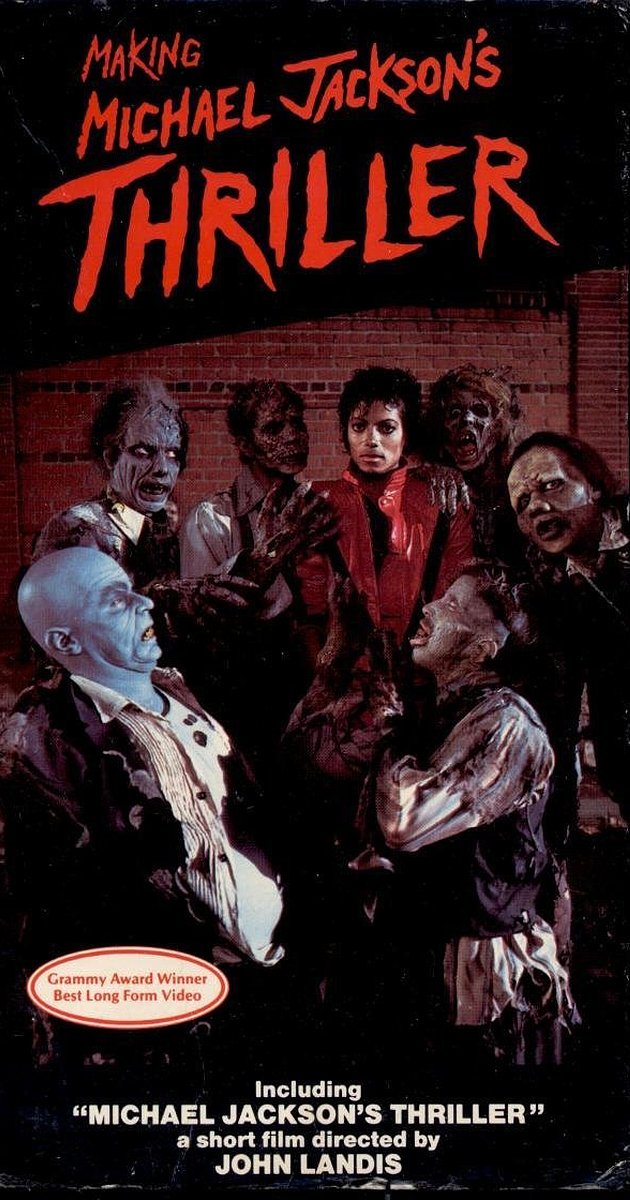
A very young Michael Jackson on a date with…his girlfriend (Ola Ray)? Jackson playing a werewolf, a zombie, and a lizard-eyed creature? Vincent Price reading an outro? Bad ’80s hair? You know it’s thriller, thriller night!

It’s not his best song, but Michael Jackson’s Thriller is a fucking cool video. It features all the showmanship he’s known for — the dancing, the weirdness, the bigness of the whole thing, that red jacket and those white socks, oh and a setting in the midst of seedy urban decay, this time a cemetery apparently somewhere downtown. Directed by John Landis, Thriller is clever: what starts as a cheesy horror movie turns out to be…a cheesy horror movie. Loaded with references to Night of the Living Dead and An American Werewolf in London, Thriller demonstrates that Jackson actually had a sense of humor.

I don’t put a music video on my blog every day. In fact, Michael Jackson’s Thriller is (so far) the only one. Why? In my quest to see as much as possible on the Library of Congress National Film Registry, I am obligated to include the final single and title track from the legendary pop star’s massive blockbuster album Thriller (https://en.m.wikipedia.org/wiki/Thriller_(Michael_Jackson_album) ). The song was not written by Jackson — Rod Temperton came up with it.

This video truly was a “seismic shift” — longer, more dramatic, and reaching beyond the song, it proved that music videos could be more than promotional clips; they literally could be little movies — or as here, bona fide events — that attract a huge audience, and thus worthy of a big budget. I can cite a number of artists who followed the template that Jackson set with Thriller.

In 2009, the United States Library of Congress deemed Michael Jackson’s Thriller “culturally, historically, or aesthetically significant” and selected it for preservation in the National Film Registry (https://www.loc.gov/programs/national-film-preservation-board/film-registry/complete-national-film-registry-listing/).

With Marcea Lane, Kim Blank, Lorraine Fields, Tony Fields, Michele Simmons, Vincent Peters, Michael Peters, Vincent Paterson, Michael De Lorenzo, Ben Lokey, John Command, Richard Gaines, Mark Sellers, Suzan Stadner, Diane Geroni, Suga Pop

Production: MJJ Productions, Optimum Productions

Distribution: Epic Records, Vestron Video

14 minutes
Not rated

(iTunes) A

https://michaeljackson.com

Killer of Sheep

(USA 1977)

“Man, I ain’t poor. Look, I give away things to the Salvation Army. You can’t give away nothing to Salvation Army if you poor.”

— Stan

Killer of Sheep has an unusually twisted history that kept it out of daylight — and the spotlight — until recently. His Master’s thesis when he was a film student at UCLA, director Charles Burnett shot it part time over a year’s worth of weekends on 16mm scraps salvaged from production houses. He used equipment borrowed from the university film department. He never intended it to be shown publicly, which is why he didn’t bother to secure licenses for all the music in it (https://mobile.nytimes.com/2007/03/25/movies/25kehr.html?referer=https://www.google.com/).

Relegated to obscurity because of copyright issues surrounding the music, Killer of Sheep was impossible to see for decades — not that that stopped the Library of Congress from adding it to the National Film Registry in just its second year of existence. A grant and a donation led to a restoration that finally placed it into the stream of commerce about ten years ago.

Burnett paints a fluid portrait of the American urban ghetto through the daily life of Stan (Henry G. Sanders), a poor black working class grunt at a slaughterhouse in Watts. His days, monotonous and uneventful, are loaded with small events like fixing the pipes under the kitchen sink, eating dinner at the table with his family, cashing a check at a liquor store, buying a used motor for a car, and getting a flat tire on a “trip to the country” only to find no spare in the truck.

While this is happening, different temptations like a job offer and a part in a crime are presented to Stan. His wife (Kaycee Moore), a weary beauty who waits for him with fresh makeup and a record on the turntable each evening, seems to be the reason he resists. Maybe it’s not her — maybe it’s because Stan simply doesn’t see himself as capable of doing any better.

Not a whole lot happens in Killer of Sheep, but that’s not the point. Like the Italian neorealist films it calls to mind, Burnett’s execution is beautifully simple: he uses non-professional actors (and children who aren’t acting at all), mundane settings and situations, and black and white film to depict the rhythm of poverty. His execution is also really haunting, as if we’re eavesdropping. It’s incredibly effective. For such a quiet and contained film, Burnett’s ultimate statement is pretty jarring.

As stated, the United States Library of Congress deemed Killer of Sheep “culturally, historically, or aesthetically significant” and selected it for preservation in the National Film Registry in 1990 (https://www.loc.gov/programs/national-film-preservation-board/film-registry/complete-national-film-registry-listing/).

With Jack Drummond, Angela Burnett, Charles Bracy,  Eugene Cherry, Delores Farley, Dorothy Stengel , Tobar Mayo, Chris Terrill, Lawrence Pierott, Russell Miles, Homer Jai, Johnny Smoke

Production: Charles Burnett

Distribution: Milestone Films

80 minutes
Not rated

(Gene Siskel Film Center) A-

http://www.killerofsheep.com

Pass the Gravy

(USA 1928)

Every now and then, I come across a literary or artistic work from the past that makes me reevaluate its day as maybe a little cooler than I gave it credit for. The silent gem Pass the Gravy is one such work. It’s longer than it needs to be, but it exhibits a twisted sense of humor that I love.

Schultz (Bert Sprotte) and Davidson (Max Davidson) are next door neighbors who don’t get along. Schultz, a well-dressed pompous ass, raises chickens that constantly eat the seeds Davidson, a far less dapper man, plants in his backyard. Schultz’s prize-winning pet rooster, Brigham, makes him, shall we say, cockproud.

When Schultz’s son (Gene Morgan) and Davidson’s daughter (Martha Sleeper) announce their engagement, the two older gentlemen reluctantly agree to set aside their differences and celebrate the occasion with a fine feast. Davidson gives his conniving son, Ignatz (Spec O’Donnell), two bucks to go buy a chicken. Instead, Ignatz pockets the money and steals a bird from Schultz’s yard — it’s Brigham.

The two families sit down at the table. Ignatz realizes what he’s done when he notices a tag that says “1st Prize” hanging off one of the roasted bird’s drumsticks. Hilarity ensues as one by one, each guest at the table realizes what Ignatz did and tries to hide it from Schultz.

Produced by Hal Roach (Our Gang, Laurel and Hardy) and directed by Fred Guiol with Leo McCarey, Pass the Gravy sounds like something Family Guy made up. It’s not: it’s real, and it’s actually pretty funny — if only for Davidson’s well played reaction that has to be seen to be appreciated and Schultz’s morbidly ironic quips (“They act like it’s a funeral” and “It’s my chicken and I’m going to eat it!”).

A football pantomime toward the end is shaky, and the joke here wears thin before the whole thing is over. Still, even with its antiquated slapstick silliness, Pass the Gravy is solid humor.

In 1998, the United States Library of Congress deemed Pass the Gravy “culturally, historically, or aesthetically significant” and selected it for preservation in the National Film Registry (https://www.loc.gov/programs/national-film-preservation-board/film-registry/complete-national-film-registry-listing/).

Production: Metro-Goldwyn-Mayer

Distribution: Metro-Goldwyn-Mayer

27 minutes
Not rated

(YouTube) B-

A Trip to the Moon [Le Voyage dans la lune]

(France 1902)

I’m guessing that a large number of people recognize a particular still from A Trip to the Moon — the one of the “spaceship” lodged into the moon’s “eye” like a bullet. I’m also guessing that a large number of people have never seen the film. I was one of them — until this afternoon.

Written and directed by French film pioneer Georges Méliès, A Trip to the Moon is a lot cooler than I expected. Imaginative and surprisingly sophisticated, it’s downright cinematic in the way it approaches its subject matter and tells its story. Méliès demonstrates far greater artistic and dramatic flair than his American contemporaries, at least from what I’ve seen.

In a Medieval chamber, a wise old astronomer (Méliès) proposes traveling to the moon, only to be scoffed at by his colleagues (Victor André, Brunnet, Henri Delannoy, Depierre, Farjaut, Kelm). Undeterred, he shows them how it will work. Soon, they’re heading for outer space in a vessel that looks like a big bullet fired with a cannon from the rooftops of Paris.

The astronomers land on the moon and deboard their “space bullet” — no need for space suits, of course. They set up camp. As they sleep, celestial bodies like a comet, the Big Dipper, and Saturn all appear in the night sky. A moon goddess (Bleuette Bernon) makes it snow. They awake and encounter huge mushrooms and insect-like aliens — played by acrobats in tights and a mask — that explode on impact. A mob of aliens captures them and takes them to the leader. The astronomers escape and flee to their capsule, aliens pursuing them. Will they get back to Earth safely?

I found A Trip to the Moon charming. It’s got a nifty surreal Alice in Wonderland meets 20,000 Leagues Under the Sea vibe. It’s theatrical and visually stunning, especially the hand tinted color — yes, color — version. The attention to detail is, in a word, heavenly.

Méliès was a wealthy Paris shoemaker who longed to be an artist. He ultimately sold his share of the family business to his brothers and bought a theater, where he performed magic shows (https://en.wikipedia.org/wiki/Georges_Méliès). A demonstration of a cinematograph, a combination camera/projector/printer (https://en.wikipedia.org/wiki/Cinematograph), in 1895 sparked his interest in film. He’s considered a sci-fi groundbreaker.

With Jeanne d’Alcy, François Lallement, Jules-Eugène Legris

Production: Star Film Company

Distribution: Star Film Company (France), American Mutoscope & Biograph (USA), Edison Manufacturing Company (USA), S. Lubin (USA), Kleine Optical Company (USA), Niels Le Tort (Sweden), The Royal Wonder Bio (Slovenia)

13 minutes
Not rated

(YouTube) A

The Great Train Robbery

(USA 1903)

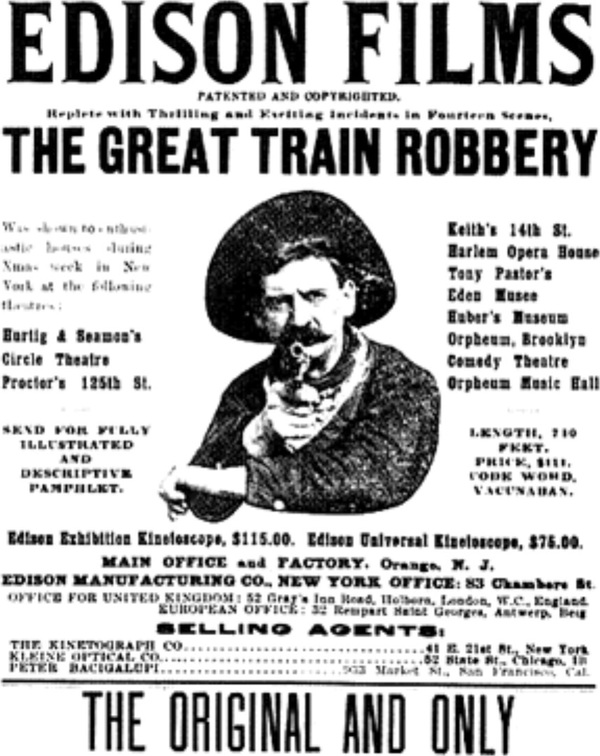
The Great Train Robbery is another early narrative film produced by Thomas Edison and directed by Edwin S. Porter. Unlike Life of an American Fireman earlier the same year, this one looks like a movie: it has a title card, a cast that acts (even if it’s humorously overdramatic), and a more complicated plot — though it’s still pretty simple.

The focus is clearly on telling a story, and on that level it works: a bunch of bandits (Gilbert M. ‘Broncho Billy’ Anderson, Justus D. Barnes, John Manus Dougherty Sr., Frank Hanaway, Adam Charles Hayman) rob a passenger train and are pursued over it. The action is parsed out more thoughtfully, no doubt for dramatic effect. The settings change, and a lot more characters are involved. Plus, the very last scene is clever — it’s a bit Hitchcockian.

In 1990, the United States Library of Congress deemed The Great Train Robbery “culturally, historically, or aesthetically significant” and selected it for preservation in the National Film Registry (https://www.loc.gov/programs/national-film-preservation-board/film-registry/complete-national-film-registry-listing/).

With A.C. Abadie, George Barnes, Walter Cameron, Donald Gallaher, Shadrack E. Graham, Morgan Jones, Tom London, Robert Milasch, Marie Murray, Mary Snow

Production: Edison Manufacturing Company

Distribution: Edison Manufacturing Company, Kleine Optical Company

11 minutes
Not rated

(YouTube) C